
Commercial AC Maintenance Near Me: A Practical Guide
You're the facility manager on call when a rooftop unit stops cooling during the worst part of the day. Tenants are sending complaints, the building's temperature is climbing, and the contractor who promised a “full tune-up” can't produce the last inspection report. A search for commercial AC maintenance near me starts as a location problem, but it quickly becomes a quality-of-service decision.
The contractor closest to your building may not be the contractor most capable of protecting uptime, indoor air quality, energy performance, or compliance. The right provider will inspect commercial equipment methodically, document readings, explain deficiencies, and stand behind the work. Convenience matters, but verifiable competence matters more.
The Real Reason You Are Searching for Commercial AC Maintenance Near Me
A facility manager running a 40,000-square-foot office in Tucson loses an RTU on a 108°F day. The failure isn't mysterious. The contractor skipped condenser coil cleaning for two cooling seasons, and the unit finally gave up when the building needed it most. The emergency repair is only the visible cost. Tenants lose confidence, staff lose productive time, and ownership may have less bargaining power during lease-renewal conversations.
That's why “near me” shouldn't mean “the first company within a short drive.” It should mean a commercial HVAC crew with documented experience, EPA Section 608 certification, appropriate recovery equipment, and the discipline to provide inspection logs. A technician who can arrive quickly but won't record refrigerant readings, airflow observations, control faults, or photos leaves you with no defensible maintenance history.
Practical rule: Proximity is useful after you've verified competence, reporting standards, and emergency accountability.
A reactive contractor relationship creates costs that don't appear on the service invoice. Repeated tenant complaints can damage your operating reputation. Unresolved equipment problems can weaken your negotiating position. If a non-certified technician opens a refrigerant circuit, warranty coverage may be placed at risk, and you may inherit a documentation problem when the property is audited, refinanced, or sold.
Commercial HVAC also interacts with other building systems. If roof penetrations, curbs, flashing, or drainage around rooftop equipment are neglected, the mechanical problem may sit inside a broader envelope issue. A clear overview of commercial roofing basics can help property teams understand why rooftop maintenance belongs in the same asset-management conversation.
Before calling anyone, review this complete guide to finding commercial HVAC companies near me. Then ask every bidder for technician credentials, equipment-specific experience, sample reports, response commitments, and exclusions. The best “near me” result is the company that leaves a paper trail proving what it did.
What a Credible Commercial AC Maintenance Visit Actually Includes
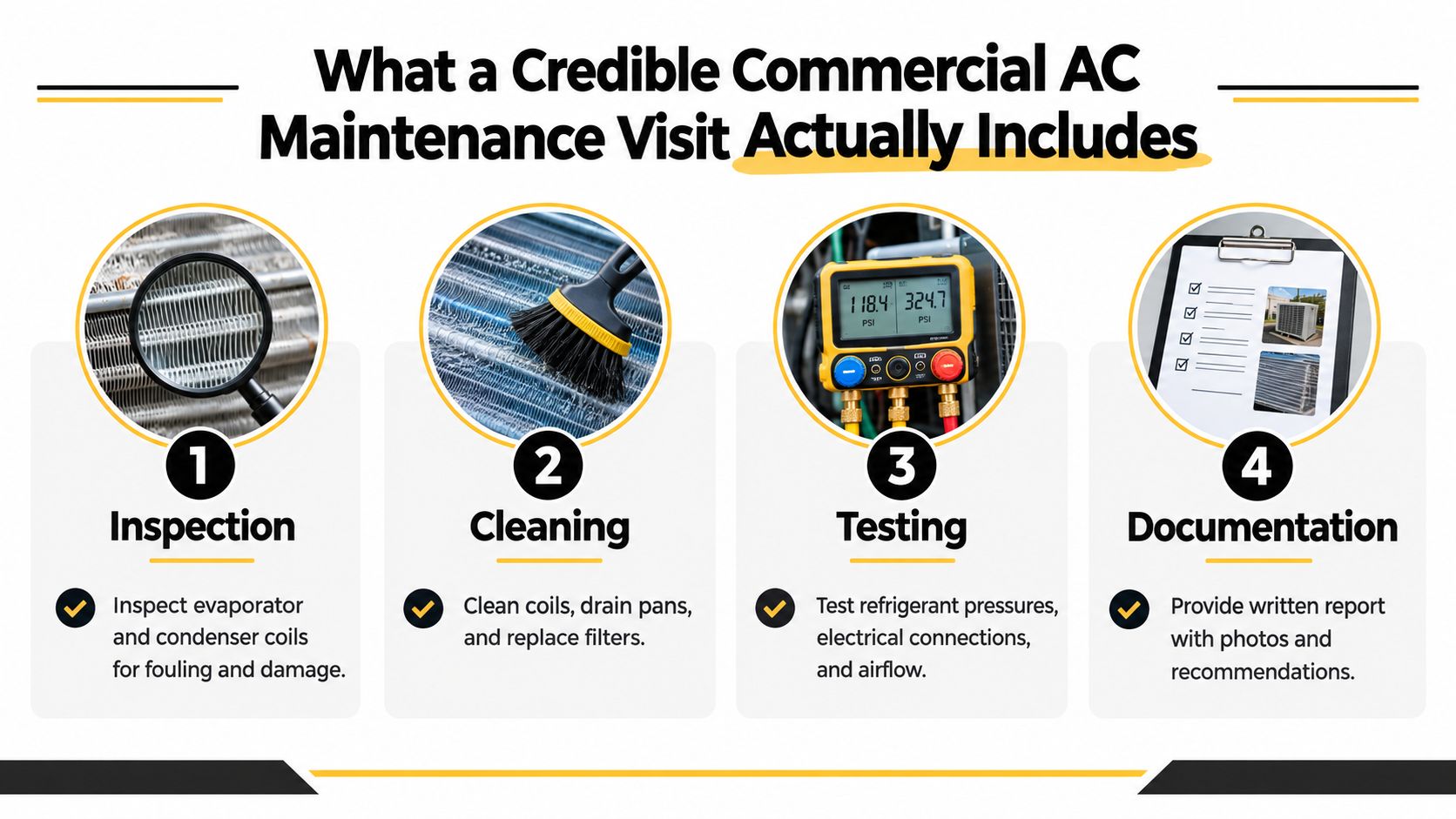
A credible visit isn't a quick visual inspection followed by a generic “unit is operating normally” note. It should move through inspection, cleaning, testing, and documentation, with each stage tied to measurable operating conditions.
Inspection starts with the equipment that moves heat and air
The technician should inspect both evaporator and condenser coils for fouling, corrosion, bent fins, and physical damage. Cleaning isn't complete unless the technician verifies the unit's temperature performance, including delta-T readings appropriate to the equipment and operating conditions.
Filters should be replaced or washed according to their condition and application. A serious visit also records static pressure, because a filter can look clean while airflow remains restricted by duct issues, a loaded coil, or a poorly adjusted fan.
The technician should inspect:
Refrigerant circuit: Check operating conditions using superheat and subcooling, investigate abnormal readings, and look for evidence of leakage rather than just adding refrigerant.
Condensate system: Clean the pan, treat or clear the drain, and verify that water leaves the unit without backing up.
Blower assembly: Record amp draw, inspect bearings and sheaves, and check belt wear and tension.
Electrical components: Examine connections, contactors, capacitors, disconnects, safeties, and control wiring for heat damage or looseness.
For systems with gas heat sections, combustion analysis belongs on the checklist. It gives the contractor a basis for identifying unsafe or poorly adjusted heating operation before the heating season begins.
Controls and ventilation deserve equal attention
The technician should operate the economizer through its full damper travel, inspect linkage, and calibrate it if the position doesn't match the control signal. A stuck economizer can compromise ventilation or waste the opportunity to use suitable outdoor conditions for cooling.
Controls verification should include thermostat accuracy, sensor calibration, setpoint response, and BAS communication logs. If the building automation system shows a command that the rooftop unit never receives, the problem isn't solved by replacing a filter.
Where IAQ sensors are installed, the contractor should calibrate or verify CO2 and particulate sensors and record the results. DOE guidance identifies testing and balancing, demand-controlled ventilation, economizers, and air-handler upgrades as important ventilation strategies, while ASHRAE's 2025 IAQ checklist includes measurement of CO2, PM2.5, TVOC, formaldehyde, relative humidity, and temperature, along with 30-day walk-through inspections. The commercial HVAC system guide provides useful context for how these components interact.
Every task should appear as a line item in the report, with before-and-after readings, equipment identification, technician notes, photos where useful, and recommendations separated into urgent, planned, and monitor categories. If the report can't show what was measured, you paid for an opinion, not maintenance.
Building a Preventive Schedule That Matches Your Facility
A generic calendar is a starting point, not a maintenance strategy. Commercial AC service frequency should reflect facility type, runtime, occupancy, contamination exposure, and operational criticality.
For a standard office, plan one spring visit before cooling demand rises and one fall visit before heating operation begins. Higher-use or critical properties should move to quarterly inspections. Facilities operating continuously may need monthly or quarterly filter checks, even when the full mechanical service occurs on a different cadence.
Match the schedule to the building
Facility Type | Visit Frequency | Peak Season Focus | Trigger for More Frequent Service |
|---|---|---|---|
Standard office | Spring and fall | Cooling performance in spring, heating readiness in fall | Recurring complaints, construction dust, or unstable readings |
Restaurant | Quarterly | Coil cleanliness, airflow, condensate control, and kitchen-related contamination | Grease exposure, heavy occupancy, or persistent humidity |
Healthcare facility | Quarterly or more often as required by the facility program | Ventilation, filtration, controls, and documented IAQ checks | Critical spaces, renovation work, or changing pressure relationships |
Data-adjacent facility | Quarterly | Cooling redundancy, controls, alarms, and airflow stability | Sensitive equipment, continuous loads, or abnormal trend data |
Data center or manufacturing clean room | Monthly or quarterly checks, based on operating conditions | Continuous performance, filtration, pressure, and sensor verification | 24/7 operation, process sensitivity, or contamination risk |
Spring service should include full cooling performance testing, condenser inspection, refrigerant-condition review, airflow checks, and controls verification. Fall service should prepare heating sections, review safety operation, inspect economizer lockout setpoints, and confirm that the transition between ventilation and conditioning modes works as intended.
Construction zones, coastal salt air, and post-renovation dust loads justify more frequent attention. Those conditions can foul coils, load filters, corrode components, and distort pressure readings faster than a standard office calendar anticipates.
Use the preventive maintenance schedule guide to organize asset tags, task ownership, and recurring work orders. The important point is consistency: each visit should produce comparable readings so your team can identify deterioration instead of starting from scratch every time.
Why Maintenance Is an Operating Cost Decision, Not Just a Reliability Decision
The CFO doesn't experience HVAC maintenance as a wrench turning on a rooftop. They experience it through repair invoices, utility charges, tenant concessions, and capital forecasts. Preventive service belongs in the operating-cost discussion because neglected equipment consumes resources before it fails.
Industry guidance citing the U.S. Department of Energy states that a structured preventive maintenance program can reduce total maintenance costs by 50 percent, while routine HVAC attention can lower energy bills by 5 to 20 percent. A separate HVAC maintenance guide reports that well-maintained systems can operate up to 20 percent more efficiently than neglected equipment. These figures are presented in the HVAC maintenance frequency guide, and they support a practical conclusion: maintenance is not merely an insurance policy against breakdowns.
Where the energy waste starts
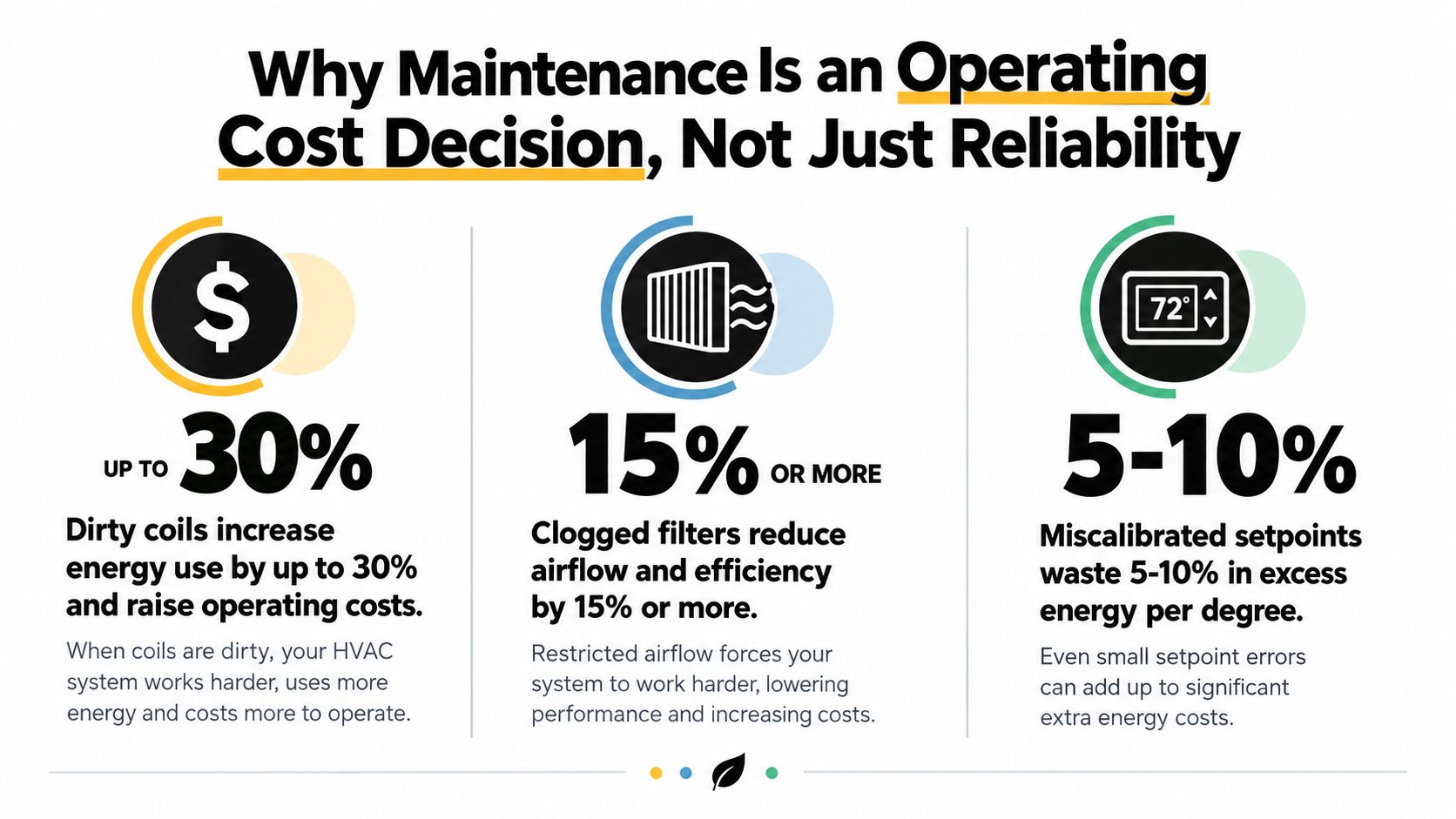
The DOE notes that dirty condenser coils can use up to 37 percent more energy. Fouling insulates the heat-transfer surface, forces the compressor to work harder, and raises operating stress during high-load periods. A neglected rooftop portfolio can therefore add substantial electricity expense without producing an obvious failure signal.
Other losses are less dramatic but still operationally important:
Clogged filters: Restricted airflow makes fans work harder and can reduce cooling delivery to occupied zones.
Undercharged circuits: Small refrigerant leaks reduce heat-transfer performance and can keep compressors running longer.
Stuck economizers: A damper that fails to open or close correctly can waste suitable outdoor cooling or bring in outdoor air at the wrong time.
Misaligned controls: Incorrect sensor readings and setpoints can cause simultaneous heating and cooling, unnecessary runtime, or poor zone comfort.
The right financial question isn't whether a maintenance visit has a low price. It's whether the contractor identifies measurable sources of waste, corrects them during a planned window, and gives you a record that supports future decisions.
Property owners should evaluate rooftop HVAC alongside other recurring building assets. A practical industrial roof upkeep cost guide offers useful context for comparing planned upkeep with the financial consequences of deferred work. The same principle applies to air conditioning: controllable maintenance expense is easier to budget than emergency downtime.
Compliance and Documentation You Should Expect From Your Contractor
Compliance paperwork isn't administrative decoration. It proves who handled refrigerant, what the technician found, what the contractor repaired, and whether the equipment remains within applicable requirements.
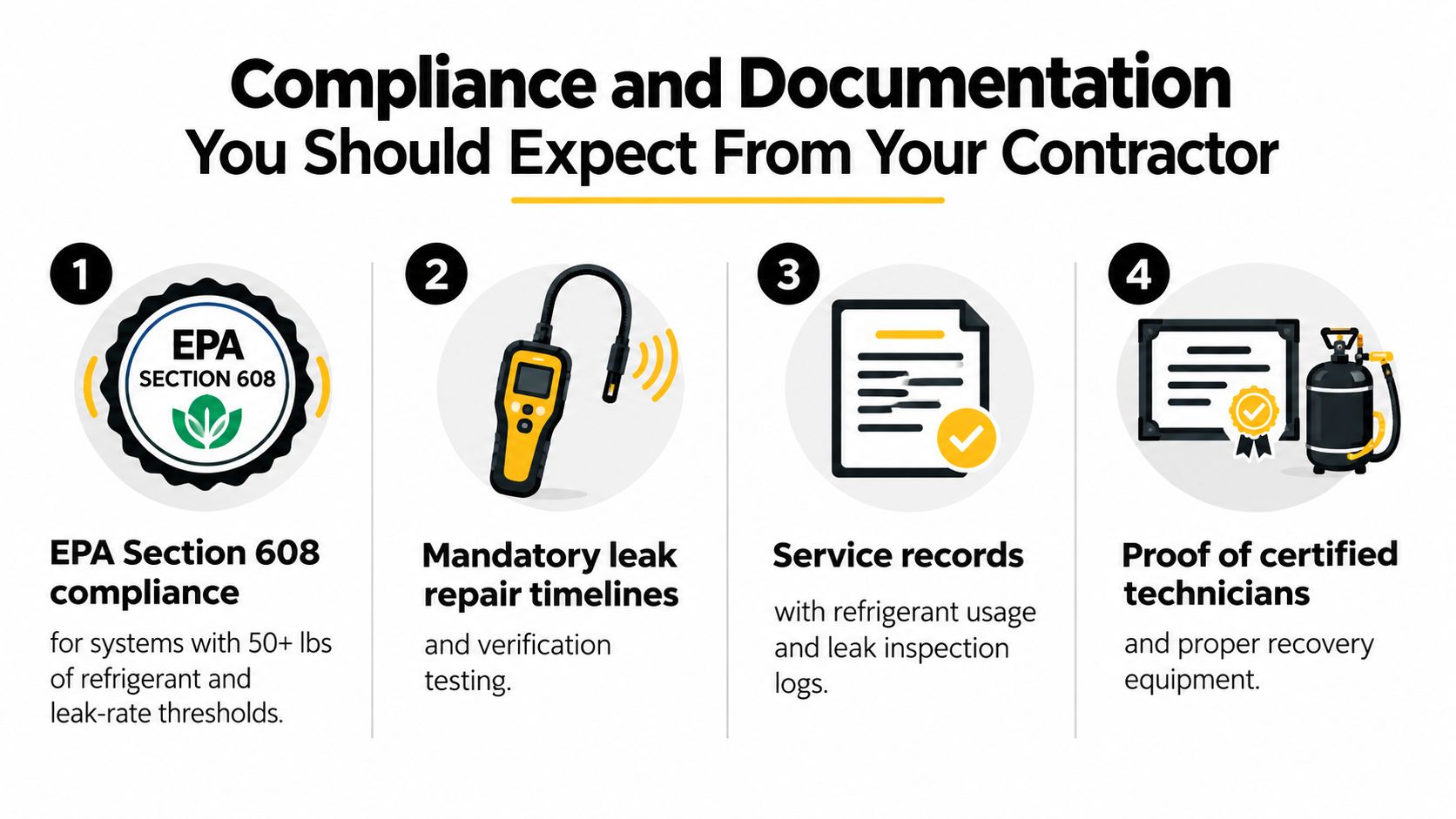
EPA requirements have evolved, so owners should ask contractors to identify the rule and threshold applicable to each piece of equipment rather than rely on an old template. The EPA's 2026 fact sheet states annualized leak-rate thresholds of 10 percent for comfort cooling, 20 percent for commercial refrigeration, and 30 percent for industrial process refrigeration. For commercial refrigeration and industrial process refrigeration appliances containing 500 or more pounds of charge, leak inspections must occur every three months until the system remains below the applicable threshold for four consecutive quarters. Review the EPA leak-repair fact sheet with your contractor and confirm how it applies to your equipment inventory.
Make the report useful to an auditor and a manager
For each refrigerant circuit, request equipment identification, refrigerant type, leak inspection findings, quantities added or recovered, repair details, and verification results. Keep records of inspection and repair activity with the asset history, not only in an email thread.
IAQ documentation should be equally concrete. Ask for outdoor-air measurements, filter MERV ratings, CO2 sensor calibration logs, humidity observations, temperature readings, and notes about demand-controlled ventilation. Local code overlays may add requirements, such as Title 24 energy acceptance testing in California or ventilation provisions tied to IMC 2024. Your contractor should identify those overlays before work begins.
Hand this checklist to the technician:
Asset identification: Unit tag, location, model, serial number, and refrigerant information.
Measured conditions: Temperature, pressure, superheat, subcooling, static pressure, amp draw, and relevant sensor readings.
Compliance record: Leak inspection status, refrigerant quantities, repairs, verification testing, and technician certification.
IAQ record: Outdoor air, filtration, CO2 calibration, particulate observations, humidity, and temperature.
Corrective action: Immediate repairs, recommended work, priority, estimated consequence of deferral, and supporting photos.
The commercial HVAC service agreement terms guide can help owners turn these expectations into contract language rather than informal promises.
Cheapest Plan vs Right Plan
The cheap plan usually offers spring and fall visits, filter changes, a quick electrical check, and a broad promise to “keep the system running.” It often says little about coil-cleaning standards, economizer operation, sensor calibration, refrigerant diagnostics, or what the report will contain.
The right plan connects service to how the building behaves. It considers runtime hours, weather conditions, building pressure, supply-air temperature drift, and unusual kWh consumption. A sensor-based or demand-controlled program can trigger targeted work when the equipment shows deterioration instead of waiting for the next calendar appointment.
The lowest bid is only cheap when the scope is equal and the results are measurable.
Use this comparison before signing:
Line Item | Cheap Twice-Yearly Plan | Sensor-Based Right Plan |
|---|---|---|
Visit scope | Broad tune-up language | Equipment-tagged tasks with acceptance criteria |
Frequency | Fixed spring and fall schedule | Calendar service plus condition-based triggers |
Controls | Basic operation check | Sensor calibration, economizer testing, and BAS review |
Documentation | Generic completion note | Photos, readings, deficiencies, and recommendations |
Pricing | Bundled exclusions may appear later | Clear parts, labor, and out-of-scope pricing |
Risk | Reactive repairs and energy waste remain hidden | Trends support planned intervention and budgeting |
Consider a three-year ownership scenario. The cheap plan has a lower recurring fee, but the building owner pays separately for emergency repairs, unexplained energy waste, premature compressor damage, and missing records. The right plan costs more each month, yet it can be cheaper over the full period if it prevents avoidable failures, identifies energy waste, and produces compliance evidence. Don't compare monthly prices in isolation. Compare the documented cost of operating the equipment.
Contractor Checklist and Contract Terms Worth Fighting For
Sales language is easy to produce. A technically serious proposal is specific enough that two contractors would inspect the same unit, perform comparable tasks, and report results in a comparable format.
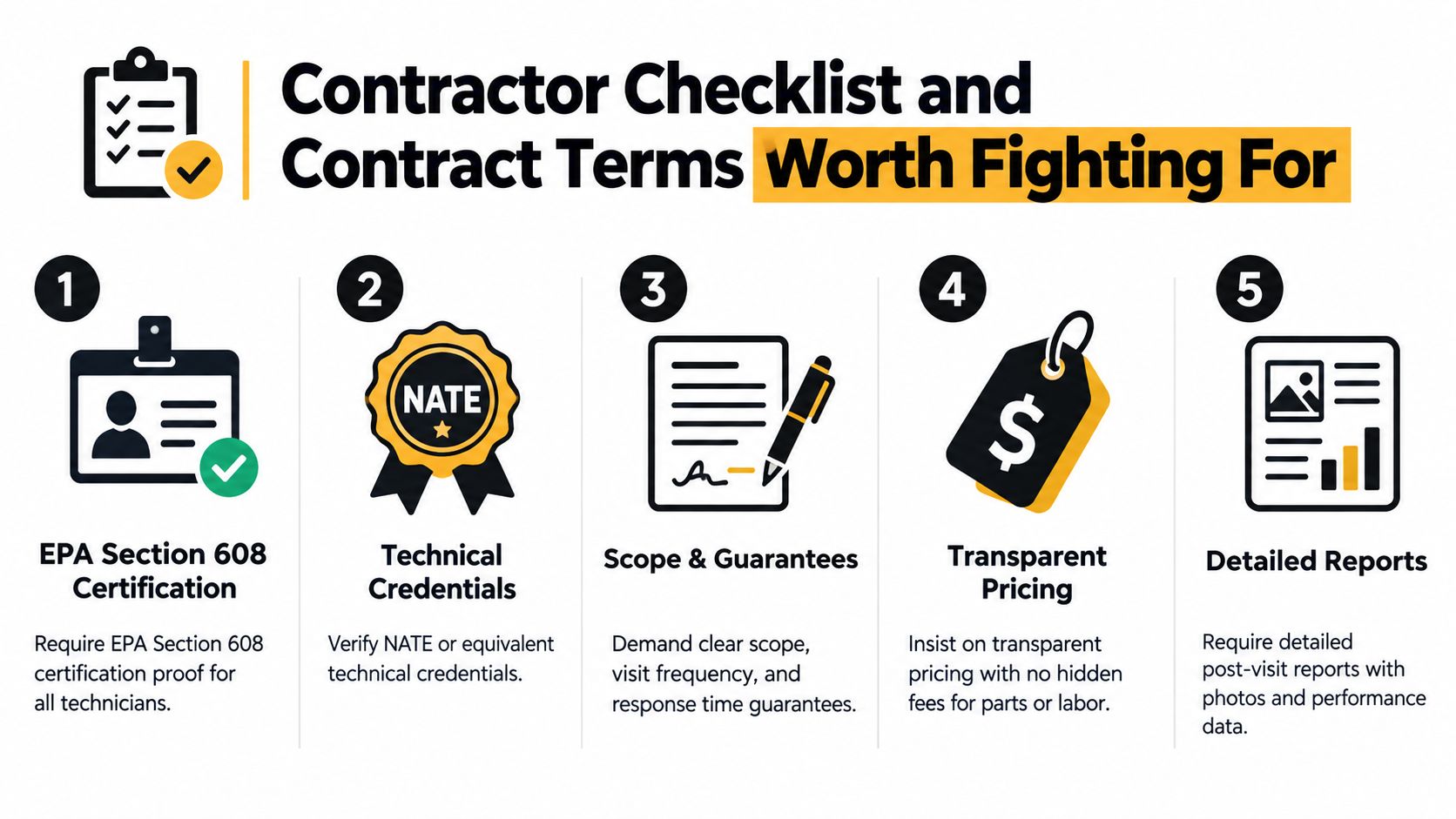
Start with qualifications. Require proof of EPA Section 608 certification for technicians who handle refrigerant. Ask for NATE or equivalent technical credentials, and request at least five commercial references with equipment and facility types similar to yours. Call the references and ask whether the contractor delivered reports on time, honored exclusions, and escalated serious findings without waiting for a failure.
Put the service scope in writing
A contract should name each task, equipment tag, frequency, and acceptance criterion. “Inspect HVAC system” is not a scope. “Clean condenser coil, record entering and leaving air temperatures, document static pressure, verify economizer travel, and attach photographs” is a scope.
Fight for these terms:
Response guarantees: Define response times in hours, not business days, and establish escalation tiers for after-hours emergencies.
Transparent pricing: Separate labor, parts, refrigerant, diagnostic charges, subcontracting, and after-hours rates. Avoid bundled flat fees that conceal markups.
Digital reports: Require photos, readings, recommendations, and completed task status within 48 hours of the visit.
Price controls: Negotiate annual price caps tied to CPI rather than accepting arbitrary increases.
Liability language: Reject broad indemnification clauses that shift responsibility for pre-existing defects to the owner.
Warranty protection: Require certified technicians, proper refrigerant recovery, and documentation that supports OEM warranty requirements.
Corrective work: Specify approval thresholds, emergency authorization limits, and who owns removed parts and service data.
A contractor-selection framework such as how to choose an HVAC contractor is useful, but your final decision should rest on evidence from the proposal, sample report, references, and walkthrough.
Complete these three actions this week
Benchmark last year: Pull HVAC invoices and total unplanned repair spending, then add any documented or reasonably estimated avoided downtime cost without disguising assumptions as measured savings.
Score three proposals: Request written bids from three contractors and grade each against the same weighting for response time, documentation, credentials, scope, exclusions, and pricing.
Inspect one valuable unit: Schedule a walkthrough of the highest-value rooftop unit with the top-ranked bidder before signing. Watch how the technician inspects, what readings they take, and which questions they ask about occupancy, runtime, controls, and complaints.
The right near-me choice is the contractor who documents results, not the one quoting the lowest visit fee. Maintenance is insurance you consume monthly, and the proof should always be in the report.
Covenant Aire Solutions offers commercial HVAC preventive maintenance, equipment service, and indoor-air-quality support for facilities that need scheduled inspections and documented results. Visit Covenant Aire Solutions to discuss a maintenance plan built around your equipment, operating conditions, and reporting requirements.