
Does Liquid Cooling Require Maintenance? a Practical Guide
A lot of people ask this question only after the system starts acting strange. In Tucson, that usually means a hot afternoon, the thermostat keeps creeping up, the blower sounds normal, and yet the house never quite catches up. In a small commercial space, it might be a server closet or process cooler that still runs, but can't pull heat off the load the way it used to. The common thread is simple: the loop didn't fail all at once, it drifted.
Liquid cooling can drift because the fluid is doing more than one job. It carries heat, it helps protect metal surfaces, and in many systems it also supports smooth pump operation. When flow drops, air gets into the loop, dust packs onto heat-rejection surfaces, or the chemistry ages out, performance slides before the hardware gives you a dramatic failure.
The Short Answer Every Homeowner Wants First
Yes, liquid cooling requires maintenance.
What changes is how much maintenance, and who should do it.
In Tucson homes and facilities, I've seen the confusion come from lumping every liquid-cooled system into one bucket. A sealed consumer loop behaves very differently from a serviceable hydronic loop, a process chiller, or a custom computer cooling setup. One might need little more than visual checks and dust control. The other needs an actual service schedule.
What the answer looks like in real life
A factory-sealed all-in-one cooler for a PC usually isn't designed for user refilling, while a custom loop commonly needs coolant replacement or refill on a 12 to 24 month cycle to prevent degradation and loss of cooling efficiency, according to Sinothermic's refill guidance. That's one of the clearest lines in this whole discussion.
The same idea applies outside the PC world. If the loop is sealed at the factory and the owner can't reasonably access the fluid, owner maintenance is light. If the system has reservoirs, strainers, pumps, fittings, makeup fluid, or exposed water quality issues, maintenance stops being optional.
Practical rule: If the coolant is accessible, testable, refillable, or exposed to makeup water, you own a maintenance program whether you planned for one or not.
The Tucson factor
Our climate makes small problems show up faster. Fine dust loads outdoor coils. Long cooling seasons keep pumps and heat exchangers working hard. Heat punishes marginal fluid quality. That's why a generic answer from a cool, mild climate usually falls short here.
For a broader look at what regular HVAC upkeep covers around Tucson homes and light commercial systems, Covenant's overview of HVAC maintenance basics is a useful companion. It helps put liquid loop care in the bigger picture of system reliability.
How a Liquid Cooling Loop Actually Works
Liquid cooling is straightforward once you strip away the jargon. A pump moves coolant through a closed path. The fluid passes a hot component or space, absorbs heat, travels to a heat exchanger, and gives that heat up to air or another fluid before returning to do it again.
A garden hose carries heat instead of irrigation water. The hose itself matters, but the critical job gets done by what's moving inside it.
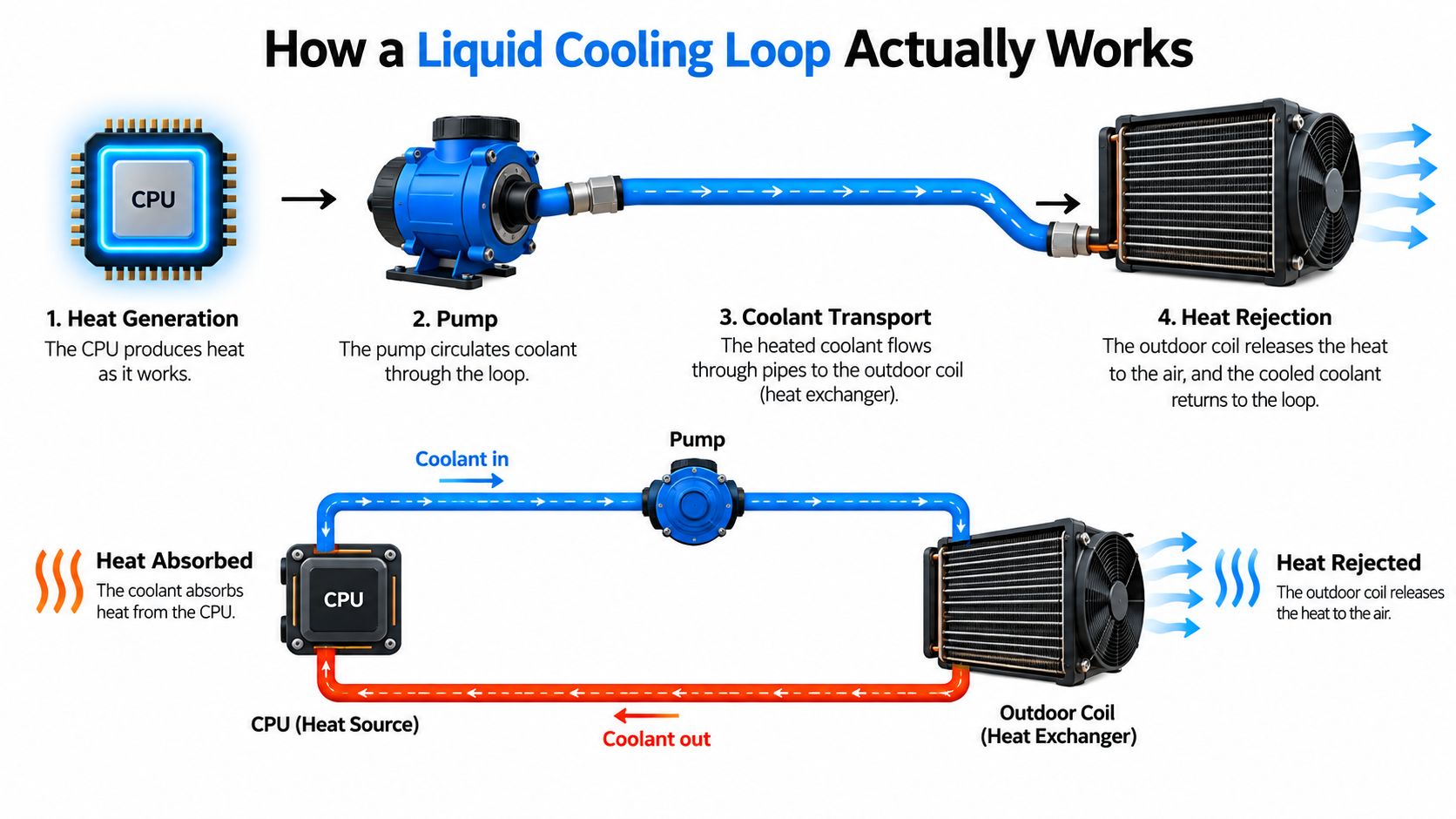
What the coolant is actually doing
The fluid in the loop isn't just a passive passenger. It has three jobs.
Heat transport: The coolant has to absorb heat at the load and carry it to the rejection point. Flow rate matters, and clean heat-transfer surfaces matter.
Corrosion and freeze protection: Many loops use glycol blends and additives to protect internal metals and keep chemistry within safe limits.
Surface contact: Coolant has to stay clean enough to transfer heat well at all the wetted surfaces inside blocks, coils, and exchangers.
If any one of those three slips, the system loses capacity.
Why Tucson makes loops less forgiving
In cooler climates, a slightly dirty coil or mildly degraded fluid may go unnoticed for a while. Tucson doesn't give you that luxury. When outdoor temperatures stay high, the system operates closer to its limits, and the heat-rejection side has less margin. A little fouling, a little trapped air, or a little pump weakness shows up faster as warm supply air, longer run times, or high-pressure nuisance trips.
That is why maintenance on liquid cooling always comes back to three things:
Fluid quality
Flow
Heat transfer
A liquid loop can look mechanically intact and still perform badly if the fluid is contaminated, aerated, or chemically out of spec.
Those three variables explain nearly every useful maintenance task you'll see, from cleaning strainers to checking for cloudiness to washing a coil.
Sealed AIO Versus Custom and Chiller Loops at a Glance
The dividing line isn't system size. It's access to the coolant.
A small sealed AIO computer cooler and a larger sealed refrigerant appliance share one maintenance reality: the owner usually isn't expected to open the loop and service the fluid. A custom PC loop, hydronic system, or serviceable chiller is different. Those systems ask for regular attention because the fluid and fittings are part of the maintenance picture.
Where sealed systems fit
Sealed systems are maintenance-light from the owner's perspective. That doesn't mean maintenance-free.
One recent beginner guide makes the distinction clearly: sealed AIO coolers are often treated as having little to no user-serviceable maintenance, while custom loops need periodic coolant checks, dust removal, leak inspection, and eventual fluid replacement. That same guidance notes that some sources suggest radiator cleaning every 3 to 6 months and full coolant changes every 12 to 24 months for custom loops, while sealed AIO units are commonly treated as light maintenance, not zero maintenance, according to Sunbeam Tech's guide to PC water cooling.
Where serviceable systems fit
Once you have fill ports, test ports, reservoirs, strainers, exposed water quality, or field-service fittings, the system needs scheduled care. That's true whether it's a custom desktop loop, a glycol circuit, a process cooler, or a building hydronic application.
Here's the simplest way to sort them:
Aspect | Sealed (AIO, mini-split refrigerant, packaged heat pump) | Serviceable (custom loop, chiller, hydronic, cooling tower) |
|---|---|---|
Coolant access | Factory closed, owner usually doesn't open it | Fluid can be tested, topped off, replaced, or treated |
Owner tasks | Visual inspection, coil cleanliness, listen for changes | Visual checks, cleaning, basic fluid observation, some topping off |
Technician tasks | Verify operation, inspect fittings, clean heat rejection surfaces | Pressure testing, chemistry checks, strainer service, descaling, pump work |
Main risk over time | Hidden wear, airflow restriction, pump aging | Chemistry drift, air ingress, contamination, fitting leaks, scale |
Best use case | People who want low-touch ownership | Loads that justify higher performance and planned upkeep |
If you're not sure what you own, ask one question first: can the fluid be accessed and serviced in the field? That answer usually tells you how serious the maintenance plan needs to be.
The Real Maintenance Tasks and How Often to Do Them
A real maintenance plan works better when each task has an owner. Some items are homeowner or facility staff checks. Others belong to a trained technician. When people mix those up, either nothing gets done or somebody opens a loop they shouldn't.
A common service window for many PC-style or serviceable liquid-cooling setups is 12 to 18 months for coolant replacement, while industrial or automotive cooling systems are often serviced on a 2 to 3 year cycle. The same guidance commonly calls for pump checks every 6 months, radiator cleaning every 6 months, tubing inspection annually, and leak checks annually, according to Sinothermic's maintenance interval guide.
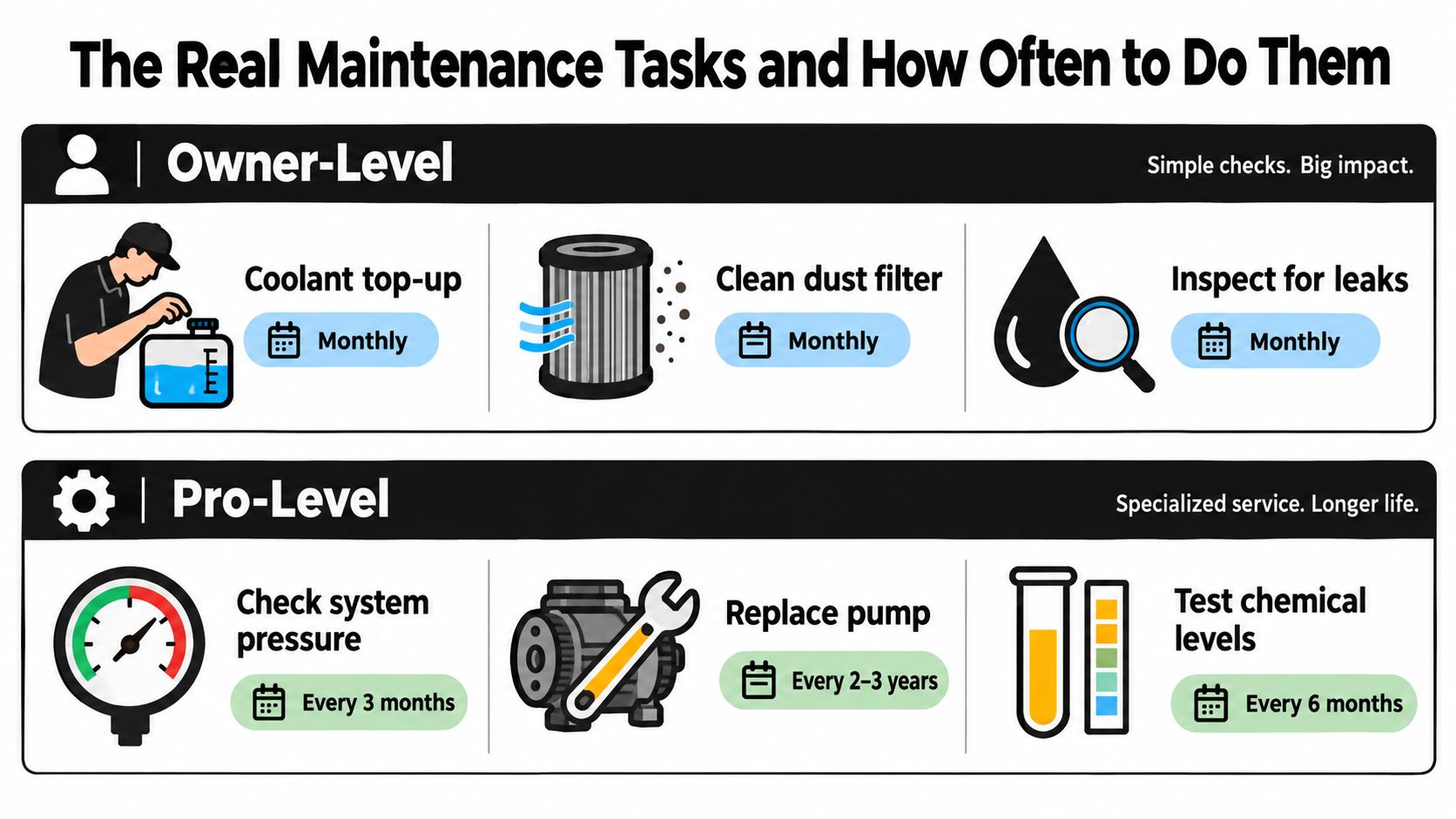
Owner-level tasks
In Tucson, owner checks matter because dust gets everywhere, and it doesn't take much buildup to hurt heat rejection.
Look at the system: Check for dampness, residue, or staining around fittings, housings, and nearby panels.
Listen to the pump: New whining, gurgling, or uneven noise often points to air, wear, or flow trouble.
Keep the heat-rejection side clean: Dust on a radiator, condenser, or coil acts like a blanket.
Watch the fluid where visible: One maintenance guide recommends monthly checks for cloudiness, sediment, or odor, and says to replace coolant immediately if those show up, according to Alibaba's liquid-cooling maintenance guide.
This video gives a decent visual sense of the routine checks involved in liquid-cooled hardware:
Technician-level tasks
The loop gets evaluated instead of just observed.
Pressure and connection checks: Closed-loop guidance commonly calls for checking the pump, radiator fittings, tubing clearance, and mounting pressure, and stopping use if dampness, streaks, or residue appear around components, as outlined in Evetech's closed-loop AIO maintenance deep dive.
Fluid testing and replacement: Fluid should be replaced when it reaches end of life or no longer meets specification, and sealed systems can still lose coolant gradually over time, according to CoolIT Systems professional services guidance.
Strainer, exchanger, and pump work: Pros catch scale, fouling, bearing wear, and weak circulation before the customer feels the loss as comfort complaints or trip events.
For commercial operators who want a good example of how disciplined schedules get applied across climate-driven equipment, this overview of commercial HVAC in Colorado and Utah is useful because it shows how maintenance planning changes when uptime matters more than reactive repair.
If you're trying to put dates on the calendar instead of guessing, Covenant's sample preventive maintenance schedule is a good framework to adapt for your own equipment mix.
What It Costs to Maintain Compared to Air Cooling
If you're comparing air cooling and liquid cooling, the first question isn't just repair cost. It's who does the work, how often the system runs at full load, and what downtime costs you.
Air-cooled equipment is usually simpler to live with. There are fewer fluid-side questions, fewer chemistry concerns, and fewer decisions about topping off, testing, or flushing. For a typical homeowner, that simplicity matters. You clean coils, keep drainage clear, inspect electrical components, and service moving parts. That's familiar territory for most residential HVAC techs.
Where liquid cooling asks for more
Liquid cooling adds maintenance categories that air cooling often doesn't. You may need to manage coolant condition, glycol concentration, sediment, pump health, air removal, and heat-exchanger cleanliness. On larger or higher-duty systems, those tasks can be more labor-intensive and more specialized.
Here's the side-by-side reality:
Category | Liquid Cooling | Air Cooling |
|---|---|---|
Routine owner upkeep | Visual checks, dust cleanup, possible fluid observation | Filter changes, coil area cleanup, visual inspection |
Professional maintenance burden | Fluid testing, pump checks, exchanger cleaning, leak diagnostics | Coil washing, electrical checks, fan and compressor service |
Failure modes | Chemistry drift, flow loss, fouling, leaks, air ingress | Dirty coils, fan problems, refrigerant issues, compressor stress |
Best financial fit | High-load applications, sensitive equipment, long runtimes | Lower complexity, simpler ownership, common residential use |
Downtime planning | More important because small drift can reduce capacity early | Still important, but service tasks are more familiar and standardized |
The trade-off most buyers miss
Liquid cooling can make sense when the load justifies it. A server room, process application, specialty equipment load, or a system that runs hard for long periods may benefit from tighter thermal control. But nobody should buy into liquid cooling thinking it eliminates upkeep. It changes the upkeep.
Air cooling usually wins on simplicity. Liquid cooling usually wins when the application needs better heat handling and the owner is prepared to maintain the loop.
If you're pricing out ongoing care for conventional AC equipment as a baseline, this breakdown of AC tune-up cost helps frame what standard air-side maintenance usually includes before fluid-side work enters the picture.
Warning Signs, Tucson Climate Factors, and When to Call a Pro
The warning signs are usually subtle at first. A room takes longer to cool. Supply temperatures creep upward. A pump starts sounding rough. You see a faint residue line near a fitting. Then the monsoon dust rolls through, the outdoor coil packs over, and a problem that was manageable on Tuesday turns into a no-cooling call by Saturday.
What Tucson does to these systems
Tucson stresses liquid-cooled systems in a few predictable ways.
Dust loading: Haboob dust and fine desert grit can choke condenser fins and radiator surfaces fast.
Heat exposure: Long stretches of high ambient temperature reduce your margin for dirty heat exchangers and weak flow.
Water quality: Any loop tied to makeup water or scaling risk can lose heat-transfer efficiency as deposits build.
Material movement: Big day-to-night swings can stress fittings, seals, and threaded connections.
In a milder climate, you might get away with a relaxed schedule. Here, that usually backfires.
What you can check yourself, and what belongs to a pro
A homeowner or facility lead can safely inspect for obvious dirt, visible weeping, unusual pump noise, and poor airflow across the heat-rejection side. You can also note whether the system is short-cycling, running long, or failing to maintain setpoint.
Call a technician when you have persistent pressure imbalance, repeat air intrusion, visible residue at fittings, electrical faults, unexplained humidity behavior, refrigerant concerns, or any sign that the loop's performance keeps sliding after basic cleaning. That's especially true going into peak cooling season. For Tucson-area systems that carry heavy summer runtime, a spring-and-fall visit is a far better baseline than a once-a-year approach, and Covenant's guide to seasonal AC maintenance lines up well with how desert equipment lives.
A maintenance interval written for a coastal or temperate market won't protect a hard-working Tucson cooling system the same way.
Building a Maintenance Plan That Actually Fits Your System
The best plan is the one that matches the equipment you own and the heat load you ask it to carry. A sealed loop in a spare bedroom office doesn't need the same attention as a serviceable hydronic loop at a retail site or a small process chiller behind a kitchen.
Tier 1 for owner checks
Start with a quarterly visual routine. Look for dirt buildup on coils or radiators, check for any staining around fittings, listen for pump noise changes, and make sure the system is holding temperature the way it normally does.
If you're in a dusty location or you had a rough monsoon season, inspect more often. Tucson doesn't care what the generic calendar says.
Tier 2 for technician inspections
A biannual visit makes sense for systems that run hard through long cooling seasons. This is the right time for coolant quality review where applicable, pump inspection, connection checks, airflow and heat-rejection cleaning, and system performance verification.
For people who don't want to build that schedule from scratch, some local service agreements package those visits into recurring maintenance. Covenant Aire Solutions offers HVAC maintenance plans for Tucson-area homes and light commercial properties, which is one practical option if you want the dates fixed on the calendar rather than handled reactively.
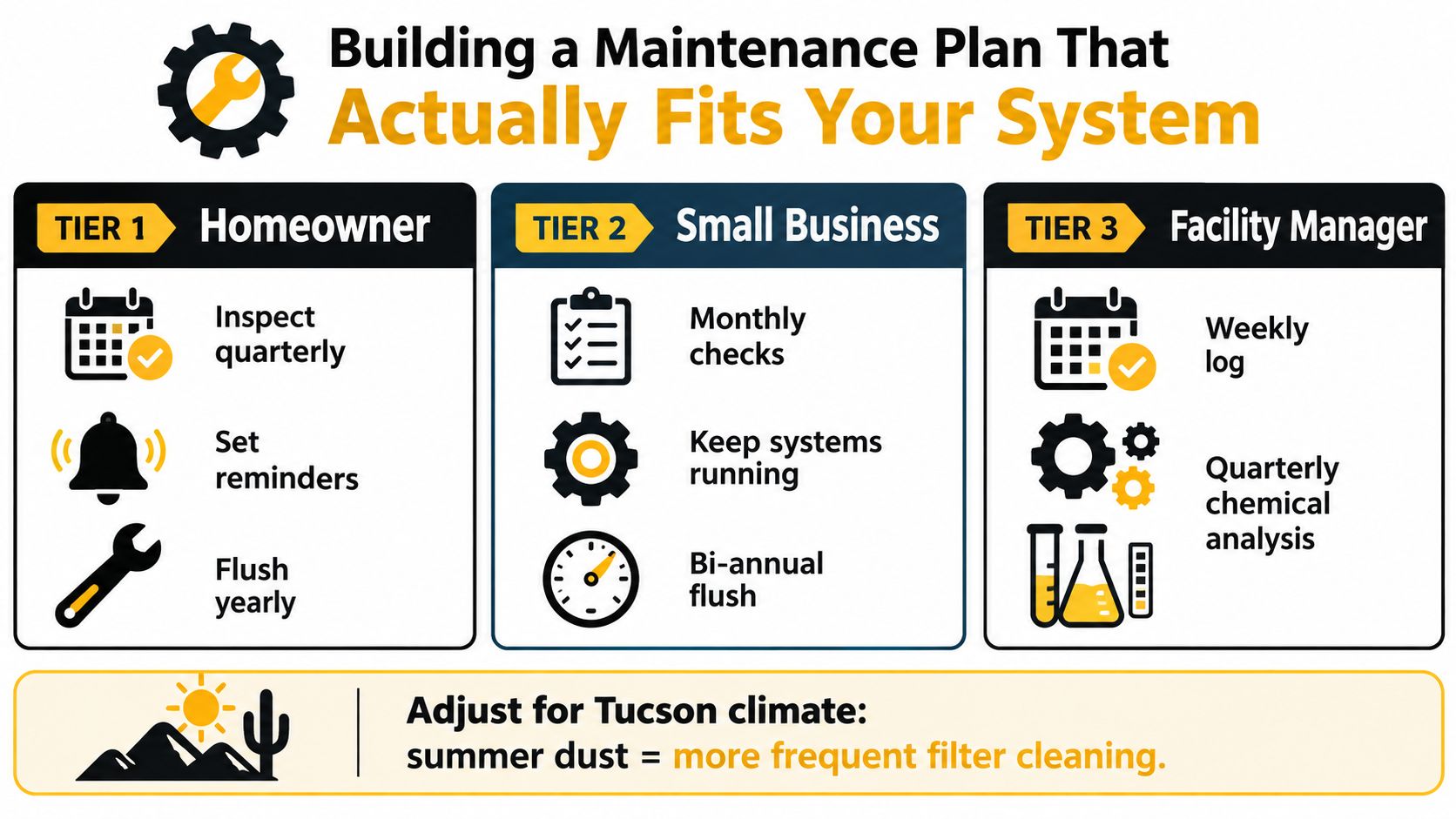
Tier 3 for full annual service
A yearly deep service belongs on any serviceable loop and on any mission-critical cooling application. That includes flush decisions where needed, pressure testing, component inspection, exchanger review, and a hard look at anything that shows early wear before peak season returns.
For data-center liquid cooling and other high-load infrastructure, maintenance is even more structured. One industry guide recommends daily checks of coolant flow and pressure, weekly checks of coolant levels and pump performance, monthly testing of coolant pH and conductivity, quarterly verification of heat-dissipation equipment, biannual deep cleaning and coolant replacement, and an annual system flush and full inspection. A separate vendor guide says coolant should be tested at commissioning, annually during normal operation, and semiannually for high-density AI GPU workloads, with checks at least every 6 months when sensing equipment isn't present, according to Sinothermic's data-center liquid-cooling maintenance summary.
That kind of schedule isn't overkill when uptime matters. It's what ownership looks like when the loop is part of critical infrastructure.
So, does liquid cooling require maintenance? Yes, every time. The only real question is whether your system needs light inspection, active fluid management, or a full operating program.
If your cooling system depends on clean heat transfer, stable flow, and reliable seasonal performance, Covenant can help put that on a real schedule instead of leaving it to guesswork. Covenant Aire Solutions handles maintenance, diagnostics, and cooling service for Tucson homes and light commercial properties, including systems where fluid-side issues and desert dust both affect reliability. Visit Covenant Aire Solutions to schedule service or compare maintenance options that fit how your equipment runs.