
Air air conditioning unit running but not cooling house: Tucson Homeowners Guide
- Jan 5
- 17 min read
It’s one of a frustrating moments for any Tucson homeowner: you can hear the air conditioner running, the fan is definitely on, but the air coming out of your vents is lukewarm at best. When the summer heat is bearing down, this is a clear sign that something in your AC’s cooling cycle has failed.
The sound of the blower can be deceiving. It makes you think everything is working, but your system is failing at its one crucial job, removing heat from the air inside your house. This kind of problem can be as simple as a missed maintenance step or as serious as a major component failure. Getting to the root cause is the first step to getting that cool relief back.
Why Your AC Is Running But Not Cooling
For your AC to do its job, a whole team of components has to work in perfect harmony. If even one of them drops the ball, the entire system’s performance takes a hit, even while other parts like the fan keep chugging along.
Here are the usual suspects we see when an AC runs without cooling:
Clogged Air Filter: This is, without a doubt, the #1 reason for cooling problems. A dirty filter essentially suffocates your system, blocking the airflow it needs to cool your home. It’s a simple fix that causes a world of trouble.
Incorrect Thermostat Settings: It sounds almost too simple, but you’d be surprised how often this happens. Someone might have accidentally switched the thermostat to "Fan Only" instead of "Cool," or maybe the batteries have died. Either way, the thermostat isn't telling the outdoor unit to kick on.
Dirty Coils: Your system has two sets of coils, the evaporator coil inside and the condenser coil outside. When either gets caked in dirt and grime, they can't transfer heat effectively, crippling the cooling process.
Refrigerant Leaks: Think of refrigerant as the lifeblood of your AC. If it starts leaking out, the system loses its ability to absorb heat from inside your house and move it outdoors.
Compressor Failure: The compressor is the powerful heart of your outdoor unit. If it gives out, the refrigerant has nowhere to go, and the entire cooling cycle grinds to a halt.
In major markets like the U.S., where 70% of homes rely on central AC systems, a surprising number of these issues boil down to missed maintenance. In our experience, consistent upkeep can prevent up to 80% of common failures, keeping your system running strong when you need it most.
Figuring out which of these problems is plaguing your system is key. Some fixes, like swapping out a dirty filter, are easy DIY tasks. Others, like dealing with refrigerant or a bad compressor, are jobs strictly for a licensed professional. If you're facing a more complex issue, our team is always ready to diagnose and resolve it with our expert cooling services.
Before you call for help, there are a few things you can safely check yourself. Our quick troubleshooting checklist below can help you narrow down the possibilities.
Quick Troubleshooting Checklist
This table breaks down the common symptoms, what might be causing them, and whether it’s something you can tackle or if it’s time to call in the pros.
Symptom | Potential Cause | DIY or Pro Call? |
|---|---|---|
AC runs, but air isn't cold | Clogged air filter | DIY |
AC runs, but air is lukewarm | Dirty outdoor condenser coil | DIY (with caution) |
Thermostat is blank or not working | Dead batteries | DIY |
Thermostat settings are wrong | Set to "Fan Only" or "Heat" | DIY |
Ice buildup on refrigerant lines | Low refrigerant or dirty filter | Pro Call |
Outdoor unit won't turn on | Tripped circuit breaker | DIY (check once) |
Grinding or squealing noises | Compressor or fan motor failure | Pro Call |
Checking these simple things first can sometimes save you a service call. But if you’ve run through the DIY steps and your home is still heating up, don’t hesitate to reach out. Trying to fix complex electrical or refrigerant issues on your own can be dangerous and often leads to more expensive problems down the road.
Your First Moves: Simple Troubleshooting Checks for Homeowners
When your AC is running but the house just isn't getting cool, it’s easy to jump to the worst-case scenario. But before you pick up the phone to call for a repair, take a breath. There are several safe, straightforward checks you can do yourself that often solve the problem without a service call.
The idea here is to rule out the simple stuff first. In my experience, a surprising number of cooling issues come down to minor oversights, not a total system meltdown. Let's walk through the key areas you can inspect safely.
This decision tree gives you a quick visual guide for where to start.
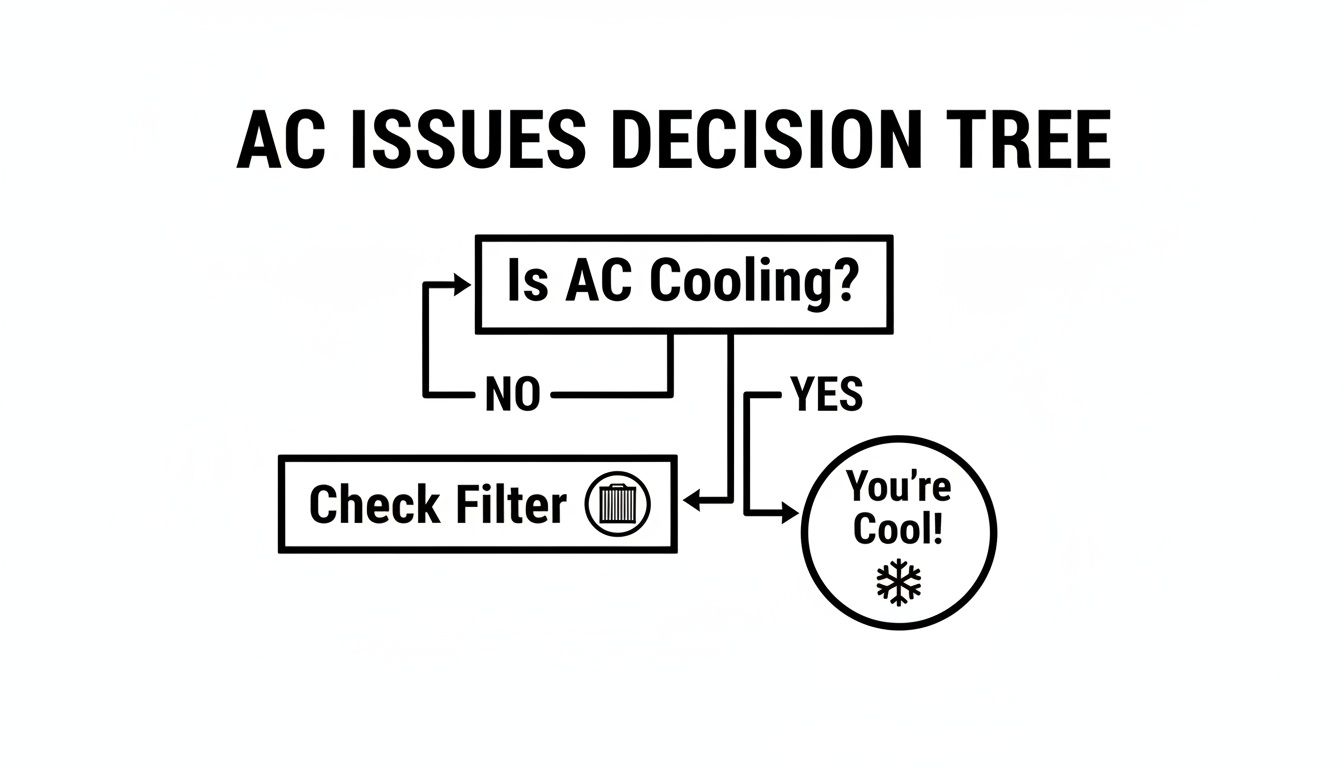
As you can see, the path almost always begins with the air filter; it’s that important to your system’s health.
Start with the Air Filter
The single most common reason an AC runs without cooling is a clogged air filter. It's the lungs of your HVAC system; if it can’t breathe, it can’t cool. A dirty filter chokes off the warm air your system needs to pull in to start the cooling process.
When there isn't enough airflow passing over the evaporator coils, they can get too cold and actually freeze over. An iced-up coil completely blocks any cooling and can even lead to water damage when all that ice melts.
What to Do:
Find the filter. It's usually in a slot in the return air duct or right inside the indoor air handler unit.
Give it a look. Slide it out and hold it up to a light. Can't see light through it? It's time for a new one.
Swap it out. Make a note of the size printed on the filter's cardboard frame and grab a replacement. When you slide the new one in, make sure the airflow arrows point toward the furnace or air handler.
A good rule of thumb is to check your filter monthly and replace it at least every 90 days. Here in dusty Tucson, especially if you have pets, you might need to swap it as often as every 30 days.
Verify Your Thermostat Settings
You’d be surprised how often the "problem" is just a simple thermostat mix-up. It's an easy thing to overlook, but one wrong setting can make a perfectly good AC unit seem broken because it’s simply following the wrong orders.
If the thermostat is set incorrectly, it might never send the signal for the outdoor condenser to kick on. Meanwhile, the indoor blower fan will happily keep running, circulating room-temperature air and making you think the AC is on when the real cooling work isn't happening.
Here’s what to double-check:
Mode Setting: Is it set to "Cool"? If it’s on "Heat," "Fan," or "Off," you won't get any cooling. The "Fan" setting is a common culprit because it runs the blower constantly without activating the cooling parts.
Temperature Setting: The temperature you set needs to be lower than the current room temperature. If it's set higher, the AC has no reason to turn on.
Batteries: Most digital thermostats run on batteries. If that screen is blank or flashing a low-battery icon, it's time for new ones. Weak batteries can cause all sorts of glitches.
Check the Outdoor Condenser Unit
Your AC's outdoor unit, the big box with the fan in it, has one job: to dump all the heat it pulled from inside your house. To do that job well, it needs to breathe.
Over time, dirt, leaves, grass clippings, and overgrown bushes can smother the unit, blocking the delicate fins around the outside and choking off airflow. This makes the system work way harder to get rid of heat, which tanks its cooling power.
Safely Inspecting Your Outdoor Unit:
Kill the Power: Safety first. Always turn off the power to the outdoor unit before you touch it. Look for a disconnect box mounted on the wall near the unit, or just flip the corresponding breaker in your main electrical panel.
Clear Debris: Pull away any leaves, twigs, or grass that have piled up around the base and sides.
Trim Back Plants: Grab some clippers and trim back any shrubs or weeds. You want at least two feet of clear space all the way around the condenser.
Give It a Gentle Rinse: You can use a regular garden hose to gently spray down the fins and wash away caked-on dirt. Never, ever use a high-pressure washer. It will bend those fragile fins and cause some serious damage.
Keeping the condenser clean is a huge part of a healthy AC. While these steps are great for routine upkeep, a deeper, professional cleaning is part of our AC maintenance services that keep your system in prime condition.
Inspect the Circuit Breakers
Last stop: your home's main electrical panel. Your air conditioning system usually has two separate circuit breakers, one for the indoor unit (the air handler) and one for the outdoor unit (the condenser).
It’s entirely possible for the outdoor unit’s breaker to trip while the indoor one stays on. When that happens, the indoor fan will run, but the condenser outside, which does all the cooling, has no power.
Open your breaker box and look for any switches that are in the "off" position or stuck in the middle. Flip it back on. If it trips again right away, leave it alone. That’s a sign of a bigger electrical problem that needs a professional electrician to sort out.
When It's Time to Call in the Pros
Look, tackling some basic troubleshooting on your own is a great first step, and honestly, it often solves the problem. But there's a point where a DIY fix isn't just ineffective, it's downright unsafe. Knowing when to put down the tools and pick up the phone is just as important as knowing how to change your filter.
Certain symptoms are clear red flags that you’re dealing with a much deeper issue, one that requires the specialized tools and trained eye of a certified technician.
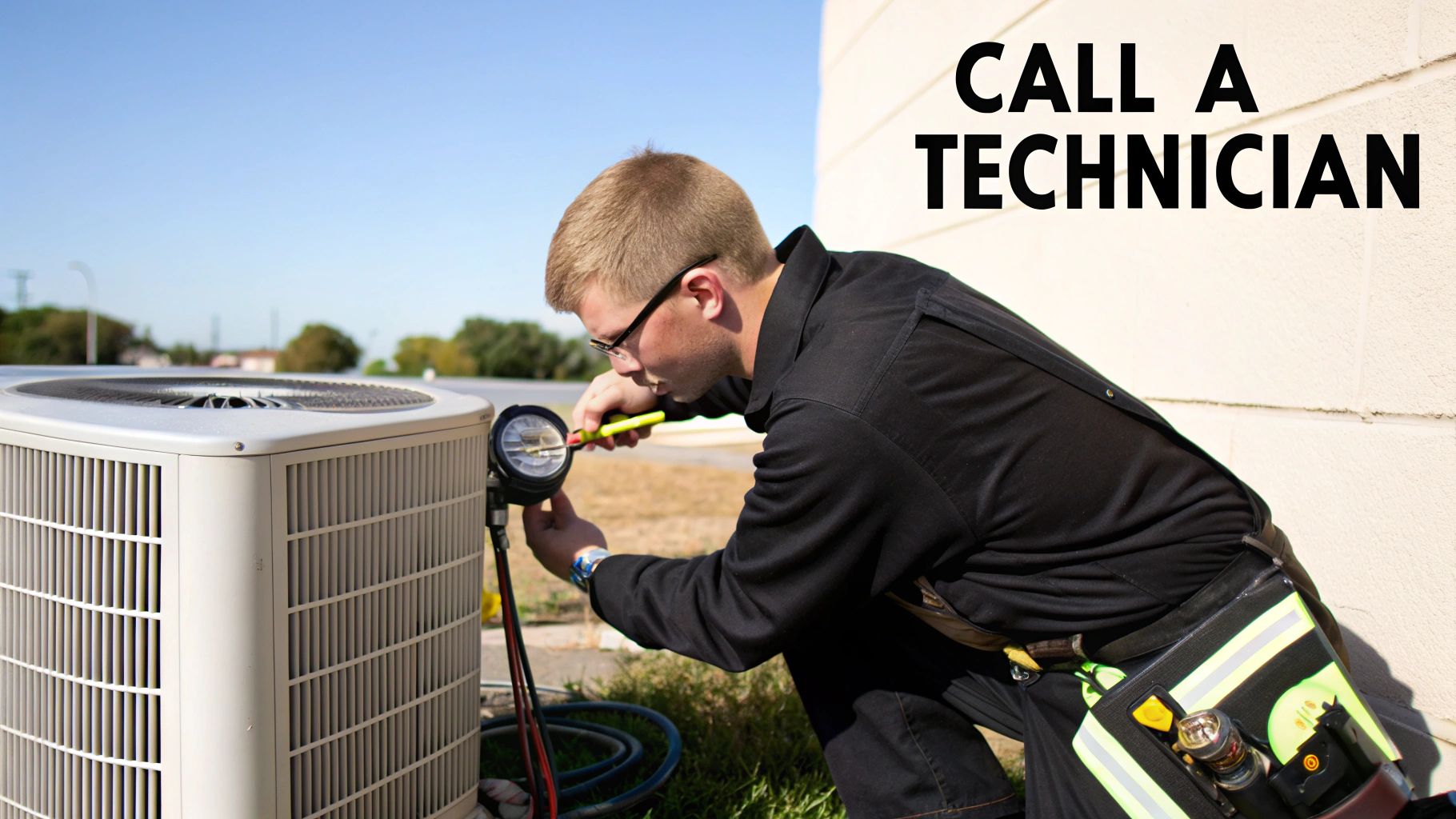
Trying to fix these more complex problems yourself can quickly turn a manageable repair into a catastrophic failure, not to mention the serious safety risks involved. Let's walk through the definite signs that your AC needs an expert touch.
Recognizing a Refrigerant Leak
Think of refrigerant as the lifeblood of your AC system. It’s the special fluid that circulates through the coils, absorbing heat from inside your house and dumping it outside. If that fluid is leaking, your AC's ability to cool is crippled. This is not a DIY job. Handling refrigerant is legally restricted to EPA-certified professionals for a reason: it's potent stuff with a real environmental impact.
Keep an eye (and ear) out for these tell-tale signs:
Hissing or Bubbling Sounds: Any unusual noises from your indoor or outdoor unit could be the sound of refrigerant escaping the lines.
Ice on the Evaporator Coils: While a dirty filter can cause coils to freeze, a refrigerant leak is another big culprit. When refrigerant levels get low, the pressure inside the system drops, causing the coils to get way too cold and form ice.
Weak Cooling: This is the classic symptom. The air coming out of your vents just isn't cold, your house feels humid, or the system runs nonstop without ever reaching the temperature on the thermostat.
A refrigerant leak isn't just about performance, it's an environmental issue. Cooling systems account for nearly 20% of global building electricity use, and leaking HFCs are potent greenhouse gases. We take this seriously, and so should any professional you hire.
If you suspect a leak, the best thing you can do is turn your AC system off completely to prevent damage to the compressor. Then, give a professional a call. Our technicians can pinpoint the leak, make the repair, and safely recharge your system to the manufacturer’s precise specifications.
Identifying Compressor and Electrical Problems
If refrigerant is the blood, the compressor is the heart of your air conditioner. This workhorse motor, located in your outdoor unit, is responsible for pressurizing the refrigerant and pumping it through the system. When it fails, the whole cooling process grinds to a halt, even if you can still hear the fans running.
Compressor issues are serious and always require an expert diagnosis. You might notice:
Loud, Alarming Noises: A healthy compressor has a steady hum. A failing one might make grinding, clanking, or rattling sounds that are impossible to ignore.
The Circuit Breaker Keeps Tripping: The compressor needs a big jolt of power to start up. If it's struggling, it can pull too much electricity and overload the circuit, causing the breaker to trip over and over.
The Outdoor Unit Shakes Violently on Start-Up: A bit of vibration is normal, but a violent shake is a major red flag that the compressor is in trouble.
Beyond the compressor, a whole network of electrical parts keeps your AC running. Capacitors, which give the motors the boost they need to get started, are a very common point of failure. A bad capacitor can cause the fan or compressor motor to just hum without actually spinning up.
Warning: Electrical problems are no place for amateurs. A faulty capacitor can hold a dangerous electrical charge even after the power is turned off. For your own safety, please leave electrical diagnostics and repairs to a licensed professional who knows how to handle these components without risk of severe shock.
When to Make the Call
Sometimes, the decision is simple: you’ve done everything you safely can, and the problem is still there. It’s time to bring in an expert. You should contact a certified technician right away if you run into any of these situations.
You've Done the Basics, But Nothing's Changed: You’ve swapped the air filter, double-checked the thermostat settings, cleaned the outdoor unit, and reset the breakers. If your home still won’t cool down, the problem is deeper.
You Spot Any Sign of a Refrigerant Leak: As we covered, hissing sounds or ice on the coils are immediate calls for professional help.
The System Is Making Loud or Bizarre Noises: Grinding, squealing, or clanking are your AC's way of crying for help. Don't ignore it.
A Breaker Trips Repeatedly: This points to a serious electrical fault that needs to be diagnosed safely by a pro.
You Smell Something Burning or See Smoke: This is an emergency. Shut the system off at the breaker immediately and call for service.
When your air conditioning unit is running but not cooling the house and you're seeing these kinds of serious symptoms, calling a professional from Covenant Aire Solutions isn't just about convenience. It’s about protecting your safety, your home, and your investment in your HVAC system.
What If the Problem Isn't Your AC Unit?
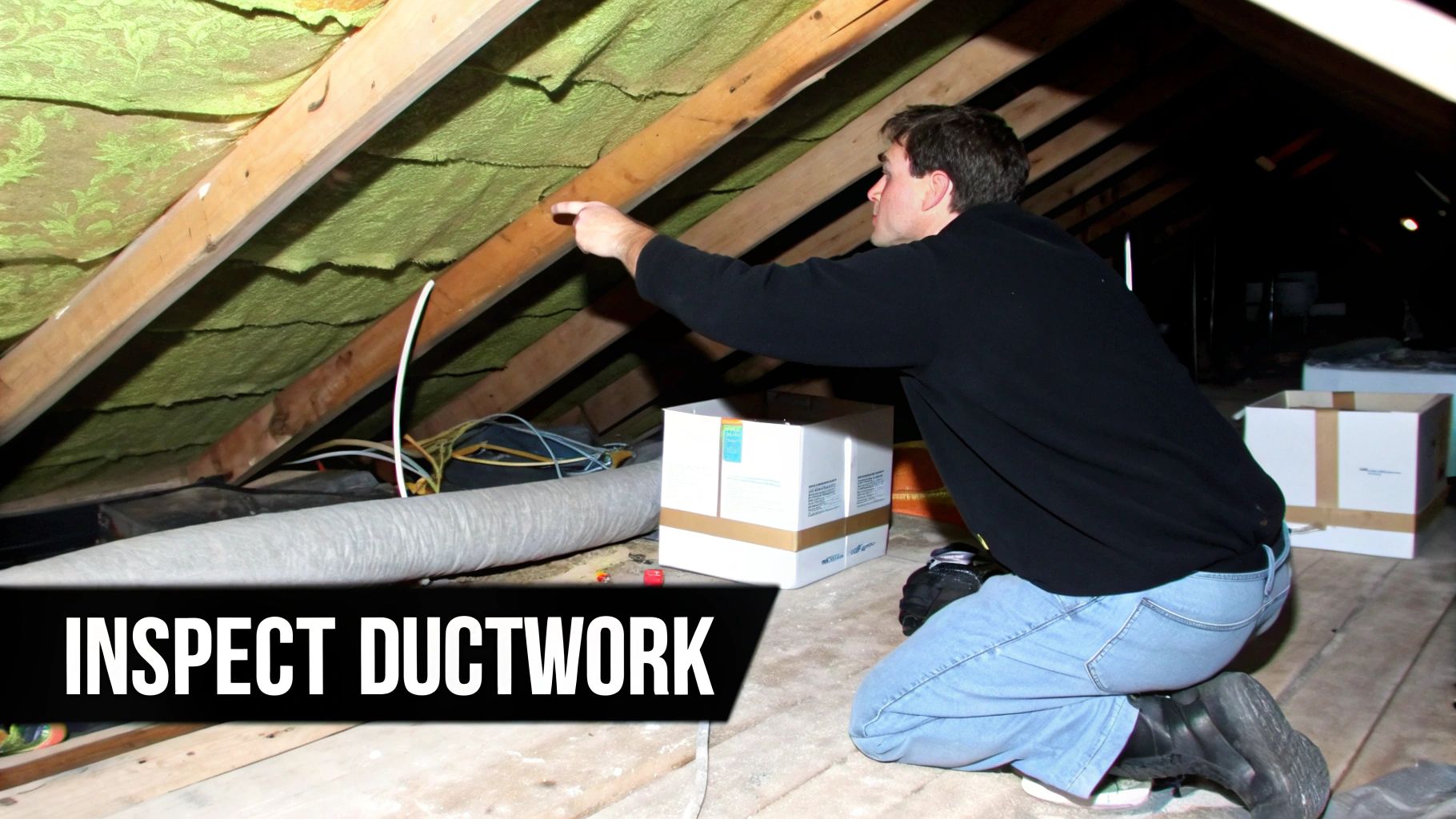
It’s a frustrating scenario we see all the time. You’ve checked the filter, the thermostat seems fine, and you’ve even hosed down the outdoor unit, but your home is still uncomfortably warm. When your AC is running but the house isn't cooling, it's time to start looking beyond the unit itself.
The real culprit might be the delivery system: your ductwork. Think of it as your home’s circulatory system. If it’s got leaks, blockages, or poor insulation, all that wonderfully cool air your AC is producing never actually makes it where it needs to go. This hidden network, tucked away in attics, crawlspaces, and walls, is a frequent and often overlooked source of the problem.
The High Cost of Leaky Ductwork
Leaky ducts are a massive energy drain. In fact, the U.S. Department of Energy estimates that a typical home loses a staggering 20% to 30% of conditioned air through leaks, holes, and bad connections. That's like trying to fill a bucket with a hole in the bottom; you're just constantly losing what you're paying good money for.
Here in Tucson, where ducts often run through scorching hot attics, a leak is a double whammy. Not only are you losing precious cool air, but your system is also sucking in hot, dusty attic air, which tanks your cooling efficiency and hurts your indoor air quality.
You might be dealing with a ductwork issue if you're noticing:
Hot and Cold Spots: One room feels like a meat locker while another is sweltering.
A Dusty Home: It feels like you're constantly cleaning, and dust seems to pour from the vents.
Sky-High Energy Bills: The AC runs nonstop, but your utility bills are higher than ever.
Strange Odors: Leaks can pull in musty, damp air from basements or crawlspaces.
You might be able to spot an obvious issue like a disconnected or crushed duct with a visual inspection. The reality, though, is that most leaks are tiny and hidden in the seams and joints, making them nearly impossible to find without professional tools.
Pinpointing Other Inefficiencies in Your Home
Beyond the ducts, your home's "thermal envelope" plays a huge part in how well your AC can do its job. Poor insulation and air leaks around windows and doors create a constant battle for your cooling system. Your AC might be working perfectly, but your home simply can't hold onto the cold air.
Picture this: an uninsulated attic on a sunny Arizona day can easily hit 150°F or more. Without a solid layer of insulation, that intense heat radiates straight down into your living space. Your AC is forced to work overtime just to keep up.
You can do a quick energy audit yourself to find these weak spots. On a hot day, carefully feel the walls and ceilings in rooms that get direct sun. If they feel warm, your insulation is likely not cutting it. Check for drafts around window frames and door jambs, these small leaks add up to a significant loss of cool air. Simple fixes like weatherstripping or caulk can make a surprising difference.
Sometimes, other factors like your home's ventilation can make it feel warmer even with the AC on. Issues like moisture buildup from poor ventilation are a common culprit. For those looking to learn more, understanding how to go about improving home ventilation is a key piece of the total home comfort puzzle.
When it comes to duct issues, though, a professional approach is almost always necessary. At Covenant Aire Solutions, we use specialized tools to pressurize the duct system and measure the exact amount of air being lost. If we find leaks, we offer advanced solutions like Aeroseal, a cutting-edge process that seals your ducts from the inside out. You can learn more about our Aeroseal duct sealing and see how this technology restores efficiency and brings back the comfort you've been missing.
The Real Value of Preventive HVAC Maintenance
Let's be honest, the absolute best way to handle a major AC problem is to make sure it never happens in the first place. When your air conditioner is running but your house is still hot, it’s almost always because a small, fixable issue was left to fester and spiral out of control.
This is exactly where preventive maintenance shines. It’s about shifting from reactive panic to proactive peace of mind.
Regular, professional tune-ups aren’t just another line item on your budget; they're a critical investment in your home’s comfort and the lifespan of your system. Think of it like a check-up for your car. You wouldn't drive it for years without an oil change, and the same logic applies to your hardworking HVAC unit, especially in our demanding Tucson climate.
What a Professional Tune-Up Really Involves
A real tune-up is so much more than just swapping out a filter. It's a deep-dive inspection and cleaning process designed to get your system running like new again. When a certified tech from Covenant Aire Solutions shows up, they're working through a detailed checklist to spot potential failures before they leave you sweating.
Here’s a glimpse of what that looks like:
Cleaning the Condenser and Evaporator Coils: Grimy coils are public enemy number one for cooling efficiency. Our techs give them a thorough cleaning to ensure they can transfer heat properly.
Checking Refrigerant Levels: We’ll check the refrigerant pressure to make sure it’s just right. If it’s off, that usually points to a leak we can find and fix early.
Inspecting All Electrical Components: This means tightening connections, checking capacitors, and testing relays to head off any surprise electrical failures.
Lubricating Moving Parts: Properly lubricated motors and fans reduce friction, which cuts down on electricity use and prevents parts from wearing out too soon.
I’ve seen it time and again: routine tune-ups catch the vast majority of potential breakdowns before they start. For Tucson homeowners, this is the difference between a minor tweak in the spring and a total system failure during a July heatwave.
From Lower Bills to a Longer Lifespan
It’s simple: a well-maintained AC is an efficient one. When every part is clean and working correctly, your unit doesn't have to struggle to cool your home, which means it uses less energy. That translates directly into lower monthly utility bills, a win for any homeowner.
This proactive care also dramatically extends the life of your equipment. An HVAC system that's constantly straining because of dirty coils or failing parts will give out years sooner than one that gets regular professional attention. By scheduling maintenance, you’re protecting your investment and getting the most out of it. To see how this fits into your overall home care, check out this comprehensive home maintenance checklist for other key seasonal tasks.
This kind of forward-thinking is vital on a bigger scale, too. Experts project that by 2050, cooling could be responsible for a staggering 10% of global greenhouse gas emissions. Inefficient systems are a huge part of that problem.
The good news? Biannual tune-ups can catch 90% of potential issues early, making sure your unit cools your home without wasting energy. To make this essential service as easy as possible, we offer structured preventive maintenance plans that deliver peace of mind and priority service when you need it most.
Common Questions When Your AC Isn't Cooling
When your air conditioner decides to take a siesta on a hot Tucson day, a flood of questions usually follows. You need answers, and you need them fast. Here are some of the most common questions we get from homeowners dealing with an AC that’s running but not actually cooling anything down.
How Long Should I Wait Before Calling a Professional?
Honestly, not long at all. After you've done the basic checks, a quick look at the filter and thermostat, you should feel a difference pretty quickly. If an hour or two goes by and your home is still an oven, it’s time to call in a pro.
Letting a faulty AC run on and on is just asking for trouble. It puts a massive strain on expensive components like the compressor. What could have been a straightforward, minor repair can quickly spiral into a full-blown replacement that costs thousands.
A word of caution: if you hear loud grinding noises, smell something burning, or see a block of ice on the coils, shut the system off at the circuit breaker immediately. That's a clear signal to call for emergency service to prevent serious damage and keep your family safe.
Can a Dirty Air Filter Really Stop My House from Cooling?
You bet it can. A severely clogged air filter is one of the top culprits we find when an AC’s performance plummets. Think of it like trying to breathe with a pillow over your face; it just doesn't work.
When the filter is packed with dust, it chokes off the airflow your system needs to pull heat out of your home. The evaporator coils can't do their job, and the whole cooling process grinds to a halt. In really bad cases, the coils get so cold they literally freeze over, completely blocking any chance of cooling.
Changing your filter is the single most important, easiest, and cheapest thing you can do for your AC. It prevents the all-too-common problem of an air conditioning unit running but not cooling house. A good rule of thumb is to check it every month and replace it every 1-3 months, maybe even more often if you have pets or live in a dusty area.
Is It Better to Repair or Replace My Old AC Unit?
That's the million-dollar question, isn't it? The right answer really depends on a few things: your AC's age, how much the repair will cost, and what your energy bills look like. Sometimes, a seemingly cheap repair is just putting a band-aid on a much bigger problem.
Here’s a little industry guideline we often use called the "5,000 rule":
Take the age of your AC unit in years.
Multiply that number by the quoted repair cost.
If that number is over $5,000, it's probably smarter to invest in a replacement.
For instance, if you're looking at a $600 repair on a 10-year-old unit, the math is $600 x 10 = $6,000. That total suggests a new unit is the better long-term financial decision. Modern, high-efficiency systems can slash your monthly bills, helping to pay for themselves over time. A good, honest technician will lay out both options for you clearly.
What if My AC Is Leaking Water and Not Cooling?
Water pooling around your indoor unit coupled with a lack of cool air is a classic symptom of a frozen evaporator coil. This usually traces back to one of two things: either airflow is blocked (think dirty filter or a closed vent), or your system is low on refrigerant.
As the AC cycles, the ice on the frozen coil melts, and the water has nowhere to go but out of the drain pan and onto your floor. This isn't just a mess; it's a clear sign your system is in distress and needs help right away.
Your first move should be to turn off the AC at the thermostat to let that ice thaw completely. While it's off, it’s the perfect time to check your air filter and swap it out if it’s dirty. If you turn it back on after the ice is gone and the filter is clean but the problem comes right back, you’re likely dealing with a refrigerant leak that a professional needs to handle.
When you’ve tried the basics and you’re still scratching your head, it’s time to call in the experts. The team at Covenant Aire Solutions is ready 24/7 to get to the bottom of the issue and bring the cool air back. Don’t sweat it out; contact us for fast, reliable service you can trust.