
Decoding Your Heat Pump Repair Costs
- Jul 31, 2025
- 13 min read
Updated: Aug 5, 2025
When your heat pump suddenly gives out, the first question that pops into your head is always, "How much is this going to cost me?" Generally speaking, you can expect to pay between $150 and $700 for most common heat pump repairs.
However, that's just a ballpark. A major failure, like a bad compressor, can easily send that bill soaring past $2,000. Because the range is so wide, it’s critical to understand what actually goes into the final number on your invoice.
What to Expect on Your Heat Pump Repair Bill
Facing a broken heat pump is stressful enough without the added anxiety of a surprise bill. The simplest way to think about the total expense is an equation: the cost of the replacement part plus the cost of the technician's time and expertise to install it. Some jobs are quick fixes, while others are basically major surgery for your HVAC system.
To give you a clearer picture, it helps to break down the costs by the specific part that failed. Swapping out a small electrical component is a completely different financial ballpark than replacing a core mechanical part like the compressor. Knowing these differences helps you set realistic expectations before the technician even rings your doorbell.
Common Heat Pump Repair Costs at a Glance
Some heat pump problems are just more common than others, and thankfully, their repair costs tend to fall into predictable ranges. Things like a faulty capacitor or a worn-out contactor are relatively inexpensive to fix. On the other hand, issues like a refrigerant leak or a stuck reversing valve require more intensive labor and specialized materials, driving up the price.
Here's a quick reference table to give you a general idea of what to expect. We've included the typical symptoms you might notice for each problem.
Common Heat Pump Repair Costs at a Glance
Component or Repair Type | Average Cost Range (Parts & Labor) | Common Symptoms |
|---|---|---|
Capacitor Replacement | $150 – $400 | The outdoor unit hums, but the fan just won't start spinning. |
Contactor Replacement | $200 – $450 | The outdoor unit either won't turn on at all or runs nonstop. |
Fan Motor Replacement | $400 – $800 | You hear loud grinding or squealing noises coming from the unit. |
Reversing Valve Repair | $450 – $1,000 | The system gets stuck in either heating or cooling mode and won't switch. |
Refrigerant Leak Repair | $300 – $1,500+ | The system is blowing warm air in summer, or you see ice on the coils. |
Compressor Replacement | $1,800 – $3,500+ | The system constantly trips the circuit breaker or makes loud, violent noises. |
This table shows just how much repair costs can vary. The key takeaway? A little prevention goes a long way.
A proactive approach is always more affordable than a reactive one. Many significant repairs can be avoided entirely with consistent upkeep, as small issues are caught before they become catastrophic failures.
The good news is that many of these expensive problems are preventable. For instance, a technician can spot a deteriorating capacitor during a routine tune-up and replace it before it fails on the hottest day of the year. To learn how to keep your system running smoothly and sidestep these unexpected costs, check out our essential guide on how to maintain your HVAC system. This kind of proactive care is the single best way to control your heat pump repair costs over the long haul.
Why Some Heat Pump Repairs Cost More Than Others
When you get the final bill for a heat pump repair, it’s natural to wonder what exactly you’re paying for. The final price tag isn't just about a single broken part; several key variables come into play. It’s a lot like car trouble: fixing a flat tire is a completely different financial ballpark than rebuilding the engine.
The same logic applies to your home's comfort system. The complexity of the job, the specific type of heat pump you own, and its age all have a major impact on the final invoice. A straightforward electrical fix might be quick and relatively inexpensive, but a serious mechanical failure is a much bigger investment.
The Type of Heat Pump Matters
Most homes have air source heat pumps, which are generally the most affordable to service. Because they're so common, parts are widely available, and most technicians are very familiar with them.
However, if you have a more advanced system, like a water source or geothermal unit, the cost considerations change. These systems require specialized knowledge and components that aren't as common, which can drive up the repair price.
The market data backs this up. In 2025, the global heat pump market was valued at around $86.6 billion. Standard air source units made up the lion's share at $67.55 billion, while the more complex water and ground source systems were valued at $10.39 billion and $3.46 billion, respectively. This just goes to show why finding parts and an expert for a standard air source model is usually easier and more affordable.
Major vs. Minor Component Failure
The single biggest factor that drives repair costs is which specific component gave out. A minor hiccup, like replacing a capacitor or contactor, usually lands on the lower end of the price spectrum. These are common electrical parts that a trained technician can access and swap out without much fuss.
A major failure, on the other hand, is a whole different story. Think of the compressor as the heart of your heat pump. Replacing it is one of the most expensive repairs you can face. Not only is the part itself costly, but the job is also very labor-intensive. It often takes several hours and involves complex steps like recovering and recharging the system’s refrigerant.
A heat pump's warranty is your financial safety net. A major repair on an in-warranty unit might only cost you the labor, while the same repair on an out-of-warranty system could cost thousands.
Age and Warranty Status
The age of your heat pump is another huge piece of the puzzle. As a unit gets older, two things happen: parts start to wear out more often, and the manufacturer's warranty eventually expires. Most parts warranties last between 5 to 10 years. If your system breaks down after that window, you're on the hook for the full cost of both parts and labor.
When an older, out-of-warranty unit suffers a major failure, like that bad compressor we talked about, it often puts homeowners at a crossroads. The high cost of the repair can sometimes get uncomfortably close to the price of a brand-new, more efficient system. Knowing your unit's age and warranty status helps you make a smart, informed decision. For more on this, check out our homeowner's guide to heat pump life expectancy.
How Your Location and Technician Choice Affect the Price
Getting a handle on these variables is key to managing your heat pump repair costs. Labor isn't a fixed price; it’s a direct reflection of the local economy and the technician's skill level.
Why Your Zip Code Matters
The cost of living in your area directly influences how much a technician charges per hour. A repair in a dense, high-cost urban center will almost certainly be more expensive than the same job in a rural town. This all comes down to higher business operating costs, including insurance, fuel, and the wages needed to attract top talent in a competitive market.
This regional price difference isn't just a local phenomenon. For instance, government programs can also play a role. In the UK, incentives like the Boiler Upgrade Scheme encourage heat pump adoption, but this can also spike demand for skilled technicians, impacting repair costs. You'll see labor costs in high-demand areas like South East England climb substantially higher than in other regions, showing a clear link between location and price. You can learn more about how regional markets and incentives affect pricing on greenmatch.co.uk.
The Value of a Certified Technician
When you start getting quotes, it's tempting to just go with the lowest bidder. Be careful. The hourly rate doesn't tell the whole story, and hiring a cheaper, less experienced technician can be a costly mistake in the long run.
A certified, seasoned professional might have a higher hourly rate, but their true value comes from efficiency and accuracy. They can diagnose complex problems much faster and, most importantly, get the job done right the first time.
Choosing a technician is like hiring a guide for a tricky journey. An experienced guide costs more upfront, but they know the safest and quickest path, preventing you from getting lost and wasting valuable time and resources.
An amateur, on the other hand, might misdiagnose the issue or use the wrong part. This can lead to a whole new set of problems:
Repeat Visits: You’ll have to pay for another service call to fix the original problem, or worse, a new one they created.
Further Damage: An improper repair can put extra strain on other components, causing more expensive failures down the line.
Voided Warranties: Some manufacturers require repairs to be done by certified professionals to keep the warranty valid.
Investing in a qualified technician protects your system and your wallet. It ensures the repair is a lasting solution, not just a temporary patch, ultimately lowering your long-term heat pump repair costs.
The Hidden Costs of Modern Heat Pump Technology
Today's high-efficiency heat pumps are truly impressive. They deliver incredible comfort and are much easier on the environment than older systems. But all that progress comes with a new layer of complexity when it's time for a repair, which can affect the overall heat pump repair costs.
The very features that make these units so good, like smart diagnostics and variable-speed parts, also demand a higher level of technical skill to service.
Think of it this way: it’s like the difference between working on a classic, purely mechanical car and a brand-new electric vehicle. The old car is simpler, but the new one is packed with computers and sensors. Fixing it right requires specialized tools and a mechanic who has invested heavily in training. The same is true for your advanced heat pump.
Smarter Systems and Specialized Repairs
Modern heat pumps are full of sophisticated circuit boards and sensors that constantly monitor how the system is running. When one of these electronic components fails, a technician can't just swap out a simple mechanical part. They need diagnostic software and a deep understanding of the unit’s complex inner workings to even find the problem.
This trend toward more complex systems is reshaping the entire HVAC industry. The global heat pump market was valued at a staggering $88.4 billion in 2024 and is expected to soar to $134.8 billion by 2030. According to BCC Research's analysis, this explosive growth, along with the push for even smarter, AI-driven systems, is creating a real shortage of technicians who can handle these advanced repairs. When demand outstrips supply, labor costs naturally go up.
The Shift to New Refrigerants
Another major factor driving up repair costs is the kind of refrigerant your heat pump uses. For years, the standard was R-22, but it's being phased out because of its negative environmental impact. The newer, eco-friendly refrigerants are a big win for the planet, but they bring their own set of challenges.
These modern coolants often are:
More Expensive: The price per pound for the refrigerant itself is typically higher.
Harder to Source: They aren't always as readily available as the older types, which can affect supply and cost.
More Demanding: They operate at different pressures and require technicians to use specific tools and follow precise procedures.
The industry's move toward sustainable technology is a fantastic step forward for the environment. However, it often means higher material and labor costs for services like fixing a refrigerant leak or recharging the system.
Because of this shift, what used to be a straightforward refrigerant leak repair is now a much more specialized job that requires updated equipment and training. Just as the size of your unit impacts its performance, the type of technology inside it has a direct effect on your final repair bill. If you want to learn more about how system specs affect your home, you might find our guide on how to size an air conditioner correctly helpful.
When a technician hands you a steep estimate for a major fix, you’ll inevitably face a tough crossroads. Do you pour more money into fixing your aging heat pump, or is it time to bite the bullet and invest in a full replacement?
This is a big decision, and it goes way beyond just the immediate repair bill.
A handy rule of thumb we use in the industry is the "5,000 Rule." It's a quick and dirty formula to see if a repair makes financial sense. Just multiply the repair cost by the age of your heat pump in years.
If that number climbs over $5,000, replacement is almost always the smarter financial move. For instance, a $600 repair on a 10-year-old unit gets you to $6,000 ($600 x 10), which is a strong signal that you should start shopping for a new system.
Factors Beyond the Math
While the 5,000 Rule is a great starting point, it's not the whole story. You have to look at your unit's track record. Are you and your HVAC technician on a first-name basis because of frequent breakdowns? Those smaller repair bills add up, and a replacement can quickly become the cheaper option in the long run.
Then there's the efficiency factor. Today's high-efficiency heat pumps can seriously slash your monthly energy bills. The savings from a modern, energy-sipping unit might offset the higher upfront cost much faster than you’d expect. Getting a clear picture of the long-term cost differences is key, which is why comparing a heat pump vs. AC cost can give you some valuable perspective.
This graphic breaks down typical repair costs by the type of problem, helping you see where your issue falls on the severity scale.
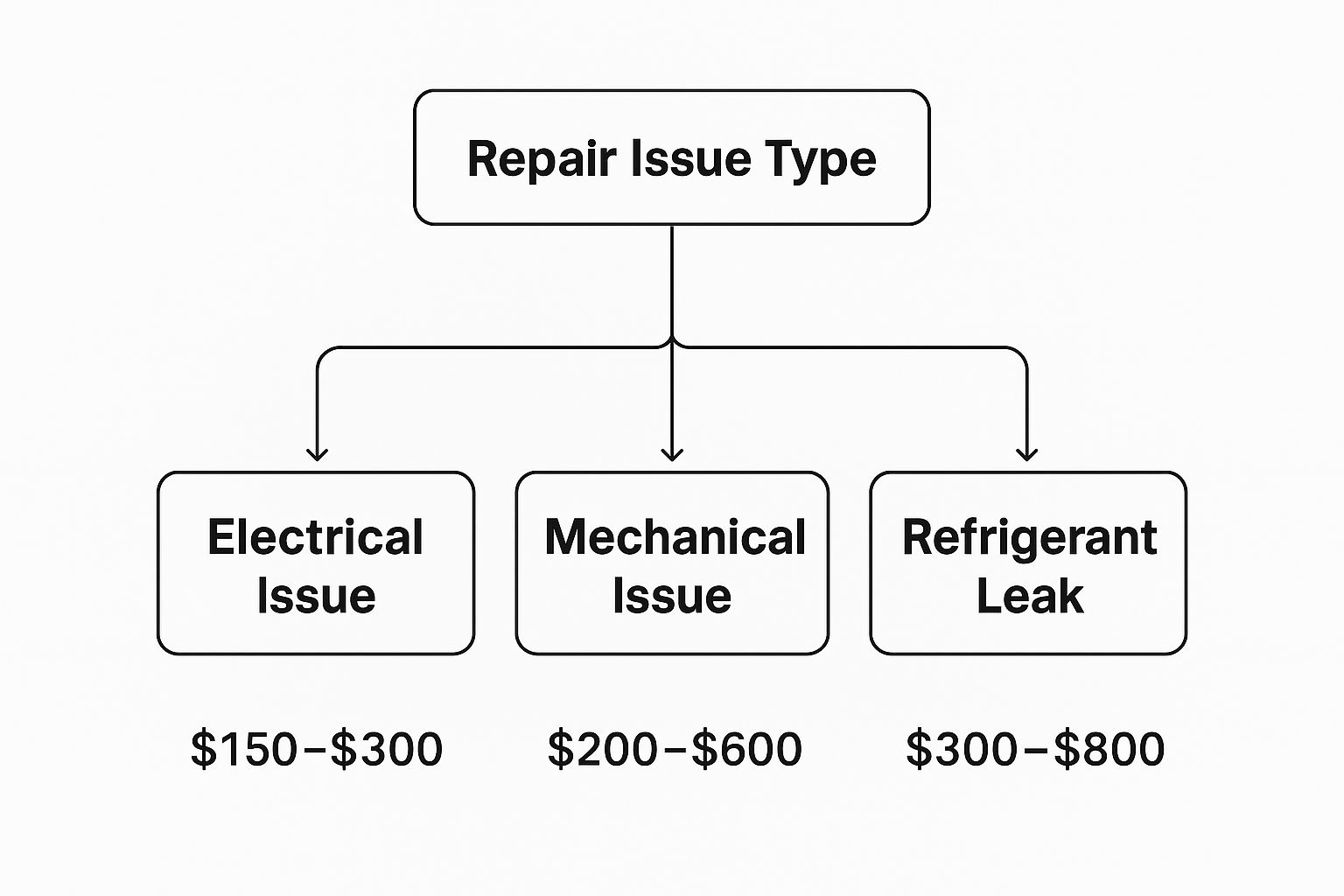
As you can see, minor electrical issues are usually on the lower end of the cost spectrum. On the other hand, things like refrigerant leaks can get expensive fast and often suggest the system is on its last legs.
Repair or Replace Decision Matrix
To make the best call for your home and budget, you need to weigh the pros and cons of each path. This isn't just about the immediate cash outlay; it's about your future comfort, reliability, and energy savings.
This table lays out the key considerations to help you choose wisely.
Consideration | Favorable for Repair | Favorable for Replacement |
|---|---|---|
Age of Unit | The unit is less than 10 years old. | The unit is over 12-15 years old. |
Repair Cost | The repair is less than 50% of replacement cost. | The repair cost is substantial and nears replacement cost. |
Repair History | This is the first or second minor repair. | The unit requires frequent and increasingly costly repairs. |
Energy Efficiency | Your current energy bills are reasonable. | A new ENERGY STAR model offers significant long-term savings. |
Looking at these factors side-by-side can bring a lot of clarity. If you're leaning one way after reviewing the table, you're likely on the right track for your home's needs.
Smart Ways to Lower Your Heat Pump Repair Bills

It helps to think of your heat pump like your car. You wouldn't drive it for 50,000 miles without an oil change or tire rotation and expect it to run perfectly, right? Your heat pump needs that same kind of consistent attention to stop small issues from snowballing into catastrophic and expensive failures.
Embrace Proactive Maintenance
By far, the most effective way to keep repair bills down is with regular, preventative maintenance. So many of the most common and costly repairs come from simple neglect. Following an ultimate HVAC preventative maintenance checklist is one of the best habits you can build to keep your system in prime condition.
Even simple tasks you can do yourself make a huge difference:
Change Air Filters Regularly: A clogged filter chokes your system, restricting airflow and forcing it to work much harder. This leads to premature wear on parts and, you guessed it, higher energy bills.
Keep the Outdoor Unit Clear: Make sure you have at least two feet of clearance all the way around your outdoor unit. Keep it free of leaves, grass clippings, and any other debris that can smother the system.
An annual professional tune-up isn't just another bill, it's an investment in your heat pump's future. A good technician can spot weakening parts, like a failing capacitor, long before it dies and causes a total system breakdown on the hottest day of summer.
Become an Empowered Homeowner
When you do have to call a pro, being prepared helps you stay in control of the costs. Don't ever feel shy about getting multiple quotes, but remember to compare them on more than just the bottom-line price. Always verify that any company you consider is licensed and insured.
When you're talking to a technician, ask smart questions:
Can you walk me through what caused this part to fail?
What are all my options for the repair?
Is this a long-term fix or more of a temporary patch?
Taking these steps doesn't just cut down on your repair bills; it also helps extend the life of your equipment. For even more ways to keep your expenses in check, you can learn about real strategies that cut costs on your heating bill and apply those same principles all year long.
Of course. Here is the rewritten section, crafted to sound like an experienced human expert and match the provided examples.
Your Top Questions About Heat Pump Repair Costs
Even with a good grasp of the basics, you probably still have a few questions rattling around in your head about what to expect with heat pump repair costs. It's completely normal. Getting straight answers helps you feel more in control when you finally have to pick up the phone and call for service.
Let's dive into some of the most common questions we hear from homeowners. The goal here is to give you practical, no-nonsense insights so you can make smarter financial decisions.
How Much Is a Typical Diagnostic Fee?
Before a single tool comes out, a technician has to play detective to figure out what’s actually wrong with your system. That initial investigation comes with what’s called a diagnostic fee or service call fee, which usually runs between $75 and $150.
Think of it as paying for the expert's time, gas, and know-how to accurately pinpoint the problem. This fee is almost always separate from the actual repair bill. However, a lot of reputable HVAC companies will credit that fee toward the final cost if you decide to go ahead with their recommended repair, which is a nice touch.
Does Homeowner's Insurance Cover Heat Pump Repairs?
This is a huge point of confusion for many, and the short answer is: probably not, but there are a few key exceptions. Your standard homeowner's insurance policy is built to cover sudden, accidental disasters, what the industry calls "perils."
So, your policy might kick in to cover a repair or even a full replacement if your heat pump was:
Zapped by a lightning strike.
Crushed by a tree falling during a major storm.
Damaged in a house fire.
What insurance almost never covers is a breakdown from simple old age, neglect, or normal wear and tear. Your best bet is always to pull out your policy documents or call your agent to get the specifics before you're in a pinch.
Think of it this way: homeowner's insurance is for the once-in-a-lifetime catastrophe, not the slow, expected decline of an appliance. Your best "insurance" against that is consistent maintenance.
How Long Should a Well-Maintained Heat Pump Last?
If you take good care of it, a quality heat pump should keep your home comfortable for 10 to 15 years. Some of the top-tier units can even stretch closer to 20 years, but that doesn't happen by accident. The magic words are "well-maintained."
Getting that long lifespan is all about consistent, annual servicing. Skipping your yearly maintenance is like deciding not to change the oil in your car. Sure, it'll keep running for a while, but you're dramatically cutting its life short and just asking for more frequent and more expensive breakdowns.
When you need fast, honest, and expert service for your heat pump, trust the certified technicians at Covenant Aire Solutions. We offer transparent pricing and 24/7 emergency support to keep your home comfortable year-round. Contact us today for a free estimate!