
Finding the Best Freon R22 Replacement
The best freon r22 replacement really depends on the age and type of your system. The most common "drop-in" alternatives we see in the field are R-407C, R-421A, and R-422D. These refrigerants let you retrofit an older AC unit without having to spring for a full, expensive replacement, making them a practical way to deal with the global R-22 phase-out.
Understanding The R22 Phase Out
If your air conditioning system was put in before 2010, there's a very high chance it runs on a refrigerant called R-22, which most people know by the brand name Freon. For decades, R-22 was the go-to standard for cooling homes and businesses.
But then, scientists discovered a major problem. R-22 contains hydrochlorofluorocarbons (HCFCs), chemicals that were found to be seriously damaging the Earth's protective ozone layer.
This discovery led to global action. Under an international treaty known as the Montreal Protocol, countries agreed to stop using ozone-depleting substances. In the U.S., the Environmental Protection Agency (EPA) rolled out a gradual reduction plan that ended with a complete ban on producing and importing R-22 as of January 1, 2020.
What This Means for Homeowners
While it’s still perfectly legal to use an existing AC system that contains R-22, the phase-out has created some serious real-world problems for homeowners. The available supply of R-22 is now incredibly small, limited to whatever has been recycled or stockpiled.
This scarcity has sent prices through the roof. What used to be a simple, affordable AC recharge has turned into a major expense.
It all comes down to basic supply and demand. With no new R-22 being made, the cost to service older units is only going to keep climbing. This makes a freon R22 replacement a smart financial move for the long run.
The market data tells the same story. The global market for HCFC-R22 refrigerant is shrinking, projected to fall from USD 4.5 billion to roughly USD 3.2 billion by 2033. This isn't just a small dip; it's a clear signal that the industry is moving on from this obsolete chemical.
The Financial and Reliability Problems
Sticking with an R-22 system today is risky for reasons beyond just the cost. If your unit springs a refrigerant leak, you're stuck with a tough choice: either pay a fortune for a chemical that's getting harder to find or start looking at a major system overhaul. This makes planning for repairs unpredictable and stressful.
Here are the key issues you'll face:
Soaring Repair Costs: A simple refrigerant leak, which was once a minor fix, can now easily cost hundreds or even thousands of dollars because of the sky-high price of R-22.
Reduced System Reliability: As AC systems get older, they're more likely to develop leaks. Constantly patching up an old unit with expensive, hard-to-find refrigerant just isn't a sustainable fix.
Higher Energy Consumption: Older R-22 systems are simply not as efficient as modern air conditioners. This inefficiency is often a big reason for climbing utility costs, which you can learn more about by understanding what causes high electricity bills.
At the end of the day, the R-22 phase-out isn't just some environmental rule; it's a practical reality that is pushing homeowners toward a more reliable and cost-effective freon r22 replacement.
How to Evaluate R22 Alternatives
Choosing the right freon R22 replacement isn't just about picking a new chemical off a list. It’s a careful process of matching a refrigerant to your specific HVAC system to ensure it runs efficiently and safely for years to come. Think of it less as a simple swap and more as a strategic upgrade.
The first thing to get out of your head is the sticker price. The total cost of conversion goes way beyond the price of the refrigerant itself. You have to factor in labor and any hardware changes needed to make the switch. Some replacements demand a full oil flush-out or new seals, and those costs add up quickly.
Performance and Efficiency Metrics
Your main goal here is pretty simple: you want your system to cool just as well as it did before, if not better. A solid R22 alternative should deliver comparable performance without making the compressor work overtime, which would completely wipe out any savings.
Energy efficiency is the other side of that coin. The ideal replacement will operate at pressures and temperatures similar to R22. This ensures your system doesn't suddenly start guzzling electricity just to keep you cool. A poorly matched refrigerant can cause a nasty surprise on your next energy bill. If you want to get into the weeds on what drives your system's power use, our guide to HVAC system efficiency is a great resource.
System Compatibility and Modifications
Here’s where the real technical work comes in. Not every refrigerant is a simple "drop-in" fix, and checking for compatibility with your existing components is probably the most critical step before you commit to a retrofit.
The most common snag is the system's lubricant. R22 systems were designed to run on mineral oil, but many modern replacements, like the common R-407C, absolutely require a switch to polyolester (POE) oil. That oil change adds both time and money to the job. On the other hand, some alternatives like R-422D were specifically designed to work with the existing mineral oil in most situations, making the whole process much simpler.
Beyond the oil, you need to verify a few other key components:
Seals and Gaskets: Some new refrigerants can make older seals shrink or break down, which is a recipe for leaks.
Expansion Valves (TXV): The new refrigerant will likely have different operating pressures, which might mean the TXV needs to be adjusted or replaced entirely for the system to perform correctly.
Compressor: Always double-check that the refrigerant you're considering is approved for your specific compressor model to avoid catastrophic failure.
A successful retrofit all comes down to matching the refrigerant to the system's original design. If you skip a critical step, like an oil flush when it’s required, you’re risking compressor failure. That's a much, much more expensive problem than the leak you started with.
Environmental Impact and Safety
Finally, you need to understand the environmental side of things to make a responsible choice. Two key numbers tell the story of a refrigerant's impact.
The Ozone Depletion Potential (ODP) is what got us here in the first place. It measures how much a chemical harms the ozone layer. R22 has an ODP, which is why it was phased out. Any modern replacement you consider must have an ODP of zero. No exceptions.
The Global Warming Potential (GWP) measures how much heat a gas traps in the atmosphere compared to carbon dioxide. While the new refrigerants are safe for the ozone, they still have a GWP. For instance, R-422D has a GWP of around 2,526. As regulations continue to tighten, choosing a refrigerant with the lowest possible GWP will help future-proof your system.
Comparing Top R22 Replacement Refrigerants
If you're staring at an old R22 system that needs a recharge, navigating the world of freon R22 replacement options can feel like learning a new language. You've got R-this and R-that, each with its own technical specs. But don't get lost in the numbers. The choice really boils down to a few key differences in performance, cost, and how much work it takes to get them into your system.
The most common alternatives you'll run into are R-407C, R-421A, R-438A, and R-422D. These are all refrigerant blends: basically, chemical cocktails designed to act like the R22 your system was built for. The catch? None of them are a perfect one-to-one match, and each one comes with its own set of trade-offs.
The Workhorse: R-407C
R-407C has been around for a while and is one of the most widely used R22 replacements. Its biggest advantage is that it closely mimics R22’s operating pressures and cooling capacity. In plain English, that means your AC should cool just as well as it always has. It's also an HFC blend with zero Ozone Depletion Potential, making it a clear environmental step up from R22.
But there's a big string attached. R-407C is not compatible with the old mineral oil lubricant found in R22 systems. To use it, a technician has to do a complete system flush and switch over to a synthetic polyolester (POE) oil. This is a labor-intensive job that adds a good chunk of change to the final bill, making it a tough sell if you just need a quick, cheap fix.
For systems where getting peak performance is the absolute priority, and the budget can handle a full retrofit, R-407C is the go-to. Its track record is solid, making it a reliable, if more involved, freon R22 replacement.
The decision often comes down to the age and health of your AC unit. If you have a relatively new R22 system with years of life left, the investment in a proper oil change can be well worth it to maintain top-tier efficiency.
The "Easy" Drop-In: R-421A
You'll often see R-421A marketed as a true "drop-in" replacement. Its main selling point is that it works with the existing mineral oil in R22 systems. This lets a technician skip the whole messy, time-consuming oil flush, which dramatically lowers the upfront cost and hassle of a retrofit. It’s designed as the straightforward solution for a leaking system that just needs a top-off.
That convenience, however, comes at a cost. R-421A often causes a slight drop in both cooling capacity and energy efficiency compared to R22. This might not be a big deal in a milder climate, but here in Arizona, that dip in performance could mean higher energy bills when the summer heat really kicks in.
The Versatile Option: R-438A (MO99)
R-438A, which you'll often see sold under the brand name MO99, tries to strike a happy medium. Just like R-421A, it's generally compatible with mineral oil, which means no oil change is needed for most residential systems. This keeps it in the cost-effective and practical category for a freon R22 replacement.
Where R-438A really shines is its performance. It usually delivers cooling capacity and efficiency that are much closer to R22, often outperforming other mineral-oil-compatible blends. It also has a slightly lower GWP than some of its competitors, which is becoming more important as environmental regulations get stricter. R-438A truly offers a balanced solution, giving you both convenience and solid performance.
The All-Rounder: R-422D
R-422D is another strong contender in the "easy retrofit" camp. It was specifically created to work with existing mineral oil, making it a direct replacement for a huge range of R22 systems, from your central air conditioner at home to commercial walk-in coolers. As a non-flammable HFC blend, it's safe to handle and use.
Like other drop-ins, you might see a minor decrease in system capacity with R-422D, but its incredible versatility makes it a popular pick. A key advantage is that it operates at similar pressures to R22, so you usually don't need to make major system tweaks like changing out expansion valves. This compatibility across so many different types of equipment is why it's used in everything from window units to massive refrigeration systems. If you're unsure what kind of equipment you have, our guide to residential HVAC system types can point you in the right direction.
To make this all a bit clearer, here's a side-by-side look at the main contenders.
R22 Replacement Refrigerant Comparison
This table breaks down the leading R22 alternatives, showing how they stack up on key technical specs and what's required to use them.
Refrigerant | Type | GWP | Oil Compatibility | System Modifications | Typical Use Case |
|---|---|---|---|---|---|
R-407C | HFC | 1774 | POE Oil Only | Requires full oil flush | High-performance retrofits where budget isn't tight |
R-421A | HFC | ~2200 | Mineral & POE Oil | "Drop-in" | Quick, low-cost repairs for leaking systems |
R-438A | HFC | 2265 | Mineral & POE Oil | "Drop-in" | Balanced performance and convenience |
R-422D | HFC | 2729 | Mineral & POE Oil | "Drop-in" | Versatile use in residential and commercial units |
This comparison highlights the core trade-off: do you want peak performance that requires more work, or do you need a fast, affordable fix?
The infographic below really puts the cost savings into perspective.
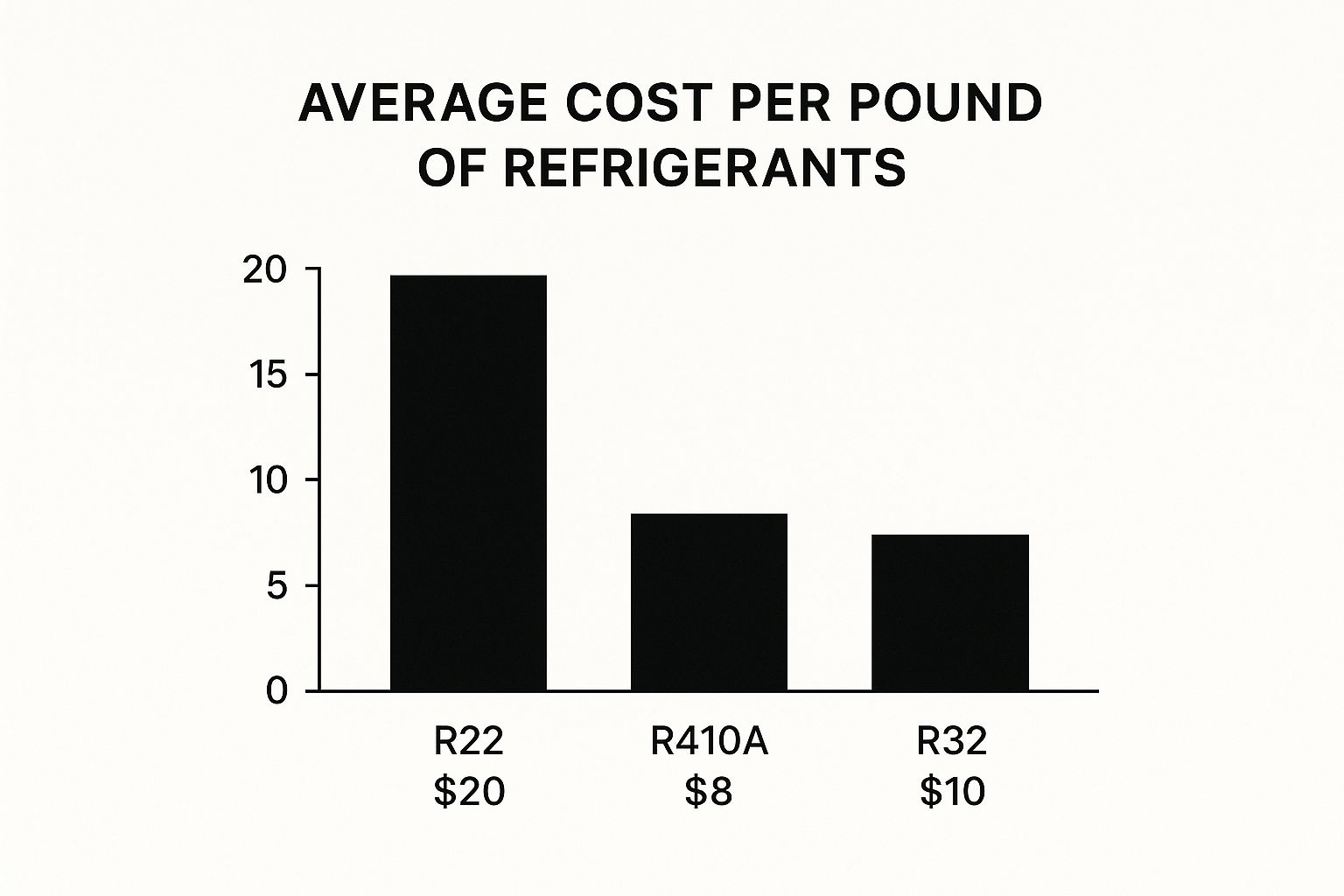
When you see the $20 per pound cost of scarce R22 next to the much more affordable modern alternatives, the financial incentive to switch becomes crystal clear.
Ultimately, picking the best freon R22 replacement comes down to what you value most.
Want peak performance and are willing to invest in a proper retrofit? R-407C is your best bet.
Looking for the fastest, most affordable way to get your AC running again? R-421A or R-422D will get the job done.
Need a balanced approach that combines convenience with strong, reliable performance? R-438A (MO99) is an excellent all-around choice.
The best move is always to talk it over with a certified HVAC professional. They can assess your specific system, your needs, and your budget to help you make the right call for the long haul.
Exploring Modern Eco-Friendly Options
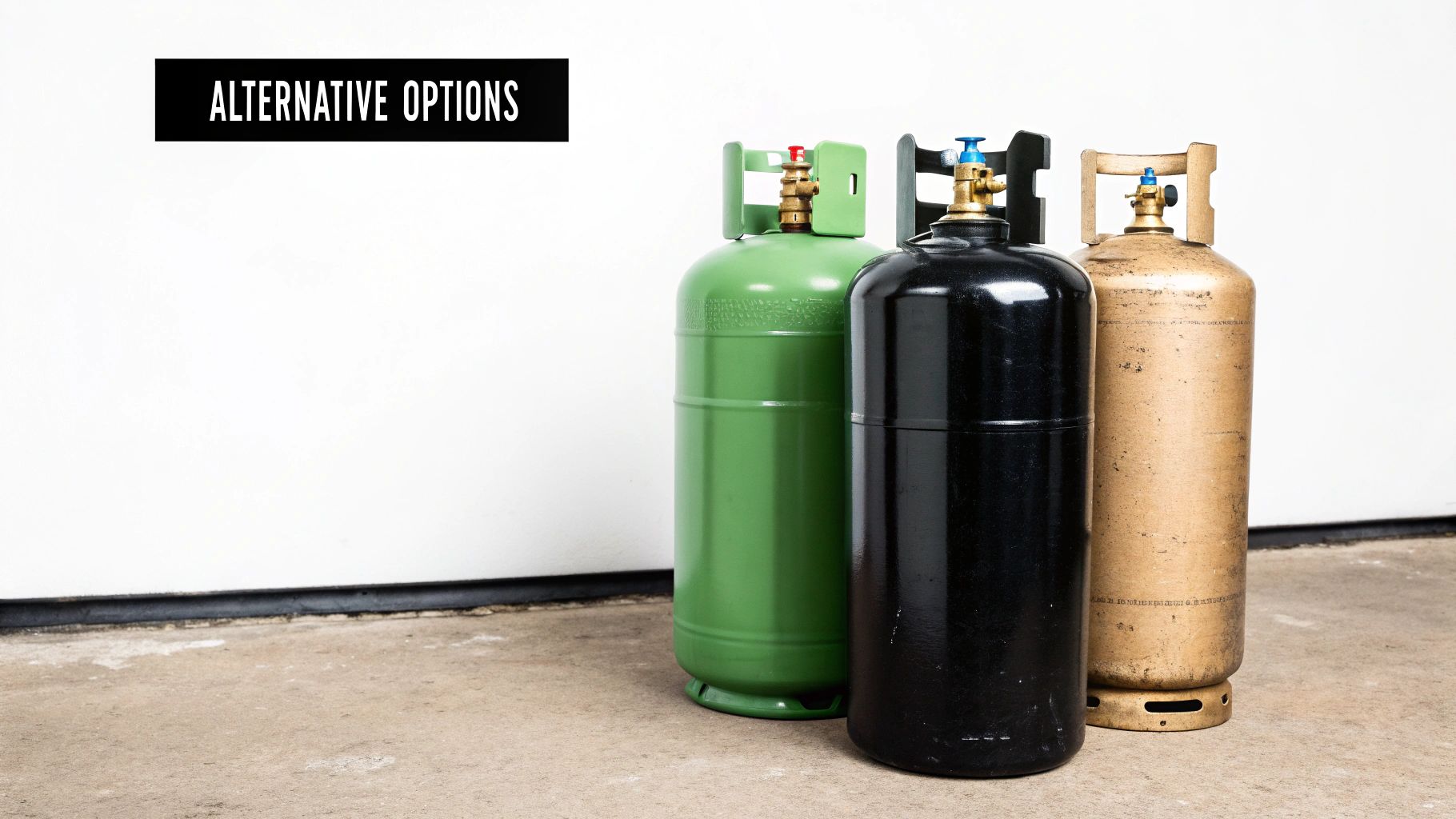
While drop-in refrigerants offer a practical fix for an aging R-22 system, a new generation of eco-friendly alternatives is definitely where the future is headed. These options are built around environmental safety and long-term efficiency, moving way beyond just patching a problem. Think of it as a forward-thinking approach to HVAC performance and sustainability.
This shift isn't happening in a vacuum. It’s driven by growing environmental awareness and increasingly strict regulations. Homeowners and businesses alike are now looking for solutions that not only cool effectively but also align with their sustainability goals. The focus is on slashing environmental impact without sacrificing an ounce of performance.
Introducing RS-44b (R-453A)
One of the standout next-generation refrigerants you'll hear about is RS-44b, also known by its official ASHRAE designation, R-453A. This blend was specifically engineered to give technicians a lower-GWP solution while delivering performance that’s right on par with R-22. Its biggest advantage? It provides a massive environmental benefit without forcing you into the expensive, labor-intensive modifications that other retrofits often demand.
For instance, RS-44b plays nice with the traditional mineral oil lubricants found in most older R-22 systems. That compatibility makes it a very attractive freon r22 replacement because it often means you can skip a complete, messy oil flush, saving you a good chunk of time and money on the job.
RS-44b is an HFC-based alternative that offers nearly identical cooling performance but with a much smaller environmental footprint. It has a Global Warming Potential (GWP) of 1664. While not zero, that's substantially lower than many other HFC replacements, and just as importantly, it has zero ozone-depleting potential.
By choosing a refrigerant with a lower GWP like RS-44b, you're not just fixing your AC; you're future-proofing your system against the next wave of environmental regulations. It’s a proactive step toward long-term compliance and sustainability.
That forward-looking perspective is critical. As environmental standards keep getting tighter, opting for a refrigerant with better green credentials today can save you from a costly, mandated switch-out tomorrow.
The Long-Term Advantages of Eco-Friendly Refrigerants
The perks of adopting advanced, eco-friendly refrigerants go far beyond just meeting today's rules. These modern alternatives are engineered for superior energy efficiency, which translates directly into lower monthly utility bills. Over the full lifespan of your HVAC system, those savings can really add up.
Here are some of the key long-term benefits you can expect:
Enhanced Energy Efficiency: Many new refrigerants have thermodynamic properties that let HVAC systems run more efficiently, using less electricity to get the same cooling job done.
Compliance with Future Standards: Adopting lower-GWP options now keeps your system compliant as environmental laws inevitably become even stricter.
Increased System Longevity: Using a refrigerant that runs efficiently and is well-matched to your system reduces strain on critical parts like the compressor, which can extend your equipment's life.
This focus on efficiency and sustainability isn't just about the refrigerant, either. As you weigh your options, it’s a great time to look at the bigger picture. You can explore a whole range of eco-friendly home appliances and their benefits to create a more sustainable home from top to bottom.
Real-World Application and Scenarios
Modern, eco-friendly refrigerants aren't just theoretical solutions; they're being successfully used in all kinds of settings right now. In a residential home, someone with an older but still functional R-22 heat pump might choose RS-44b to squeeze a few more years out of the unit while lowering their carbon footprint. This is often a much smarter financial move than a full system overhaul, especially if the equipment is still in good shape. You can explore your options further in our guide to heat pump replacement.
In the commercial world, a small business owner with several rooftop AC units could retrofit their systems with an eco-friendly freon r22 replacement to rack up significant energy savings across their properties. This move not only cuts down their operating costs but also boosts their brand's reputation as an environmentally responsible company. It just goes to show that sustainable choices are often the smartest financial ones, too.
Should You Retrofit or Replace Your System
When your old R-22 system finally gives up, you’re at a major fork in the road. Do you try to breathe new life into it by retrofitting it with a modern refrigerant, or is it time to bite the bullet and go for a full system replacement? This isn't just a simple fix; it's a big financial decision that will impact your comfort and your wallet for years to come.
There's no single right answer here. The best path forward really depends on the age and condition of your specific equipment. Sometimes a retrofit is the perfect solution, but in other cases, a full replacement is the only logical choice. The key is to weigh the upfront cost of a freon R-22 replacement against the long-term reliability and efficiency gains of a brand-new unit.
When a Retrofit Is the Smart Move
A retrofit can be a fantastic, cost-effective option, but only if the situation is right. The perfect candidate for a retrofit is an R-22 system that’s still relatively young, generally under 10 years old, and has a solid maintenance history. If your unit is in great mechanical shape otherwise, a simple refrigerant leak doesn't have to be a death sentence.
Picture this: your seven-year-old R-22 system springs a minor leak. The compressor is strong, the coils are clean, and the fan motor is running perfectly. In this scenario, spending a few hundred dollars for a technician to patch the leak and charge the system with a compatible drop-in like R-438A or R-422D is a totally sensible investment.
A retrofit's value lies in extending the life of an otherwise healthy system. It’s a targeted repair that solves an immediate problem without the massive expense of a full replacement, making it a pragmatic choice for newer, well-cared-for equipment.
This approach lets you squeeze every bit of value out of your original investment. You get to sidestep the high cost of a new system while still getting away from the obsolete and expensive R-22.
When to Seriously Consider a Full Replacement
On the flip side, pouring money into an old, inefficient, or unreliable system is usually a losing game. If your R-22 unit is more than 12-15 years old, it's already living on borrowed time and nearing the end of its useful life. At that age, a retrofit is just a temporary patch on a system that's bound to fail again soon.
Here are some clear signs that a full replacement is the smarter financial move:
Age and Inefficiency: An older unit, even after a retrofit, will never come close to the energy efficiency of a modern system. The money you'll save on your monthly energy bills with a new unit can often pay for the higher upfront cost over time.
Frequent or Costly Repairs: Are you already dealing with expensive repairs beyond just the refrigerant, like a failing compressor or fan motor? If so, a replacement is the wiser choice. Don't throw good money after bad.
Poor Performance: If your system was struggling to keep your house cool even before the leak, a new refrigerant isn't going to magically fix its underlying problems.
Making this call can be tough, and our guide on whether it's time to replace or repair your AC offers a much deeper dive to help you sort it out. Ultimately, investing in a new system gives you peace of mind, a fresh manufacturer's warranty, and much lower energy bills for years to come.
Got Questions About R-22 Replacements? We've Got Answers.
Making the switch from R-22 is a big decision, and it naturally brings up a lot of practical questions. When you're looking at a freon r22 replacement, you need clear, straightforward answers to feel good about the path you choose. This section tackles the most common concerns we hear from homeowners navigating this transition.
We'll cut through the confusion and give you the essential facts, helping you understand the real-world implications of retrofitting or replacing your system.
Can I Just Top Off My System with a Replacement Refrigerant?
This is easily one of the most critical questions we get, and the answer is a hard no. You can never mix an R-22 replacement refrigerant with the original R-22 charge that's already in your system. It's not just bad practice; it's a recipe for disaster for your equipment.
Think of refrigerants as highly specific chemical blends, each with its own pressure and temperature profile. Mixing them creates an unpredictable cocktail that causes serious problems:
System Damage: The wrong mix can create wild pressure spikes, potentially destroying the compressor, the heart of your AC system.
Performance Failure: Your system simply won't cool properly. The mixed refrigerant won't evaporate and condense at the right temperatures to transfer heat.
Voided Warranties: If you have any existing warranties on your equipment, mixing refrigerants is a surefire way to void them.
Before any new refrigerant is added, a certified technician has to perform a full recovery, completely evacuating every last bit of old R-22. Only then can the new refrigerant perform the way it was designed to.
What’s the Typical Cost to Retrofit an R-22 System?
The cost of a retrofit can vary quite a bit, but it's almost always significantly cheaper than replacing the entire system. What you'll end up paying depends on the refrigerant you choose, the size of your AC unit, and the labor required. A simple "drop-in" replacement that works with the existing mineral oil will always be your most affordable option.
For a typical home system, you can expect the cost to land somewhere between a few hundred to over a thousand dollars. The lower end of that range usually covers a basic leak repair and a recharge with a compatible drop-in like R-422D or R-438A.
The higher end of that price range typically involves a more complex retrofit using a refrigerant like R-407C. That process requires a complete system flush to swap the old mineral oil for new POE oil, which is a much more involved and labor-intensive job.
While retrofitting is a great short-term fix to get you up and running, it's important to remember that it doesn't turn back the clock on your system's age. It's a strategic repair, not a complete overhaul.
How Will a New Refrigerant Affect My AC’s Performance and Warranty?
A properly selected freon r22 replacement should give you cooling performance that feels nearly identical to what you had with R-22. Most modern replacements were engineered to mimic R-22's properties very closely. That said, some of the easier "drop-in" alternatives might cause a slight dip in cooling capacity or efficiency, usually around 5%, which most people never even notice.
When a qualified technician performs the retrofit following the manufacturer's guidelines, the impact on performance is minimal. The key is picking the right refrigerant for your specific unit and making sure the job is done right.
As for your warranty, a retrofit won't affect the original manufacturer's warranty if it has already expired, which is true for the vast majority of R-22 systems still out there. If your unit is somehow still under warranty, using a non-approved refrigerant would likely void it.
The bigger issue, however, is that the R-22 phase-out has made servicing a leaky unit with R-22 financially unsustainable. The global market for R-22 is still surprisingly large, valued at about USD 1.2 billion in 2023, but this is driven by scarcity, not new production. You can learn more about these R22 refrigerant market trends on dataintelo.com. For an out-of-warranty system, choosing a replacement is often the only practical way forward.
Navigating HVAC decisions can be challenging, but you don’t have to do it alone. The certified experts at Covenant Aire Solutions are here to help you find the perfect solution for your home, whether it’s a simple retrofit or a full system upgrade. Contact us today to schedule a consultation and ensure your home stays comfortable and efficient. https://www.covenantairesolutions.com