
Your Guide to Fall HVAC Maintenance
Updated: Aug 5, 2025
When the first crisp autumn air rolls in, it's a sure sign that winter isn't far behind. That shift makes fall HVAC maintenance your most important defense against the cold. This isn't just another task to cross off your to-do list; it's a vital prep session to ensure your heating system is ready to run safely, efficiently, and reliably all season long.
Why Fall HVAC Maintenance Is So Important
Putting off your annual fall HVAC tune-up might seem like no big deal, but it often leads to major headaches. Just picture your furnace giving out during the first real cold snap. Suddenly, you're in a scramble, trying to find an emergency repair service and likely paying a premium for it. A proactive check-up is a smart investment, not just in your home's health, but in your own peace of mind.
This pre-season inspection is about more than just convenience. It's a cornerstone of responsible homeownership that directly affects three critical areas: system reliability, energy bills, and your family's safety.
Prevent Costly Emergency Breakdowns
After sitting dormant all summer, your furnace is about to be put to work for months straight. That transition puts a unique kind of stress on its internal components. Minor problems that went unnoticed before, like a worn-out belt or a dusty burner, can quickly snowball into total system failures under the new workload.
An ounce of prevention is truly worth a pound of cure with heating systems. A scheduled fall tune-up gives a technician the chance to catch and fix these small issues before they turn into a no-heat emergency on the coldest night of the year.
Boost Efficiency and Lower Heating Bills
It's simple: a well-maintained furnace just runs better. When all the parts are clean, lubricated, and properly adjusted, your system doesn't have to work nearly as hard to heat your home. That translates directly into less energy used and lower monthly utility bills. In fact, the Department of Energy estimates that regular tune-ups can help your system keep up to 95% of its original efficiency.
This focus on efficiency isn't just a homeowner trend; it's a global one. The HVAC maintenance market was valued at around USD 161.2 billion in 2024 and is expected to grow to USD 207.9 billion by 2030, largely because changing climates demand better, more efficient performance from our systems. You can read the full research about these HVAC market trends to see where things are headed.
Protect Your Family from Safety Hazards
The most critical reason for fall HVAC maintenance comes down to safety. Furnaces that burn fuel, like natural gas or oil, produce carbon monoxide (CO) as a byproduct. A healthy, well-functioning system safely vents this dangerous, odorless gas outside. But a small crack in the heat exchanger or a blocked flue can cause CO to leak directly into your home.
A professional inspection always includes vital safety checks of these components to make sure your system is operating exactly as it should. It’s the single best defense against these hidden dangers, giving you the confidence that your home is not just warm, but truly safe.
Here's a quick overview of how these key fall tasks directly benefit your home and wallet.
Key Fall HVAC Tasks and Their Direct Benefits
This table gives you a quick look at essential fall maintenance tasks and the practical benefits you can expect from each one.
Maintenance Task | Primary Benefit |
|---|---|
Clean or Replace Filter | Improves airflow, boosts efficiency, and enhances indoor air quality. |
Inspect and Clean Burners | Ensures complete fuel combustion, which increases efficiency and prevents safety issues. |
Test Thermostat | Confirms accurate temperature readings, preventing wasted energy and ensuring comfort. |
Check Heat Exchanger | Prevents dangerous carbon monoxide (CO) leaks into your home. This is a critical safety check. |
Inspect Electrical Connections | Reduces the risk of electrical shorts or system failure. |
Lubricate Moving Parts | Decreases friction and wear on motors and bearings, extending the system's lifespan. |
Completing these tasks doesn't just prepare your system for the winter; it optimizes it for peak performance, safety, and efficiency. It’s a small investment of time that pays off all season long.
Your Essential DIY Fall Maintenance Checklist
While some fall HVAC maintenance definitely calls for a professional, there are several key tasks you can easily tackle yourself over a weekend. Getting your hands dirty with these simple checks not only saves you a bit of money but also helps you understand your heating system a lot better. These steps are surprisingly effective at boosting performance and nipping common problems in the bud before they can turn into expensive headaches.
This image shows a technician doing one of the most important jobs: swapping out a dirty, clogged filter for a fresh one. It's a fundamental task for keeping your system healthy and the air in your home clean.
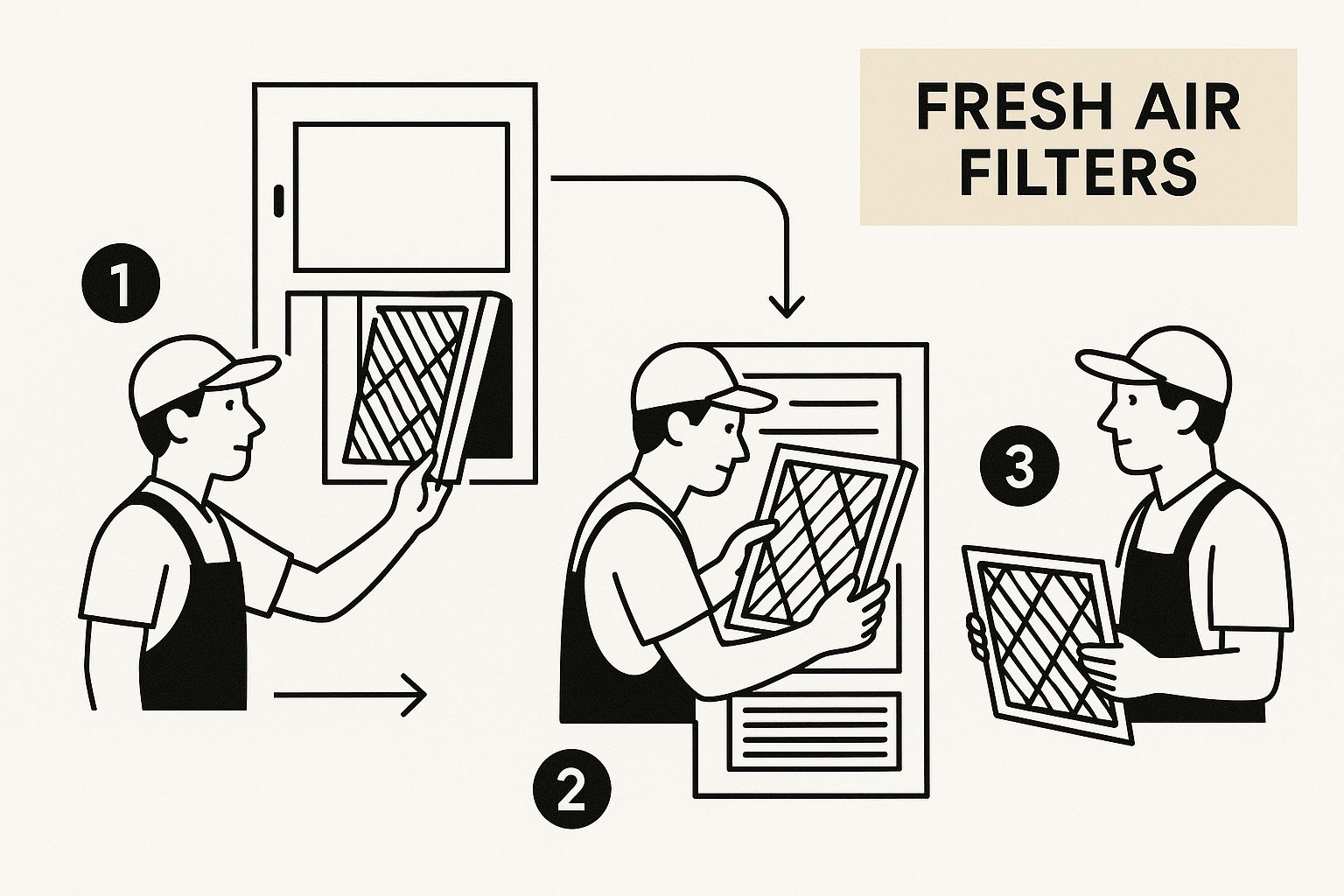
As you can see, a clean filter is step one. It directly impacts how efficiently your furnace can run without being overworked.
Change Your Air Filter
If you only do one thing on this list, make it this one. The single most impactful DIY task you can do is change your air filter. A clogged filter is like trying to breathe with a hand over your mouth; it chokes the system, forcing it to work way harder and driving up your energy bills. That kind of strain can eventually lead to pricey repairs.
Most homeowners should get in the habit of checking their filter every month, especially during fall and winter when the heat is running constantly.
Finding the Right Size: The filter's dimensions are printed right on its cardboard frame. Snap a quick picture with your phone or jot it down so you're never scrambling for the right size at the hardware store.
Understanding MERV Ratings: MERV stands for Minimum Efficiency Reporting Value. A higher number means it can trap smaller particles, but be careful: a rating that's too high can restrict airflow and strain your system. For most homes, a MERV rating between 8 and 11 is the sweet spot, giving you great filtration without hurting your furnace's performance.
Not sure if it’s dirty enough? A good rule of thumb is to hold it up to a light source. If you can’t see light passing through, it’s long overdue for a change. Don't wait until it’s caked in a thick layer of grime.
Clear Debris from Your Outdoor Unit
That big metal box outside, your air conditioner or heat pump, needs some love, too. All through summer and early fall, it accumulates a surprising amount of leaves, grass clippings, and dirt. All that gunk smothers the unit and keeps it from "breathing," which is critical for efficiency, even when you're primarily using the heat.
Take a garden hose and gently spray the unit from the top down to wash away any built-up dirt. For stuck-on leaves or twigs, use a soft broom or just your hands to clear them away from the fins. Just be gentle, as those thin aluminum fins can bend easily.
Check the Condensate Drain Line
Your HVAC system creates condensation as it runs, and that water is supposed to flow away through a small PVC pipe. The problem is, this line can get clogged with algae and sludge, causing water to back up. If that happens, you could be looking at serious water damage inside your home.
Luckily, clearing it is pretty simple. Find the drain line near your indoor furnace or air handler, pop the cap off, and slowly pour about a cup of distilled vinegar down the pipe. This will help dissolve any gunk starting to build up. If you ever see standing water in the drain pan, that’s a red flag for a clog that needs to be dealt with right away. For a deeper dive, this preventative HVAC maintenance checklist offers some more great tips.
Inspect Your Indoor Vents
Last but not least, do a quick walk-through of your house and check all the supply vents. You’d be surprised how often they get accidentally closed or blocked by furniture, area rugs, or drapes. When a vent is blocked, it throws off the system's airflow, which leads to annoying hot and cold spots and forces your furnace to work overtime. This five-minute check ensures your home heats evenly and efficiently.
How to Test Your System Before the First Freeze
The absolute biggest mistake I see homeowners make is just assuming their furnace will work perfectly when that first cold snap hits. Waiting for a freezing night to discover a problem is a surefire recipe for a cold, stressful, and usually expensive emergency call.
A much smarter move? Run a simple test on a mild autumn day. This gives you plenty of time to find and fix any issues that have been hiding all summer. Firing up your system for the first time is a critical diagnostic step; it lets you use your own eyes and ears to spot trouble.
Performing the Initial Test Run
Before you start, head over to your thermostat and switch it to "heat." Now, crank the temperature up a few degrees higher than the current room temperature. This should trigger your furnace to kick on within a minute or two.
This is your moment to play detective. Get close to your indoor unit and just listen.
Normal Sounds: A gentle hum from the motor and the whoosh of air moving through your vents are perfectly fine. You'll probably hear a distinct whoosh as the burners ignite, too. That's normal.
Problem Sounds: Loud banging, high-pitched screeching, or metallic grinding noises are immediate red flags. A screeching sound often points to a worn-out belt or bad motor bearings. A loud bang could signal a serious burner ignition issue. If you hear any of these, turn the system off immediately and call a professional.
One of the most common things homeowners call me about is a faint burning odor during this first test run. In most cases, this is just the smell of dust burning off the heat exchanger and internal parts. It's totally normal and should disappear within an hour.
However, you need to know which smells are okay and which aren't. If the odor is strong, sticks around for more than an hour, or smells distinctly metallic or electrical, shut the system down right away. A metallic smell can mean wires are overheating, which is a serious fire hazard.
Checking Your Thermostat for Accuracy
Your thermostat is the brain of the whole operation. If it's not reading the room temperature correctly, you're either wasting money on heat you don't need or left shivering. A quick accuracy check is one of the easiest parts of your fall tune-up.
Just tape a simple glass thermometer to the wall right next to your thermostat. Walk away for about 15 minutes, then come back and compare the readings. If there's a difference of more than a couple of degrees, your thermostat likely needs to be recalibrated or replaced. A faulty thermostat can make your furnace run nonstop, tacking pointless costs onto your energy bills.
This is where a smart thermostat proves it's more than just a cool gadget. It's a powerful tool for managing your energy use. On average, homeowners can save up to 10-12% on heating costs simply by setting schedules that match their daily lives. This kind of control is a key reason that regular maintenance is in such high demand. In markets with aggressive climate variations, such as North America, energy-efficiency goals drive the need for optimized systems. You can discover more insights about HVAC efficiency goals on grandviewresearch.com.
By taking these few simple steps, you can catch warning signs early and schedule a repair on your own terms, not in a panic. For more tips, check out our guide on the complete air conditioner tune-up checklist, as many of these principles of system care apply all year. Don't wait for a breakdown; be proactive and make sure your home stays warm all winter.
Critical Safety Checks You Cannot Afford to Skip
While we all want our HVAC systems to run efficiently, nothing trumps safety. As you start buttoning up your house for the colder months, these checks are your first line of defense against hidden dangers like carbon monoxide leaks and fire hazards.
Honestly, skipping these steps just isn't worth the risk. A few minutes of your time can buy you peace of mind for the entire winter.
Test Your Smoke and Carbon Monoxide Detectors
This is the big one, a non-negotiable. Carbon monoxide (CO) is a colorless, odorless gas that any fuel-burning appliance, including your furnace, can produce. It’s called the "silent killer" for a reason; you can't see it or smell it, and a working alarm is the only way to know it's there.
Go to each detector and press the "test" button. Hold it down until you hear the alarm. If it works, great: the power and siren are good to go. If not, the batteries are likely dead.
Swap the Batteries: Get into the habit of replacing the batteries in all your smoke and CO detectors at least once a year. Tying it to Daylight Saving Time is a great way to remember.
Check the Expiration Date: These units don't last forever. Most CO detectors have a lifespan of 5-7 years, and smoke detectors last about 10 years. The manufacturing date is usually printed on the back. If it’s past its prime, replace the whole unit.
Inspect the Area Around Your Furnace
Over the year, the furnace room can easily turn into a catch-all for storage. I've seen it all: piles of laundry, old paint cans, you name it. This is a massive fire risk. Your furnace needs room to breathe.
Keep a clearance of at least three feet around your furnace at all times. This zone should be completely clear of anything flammable, like old boxes, cleaning supplies, gasoline, or rags.
This isn't just about being tidy; it's about preventing a stray spark from igniting something combustible. For a deeper dive into system safety, you can learn more about how to maintain your HVAC system in our essential guide.
Ensure Proper Furnace Ventilation
Just like us, your furnace needs to breathe. It pulls in air for combustion and has to vent exhaust gases, like carbon monoxide, safely outside your home. If that ventilation path gets blocked, those dangerous fumes have nowhere to go but back inside.
Take a quick look at the flue pipe (that's the metal vent pipe running from your furnace to the outdoors). Check for any obvious signs of rust, gaps, or loose connections. While you're at it, step outside and make sure the intake and exhaust vents aren't clogged with leaves, snow, or a bird's nest.
A clear pathway is absolutely vital for safe operation and is the final piece of your most important fall hvac maintenance safety checklist.
Knowing When to Call a Professional
While all the DIY checks we’ve covered are fantastic for keeping your system in good shape, they simply can't replace an annual professional tune-up. Let's be honest, some tasks just carry too much risk or demand specialized tools and know-how.
Knowing the line between a weekend project and a job for the pros is the key to keeping your system running safely and efficiently. A professional service call for fall HVAC maintenance goes miles beyond what a homeowner can or should do. Technicians are trained to handle the complex, and frankly, dangerous components inside your furnace.
What a Professional Tune-Up Really Includes
When a certified technician shows up, they aren't just giving your furnace a quick once-over. They're performing a series of incredibly detailed checks that are absolutely essential for both safety and peak performance. It’s a deep dive into the heart of your system.
A proper fall service always includes:
Inspecting the Heat Exchanger: This is, without a doubt, the most critical safety check. A technician is meticulously looking for tiny, hairline cracks or signs of metal fatigue that could leak deadly carbon monoxide into your home. It’s something an untrained eye would almost certainly miss.
Cleaning the Burner Assembly: Over time, burners get caked with residue, which leads to incomplete fuel combustion. A pro will clean the burners to make sure they ignite smoothly and burn cleanly, which directly translates to savings on your fuel bill.
Verifying Gas Pressure and Connections: If the gas pressure is off, it can cause all sorts of problems, from poor efficiency to dangerous ignition issues. A technician uses a special tool called a manometer to test and adjust the pressure to the manufacturer’s exact specifications.
Checking Electrical Components: This involves testing all the electrical connections, capacitors, and motors. They’re hunting for frayed wires or failing parts that could either shut your system down on the coldest night of the year or create a serious fire hazard.
A classic scenario we see is a furnace that makes a loud "bang" when it kicks on. A homeowner might just get used to the noise, but a technician immediately recognizes it as delayed ignition. That's a potentially serious problem that can damage the system if you let it go. This is where that professional expertise is truly priceless.
The Clear Line Between DIY and Professional Work
Some issues are flashing red lights, telling you it’s time to put down the tools and pick up the phone. Trying to tackle these problems yourself can easily lead to more damage, even more expensive repairs, or even voiding your system’s warranty.
For instance, if you're constantly going back and forth on whether to fix a recurring problem or just upgrade the whole system, you need an expert opinion. You can learn more about deciding between HVAC repair or replacement in our detailed guide.
This reliance on professional expertise isn't just a local thing; it's a global trend. India is one of the fastest-growing markets for HVAC maintenance, while North America and Europe are seeing demand surge due to smart building technologies and stricter energy efficiency policies. These trends just confirm what we already know: fall HVAC maintenance is vital for equipment longevity and meeting modern sustainability goals. You can discover more insights about these global HVAC service trends on globenewswire.com.
Ultimately, investing in a professional service call isn't just about performance; it’s about protecting your home and family.
Common Questions About Fall HVAC Maintenance
Even with the best checklist, getting your HVAC system ready for winter always brings up a few practical questions. Over the years, we've heard them all. Here are some of the most common things homeowners ask us as they switch from cooling to heating.
Getting clear answers to these can be the difference between a cozy, trouble-free winter and an unexpected headache.
How Often Should I Really Change My Furnace Filter in the Fall and Winter?
The standard advice for those basic, one-inch filters is to swap them out every month. If you've invested in the thicker, high-quality pleated filters (the ones that are four or five inches deep), you can usually stretch that to about 90 days.
But that's just a baseline. The real-world answer depends entirely on what's going on inside your house.
Got pets? Fur and dander are filter-clogging machines. You’ll want to check it monthly, without fail.
Allergies in the family? Clean air isn't a luxury; it's a necessity. A 30-day schedule is your best bet.
Anyone smoke indoors? Smoke particles are tiny but potent, and they’ll slash a filter's lifespan. Check it often.
A dirty filter is still one of the top reasons we see furnaces strain and eventually fail. Staying on top of this simple task is your best defense.
A great tip for improving indoor air quality beyond just changing filters is to consider your entire home's ecosystem. For those in arid climates, you can find helpful information on improving indoor air quality in Tucson that applies to many different homes.
Is a Professional Tune-Up Truly Necessary Every Single Year?
Yes, absolutely. Both HVAC experts and the manufacturers who build these systems are unified on this. For newer systems, skipping an annual professional service can actually void your warranty, a mistake you don't want to make.
For any furnace that's seen a few winters, it becomes a crucial safety and efficiency check. A trained technician can spot hidden dangers a homeowner would almost certainly miss, like a hairline crack in the heat exchanger that could leak deadly carbon monoxide. They also inspect electrical connections and components that could become a fire hazard over time.
What’s That Burning Smell When I Turn on the Heat for the First Time?
That faint, dusty, burning smell when you fire up the furnace for the first time is almost always normal. It's simply the dust that has settled on the internal heating elements over the summer burning off. The smell should go away completely within an hour or so.
However, some smells are major red flags. If you detect a sharp metallic odor, the smell of melting plastic, or a "rotten egg" scent (the tell-tale sign of a natural gas leak), you have a serious problem. If that happens, turn the system off immediately at the thermostat, leave your home, and call your gas company or an HVAC professional right away.
Should I Cover My Outdoor AC Unit for the Winter?
This is one of the most common points of confusion for homeowners. Wrapping your outdoor AC unit tightly in a waterproof tarp is actually a bad idea. It traps moisture and condensation against the metal, promoting rust and corrosion. It also makes a very inviting winter home for rodents who love to chew through wiring.
A much better strategy is to use a cover that only protects the top of the unit from falling ice, leaves, and other debris while leaving the sides open for air to circulate freely. Honestly, a simple piece of plywood weighed down with a brick does the job perfectly. The goal is to protect it from direct impact, not to seal it away from the elements.
If you want to ensure your heating system is safe, efficient, and ready for winter, trust the experts. Covenant Aire Solutions offers professional fall HVAC maintenance to give you total peace of mind. Schedule your appointment today at covenantairesolutions.com.