
Best Temperature to Set AC for Comfort and Savings
When it comes to the perfect temperature for your AC, the magic number is often 78°F (25.5°C), especially when you're home. Think of this as the sweet spot: it strikes the ideal balance between keeping you comfortable and keeping your energy bills from skyrocketing.
Your Quick Guide to the Ideal AC Temperature
Figuring out the best temperature for your air conditioner is about more than just dodging the heat. It’s a strategic move that directly impacts your wallet. While everyone's comfort level is a bit different, starting with an expert-recommended baseline is always the smartest way to go.
Energy experts point to 78°F as the sweet spot for balancing cooling with efficiency. Cranking the thermostat way down forces your HVAC system into overdrive, which can inflate your energy use by a staggering 20-30% or more. This isn't just theory; it's a reality detailed in reports like this one on global cooling challenges from energy authorities.
Of course, you don’t need to lock your home at 78°F 24/7. The real savings come from making smart adjustments based on your daily routine. Letting the temperature rise a bit when you're sleeping or away from home is where you can really maximize your efficiency. For more great ideas, check out our guide on how to improve AC efficiency and lower your bills.
This simple infographic breaks down the recommended settings for different times of the day.
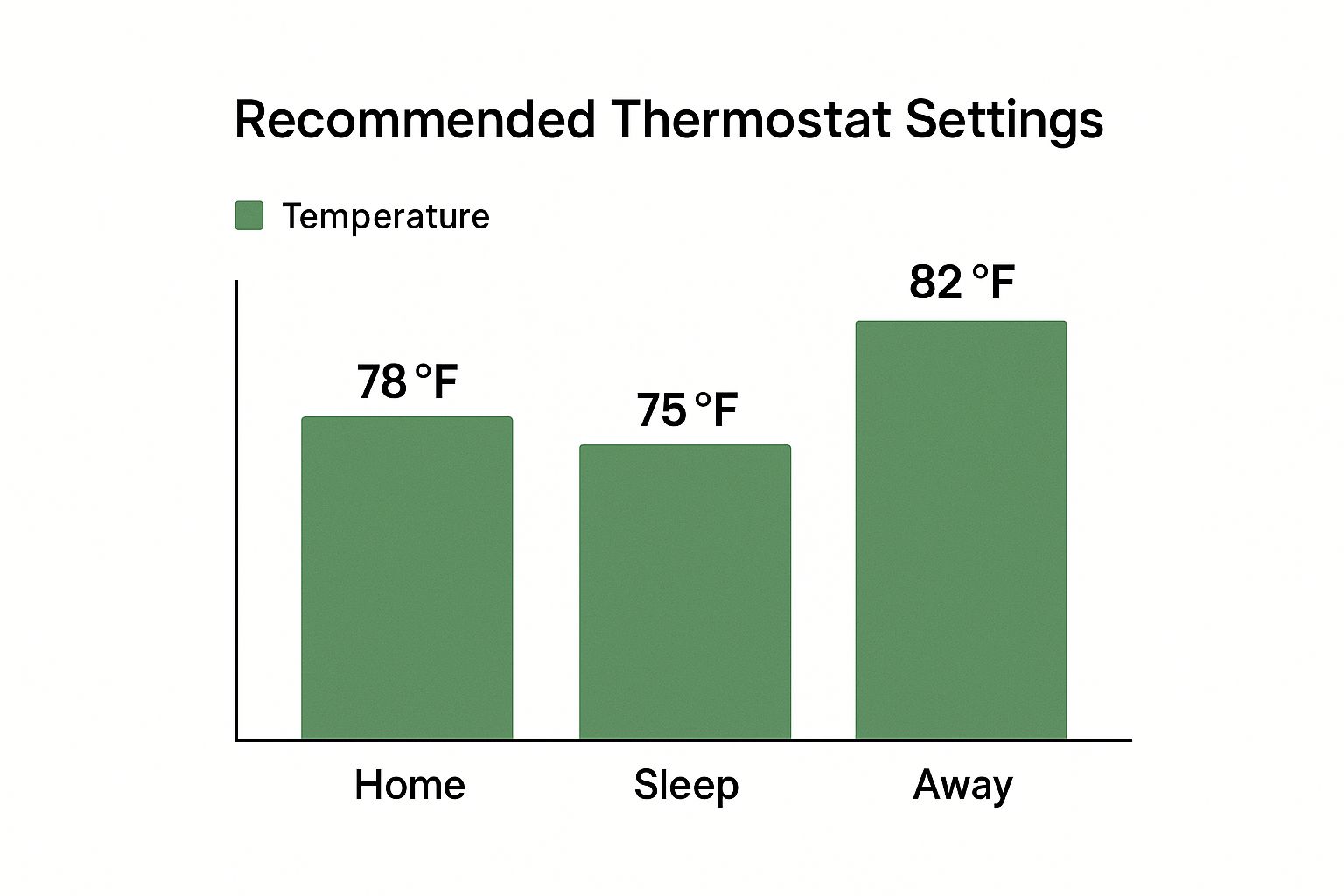
As you can see, the biggest opportunity for energy savings comes from allowing the temperature to rise when no one's home.
Recommended AC Temperature Settings at a Glance
To make it even simpler, here’s a quick reference table summarizing the best thermostat settings for different situations. Use this as a starting point to find what works best for your home and lifestyle.
Situation | Recommended Temperature (Fahrenheit) | Recommended Temperature (Celsius) | Primary Goal |
|---|---|---|---|
When You Are Home | 78°F | 25.5°C | Balance Comfort & Savings |
When You Are Sleeping | 82°F | 28°C | Energy Savings & Health |
When You Are Away | 85-88°F | 29-31°C | Maximum Energy Savings |
With Pets at Home | 80°F | 26.5°C | Pet Safety & Savings |
Sticking to these general guidelines can make a huge difference in your monthly utility costs without forcing you to sweat it out. The key is to be strategic and let your thermostat do the heavy lifting for you.
Why 78 Degrees Is the Magic Number for Your Thermostat
So, what’s so special about 78°F? Why is it the number you hear thrown around as the best temperature for your AC?
Think of your air conditioner like a marathon runner. If you demand it keep your home at a frigid 70°F on a hot day, you're essentially asking that runner to sprint the entire 26.2 miles. It's not just unsustainable; it's going to burn a colossal amount of energy and wear them out fast.
Every single degree you drop the thermostat below 78°F forces your system to work significantly harder. We're not talking about a tiny adjustment, either; it increases energy consumption by about 3-5% for every degree. That added strain shows up on your utility bill and puts extra wear and tear on your equipment.
Balancing Cost and System Health
This "magic number" isn't just a random suggestion; it's the sweet spot recommended by the U.S. Department of Energy. It’s the optimal balance point that keeps your AC unit from constantly cycling on and off, which is one of the most stressful things for its components. A smoother, steadier operation is the secret to a longer lifespan.
Holding the temperature steady at 78°F helps reduce the workload on critical parts like the compressor and fan motors. Less stress means fewer breakdowns and a much lower chance of getting hit with an expensive emergency repair bill. In a way, a higher thermostat setting is a form of preventative maintenance for your HVAC system.
By maintaining a consistent, energy-efficient temperature, you not only reduce your monthly electricity bills but also extend the operational life of your air conditioner, ensuring it performs reliably for years to come.
The Science of Temperature Difference
At its core, an AC unit's efficiency boils down to one simple thing: the difference in temperature between the inside of your home and the great outdoors. This gap is known as the thermal load. The bigger the gap, the harder your system has to fight to pump heat out and keep your indoor air cool.
Let’s put it in real-world terms. Imagine it’s a scorching 95°F day outside:
Setting your thermostat to 78°F creates a 17-degree difference for your AC to overcome.
Setting it to 72°F creates a much larger 23-degree difference, demanding way more work from your system.
This is exactly why even a small tweak can lead to big savings. Once you grasp this principle, it all starts to make sense. You can dig deeper into this by reading about what temperature to set your thermostat for big savings. By choosing 78°F, you’re simply lowering that thermal load, allowing your system to run smarter, not harder, and keeping more money in your pocket.
How Climate Change Reshapes Our Cooling Needs
That little box on your wall, the thermostat, has a much bigger impact than you might realize. It’s a direct link between your personal comfort and a massive global challenge. As our planet warms up, summers are getting hotter and sticking around longer, making us lean more heavily on our air conditioners. This isn't just a feeling; it's a trend we can measure.
To get a handle on this, experts use a simple but powerful metric called cooling degree days (CDD). Just think of it as a daily "heat score." It calculates how much the average outdoor temperature for a day climbs above a comfortable baseline of 65°F (18.3°C).
As global temperatures rise, that heat score goes up. A higher CDD score means we need more AC for longer stretches just to feel comfortable. This skyrocketing demand puts a serious strain on our energy grids and drives up energy use everywhere.
The Growing Need for Efficient Cooling
This isn't some distant, future problem; it's happening right now. Historical data clearly shows a dramatic spike in cooling demand that's tied directly to our warming climate.
For example, one analysis found that since 1970, annual cooling degree days have shot up in 97% of the U.S. locations studied. That’s a crystal-clear sign of our growing dependency on AC. The rising heat score means our air conditioners are being pushed harder than ever. You can even see how cooling demand has changed in your area by exploring these climate trends.
This is exactly why choosing the best temperature to set your AC matters so much. When you set your thermostat to an energy-savvy temperature like 78°F, you aren't just making a smart move for your wallet. You're actively joining a collective effort to slash overall energy demand.
Your thermostat setting is a powerful tool. A small adjustment contributes to lowering greenhouse gas emissions, which is a vital part of adapting to a warmer world and mitigating its future impact.
This single, conscious choice helps ease the immense burden on our electrical grids, especially during brutal peak heatwaves. For you as a homeowner, it translates into real savings and a more sustainable household. To see what else you can do, check out these simple, effective strategies on how to reduce energy consumption in your home. In this changing climate, your choices have never been more important.
Finding Your Personal Comfort Zone Across the Globe
While 78°F is a fantastic universal starting point, the truth is that the best temperature for your AC is deeply personal. Think of it less like a strict rule and more like a flexible guideline. Your perfect cool-down setting is shaped by everything from the climate you live in to how active you are day-to-day.
Personal comfort is subjective, and it can change dramatically depending on where you are in the world. What feels perfectly crisp and cool in a dry climate like Tucson might feel stuffy and damp in a humid city like New Orleans. This is exactly why a one-size-fits-all approach to air conditioning rarely works for everyone.
Global Habits and Local Climates
It's fascinating to see how much AC settings vary across different cultures. A recent study found that Tokyo has the highest average set temperature at 79.2°F (26.2°C), which points to a cultural emphasis on saving energy. On the flip side, residents in Lagos, Nigeria, prefer a much cooler 71.4°F (21.9°C), with folks in New York and Sao Paulo not far behind.
This just goes to show there’s no single right answer, only what feels right for you and your environment.
The goal is to find your unique equilibrium, a setting that balances personal comfort with energy efficiency. Start at 78°F and adjust by a degree or two each day until you discover what feels best.
To truly dial in your personal comfort, you'll want to look beyond just the thermostat. Humidity, for instance, can completely change how a temperature feels on your skin. You can learn more about how to control humidity in your house in our expert guide.
Even your choice of clothing plays a role; understanding how linen keeps you cool and sweat-free can make a huge difference. By experimenting with all these factors, you can fine-tune your environment for that perfect blend of comfort and efficiency.
Smart Adjustments For Day, Night, And When You're Away
Setting your thermostat and forgetting it is one of the biggest missed opportunities for saving money and staying comfortable. Your home’s cooling needs aren't static; they change from morning to night, and when you're home versus when you're out. To really get the most out of your AC, you need to think dynamically.
When you leave the house for work or a long outing, there's no reason to keep it frosty inside. This is the perfect time to let your air conditioner take a break.
By bumping the temperature up to around 85°F, you dramatically lighten your system's workload. It’s a simple tweak that can make a real dent in your cooling costs, and since no one's home to feel the difference, it’s a total win-win.
Optimizing Your Settings For Sleep
Nighttime offers another great chance to fine-tune your settings. As you sleep, your body's core temperature naturally dips. You can work with this biological process by setting your AC a bit cooler than your typical daytime preference, which can help promote deeper, more restorative rest.
Of course, your thermostat isn't the only tool at your disposal. Personal comfort, especially while sleeping, can be boosted by simple choices like your bedding. Materials like bamboo cooling sheets, for instance, are great for helping regulate body temperature for an even better night's sleep.
A smart thermostat can take all the guesswork out of this. It learns your daily and nightly routines and automates these temperature adjustments for you, ensuring you save money without even thinking about it.
Even if you have an older, non-programmable thermostat, making these changes manually is still incredibly effective. If you're thinking about an upgrade, our guide on how to program a thermostat to save money and boost efficiency is a great place to start.
Simple Tips For Maximum Efficiency
Beyond the thermostat itself, a few other small habits can have a surprisingly big impact on your home's temperature and your energy bill.
Use Ceiling Fans: A fan creates a "wind chill" effect that can make a room feel several degrees cooler than it is. This little trick lets you raise the thermostat a few degrees without feeling any less comfortable.
Block The Sun: During the hottest parts of the day, just keep your blinds and curtains closed, especially on south- and west-facing windows. It’s a low-tech but highly effective way to block solar heat from warming up your home in the first place.
Perform Basic Maintenance: A clean air filter is your AC’s best friend. When it's clogged, your system has to work much harder. Regularly checking and changing your filter is one of the easiest and most important things you can do.
Still Have Questions About AC Temperatures?
Even with the best advice, you're bound to have a few lingering questions about where to set your thermostat. Let's clear up some of the common myths and tricky situations so you can feel confident in your cooling decisions.
Here are straightforward answers to the questions we hear most often from homeowners.
A classic debate is whether it's better to turn the AC off completely when you leave or just let it run. It’s actually much more efficient to just turn the thermostat up, somewhere around 85°F to 88°F (29-31°C), instead of shutting it down entirely.
When your system is off, your home soaks up heat and humidity all day. When you get back and turn it on, the AC has to run a long, hard, energy-guzzling cycle to bring the temperature back down. That sudden, intense effort almost always uses more power than simply keeping the house at a stable, warmer temperature while you're out.
Finding The Sweet Spot For Sleep
Getting the temperature right for sleep is another critical piece of the puzzle. While sleep experts often point to a chilly 60-67°F (15.6-19.4°C) as the ideal, running your AC that low all night can get expensive fast.
A much more practical approach is to set your thermostat just a few degrees cooler than your daytime preference, maybe around 72-76°F (22-24°C). This range is cool enough to support your body's natural temperature drop during sleep, which helps you rest better, but it won't send your energy bill through the roof. A ceiling fan can also be a game-changer here, making a warmer room feel much cooler.
High humidity can completely change how warm you feel. Because the moisture in the air slows down how fast sweat evaporates from your skin, the same temperature can feel much hotter and stickier. In humid climates, you might need to nudge the AC a little lower to feel comfortable.
How Humidity and Seasons Change The Game
Speaking of humidity, many modern air conditioners have a "Dry" mode. This setting focuses on pulling moisture out of the air instead of just blasting cold air. It can make a higher temperature feel way more comfortable while using less energy than the standard cooling mode.
Finally, the same logic of setting back the thermostat applies in the winter, just in reverse. For heating, the Department of Energy recommends setting your thermostat to 68°F (20°C) when you're home and awake. Just like in the summer, you can save energy by turning it down when you're asleep or away. For every single degree you lower the thermostat for an eight-hour stretch, you can save about 1% on your heating costs. Those small adjustments really add up all year long.
For expert help finding the perfect balance of comfort and efficiency in your home, trust the certified technicians at Covenant Aire Solutions. Visit our website to schedule a consultation and learn how we can improve your home's climate control today.