
Emergency Air Conditioning Repair Guide for Homeowners
When your air conditioner gives up the ghost during a sweltering heatwave, it’s more than an inconvenience; it feels like a full-blown crisis. But before you hit the panic button and start searching for emergency air conditioning repair, take a deep breath.

From my experience, many sudden AC failures aren't catastrophic breakdowns. Often, they’re caused by simple, overlooked issues you can safely check and fix yourself in just a few minutes.
What to Do When Your AC Suddenly Fails
That moment the cool air cuts out is undeniably stressful, but a calm, methodical approach can save you a lot of time, hassle, and money. Rushing to call a technician without doing a few basic checks might mean paying for a service call you didn't actually need.
Instead, let's walk through the easiest and most common culprits that often masquerade as a major system failure. These steps are completely safe for any homeowner, no need to start taking things apart or messing with complex components. We're just ruling out the simple stuff first.
First-Response Troubleshooting Steps
Believe it or not, the root of the problem is often found at the control center of your entire HVAC system: the thermostat. You'd be surprised how many emergency calls I've seen that were just due to a wrong setting.
Check the Thermostat: Make sure it’s set to "cool" and the target temperature is at least 5 degrees lower than the current room temperature.
Inspect the Circuit Breaker: Head over to your home's electrical panel. Look for a breaker labeled "AC," "Air Handler," or "Condenser." If it's in the middle or "off" position, it has tripped. Flip it firmly to the "off" position, then back "on" one time.
Examine the Air Filter: A severely clogged air filter can choke your system, restricting airflow so much that it shuts down as a safety measure. If the filter looks caked with dirt, it's time for a new one.
These quick checks are your first line of defense, starting with the simplest fixes at the thermostat.
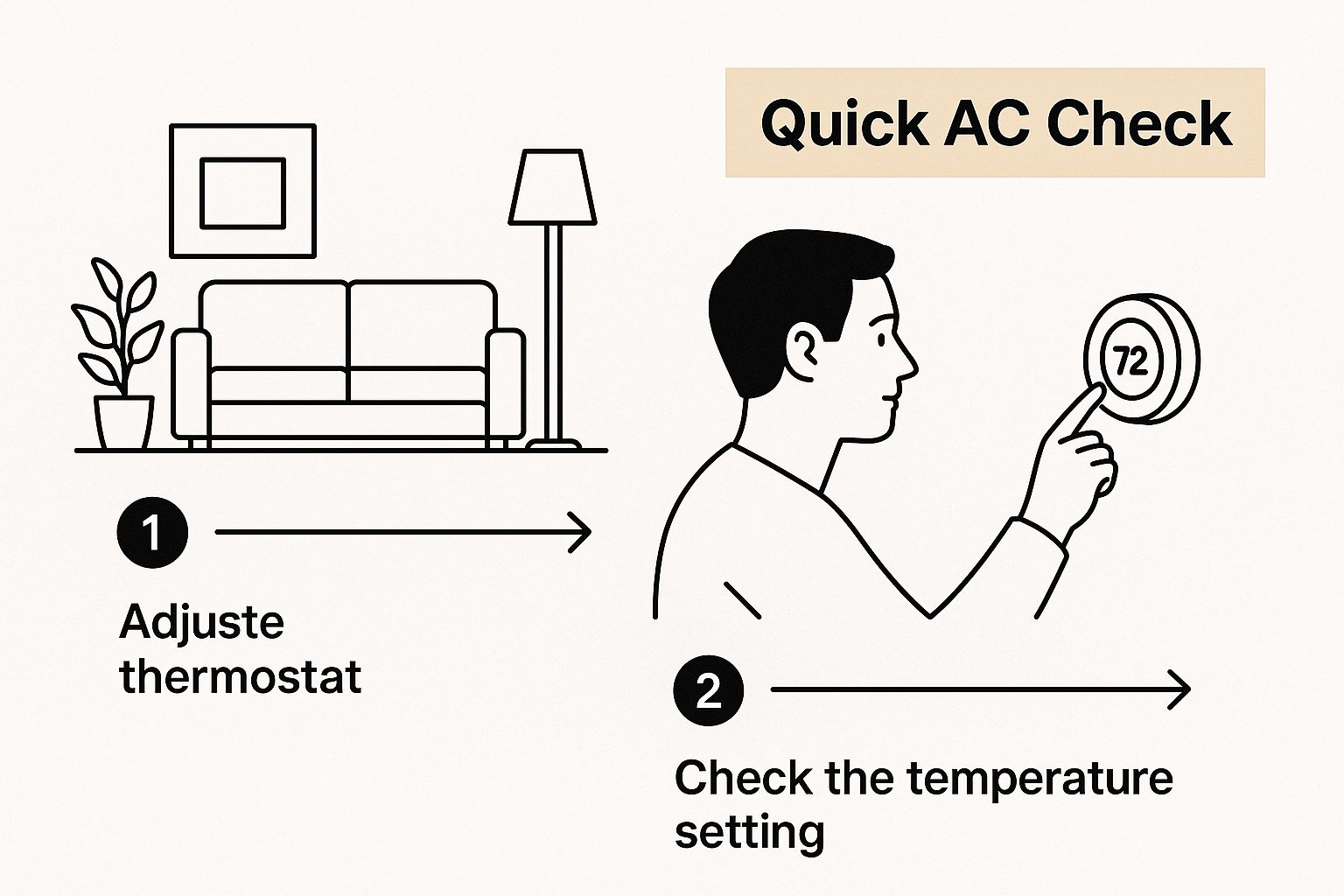
As you can see, initial diagnostics are often straightforward, empowering you to handle minor issues on your own before bringing in a pro.
Before you make that call for emergency service, running through a quick checklist can often solve the problem or, at the very least, give the technician valuable information. Here are the simple, safe checks every homeowner can perform.
Quick Troubleshooting Checklist Before You Call
Check Item | What to Look For | Action to Take |
|---|---|---|
Thermostat Settings | Is it set to "Cool"? Is the temperature set below the current room temp? | Adjust settings to "Cool" and lower the set temperature. Replace batteries if the screen is blank. |
Circuit Breaker | A tripped breaker in the "off" or middle position. | Flip the breaker completely off, then back on once. |
Air Filter | Visible dirt, dust, or debris clogging the filter. | Replace the filter with a new, clean one of the correct size. |
Outdoor Unit | Debris (leaves, grass) blocking the fins; power switch is off. | Clear away any debris. Ensure the nearby power switch is in the "on" position. |
Condensate Drain Line | Water pooling in the drain pan near the indoor unit. | The safety switch may have tripped. This often requires a professional to clear the clog safely. |
Completing this checklist helps you quickly identify if you're dealing with a simple fix or a more complex issue that truly requires professional help.
Beyond the Basics
If those initial steps don't bring your AC back to life, a couple of other common culprits are worth a look. The condensate drain line has a safety switch that will shut the whole system down if it detects a water backup from a clog. Another possibility is that the power switch on the outdoor unit itself got bumped or accidentally turned off.
For a more detailed walkthrough, be sure to check out our guide on quick fixes for an air conditioner that's not working.
Remember, these troubleshooting steps are your first line of defense. They help you quickly determine if you have a simple fix or a genuine need for professional intervention.
Industry forecasts are predicting longer and more intense heatwaves, which will put a massive strain on HVAC systems, especially those over 10 years old. These extreme conditions are expected to drive a significant increase in the demand for emergency services.
Warning Signs That Demand Immediate AC Repair
Not every little hiccup with your air conditioner is a full-blown crisis, but some symptoms are your system’s way of screaming for help. Learning to spot these red flags is the first step in avoiding a catastrophic failure, a shockingly high repair bill, or even a serious safety hazard for your family.
Think of these not as subtle hints, but as loud, blaring alarms. When your AC unit starts making a sound it has never made before, it's time to pay close attention.
Alarming Sounds and Smells
Some noises are unmistakable signs of serious mechanical trouble and mean you need to shut down your AC immediately. If you hear these, don't just hope they go away; continuing to run the unit could cause damage that's beyond repair.
Grinding or Scraping: This is a bad one. It often points to a major issue with the motor's bearings or a broken part inside the compressor. This isn't a DIY fix; it needs a pro right away.
Loud Squealing: That high-pitched squeal could be a failing belt or, more seriously, extreme pressure building up inside the system. Both are urgent problems that can't be ignored.
Beyond the noises, your nose can also be a great detective. If you smell something burning, for example, that’s a huge red flag for an electrical problem, like wiring issues or an overheating motor. In that situation, kill the power to the unit at your circuit breaker and call for emergency air conditioning repair.
A burning smell is one of the most serious warning signs you can get from your AC. Electrical failures are a significant fire risk, so turning off the power and calling a professional is a non-negotiable safety measure.
Other major red flags? Your system is blowing warm air and just won't stop, or you notice a significant water leak. A little condensation is normal, but an active puddle of water can cause serious damage to your home and often signals a major clog or a failed component. If you're seeing water, you can learn more about why your AC is leaking water outside and how to fix it quickly.
Finding a Trustworthy 24/7 Repair Service
When your AC dies on a sweltering night, the temptation to call the first company that pops up on Google is overwhelming. I get it. But a hasty decision in a moment of panic can lead you straight to an unqualified, or worse, dishonest technician, making a bad situation a whole lot worse.
Taking just a few minutes to vet a company, even when you're under pressure, can save you from shoddy work and outright scams. The key is to know what to look for.
A legitimate emergency air conditioning repair service will always be licensed, bonded, and insured. This isn't just paperwork; it protects you from liability if an accident happens on your property and proves the technicians have met the required state competency levels.
What to Ask Before You Hire
Before you let anyone touch your AC unit, get them on the phone and ask a few direct questions. How they answer will tell you everything you need to know.
"Are you licensed and insured?" This is non-negotiable. Don't be afraid to ask for their license number if you want to double-check it.
"What is your after-hours emergency fee?" Transparency here is a huge green flag. A good company will be upfront about any premium rates for night, weekend, or holiday calls.
"Do you have a separate diagnostic fee?" Some companies charge a flat rate just to come out and diagnose the problem. Ask if this fee gets applied to the final repair cost if you move forward with the work.
"What is your estimated arrival time?" A vague answer like "sometime tonight" is a red flag. A professional service should be able to give you a reasonably specific window.
These simple questions help you quickly filter out companies that aren't properly qualified or transparent about their pricing. When you're dealing with an AC emergency, it's so important to know how to go about choosing the right 24-hour service provider.
A trustworthy technician will never pressure you into an immediate, expensive decision. They should diagnose the issue, explain the options clearly, and provide a written estimate before starting any work.
The demand for these after-hours services is massive. In 2023 alone, U.S. consumers spent over $10 billion on HVAC repairs, and emergency calls are a huge slice of that pie, driven by aging equipment and increasingly hot summers.
Finally, trust your gut. If a company seems evasive on the phone or immediately starts using high-pressure sales tactics, just hang up and call someone else. To see how we approach things with honesty and reliability, check out our guide on professional AC repair.
How to Prepare for the Technician's Arrival
You've made the call, and help is on the way. But the time you spend waiting doesn't have to be wasted time. A few simple steps on your end can make a huge difference in how quickly and efficiently the technician can get to work. Honestly, it often means lower labor costs and a faster return to a comfortable home for you.
The most important thing you can do is make sure the technician has clear and safe access to both the indoor and outdoor parts of your AC system. They're often lugging heavy tools and bulky equipment, so a clutter-free path is a big deal for both their safety and their speed.
Create a Clear Workspace
A technician's efficiency is directly tied to how easily they can get to your equipment. Just a few minutes of prep work from you can save them a ton of time on the clock.
Indoor Unit: Take a look around your air handler or furnace. Move any furniture, boxes, or anything else that's stored nearby. You want to aim for at least a three-foot circle of open space around it.
Outdoor Condenser: Head outside and clear the area around the condenser unit. Trim back any overgrown bushes or weeds, and move any garden tools, toys, or other obstacles that might be in the way.
This simple cleanup lets the technician jump right into diagnosing the problem instead of spending your valuable time just trying to make room to work.
Have all the necessary information ready when the technician arrives. This includes the make and model of your AC unit and a detailed list of the symptoms you've observed, like strange noises or specific smells.
Being ready with this kind of information helps them narrow down the problem much, much faster. It turns a generic service call into a focused mission to solve your specific issue, making the whole emergency air conditioning repair process smoother for everyone involved.
What To Expect With Emergency Repair Costs And Procedures
Let's be honest, the thought of an unexpected repair bill can be just as stressful as your AC quitting in the middle of a heatwave. Getting a handle on the costs tied to an emergency air conditioning repair call is the best way to feel in control and avoid any nasty surprises on the final invoice.
Emergency service almost always comes at a premium. Companies have to staff technicians around the clock, which means you should expect higher rates for any service calls outside of normal business hours, especially on nights, weekends, or holidays.

Breaking Down The Bill
A typical emergency invoice is broken down into several key parts. Knowing what each charge represents empowers you to have a clear, informed conversation with your technician and understand exactly where your money is going.
Here’s what you'll likely see:
Service Call Fee: This is the flat charge just for the technician to come to your home. For emergency calls, this often ranges from $150 to $300.
Diagnostic Fee: Some companies roll diagnostics into the service fee, while others list it separately. It covers the time and expertise needed to pinpoint the exact problem.
Labor Costs: This is the technician's hourly rate. You can expect after-hours labor to be 1.5 to 2 times higher than the standard daytime rates.
Parts: This covers the cost of any replacement components needed for the repair, from a simple capacitor to a more expensive fan motor or control board.
Understanding the complexities of emergency repairs is vital for any homeowner. For some perspective on how these situations are handled in other critical home services, you can find information on emergency repair procedures and costs.
Key Takeaway: Always demand a detailed, written estimate before you authorize any work to begin. A reputable technician will diagnose the issue, walk you through the necessary repairs, and provide a clear cost breakdown for your approval.
The final bill can vary wildly depending on what actually failed. To give you a better idea of what to expect, here's a look at some common emergency repair scenarios and their typical costs.
Typical Emergency Repair Cost Breakdown
Repair Type | Common Cause | Estimated Cost Range |
|---|---|---|
Capacitor Replacement | Power surges, overheating, or age-related wear. | $200 - $450 |
Fan Motor Replacement | Worn bearings, electrical failure, or debris buildup. | $450 - $850 |
Refrigerant Leak Repair | Corrosion, vibrations, or physical damage to lines. | $300 - $1,500+ |
Condensate Drain Clog | Algae, mold, and debris buildup causing a blockage. | $150 - $400 |
Of course, these are just estimates. A major failure, like a bad compressor, can be a much bigger expense. For a detailed look at what that kind of serious repair involves, our AC compressor replacement cost guide offers some valuable insights. Knowing the possibilities helps you prepare for even the worst-case scenarios.
Want to Avoid Future Emergencies? Think Proactive Maintenance
Let's be honest, the best way to handle a middle-of-the-night AC emergency is to prevent it from ever happening in the first place. This means shifting your mindset from reactive panic to proactive care. That simple change is the secret to making sure your air conditioner is a source of reliable comfort, not last-minute stress.
The cornerstone of this strategy? Regular, professional tune-ups. Having a certified technician inspect your system once a year is non-negotiable. They can spot worn-out parts before they fail, clean essential components that get gummed up over time, and fine-tune your system for maximum efficiency. This single visit dramatically lowers your risk of a sudden, catastrophic breakdown.
Simple Steps You Can Take Right Now
While a pro's eye is vital, there are a couple of incredibly simple things you can do yourself that make a massive difference.
Change Your Air Filters religiously. This is the single easiest and most impactful task on your list. A clogged filter chokes your system, forcing it to work way harder than it should. This leads directly to overheating and component failure. Make it a habit to check it every month.
Give Your Outdoor Unit Room to Breathe. Your condenser unit is the lungs of your AC system. It needs space. Make sure you have at least two feet of clearance all the way around it. Keep it clear of fallen leaves, grass clippings, and those bushes that seem to grow an inch every day.
For a more detailed game plan, check out our guide on creating your essential HVAC maintenance schedule.
A service plan is one of the smartest investments a homeowner can make. It not only covers your annual tune-ups but often includes priority service and discounts on parts if you ever do need an emergency air conditioning repair.
This proactive approach is even more critical in sectors like healthcare, where dependable climate control is a matter of patient safety. Hospitals rely on robust HVAC systems and immediate emergency response to maintain sterile, precisely controlled environments, all driven by strict regulatory standards. You can learn more about the vital role of AC in hospital settings at archivemarketresearch.com.
Of course. Here is the rewritten section, crafted to sound completely human-written and natural, following all your requirements.
Got Questions About Emergency AC Repair? We've Got Answers.
When your AC dies in the middle of a heatwave, your mind starts racing with questions. It's totally normal. Let's tackle a couple of the most common things homeowners ask when they're in a tight spot and need an emergency air conditioning repair.
So, How Much More Is This Going to Cost Me?
Let's be upfront: you're going to pay a premium for after-hours, immediate service. There's just no way around it. Most companies have a higher initial fee for an emergency call-out, usually somewhere in the $150 to $300 range, which is more than a standard daytime visit.
On top of that, the hourly labor rate for a technician working nights, weekends, or holidays is typically 1.5 to 2 times higher than normal. The final bill obviously depends on what's actually wrong, but the urgency is definitely a factor in the total cost.
Hearing a grinding or squealing noise from your AC? That's your system screaming for help. Shut it down immediately, at the thermostat and the circuit breaker. Pushing it could turn a simple fix into a catastrophic failure, and you'll be looking at a full system replacement instead of a repair.
Can't I Just Add Some Refrigerant Myself?
I get why people ask this, but the answer is a hard no. Adding refrigerant isn't a DIY job, and honestly, it's not a real fix. Your air conditioner is a sealed, closed-loop system. If the refrigerant is low, it means you have a leak somewhere, period.
Only a licensed technician can legally and safely find that leak, repair it, and then recharge the system with the precise amount of refrigerant it needs to run properly.
Don't let a broken AC ruin your day (or night). The certified pros at Covenant Aire Solutions are on call 24/7 to deliver fast, reliable repairs with clear, upfront pricing. If you need help right now, get in touch with us immediately.