
How to Lower Electric Bill in Summer: Tucson Homeowner's Guide
When you live in Tucson, figuring out how to lower your electric bill in the summer really boils down to one thing: getting a handle on your air conditioner. It’s the single biggest energy hog in your home, no question. The trick isn't some magic bullet, but a smart, combined strategy of good thermostat habits, regular AC maintenance, and some basic home efficiency tweaks. If you can get these three things right, you can seriously cut your cooling costs without sweating it out.
Conquering Tucson's Summer Energy Spikes
That feeling when you open a summer electric bill in Tucson? It can be a real gut punch. Once those triple-digit temperatures become the new normal, your air conditioner is suddenly working around the clock. It quickly becomes the main driver behind your monthly utility costs, and for a lot of homeowners, that sky-high bill just feels like the price of admission for living in the desert.
But it doesn't have to be that way.
A painful power bill isn’t inevitable. It’s a problem, and problems have solutions: clear, actionable ones that put you back in control of your budget. Think of this guide as your playbook for a cooler, more affordable summer.
Understanding the Main Culprit
The link between scorching heat and your energy bill is direct and undeniable. In the peak of a Tucson summer, it's not uncommon for air conditioning to make up 50-70% of a household's entire electric bill. That’s especially true when we get those long stretches of 100°F+ days.
The data backs this up. Nationally, energy demand spikes in July and August, and it’s almost entirely because of AC usage. We’ve seen firsthand how something as simple as a professional HVAC tune-up can knock 15-20% off that cooling portion of your bill.
This guide is your roadmap to turning that massive expense into something much more manageable. We'll walk through practical strategies that cover everything from simple daily habits to critical system maintenance.
The goal is simple: show you how to beat the heat without breaking the bank. By implementing even a few of these tips, you can see a noticeable difference in your next utility statement.
A Practical Approach to Savings
Lowering your summer energy costs isn't about toughing it out in the heat; it's about working smarter, not harder. You don’t need to rip out walls or drain your savings on a massive home renovation to see real results. Often, the most effective strategies are the small, consistent adjustments you make every day.
We're going to focus on a few key areas to help you build a solid energy-saving plan:
Strategic Thermostat Management: We’ll show you how to program your thermostat for maximum savings without making your home uncomfortable.
Proactive AC Maintenance: You’ll understand why a well-maintained system is your absolute best defense against high bills.
Simple Home Efficiency Fixes: Discover some easy, low-cost ways to keep the blistering sun from heating up your home in the first place.
By tackling these core areas, you can create a home that’s not just cooler, but far more efficient. For an even deeper look, check out our guide on professional HVAC energy-saving tips for Arizona homes. Consider this your first step toward a much cooler and less expensive summer.
Master Your Thermostat for Immediate Savings
Your thermostat is the command center for your summer energy spending. We've all been there: it's a blazing Tucson afternoon, and the first instinct is to crank the AC way down. But that reactive approach is a quick way to inflate your electric bill. A little strategy goes a long way.
It all starts with finding that sweet spot between comfort and efficiency.
The U.S. Department of Energy gives a solid starting point: set your thermostat to 78°F when you’re home. I know, that might sound a bit warm, but you'd be surprised how comfortable it can be, especially when you pair it with other tricks we'll cover.
Here’s the real kicker: for every single degree you raise the temperature, you can cut your cooling costs by up to 3%. It’s one of the simplest and fastest ways to see a real difference on your next TEP bill.
Create a Smart Cooling Schedule
Here’s where the real savings happen. Why pay to keep your home at a chilly 75°F when nobody is even there? Cooling an empty house is just throwing money away. This is exactly where a programmable or smart thermostat becomes your best friend.
Let's walk through a typical Tucson day. You head out for work around 8 AM and get back at 6 PM. Instead of letting the AC run on full blast all day, you can set a schedule.
When You Leave: Let the temperature climb to 85°F or even a little higher. This "setback" drastically cuts down on how often your AC has to kick on.
Before You Return: Program the thermostat to start cooling things back down to a comfortable 78°F about 30-45 minutes before you walk in the door.
Overnight: Most people can sleep comfortably with the temperature a few degrees warmer, since our body temperature naturally drops while we sleep.
This simple automation means you come home to comfort without paying for it all day. If you want a more detailed guide, we have a whole post on how to program a thermostat to save money and boost efficiency.
Key Insight: Cooling an empty house is one of the biggest sources of wasted energy during a Tucson summer. A simple, automated schedule eliminates this waste and directly lowers your bill.
Maximize Comfort with Ceiling Fans
Think of ceiling fans as your AC's best partner. They don't actually lower the room's temperature, but they create a wind-chill effect that makes you feel several degrees cooler. It's a simple perception trick that has a real impact on your bill.
With a ceiling fan running, you can comfortably set your thermostat about 4°F higher than you normally would and not even notice the difference. That small change can add up to huge savings over a long, hot summer. Just remember to turn them off when you leave the room, as fans cool people, not empty spaces.
Quick tip: Make sure your fan is spinning the right way. For summer, the blades should rotate counter-clockwise to push cool air straight down.
How Thermostat Settings Impact Your Monthly Bill
To really drive the point home, let's look at how these small adjustments translate into actual dollars. This table gives a rough idea of the potential savings for a typical Tucson home just by tweaking the thermostat.
Thermostat Setting When Home | Estimated Cooling Cost Reduction | Potential Monthly Savings |
|---|---|---|
78°F (Recommended) | Baseline | $0 |
79°F | Up to 3% | $5 - $15 |
80°F | Up to 6% | $10 - $30 |
82°F (with ceiling fan) | Up to 12% | $20 - $60 |
Note: Savings are estimates and can vary based on your home's size, insulation, AC efficiency, and local utility rates.
See? Even one degree makes a difference. When you start combining these strategies, such as a higher baseline temperature, smart scheduling for when you're away, and using fans, the savings really start to multiply. This is the foundation for taking control of your summer electric bill.
Why a Neglected AC Costs You Money
Running an unmaintained AC unit through a brutal Tucson summer is a lot like driving a car that’s way overdue for an oil change. Sure, it still runs, but it’s working much harder, burning more fuel, and is always one surprise away from a major, expensive breakdown on the side of the road.
A professional AC tune-up isn't just another household chore to check off the list; it's a strategic investment in efficiency and reliability.
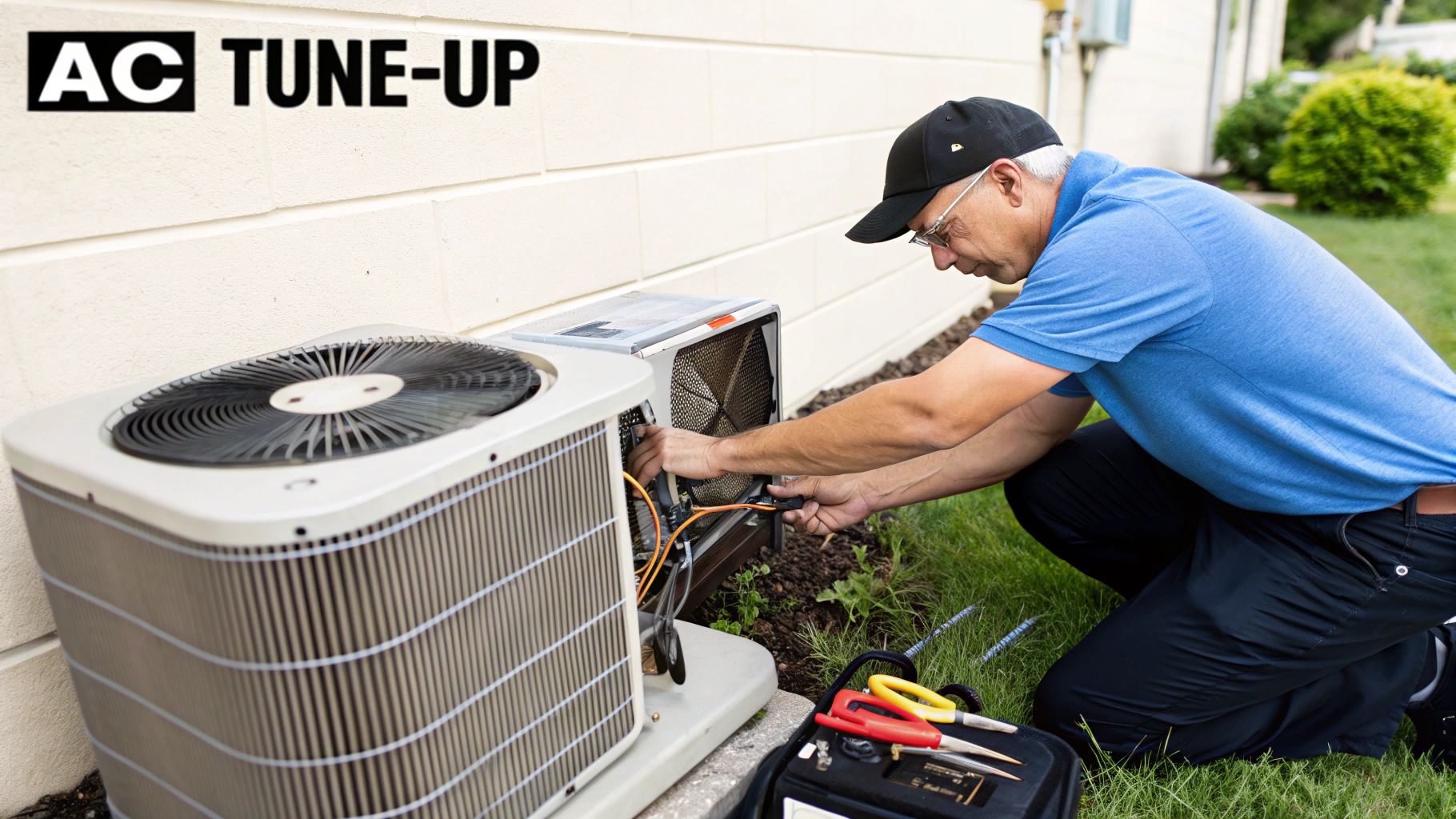
Just think about what your outdoor unit has to put up with. It’s constantly battling desert dust, monsoon moisture, and blowing debris. All that grime builds up on critical components, forcing the entire system to struggle just to keep you cool.
The High Cost of Dirty Coils
Inside your AC, the evaporator and condenser coils are the unsung heroes of heat exchange. When they're clean, they can easily pull heat from your home's air and dump it outside. But when they get caked with a layer of Sonoran Desert dust, they become insulated.
This blanket of dirt basically prevents the coils from doing their job. Your AC has to run longer and harder just to hit the temperature you set on the thermostat. This isn't a small problem, as dirty coils alone can spike your air conditioner's energy consumption by a staggering 30% or more.
That means you could be paying a third more on your cooling bill just because the system needs a good cleaning. During a tune-up, a technician meticulously cleans these coils, bringing your AC back to life so it can cool your home quickly and efficiently.
Refrigerant Levels and Minor Leaks
Another critical part of any tune-up is checking the refrigerant level. Your AC is a closed-loop system, which means it shouldn’t ever lose refrigerant. If the level is low, that’s a dead giveaway you have a leak somewhere in the lines.
Even a tiny leak has a big impact. Low refrigerant means the system can't absorb heat effectively, leading to much longer run times and sky-high energy use. A technician will not only check the levels but also find and seal minor leaks before they turn into major problems that can kill your compressor, the heart of your AC unit.
A properly charged AC unit uses significantly less energy to cool your home. It’s the difference between a system working at peak performance and one that's constantly struggling just to keep up.
Getting your system's refrigerant charge right is one of the fastest ways to boost performance and cut down your monthly bills.
What a Professional Tune-Up Really Involves
A comprehensive tune-up is so much more than a quick filter change. It’s a full system health check designed to catch small issues before they snowball into expensive repairs and to make sure every part is working together for maximum efficiency.
Here’s a glimpse of what a certified technician takes care of:
Inspecting and Cleaning Coils: As we covered, this is absolutely crucial for efficient heat transfer and lower energy use.
Checking Electrical Connections: Technicians tighten all connections and measure the voltage and current on the motors. Faulty electrical parts aren't just inefficient; they're a safety hazard.
Lubricating Moving Parts: Proper lubrication cuts down on friction in motors, which means they draw less power.
Verifying Thermostat Accuracy: They make sure your thermostat is calibrated correctly, so your AC only runs when it’s supposed to.
Inspecting the Condensate Drain: A clogged drain can lead to serious water damage in your home and cause the whole system to shut down.
This proactive maintenance gets your system back to its factory-fresh performance, which translates directly into lower monthly bills and a much longer life for your unit. To see everything involved, take a look at our detailed 2025 air conditioner tune-up checklist. Skipping this simple step is one of the easiest ways to overpay on electricity all summer long.
Fortify Your Home Against the Desert Heat
Your air conditioner can only do so much if your home is actively working against it. When the relentless Tucson sun pours in through windows and radiates through a poorly insulated attic, your AC is fighting a losing battle. The goal here is to create a solid barrier that keeps the heat out and the cool air in. Think of your home’s structure, its insulation, windows, and seals, as your first line of defense.
An inefficient, leaky home forces your AC to run almost constantly. You’re essentially paying to cool the entire neighborhood. By focusing on a few key areas, you can plug those energy drains and stop the waste.
The Hidden Energy Drains in Your Home
So where is all that cool air going? Two of the biggest culprits are hiding right above your head and inside your walls: skimpy insulation and leaky ductwork. These two issues can quietly sabotage your cooling efforts, forcing your AC system to work much harder than it should.
Attic insulation is especially critical in our climate. As the sun beats down on your roof all day, your attic can easily turn into a 150-degree oven. Without enough insulation, that intense heat radiates right down into your living spaces. For a home in the Tucson area, you really want to see an insulation level with an R-value of at least R-38.
Leaky air ducts are another massive energy vampire, especially when they run through a scorching attic or crawlspace. The Department of Energy estimates that leaky ducts can account for up to 30% of your cooling energy loss. Just think about that; nearly a third of the chilled air you’re paying for might be escaping before it ever reaches your rooms.
Start with Simple, High-Impact Fixes
You don't have to tackle a huge renovation project to see a real difference. Many of the most effective solutions are simple, low-cost fixes that block heat at its source: your windows.
Block the Sun: Your windows, especially those facing south and west, act like giant heat magnets in the afternoon. A simple fix like installing blackout curtains or external solar screens can dramatically reduce how much solar heat gets in, keeping your rooms noticeably cooler.
Strategic Shading: Don’t underestimate the power of old-fashioned shade. A well-placed awning over a sunny window can block direct sunlight completely. For a long-term solution, planting a deciduous tree on the west side of your home provides incredible summer shade while still letting that warm winter sun through when you want it.
Beyond just shading, it’s worth looking into how different window treatments perform. You can explore the direct benefits and thermal performance of blackout curtains to see just how much of a difference they can make. Every bit of heat you prevent from entering your home is energy your AC doesn’t have to spend removing.
Tackling air leaks is one of the most cost-effective ways to boost your home's efficiency. Even small gaps around windows, doors, and plumbing penetrations can add up to the equivalent of leaving a window open all summer long.
Finding and Sealing Air Leaks
So, how do you find these phantom drafts? On a windy day, you can often feel them around window frames and under door jambs. For a more thorough approach, a professional energy audit can use tools like blower doors and infrared cameras to pinpoint every last leak with precision.
Once you know where the problems are, sealing them is often a straightforward DIY project. Use caulk for small gaps around stationary frames (like windows and outlet boxes) and weatherstripping for moving parts like doors. This simple task ensures the cool air your AC produces stays where it belongs, inside your home. For a complete walkthrough, check out our detailed guide on how to find and seal air leaks to save money.
By fortifying your home’s envelope, you give your AC a fighting chance, leading directly to a lower electric bill this summer.
Deciding Between an AC Repair and a Full Upgrade
It’s the question every Tucson homeowner with an older AC unit eventually has to ask. Do you shell out for another potentially expensive repair, or is it finally time to bite the bullet and invest in a brand-new system? Staring down a hefty repair quote can feel paralyzing, but stepping back to look at the numbers and long-term value usually makes the path forward a lot clearer.
This isn't just about the money, either. It’s about reliability. The last thing you want is for your AC to die in the middle of a July heatwave, forcing you into an emergency replacement that costs more and gives you fewer options. Being proactive saves you money, stress, and a whole lot of sweat.
The 5,000 Rule: A Simple Guideline
A great rule of thumb we use in the field is the "5,000 rule." It’s a dead-simple calculation that gives you a solid starting point for making the call.
Just multiply the age of your air conditioner by the quoted repair cost. If that number comes out over $5,000, it’s a strong sign that replacing the unit is the smarter financial move.
Let's walk through a real-world scenario. Say your AC is 12 years old, and the technician tells you it needs a new fan motor for $450.
12 years (age) x $450 (repair cost) = $5,400
Since $5,400 is over the $5,000 threshold, the rule suggests that sinking more money into this aging unit is probably a bad investment. You’re getting into that zone of diminishing returns where another costly repair is likely just around the corner next summer. For a deeper dive into this, our guide on whether it's time to replace your HVAC system or repair your AC has more insights.
Long-Term Savings Through Efficiency
Putting aside the cycle of repair bills, a new AC system brings a massive benefit to the table: pure, unadulterated efficiency. An older unit, even one that was top-of-the-line a decade ago, simply can't keep up with modern technology.
Swapping out an old 10-SEER model for a new high-efficiency system with a SEER (Seasonal Energy Efficiency Ratio) rating of 16 or higher can slash your cooling costs by 30-50%. For a typical Tucson home, that's hundreds of dollars in real savings every single summer.
This flowchart breaks down a simple decision tree for home efficiency, from sealing leaks to shading windows.
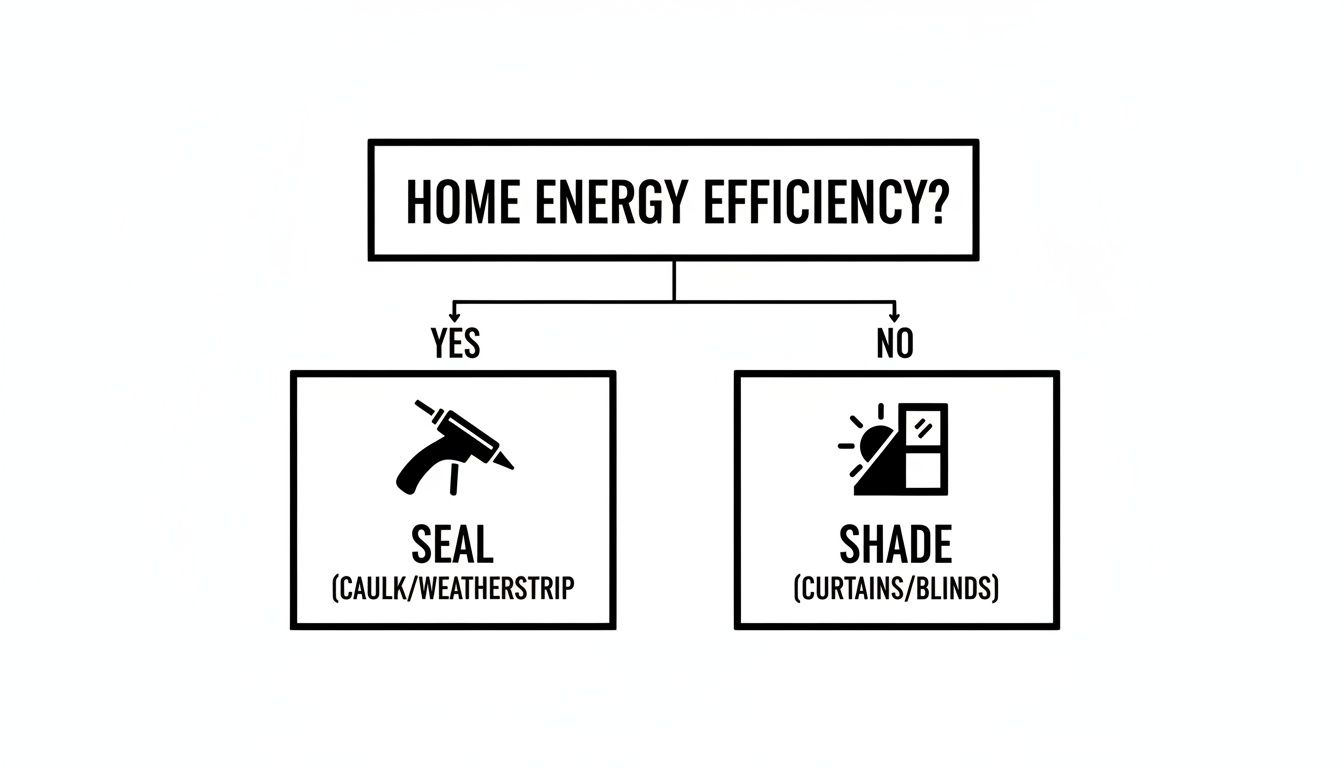
As the graphic shows, sealing up air leaks is always the first move. It’s the foundation of an efficient home, something you should tackle before even thinking about system upgrades.
Making the Upgrade Pay for Itself
The ultimate fix for an old, power-hungry system is upgrading to a modern, high-efficiency unit. These systems can deliver 20-30% savings over older models, with some top-tier units boasting SEER ratings as high as 25. That can easily translate to a $300-$500 reduction in your annual cooling costs.
A professional installation that optimizes your ductwork is also critical. Leaky ducts can waste 20-30% of the cool air your system produces before it ever reaches your rooms.
When you add up the monthly energy savings and the money you aren't spending on surprise repair bills, a new air conditioner starts to pay for itself. It stops being an expense and becomes an investment in lower bills and reliable comfort.
Got Questions About Summer Energy Savings? We've Got Answers
Even with the best game plan, a few questions always seem to pop up when you're trying to wrangle that summer electric bill. Down here in Tucson, most of us run into the same handful of head-scratchers. Let's clear the air and tackle the most common ones.
Think of this as your quick-reference guide for those "what if" moments, reinforcing the best practices for a cool, efficient Tucson summer.
Is It Really Cheaper to Leave My AC on All Day or Just Turn It Off?
This is the big one, and the answer almost always surprises people. It is far cheaper to set your thermostat to a higher temperature, say, 85°F, when you're out than it is to turn the system off completely.
When your AC is off, your entire house soaks up the Tucson heat like a sponge. The drywall, the furniture, the floors, everything. When you get home and flip the switch, your air conditioner has to run at full blast for hours just to pull all that stored thermal energy back out. That massive effort burns way more electricity than simply keeping the house at a stable, albeit warmer, temperature all day.
This is where a programmable or smart thermostat really shines. It handles the adjustments for you, so you don't even have to think about it.
The Takeaway: That old "turn it off to save money" advice is a myth in our climate. It’s more efficient to maintain a higher temp than to force your AC to overcome a house that's been baking for hours.
How Much Can I Actually Save With a New High-Efficiency AC?
We're not talking about marginal savings here; the difference is substantial. When you swap out a 10 or 15-year-old AC unit for a modern system rated at 16 SEER or higher, you can realistically expect to slash your cooling costs by 30% to 50%.
For a typical Tucson home, that can easily add up to hundreds of dollars in savings every single summer. The initial investment starts paying for itself right away through lower TEP bills, fewer emergency repair calls, and a much more comfortable home. A pro can even run the numbers for you, giving you a personalized ROI based on your home's size and your family's habits.
Are There Rebates in Tucson for Upgrading My HVAC?
Yes, absolutely! Local utilities like Tucson Electric Power (TEP) are always looking for ways to reduce the strain on the power grid, so they often offer rebates and financial incentives for homeowners who make energy-efficient upgrades.
These programs typically give you cash back for things like:
Installing a new high-SEER central air conditioner
Switching to a high-efficiency heat pump
Adding a smart thermostat to your system
The details and dollar amounts can change from year to year, so it's always a good idea to check the TEP website or talk to a local HVAC contractor who keeps up with the latest offers. They'll know exactly how to help you get the most money back on your investment.
Besides My AC, What Else Is Driving Up My Summer Bill?
Your air conditioner is definitely the star of the show, but a few other key players are running up the score on your electric bill. The big ones are your refrigerator, clothes dryer, oven, and, if you have one, your pool pump.
The trick is to minimize the extra heat these appliances create inside your house.
Shift your schedule. Run your dishwasher and clothes dryer late at night after the sun goes down. Your AC won't have to fight the heat they produce.
Change how you cook. Firing up the oven can turn your kitchen into a sauna. Lean on the microwave, a slow cooker, or the grill outside during the hottest times of the day.
Check your pool pump timer. Is your pump running longer than it needs to? An oversized pump or an excessive run time is a massive, and often hidden, energy hog.
Inspect your fridge seals. A leaky door gasket makes the compressor work overtime. Try the dollar bill test: if you can easily pull a dollar bill out from between the closed door and the frame, your seal is weak and needs replacing.
Tackling these secondary energy drains can add up, giving your AC and your wallet a much-needed break.
Ready to put these strategies into action and achieve peak home comfort and efficiency? The team at Covenant Aire Solutions is here to help. From professional AC tune-ups to high-efficiency system upgrades, we provide the expert service you need to conquer the Tucson heat and lower your electric bills. Visit us online to schedule your service today!