
How to remove vocs from home: A Practical Guide for Safer Indoor Air
Getting rid of VOCs in your home isn't a one-and-done fix. It’s really a combination of three things: cutting down on the sources you bring in, getting fresh air circulating, and using the right tools to clean the air you have. The goal is simple: let fewer chemicals in and get the ones that are inside out.
The Invisible Risk Inside Your Arizona Home
You know that “new house” or “new car” smell? While a lot of people find it oddly satisfying, it’s often a sign of invisible chemicals called Volatile Organic Compounds, or VOCs. These are gases that leak out of common household items, and they can create a serious indoor air quality problem that most of us don't even realize we're dealing with.
Here in Arizona, our homes are built to be fortresses against the heat. They're sealed up tight to keep our energy bills from skyrocketing in the summer. That’s great for efficiency, but it creates a major downside: it traps airborne pollutants like VOCs right inside with us. With nowhere to go, these compounds build up to levels that can become unhealthy.
Common Sources Hiding in Plain Sight
Finding the source of VOCs is easier than you might think. They're constantly being released from a huge range of everyday products in a process called "off-gassing." Just knowing where they come from is a huge first step in cutting down your family's exposure.
You’ll find them in:
New Furniture and Carpeting: The particleboard, glues, and synthetic fibers in these items are notorious for releasing formaldehyde and other VOCs.
Fresh Paint and Finishes: The solvents in paints, varnishes, and even floor finishes are major culprits, both during and long after they've been applied.
Household Cleaning Products: Think aerosol sprays, disinfectants, and yes, even those plug-in air fresheners. They can all emit a cocktail of chemicals into your air.
Personal Care Items: Things like cosmetics, nail polish remover, and perfumes also contribute to the chemical load inside your home.
This constant, low-level exposure can trigger a whole host of issues, from nagging headaches and dizziness to irritation of the eyes, nose, and throat. For a closer look at just how common these compounds are, you can learn more about understanding VOCs.
The U.S. Environmental Protection Agency (EPA) has found that concentrations of many VOCs are consistently up to ten times higher indoors than outdoors. This really drives home how critical it is to manage the air inside your four walls.
Taking control of your home's air starts by recognizing these hidden risks and then taking action. The air you breathe every day is a cornerstone of a healthy home. To see what a real solution looks like, you can learn about comprehensive indoor air quality systems that make a tangible difference. This guide will walk you through the practical, real-world steps you can take to clear the air and keep your family safe.
Pinpointing and Reducing VOCs Room by Room
Before you can get rid of VOCs, you have to play detective and figure out where they're coming from. The tricky part is that these compounds are masters of disguise, off-gassing from everyday items you probably don't think twice about. Let's do a practical, room-by-room walkthrough to uncover these hidden sources and talk about real-world ways to cut them down.
As you can see, the biggest offenders, such as furniture, paint, and cleaning supplies, are in virtually every home. That's why a systematic audit is the best first step you can take to improve your indoor air quality.
The Kitchen and Laundry Room
Your kitchen can be a real hotspot for VOCs, and it’s not just from the food you cook. Many popular cleaning products, from the spray you use on your counters to heavy-duty oven cleaners, release a cocktail of chemicals every time you use them. It's the same story in the laundry room, where heavily fragranced detergents and dryer sheets are constantly adding to the VOC load.
Cleaners: Ditch the harsh chemical sprays. You can get just as clean with simple stuff like vinegar and water, or look for products that are clearly marked with a "VOC-free" label.
Gas Stoves: When natural gas burns, it can release VOCs like formaldehyde. This is an easy fix: just make sure you flip on your range hood every single time you cook to pull those pollutants outside.
Cabinetry: A lot of cabinets, especially older ones, are made from particleboard or MDF held together with formaldehyde-based resins. If you’re planning a renovation, look for solid wood or products that are certified as low-VOC.
This isn’t a new problem. In fact, homes built between the 1950s and 1990s often have higher concentrations of total VOCs. This is especially true if they have an attached garage where fumes from chemicals and car exhaust can sneak inside. Studies have found that in some homes, levels of certain VOCs like butane were nearly three times higher in rooms without proper ventilation compared to those with it.
Living Room and Bedrooms
We spend most of our downtime in these rooms, so the air quality here is incredibly important. The irony is that they are often filled with things that can off-gas chemicals for months, or even years, after you bring them home.
That new furniture smell? That's often VOCs. Items made from pressed wood are big culprits, as are new carpets. The adhesives used in carpet backing and padding can release a significant amount of chemicals, including styrene and formaldehyde. Even your new TV can off-gas when it heats up.
Pro Tip: When you buy a new couch or a large rug, don't bring it straight into the living room. If you can, unwrap it and let it air out in the garage or on a covered patio for a few days. This "off-gassing period" lets the highest concentration of VOCs dissipate outside your home, not in it.
To help you get a better handle on what to look for, here's a quick reference guide for common household items and what you can swap them out with.
Common VOC Sources and Safer Alternatives
Household Item | Common VOCs Emitted | Safer Alternative |
|---|---|---|
Aerosol Sprays (air fresheners, hairspray) | Benzene, Formaldehyde, Toluene | Essential oil diffusers, pump-spray products, unscented options |
Paints and Finishes | Formaldehyde, Toluene, Benzene | Low-VOC or zero-VOC paints, water-based stains |
Vinyl Flooring | Phthalates, Ethylene Glycol | Hardwood, tile, cork, natural linoleum, low-VOC vinyl |
Pressed Wood Furniture (MDF, particleboard) | Formaldehyde | Solid wood furniture, GREENGUARD certified products |
Scented Candles and Wax Melts | Benzene, Toluene, Formaldehyde | Beeswax or soy candles with natural scents, essential oil diffusers |
Dry-Cleaned Clothing | Perchloroethylene (PERC) | Find a "green" dry cleaner that uses alternative methods, air out clothes before storing |
Mattresses (memory foam) | Formaldehyde, Benzene, Naphthalene | Mattresses made with natural latex, organic cotton, or wool; look for CertiPUR-US® seal |
This table isn't exhaustive, but it's a great starting point for making smarter, healthier choices about the products you bring into your home. Every small swap makes a difference.
The Garage and Storage Areas
Think of your garage as the storage depot for the most potent VOC sources you own. Old cans of paint, solvents, pesticides, and gasoline containers are constantly releasing fumes. And since most garages are attached to the house, it's all too easy for those chemicals to find their way into your living space.
Here’s how to lock down this high-risk area:
Seal Everything Tightly: Double-check that every can of paint, solvent, and chemical is sealed completely. If the lid is damaged, it’s not doing its job.
Dispose of Old Products: We all have that half-used can of something from a project five years ago. It’s time to let it go. Check your local guidelines for hazardous waste disposal and get rid of anything you don’t need.
Improve the Seal: Take a close look at the weatherstripping on the door between your garage and your house. If it’s cracked, worn, or you can see daylight, replace it to create a tight seal that stops fumes from seeping in.
Running through this kind of audit gives you a solid baseline of your home's air quality situation. If you want to get more precise, our guide on using an air quality home test kit has some great advice for getting accurate readings. For a more heavy-duty approach, you can even learn about Choosing an Industrial Indoor Air Quality Monitor to get deeper insights. By systematically finding and replacing these sources, you can make a huge dent in your home's VOC levels before even thinking about filtration or purifiers.
Using Smart Ventilation to Clear the Air
Once you’ve done the detective work to track down and reduce the sources of VOCs in your home, the next move is to get the lingering ones out. Think of your house as a sealed box; if you keep putting contaminants in without an exit strategy, they just build up. This is where smart ventilation comes in.
It's really just the process of diluting and removing all those trapped chemicals by swapping stale, polluted indoor air with fresh outdoor air. Honestly, it's one of the most powerful tools in your arsenal for getting VOCs out of your home for good.
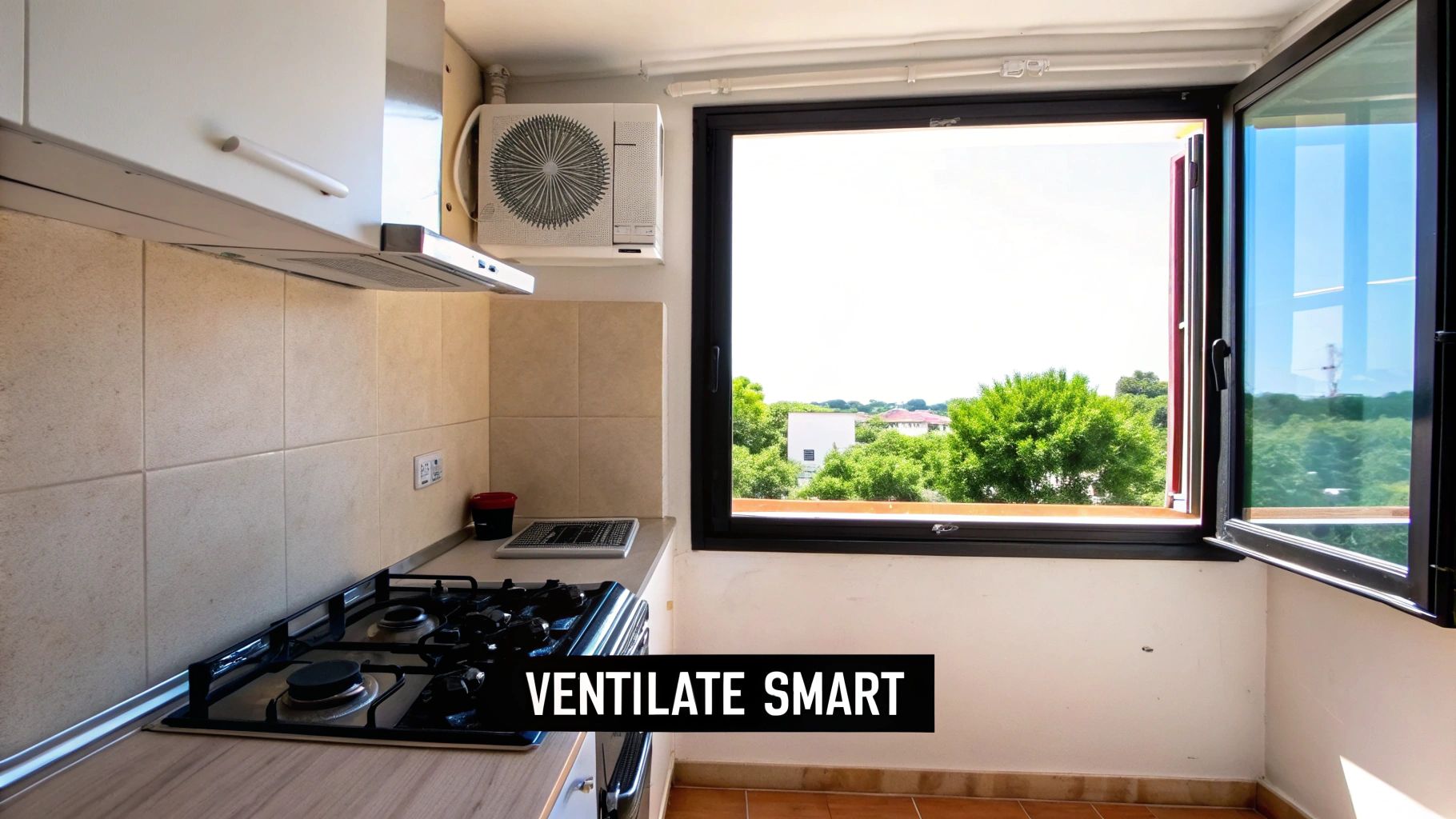
This can be as low-tech as throwing open a window or as advanced as a fully automated system tied into your HVAC. Let’s walk through the three main ways you can start clearing the air.
Natural Ventilation The Arizona Way
The most basic method is also one of the best: opening your windows and doors to create a cross-breeze. This simple act pushes polluted indoor air out and pulls fresh air in, immediately diluting the concentration of any VOCs hanging around. It sounds simple, but timing is everything, especially here in Tucson.
For Arizona homeowners, you have to be strategic to get the benefits without the heat:
Early Mornings: This is your golden hour. Take advantage of that cool desert air before the sun really starts beating down. Even opening windows for 30-60 minutes can make a huge difference.
Cooler Evenings: Once the sun sets, temperatures drop, giving you another prime opportunity to air out the house without sending your cooling bill through the roof.
During Off-Gassing: Just bring home a new mattress or finish a painting project? Keep the windows in that room open as much as you possibly can for the first 48-72 hours. This will flush out the highest concentration of VOCs right at the source.
Spot Ventilation Targeting High-Pollutant Zones
Spot ventilation is all about precision. It uses exhaust fans to capture and remove pollutants right where they originate, stopping them before they ever have a chance to spread through your home. It’s an incredibly effective, targeted approach for rooms known for high emissions.
Your kitchen range hood and bathroom exhaust fans are your two best friends here. Firing up the range hood every single time you cook, especially on a gas stove, pulls VOCs like formaldehyde and benzene right outside. In the same way, running the bathroom fan during and after a shower not only tackles humidity but also vents VOCs from hairspray, cleaners, and other personal care products.
We see a lot of people who think these fans are just for smells or steam. That's a huge mistake. Their real job is source control, which is fundamental to good indoor air quality. Get in the habit of using them every time.
Whole-Home Mechanical Ventilation
Natural and spot ventilation are great, but they're not always running. For a continuous, hands-off solution, a whole-home mechanical ventilation system is the gold standard. These systems are designed to work with your home’s HVAC to guarantee a constant, steady exchange of indoor and outdoor air.
There are a few different types, but they all operate on the same core principle: pull in fresh, filtered air while pushing out stale, polluted air. This creates a balanced pressure environment where VOCs simply can't accumulate to harmful levels.
An Energy Recovery Ventilator (ERV) is a fantastic fit for the Arizona climate. It’s smart enough to transfer heat and moisture between the incoming and outgoing air. This means you get all the benefits of fresh air without making your air conditioner work overtime to cool it down.
These systems are engineered to achieve a specific number of air exchanges per hour, a key metric for effective dilution. If you want to dive deeper into the science behind it, we have a detailed guide on how professionals calculate air changes per hour accurately. A properly installed mechanical ventilation system is what ensures your tightly sealed, energy-efficient home doesn't secretly become a trap for unhealthy air.
Choosing the Right Air Purification Technology
When you've done everything you can with smart ventilation and cutting down on VOC sources, but you're still dealing with stubborn airborne chemicals, it's time to bring in the big guns. I'm talking about technology designed to actively destroy VOCs. This is a really important distinction. The standard filter in your HVAC system is great for dust and pollen, but it’s mostly useless against gaseous pollutants. Those tiny molecules just pass right through typical filter media, leaving your air filled with the very stuff you’re trying to get rid of.
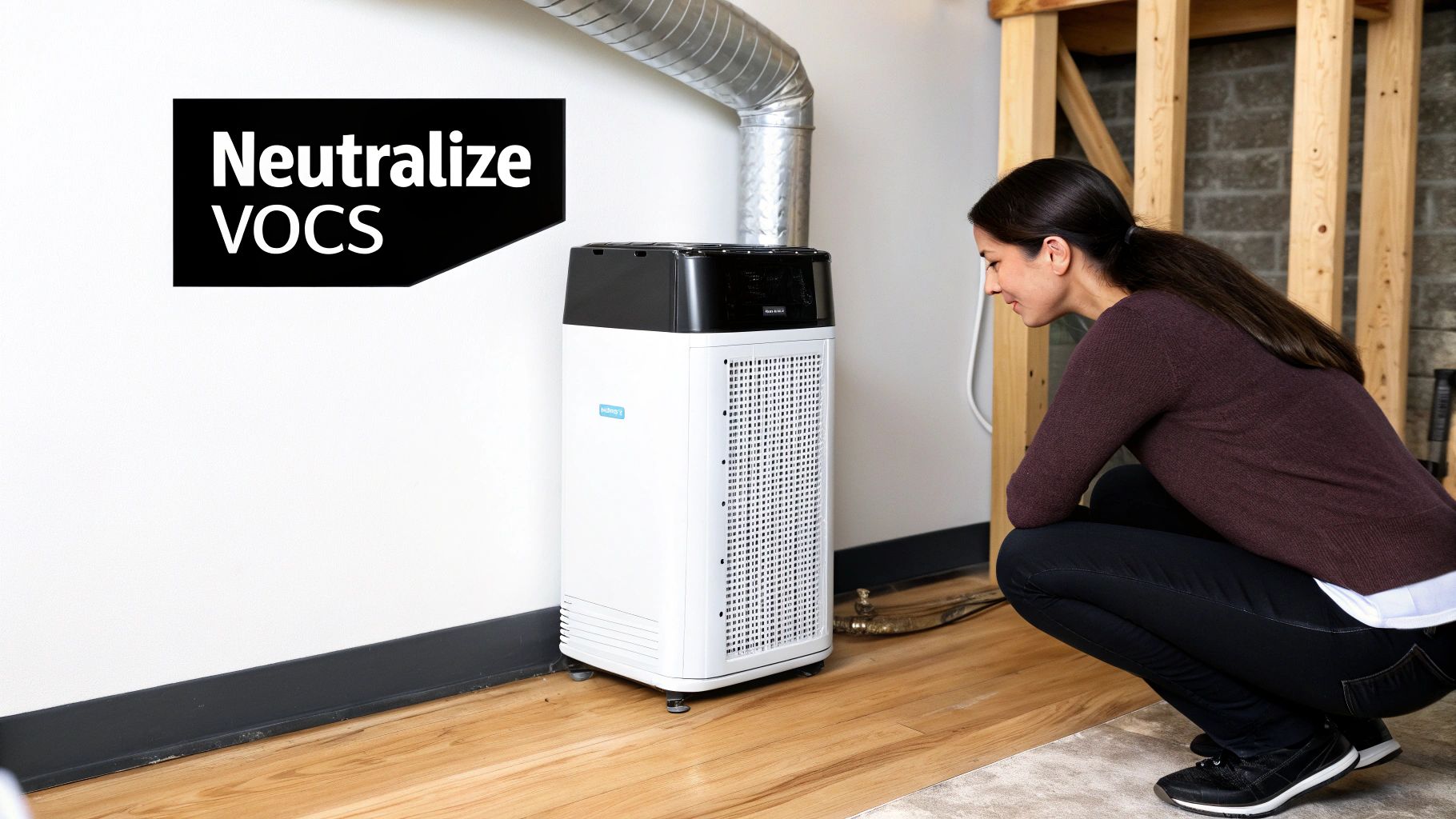
To truly get your air clean, you have to move beyond simple filtration. Advanced air purification technologies are engineered not just to trap particles but to actively neutralize VOCs, bacteria, and viruses. This is how you get a comprehensive, whole-home solution for genuinely superior indoor air quality.
Why Standard Filters Fall Short
Your HVAC system’s main filter has one job: protecting the system’s sensitive mechanical parts from big stuff like dust, pet dander, and lint. Even the high-efficiency filters, like those with a high MERV (Minimum Efficiency Reporting Value) rating, are designed to capture solid particulates, not gases.
Think of it like using a fishing net to catch sugar dissolved in water. The net is perfect for the fish (particles), but the dissolved sugar (VOCs) will flow right through. Volatile Organic Compounds are so small they act more like gases than particles, which means you need a completely different approach to get them out of the air you breathe.
Going Beyond Trapping to Destroying VOCs
To effectively remove VOCs from your home, you need a system that can literally break them down at a molecular level. This is where active purification technologies really shine, offering a powerful method for neutralizing harmful gases instead of just trying to trap them.
One of the most effective technologies we recommend for homeowners is Photocatalytic Oxidation (PCO). It’s an active process that works throughout your entire home, not just in one room.
Photocatalytic Oxidation doesn't just filter the air; it actively sanitizes it. The technology uses a combination of a UV light source and a catalyst, typically titanium dioxide, to create a powerful reaction that breaks down VOCs and other pollutants into harmless molecules like water and carbon dioxide.
This process is incredibly effective against a wide range of contaminants, including:
Volatile Organic Compounds (VOCs) from paint, furniture, and cleaning products.
Mold Spores and Bacteria that can trigger allergies and respiratory issues.
Viruses that circulate through your home’s air.
Unlike passive filters that only clean the air passing directly through them, a PCO system installed in your HVAC ductwork sends out purifying agents to actively seek and destroy pollutants in every single room. This whole-home coverage is what makes it such a game-changer for removing VOCs from your home.
The Science Behind Photocatalytic Oxidation
The PCO process might sound complicated, but its function is pretty straightforward. It essentially turns your HVAC system into a powerful air sanitizer that runs every time your system kicks on.
Here’s a quick breakdown of how it works:
Activation: As air passes through your ductwork, it flows over the PCO unit. Inside, a special UV lamp shines on a surface coated with a titanium dioxide catalyst.
Reaction: This combination of UV light and the catalyst creates highly reactive molecules known as hydroxyl radicals.
Neutralization: These hydroxyl radicals are then distributed throughout your home via your HVAC system's airflow. When they come into contact with VOCs, bacteria, or viruses, they effectively break the pollutant's molecular structure apart, rendering it completely harmless.
The U.S. EPA has found that indoor VOC concentrations are often 2 to 5 times higher than outdoors. Chemicals from our furnishings, paints, and cleaners really build up, especially in newer, energy-efficient homes with less natural air exchange. By actively neutralizing these compounds, PCO systems directly attack this major indoor air quality problem. You can learn more by checking out the EPA's technical overview on volatile organic compounds to grasp the full scope of the issue.
Investing in an advanced system gives you a proactive, continuous solution. You can explore a variety of whole-home air purification systems that integrate this kind of technology. This moves your strategy from simply trapping some pollutants to creating a healthier environment where harmful chemicals are constantly being destroyed.
Knowing When to Call an Air Quality Professional
So, you’ve done everything you can think of. You’ve swapped out high-VOC products, cracked open the windows to improve ventilation, and maybe even invested in a fancy new air purifier. But despite all that effort, there's still a faint chemical smell you can't shake, or your family is still dealing with unexplained headaches and allergy flare-ups.
This is the point where many homeowners get frustrated. It's a clear signal that the problem might be more complex than a DIY approach can solve. Knowing when your best efforts have hit a wall is a crucial part of getting rid of VOCs for good. While simple changes can fix many issues, some situations demand a professional diagnosis to uncover the real root of the problem.
Red Flags That Signal It’s Time for an Expert
Certain scenarios almost always warrant a call to a certified indoor air quality (IAQ) professional. These experts come armed with specialized tools and training to see what you can’t, giving you data-driven answers instead of just educated guesses. Don’t hesitate to reach out if you’re experiencing any of the following:
Persistent Odors You Can’t Trace: If a strange chemical or musty smell just won’t go away no matter how much you clean or ventilate, it could point to a hidden source. Think slow leaks, or even off-gassing from building materials trapped inside your walls.
Ongoing Health Symptoms: This is a big one. When symptoms like headaches, dizziness, fatigue, or respiratory irritation consistently get better when you leave the house and flare up as soon as you come back, your indoor environment is the prime suspect.
After a Major Renovation or Incident: Big events like a kitchen remodel, installing new flooring, or even minor water damage can introduce a massive wave of VOCs into your home. A professional assessment can confirm if the air is safe after the project is complete.
What to Expect During a Professional IAQ Assessment
Hiring an IAQ specialist isn’t about getting a sales pitch for a new system. It’s about finding a partner who can properly diagnose your home’s specific air quality issues. A thorough assessment isn't just a quick look around; it involves several key steps to build a complete picture of your home's health.
The process usually starts with a detailed consultation, where the expert will listen to your concerns, ask about your family’s health symptoms, and learn about any recent changes to your home.
From there, they’ll conduct a deep dive into your HVAC system and ductwork, looking for issues like poor filtration, dirty coils, or leaky ducts that could be spreading pollutants around your home.
Finally, they'll use professional-grade equipment for advanced air sampling. This allows them to test for specific VOCs, mold spores, and other pollutants, giving you concrete data on exactly what’s in your air.
Think this is overkill? Research from over 14,668 indoor air samples across the U.S. shows that VOC levels in modern homes are often 3 to 10 times higher than outdoor levels. Attached garages can contribute up to 40% of a home's total VOCs, and energy-efficient homes without proper ventilation can see 30% higher formaldehyde levels. This data, published in journals like Groundwater Monitoring & Remediation, highlights just how critical professional testing can be.
An expert assessment provides a clear, actionable roadmap. Instead of guessing which product to buy next, you’ll receive recommendations based on scientific evidence, tailored specifically to resolve your home’s unique air quality challenges.
The goal is to move beyond temporary fixes and find a lasting solution. For those of us in Southern Arizona, understanding the specifics of indoor air quality testing in Tucson can offer even more clarity. Ultimately, a professional helps you invest wisely in solutions that will make your home a healthier place to breathe for years to come.
Got Questions About VOCs? We’ve Got Answers.
Even after you've started making changes, you're bound to have questions. Let's be honest, indoor air quality can get complicated, and you want to feel confident you're doing the right thing for your family. Here are some of the most common questions we get from homeowners just like you.
Can House Plants Really Get rid of VOCs?
It’s a great idea in theory, and one that mostly comes from an old NASA study. The research showed plants could scrub VOCs from the air, but there's a catch: it was done in small, sealed chambers. That’s a world away from your open-plan living room.
The reality is, the sheer volume of air in your home, combined with the constant stream of chemicals off-gassing from furniture and finishes, is just too much for a few plants to handle. You'd need to turn your home into a literal jungle to see a measurable difference.
So, think of your snake plant and pothos as beautiful, mood-boosting additions, not your primary air-cleaning crew. For the heavy lifting, you’ll need to rely on powerful tools like mechanical ventilation and dedicated air purification systems.
A few spider plants might not clear the air after you paint, but they sure do make a space feel more alive. Just don't count on them to neutralize the serious stuff.
What's the Difference Between an Air Filter and an Air Purifier?
This is a big one, and the confusion is understandable. At its core, an air filter, like the one in your HVAC system, is a physical barrier. It's built to trap solid particles. We're talking about dust, pollen, pet dander, and lint that could otherwise gum up your heating and cooling equipment.
The problem is, gaseous pollutants like VOCs are made of molecules so tiny they sail right through the fibers of a standard filter.
An air purifier, however, is designed specifically to go after those gases, along with germs and other microscopic threats. Advanced purifiers, particularly those using Photocatalytic Oxidation (PCO), don't just trap pollutants; they trigger a chemical reaction that dismantles VOCs, breaking them down into harmless things like water and carbon dioxide.
Simply put: filters trap particles, while purifiers eliminate gases and microorganisms.
How Can I Tell If My Home Has High VOC Levels?
While a professional air quality test is the only way to know for sure, your own senses are surprisingly good detectors. You just have to know what to look (and smell) for.
That "New" Smell: A strong, chemical odor from new furniture, carpet, or a fresh coat of paint is the most obvious sign. That's the smell of VOCs actively off-gassing into your air.
Listen to Your Body: Are you dealing with nagging headaches, dizziness, or a scratchy throat that seems to get better when you leave the house? Do your allergies or asthma flare up indoors? These physical symptoms can be your body's way of telling you the air is contaminated.
If you notice any of these signs, the best immediate action you can take is to open the windows and get the air moving.
How Long Does It Take for New Stuff to Stop Off-Gassing?
This varies a ton based on the product. The most intense period of off-gassing, when that "new" smell is strongest, usually happens in the first few days to weeks.
But it doesn't just stop there. Many materials will continue to release VOCs at lower levels for months, sometimes even for years. This slow, steady release is exactly why ongoing ventilation and air purification are so critical for maintaining a healthy home long-term.
A great pro tip is to speed up that initial phase somewhere else. If you can, let that new mattress or bookshelf air out in a well-ventilated garage or on a covered porch for a few days before bringing it inside. It can make a huge difference in the initial VOC spike your family is exposed to.
At Covenant Aire Solutions, we believe every family deserves to breathe clean, healthy air. If you're struggling with persistent odors or health symptoms, our team can provide a professional air quality assessment to pinpoint the problem and design a real solution. Visit us at https://www.covenantairesolutions.com to schedule a consultation.