
HVAC Heat Blowing Cold Air How to Fix It Fast
You turn the thermostat up on a cold Tucson morning, hear the system start, and wait for warm air. Instead, the vents push air that feels cool, lukewarm, or no warmer than the room. That symptom can come from a harmless heat pump defrost cycle, a thermostat setting, restricted airflow, a furnace ignition failure, or a control problem.
The fastest way to avoid a wrong diagnosis is to identify what kind of system you have and whether the cold air is intermittent or continuous. A heat pump behaves differently from a gas furnace, and a fan set to run constantly can make a working heater feel broken. The checks below help you separate normal operation from a repair that needs a trained technician.
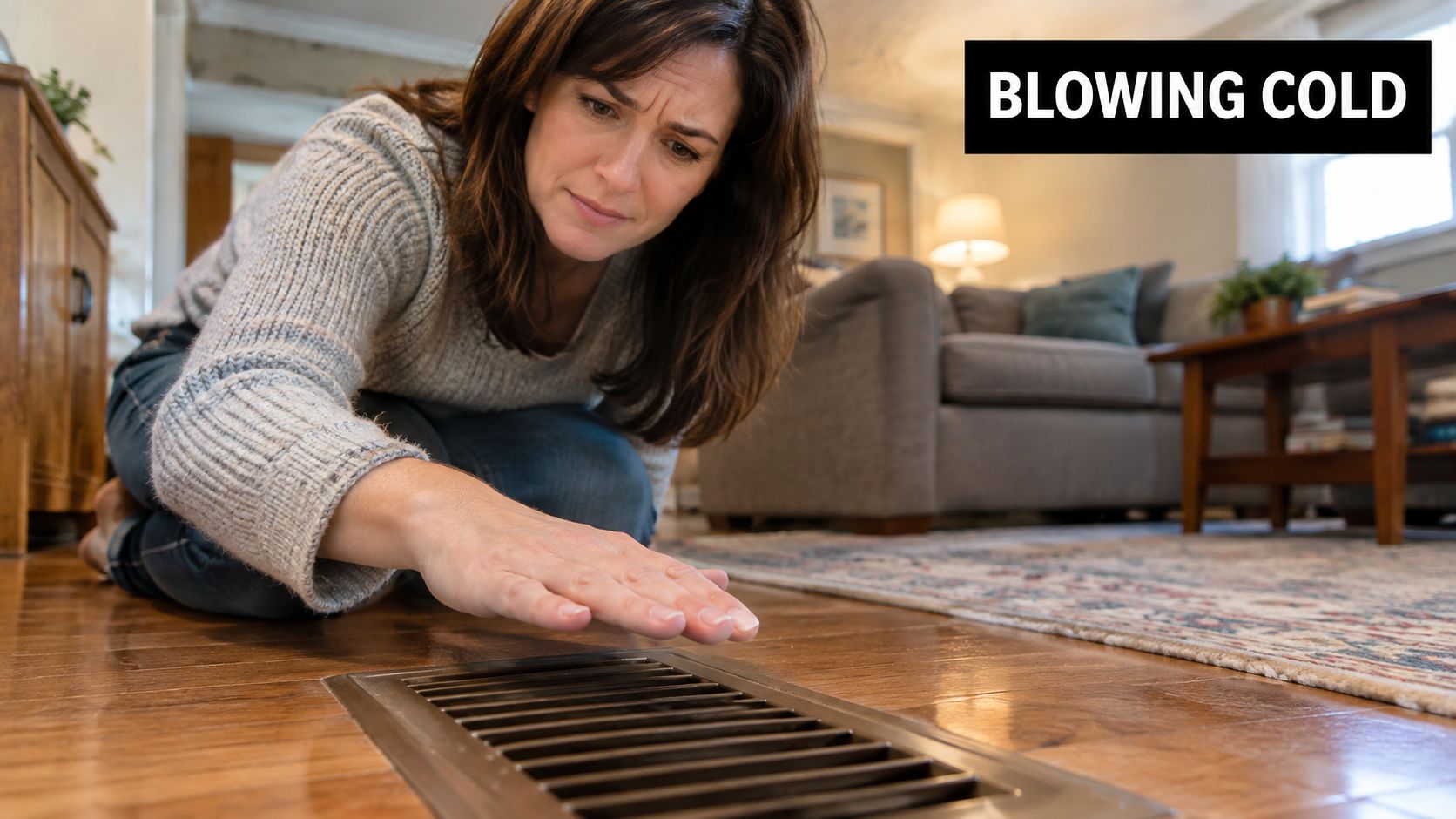
If you're comparing service companies or trying to understand your options before booking a repair, this guide to alternatives to Ezheatandair Com can provide additional context. For now, don't remove panels or adjust gas controls. Start with information you can gather safely: the thermostat mode, fan setting, system type, outdoor temperature, filter condition, and the point at which the air turns cold.
Why Your HVAC Heat Is Blowing Cold Air Right Now
Start with the symptom, not the assumption
A homeowner may describe every no-heat call the same way, but the timing tells us much more. If warm air comes from the vents, turns cool briefly, and then returns without anyone touching the controls, a heat pump may be defrosting. If the blower starts immediately and keeps pushing room-temperature air, the fan may be set to On, the equipment may have failed to complete its heating sequence, or the furnace may be running into an airflow safety limit.
A gas furnace should complete several steps before it delivers sustained heat. The thermostat sends a heat call, the inducer starts, safety controls verify proper venting, the igniter operates, gas is admitted, and the flame sensor confirms combustion. A failure at any stage can leave the blower moving air without producing heat.
Practical rule: Intermittent cool air and continuous cool air are different diagnostic problems.
Before changing settings, stand at a supply register and note how the air feels after the system has had time to operate. Check whether every room has the same complaint. One weak or cool register points more toward a duct or airflow issue, while every register feeling cold points closer to the equipment or controls.
What to record before touching anything
Write down whether the thermostat shows Heat, Emergency Heat, or another mode. Note whether the fan is set to Auto or On, and listen for the outdoor unit if you have a heat pump. A heat pump can run in heating mode even though its outdoor cabinet doesn't look or sound like a furnace.
Also look at the filter and the outdoor unit. A blocked filter can reduce airflow enough to trigger protective controls, while leaves or debris around a heat pump can interfere with operation. Don't treat the word “running” as proof that the system is heating. A blower motor can run when the heat-producing part of the sequence has stopped.
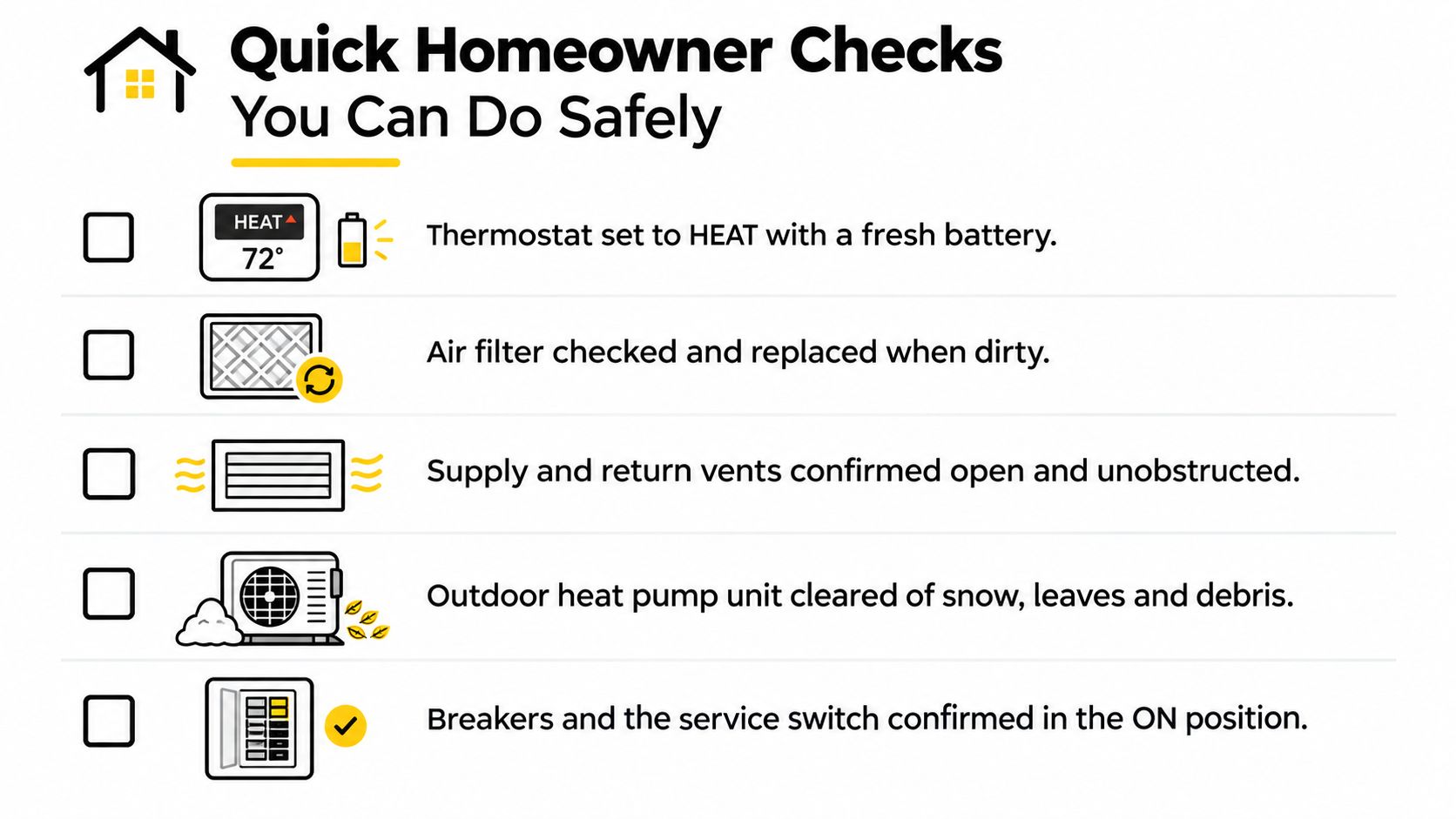
Quick Homeowner Checks You Can Do Safely
Most safe checks happen at the thermostat, filter, registers, and electrical disconnect. You won't need a multimeter, manometer, or screwdriver for these steps, and you shouldn't open gas or high-voltage compartments to investigate a cold-air complaint.
Check the thermostat first
Set the mode to Heat, then set the fan to Auto. Carrier's heat pump troubleshooting guidance explains that a fan left on On can circulate air even when the system isn't actively heating, which makes the supply air feel cold. You can review that guidance on heat pump thermostat troubleshooting.
Raise the setpoint enough to create a clear call for heat, then wait for the system to respond. If the display is blank, replace the thermostat batteries if your model uses them. Don't remove thermostat wires or guess at O/B settings. Heat pump wiring logic varies by equipment and thermostat configuration.
Inspect the filter and airflow path
Turn the system off at the thermostat before removing the filter. If the filter is visibly loaded with dust, replace it with the same size and make sure the airflow arrow points toward the furnace or air handler. A dirty filter can choke airflow, overheat a furnace heat exchanger, or make a heat pump struggle to move the designed volume of air.
Open all supply registers and make sure furniture, rugs, and curtains aren't covering them. Keep return grilles clear too. A return cannot pull enough air through the system when a cabinet, storage box, or heavy dust buildup blocks it.
For practical guidance on choosing and handling replacement filters, see this resource on air filter replacement frequency.
Check power without opening equipment
Look at the home electrical panel for a breaker labeled furnace, air handler, heat pump, or HVAC. A tripped breaker may sit between On and Off, so switch it fully Off before returning it to On only once. If it trips again, leave it off and call for service.
Some systems also have a nearby service switch that resembles a light switch. Confirm it's in the On position if you can identify it confidently. Don't repeatedly reset a breaker, bypass a switch, remove an electrical panel, or touch wiring. Repeated trips indicate an electrical or equipment problem that needs testing.
If these checks restore heat, watch the system long enough to confirm the air stays warm. If the air remains cold, record what you observed and give that information to the technician. It can shorten the diagnostic process.
Heat Pump Cold Air and When It Is Actually Normal
Defrost changes what you feel indoors
A heat pump extracts heat from outdoor air and moves it indoors. In cold, humid weather, frost can build on the outdoor coil, especially when outdoor temperatures sit in the roughly 25°F to 40°F range where moisture is present. When that frost needs to melt, the system briefly reverses refrigerant flow and operates in a cooling-like direction to warm the outdoor coil.
During that period, the indoor supply air can feel cooler. The system isn't necessarily malfunctioning. In cold, humid conditions, defrost cycles commonly occur every 30 to 90 minutes and usually last about 2 to 10 minutes, with many systems ending when the outdoor coil reaches roughly 55°F to 60°F, according to this heat pump defrost explanation.
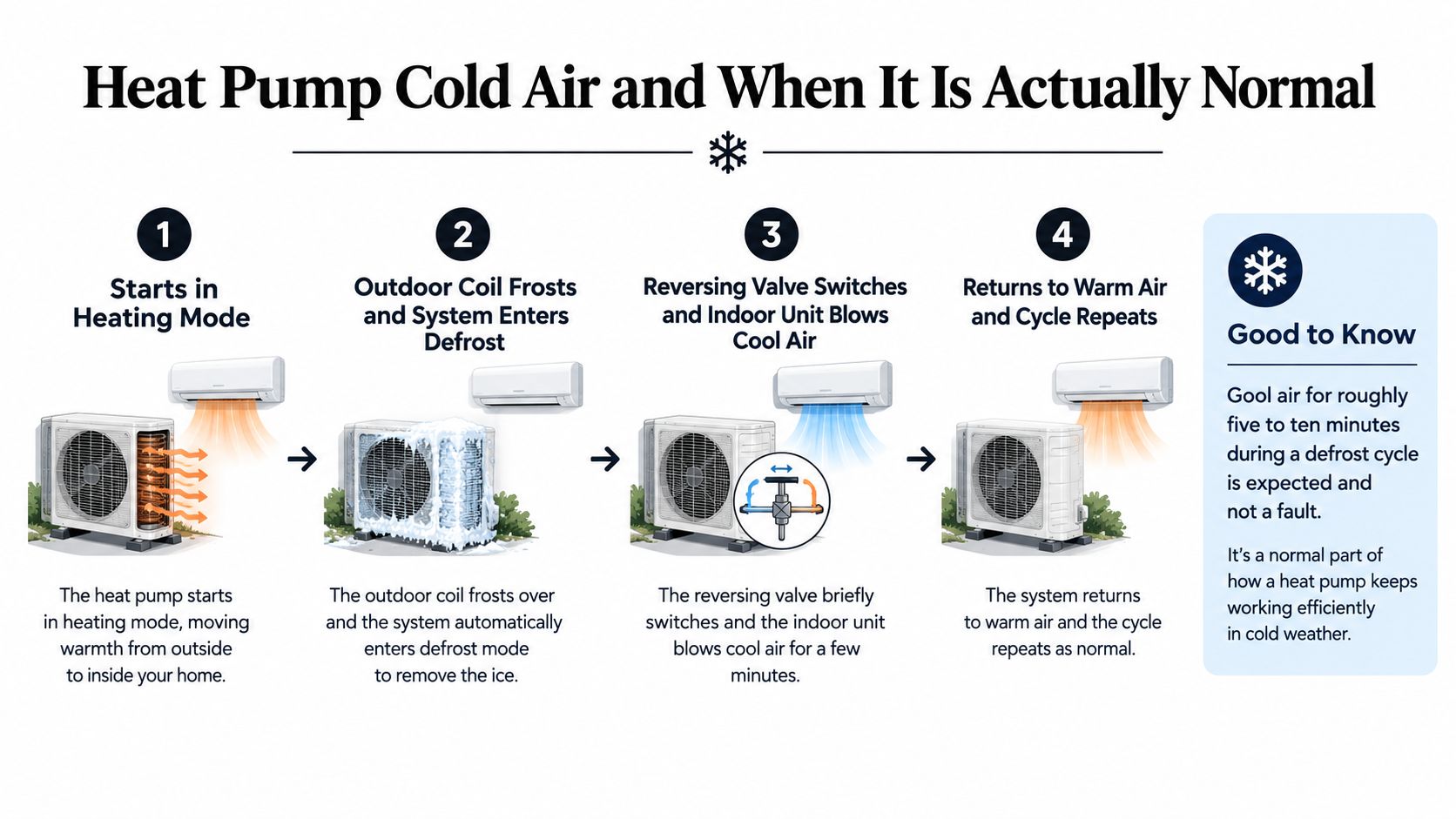
You may notice steam or water around the outdoor unit as the frost melts. The indoor air should return to normal heating afterward. A brief change that follows this pattern is different from a heat pump that supplies cool air continuously.
Use timing to separate normal from faulty
Watch the thermostat and outdoor unit without standing in unsafe weather or touching the cabinet. Ask three questions:
Does the cool air start suddenly? A heat pump entering defrost can change indoor discharge temperature quickly.
Does the outdoor coil show frost or produce steam? That supports a defrost explanation, although only a technician can confirm the controls and refrigerant circuit.
Does warm air return on its own? Recovery after a short interval supports normal operation.
Continuous cool discharge is more concerning. Possible causes include incorrect thermostat configuration, a tripped breaker or disconnect, a clogged filter, low refrigerant, or a reversing valve that isn't shifting correctly. Carrier identifies defrost as a normal temporary cause, while refrigerant and reversing-valve problems require repair. A field analysis reports that reversing-valve failures account for about 15% to 20% of heat pump service calls, making that component worth testing when the symptom is persistent. See this heat pump not heating guidance for the distinction.
A useful technical overview is this explanation of how a heat pump works. For broader heat pump context, including equipment that combines electric heating with domestic hot-water production, this article on a Ring Hot Water Melbourne heat pump is also relevant.
Auxiliary and emergency heat add confusion
Heat pumps may use auxiliary or emergency heat when outdoor conditions make normal heat-pump operation less effective. Emergency heat is a secondary heat source, not a stronger version of the compressor. Depending on the thermostat and control setup, backup heat may be restricted by an outdoor-temperature setting. One published thermostat manual states, “The Auxiliary Heat will not run above this outdoor temperature,” and specifies a hard cutoff at 35°F. That means a homeowner may expect backup heat while the control is intentionally preventing it.
Cold-climate equipment and controls are designed to reduce cold blow, but repeated auxiliary operation still deserves attention when it appears outside the system's expected conditions. The technician should verify thermostat O/B logic, outdoor sensor inputs, supply and return temperatures, and whether the heat pump recovers normally after defrost.
Furnace Reasons for Cold Air and What They Mean
A furnace that blows cold air continuously usually isn't performing its combustion sequence correctly, or it is moving air after a safety control has stopped heat production. The blower itself may be working perfectly. That's why replacing a thermostat without testing the sequence often wastes time.
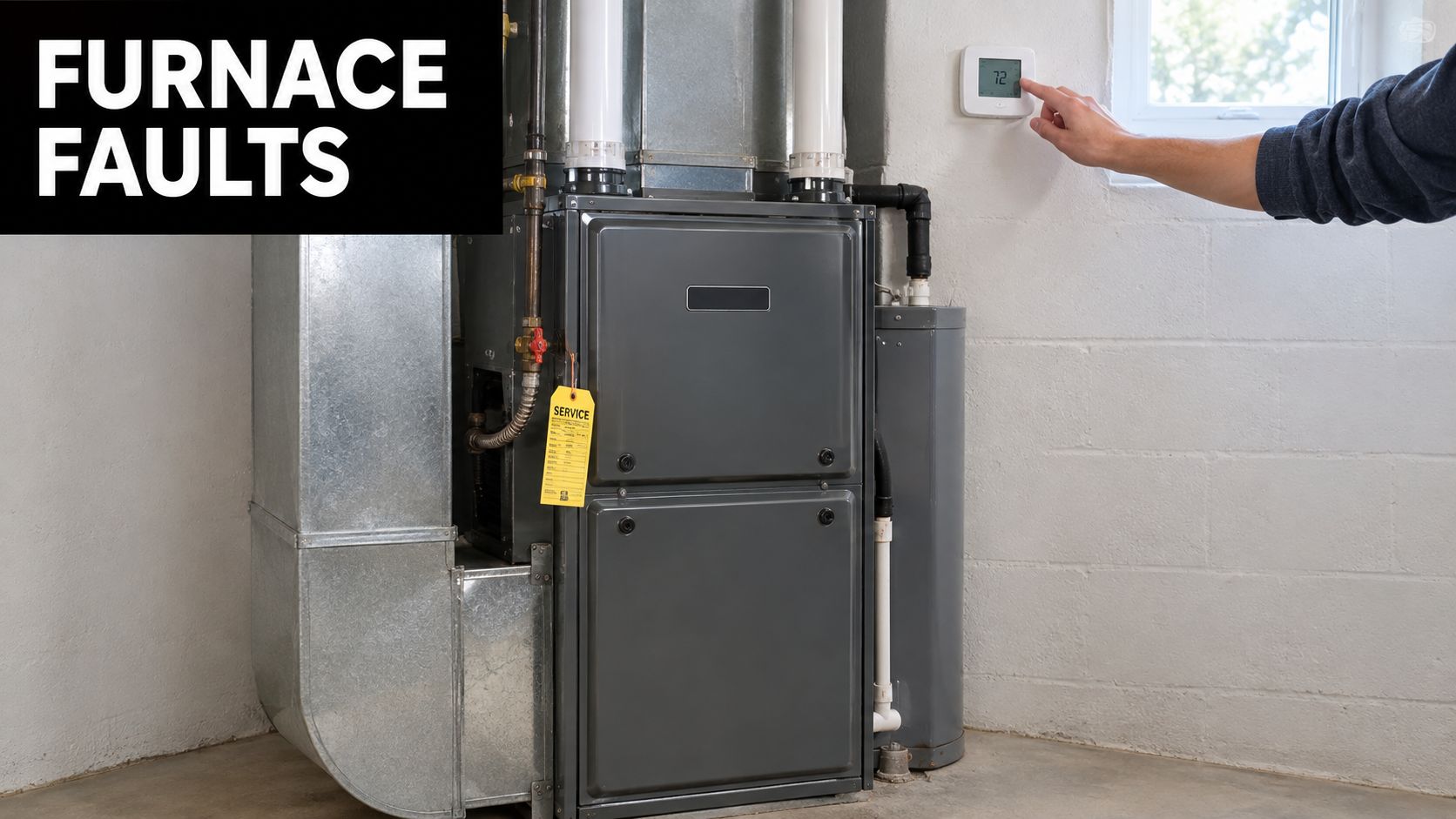
What the furnace must prove before heating
A technician checks the call for heat and then follows the furnace's order of operation. The expected path includes:
24-volt heat call: The control board must receive the thermostat's demand.
Inducer operation: The draft motor starts so the furnace can establish safe venting.
Pressure-switch closure: The switch confirms the required draft.
Igniter behavior: The igniter must heat or spark as designed.
Gas-valve operation: The valve needs correct control voltage and gas pressure.
Flame-sensor stability: The sensor must prove that the burner flame remains established.
Temperature rise and limit behavior: The furnace must stay within its rated operating range.
Independent furnace diagnostic guidance recommends a multimeter for 24-volt control checks, a manometer for pressure-switch and gas-pressure verification, and a thermometer for supply-air temperature rise. Those aren't homeowner guesswork tools. Incorrect readings or unsafe adjustments around gas and combustion equipment can create a greater hazard than the original complaint.
Airflow can stop a healthy burner
A restricted filter, blocked return, closed register, dirty indoor coil, or blower problem can raise furnace temperature. The limit control may shut the burners down while the blower continues moving air. From the vent, that feels exactly like a furnace blowing cold air.
A fan limit switch can create a similar symptom. The switch is designed to keep the blower off until the plenum reaches roughly 120°F to 140°F, then shut the blower off again as the plenum cools, as described in this fan limit switch explanation. If it sticks closed, the blower may run continuously and push unheated air into the ductwork.
Safety boundary: Don't bypass a limit switch, jumper a pressure switch, relight equipment after a safety shutdown, or adjust gas pressure without the proper instruments and training.
If you smell gas, see flame rollout, notice scorch marks, or hear repeated ignition attempts, shut the system off and call for professional help. When combustion concerns involve a heat exchanger, the appropriate diagnostic path includes combustion and safety testing, not a thermostat reset. Information about that repair category is available in this guide to HVAC heat exchanger replacement. Homeowners needing urgent furnace assistance can also review Bender's Oil emergency heating help as another service resource.
Ductwork Airflow and Delivery Problems That Feel Like No Heat
Sometimes the equipment makes heat, but the house doesn't receive it effectively. Leaky, disconnected, poorly supported, or uninsulated ducts can cool the air before it reaches a room. Energy Star-linked guidance commonly notes that 20% to 30% of conditioned air can be lost through leaky ducts, which can make a heating complaint feel like the unit is blowing cold air even when refrigerant operation isn't the issue. See the detailed heat pump frost and duct-loss discussion.
Is It the Equipment or the Ducts
Clue | Points to Equipment Fault | Points to Duct or Airflow Issue |
|---|---|---|
Air temperature | Cold air comes from most or all registers | Air is warmer near the equipment but cooler at distant registers |
Room pattern | The whole home has the same complaint | One room, branch, or level is noticeably worse |
Air volume | The blower runs with little useful heat | Airflow is weak, uneven, or noisy |
Sound | Ignition clicks, repeated retries, or control cycling | Whistling, rattling, or air noise at joints and grilles |
Filter and registers | A clean filter doesn't change the symptom | A dirty filter, blocked return, or closed register affects delivery |
A quick homeowner check is to compare a nearby register with one at the end of a long duct run. Feel for weak airflow, listen for whistling around accessible grilles, and look at exposed duct joints in garages, attics, or utility spaces. Don't crawl into an attic to inspect ductwork if access is unsafe, and don't seal combustion vents or furnace panels with duct tape.
What you can correct, and what needs testing
Opening a closed register, clearing a return grille, and replacing a dirty filter are reasonable homeowner tasks. A disconnected flex duct, crushed run, leaking plenum, or badly balanced system needs a professional inspection. The repair may involve sealing, reconnecting, insulating, or measuring airflow rather than replacing the furnace.
Static pressure helps distinguish a blower problem from a restrictive duct system. This explanation of static pressure in ductwork describes why technicians measure resistance across the air-distribution system. If the supply air is properly heated at the equipment but delivery remains weak, duct diagnosis is more productive than refrigerant work.
When to Call Covenant Aire Solutions and What to Expect
Call for service when cold air continues after the thermostat, fan, filter, register, and power checks are correct. Persistent cool discharge from a heat pump, repeated breaker trips, ignition failure, unusual combustion sounds, or a gas odor all move the problem beyond safe homeowner troubleshooting.
For emergency decision-making, use this guide to what is considered an HVAC emergency. If you smell gas, leave the area and contact the appropriate emergency service. Don't keep resetting equipment that shuts down on a safety control.
Prepare useful details for dispatch
Tell the technician whether you have a gas furnace, electric air handler, or heat pump. Report the thermostat mode, fan setting, filter condition, breaker status, outdoor temperature, and whether the cold air is constant or appears only during a suspected defrost cycle. Mention any error code, unusual noise, water, odor, or visible frost.
A proper visit should follow the equipment's logic rather than jump straight to parts replacement. The technician may verify the 24-volt heat call, inducer operation, pressure-switch response, igniter, gas-valve voltage and pressure, flame sensing, temperature rise, limit behavior, airflow, and heat pump reversing-valve operation. A manometer, multimeter, and thermometer answer different questions, so one tool can't replace the entire diagnostic process.
Covenant Aire Solutions provides heating repairs, heat pump service, furnace work, ductwork evaluation, maintenance, and indoor air quality services for Tucson-area homes and commercial properties. Its service model includes upfront pricing, 24/7 emergency response, and maintenance plans with biannual checkups, priority service, and discounts. Repeated auxiliary-heat operation, recurring defrost complaints, or a system that only works after resets are good reasons to schedule diagnosis rather than wait for a complete failure.
Covenant Aire Solutions can inspect your furnace or heat pump, test the controls and safety sequence, and determine whether the cold air comes from normal defrost logic, airflow loss, or a component failure. Visit Covenant Aire Solutions to request Tucson heating service, emergency support, or a maintenance plan that helps prevent repeat no-heat calls.