
A Guide to Air Conditioning Unit Sizing
Getting the air conditioning unit sizing right is the single most important thing you can do for your home’s comfort and energy efficiency. This is a game of precision, not guesswork. Go too small, and the unit will run itself into the ground without ever cooling your space. Go too big, and you’ll trade the heat for a cold, clammy feeling that’s just as uncomfortable.
Why the Right AC Size Is Non-Negotiable
Shopping for a new air conditioner can feel like a maze of specs and features, but one detail towers above the rest: the system's size. Mess this up, and you’re signing up for a whole host of problems that hit your comfort, your wallet, and the lifespan of your expensive new equipment. It's a classic mistake to think "bigger is better," but in the world of HVAC, that couldn't be more wrong.
Simply put, an improperly sized unit, whether it's too big or too small, is an inefficient one. This inefficiency shows up immediately on your monthly energy bills and cripples the system's performance from day one.
The Pitfalls of an Oversized AC Unit
Let's paint a picture. A Tucson homeowner, tired of the brutal summer heat, invests in a beast of an AC unit, thinking more power is the answer. But instead of relief, their house feels oddly damp and clammy, even though it’s cool. What gives?
The unit is just too powerful. It blasts the space with cold air so fast that it hits the thermostat's target and shuts off before it can do its other critical job: removing humidity.
This constant on-and-off routine is called short cycling, and it’s a system killer. It leads to a few big problems:
Lousy Humidity Control: The system never runs long enough to properly dehumidify the air. This leaves you with that sticky, swamp-cooler feeling even when the thermostat says it's cool inside.
Increased Wear and Tear: Imagine starting your car's engine, driving for 30 seconds, and then shutting it off, over and over again. That’s what short cycling does to your AC's compressor, the heart of the system. This stress leads to more breakdowns and a much shorter lifespan.
Wasted Energy: An air conditioner guzzles the most energy right when it kicks on. With constant short cycling, your unit is always operating in its least efficient mode, which sends your utility costs through the roof.
The Problem with an Undersized System
Now, flip the script and imagine an undersized air conditioner. This unit is the little engine that can’t quite make it up the hill. On a blistering Arizona afternoon, it will run and run and run, desperately trying to reach the temperature you’ve set. It never gets a break, which is just as damaging as short cycling.
This constant operation means you’ll be paying sky-high energy bills for mediocre comfort. The system just doesn't have the muscle to pull enough heat out of your home, leaving you with lukewarm rooms and uneven temperatures. And just like its oversized cousin, the constant strain will cause the unit to fail years before it should.
An air conditioner's size, measured in BTUs or tons, has to be perfectly matched to your home's unique heat load. A correct match gives you long, efficient run cycles that deliver consistent cooling and pull humidity out of the air, the real key to comfort.
In the end, both mistakes lead to the same place: wasted money, a frustratingly uncomfortable home, and an early trip to replace a system that was never right to begin with. Proper air conditioning unit sizing isn't just a technicality; it's the bedrock of a reliable and efficient cooling system. Beyond your home, proper AC sizing is also a critical component of overall commercial building energy efficiency and keeping operating costs down.
And speaking of efficiency, you can learn more about how it’s measured and how a SEER rating impacts your energy bills in our detailed guide.
Decoding Your Home's Heat Load
When a professional HVAC technician shows up at your door, they aren't just there to measure your home's square footage. The good ones are performing a detailed heat load calculation, the industry calls it a Manual J calculation, to figure out exactly how much AC power you really need.
Think of it like this: your home is a bucket, and the blistering Arizona heat is the water constantly trying to fill it up. The heat load calculation measures every single "leak" and heat source that adds to that load. It tells us exactly how big of a "pump" (your AC unit) is needed to keep the bucket from overflowing on the hottest day of the year.
What Goes Into a Real Heat Load Calculation?
A proper calculation is way more involved than those free online calculators. It's a full-blown inventory of your home's unique thermal personality, where every little detail can change the final number. Miss one of these, and the whole recommendation is off.
Some of the key elements we look at are:
Total Square Footage: This is just the starting point. It gives us a basic idea of the air volume we need to cool, but it's only one piece of a much larger puzzle.
Window Efficiency and Orientation: Windows are massive gateways for heat. We have to note their size, type (single-pane is a heat magnet compared to double-pane), and which direction they face. That big, beautiful west-facing window in your Tucson living room adds a ton more heat than a small, north-facing one.
Insulation R-Value: How well is your attic and wall insulation doing its job? A home with good insulation holds onto that precious cool air so much better, which means your AC unit doesn't have to work nearly as hard.
Air Leakage: Every home has tiny gaps around doors, windows, and pipes that let hot air sneak in. A pro will assess the overall "tightness" of your home's construction. If you're curious about this, you can learn more by checking out our guide on how to find air leaks to save money by sealing your home.
It's Not Just About the House Itself
The analysis doesn't stop at your four walls. We also have to account for all the heat being generated inside your home and the unique climate outside of it.
The local climate is a huge one. A 2,000-square-foot house in mild San Diego will have a completely different heat load than the exact same house baking under the Tucson sun. This is where having local, on-the-ground expertise is non-negotiable for getting the right size AC.
Other factors that might surprise you include:
Occupancy: Every person in your home is like a tiny space heater, generating body heat that adds to the cooling demand.
Appliances and Lighting: Your oven, dishwasher, computers, and even your light bulbs all kick off heat when they're running.
Landscaping and Shade: Those big, beautiful mesquite trees shading your home aren't just for looks. They can dramatically reduce how much solar heat gets in.
Speaking of solar heat, don't forget your windows and screens. Especially in a sun-drenched climate, understanding how updated screens can reduce your home's heat load is a critical piece of the puzzle.
A heat load calculation isn't a suggestion; it's the definitive roadmap for choosing the right air conditioner. It takes all the guesswork out of the equation and replaces it with hard data, ensuring your investment keeps you comfortable and efficient for years.
This detailed approach is quickly becoming the standard across the industry. The global air conditioning market was estimated at USD 98.74 billion in 2024 and is only expected to grow. A huge part of that growth is driven by homeowners demanding more energy-efficient solutions, which all starts with precise sizing methods like the Manual J.
The bottom line? Now you know why a contractor who just asks for your square footage over the phone is cutting corners. A true professional takes the time to get to know your home's unique thermal signature before they recommend a single piece of equipment.
A Practical Guide to Estimating Your Needs
While a professional Manual J calculation is the gold standard for air conditioning unit sizing, having a solid understanding of the estimation process is incredibly empowering. It helps you ask the right questions, spot an overly simplified quote from a contractor, and just appreciate the nuance that goes into getting it right.
This guide will walk you through a practical estimation, using a hypothetical Tucson home to make the numbers feel real. Let's move beyond those generic square footage charts. While they offer a starting point, they're far too simple for a climate like Arizona's, where the sun's heat is a massive factor. A true estimate involves layering critical adjustments on top of that baseline figure.
Establishing Your Baseline Capacity
First, let's get a rough idea of the cooling power needed based purely on the size of the space. The universal measurement for an air conditioner's cooling capacity is the British Thermal Unit (BTU). Think of one BTU as the energy needed to raise one pound of water's temperature by one degree Fahrenheit.
A common rule of thumb suggests you need about 20-25 BTUs per square foot. Let’s use our model home: a 1,800 sq. ft. house in Tucson.
1,800 sq. ft. x 25 BTU/sq. ft. = 45,000 BTU
This initial calculation gives us a baseline of 45,000 BTUs. In HVAC terms, this is a 3.75-ton system, since one ton of cooling equals 12,000 BTUs. Now, the real work begins as we adjust this number based on our Tucson home's unique profile.
Baseline Cooling Capacity by Square Footage
This table offers a starting point for estimating AC capacity. Remember, these numbers must be adjusted for climate, insulation, windows, and other home-specific factors.
Area to be Cooled (Square Feet) | Recommended Capacity (BTUs per Hour) |
|---|---|
1,000 to 1,200 | 21,000 |
1,200 to 1,400 | 23,000 |
1,400 to 1,500 | 24,000 |
1,500 to 2,000 | 30,000 |
2,000 to 2,500 | 34,000 |
2,500 to 3,000 | 42,000 |
Think of these as the absolute minimums before we start accounting for the reality of your specific home.
Adjusting for Real-World Factors
This is where a simple chart fails and a thoughtful assessment makes all the difference. Heat doesn't just come from the ambient air; it floods in through windows, radiates down from the ceiling, and is generated by the people and appliances inside.
Let's make some adjustments for our 1,800 sq. ft. example home:
Sun Exposure: Our model home has a large, west-facing picture window in the living room. Here in Tucson, that's a major source of heat gain, especially during those brutal afternoons. We need to increase our capacity estimate by 10-15%. We'll add about 4,500 BTUs.
Insulation Quality: Let's say the attic insulation is older and has settled, so it's not performing well. Poor insulation means the cool air escapes and hot attic air radiates down into your living space. This requires another increase, maybe 10%, which adds another 4,500 BTUs.
Occupancy: The family of four living in the home also generates body heat. A standard adjustment is to add 400 BTUs per person. For this family, that's an extra 1,600 BTUs.
After these adjustments, our initial estimate has changed dramatically. Let's see where we stand now.
Original Estimate: 45,000 BTUSun Exposure Adjustment: +4,500 BTUPoor Insulation Adjustment: +4,500 BTUOccupancy Adjustment: +1,600 BTUNew Estimated Total: 55,600 BTU
This new total is much closer to a 4.5-ton or 5-ton unit, a huge jump from our initial 3.75-ton baseline. This perfectly illustrates why a one-size-fits-all chart can lead you seriously astray. For a deeper dive into the math, our expert guide on how to calculate BTU per square foot for air conditioning provides even more detail.
This visualization sums it up nicely, showing how heat load is about more than just square footage.
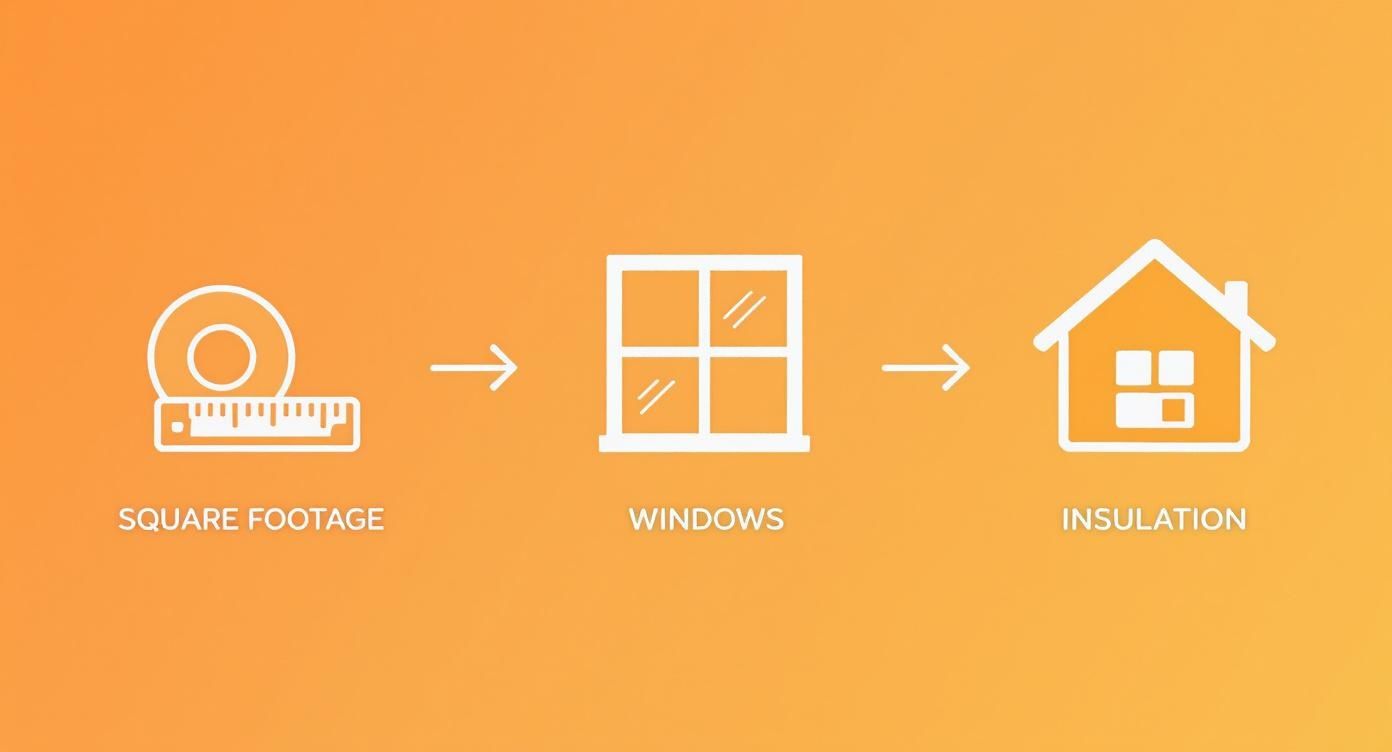
As the graphic shows, proper sizing is a multi-step process. You have to look at your home's structure and environment, not just its basic dimensions.
Other Important Considerations
And the factors don't stop there. Several other elements can nudge your required BTUs up or down. A professional technician will account for all of these during an on-site visit.
Kitchen AppliancesIf you cook frequently, the heat from your oven and stovetop adds a considerable load to the system. It's common to add around 4,000 BTUs to your estimate to account for a kitchen that sees regular use.
Ceiling HeightMost baseline calculations assume a standard eight-foot ceiling. But if your home features vaulted ceilings or an open-concept design, you have a much larger volume of air to cool. You’ll need to increase your BTU estimate to compensate. A home with 10-foot ceilings, for example, might need a 20% increase in capacity compared to one with 8-foot ceilings.
By understanding these variables, you can have a much more productive conversation with an HVAC contractor. You’ll be equipped to ask why they recommend a certain size and ensure they’ve considered your home’s unique profile, not just a generic chart.
Common Sizing Mistakes Homeowners Make
When it comes to air conditioning unit sizing, some of the most well-intentioned advice can lead you down a very expensive, uncomfortable path. Too many homeowners, and frankly, too many contractors, still lean on old rules of thumb that just don't cut it in a demanding climate like ours in Arizona.
These shortcuts almost always result in a system that’s poorly matched to your home. The outcome? High energy bills and a house that’s never quite comfortable. Steering clear of these common pitfalls is your single best defense against a bad investment. Let's walk through the most frequent sizing mistakes I see in the field.
Mistake 1: Relying Only on Square Footage
The biggest and most common shortcut is the "square-footage-only" method. It's when a contractor glances at your home's total area, maybe consults a generic chart, and picks a unit. While square footage is a piece of the puzzle, it's a dangerously incomplete picture of your home’s actual cooling needs.
This approach completely ignores the unique factors that dramatically impact how much heat your home gains throughout the day. A real, professional assessment has to account for your home's specific character.
Window Orientation and Quality: A home with huge, single-pane windows getting blasted by the afternoon sun has a much higher heat load than one with shaded, energy-efficient windows.
Insulation Levels: The R-value of the insulation in your attic and walls is a massive factor in how well your home holds onto cool air.
Ceiling Height: A house with soaring vaulted ceilings has a ton more air volume to cool than one with standard eight-foot ceilings, even if the floor plan is identical.
Beware of any contractor who gives you a quote over the phone based solely on square footage. This is a massive red flag that they aren't performing the detailed analysis required for accurate air conditioning unit sizing.
Mistake 2: Replacing Old with the Same Size
Another frequent error is to simply replace an old air conditioner with a new one of the exact same tonnage. On the surface, it seems logical. But this assumes the original unit was correctly sized in the first place, which is often not the case.
More importantly, your home has likely changed since that first AC was installed. Have you made any of these upgrades over the years?
Installed new, energy-efficient windows or doors
Added more insulation to the attic or walls
Planted trees that now provide significant shade
Sealed up air leaks around your home
Every single one of these improvements reduces your home's heat load. That means you might actually need a smaller, more efficient AC unit now. Just swapping in the same size could leave you with an oversized system that short-cycles, wastes a ton of energy, and does a terrible job controlling humidity. Always, always insist on a fresh Manual J load calculation for any replacement.
Mistake 3: Ignoring Your Ductwork
Your air conditioner and your ductwork are two halves of a whole system. One can't do its job properly without the other. An undersized, leaky, or poorly designed duct system can absolutely cripple the performance of even a perfectly sized AC unit. It’s like trying to drink a thick milkshake through a tiny, cracked straw.
The air conditioner can churn out all the cold air in the world, but if the ducts can't deliver it efficiently to your rooms, you're just paying to cool your attic. A truly comprehensive assessment has to include a thorough inspection of your ductwork for leaks, blockages, and proper sizing.
Sometimes, fixing duct issues can improve your comfort more than a brand-new AC unit. The type of unit matters, too. For instance, understanding if a single-stage air conditioner is a smart choice for your home can help you match the right equipment to your home's specific needs and existing ductwork.
What a Professional On-Site Assessment Involves
Any online calculator can spit out a rough estimate, but it can't see what makes your home your home. This is where a professional on-site assessment becomes the single most important step in the entire air conditioning unit sizing process.
This isn’t some upsell or a box to check. It's a critical investment in your long-term comfort and your system's efficiency. Think of it as the difference between a generic map and a detailed land survey of your property. A true HVAC pro goes way beyond just measuring square footage; they become a detective, hunting down every clue that contributes to your home’s heat load.
The Anatomy of a Thorough Evaluation
So, what should you expect when a certified technician shows up at your door? A comprehensive assessment is a hands-on, detailed process. If a contractor you're considering isn't doing these things, it’s a major red flag that they might be cutting corners.
A proper evaluation should always include:
Room-by-Room Measurements: This means pulling out the tape measure and getting the real dimensions of each room, including ceiling height. It's all about calculating the total volume of air that needs to be cooled.
Window Inspection: They'll meticulously note the size, type (single-pane vs. double-pane), and which way every window faces. Here in Tucson, a big west-facing window is a heat magnet, adding way more load than a small, shaded north-facing one.
Insulation and Air Leakage Check: This involves getting up into the attic to physically check the depth and R-value of your insulation. They'll also get a feel for the "tightness" of your home, looking for potential air leaks around doors, windows, and light fixtures.
The whole point of an on-site visit is to replace assumptions with hard data. A technician who spends real time in your attic, inspects your windows, and asks a lot of questions is doing their job right. They’re ensuring your new system is a perfect fit, not just a guess.
This in-depth approach is what separates a professional quote from a rushed estimate scribbled on a napkin. You wouldn't want a doctor prescribing medication without a proper diagnosis, and the same principle applies here. For more insights on what a quality installation looks like from start to finish, check out our guide, Your 2025 HVAC Install Checklist 7 Essential Steps.
Sizing for Modern Zoned Systems
The need for this kind of precision gets even more critical with modern zoned systems like ductless mini-splits. Unlike a central unit trying to cool the whole house at once, a mini-split system uses individual indoor heads to cool specific rooms or "zones." This demands a room-by-room load calculation to make sure each head is perfectly sized for its space.
Getting this right is everything for performance. It's no surprise the global mini-split market was valued at USD 7.4 billion in 2024 and keeps climbing. People are realizing that proper sizing is the key to unlocking their amazing efficiency. You can discover more insights about mini split market trends on gminsights.com.
The Final, Critical Steps
Beyond the physical structure, a great technician will dig into two more vital factors: your ductwork and your lifestyle.
Ductwork Assessment: Your ducts are the arteries of your HVAC system. A tech should inspect them for leaks, kinks, or poor sizing. Even a perfectly sized AC unit will struggle if its delivery system is faulty.
Lifestyle Conversation: They’ll ask about your family's habits. How many people live here? Do you host big gatherings often? Do you run heat-generating appliances like computers or ovens all day? This information helps them fine-tune the final BTU calculation.
By the end of this process, it becomes crystal clear that hiring a certified professional isn't just a good idea, it's the only reliable way to guarantee years of efficient, comfortable cooling.
Of course. Here is the rewritten section, crafted to sound like an experienced human expert, following all the provided style requirements and examples.
Your Top AC Sizing Questions, Answered
When it comes to sizing an air conditioner, there's a lot of jargon and a few persistent myths floating around. Getting clear, straightforward answers is the only way to feel confident you're making the right call for your home. Let's tackle some of the most common questions I hear from homeowners.
What's the Difference Between BTUs and Tons?
Think of these two terms as different ways to measure the same thing: cooling power. They’re the basic language of any AC system.
A BTU, or British Thermal Unit, is the nitty-gritty measurement. Technically, it’s the energy needed to heat one pound of water by one degree Fahrenheit. For our purposes, it tells us exactly how much heat your air conditioner can pull out of your house in a single hour.
A ton is just a bigger, more convenient number the industry uses. One ton of cooling power equals 12,000 BTUs per hour. So, if we install a 3-ton AC unit, we know it can remove 36,000 BTUs of heat from your home every hour. We use these terms to make sure the system's muscle perfectly matches your home's calculated heat load.
Will a Bigger AC Unit Cool My House Better?
This is easily one of the most damaging myths in the HVAC world. The short answer is no. A bigger air conditioner is almost always a worse air conditioner for your home.
An oversized unit is simply too powerful. It blasts your home with frigid air so fast that the thermostat shuts it off before it can do its other critical job: dehumidifying. The result? A room that feels cold but also damp and clammy. Not exactly comfortable.
This constant on-and-off cycle, what we call short cycling, also puts a ton of strain on the system's compressor.
An oversized air conditioner creates more problems than it solves. You'll deal with poor humidity control, increased wear and tear from short cycling, and ultimately, higher energy bills and a shorter system lifespan. The goal is a perfect match, not maximum power.
A correctly sized unit runs for longer, smoother cycles. This gives it the time it needs to not only hit the right temperature but also wring all that excess moisture out of the air, which is what delivers true comfort.
How Does a Hot Climate Like Tucson Affect AC Sizing?
Living somewhere as hot and sunny as Tucson completely changes the game. Our climate dramatically increases a home's cooling demand, or what professionals call the "heat load."
The relentless Arizona sun beating down on west-facing windows and dark roofs means a home here needs a much more powerful AC unit than the exact same house in a cooler, cloudier state.
A professional Manual J calculation for a Tucson home has to put heavy emphasis on these local factors:
Intense Solar Gain: The sheer amount of direct sunlight hammering your home.
Roof and Wall Color: Dark colors absorb a massive amount of heat compared to lighter shades.
Window Efficiency: The quality of your windows makes a huge difference in blocking heat.
Insulation Quality: Good insulation is your first line of defense against our extreme heat.
If you ignore these local details, you're setting yourself up for an undersized system that will run constantly but never actually make your home feel comfortable.
Should I Get a New Sizing Calculation When Replacing an Old AC?
Yes. Absolutely. Every single time.
It's a huge mistake to just swap out an old unit for a new one of the exact same size. That assumes the original unit was sized correctly in the first place (which often isn't true) and that your home hasn't changed at all over the years.
Think about it. You’ve likely made improvements that have lowered your home's heat load. Maybe you installed new energy-efficient windows, added insulation to the attic, sealed up air leaks, or planted a tree that now shades the west side of the house.
Each of those changes means you might actually need a smaller, more efficient AC unit today. A fresh heat load calculation ensures your new system is perfectly matched to your home as it is right now, not as it was 15 years ago.
For a professional, on-site assessment that considers every unique detail of your home, trust the experts at Covenant Aire Solutions. We ensure your new air conditioner is perfectly sized for maximum comfort and efficiency. Visit us at https://www.covenantairesolutions.com to schedule your consultation.