
Best Air Purifier for Mold A Complete Guide
When you're dealing with mold, the best air purifier is one that can snatch those microscopic spores right out of the air. For years, HEPA filters have been the gold standard for this kind of passive filtration. But today, more advanced active systems can go on the offensive, neutralizing contaminants not just in the air but on surfaces, too, a game-changer for homes with stubborn mold issues.
How Air Purifiers Tackle Airborne Mold
An air purifier is a fantastic ally in the fight against mold, but it's important to know exactly what it can and can't do. A common mistake is thinking you can just plug one in and make a mold problem disappear. The reality is that an air purifier is just one piece of a much bigger puzzle for keeping your home’s air healthy.
The main job of an air purifier is to deal with airborne contaminants. When a mold colony takes root on a surface, it spews thousands of microscopic spores into the air. You can't see them, but they can travel all over your house, sparking allergic reactions, triggering asthma attacks, and setting up new mold colonies wherever they happen to land.
Capturing Spores vs. Removing Colonies
This is where an air purifier truly excels. It pulls in the air from a room, runs it through a set of filters or a purification chamber, and either traps or destroys those wandering spores. By constantly cycling the air, it massively cuts down on the concentration of mold spores, which achieves two critical things:
It helps stop mold from spreading to clean, uncontaminated areas.
It improves your breathing by pulling allergens directly out of the air you're inhaling.
It's absolutely crucial to remember that an air purifier cannot get rid of existing mold growing on your walls, in your carpets, or on any other surface. It's not a replacement for proper mold remediation, which means finding and fixing the moisture source and physically cleaning up the contamination.
An Introduction to Purification Technologies
To find the right air purifier for your mold problem, you need to understand the two main ways they clean the air. Each one works differently, and the best choice really boils down to your specific needs.
Technology Type | Mechanism of Action | Primary Role in Mold Control |
|---|---|---|
Passive | Physically traps particles as air passes through a filter. | Captures airborne mold spores within the purifier unit. |
Active | Sends out purifying agents to neutralize contaminants. | Neutralizes mold spores and MVOCs in the air and on surfaces. |
Passive systems, which most often use HEPA (High-Efficiency Particulate Air) filters, are great at trapping particles that are pulled into the unit. Active systems, like ActivePure, take it a step further by actually sending out agents that seek and destroy contaminants where they are.
You can learn more by exploring different air purification systems to see which technology makes the most sense for your home. Ultimately, the best defense is a complete one, starting with moisture control and backed up by the right air purification technology.
Comparing Air Purification Technologies for Mold
When you're trying to choose the best air purifier for mold, it's crucial to understand how different technologies actually get the job done. Some systems work like a net, grabbing spores out of the air as they pass through. Others are more like a search-and-destroy mission, actively neutralizing contaminants all over your house. Each one has its place, and the right choice really depends on how bad your mold problem is and what you want for your overall air quality.
The technology most people are familiar with is passive filtration. This is your classic purifier that relies on a physical barrier to clean the air. Think of it as a super-fine sieve for your home's atmosphere.
The Role of HEPA Filters in Capturing Mold Spores
The powerhouse behind most of these passive systems is the HEPA (High-Efficiency Particulate Air) filter. It’s the industry gold standard for good reason. A true HEPA filter is certified to capture a staggering 99.97% of airborne particles as small as 0.3 microns. Since most mold spores are between 3 and 40 microns, they are an easy catch for a HEPA filter that's working properly.
But here’s the catch: just trapping the spores isn’t the end of the story. All that organic gunk caught in the filter can, ironically, become a breeding ground for more mold. Research has shown that fungal colonies can actually start growing inside the filter itself. One study found contamination as high as 9.71 × 10² colony-forming units per square centimeter, with nasty stuff like Cladosporium and Penicillium thriving in the filter fibers.
This is exactly why regular filter changes are not just a suggestion; they're a necessity. As you look at different purifiers, it's important to understand how different filtration systems work, including those that use Advanced HEPA Filtration Technology.
Activated Carbon for Tackling Musty Odors
While HEPA filters are champs at grabbing physical particles, they can’t do a thing about that signature musty smell mold leaves behind. That odor is caused by Microbial Volatile Organic Compounds (MVOCs), which are basically gases that mold releases into the air. To fight the smell, you need an activated carbon filter.
Activated carbon works through a process called adsorption. The carbon is incredibly porous, creating a massive surface area where gas molecules (like MVOCs) get trapped and chemically bond to it. This pulls the smell right out of the air. A purifier that combines both HEPA and activated carbon gives you a solid one-two punch against mold, capturing the spores and getting rid of the odor. If you want to get into the weeds on how these two filters stack up, our guide on choosing between a HEPA vs carbon filter is a great resource.
The infographic below really drives home the three key steps for managing mold, showing just how critical air purification is in the overall strategy.
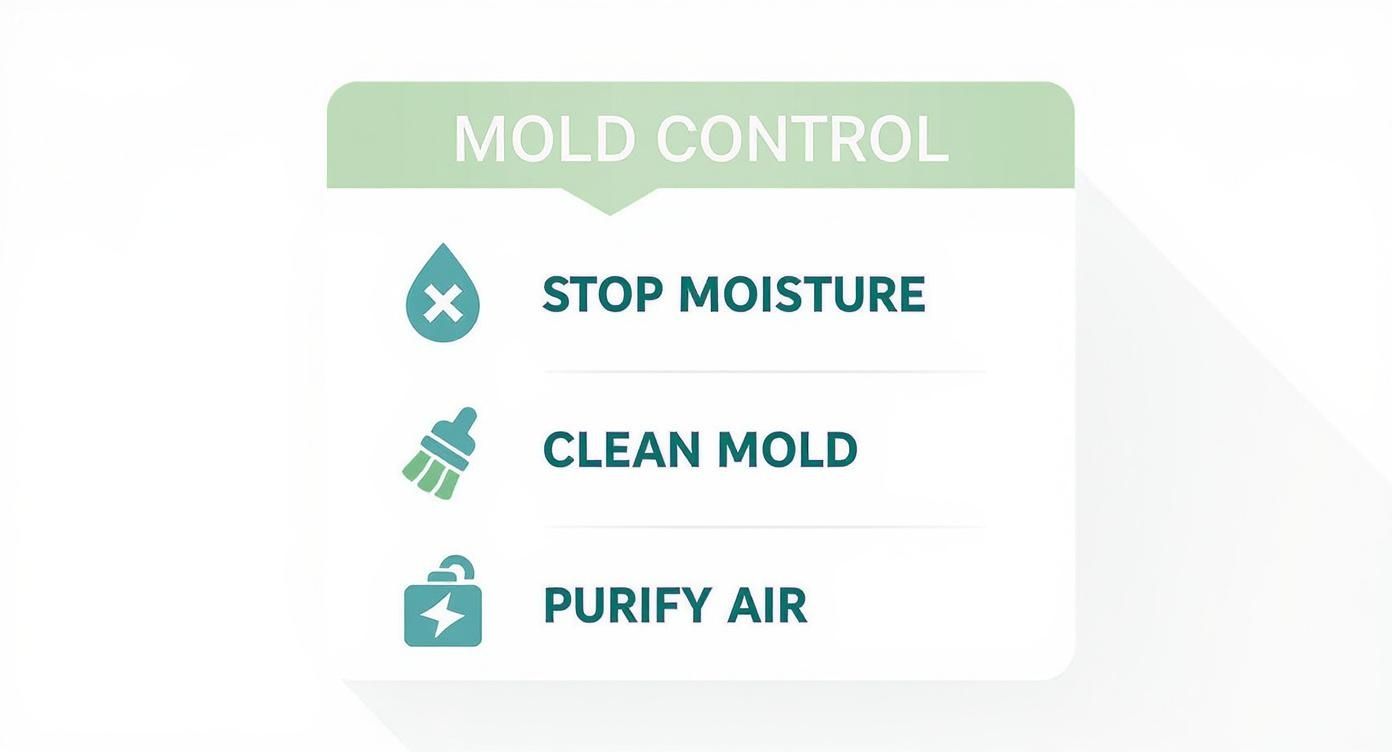
This visual confirms that once you’ve stopped the moisture source and cleaned up the visible mold, ongoing air purification is the final piece of the puzzle.
Below is a quick-glance table comparing the technologies we've discussed so far, helping you see how they stack up against each other for dealing with mold.
Comparing Air Purification Methods for Mold
Technology | Mechanism of Action | Mold Spore Effectiveness | Mold Odor Effectiveness | Primary Advantage |
|---|---|---|---|---|
HEPA Filter | Physically traps airborne particles in a dense fiber mesh. | Excellent. Captures over 99.97% of spores that pass through it. | None. Cannot capture gaseous MVOCs. | Gold-standard for particulate removal. |
Activated Carbon | Adsorbs gases and odors onto a highly porous carbon surface. | None. Does not capture physical particles like spores. | Excellent. Effectively neutralizes musty odors from MVOCs. | The best solution for removing smells. |
ActivePure | Sends out oxidizing molecules to destroy pollutants in the air and on surfaces. | Excellent. Neutralizes spores on contact, wherever they are. | Excellent. Breaks down the MVOCs causing the odors. | Proactively treats the entire space, not just the air passing through it. |
This comparison highlights a major difference in approach: passive filters clean the air that enters the unit, while active technologies go on the offensive.
Active Technology for Proactive Mold Control
Active purification technologies flip the script entirely. Instead of passively waiting for pollutants to drift into the machine, these systems actively send purifying agents out into your room to hunt down and neutralize contaminants. This is a game-changer when you're dealing with something as stubborn as mold.
A prime example of this is ActivePure Technology. It uses a unique, patented process to create and push powerful, safe oxidizing molecules out into your space. These molecules actively seek out and destroy pathogens like mold spores, bacteria, and viruses on contact, in the air and even on surfaces like countertops and doorknobs.
An active system treats the entire space, not just the air that passes through the unit. This proactive approach helps prevent new mold colonies from forming on surfaces, offering a more complete and continuous solution for mold control.
By destroying contaminants where they are, active technologies slash the risk of mold finding a nice, quiet corner to settle and grow. This makes them a fantastic choice for homes with chronic humidity issues, a history of water damage, or for anyone who is especially sensitive to mold. The ability to sanitize both air and surfaces offers a layer of protection that passive filters just can't provide. That difference is what you need to keep in mind when choosing the absolute best air purifier for mold.
Key Metrics for Choosing a Mold Air Purifier
When you're shopping for an air purifier to combat mold, it's easy to get lost in marketing jargon. To find a unit that actually works, you have to look past the promises and dig into the numbers that define real-world performance. These metrics are what separate the serious contenders from the glorified fans.
The single most important number to understand is the Clean Air Delivery Rate (CADR). This metric, measured in cubic feet per minute (CFM), tells you exactly how much clean air the unit pumps out. Think of it as the raw horsepower of the purifier; a higher CADR means it cleans your room's air faster.
And when you're dealing with mold, speed is everything. You need to pull those spores out of the air before they can settle and start new colonies. The best models designed for mold will have impressive CADR ratings, some hitting as high as 410 CFM. To put that in perspective, the EPA explains that a dust CADR of 250 is like injecting 250 cubic feet of fresh, clean air into your room every single minute.
Sizing Your Purifier with CADR and ACH
CADR directly ties into how large of a space a purifier can handle. The Association of Home Appliance Manufacturers (AHAM) gives us a handy rule of thumb: a purifier's CADR should be at least two-thirds of the room's square footage. So, for a 300-square-foot room, you’d want a unit with a CADR of at least 200.
But for a stubborn problem like mold, that’s just the starting point. We need to look at Air Changes Per Hour (ACH). This tells you how many times the purifier can cycle through and filter all the air in a room within one hour. For just keeping the air fresh, an ACH of 2-3 is fine.
When you're up against mold, or if someone in your home has allergies or asthma, you need to be more aggressive. Look for a purifier that can deliver 4 to 5 air changes per hour. This ensures airborne spores are captured quickly and consistently, keeping levels low.
To hit that higher ACH, you'll likely need to "oversize" your unit, that is, choose a purifier rated for a space larger than your actual room. This strategy gives you the power to keep spore counts down without having to run the machine on its highest (and loudest) setting all the time. If you want to get into the nitty-gritty, we have a whole guide on how to calculate air changes per hour accurately.
Balancing Performance with Practicality
A powerful purifier is useless if it’s too annoying to run. The best machine is one that fits into your daily life, which means you have to consider noise and energy costs.
Noise Level (Decibels)If your air purifier sounds like a jet engine, you’re just going to turn it off. That's why noise levels, measured in decibels (dB), are so important.
20-30 dB: Whisper-quiet. Perfect for bedrooms.
40-50 dB: About the same as a modern refrigerator. Great for living areas.
60+ dB: This is the level of a normal conversation, which can get pretty distracting.
Look for a model that can still deliver a decent CADR on its lowest, quietest setting. That's the sweet spot for running it overnight without it keeping you awake.
Energy ConsumptionTo effectively control mold, your air purifier needs to run 24/7. That means its energy consumption will show up on your monthly electricity bill. Always look for the ENERGY STAR certification; these models are at least 40% more energy-efficient than their uncertified counterparts.
Many modern purifiers also come with an "auto mode" that uses sensors to monitor your air quality in real time. It will automatically ramp up the fan speed when it detects pollutants and then power down when the air is clean. This is a great feature for getting maximum protection without wasting energy.
Understanding What Air Purifiers Can (and Can't) Do About Mold
Look, while the right air purifier is a phenomenal tool in the fight against mold, it’s crucial to have realistic expectations. A common, and often costly, mistake is thinking of an air purifier as a magic cure-all. It's a vital part of a larger strategy, not a standalone solution. The machine’s job is to clean the air, but the root of every single mold problem is always moisture.
An air purifier simply can't fix a leaky pipe, a damp basement, or a bathroom with poor ventilation. These are the sources that give mold a place to grow. If you put a top-of-the-line air purifier in a room with an active mold colony, it will diligently capture the spores being pumped into the air. But it won't do a single thing to stop that colony from growing and producing more spores.
This distinction is everything. An air purifier helps you manage the symptoms of a mold problem, like airborne allergens and that musty smell, but it doesn't touch the underlying cause. Without fixing the moisture issue, you're just fighting a losing battle. The purifier will be working overtime, and the mold will keep right on thriving.
Questioning Certain Technologies
Not all air purification technologies are built the same, especially when it comes to the unique challenge of mold. For example, you’ll see a lot of consumer-grade purifiers that include UVGI (ultraviolet germicidal irradiation) lights, often marketed as a way to "kill" mold and bacteria. While UV light absolutely can neutralize microorganisms, its effectiveness inside a typical portable air purifier is often pretty limited.
Mold spores are notoriously tough. They require a significant dose of UV radiation to be rendered harmless. The problem is, in many portable units, the air zips past the UV lamp so quickly that the light doesn't have time to do its job. This short "dwell time" means many spores can fly right through completely unscathed. While beefy industrial or whole-home UVGI systems can be very effective, the small bulbs in many portable units often don't live up to their marketing hype for serious mold control.
The single biggest limitation of any air purifier is that it cannot remove existing mold colonies from surfaces. Its job is to manage what's floating in the air, but physically removing the mold and controlling the moisture source are the non-negotiable first steps in any successful mold remediation plan.
One Piece of a Complete Plan
The key to success is thinking of an air purifier as just one component in a complete system. Industry experts and government agencies consistently back this up. Research shows that portable air cleaners can reduce mold-related particles and odors, but they can't resolve the fundamental conditions that allow mold to grow in the first place. You can get more great insights on this from the EPA's official guide on air cleaners for your home.
A truly effective approach always involves a few coordinated steps:
Find and fix the moisture source. This is always, always the first and most critical action.
Physically clean and remove existing mold. Use the right cleaning agents and safety gear to get all visible mold off of surfaces.
Deploy a high-quality air purifier. After the source is fixed and the surfaces are clean, an air purifier helps snag any leftover airborne spores and keeps the air clean moving forward.
By understanding these limits, you can sidestep common frustrations and use your air purifier as intended: not as a quick fix, but as a powerful tool for maintaining a healthy, mold-free home after the real problem has been solved. This sets you up for a robust, long-term mold control strategy that actually works.
Building a Complete Mold Control Strategy
Buying the best air purifier for mold is a fantastic final move, but it shouldn't be your first. To really win the war against mold, you need a coordinated plan that attacks the problem at its source. Think of an air purifier as the guardian that maintains clean air after you’ve created an environment where mold can't thrive in the first place.
This complete approach hinges on controlling moisture, ensuring proper ventilation, and knowing when it's time to call in the professionals. Each step builds on the last, creating a home that’s actively hostile to mold growth. Without these foundational pieces, even the most powerful air purifier will be fighting a losing battle.
Prioritizing Humidity Control
If mold needs one thing to survive, it’s moisture. That’s why controlling the humidity inside your home is the single most effective preventive measure you can take. The sweet spot for your indoor humidity is between 30% and 50%.
Anything above that range is basically rolling out the welcome mat for mold spores to settle down and multiply. A high-quality dehumidifier is an indispensable tool for hitting this target, especially in naturally damp spots like basements, crawl spaces, and bathrooms. Regularly checking humidity levels allows you to make adjustments before a problem can even start.
For a deeper dive, check out the practical techniques in our guide detailing five easy tips to reduce humidity in your home.
Improving Home Ventilation
Stagnant, humid air is a playground for mold. Improving your home's ventilation is all about moving that moist air out and replacing it with fresh, dry air. This is especially critical in rooms that generate a lot of steam and moisture.
Simple habits can make a massive difference:
Run Exhaust Fans: Always use the exhaust fan in your bathroom during and after a shower. Let it run for at least 20-30 minutes afterward to clear out all that steam.
Ventilate When Cooking: Use the range hood fan in your kitchen to pull cooking steam and odors outside where they belong.
Ensure Dryer Vents are Clear: Make sure your clothes dryer vent is properly connected and exhausts to the exterior, with no blockages slowing it down.
These simple practices prevent moisture from camping out on surfaces where mold could take root.
Addressing the Source Immediately
Proactive maintenance is the cornerstone of any effective mold control strategy. Even tiny leaks can mushroom into significant mold problems if you let them slide. Be vigilant about checking for any signs of water damage.
A slow drip under a sink or a small stain on the ceiling can quickly escalate into a widespread mold colony. Addressing these issues immediately, before mold has a chance to grow, saves you time, money, and stress in the long run.
This also applies to any mold you can see. While air purifiers are great for airborne spores, a complete strategy means you also have to deal with visible mold on surfaces, like learning how to remove mold from carpet safely and effectively.
Knowing When to Call a Professional
Sometimes, a mold problem is just too big or complex to handle on your own. If you suspect mold is growing inside your walls or, even worse, in your HVAC system, it’s time to call for professional help.
Services like professional mold inspections can uncover hidden mold sources you'd never find. And HVAC duct cleaning is critical for removing mold and spores that have colonized your air ducts. Trying to clean ductwork yourself can actually make the problem worse by blasting spores throughout your entire home. A professional has the right equipment and expertise to do the job safely.
Once these foundational issues are resolved, installing a high-quality air purifier becomes the final, crucial step. It acts as a constant guardian, capturing any lingering airborne spores and ensuring your home’s air stays clean, healthy, and safe for your family.
Choosing the Right Air Purifier for Your Needs
Picking the best air purifier for mold really comes down to matching the right tool to your specific situation. There’s no one-size-fits-all answer here, so the first step is always to get a clear handle on your home's unique challenges. Once you understand the problem, you can weigh performance metrics against real-world needs to find that sweet spot between capability and cost.
Your decision should start with an honest assessment. Are you dealing with a little mildew in a small area, or is this a persistent, house-wide problem? The answer to that question will point you in the right direction.
Scenario-Based Recommendations
Let's walk through a few common scenarios. Each one calls for a different level of intervention, from basic filtration to a more aggressive, proactive system.
For a Small Room with Minor Mildew
Picture a small bedroom or office where you've spotted some mildew in a corner, likely from poor ventilation. You’ve already fixed the airflow and cleaned the spot, so now your goal is just to keep the air clear.
Recommendation: A high-quality portable unit with a strong CADR for the room size and a true HEPA filter is your best bet. This setup will snag any lingering spores and give you peace of mind without breaking the bank on features you don't need.
For a Larger Area with Allergy Concerns
Now think about a family living room where someone has a mold allergy. In this case, even a small amount of airborne spores can set off symptoms, so you need to clean the air quickly and efficiently.
Recommendation: You’ll want a beefier purifier capable of 4 to 5 air changes per hour (ACH). Look for a combination unit that pairs a HEPA filter for the spores with an activated carbon filter to absorb those musty odors (MVOCs) that often come with mold.
For a Home with Persistent Mold or Severe Allergies
Imagine a home with a history of water damage or chronic humidity. Here, mold isn't just a one-time annoyance; it's a constant battle that demands a more powerful defense.
Recommendation: This is where an active purification system like ActivePure Technology really shines. Instead of just waiting for spores to pass through a filter, ActivePure sends out purifying agents to destroy mold spores and other contaminants right where they are: in the air and on surfaces. This proactive attack helps stop new mold from getting a foothold, offering a whole other level of protection for those with severe sensitivities or stubborn mold issues.
Evaluating Long-Term Costs
Choosing an air purifier isn’t just a one-time purchase; it’s an ongoing investment in your health. To make a smart choice, you have to look past the sticker price and think about the total cost of ownership over the years.
Viewing your air purifier as a long-term health investment means accounting for ongoing expenses. The cheapest unit upfront might become the most expensive over time due to frequent filter changes or high energy use.
Think about these factors:
Filter Replacement Costs: How often do the HEPA and carbon filters need replacing, and how much do they cost? A unit with a $100 filter that lasts 12 months is a better deal than one with a $60 filter you have to swap out every four months.
Energy Consumption: An ENERGY STAR certified model can save you a surprising amount on your electric bill, especially when you’re running it 24/7.
Unit Lifespan: Do a little research on the brand’s reputation for durability. A well-built machine might cost more upfront, but it will easily outlast cheaper alternatives, giving you much better value in the long run.
For those with more serious concerns, it might be wise to look beyond portable units. Our guide to the 12 best whole-house air cleaners offers a deeper dive into integrated solutions. By carefully matching the technology to your needs and planning for long-term costs, you can confidently choose the best air purifier for mold.
Still Have Questions About Mold and Air Purifiers?
It's completely normal to have questions when you're trying to find the right air purifier for mold. Getting the details right can make a huge difference in how clean your indoor air actually is. Let's tackle some of the most common things people ask.
That musty, earthy smell you associate with mold comes from something called Microbial Volatile Organic Compounds (MVOCs). Think of these as tiny gas molecules that mold releases as it grows and eats. A standard HEPA filter is fantastic at grabbing physical particles like mold spores, but it can't touch these gases. That's why a room might still have that "moldy" smell even with a purifier running.
To actually get rid of the odor, you need a purifier with a heavy-duty activated carbon filter. The carbon's massive surface area is designed to trap and adsorb these MVOCs, pulling the smell right out of the air. Alternatively, active systems like ActivePure go a step further by seeking out and neutralizing these compounds, breaking them down so the smell is gone for good.
How Long Should I Run an Air Purifier for Mold?
For serious mold control, the answer is simple: 24 hours a day, 7 days a week. Mold doesn't operate on a schedule. Spores can be released at any time and hang in the air for hours. Continuous filtration is the only way to catch them as they become airborne, stopping them before they can land and create new problems.
Running your unit sporadically just gives mold spores a window of opportunity to spread and settle back into your home.
If your home has a history of mold, deals with high humidity, or if anyone in the family has significant allergies, running your purifier non-stop isn't just a suggestion; it's essential. The goal is to keep the airborne spore count consistently low, and that requires a constant defense.
Where Is the Best Place to Put an Air Purifier for Mold?
Placement is everything. You can have the best purifier in the world, but if it's stuck in a bad spot, its performance will suffer. The best location is usually the room where you spend the most time, like your bedroom or living room, or right in the area where you suspect a mold issue.
To get the most out of your unit, follow these simple rules:
Give It Room to Breathe: Don't shove it against a wall or tuck it behind the couch. Place the unit at least a few feet away from furniture and walls so it can pull in air from all directions without being blocked.
Think Central: If you can, placing it in a more central part of the room helps it establish a strong, circular airflow pattern, cleaning the air much more effectively than if it were stuck in a corner.
Go to the Source: If you know the mold is coming from a damp corner in the basement, for example, putting the purifier nearby helps capture spores right at their source before they have a chance to travel through the rest of your house.
By getting these details right, you can turn your air purifier into a truly powerful tool in your fight for a mold-free home.
For professional guidance on selecting the best air purification solution for your home's unique needs, trust the experts at Covenant Aire Solutions. Explore our advanced ActivePure systems and HVAC services today.