
How to Choose an Air Purifier: how to choose air purifier for Arizona Homes
Picking the right air purifier isn't as complicated as it seems. It really boils down to three things: matching the unit to your room size, knowing what pollutants you're trying to get rid of, and picking the right filter for the job.
Here in Arizona, that usually means finding a model with a high Clean Air Delivery Rate (CADR) to tackle the constant dust and allergens we live with. For the best all-around protection, I always recommend a unit that has both a True HEPA filter for tiny particles and an activated carbon filter for odors and gases.
Your Quick Guide to Selecting the Right Air Purifier
Walking down the air purifier aisle, or scrolling online, can feel a bit overwhelming with all the options out there. But let's simplify it. Your mission is to find a machine that actually cleans the specific gunk floating around in your home's air.
For us in Arizona, our challenges are a bit different. We're dealing with everything from fine desert dust that coats every surface to the mold spores that pop up during monsoon season.
Think of an air purifier as your home's quiet bodyguard. It works around the clock, pulling air through a series of filters to trap all those unwanted intruders. It’s like a super-fine net designed to catch microscopic particles that your main HVAC filter just can't grab. The end goal is to breathe easier, which is a game-changer for anyone with allergies, asthma, or other respiratory issues.
To help you narrow down your search, here’s a quick-glance table covering the most important decision factors.
Key Air Purifier Decision Factors at a Glance
Factor | What It Means | Why It Matters for Arizona Homes |
|---|---|---|
Room Size & CADR | Match the purifier's capacity (Clean Air Delivery Rate) to your room's square footage. | Our larger, open-concept homes need a unit with enough power to circulate all the air effectively. An undersized unit won't keep up with desert dust. |
Filter Type | The technology used to capture pollutants (e.g., HEPA, Activated Carbon). | A True HEPA filter is non-negotiable for our dust and pollen. An Activated Carbon filter is crucial for wildfire smoke and VOCs. |
Air Changes Per Hour (ACH) | How many times the purifier can clean the entire volume of air in a room in one hour. | For allergy sufferers or during smoke events, you'll want a higher ACH (4-5x) to keep the air consistently clean. |
Noise Level (dB) | The sound the unit produces, measured in decibels. | A loud purifier in a bedroom is a non-starter. Look for models under 50 dB on their highest setting for living areas, and even lower for sleeping. |
Choosing the right features directly impacts how clean your air will be, especially given our unique environmental challenges in the Tucson area.
Key Factors for Arizona Homeowners
Before you can pick the right tool, you have to know what you’re up against. In Tucson and the surrounding communities, the air inside our homes is directly impacted by what’s happening outside.
Desert Dust and Particulates: Fine dust is just a fact of life here. A powerful purifier is your best defense for grabbing these tiny particles before they get into your lungs or settle on furniture.
Seasonal Allergens: From spring pollen to fall ragweed, allergens can make daily life a struggle. A True HEPA filter is the industry gold standard for trapping these triggers.
Monsoon-Related Mold: We love the summer rains, but the moisture they bring can kick up mold growth. An effective purifier helps snag airborne mold spores before they find a place to land.
Wildfire Smoke: When smoke from regional wildfires drifts into our area, it brings nasty particles and odors with it. You need specific filtration to deal with that.
A common mistake I see all the time is people buying an undersized unit. An air purifier that's too small for the room will just run constantly without ever getting the job done. It basically becomes a very expensive fan that just pushes dirty air around. Always, always check the manufacturer’s recommended room size and CADR ratings.
If you really want to get a precise picture of what’s in your home’s air, an initial assessment is a great starting point. For those who are unsure about the specific pollutants they're dealing with, you can learn more about how to get started with an air quality home test kit. This gives you a clear baseline, making sure your investment in an air purifier is targeted and effective right from the start.
Figuring Out What's Floating Around Your Arizona Home
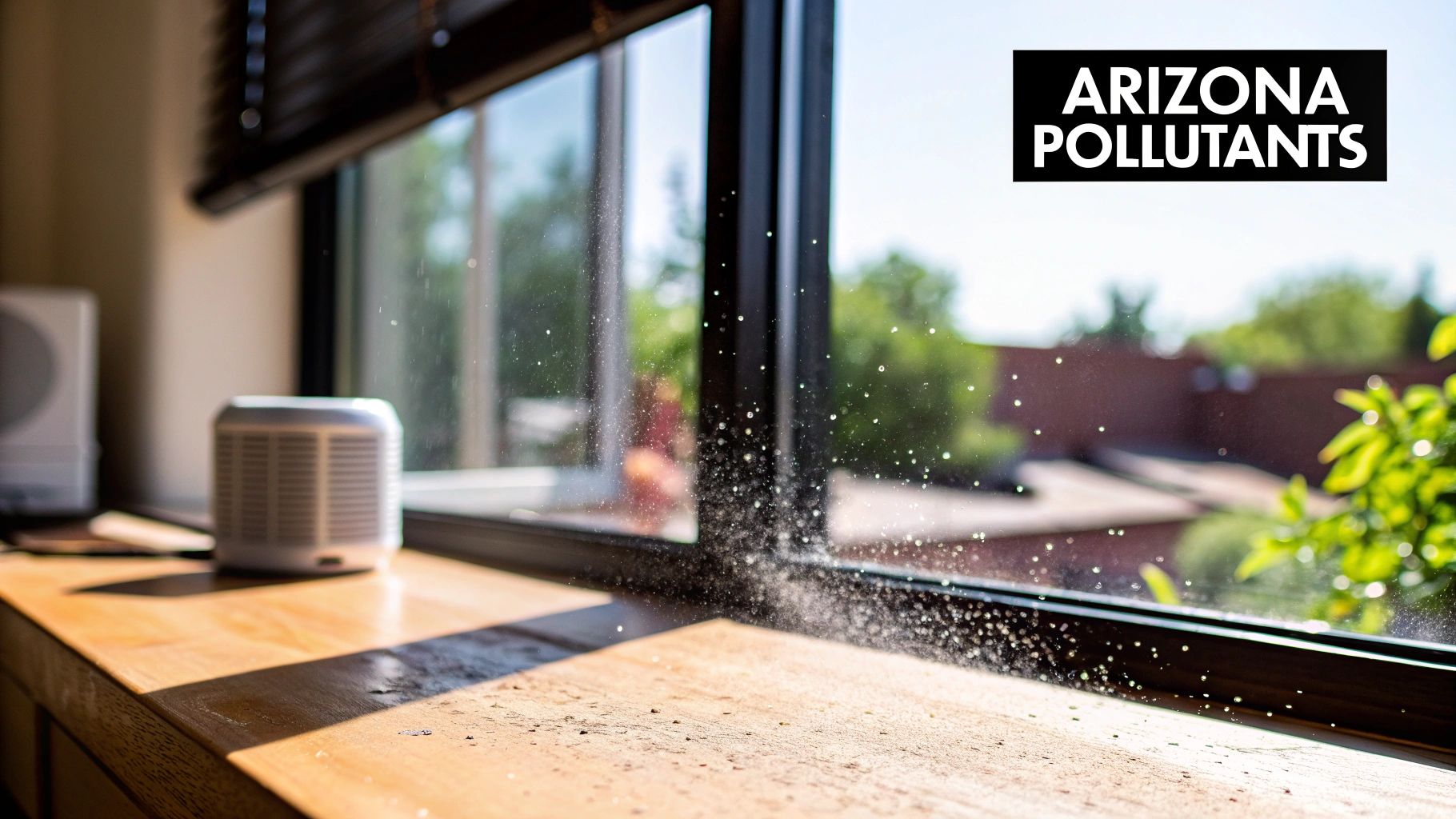
Before you can pick the right air purifier, you have to know what you're actually fighting. Here in Arizona, the air inside our homes is a unique cocktail of desert dust, seasonal allergens, and everyday household chemicals. Understanding the enemy is the first real step toward choosing a purifier that will actually clean your air.
The stuff floating around your living room falls into a few key categories. Some of it you can see, like the fine layer of dust that settles on everything moments after you've cleaned. Much of it, though, is completely invisible.
Each type of pollutant needs a specific kind of filter to be yanked out of the air. This is exactly why a "one-size-fits-all" purifier often disappoints, leaving you wondering why your allergies are still acting up or why that weird pet smell won't go away.
Particulate Matter: The Visible and Invisible Irritants
When we talk about Particulate Matter (PM), we’re referring to a mix of tiny solid particles and liquid droplets hanging in the air. For most Arizonans, these are the primary culprits behind allergy flare-ups and respiratory issues. Think of them as tiny invaders that a good filter is designed to trap.
These particles come in all sizes. The bigger ones might just make you sneeze, but the really small ones can get deep into your lungs and even your bloodstream.
Here are the most common particles we see in Tucson homes:
Fine Desert Dust: Living in the beautiful Sonoran Desert has its perks, but it also means a constant battle with fine, sandy dust. It sneaks in through every open window and gets tracked in on shoes. A True HEPA filter is non-negotiable for capturing these microscopic particles.
Pervasive Pollen: Arizona doesn't have just one pollen season; we have several. From trees in the spring to ragweed in the fall, allergy sufferers can face months of misery. A purifier with a high CADR (Clean Air Delivery Rate) is key to cycling the air fast enough to remove these triggers.
Pet Dander: We all love our furry friends, but their dander, microscopic flecks of skin, is a major allergen for many. It's so lightweight it can hang in the air for hours, making continuous filtration a must.
Wildfire Smoke: As wildfire seasons become a regular threat, smoke can drift for miles, carrying harmful fine particulate matter known as PM2.5. To handle this, you need a combination of a HEPA filter for the particles and an activated carbon filter for the odors and gases.
Gaseous Pollutants: The Odors and Chemicals
Not all pollution is made of solid bits. Many of the worst offenders are gases, chemical fumes, and stubborn odors that a standard HEPA filter can't touch. These invisible threats come from all sorts of things inside your home and require a completely different approach: an activated carbon filter.
I can't tell you how many homeowners are shocked to learn that their new couch, fresh paint job, or even their cleaning sprays are releasing chemicals into the air. These compounds can cause everything from headaches to more serious long-term health issues.
For these gaseous pollutants, you need a filter that can adsorb them, which means the gas molecules get trapped on its surface.
Volatile Organic Compounds (VOCs) are the biggest category here. They "off-gas" from countless common household products, including:
New furniture and carpeting
Paints, varnishes, and solvents
Aerosol sprays and air fresheners
Many cleaning and disinfectant products
Beyond just purification, adopting regular deep cleaning habits can also significantly improve overall indoor air quality by removing pollutants that have settled on surfaces before they can get kicked back into the air.
Biological Contaminants: The Living Threats
Finally, we have biological contaminants. These are living organisms (or their byproducts) that can take hold inside, especially when there's moisture. The Arizona monsoon season, with its sudden spike in humidity, can create the perfect breeding ground.
Mold Spores: After our summer rains, mold can become a real problem. The airborne spores trigger allergies and respiratory distress. A HEPA filter is great at capturing spores, but it's just as important to find and fix the source of the moisture. If mold is your main concern, we have a whole guide on finding the best air purifier for mold.
Bacteria and Viruses: These microbes can easily circulate through your home's air, especially when someone is sick. While a good filter can trap them, some newer technologies are designed to actively neutralize them as well.
Once you understand these different pollutant types, it becomes obvious why you need to match the purifier's technology to your home's specific problems. A machine with only a HEPA filter will be a champion against dust but completely useless against the smell from last night's fish dinner or the VOCs from that new rug.
Matching Filter Technology to Your Home's Needs
Alright, now that you have a good idea of what’s floating around in your home's air, it’s time for the most important part: picking the right filter technology to fight it. This is where the technical jargon turns into real-world solutions for your family. Think of it like building a specialized toolkit for your air; each filter is a tool designed for a very specific job.
Getting the right combination of filters creates a multi-layered defense against everything from desert dust to chemical fumes. If you don't get this match right, you could end up with a purifier that’s great at grabbing pollen but does absolutely nothing for the cooking odors still hanging around from last night’s dinner.
The Gold Standard: True HEPA Filters
When it comes to trapping microscopic particles, True HEPA (High-Efficiency Particulate Air) filters are the undisputed champions. And that’s not just marketing fluff; it’s a strict performance standard. To earn the "True HEPA" label, a filter must be certified to capture an incredible 99.97% of airborne particles as small as 0.3 microns.
To put that size in perspective, a single human hair is about 50-70 microns thick. HEPA filters trap particles hundreds of times smaller than that. We're talking about:
Desert dust and fine particulates
Pollen and ragweed
Pet dander and dust mite allergens
Mold and mildew spores
Airborne bacteria
The technology works like a super-dense, tangled web of fibers. As air is forced through, even the tiniest particles get stuck. For anyone in Arizona dealing with allergies, asthma, or the constant battle against dust, a True HEPA filter isn’t just a nice feature, it’s non-negotiable.
Tackling Odors and Fumes with Activated Carbon
Here's a crucial point: while a HEPA filter is a master of capturing particles, it’s completely useless against gases, odors, and chemical fumes. That's where activated carbon filters step in. These filters are specifically designed to trap gaseous pollutants through a process called adsorption, where odor and chemical molecules literally stick to the carbon's massive surface area.
An activated carbon filter is your best defense against:
Volatile Organic Compounds (VOCs) from new paint, furniture, or cleaning products.
Lingering cooking odors from spices, oil, or that slightly burnt toast.
Unpleasant pet odors.
Smoke and its associated smells from wildfires or tobacco.
If you want to get deeper into how these two core technologies work together, check out our guide on choosing between HEPA and activated carbon filters. The main takeaway? Most homes really need both.
A common mistake I see is someone buying a purifier with only a HEPA filter and then feeling let down when it doesn't remove the smell of last night's fish tacos. For truly clean air, you have to address both the particles and the gases, which almost always means getting a combination unit.
This reality is reflected in what people are buying. HEPA filters dominate the industry, holding a massive 40.2% market share because they are so effective at trapping those ultra-fine pollutants like allergens and wildfire smoke. But savvy consumers know they need more. That's why combination units now hold a 60% market preference in residential sales, a figure that has jumped 12% since 2020. You can explore more insights about the air purifier market on Coherent Market Insights.
To help you visualize the trade-offs, here’s a quick breakdown of the most common filter technologies we see in Arizona homes.
Comparing Filter Technologies for Arizona Homeowners
Technology Type | Best For Targeting | Limitations | Ideal Scenario |
|---|---|---|---|
True HEPA | Dust, pollen, pet dander, mold spores, bacteria (0.3 microns and larger). | Ineffective against odors, chemicals, VOCs, and viruses smaller than 0.3 microns. | Homes with allergy or asthma sufferers; dusty environments. The foundation of any good purifier. |
Activated Carbon | Odors (cooking, pets), smoke, VOCs, chemical fumes from cleaning supplies or new furniture. | Does not capture particulate matter like dust or pollen. Can become saturated and require frequent replacement. | Kitchens, homes with pets or smokers, or rooms with new paint or furniture. Best when paired with a HEPA filter. |
ActivePure® | Viruses, bacteria, mold, VOCs, and odors in the air and on surfaces. | Less effective on its own for heavy particulate loads like dust. | Households with immunocompromised individuals or anyone wanting the highest level of proactive protection against germs. |
UV-C Light | Killing airborne bacteria, viruses, and mold spores that pass through the unit. | Only effective with sufficient exposure time; doesn't remove dust, allergens, or odors. | Added layer of germicidal protection within the purifier, often combined with HEPA and Carbon filters. |
Each technology has its strengths. The key is layering them to build a comprehensive defense against your specific indoor air quality challenges.
Advanced Active Purification Technologies
Beyond passive filters that just sit there and trap whatever passes through, some "active" technologies proactively go on the attack. One of the most effective is ActivePure® Technology. This system, which was originally developed for use by NASA, creates and sends out special oxidizing molecules into your home's air.
Instead of waiting for a pollutant to get sucked into the machine, these molecules actively seek out and destroy contaminants in the air and on surfaces, including:
Viruses
Bacteria
Mold spores
VOCs
This offers a layer of protection that passive filters simply can't match. It’s the difference between setting a trap and sending out a search party. ActivePure neutralizes a virus or mold spore right where it is, whether it's floating mid-air or sitting on your kitchen counter. This makes it an excellent choice for households where someone has a compromised immune system or for anyone who wants the absolute highest level of protection available.
Calculating the Right Size and Power for Your Space
Picking an air purifier without checking its power rating is like trying to cool your house with a tiny desk fan; it's just not going to cut it. An undersized unit will run constantly, struggling to clean the air and never quite getting the job done. To avoid that frustrating and costly mistake, you need to match the purifier's muscle to your room's actual dimensions.
This is where two key metrics come into play: CADR (Clean Air Delivery Rate) and ACH (Air Changes per Hour). Getting a handle on these concepts is the secret to making sure the model you choose is powerful enough to keep your air genuinely fresh and clean.
Decoding the CADR Rating
The Clean Air Delivery Rate, or CADR, is a metric developed by the Association of Home Appliance Manufacturers (AHAM) that basically measures an air purifier's horsepower. It tells you how quickly a unit can scrub specific pollutants from the air.
A CADR rating isn't a single number; it's actually three, one for each common type of pollutant:
Smoke: The smallest particles, like those from wildfires or cooking.
Dust: Mid-sized stuff like common household dust and pet dander.
Pollen: The largest particles, including most seasonal allergens.
The higher the CADR number, the faster the purifier cleans that specific pollutant out of the air. Simple as that.
My pro tip? Always focus on the smoke CADR. Since smoke particles are the smallest and hardest to catch, a purifier that scores well here will have no problem handling bigger particles like dust and pollen. It's the best single indicator of a unit's overall performance.
Applying the Two-Thirds Rule for a Perfect Match
So, how do you put this CADR number to work? There's a simple, reliable guideline I always recommend called the "two-thirds rule." It makes matching a purifier to your room a breeze.
First, you need your room's square footage. Just multiply its length by its width. For a typical Arizona master bedroom that's 15 feet by 20 feet, you're looking at 300 square feet.
Now, here's the rule: Your air purifier's smoke CADR rating should be at least two-thirds of your room's area in square feet.
Real-World Example: For that 300 sq. ft. bedroom, you'll need a purifier with a smoke CADR of at least 200 (300 x 2/3 = 200). This ensures the machine has enough oomph to circulate and clean the air efficiently without running on high 24/7.
Getting this match right is critical; a major mismatch can slash a unit's effectiveness by up to 40%. For a larger 500 sq. ft. living area, you'd want a smoke CADR of 300+. A unit with that rating, certified by AHAM, can deliver 4.8 air changes per hour and reduce pollutants by 80% in just 30 minutes. This is especially true here in Tucson, where humidity swings put extra stress on HVAC systems. It’s why whole-home solutions like Covenant’s ActivePure, which NASA validations show can eliminate 99.98% of bacteria, are so vital. You can dig deeper into the air purifier market on Precedence Research.
This little flowchart is a great shortcut for figuring out which filter type you need based on what you're trying to remove from your air.
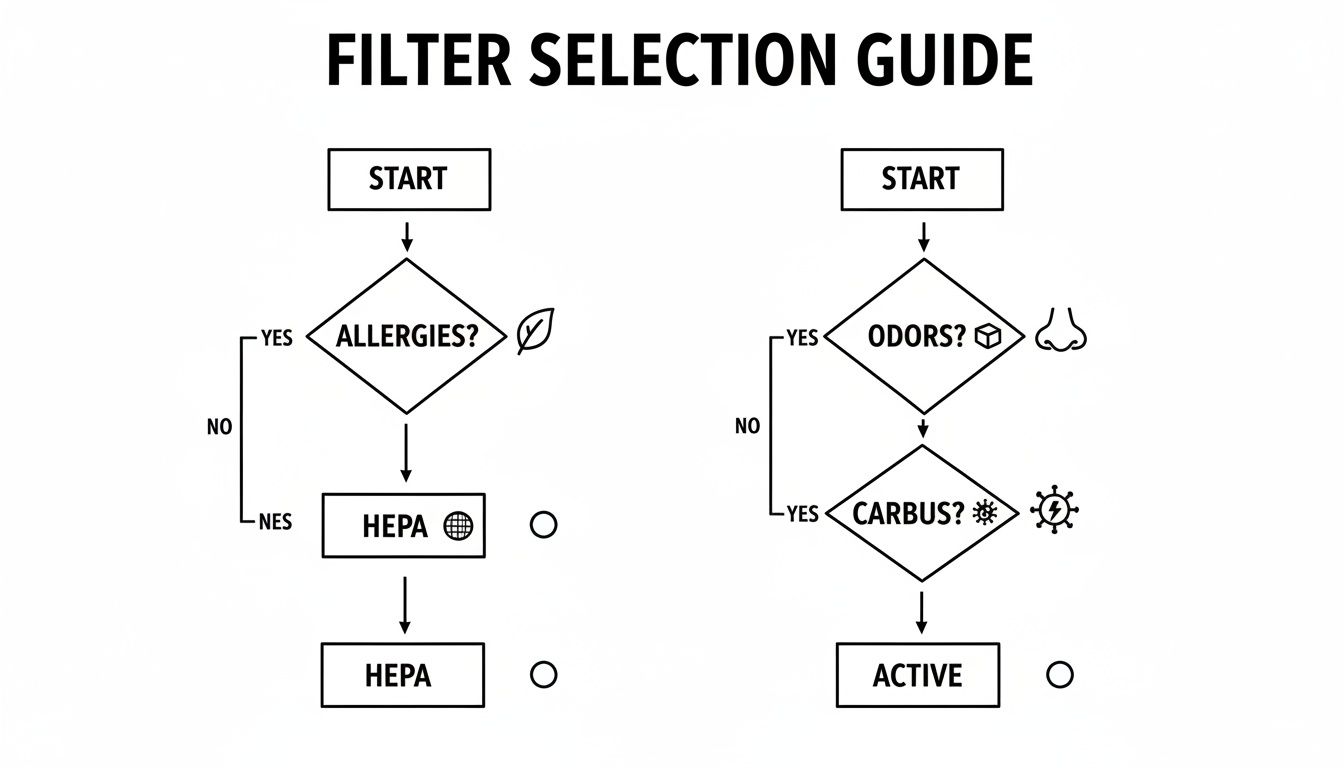
The big takeaway here is that there's no single "best" filter. The right choice always comes down to the specific gunk you need to target.
Why Air Changes Per Hour (ACH) Matter for Your Health
While CADR tells you about raw power, Air Changes per Hour (ACH) tells you how thoroughly that power is actually being put to use. ACH measures how many times the purifier can cycle through and clean the entire volume of air in your room in one hour.
For just general air quality improvement, an ACH of 2-3 is perfectly fine.
But for households with specific health concerns, this number becomes much more important.
For Allergy or Asthma Sufferers: You really want a system that achieves 4 to 5 air changes per hour. This high turnover rate means allergens like pollen, dust mites, and pet dander are constantly being pulled out of the air, offering real, consistent relief.
During Wildfire Season: A higher ACH is also non-negotiable when smoke is in the air. It helps clear out those dangerous fine particles much, much faster.
If you're interested in the nitty-gritty, you can check out our guide on how to calculate air changes per hour accurately. It’ll help you make sure your system is dialed in for peak performance.
Adjusting for Real-World Spaces
Standard calculations are great for rooms with average 8-foot ceilings. But what about open-concept great rooms or bedrooms with dramatic vaulted ceilings? In those spaces, the total volume of air is much larger, and you'll absolutely need more power.
If your ceilings are higher than 8 feet or your room opens up into other areas, you should size up. Choose a purifier rated for a larger square footage than your floor measurements alone suggest. This will compensate for that extra air volume and save you from the disappointment of an undersized, underperforming unit.
Don’t Forget About Long-Term Costs, Maintenance, and Noise
The sticker price on an air purifier is just the opening act; the real story is the total cost of ownership over its lifetime. To make a truly smart investment, you have to look past the initial purchase and think about the ongoing expenses that keep the unit humming along effectively for years.
These long-term costs, everything from filter replacements to the extra juice on your electricity bill, can swing wildly from one model to another. Factoring them in from the start ensures you pick an air purifier that not only cleans your air but actually fits your budget for the long haul.
Breaking Down Ongoing Maintenance Costs
For almost any air purifier you buy, the biggest recurring expense will be replacing the filters. Think of them as the engine of the machine; they do all the heavy lifting, and they absolutely don’t last forever.
Here’s a realistic breakdown of what to expect:
HEPA Filter Replacements: This is the core of your purifier. A True HEPA filter usually needs to be swapped out every 12 to 18 months. The cost can be anywhere from $20 to over $100, depending on the brand and model.
Activated Carbon Filter Replacements: These are the filters that tackle odors and gases. They have a much shorter lifespan and you'll likely need to replace them every 3 to 6 months to keep them effective against smells and VOCs.
Pre-Filter Upkeep: Many purifiers have a washable pre-filter that catches the big stuff like pet hair and dust bunnies. Cleaning this filter every 30 days is probably the single best thing you can do to extend the life of your pricier internal filters.
When you're shopping, make True HEPA technology non-negotiable. These filters are certified to capture 99.97% of particles as tiny as 0.3 microns, making them essential for getting rid of fine dust and allergens. Look for certifications from bodies like AHAM, which also tests for the clean air delivery rate (CADR).
Combining a quality HEPA filter with diligent pre-filter maintenance is a game-changer; some studies show this simple habit can slash your replacement costs by as much as 25%. Here in Tucson, integrating advanced systems like the NASA-certified ActivePure tech we offer at Covenant Aire Solutions can boost efficacy by 90% against viruses, according to independent tests. You can dig deeper into the air purifier industry on Grand View Research.
The Impact of Energy Consumption
An air purifier is meant to run 24/7, so its energy use will show up on your monthly electricity bill. A model that looks like a bargain on the shelf could end up being an energy hog that costs you more over time.
This is exactly why you should look for the Energy Star logo. An Energy Star-rated air purifier is, on average, 40% more energy-efficient than a standard model. That little blue sticker can translate into real savings year after year, making it a critical factor for long-term affordability.
A common oversight is forgetting to check the price and availability of replacement filters before buying a purifier. I've seen homeowners purchase a seemingly affordable unit, only to discover later that its proprietary filters are expensive and hard to find. Always do a quick online search for replacement filter costs first.
Understanding Noise Levels for a Peaceful Home
Finally, let's talk about noise. A purifier that sounds like a jet engine is going to get switched off, defeating the whole purpose. The noise a unit makes is measured in decibels (dB).
To give you some real-world context, here’s how to think about decibel levels:
Decibel Level (dB) | Comparable Sound | Ideal Placement |
|---|---|---|
20-30 dB | A whisper or rustling leaves | Perfect for a bedroom on its lowest "sleep mode" setting. |
40-50 dB | A quiet library or refrigerator hum | A good range for a living room or office on medium settings. |
60+ dB | A normal conversation | Too loud for most indoor living spaces, especially on a continuous basis. |
When you're comparing models, check the dB rating for both the lowest and highest fan speeds. A quiet "low" setting is a must-have for nighttime use in a bedroom. A louder, more powerful "high" setting is great for quickly clearing the air after you’ve been cooking or when the pollen count is through the roof. The sweet spot is finding a unit that balances powerful filtration with quiet operation you can actually live with.
When It’s Time to Go Beyond Portable Purifiers
Portable air purifiers are great tools for cleaning up the air in a single room, like a bedroom or a home office. But let's be honest, they have their limits. When you start needing one for the living room, another for the kitchen, and one for each bedroom, things get complicated. You’re suddenly juggling multiple filter changes, tripping over power cords, and losing valuable floor space.
At some point, this room-by-room strategy just isn't practical anymore.
This is usually the lightbulb moment when homeowners start looking at a more powerful, integrated solution. A whole-home air purification system ties directly into your existing HVAC setup. The beauty of this is that it treats every bit of air that cycles through your home, a true "set it and forget it" approach that delivers clean, consistent air quality everywhere.
When a Single-Room Solution Just Won’t Cut It
Moving to a whole-home system isn't just about convenience; it's about achieving a level of clean that a collection of portable units simply can't match. This becomes especially important in homes where air quality isn't just a preference, but a necessity.
You should seriously consider making the switch if any of these sound familiar:
You're dealing with severe allergies or asthma. For someone with serious respiratory sensitivities, creating a safe haven in just one room isn't enough. You need to reduce triggers throughout the entire home to get consistent relief.
A family member has a compromised immune system. When you’re trying to protect a vulnerable loved one from airborne viruses and bacteria, you need a solution that’s comprehensive and always on guard.
You want to clean more than just the air. Some of the more advanced whole-home technologies can actually neutralize germs and contaminants on surfaces like countertops, doorknobs, and light switches.
Here's something I see trip people up all the time: thinking a high-end HVAC filter is the same as a whole-home purifier. A good MERV filter is fantastic for trapping dust and dander, but a dedicated purification system goes a step further by actively neutralizing things like viruses, VOCs, and mold spores that are too small for filters to catch.
The Power of Active, Integrated Technology
The real game-changer with whole-home systems is their ability to use "active" purification technologies. For instance, solutions like ActivePure® Technology, originally developed for NASA to use in space, don't just sit back and wait for pollutants to pass through a filter. Instead, they create and send out special oxidizing molecules that actively hunt down and destroy contaminants, both in the air and on surfaces.
This gives you a proactive clean that's constantly working behind the scenes.
If you’re ready to see how a whole-home solution could transform the air your family breathes, take a look at our guide to professional air purification systems specifically designed for Arizona homes. A professional consultation is the best way to get a system that truly matches your health goals and your home’s layout, ensuring clean air in every corner.
Got Questions About Air Purifiers? We've Got Answers.
Even after you've done your homework, a few questions about air purifiers can pop up. Let's walk through some of the most common ones we hear from homeowners right here in Arizona, so you can feel totally confident about your choice.
Do Air Purifiers Really Help With Spring Allergies?
You bet they do. An air purifier equipped with a True HEPA filter is one of your best defenses against the misery of seasonal allergies. It’s a workhorse, capturing all those airborne culprits like pollen, dust mites, and pet dander that lead to sneezing, congestion, and itchy eyes.
If you run the unit consistently, especially in your bedroom overnight, you’ll dramatically cut down on the number of allergens floating around. Think of it as creating a clean air sanctuary where your system can finally get a break from the brutal pollen counts we see around Tucson.
During allergy season, a HEPA filter is your best friend. It physically traps those microscopic irritants before they ever have a chance to trigger a reaction.
How Often Should I Be Changing Filters Here in Arizona?
Living in Arizona means dust is just a part of life, and that means you'll need to be more on top of filter maintenance than someone in a less dusty climate.
Here’s a good rule of thumb:
Pre-filters: These are often washable screens. Check them once a month. A quick rinse can seriously prolong the life of your more expensive filters inside.
HEPA and Carbon Filters: Start with the manufacturer's recommendation, which is usually every 6 to 12 months.
However, that's just a starting point. If you have pets shedding dander, live near a construction site, or are dealing with wildfire smoke, you'll need to swap them out sooner. The best advice? Just look at it. If the filter is dark gray and visibly clogged, it’s time for a fresh one.
Can a Purifier Actually Get Rid of Wildfire Smoke Odors?
Yes, it absolutely can, but you need the right one-two punch of filtration. A True HEPA filter is non-negotiable for capturing the dangerous fine particulate matter (PM2.5) that makes smoke so hazardous to breathe.
But a HEPA filter can’t do anything about the gases and the lingering, smoky smell. For that, you absolutely need a unit with a substantial activated carbon filter. This is the component that adsorbs those stinky volatile organic compounds (VOCs), pulling the odor out of the air and leaving it fresh. For serious smoke removal, make sure the purifier you choose has both.
Choosing the right path for your home's air quality is a major decision, but you don't have to figure it all out on your own. If you're thinking about a whole-home solution or just want an expert opinion tailored to your specific space, the team at Covenant Aire Solutions is ready to help. Contact us today to set up a consultation and start breathing easier.