
Heat Pump Vs Air Conditioner Cost: A Guide for Arizona Homeowners
When you're weighing the heat pump vs air conditioner cost, a heat pump often comes out ahead as the more economical choice for Arizona homeowners in the long run. Yes, a traditional air conditioner might have a lower sticker price at first glance. But a heat pump's ability to both cool and heat, paired with some pretty significant tax credits, can deliver much better value over the years.
Comparing Your Initial Investment
Choosing a new HVAC system is a big decision that impacts your wallet for years to come, not just on installation day. For folks here in Tucson, the choice between a heat pump and a conventional air conditioner means looking at the total picture: the upfront bill and what you'll be paying to run it season after season. A heat pump is an all-in-one workhorse, giving you powerful cooling for our blistering summers and just the right amount of heat for our mild winters.
That dual functionality is really where the cost difference starts. An air conditioner only does one thing: cool. That means you'll also have to buy and install a separate furnace for heating, which is another huge expense to tack onto your total cost. A heat pump wraps both of those jobs into a single, highly efficient system.
Quick Cost Snapshot: Heat Pump Vs AC in Arizona
Let's break down the numbers. This table gives a quick, side-by-side look at the key cost differences you can expect for a typical home here in the Tucson area.
Cost Factor | Heat Pump | Air Conditioner + Furnace |
|---|---|---|
Initial Equipment Cost | Higher | Lower (for AC alone) |
Heating Function | Included | Requires separate furnace |
Energy Efficiency | High (transfers heat) | Varies (creates cool air) |
Federal Tax Credits | Often Eligible (up to $2,000) | Limited or None |
Looking at the table, it's clear that the upfront costs can be a bit deceiving without the full context.
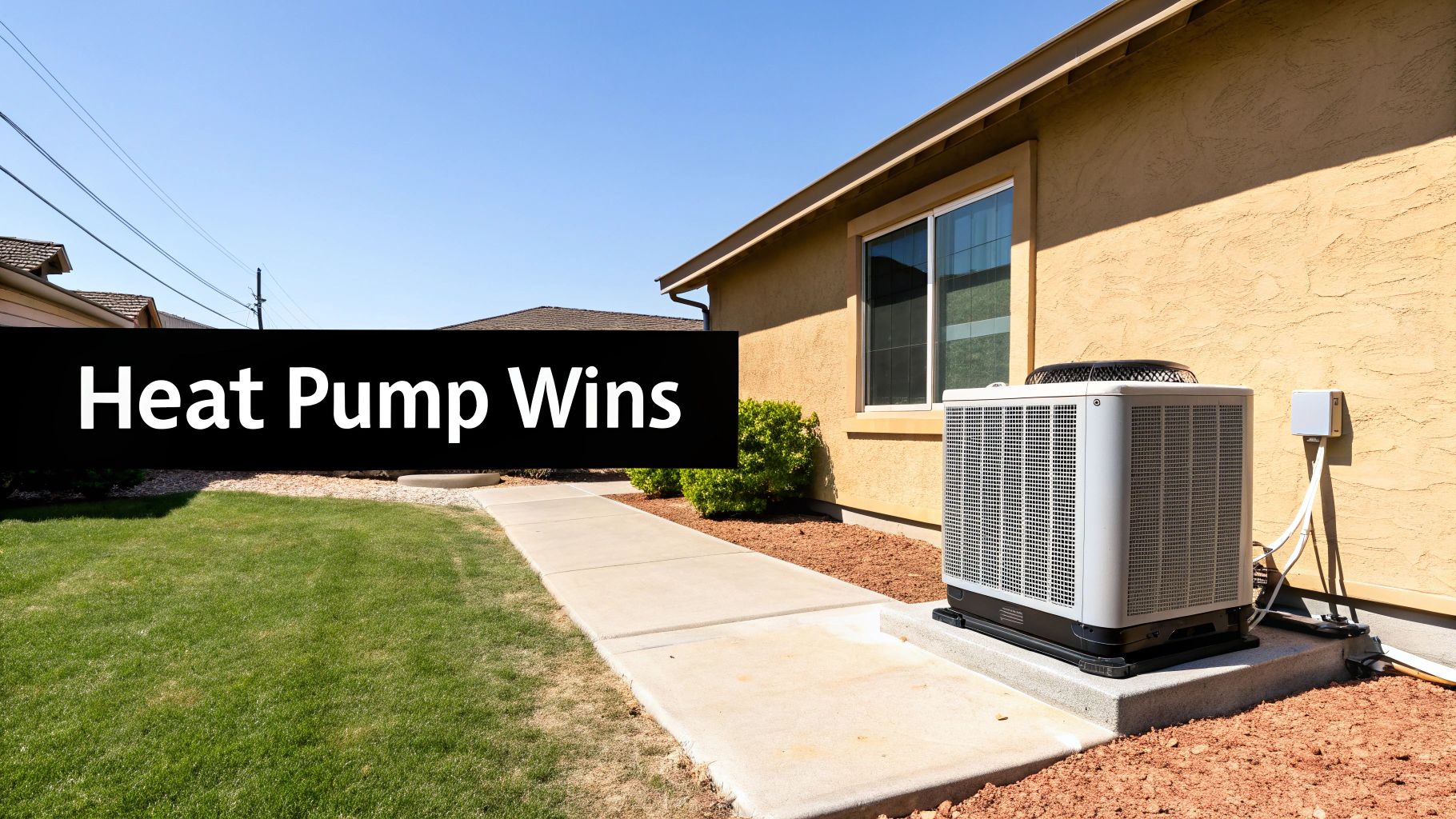
When you compare upfront price tags, heat pumps can seem more expensive because of their two-in-one capability. For example, a standard heat pump installation might average around $4,611, whereas a similar central AC system is closer to $4,192.
Here's the kicker, though: once you factor in the current federal tax credit of up to $2,000 for qualifying heat pump models, the math changes completely. That credit can slash the effective cost, often making the heat pump the more affordable initial investment right out of the gate. You can learn more about how a heat pump works in our detailed guide here: https://www.covenantairesolutions.com/post/what-is-a-heat-pump-air-conditioning-system-discover-its-benefits.
And for those interested in how this technology compares in other applications, this piece on Electric Pool Heat Pumps vs. Gas Pool Heaters offers some great insights into efficiency and cost.
Understanding the Upfront Investment for Each System
When you're weighing the cost of a heat pump against a traditional air conditioner, the price tag you see first is just the beginning of the story. To get a real handle on the upfront investment, you have to look at everything that goes into the final bill so there are no surprises down the road.
The total cost isn't random; it's a direct reflection of a few key factors that apply to both types of systems. These elements don't just set the equipment price, they also determine how complex and costly the actual installation will be.
Core Factors Influencing Your Initial Cost
Think of it like buying a car. The final price you pay is a direct result of the system's power, quality, and performance. Three main variables will have the biggest impact on what you invest initially.
System Size (Tonnage): We size HVAC systems in "tons," which is a measure of their cooling capacity. A bigger house facing Tucson’s intense sun needs a higher tonnage system, and that will naturally cost more than a smaller unit. Getting this wrong is a big deal; a system that’s too big or too small will struggle to keep you comfortable, drive up your bills, and wear out way too fast.
Brand and Model: Just like cars, some HVAC brands come with a premium price tag. Top-tier brands might offer advanced features, better warranties, or just a rock-solid reputation for durability, all of which is reflected in their cost.
Efficiency Ratings: This is a major cost driver. Higher efficiency ratings like SEER2 (Seasonal Energy Efficiency Ratio 2) and HSPF2 (Heating Seasonal Performance Factor 2) mean the unit sips energy instead of chugging it. These high-performance models cost more upfront but pay you back with serious long-term savings on your utility bills.
It's easy to forget that with an air conditioner, you're only buying a cooling appliance. A heat pump, on the other hand, handles both cooling and heating in one streamlined package, combining what would otherwise be two separate purchases.
Breaking Down Realistic Price Ranges in Tucson
For homeowners here in the Tucson area, getting a new central air conditioner installed typically runs anywhere from $4,000 to over $8,000. This ballpark figure usually covers the outdoor condenser, the indoor evaporator coil, and the standard labor to put it all together.
Now, a heat pump installation generally starts around $5,000 and can go to $10,000 or more. At first glance, that number looks higher, but it’s a more complete picture. It gives your home both a high-efficiency air conditioner and a heater, meaning you don't have to buy a separate furnace.
That distinction is everything. When you buy a standalone AC, you've still got to figure out how to heat your home. For most people, that means buying a furnace, which tacks on another $3,000 to $6,000 to the project. All of a sudden, that "cheaper" AC option isn't so cheap when you account for a complete, year-round comfort system. The heat pump rolls that all into one, more efficient unit. You can get more details on this in our guide to AC replacement.
Don't Forget Potential Secondary Costs
Beyond the big equipment, the existing setup in your home can add to the final installation price. It’s smart to anticipate these secondary costs to build a truly accurate budget.
Potential additional expenses include:
Ductwork Modifications: If your ducts are old, leaky, or not sized correctly for the new system, they’ll probably need some work. Good airflow is non-negotiable for efficiency, so fixing duct issues is an investment that pays off.
Electrical Upgrades: Modern, high-efficiency systems sometimes have different electrical needs than the old clunkers they’re replacing. Your home might need a new circuit, an upgraded panel, or other wiring tweaks to safely power the new equipment.
Thermostat Upgrade: To really unlock the full potential of a new system, especially a multi-stage heat pump, a new smart thermostat is almost always the right move. It’s a small extra cost that delivers huge benefits in efficiency and comfort.
Looking Beyond the Sticker Price: Long-Term Operating Costs and Savings
The initial purchase price is a big number, but the real cost of your HVAC system shows up on your monthly utility bills, year after year. This is where the true financial gap between a heat pump and a traditional air conditioner becomes clear, especially here in Arizona. It’s also where a heat pump’s incredible efficiency really starts to pay off.
Unlike a furnace that literally burns fuel to generate heat, a heat pump simply transfers it. In the summer, it pulls heat from inside your home and moves it outside. In the winter, it does the exact opposite, pulling warmth from the outside air and bringing it in. This process of moving heat is far more efficient than creating it from scratch, which translates directly into lower electricity usage and serious savings.
Making Sense of Efficiency Ratings: SEER, HSPF, and COP
To really grasp these savings, you need to speak the language of HVAC efficiency. When you're comparing systems, you'll run into a few key ratings, each telling a piece of the story.
SEER (Seasonal Energy Efficiency Ratio): This is all about cooling efficiency. A higher SEER rating means the unit sips less energy to cool your home, an absolute must for surviving a Tucson summer without breaking the bank.
HSPF (Heating Seasonal Performance Factor): Think of this as the SEER for heating, specific to heat pumps. It measures how efficiently the unit warms your home over an entire winter season.
COP (Coefficient of Performance): This rating gives you a real-time snapshot of efficiency. A COP of 3, for example, means the heat pump is producing three units of heat for every single unit of electricity it uses.
The real magic of a heat pump is its dual-function efficiency. A high-SEER heat pump cools just as powerfully as a high-SEER air conditioner, but it also delivers heat that is often 200% to 400% more efficient than a standard electric furnace.
You can take a closer look at these ratings and find out more about what a SEER rating is and how it impacts your energy bills in our detailed guide. Getting familiar with these numbers helps you accurately predict the long-term heat pump vs air conditioner cost.
This chart breaks down the main factors that drive overall HVAC costs, highlighting the critical role that efficiency plays. As you can see, choosing a more efficient system is a direct investment in lower operating costs and better long-term value.
What This Means for Arizona Homeowners
All that efficiency isn't just theory; it adds up to real money in your pocket, year after year. This is especially true in Arizona's climate, where our long, brutal cooling seasons and milder winters create the perfect conditions for a heat pump to shine. The savings start piling up quickly, chipping away at any higher upfront installation cost.
And the research backs this up. The National Renewable Energy Lab found that a whopping 62% to 95% of U.S. households could lower their energy bills by switching to a heat pump. For most families, that means annual savings between $300 and $1,500. On top of that, their incredible efficiency means heat pumps also cut household emissions by 36% to 64%, which is a huge win for air quality in our communities.
To make an even bigger dent in your long-term energy bills, it pays to look at other home efficiency upgrades. For example, learning about how much solar screens cost can reveal another powerful way to lighten your AC's workload and slash those monthly expenses.
Ultimately, picking a high-efficiency heat pump is a direct investment in your future utility bills, making it a smart financial move for most homeowners in the Tucson area.
Maximizing Your Return With Rebates And Tax Credits
The sticker price on a new HVAC system rarely tells the whole story. When you’re weighing the heat pump vs. air conditioner cost, what really matters is the final number you pay out-of-pocket. Smart homeowners know that federal and local incentives can dramatically shrink that initial investment, often turning a high-efficiency heat pump into a surprisingly savvy financial move.

The biggest game-changer here is the federal tax credit available through the Inflation Reduction Act. This isn't just a small discount; it’s a direct, dollar-for-dollar reduction of what you owe on your taxes, making it an incredibly powerful tool.
This credit is a big deal. It specifically targets high-efficiency heat pumps, often leaving standard air conditioners out of the running. This alone can fundamentally shift the cost calculation in favor of modern, energy-saving technology.
Unlocking Federal Tax Credits For Your New Heat Pump
The federal government is actively encouraging homeowners to upgrade to energy-efficient equipment, and heat pumps are front and center. Getting the details right is the key to maximizing your return.
Credit Amount: You can claim a credit for 30% of the total project cost, capped at $2,000 annually, for a qualifying heat pump installation.
Eligibility Requirements: The system has to meet specific energy efficiency benchmarks set by the Consortium for Energy Efficiency (CEE). We make sure the models we recommend at Covenant Aire Solutions always meet or exceed these standards.
Claiming the Credit: It's pretty straightforward. You'll file IRS Form 5695, Residential Energy Credits, with your yearly tax return. Just be sure to keep all your invoices and installation paperwork handy.
This tax credit effectively slashes the net cost of your new heat pump. In many cases, it makes the upfront price more competitive than a less-efficient AC and furnace combo.
Tapping Into Local Utility Rebates In Tucson
On top of the federal incentives, don't forget to look closer to home. Many local utility companies right here in the Tucson area offer their own rebate programs. Think of these as direct cash-back offers for installing a system that helps reduce strain on our local power grid.
Stacking incentives is the smartest way to save. When you combine a federal tax credit with a local utility rebate, you can potentially knock thousands of dollars off the price tag. Suddenly, a top-of-the-line heat pump becomes incredibly affordable.
These local programs are designed to reward you for making energy-conscious choices. Tucson Electric Power (TEP), for example, frequently offers rebates for high-efficiency heat pumps that meet certain SEER2 ratings. The exact amounts can change, but they provide another fantastic layer of savings that brings your out-of-pocket cost down even further.
Sample Return On Investment Calculation: Tucson Scenario
So, what does this look like in the real world? This table breaks down a realistic scenario for a Tucson homeowner, showing how incentives dramatically change the financial picture when choosing a heat pump over a traditional AC and furnace setup.
Metric | Heat Pump Example | AC + Furnace Example | Notes |
|---|---|---|---|
Upfront Installation Cost | $9,000 | $7,500 | Assumes a premium, high-efficiency heat pump and a mid-range traditional system. |
Federal Tax Credit | -$2,000 | $0 | The credit is typically for high-efficiency heat pumps only. |
Local Utility Rebate (TEP) | -$500 | $0 | Rebates are also geared toward energy-efficient heat pump technology. |
Net Initial Cost | $6,500 | $7,500 | After incentives, the more advanced system is actually cheaper upfront. |
Annual Energy Savings | $400 | $0 | Estimated savings from the heat pump's superior efficiency. |
Payback Period for Extra Cost | Immediate | N/A | The heat pump is less expensive from day one and saves money every year. |
As you can see, the initial investment for the more advanced heat pump becomes $1,000 less than the traditional option once you apply the available incentives.
This powerful combination of federal and local programs makes the financial argument for a heat pump incredibly compelling. When you add in the long-term energy savings, the return on investment is undeniable. Juggling these costs and financing can get complicated, which is why our guide on HVAC financing options can help provide more clarity and solutions.
Comparing Maintenance, Lifespan, and Repair Expenses
An HVAC system is a big-ticket item, and its true cost goes far beyond what you pay on day one. To really stack up the heat pump vs air conditioner cost, we have to look down the road at maintenance, expected lifespan, and the repair bills that might pop up. Both systems need a pro’s touch to run right, but how they work day-to-day can change how long they stick around.
The biggest difference? A heat pump pulls double duty, working all year long. It’s your go-to for cooling during Tucson's blistering summers and your source for heat in our mild winters. That constant use means it racks up more hours than a standard air conditioner, which gets a break once the weather cools down.
But don't assume that automatically means a shorter life. Today’s heat pumps are built for the long haul. They’re engineered with heavy-duty components specifically designed to handle the grind of both heating and cooling, keeping them reliable no matter the season.
How Usage Impacts System Lifespan
A typical central air conditioner, with the right care, should last you somewhere between 15 to 20 years. It does all its hard work during the hottest months and then gets some well-deserved downtime.
On the other hand, a heat pump usually has a slightly shorter estimated lifespan, often in the 10 to 15-year range. This is purely a result of its year-round job. Since it's running in both summer and winter, parts like the compressor and reversing valve just see more action. You can get a deeper dive on this in our guide to heat pump life expectancy for homeowners.
This difference is a huge piece of the long-term cost puzzle. While a heat pump can trim your monthly energy bills, you might be planning for a replacement a few years sooner than you would with a standalone AC.
The Critical Role of Professional Maintenance
Whether you land on a heat pump or an air conditioner, the single most important thing you can do to get the most out of it and dodge repair costs is consistent, professional maintenance. Skipping service is a surefire way to find yourself with a broken system and a hefty emergency bill, especially during a Tucson heatwave.
Think of your HVAC system like any high-performance machine: it needs regular tune-ups to stay at the top of its game. Biannual maintenance isn't just a suggestion; it's an investment that pays for itself by preventing up to 95% of common repairs and seriously extending the system’s life.
Regular check-ups also make sure your system is running as efficiently as possible, which keeps your energy bills from creeping up. For either system, a pro technician will handle the crucial tasks that protect your investment.
Key Maintenance Tasks Include:
Cleaning Coils: Dirty condenser and evaporator coils make the system work overtime, jacking up energy use and putting a strain on the compressor.
Checking Refrigerant Levels: The wrong refrigerant level can wreck the compressor, which is one of the most expensive parts to replace in any HVAC system.
Inspecting Electrical Components: A technician will tighten connections and check capacitors and contactors to head off electrical failures before they happen.
Clearing Drain Lines: A clogged condensate drain line can cause water damage in your home and shut your whole system down flat.
For a heat pump, we recommend maintenance twice a year: once in the spring to get it ready for cooling, and again in the fall to prep for heating. An air conditioner also needs that annual spring check-up, while the furnace it's paired with will need its own inspection in the fall.
Ultimately, being proactive is the smartest way to manage your HVAC costs over the long term. By scheduling regular service, you give both systems the best shot at reaching their full lifespan while keeping surprise repair bills off your plate.
Which System Is Right for Your Arizona Home
After weighing everything from the initial price tag to the monthly utility bills, the final verdict in the heat pump vs. air conditioner cost debate really boils down to your specific home and lifestyle. There’s no magic answer that works for every Arizona household, but by walking through a few common situations, we can get you much closer to the right choice.
For the vast majority of Tucson homeowners who are looking to replace their entire HVAC system, a modern heat pump is the clear winner. The long-term value is simply unmatched, since it bundles high-efficiency heating and cooling into a single unit. When you factor in the massive energy savings and the big federal tax credits available, the total cost of ownership often ends up being lower than installing a separate AC and furnace.
This all-in-one approach streamlines maintenance and gives you rock-solid comfort through our long, hot summers and milder winters. It's a smart investment that literally pays you back on every utility bill.
Recommendations for Specific Arizona Lifestyles
While a heat pump is generally the best all-around option, some scenarios call for a more tailored approach. Your day-to-day life plays a huge role in what system will serve you best.
For the Year-Round Resident: If you’re living in your home full-time, maximizing energy efficiency is the name of the game. A high-efficiency heat pump is your best bet for keeping those summer electricity bills under control while still getting plenty of warmth when the temperature drops. Its steady, reliable performance makes sure your home is a comfortable escape, no matter the season.
For the Seasonal "Snowbird": Seasonal residents need a system that's both dependable and smart, especially one you can control from afar. A heat pump connected to a smart thermostat gives you total peace of mind. It ensures your home is protected and ready for your return without burning through cash while you're gone.
For the Air Quality-Focused Family: If top-notch indoor air quality is a major priority, you can add advanced air purification technology to either system. That said, a heat pump's consistent air circulation can give it an edge. By moving air more frequently, it helps your filtration system continuously pull dust, allergens, and other gunk out of the air you breathe.
The best HVAC system is one that perfectly aligns with your home's unique layout, your family's comfort preferences, and your financial goals. A professional assessment is the only way to guarantee you're making the right choice, not just a good one.
Ultimately, the smartest thing you can do is get a personalized evaluation from a trusted professional. A technician can run a detailed load calculation, check out your existing ductwork, and talk through your specific needs to recommend a system that’s perfectly sized and configured for your home. This is the only way to ensure you get the absolute most comfort and efficiency out of your investment for years to come.
Answering Your Top Questions About HVAC Costs in Arizona
When it comes to the heat pump vs. air conditioner cost debate, a few practical questions always come up. To help you get some clarity, we've put together direct answers to the concerns we hear most often from homeowners right here in Arizona. Making a confident choice means having all the facts, especially the ones that apply to our unique climate.
This isn't just a generic FAQ; we're tackling the real-world scenarios you're probably thinking about. We'll get into how these systems hold up under the brutal Tucson sun and whether a heat pump can truly handle our mild winters on its own. Our goal is to give you those last few pieces of the puzzle so you can pick the perfect system for your home.
Can a Heat Pump Really Handle an Extreme Arizona Summer?
Absolutely. This is probably the most critical question for anyone living in Tucson, and the answer is a resounding yes. Modern heat pumps are built to cool just as effectively as traditional air conditioners, even when the thermometer blasts past 100°F.
They use the exact same technology for cooling: pulling heat from inside your home with refrigerant and dumping it outside. The trick is to choose a unit with a high SEER2 rating. A higher rating means it's more efficient at cooling, which is a must-have for both comfort and keeping your electric bills from getting out of control during our long summers. A properly sized, high-efficiency heat pump is more than ready to take on Arizona's heat.
A lot of homeowners are surprised when they learn that a heat pump's cooling function is identical to a central AC's. The only real difference is its ability to reverse that cycle for heating, making it a powerful two-in-one solution that doesn't compromise on summer performance.
Is a Heat Pump Alone Enough for Our Winters?
For the vast majority of homes in and around Tucson, a heat pump is the perfect all-in-one heating solution. Our winters are pretty mild, and we rarely see the kind of bone-chilling temperatures that would push a modern heat pump to its limits. They are incredibly good at extracting warmth from the cool outdoor air.
On the rare occasion we do get a serious cold snap, most heat pumps come equipped with auxiliary heating strips, sometimes called "aux heat." It's basically an electric resistance heater that kicks in for an extra boost of warmth, guaranteeing your home stays comfortable. But in our climate, you'll hardly ever need it, letting you cash in on the heat pump's amazing energy efficiency all winter long.
How Much Will the Tax Credits Actually Save Me?
The federal tax credits can make a huge difference, often making a top-tier, high-efficiency system much more affordable. Right now, you can claim a tax credit for 30% of the total project cost, with a maximum savings of $2,000.
This isn't just a deduction; it's a direct, dollar-for-dollar reduction of what you owe in taxes. For instance, if your new heat pump installation costs $9,000, that $2,000 credit brings your final out-of-pocket cost down to $7,000. This incentive can completely close the price gap between a heat pump and a new AC, often making the more efficient choice the more affordable one right from the start.
Ready to find the perfect, most cost-effective comfort solution for your home? The experts at Covenant Aire Solutions are here to provide a personalized assessment and a transparent, no-pressure quote. Visit us online or call today to schedule your consultation.