
Unlock hvac service contract cost: Save on premium service plans today
- Feb 7
- 14 min read
On average, you can expect an HVAC service contract to run somewhere between $175 and $350 per year. That typically covers two seasonal tune-ups to make sure your system is ready for the brutal summer heat and the chilly winter nights.
Think of it this way: it's a small, planned expense. It’s a strategic move that helps you sidestep those sudden, gut-wrenching repair bills that can easily top a thousand dollars, especially during Arizona's peak seasons.
Is an HVAC Service Contract a Smart Investment for Your Home?
Honestly, the best way to think about an HVAC service contract is like preventive medicine for your home’s hardest-working system. Here in Arizona, our air conditioners and furnaces don't just work; they work overtime. All that stress leads to serious wear and tear.
A service plan flips the script from reactive panic to proactive care. Instead of scrambling to find a technician during a miserable mid-July breakdown, you’ve got a trusted partner on your side, making sure your system is ready for whatever the weather throws at it. That small, predictable annual fee is your shield against unexpected and often staggering repair costs.
The Financial Logic of Preventive Care
The numbers really tell the story here. The average professional HVAC maintenance agreement costs about $225 a year, which gets you those biannual check-ups, priority service when you need it, and discounts on any repairs.
Now, let's compare that to flying without a net. A single emergency repair can easily set you back anywhere from $415 to $1,200. And if the whole system gives up? You could be looking at a replacement cost of $9,000 to $16,500. Suddenly, that annual fee looks pretty reasonable.
An HVAC service contract essentially trades a small, fixed cost for protection against massive, unpredictable expenses, ensuring both your comfort and your financial peace of mind.
To really get why this makes sense, check out our guide on the top benefits of HVAC maintenance for Tucson homes. When you see what goes into proper upkeep, like the tasks in this ultimate seasonal home maintenance checklist, you start to appreciate the value of having a professional handle it all.
Let's break down how that annual plan fee stacks up against the cost of common emergency repairs you might face without one.
Annual Plan Cost vs. Potential Emergency Repair Costs
Expense Type | Average Annual Cost | Potential Savings |
|---|---|---|
HVAC Service Plan | $175 - $350 | - |
Emergency AC Repair (e.g., Capacitor) | $415+ | $240+ |
Emergency Furnace Repair (e.g., Ignitor) | $350+ | $175+ |
Refrigerant Leak Repair | $225 - $1,600 | $50 - $1,425+ |
As you can see, the cost of just one unexpected repair can often be double or triple the price of an entire year's worth of preventive maintenance. A service plan isn't just an expense; it's an investment in reliability and a buffer against budget-busting surprises.
Here at Covenant Aire Solutions, we're all about transparent pricing and honest advice. We want to give you a clear, upfront look at what an HVAC service contract costs so you can decide if it’s the right financial move for your family.
What Factors Determine Your HVAC Contract Price?

The price tag on an HVAC service contract isn't just a random number; it's carefully calculated based on the specific details of your home's system. Think of it like car insurance: your premium depends on the make, model, and age of your vehicle. In the same way, the final hvac service contract cost reflects what your unique equipment needs to stay in top shape.
Getting a handle on these variables helps you see exactly what you're paying for. It takes the mystery out of the quote and lets you make a confident decision, ensuring you get the right coverage without paying for extras you don’t need.
System Type and Size
The biggest factor influencing your contract price is the equipment itself. A home with a straightforward central air conditioner and furnace will have a different cost than one with a more complex heat pump or a ductless mini-split system that has several indoor units to service.
It makes sense, right? Larger systems with a higher tonnage, built to cool bigger homes, simply require more time, effort, and materials to tune up properly. The scope of the work scales directly with the size and complexity of your HVAC setup.
Equipment Age and Condition
The age and current health of your system are also huge. An older unit, a lot like a high-mileage car, is naturally more prone to wear and tear. It might require a little more attention from a technician to keep it running smoothly and reliably.
A service plan for a system over 10 years old may cost slightly more because it represents a higher risk of needing repairs. Technicians must be more thorough in checking for worn parts and potential failures.
On the flip side, a brand-new system might qualify for a lower-priced contract since it's far less likely to have immediate problems. In this case, the contract's goal is purely preventive, focusing on maintaining peak efficiency from day one.
Coverage Level and Service Frequency
Not all service plans are created equal. A basic plan might just cover two annual tune-ups, one for heating and one for cooling. A premium plan, however, could include a lot of valuable extras that increase the overall hvac service contract cost.
These more comprehensive plans often provide perks that can really pay off, such as:
Discounts on Repairs: Many contracts offer a nice 10-20% off any necessary repair parts and labor.
Priority Service: This is a huge one. It lets you jump to the front of the line during busy seasons, an absolute lifesaver in an Arizona summer.
Waived Diagnostic Fees: Some premium plans will waive the standard service call fee if a repair is needed, which saves you money right away.
Understanding how much HVAC maintenance costs can help you decide which coverage level is the right fit. While upfront fees can deter 30-40% of households, those with contracts often see 20-30% lower operational costs over five years. It's a powerful testament to the value of preventive care.
Decoding the Fine Print: What a Great Service Contract Includes
When you sign up for an HVAC service contract, you're not just buying a tune-up; you're investing in peace of mind. But to really get your money's worth, you need to know what a high-quality plan actually delivers. Think of it like a car's factory maintenance schedule; specific tasks are done to keep the engine humming and prevent a breakdown on the highway.
A great service contract goes far beyond a quick, superficial glance. It should lay out a detailed, systematic check of your entire system to make sure it's ready for the brutal demands of an Arizona summer. Knowing what to look for helps you spot a thorough plan that offers real protection versus one that just checks a box.
Core Maintenance and Inspection Tasks
The foundation of any worthwhile service agreement is a comprehensive inspection and cleaning. A good technician should do far more than just swap out a filter. A solid plan will always include meticulous checks of the most critical, hardest-working parts of your system.
Key services you absolutely want to see include:
Complete System Inspection: This means checking all electrical connections for safety, testing capacitors and relays, and inspecting the blower motor and wheel. These are the components that are most likely to fail under the stress of a heatwave.
Coil and Drain Cleaning: Here in Arizona, dust and debris can quickly clog your evaporator and condenser coils, forcing your system to work much harder than it should. A technician needs to clean these coils and flush the condensate drain line to prevent water damage and boost efficiency.
Refrigerant Level Checks: Improper refrigerant levels are a top cause of AC failure and inefficiency. A tech will check the pressure to ensure it matches the manufacturer’s specs, which prevents unnecessary strain on your compressor.
Thermostat Calibration: A thermostat that's even slightly off can lead to discomfort and wasted energy. The technician should test its accuracy to ensure it’s reading the room temperature correctly and signaling your system at the right times.
A truly valuable HVAC service contract is defined by its thoroughness. It should include detailed inspections of electrical systems, cleaning of critical coils, and precise calibration to ensure every part of your system works in harmony.
What Sets a Premium Plan Apart
Beyond the essential tune-up tasks, many contracts offer extra benefits that significantly boost their value. These perks are designed to save you money and headaches when problems pop up. They transform the agreement from a simple maintenance checklist into a true service partnership.
A premium plan often adds financial and logistical safeguards. For example, many contracts provide priority service, which bumps you to the front of the line during a heatwave when wait times can stretch for days. They also frequently include a 10-20% discount on any necessary repairs, covering both parts and labor, which can quickly pay for the annual contract itself. Some even waive diagnostic fees entirely. You can explore different preventive maintenance plans to see how these valuable extras are structured.
These are the features that ensure when you need help the most, you get it fast and at a lower cost.
Before you sign on the dotted line, it's crucial to understand exactly what you're getting. A well-structured contract should feel like a protective shield for your home's most important appliance. This checklist breaks down the essential services a high-value plan should offer, especially for homeowners here in Arizona.
Essential Checklist for a High-Value HVAC Service Contract
Service Category | Key Tasks Included | Why It Matters in Arizona |
|---|---|---|
Electrical System | Inspect and tighten all wiring, check capacitors and relays, test motor voltage and amperage. | Loose connections and failing capacitors are a leading cause of sudden breakdowns during extreme summer heat. |
Airflow & Blower | Inspect blower components, clean blower wheel, verify proper airflow. | Dust buildup on the blower can restrict airflow, reducing efficiency and putting extra strain on the motor. |
Coil & Condensate | Clean evaporator and condenser coils, flush and treat condensate drain line. | Clogged coils force the AC to run longer to cool your home, while a blocked drain can cause water damage. |
Refrigerant Levels | Measure refrigerant charge and check for leaks. | Incorrect refrigerant levels dramatically reduce cooling power and can destroy the compressor over time. |
Safety & Controls | Calibrate thermostat, test safety controls, check starting capabilities. | Ensures the system operates safely and responds accurately to your temperature settings, preventing energy waste. |
Outdoor Unit | Clean debris from condenser unit, inspect fan motor and blades. | A clean outdoor unit can expel heat more effectively, which is critical for efficiency in our hot climate. |
Using a checklist like this helps you compare different plans apples-to-apples. A contract that includes these detailed tasks isn't just a cost; it's an investment in reliability, efficiency, and comfort for your home.
Calculating the True Value of Your Maintenance Plan
It's easy to look at an HVAC service contract as just another annual expense, but that’s like looking at only one side of a coin. To really understand its worth, you have to think about the long-term return on your investment. A maintenance plan isn’t just a fee; it's a powerful tool for protecting the single most expensive appliance in your home from breaking down too soon or running inefficiently.
The value really comes from two places: making your system run better to lower your monthly bills, and stopping those catastrophic breakdowns that can completely drain your savings. When your system is clean and running at its peak, it uses less energy. That translates directly into lower utility bills, month after month.
Extending Your Equipment’s Lifespan
Think of regular HVAC maintenance like getting routine oil changes for your car; it’s absolutely essential if you want it to last. A well-maintained HVAC system can run for years longer than one that's been neglected, pushing back the massive expense of a full replacement, which can easily top $9,000.
When a technician catches and fixes small issues like a worn-out capacitor or a loose electrical connection, they’re preventing a domino effect that could take out major components, like the compressor. This proactive care is what keeps your system humming along reliably for its entire intended lifespan.
This infographic breaks down the core tasks that are the foundation of any valuable HVAC maintenance plan.
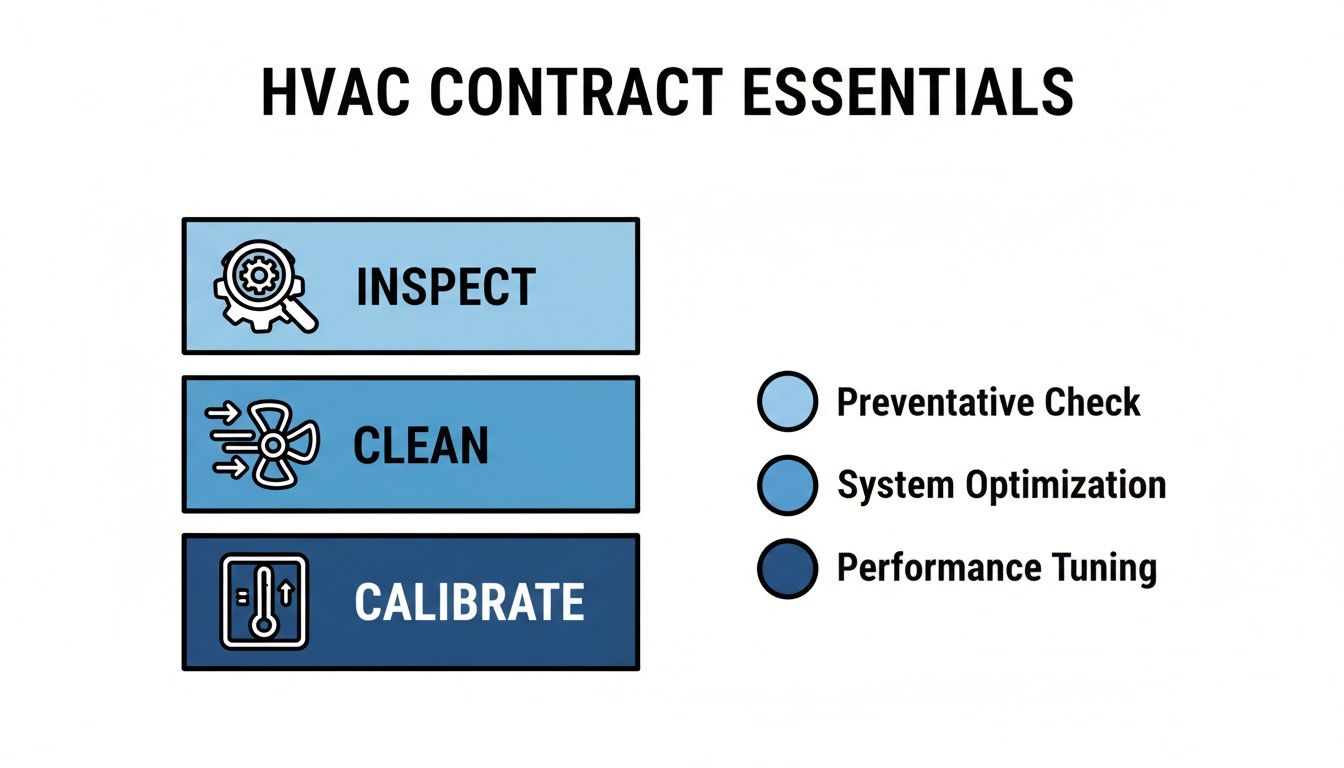
These three pillars, inspecting, cleaning, and calibrating, all work together. They ensure your system operates at peak performance, which directly contributes to its longevity and efficiency.
Shielding Your Budget from Unexpected Repairs
A good maintenance plan also acts as a financial buffer, protecting you from getting blindsided by sudden, expensive repair bills. Industry data shows that having regular maintenance can head off up to 70% of all equipment failures. This preventive approach is becoming more common, with the global market for proactive care projected to grow by 6.2% by 2030 as more homeowners realize it's smarter than waiting for a breakdown.
Let’s run the numbers with a realistic five-year scenario to see how the savings really stack up.
Scenario: A Five-Year Cost Comparison
Imagine two homeowners with identical 8-year-old HVAC systems. Homeowner A decides to invest in a $250 annual service plan, while Homeowner B skips it.
Homeowner A (With a Plan): Over five years, they spend $1,250 on maintenance. Their plan gives them a 15% discount on any repairs. When the fan motor inevitably gives out (a $600 job), they only pay $510. Their total five-year cost comes to $1,760.
Homeowner B (Without a Plan): They skip maintenance altogether. Their system runs inefficiently, tacking an extra $20/month onto their energy bills ($1,200 over five years). When that same fan motor fails, they pay the full $600. Their total five-year cost is $1,800.
Even in this conservative example, Homeowner A came out ahead. And that's not even counting the priority service they received or the simple peace of mind that comes from knowing a professional is keeping an eye on their system. Over time, the savings from better efficiency and discounted repairs make the initial hvac service contract cost a clear financial win. You can learn more about how to improve your AC efficiency and lower bills in our detailed guide.
How to Choose the Right HVAC Service Plan for Your Needs
Choosing an HVAC service plan isn't about just grabbing the cheapest one or the one with the most features. It’s about finding a perfect match for your home, your system, and your budget. The right contract is like a personalized shield for your heating and cooling equipment, giving you peace of mind without breaking the bank.
Making the right call requires a little honest self-assessment. If you take a clear-eyed look at your equipment, your finances, and how you feel about risk, you can easily navigate the options and pick a plan that feels like it was designed just for you.
Assess Your System and Your Situation
First thing's first: take a look at your HVAC unit itself. Is it a brand-new system that's still comfortably under warranty, or is it a seasoned veteran that’s been chugging along for more than a decade? The age and performance history of your equipment are the biggest pieces of the puzzle.
An older system is simply more likely to need repairs; that's just a fact of life. This makes a more comprehensive plan a pretty smart bet. On the flip side, a newer system might only need a basic plan focused on preventive tune-ups to keep that warranty valid and ensure it stays efficient right from the start.
Your personal comfort level with risk is just as important as your system’s age. Ask yourself this: would a sudden $800 repair bill be a major financial headache, or is that something you could handle without much stress?
If an unexpected expense would throw your budget into chaos, a higher-tier plan that offers discounts on repairs and waives diagnostic fees can be a lifesaver. It essentially transforms an unpredictable, potentially large repair cost into a fixed, manageable annual fee.
Compare Service Tiers and Coverage
Once you’ve got a handle on your needs, you can start comparing the different levels of service companies offer. Most HVAC contractors have a few tiers, letting you pick the coverage that best lines up with your situation.
Here’s a common breakdown you’re likely to see:
Basic Plans: These usually cover the essentials, the two yearly tune-ups for your heating and cooling systems. They’re perfect for newer systems or for homeowners who want to prioritize preventive care on a tighter budget.
Mid-Tier Plans: These plans often bundle the tune-ups with extras like a 10-15% discount on any repairs that pop up. They also typically include priority service, which bumps you to the front of the line during those sweltering summer or freezing winter peaks.
Premium Plans: Think of these as the all-inclusive option. They usually offer the highest discounts (sometimes 20% or more), waive service call fees entirely, and might even cover the cost of certain common replacement parts. This is the ideal choice for older systems or for anyone who wants maximum protection against surprise costs.
By carefully weighing your system's condition against your financial comfort zone, you can confidently choose the plan that gives you the right balance of protection and value. This ensures the hvac service contract cost isn't just an expense, but a truly wise investment in your home's comfort and your own peace of mind.
Smart Ways to Save Money on Your HVAC Contract
Making sure you have a quality service plan doesn't mean you have to break the bank. With a few smart strategies, you can lower the HVAC service contract cost while still getting the excellent coverage your system needs. It really just comes down to asking the right questions and knowing when to hunt for a deal.
One of the easiest ways to save a little cash is to ask about multi-year agreements. Think about it from the company's perspective: guaranteed business is a good thing. Many providers are happy to offer a discount if you commit to two or three years upfront, which also lets you lock in a lower rate and sidestep any annual price hikes.
Timing your purchase can also work in your favor. HVAC companies are swamped during heatwaves and cold snaps, so try asking about seasonal promotions during the milder spring or fall months when their phones aren't ringing off the hook.
Finding Hidden Discounts and Special Offers
Beyond the usual seasonal deals, a lot of community-focused HVAC providers have programs designed to give back to the folks who serve us all. It never hurts to ask if a company has special rates for certain groups.
For instance, many companies are proud to support local heroes. At Covenant Aire Solutions, this is something we believe in strongly, which is why we offer discounts for:
Teachers
Military Personnel (Active and Veterans)
First Responders
The best value isn't always the lowest sticker price; it's finding a comprehensive plan from a trusted provider that fits comfortably within your budget.
Also, if you're already planning on other services like duct cleaning or an air quality assessment, ask about bundling them together. Companies can often put together a package deal that brings down the total cost compared to scheduling everything separately.
And for homeowners looking for more ways to manage big-ticket expenses, learning about HVAC financing options and ways to save can provide some much-needed financial breathing room. Just by being a proactive and informed customer, you can find a plan that delivers both top-notch service and great value.
Answering Your Questions About HVAC Service Contracts
Even after laying it all out, you probably have a few specific questions floating around. That’s perfectly normal. To make sure you feel totally confident in your decision, let's tackle some of the most common questions we hear from homeowners about what these plans really do.
Is an HVAC Service Contract Worth It for a Brand New System?
Absolutely, and here's the biggest reason why: most manufacturers actually require proof of regular professional maintenance to keep your warranty valid. A service contract is the easiest way to check that box from day one, protecting your big investment.
Beyond the warranty, it's about starting off on the right foot. A new system needs to be dialed in to run at peak efficiency right away. This saves you money on energy bills and prevents unnecessary wear on critical parts, setting your system up for a long, trouble-free life.
Can I Just Do My Own HVAC Maintenance Instead?
While homeowner tasks like swapping out your air filters are incredibly important, they simply don't take the place of a professional tune-up. Certified technicians come equipped with specialized tools to handle tasks that are either unsafe or impossible for the average homeowner.
They’re checking refrigerant levels, testing sensitive electrical components, and deep cleaning internal parts you can't see. Professional maintenance is the only way to guarantee safety, hit peak efficiency, and stay fully compliant with your system's warranty.
What Is the Difference Between a Service Contract and a Home Warranty?
This is a fantastic question, and the answer comes down to one key difference: being proactive versus being reactive.
A service contract is all about preventive maintenance. Its goal is to keep your system running perfectly to avoid breakdowns in the first place. A home warranty is reactive insurance that helps pay for repairs after your system has already failed.
A good service contract from a dedicated HVAC company like ours often prevents you from ever having to make a home warranty claim for your heating and cooling system.
How Often Should My HVAC System Be Serviced in Arizona?
Given Arizona's extreme climate, we strongly recommend biannual service. That means one tune-up in the spring to get your air conditioner battle-ready for the summer, and another in the fall to prepare your heater for the cooler months.
This twice-a-year frequency is critical for systems that work as hard as ours do in the Valley. It’s the best way to ensure top performance, high efficiency, and the long lifespan you expect from your equipment, year after year.
Ready to protect your home's comfort system with a plan that delivers real value and peace of mind? The team at Covenant Aire Solutions is here to help you find the perfect preventive maintenance plan for your needs and budget. Visit us online to explore your options and schedule your first service.