
The Best Air Purifiers for Home an In-Depth Guide
Finding the best air purifiers for home really comes down to matching the right technology to what you’re dealing with. A unit with a True HEPA filter is a must-have for allergies, but if you’re trying to get rid of odors, activated carbon is what you need. The most effective choice always circles back to your primary concern: are you capturing dust and dander, or are you neutralizing smoke and chemicals?
Your Guide to Selecting the Right Home Air Purifier
Trying to navigate the world of air purifiers can feel like a chore, especially here in Tucson where dust and allergens are practically a way of life. This guide is here to cut through the noise and help you make a confident decision for your family’s health. Before diving in, it’s helpful to understand the different methods for improving indoor air quality to be sure a purifier is the right tool for the job.
Understanding Key Air Purifier Differences
The first thing to get straight is that not all purifiers are created equal. They use different technologies to clean the air, so your choice should line up with the unique challenges in your home. Some systems are passive, meaning they just trap particles that happen to pass through their filters. Others are active, working to proactively neutralize contaminants in the air and on surfaces throughout your home.
The biggest fork in the road is choosing between portable units that cover a single room and whole-home solutions that integrate with your HVAC system to treat every room at once. Your lifestyle and what you want to achieve with your air quality will point you in the right direction.
Portable vs. Whole-Home Solutions
Choosing between a small, portable unit and a fully integrated system is the first major decision you'll make. This table breaks down the core differences to help you see which one really fits your home and budget. For a deeper dive, check out our guide on how to choose an air purifier for Arizona homes.
Feature | Portable Air Purifier | Whole-Home Air Purifier |
|---|---|---|
Coverage | Limited to a single room or small area. | Covers the entire house through HVAC ducts. |
Primary Goal | Targets specific problem areas like bedrooms or offices. | Provides consistent, uniform air quality everywhere. |
Installation | Plug-and-play; no professional installation needed. | Requires professional installation into your HVAC system. |
Cost | Lower initial purchase price, but multiple units may be needed. | Higher upfront investment, but often more efficient long-term. |
When you start shopping for an air purifier, it's easy to get lost in the marketing jargon. To pick the right one, you have to look past the sleek designs and get a handle on what’s actually happening inside the machine. Different technologies go after different pollutants, so understanding how they work is the only way to find a solution that will genuinely clean up your air.
We'll break down the core systems, from old-school physical filters that literally trap particles to more advanced active technologies that hunt down and neutralize contaminants on contact.
This simple visual guide lays out the three things you need to think about: your specific needs, the technologies available, and the size of your space.
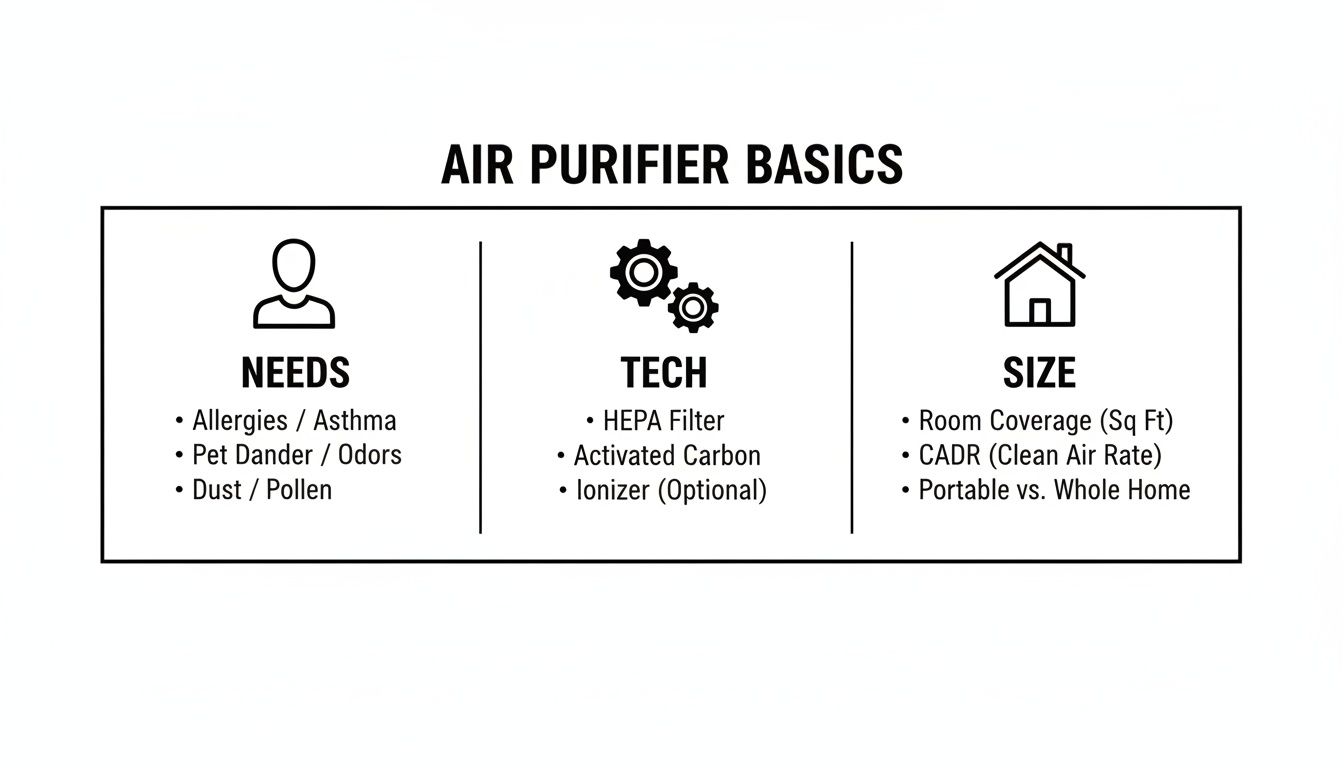
As the infographic shows, it all starts with figuring out what problems you're trying to solve. That will point you toward the right technology and the right size unit for your home.
The Foundation: True HEPA Filtration
The technology most people have heard of is the True HEPA filter. HEPA stands for High-Efficiency Particulate Air, and for a filter to earn that label, it has to be certified to capture a whopping 99.97% of airborne particles as small as 0.3 microns.
To put that into perspective, a single human hair is about 50 to 70 microns thick. This means HEPA filters are absolute champs at trapping the microscopic stuff that triggers allergies and asthma, like:
Pollen and ragweed
Dust mite debris
Pet dander
Mold spores
Because they’re so effective, HEPA-based systems continue to lead the market. The global air purifier industry is on track to grow from USD 18.09 billion in 2025 to over USD 30 billion by 2033, and HEPA's dominance is a big reason why.
Tackling Odors with Activated Carbon
While HEPA filters are fantastic at capturing solid particles, they don’t do a thing for gases, odors, or chemicals. That’s where activated carbon steps in. These filters use a special, porous form of carbon with an absolutely massive surface area.
Gaseous pollutants like volatile organic compounds (VOCs) from fresh paint or cleaning supplies get absorbed into the carbon through a process called adsorption. The molecules basically stick to the carbon’s surface, pulling them out of the air. If you've got pets, smokers, or have done any recent renovations, a good activated carbon filter is a must-have. For a closer look, check out our HEPA vs. carbon filter guide.
Key Insight: A common mistake is thinking one filter can do it all. The best all-around portable air purifiers combine a True HEPA filter for particles with a hefty activated carbon filter for odors and VOCs. This multi-stage approach gives you really well-rounded protection.
Sterilizing with UV-C Light
Another technology you’ll run into is UV-C light. Unlike filters that trap things, UV-C light is germicidal; it zaps the DNA of microorganisms like bacteria, viruses, and mold spores, making them harmless.
But here’s the catch: its effectiveness in a standard air purifier can be limited. For UV-C to actually work, the bug needs to be exposed to the light for a certain amount of time. In the fast-moving airstream of a purifier, that exposure might be too brief to guarantee it gets the job done, making it more of a secondary feature than a primary line of defense.
Proactive Purification with Active Technology
All the technologies we've talked about so far are passive. They only clean the air that gets pulled through the unit. Active technologies like ActivePure, on the other hand, work proactively. Instead of waiting for pollutants to find the filter, these systems send out oxidizing molecules that spread throughout your home’s air and onto surfaces.
These molecules actively hunt down and destroy pollutants wherever they are: on countertops, doorknobs, furniture, you name it. This makes them incredibly effective against viruses, bacteria, and mold, providing a level of clean that passive filters just can't achieve on their own. Active systems are often built into whole-home solutions, giving you comprehensive protection in every single room.
To make things clearer, here’s a quick rundown of how these four technologies stack up.
Air Purifier Technology Feature Comparison
This table offers a side-by-side look at the four main air purification methods, breaking down what they do, what they're best at targeting, and where they fit best in a home.
Technology | Primary Function | Best For Targeting | Ideal Home Environment |
|---|---|---|---|
True HEPA | Mechanical filtration | Dust, pollen, pet dander, mold spores | Homes with allergy or asthma sufferers |
Activated Carbon | Adsorption of gases | Odors, smoke, VOCs, chemical fumes | Homes with pets, smokers, or new furniture |
UV-C Light | Germicidal irradiation | Bacteria, viruses, airborne pathogens | As a supplemental feature for germ concerns |
ActivePure | Proactive neutralization | Viruses, bacteria, mold on air and surfaces | Homes seeking comprehensive, whole-home sanitization |
At the end of the day, the right air purifier is the one that solves your specific problems. Once you understand how each technology works, you can pick a system that’s perfectly matched to make your home a healthier place for your family.
How to Size an Air Purifier for Your Space
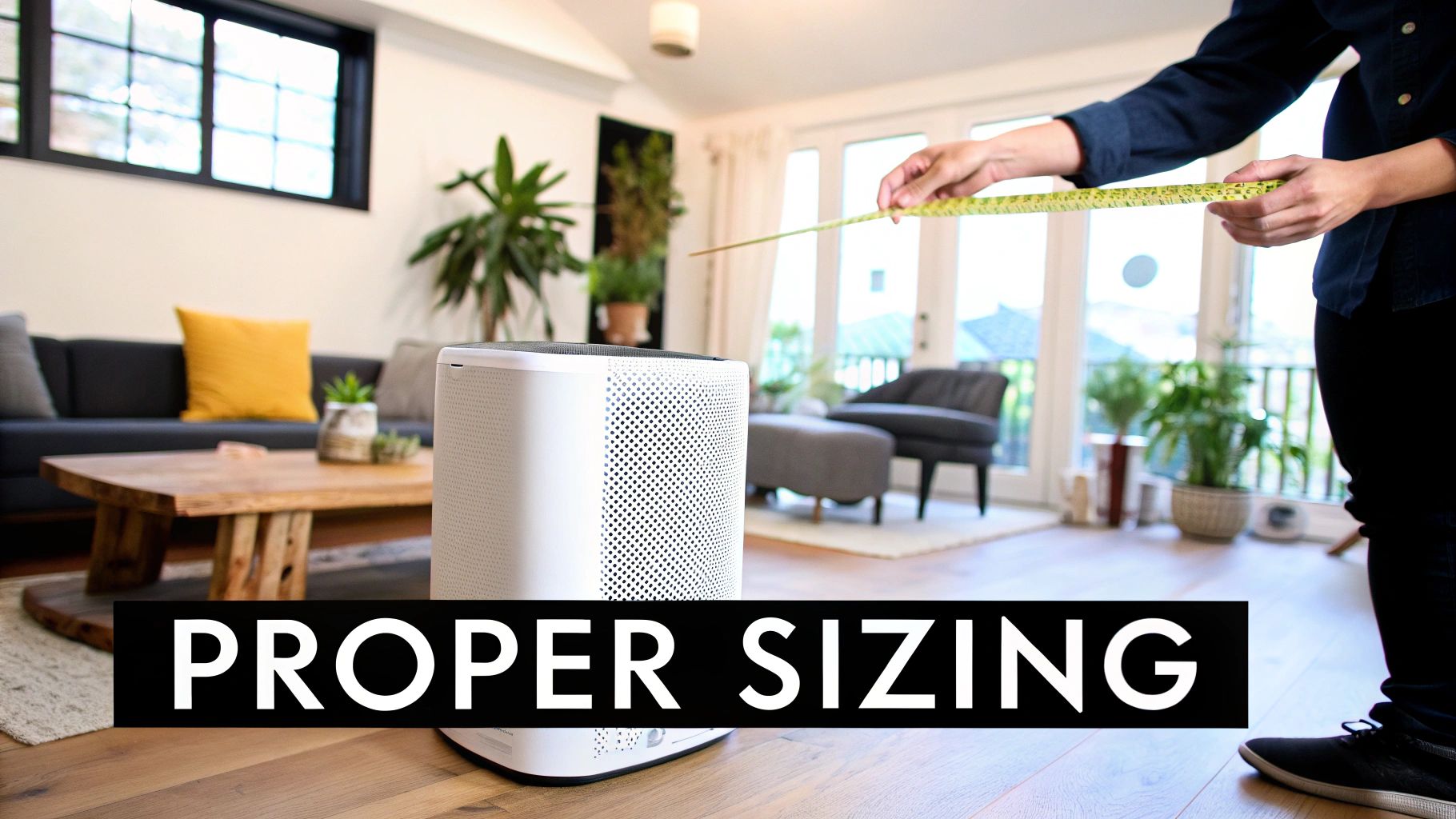
Choosing the right technology is half the battle; the other half is making sure your purifier is actually powerful enough for your room. An undersized unit in a large space is like trying to cool a house with a tiny window AC unit, it just won't keep up. Honestly, the single most important factor for an air purifier’s effectiveness is getting the size right.
This decision really comes down to two key numbers you'll see plastered on every product box: CADR (Clean Air Delivery Rate) and ACH (Air Changes per Hour). Getting a handle on what these mean is the key to finding a unit that does its job without sounding like a jet engine.
Decoding CADR and Room Size
Clean Air Delivery Rate, or CADR, is a straightforward performance score from the Association of Home Appliance Manufacturers (AHAM). It tells you how much clean air a purifier can pump out, measured in cubic feet per minute (CFM). The higher the CADR, the faster it can clean a room.
You'll see it broken down into three numbers, one for each major type of gunk in your air:
Smoke: This number shows how well it tackles tiny particles from things like tobacco or wildfire smoke.
Dust: This one is for mid-sized stuff like common household dust and dust mite debris.
Pollen: This measures its ability to grab larger particles like pollen and pesky mold spores.
Here’s a great rule of thumb we use: pick a purifier with a smoke CADR that is at least two-thirds of your room's square footage. So, for a 150-square-foot room, you’d need a smoke CADR of at least 100. This makes sure the unit is beefy enough to filter out the smallest, trickiest particles.
A Quick Guide to Calculating Your Needs
Figuring out the right CADR for your space is pretty simple. No complex math required.
Measure Your Room: Grab a tape measure and calculate the square footage (length x width). For example, a bedroom that's 12 feet by 15 feet is 180 square feet.
Apply the Two-Thirds Rule: Multiply your room’s square footage by 2/3 (or just 0.67). For that 180-square-foot bedroom, you’d need a minimum smoke CADR of 120 (180 x 0.67 = 120.6).
Pro tip: Choosing a unit with a slightly higher CADR than you need is always a smart move. It means you can run the purifier on a lower, quieter setting and still get fantastic filtration.
An undersized air purifier blasting away on its highest setting won't clean the air well and will drive you crazy with noise. It’s always better to get a slightly bigger unit and run it on a lower fan speed for quiet, consistent performance.
Understanding Air Changes Per Hour (ACH)
The other critical number to know is Air Changes per Hour (ACH). This tells you exactly how many times the purifier can cycle through and filter all the air in a room in one hour. For general air quality improvement, a rating of 2 ACH is a solid baseline.
But if you’re dealing with specific health concerns, you'll want to aim higher for better protection.
Allergy or Asthma Sufferers: Look for a unit capable of 4 to 5 ACH. This cleans allergens out of the air much faster, giving triggers less time to cause problems.
High-Pollutant Environments: If you're in a room with smokers or dealing with wildfire smoke, a system that provides 5 or more ACH is what you need.
For homeowners who want to dive deeper into the numbers, our article on how to calculate air changes per hour accurately breaks it all down. Getting the sizing right from the start guarantees that the best air purifiers for your home will actually live up to their promises.
Recommendations for Common Household Needs
Picking the right air purifier isn't a one-size-fits-all deal. It’s all about solving specific problems in your home. The perfect unit for trapping pet dander might not cut it when you’re dealing with wildfire smoke. Let’s break down the ideal features for the most common challenges we see here in Tucson.
There's a reason clean indoor air is on everyone's mind. The market for residential air purifiers is set to jump from USD 5.25 billion in 2025 to a whopping USD 8.59 billion by 2031 as families get serious about managing allergies and respiratory health. With over 131 million people in the U.S. breathing unhealthy air, homeowners are looking for real solutions to PM2.5, mold, and VOCs, all common culprits in Tucson that can aggravate conditions like asthma, which already affects 1 in 13 Americans. To dig deeper into these numbers, you can read the full research on residential air purifier trends.
For the Allergy Sufferer
If seasonal pollen, dust, and mold spores make your home feel like a symptom zone, your main goal is capturing microscopic particles. Constant exposure to these airborne irritants inflames your sinuses, leading to congestion, headaches, and terrible sleep.
For real relief, a purifier with a True HEPA filter is non-negotiable. This type of filter is certified to capture 99.97% of particles as small as 0.3 microns, which covers almost every common allergen. You’ll also want a unit with a high Air Changes per Hour (ACH) rating, ideally 4 to 5 ACH, to cycle the air in your room frequently, pulling triggers out before they can cause a reaction.
For allergy sufferers, the goal is constant filtration. Running a correctly sized HEPA purifier in the bedroom overnight can dramatically reduce morning congestion by creating an allergen-free zone while you sleep.
For the Pet Owner
We love our pets, but that doesn't mean we love their dander and odors. Pet dander is made of tiny flecks of skin shed by animals, and it’s a powerful allergen for a lot of people. On top of that, you have to deal with those lingering pet smells that seem to get into every carpet and piece of furniture.
A multi-stage filtration system is your best bet here. You need two key components working in tandem:
A True HEPA Filter: This is your first line of defense, grabbing the physical dander, fur, and dust your pets stir up.
A Substantial Activated Carbon Filter: This is what tackles the odors. A thick, heavy carbon filter has the surface area needed to adsorb the gases that cause pet smells, leaving your air noticeably fresher. Those flimsy carbon pre-filters just won’t do the job.
For Households Concerned with Smoke
Whether it's from nearby wildfires, a growing concern in Arizona, a neighbor's fireplace, or something indoors, smoke is a serious air quality problem. It's a nasty mix of tiny, harmful particles (PM2.5) and a wide range of gassy pollutants like volatile organic compounds (VOCs).
To fight smoke effectively, you need a high-performance system. Your top priority should be a unit with a high smoke CADR rating, which proves it can clear those fine particulates out of the air quickly. Just as important is a robust activated carbon filter to remove the hazardous gases and the stubborn odors that smoke leaves behind. During a smoke event, you'll want a purifier powerful enough to achieve 5 or more ACH to keep your indoor air safe.
This table sums up the ideal features for each situation, helping you match your problem to the right technology.
Household Need | Primary Technology | Key Feature to Prioritize | Ideal ACH Rating |
|---|---|---|---|
Allergies | True HEPA Filter | High Pollen & Dust CADR | 4-5 ACH |
Pets | HEPA + Activated Carbon | Heavy Carbon Filter | 3-4 ACH |
Smoke | HEPA + Activated Carbon | High Smoke CADR | 5+ ACH |
By lining up your purifier's strengths with your specific needs, you can be confident your investment will deliver real results and a healthier, more comfortable home.
Exploring Whole-Home Air Purification Systems
While portable air purifiers are great for single rooms, many homeowners eventually look for a more comprehensive, set-it-and-forget-it solution. This is where whole-home air purification systems come in, representing a major leap in both coverage and convenience.
Instead of juggling multiple units in different rooms, these systems are installed directly into your home's HVAC infrastructure. This means every time your heat or AC kicks on, purified air is circulated through your existing ductwork to every single room. You get consistent, house-wide air quality without the noise or clutter of standalone devices.
The Power of Integrated Active Technology
Many of the best whole-home solutions go beyond simple filters by using advanced active technologies, like ActivePure. Unlike passive filters that just wait for contaminants to get sucked into them, active systems proactively send out purifying agents that hunt down and neutralize pollutants, not just in the air, but on surfaces, too.
This is a critical difference. Professional installation ensures these systems work seamlessly with your furnace and air conditioner for peak performance and efficiency. While the upfront investment is higher than a portable unit, the long-term benefits for your home’s health are significant.
The ability to sanitize the surfaces you touch every day, countertops, light switches, doorknobs, is a game-changer. It creates a genuinely healthier living space, which is especially important for families with kids or anyone with a compromised immune system.
A Superior Solution for Challenging Environments
Here in Tucson, our environment presents unique challenges. Whole-home systems offer a level of protection that portables just can't match. When dust storms kick up, particulate levels can spike by a factor of 10. In these situations, NASA-certified ActivePure systems really shine.
These systems don't just filter; they actively destroy pathogens. Independent tests show they reduce viruses by 99.9%, far beyond what passive filtering can do. Plus, our local bonded technicians can integrate these systems flawlessly, often boosting overall HVAC efficiency by up to 25% by optimizing your ductwork at the same time.
For homeowners truly committed to creating the healthiest indoor environment possible, the comprehensive, always-on coverage of a whole-home system is simply unmatched.
Comparing Portable and Whole-Home Solutions
So, which is right for you? The decision between portable units and an integrated system really comes down to your goals, budget, and how much hands-on effort you want to put in. A whole-home solution is an investment in your property and your family's long-term health, delivering consistent, powerful results with zero daily effort on your part.
If you're leaning toward an integrated solution, you can learn more about choosing whole-house air purification systems in our detailed guide.
This table breaks down the key differences in approach and outcome.
Feature | Portable Air Purifiers | Whole-Home Purification Systems |
|---|---|---|
Coverage Area | Limited to a single room or small zone | Entire home through existing HVAC ductwork |
Operational Mode | Passive filtration (traps contaminants) | Often active (neutralizes contaminants in air and on surfaces) |
Convenience | Requires manual placement and operation | Fully automated, operates with HVAC system |
Aesthetics | Multiple units can create clutter | Invisible, with no impact on living space |
Initial Cost | Lower per unit, but multiple may be needed | Higher initial investment for professional installation |
Long-Term Value | Effective for targeted problem areas | Provides comprehensive, consistent, and effortless air quality control |
Analyzing Long-Term Costs and Maintenance
That initial price tag on an air purifier is just the starting line. To really figure out which air purifier fits your budget, you have to look at the total cost of ownership. This means getting honest about the recurring expenses that keep the machine actually doing its job.
Thinking about these costs upfront saves you from annoying budget surprises later. For most portable units, the biggest ongoing cost is filter replacement, but you also have to factor in electricity use and the potential for repairs down the road.
Breaking Down Ongoing Expenses
For any portable purifier using a physical filter, like a HEPA system, filter replacement is going to be your most consistent expense. True HEPA and activated carbon filters don’t last forever. They fill up with all the gunk they pull from your air and eventually need to be swapped out to stay effective.
HEPA & Carbon Filters: Most brands suggest a replacement every 6 to 12 months. Depending on the size and complexity of your purifier, a new filter can run anywhere from $20 to over $100.
Pre-filters: A lot of purifiers come with a washable pre-filter designed to catch the big stuff like pet hair and dust bunnies. Giving this a rinse once a month can really help your more expensive HEPA and carbon filters last longer.
Don't forget about electricity consumption. While today's air purifiers are pretty efficient, anything running 24/7 is going to add to your utility bill. Look for an Energy Star-rated model; they often use 25% to 40% less energy than standard units, which can make a real difference over the course of a year.
The true cost of a cheap air purifier often shows up when you see the price of its replacement filters, if you can even find them. Always check the cost and availability of filters before you buy. A slightly more expensive unit upfront might actually be cheaper in the long run.
The Value of Professional Maintenance
When we're talking about whole-home systems that tie into your HVAC, professional maintenance plans are a game-changer. Yes, it's an added expense, but scheduled service makes sure your entire system, purifier included, is running at its absolute best. This isn't just about preventing expensive breakdowns; regular tune-ups can actually lower your energy bills.
A technician will make sure filters are installed correctly, all the components are clean, and the system is calibrated for top performance. It’s a proactive approach that not only makes the purifier last longer but also protects your much larger HVAC investment. For a full picture of what this involves, you can learn more about what HVAC maintenance costs and see why it’s such a smart move for your home's air quality and overall comfort. Planning for these costs ensures your system stays effective and affordable for years to come.
Common Questions About Home Air Purifiers
Even after you've done your research, a few lingering questions are perfectly normal. Getting straight answers helps you move forward with confidence, knowing you've made the right call for your home and family. Here are some of the most common things homeowners ask us when they're ready to choose an air purifier.
How Often Do I Need to Replace the Filters?
This is probably the most-asked question, and the answer really depends on the filter type and how much work it's doing in your home. It’s the single most important maintenance task for keeping your system effective.
For most portable units with HEPA and activated carbon filters, manufacturers suggest a replacement every 6 to 12 months. If you have a washable pre-filter, giving it a quick rinse once a month can definitely help the main filters last longer. With professionally installed whole-home systems, this is something you don’t have to worry about, as filter changes are typically rolled into a biannual service plan.
Can an Air Purifier Really Help with My Asthma and Allergies?
Yes, absolutely. A high-quality air purifier can be a game-changer for anyone with respiratory sensitivities. The key is choosing a unit with a True HEPA filter, which is specifically designed to capture the microscopic airborne irritants that trigger asthma and allergies.
By constantly pulling things like pollen, dust mites, pet dander, and mold spores out of the air, a good purifier drastically reduces the triggers that cause flare-ups. This often leads to fewer symptoms, more restful sleep, and just an overall better quality of life.
For even more comprehensive relief, active systems like ActivePure go a step further. Instead of just trapping particles, they neutralize contaminants everywhere the air reaches, creating a much cleaner baseline environment for everyone in the home.
Is a Whole-Home System Better Than a Portable Purifier?
The best choice here really boils down to your specific goals and budget. Portable purifiers are fantastic for zeroing in on problem areas. Think of placing one in the bedroom to improve sleep or in a home office where you spend eight hours a day. They give you flexibility and don't require a big upfront investment.
A whole-home purifier, on the other hand, is the set-it-and-forget-it solution. It integrates directly with your HVAC system to deliver consistently clean air to every single room. While it's a larger initial investment, it’s far more convenient and efficient for achieving total-home air quality improvement over the long haul. It's the ideal choice for families who want comprehensive protection without having to manage multiple devices.
Ready to explore a whole-home solution for your Tucson residence? The certified technicians at Covenant Aire Solutions specialize in installing and maintaining advanced ActivePure systems for superior indoor air quality. Contact us today for a free consultation.