
How Heat Pumps Work in Winter A Simple Guide
Updated: Jan 26
Even on a frosty Tucson morning, a heat pump can pull warmth right out of the cold air to heat your home. It’s a clever process that works by absorbing existing thermal energy from the outdoors and simply transferring it inside. This is a world away from a traditional furnace, which has to create heat from scratch, making the heat pump an incredibly efficient way to stay comfortable.
The Surprising Science of Winter Heating
Most people find it hard to wrap their head around how a machine can find heat in cold air. It seems to go against everything we know, but the science is surprisingly simple once you grasp one key principle: even cold air contains a lot of thermal energy. Absolute zero, the point where no heat exists, is -459.67°F. Anything warmer than that has heat to give.
Think of your heat pump's outdoor unit like a super-effective sponge. Just like a dry sponge eagerly soaks up any available water, a heat pump's refrigerant is designed to absorb thermal energy from the air, no matter how chilly it feels to us. It doesn’t care if it's 50°F or 30°F; its entire job is to find and capture that heat.
How It Pulls Heat from Thin Air
This "magic" all comes down to the refrigerant inside the heat pump, which is engineered to be much, much colder than the outside air. Heat naturally moves from warmer places to colder places. By creating this extreme temperature difference, the heat pump basically tricks the outdoor thermal energy into flowing right into its coils, starting the journey into your home. This is the core function that makes a heat pump such a powerful year-round solution, a concept we explore more deeply in our guide on what a heat pump is and how it provides both heating and cooling.
This technology is so effective that it’s reshaping how people think about home comfort all over the world. Demand is skyrocketing, with the global heat pump market reaching USD 83.66 billion in a recent year. This massive global adoption just goes to show how reliable and efficient these systems have become for winter heating.
A heat pump doesn't create heat; it moves it. By capturing existing warmth from the outdoor air and transferring it indoors, it uses far less energy than conventional heating systems that must burn fuel to generate heat from nothing.
The Key Players in the Process
To really get how this heat transfer works, it helps to know the main components involved. Each part has a very specific job in capturing, concentrating, and then releasing that warmth into your living space. The table below gives a quick rundown of the essential parts and what they do during the winter heating cycle.
Key Components of a Heat Pump in Winter
Component | Winter Function |
|---|---|
Evaporator Coil (Outdoors) | Absorbs heat from the outside air into the cold refrigerant. |
Compressor | Pressurizes the refrigerant, intensely heating it up. |
Condenser Coil (Indoors) | Releases the concentrated heat from the refrigerant into your home. |
Expansion Valve | Rapidly cools the refrigerant down to restart the heat-absorption cycle. |
Each of these parts works in a continuous loop, tirelessly moving heat from where you don't want it to where you do.
The Heating Cycle Step by Step
To really wrap your head around how a heat pump pulls warmth out of cold air, it helps to follow the journey step-by-step. The entire process is a continuous loop called the refrigeration cycle. Four key components work in perfect sync to grab heat from the outdoors and bring it inside your home. It’s a surprisingly elegant process that keeps you comfortable all winter.
This simple visual breaks it down: heat is absorbed outside, moved by the system, and then released inside.
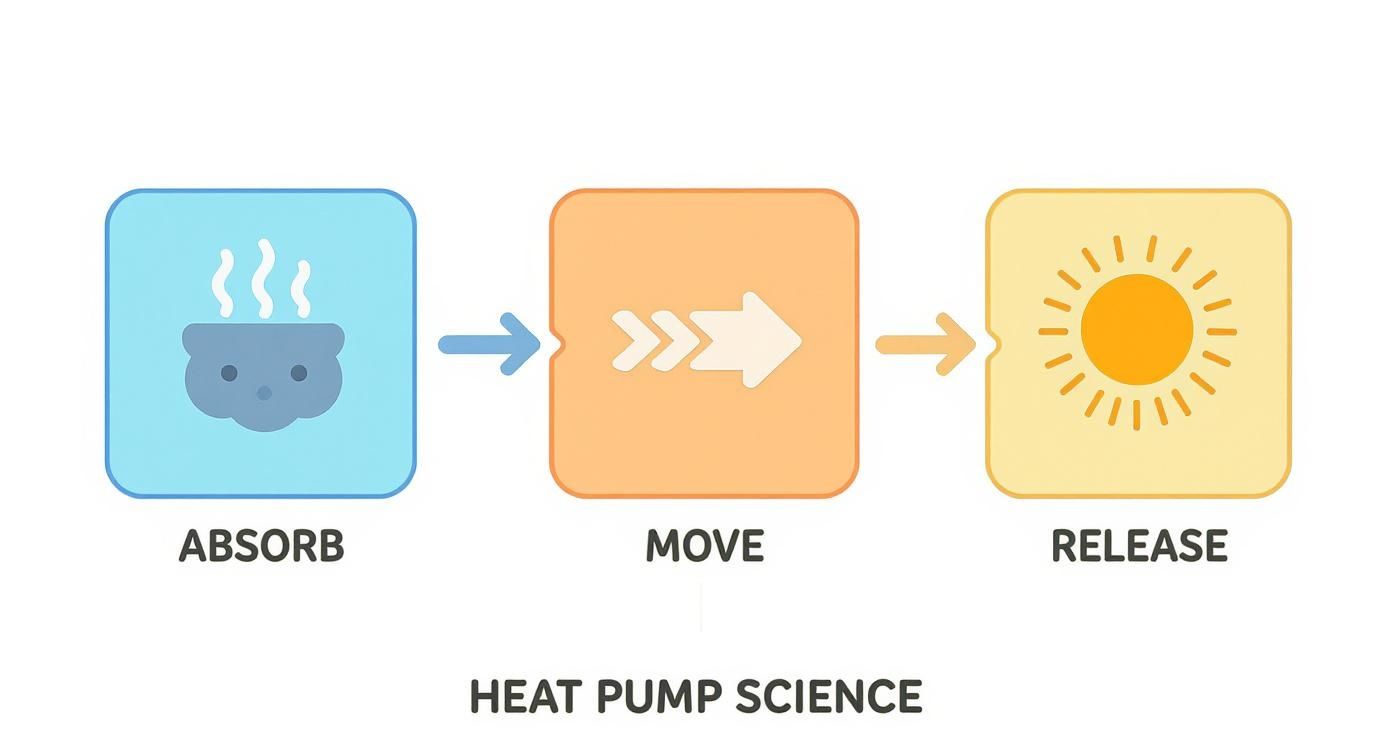
As you can see, the whole magic trick is about moving existing heat, not creating it from scratch like a furnace does. Let's walk through each stage of this cycle to see exactly how it all comes together.
Step 1: Absorption at the Evaporator Coil
The action starts at your outdoor unit, where the evaporator coil is the star of the show. Running through this coil is a special substance called refrigerant, which has an incredibly low boiling point. Even on a chilly Tucson day, this liquid is much, much colder than the air around it.
Because heat naturally moves from a warmer place to a cooler one, the thermal energy in the outdoor air gets absorbed into that super-cold refrigerant. This transfer of heat is enough to make the refrigerant boil and transform into a low-pressure gas, sort of like water turning into steam on a stove.
Step 2: Pressurization by the Compressor
Next up, that low-pressure gas makes its way to the heart of the system: the compressor. The compressor is basically a powerful pump with one job, it squeezes the gas molecules together, which dramatically ramps up their pressure and temperature. This is the most critical part of the process.
Think about pumping up a bicycle tire. You can feel the pump get hot in your hands as you compress the air. The exact same principle applies here. By putting the refrigerant gas under immense pressure, the compressor concentrates all that absorbed heat, turning it into a very hot, high-pressure gas.
To really get into the weeds of this technology, you can discover more about what a scroll compressor is in our HVAC explainer. This is the step that makes the captured warmth potent enough to actually heat your house.
Step 3: Heat Release at the Condenser Coil
This superheated gas, now often over 100°F, travels to your indoor unit, where it flows into the condenser coil. Your system’s indoor fan then blows air from inside your home across the fins of this hot coil. As the air passes over, it sponges up the heat from the refrigerant.
That freshly warmed air is then pushed through your ductwork, raising the temperature throughout your home. As the refrigerant gives up its heat to the indoor air, it starts to cool down and condense back into a high-pressure liquid.
### The Role of the Reversing ValveEver wonder how the same machine cools your house in the summer? The secret lies in the reversing valve. This small but mighty component acts like a traffic controller, changing the direction of the refrigerant flow. In winter, it sends the hot gas indoors to heat your home. In summer, it flips the flow to send the hot gas outdoors, releasing heat and cooling your home.
Step 4: Cooling at the Expansion Valve
The final step gets the refrigerant ready to start the cycle all over again. The now-warm, high-pressure liquid refrigerant is forced through a tiny opening called an expansion valve. This causes a sudden, massive drop in pressure.
This rapid depressurization makes the refrigerant intensely cold again, even colder than the winter air outside. Now back to its original state as a cold, low-pressure liquid, the refrigerant flows back to the outdoor evaporator coil, ready to absorb more heat and repeat the whole process.
This four-step cycle runs continuously, pulling a steady stream of warmth into your home and proving just how effective a heat pump can be for reliable winter comfort.
Measuring Heat Pump Efficiency in the Cold
Knowing how a heat pump works in the winter is one thing, but understanding how to measure its performance is what really matters for your wallet. As the temperature outside drops, a heat pump has to work harder to pull in that ambient heat, and that naturally impacts its efficiency.
The key metric here is the Coefficient of Performance, or COP.
In plain English, COP tells you how many units of heat energy the system creates for every single unit of electrical energy it consumes. For example, a heat pump with a COP of 3.0 is giving you three units of heat for every one unit of electricity you pay for. This is a huge leap over traditional electric resistance heaters, which are stuck with a COP of 1.0, one unit of heat out for every one unit of electricity in.
This incredible efficiency is a big reason the heat pump market is booming. The global market showed its muscle in meeting winter heating demands, growing from a value of USD 88.4 billion one year to USD 93.2 billion the next.
How Temperature Affects COP
It’s just common sense: as the air gets colder, there's less heat energy available for the heat pump to grab. This forces the compressor to work harder to concentrate that energy into useful warmth for your home, causing the system's COP to drop. A heat pump that’s a star performer at 47°F will be less efficient at 17°F, but the important thing to remember is that it's still working.
This isn't an on/off switch. The system doesn't just give up when the temperature hits freezing. In fact, modern cold-climate models are specifically engineered to maintain a strong COP even when it gets seriously cold, keeping your home toasty without sending your energy bills through the roof.
To give you a clearer picture, here’s a look at how a typical heat pump's performance changes as the mercury falls.
Heat Pump COP vs Outdoor Temperature
This table shows how a typical heat pump's Coefficient of Performance (COP) changes as the outside temperature drops.
Outdoor Temperature (°F) | Example COP | Meaning |
|---|---|---|
47°F | 3.8 | The system produces 3.8 units of heat for every 1 unit of electricity. |
32°F | 2.9 | Efficiency drops but still delivers nearly 3x the energy it consumes. |
17°F | 2.2 | The system works harder but remains more than twice as efficient as electric heat. |
5°F | 1.8 | Still provides a significant efficiency advantage over resistance heating. |
As you can see, even in truly cold conditions, a heat pump remains a far more effective heating solution than the alternative. Getting a handle on these metrics is a big part of managing your home's comfort, and you can learn even more by checking out your guide to HVAC system efficiency.
Finding the Balance Point
Every home and heat pump combination has a unique "balance point." This is the exact outdoor temperature where the heat pump's output perfectly matches your home's heat loss. It’s the moment the system can no longer keep up with your thermostat setting all on its own.
The balance point is not when the heat pump stops working. It is the temperature at which it needs a little help from a secondary source to keep you comfortable.
Once the outside air dips below this balance point, your system will call for backup by automatically turning on its supplemental heat source. In most all-electric setups, this backup comes from electric resistance heating strips.
While this auxiliary heat guarantees your house stays warm no matter how frigid it gets outside, it runs at a COP of 1.0. That makes it far less efficient and more expensive to operate.
Knowing your system’s balance point helps you understand what to expect from your winter energy bills. While heat pumps are fantastic money-savers, pairing them with other proven tips to reduce heating costs can take your savings even further. By combining an efficient system with smart habits, you can stay warm all winter without breaking the bank.
What Makes Cold Climate Heat Pumps Different
If you've heard stories about heat pumps struggling when the temperature really drops, you're not wrong, but you're probably thinking of older, traditional models. Those units often needed a boost from expensive backup heat.
Modern cold-climate heat pumps are a completely different animal. They’ve been engineered from the ground up with specific tech upgrades that let them maintain incredible efficiency and heating power, even in freezing conditions. These aren't your grandparents' heat pumps; they're high-performance machines built for serious winter duty.
This new generation of technology is driving a massive shift in how people heat their homes. Just look at Europe, where winter heat pump sales shot up by 9% in the first half of a recent year. It’s clear that homeowners are embracing these far more capable systems.
Inverter Technology for Smarter Performance
The single biggest game-changer in cold-climate heat pumps is the variable-speed compressor, which you'll also hear called inverter technology.
Think of a standard, old-school compressor like a light switch: it’s either all the way on or all the way off. That jarring on-off cycle creates huge energy spikes and doesn't do a great job of keeping the temperature consistent.
A variable-speed compressor, on the other hand, is more like a dimmer switch. It intelligently adjusts its speed, ramping up or slowing down, to precisely match what your home needs at that exact moment.
This smooth, continuous operation brings a few huge benefits:
Greater Efficiency: By running at lower speeds most of the time, it sips electricity instead of guzzling it like a system that’s constantly kicking on at full blast.
Consistent Comfort: It gets rid of the frustrating temperature swings you see with older systems, delivering a steady, even stream of warmth.
Enhanced Cold-Weather Operation: This is the key. The technology allows the compressor to ramp up to maximum power when it gets brutally cold, giving it the muscle it needs to keep pulling heat from the frigid air.
This is the core technology that helps modern heat pumps maintain a high COP well below freezing.
Enhanced Vapor Injection for an Extra Boost
Another critical innovation you'll find in top-tier models is Enhanced Vapor Injection, or EVI. You can think of EVI as a turbocharger for the refrigerant cycle, giving the system an extra jolt of power when the temperature really plummets.
Here's how it works: the system diverts a tiny amount of hot refrigerant gas from later in the cycle and injects it back into the compressor. This small but powerful injection boosts the pressure and temperature of the main refrigerant flow, allowing the system to produce much hotter air and maintain its heating capacity even in seriously cold weather.
EVI technology is what allows some of the best cold-climate heat pumps to keep running efficiently at temperatures as low as -13°F or even colder, a feat that was once flat-out impossible for a residential heat pump.
Key Features of a Cold Climate Heat Pump
When you put a standard heat pump side-by-side with a cold-climate unit, the differences become obvious. The latter is packed with features designed specifically to master winter, which is why many of the best ductless mini-split systems excel in this area.
Here’s a quick rundown of what sets them apart:
Feature | Standard Heat Pump | Cold Climate Heat Pump |
|---|---|---|
Compressor | Single-speed or two-speed | Variable-speed (inverter) |
Low-Temp Performance | Struggles below 25-30°F | Efficient down to 5°F or lower |
Refrigerant Cycle | Standard process | Enhanced with Vapor Injection (EVI) |
Energy Usage | Higher spikes from cycling | More consistent, lower usage |
These advancements mean a cold-climate model isn't just a part-time heater. It's a primary heat source you can rely on all winter long, even here in Tucson when those clear desert nights get surprisingly chilly.
Troubleshooting Common Winter Issues
Even the most reliable heat pump can hit a snag, especially when a Tucson winter brings an unexpected cold snap. The key to keeping your system running smoothly (and keeping your sanity) is knowing what’s normal and what’s not. A lot of common issues have simple explanations you can tackle yourself.
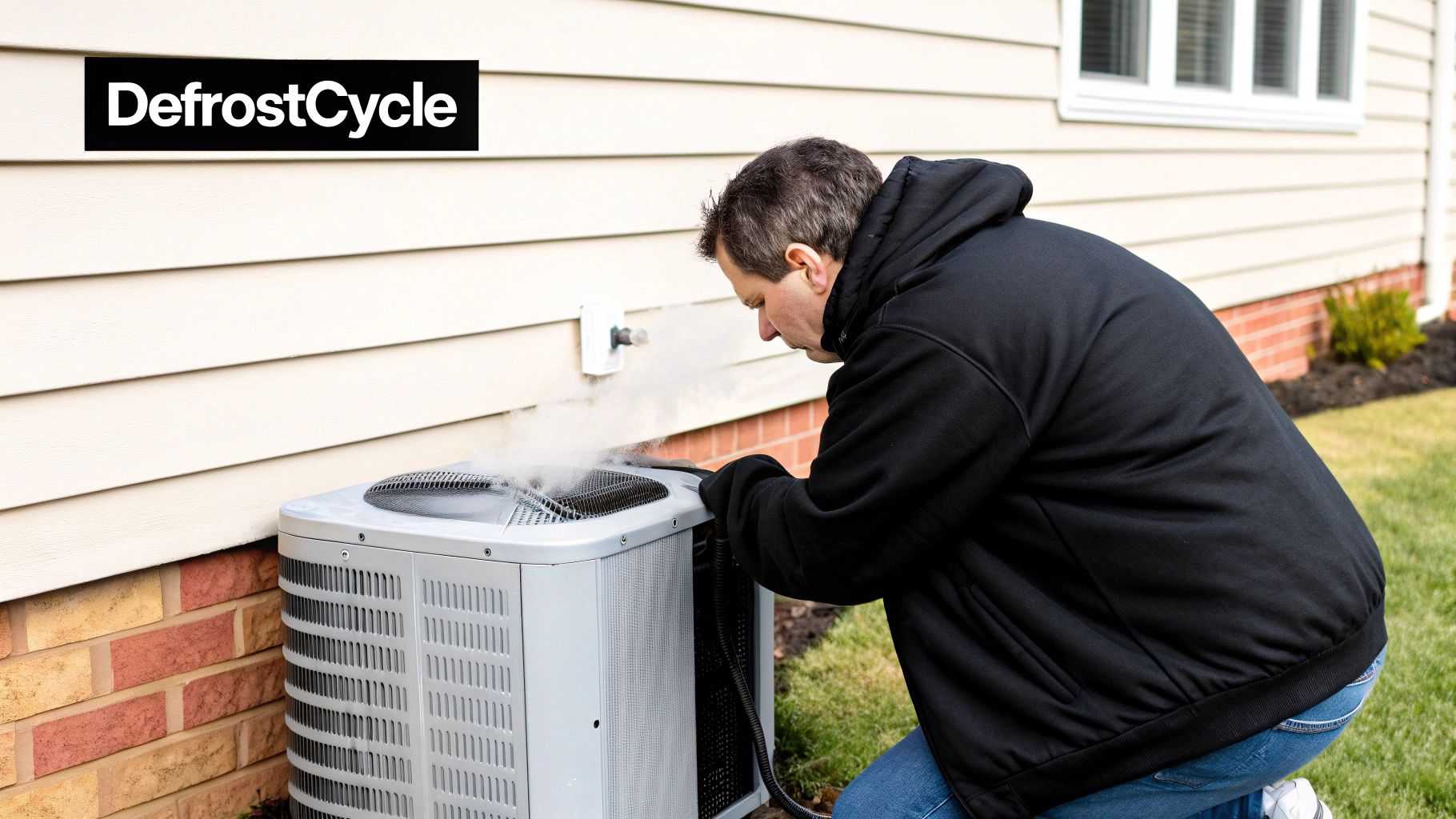
Before you start to worry, remember that some behaviors are just part of the job. A heat pump running for long periods on a really cold day is often just a sign it's working as designed. Other quirks, though, might point to an underlying problem that needs a closer look.
Why Is My Heat Pump Blowing Cool Air?
This is probably the number one concern we hear from homeowners. Feeling cool air from your vents when you expect heat can be alarming, but it doesn't automatically mean something is broken. More often than not, it just means your system is in its defrost cycle.
The defrost cycle is a completely normal and necessary function. It briefly reverses the refrigeration cycle, sending warm refrigerant to the outdoor unit to melt any frost that has built up. This whole process usually takes just 5 to 15 minutes. During that time, the indoor fan might keep running, which circulates air that feels cool until the auxiliary heat kicks in.
Now, if your system is blowing cool air constantly, that's a different story. It could point to a bigger issue. Sometimes the fix is simple, and you can find it in a good troubleshooting guide for when your HVAC is not blowing warm air. Other times, the culprit could be low refrigerant levels or a faulty reversing valve.
What to Do If the Outdoor Unit Is Iced Over
A light dusting of white frost on the outdoor unit is perfectly fine, but a thick sheet of ice is a definite red flag. When your unit looks like a block of ice, it can't absorb heat from the air. This kills its efficiency and can cause serious damage to the system.
An iced-over unit signals that the defrost cycle is failing or that airflow is severely restricted. This problem will not resolve on its own and requires immediate attention to prevent compressor damage.
Here are a few things you can check yourself:
Check for Obstructions: Make sure there are at least two feet of clear space around the unit. Clear away any leaves, fallen debris, or snow that might be blocking airflow.
Inspect the Gutters: A leaky or clogged gutter dripping water onto the unit is a common cause of ice buildup.
Observe the Defrost Cycle: If you suspect the unit should be defrosting but isn't, there might be a problem with a sensor or the control board.
If you've cleared the area and the ice persists, it's best to turn the system off to prevent further damage and give a professional a call.
Why Is My System Running Constantly?
Heat pumps are designed to run longer, more consistent cycles than a traditional furnace, that's part of what makes them so efficient. This is especially true on the coldest days of the year. So, a unit that runs for a long time isn't necessarily a sign of trouble; it might just be working hard to keep you warm.
But if it runs nonstop even on mild days or just can't seem to get your home to the right temperature, something else might be going on.
Common Reasons for Nonstop Operation:
Dirty Air Filters: This is always the first thing to check. A clogged filter chokes the airflow inside your home, forcing the system to work overtime to push heated air through.
Incorrect Thermostat Settings: Make sure your thermostat is set to "HEAT," not "AUTO." In auto mode, it can sometimes get confused and switch between heating and cooling unnecessarily.
Ductwork Leaks: Leaky ducts can waste a huge amount of heated air into your attic or crawlspace before it ever reaches your living areas. The system has to run longer just to make up for the loss.
By understanding these common winter quirks, you can better diagnose what's happening with your system. Running through these simple checks can often save you from an unnecessary service call and keep you warm all season.
Frequently Asked Questions About Winter Heat Pump Use
Even with a good grasp of the science, we find that most homeowners still have a few practical questions about how their heat pump should behave day-to-day in the winter. We get these questions all the time from folks right here in Tucson, so let's clear up some of the most common ones. Our goal is to help you feel confident that your system is up to the task when the temperatures drop.
At What Temperature Do Heat Pumps Stop Being Effective?
This is probably the number one concern we hear, and the answer has changed a lot over the years. It’s true that older, standard heat pumps used to struggle once temperatures dipped below 40°F, often needing backup heat to kick in somewhere around 25°F. But modern cold-climate models are a completely different animal.
These newer, high-efficiency units are engineered to keep working effectively down to 5°F, and some of the top-tier systems can reliably pull heat from the air in temperatures as low as -13°F. The real-world limit for your system comes down to its specific technology, like whether it has a variable-speed compressor. The best way to know for sure is to check the specs for your particular model.
Is a Frosty Heat Pump Normal in Winter?
Yes, it absolutely is. Seeing a thin layer of white frost or even some light ice on your outdoor unit is perfectly normal. This is actually a sign that your heat pump is doing its job. As the outdoor coil absorbs heat, its surface gets colder than the surrounding air, which causes moisture to condense and freeze right onto it.
Your heat pump knows how to handle this. It will automatically run a defrost cycle to manage the buildup. During this cycle, the system briefly reverses itself to send warm refrigerant through the outdoor coils and melt the ice. You might notice a puff of steam coming from the unit, which is totally normal. A typical defrost cycle lasts about 5 to 15 minutes. Now, if your unit is encased in a solid block of ice, that’s a different story, it points to a problem that needs a professional look.
A light frost is a sign your heat pump is working correctly, absorbing heat from the cold air. A solid block of ice, however, indicates a problem with the defrost cycle or airflow that needs attention.
What Is Auxiliary Heat and When Does It Activate?
Auxiliary heat (you'll probably see "aux heat" on your thermostat's display) is your system's built-in backup. It’s a secondary heat source, usually a set of electric resistance coils, designed to make sure your home stays warm no matter what. Think of it as a booster for when the weather gets unusually cold.
It kicks on automatically when the outside temperature drops so low that the heat pump can’t keep up with your thermostat setting on its own. This crossover point is called the system's "balance point." While auxiliary heat is fantastic for that extra warmth, it's much less energy-efficient than the heat pump. Its use will definitely show up on your electricity bill, which is why it's designed for supplemental, not primary, heating.
How Can I Maximize My Heat Pump Efficiency in Winter?
Getting the most bang for your buck from your heat pump in the colder months comes down to a few simple but powerful habits. A little bit of care goes a long way in keeping your system operating at peak performance, keeping you comfortable while managing your energy costs.
Here are the best practices we recommend to all our customers:
Maintain Clean Filters: Make it a habit to check your indoor air filter every month. A clogged filter is like trying to breathe through a straw, it forces the whole system to work much harder to move air.
Keep the Outdoor Unit Clear: Walk outside and make sure there's at least two feet of clear space around your unit. Get rid of any fallen leaves, snow, ice, or other debris that could block airflow.
Avoid Large Thermostat Adjustments: Find a comfortable temperature and try to leave it there. Bumping the thermostat up by several degrees at once is a surefire way to trigger the inefficient auxiliary heat to turn on. A steady setting lets the heat pump do its job.
Seal and Insulate Your Home: The less heat your house loses, the less your system has to run. Sealing up drafts around windows and doors and checking your attic insulation are some of the best investments you can make to lower the heating load.
By sticking to these tips, you'll help your heat pump run the way it was designed to, providing reliable, efficient warmth all winter long.
For expert heat pump maintenance, repair, or installation in the Tucson area, trust the certified professionals at Covenant Aire Solutions. We offer honest advice and reliable service to keep your home comfortable year-round. Visit us at https://www.covenantairesolutions.com to schedule your appointment today.