
Replacing Central Air Compressor: replacing central air compressor tips
The decision to replace a central air compressor rarely comes out of nowhere. Your AC unit will almost always give you a heads-up before it completely gives out. For us here in Tucson, ignoring those warnings can mean a total system failure on the hottest day of the year, turning a manageable problem into a genuine emergency.
Learning to spot the early symptoms is the first and most important step.
Is Your AC Compressor Failing? Tucson Warning Signs
Think of your air conditioner's compressor as its heart; it's the powerful muscle that circulates the refrigerant needed to cool your home. When it starts to go bad, the decline is hard to miss. It's a lot like a car engine losing power; it might keep running for a bit, but you can hear and feel that something major is about to go wrong.
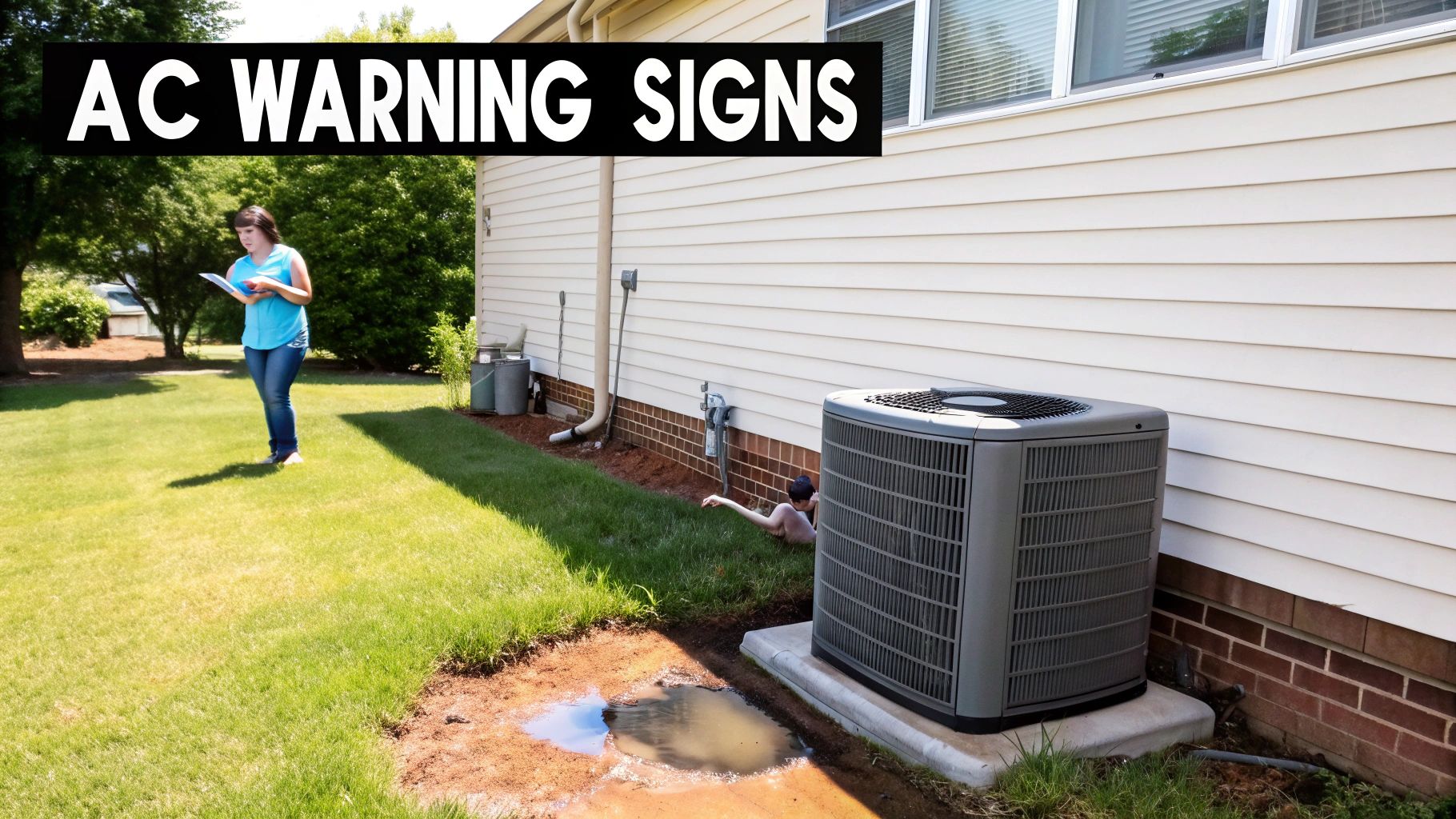
Here in Arizona, our air conditioners are pushed to the limit, so compressor strain is something we see all the time. Catching the trouble early doesn't just give you time to prepare for a replacement, it also helps protect the rest of your system from getting damaged in the process.
Unmistakable Noises From the Outdoor Unit
One of the first and most obvious clues of a failing compressor is the sound it makes. A healthy AC unit should just produce a steady, low hum when it kicks on. When the compressor is in trouble, that sound changes, and not for the better.
Listen for these red flags:
Loud Banging or Clanking: This is a bad one. It usually means internal parts like a piston have broken loose. If you hear this, shut your system down immediately to prevent a complete blowout.
High-Pitched Screeching: A sharp, piercing squeal often points to dangerously high pressure building up inside the compressor. This is a serious issue that needs a professional right away.
Rattling or Grinding: These noises typically mean the motor's bearings are shot. The compressor is working way too hard just to function, and it's on a path to seizing up completely.
These aren't just annoying background noises; they're your AC screaming for help. If you want to get a better sense of how all these components work together, you can learn more about the parts of a central air conditioning unit in our homeowner's guide.
A dying compressor forces the entire system into overdrive, which can make your monthly TEP bill jump significantly. If your summer cooling costs suddenly spike with no change in your habits, an inefficient compressor is a likely suspect.
Performance Problems You Can Feel
Beyond the strange sounds, a dying compressor has a direct impact on your comfort. The number one symptom we hear about is a major drop in cooling power.
Your AC might be blowing air, but it feels lukewarm or just not as crisp and cold as it should. This is because a struggling compressor can no longer pressurize the refrigerant properly, which is the key to the entire cooling cycle.
Another telltale sign is inconsistent cooling. Maybe some rooms are fine while others stay stubbornly hot, or perhaps the system just can't keep up during the peak heat of a Tucson afternoon. This uneven performance is a clear signal that the heart of your AC is too weak to do its job.
Electrical Issues and Fluid Leaks
A failing compressor often makes its presence known through electrical problems. It takes a huge jolt of power to get started, and a struggling unit can easily overload the circuit.
Frequent Circuit Breaker Trips: Find yourself constantly heading to the breaker box to reset your AC? The compressor is the likely culprit. It's drawing too much electricity as it struggles to start, a condition technicians call a "hard start."
Visible Fluid Leaks: Take a look around your outdoor unit for any oily or greasy residue. This is often a sign of a refrigerant leak. While the leak might be coming from another part, it puts immense strain on the compressor, which simply can't run correctly on low refrigerant.
If you're noticing any of these symptoms, you've got a serious problem brewing. It's time to call in a professional. Acting fast gives you the time to plan for replacing the central air compressor before your home is left without any cooling at all.
The Big Question: Repair or Replace Your AC Unit
When a major part of your AC system, like the compressor, gives out, you’re hit with a big decision. It's a choice that doesn't just affect your immediate comfort but also your finances for years to come. Do you pay for a big repair on the central air compressor, or is it time to replace the whole unit? This isn't just about the upfront price tag; it's an investment in your home's efficiency and reliability.
This decision is especially tough here in Tucson, where a working air conditioner isn't a luxury, it's an absolute necessity. A quick fix might sound good now, but it could easily become a money pit, leading to more breakdowns and higher bills down the road. Let's walk through the key things to consider so you can make a smart, cost-effective choice.
Key Factors Influencing Your Decision
Before you jump to a conclusion, it helps to look at the bigger picture. A few critical details will tell you whether a repair is a smart move or if a full replacement is the wiser long-term investment.
System Age: Most central AC units have a lifespan of about 10 to 15 years. If your system is getting close to that age or has already passed it, sinking a lot of money into a major repair like a compressor replacement is usually a bad bet.
Energy Efficiency (SEER Rating): Older AC units have much lower Seasonal Energy Efficiency Ratio (SEER) ratings. A new, high-efficiency system can seriously cut down your monthly energy bills, helping that initial investment pay for itself over time.
Refrigerant Type: Many older systems run on R-22 refrigerant. This type was phased out because of its environmental impact, and now it's incredibly expensive and hard to find. This alone can make repairing an older unit impractical and incredibly costly.
When you put these factors together, you get a pretty clear idea of your system's overall health. Putting a new compressor in an old, inefficient unit is like dropping a new engine into a rusty car: it might work for a bit, but you're still left with all the other old parts that are likely to fail soon.
If you're still on the fence, our guide on whether it's time to replace or repair your HVAC system offers even more clarity on this common homeowner dilemma.
The Cost-Benefit Analysis
Ultimately, the right choice comes down to weighing the short-term cost of a repair against the long-term value of a replacement. Yes, a new compressor is a big expense, but it's often just a fraction of what a completely new system costs.
This is a decision millions of homeowners face. Across the U.S., up to 3 million heating and cooling systems are replaced every year. It’s a sign of our aging infrastructure, where systems over 10 years old can be running at just 60% of their original efficiency. For those of us in Tucson, that inefficiency translates to energy bills that can be up to 40% higher during our brutal summers. Timely replacement isn't just about avoiding breakdowns; it's about controlling those sky-high costs. You can explore more HVAC industry statistics to see just how common this is.
To make this choice a little easier, let's break down the two options side-by-side.
Comparing AC Compressor Repair Versus Full Unit Replacement
This table helps lay out the financial and practical differences between fixing the compressor and starting fresh with a new air conditioner.
Factor | Repairing the Compressor | Replacing the Unit |
|---|---|---|
Upfront Cost | Lower initial investment. You only pay for the part and labor. | Higher initial investment for the new equipment and installation. |
Energy Efficiency | No change. The system's original, lower SEER rating remains. | Significant improvement. Modern units have much higher SEER ratings, lowering monthly bills. |
Reliability | Uncertain. While the compressor is new, other old parts (fan motor, coils) can still fail. | High. A new system comes with all-new components and a fresh start. |
Warranty | Limited. Usually a one-year warranty on the new part and labor only. | Comprehensive. Typically a 10-year manufacturer's warranty on all parts. |
Future Costs | High potential for future repairs on other aging components. | Minimal. Covered under warranty for a decade, requiring only routine maintenance. |
Long-Term Value | Decreasing. You've invested in a system that is still aging and inefficient. | Increasing. Adds value to your home and provides years of energy savings. |
In the end, while a minor repair on a newer unit can make perfect sense, spending thousands on an old, inefficient system rarely pays off. A full replacement brings peace of mind, lower energy bills, and reliable cooling for years, something that's truly priceless during a hot Tucson summer.
Industry Rule of Thumb: When the cost of a repair is 50% or more of the cost of a new unit, replacement is almost always the smarter financial choice. This is known as the "50% rule" in the HVAC industry.
What Goes Into a Professional Compressor Replacement?
The thought of a technician taking apart the heart of your AC unit can feel a little unnerving. But once you understand what's actually involved in replacing a central air compressor, the whole thing feels a lot less mysterious. It’s a precise, multi-step job that really drives home why this is strictly for certified professionals. Knowing what to expect gives you peace of mind that your home is in good hands.
From the moment one of our Covenant Aire Solutions technicians shows up, their focus is on safety and doing the job right. This isn’t just about swapping out a broken part; it’s about systematically bringing your AC's cooling power back to life.
This chart breaks down the key factors we consider: age, efficiency, and cost, when helping homeowners decide on the best path forward for their AC system.

Seeing it mapped out like this helps you understand how everything connects, making it easier to choose between a major repair and a full system upgrade.
Initial Safety and System Prep
Before a single tool comes out, safety is the top priority. The technician will shut off all electricity to your outdoor unit, both at the main breaker box and at the external disconnect switch right next to the unit. This is a non-negotiable first step to eliminate any risk of electrical shock.
Next, they'll hook up a specialized gauge manifold to the system’s service ports. This lets them double-check the initial diagnosis and see how much refrigerant is currently in the system before they get started.
Environmentally Safe Refrigerant Recovery
Handling the refrigerant is one of the most critical parts of the job. It's not just illegal to release it into the atmosphere; it’s also incredibly harmful to the environment.
Using an EPA-certified recovery machine and tank, the technician will carefully pump all the old refrigerant out of your AC system. This process ensures every last ounce is captured for proper, safe disposal, following strict federal laws. This is a major reason why this work requires a licensed pro.
A common question we get is whether the old refrigerant can be reused. The answer is a hard no. It’s likely contaminated with acid or tiny metal shavings from the failed compressor, and putting it back in would destroy the new component almost immediately. The system needs a completely fresh start.
Installing the New Compressor
With the system now empty and safe, the real hands-on work begins. The technician will carefully disconnect the electrical wires and refrigerant lines attached to the old compressor. These copper lines are usually brazed (a form of welding) into place, so a torch is needed to heat them up and separate the connections.
Once it's free, the old, heavy compressor is lifted out. The tech will then take the time to meticulously clean the inside of the condensing unit, getting rid of any debris or contaminants that got left behind.
The new compressor is then carefully set into place and bolted down securely. Using high-temperature brazing rods and a torch, the technician re-welds the refrigerant lines to the new part, creating strong, leak-proof seals. There are different kinds of compressors, and if you're curious, you can learn about the common scroll compressor in our HVAC explainer.
System Evacuation and Recharging
Just because the new compressor is installed doesn't mean the job is done. Far from it. The system is now full of air and moisture, two things that are absolute enemies of a healthy AC system. To fix this, a powerful vacuum pump is connected to the service gauges.
The pump pulls the system into a deep vacuum, a crucial step that can take an hour or more. This process literally boils off any trapped moisture and removes all the air and other non-condensable gases. It ensures the new refrigerant can do its job properly without any interference.
Finally, the tech recharges the system with brand-new, clean refrigerant. Using a precise digital scale, they weigh in the exact amount specified by the manufacturer. This isn't a guessing game; too much or too little refrigerant will put a major strain on the new compressor and hurt its performance. The very last step is to power the unit back on and run a series of tests to confirm everything is running perfectly.
Breaking Down the Costs of Compressor Replacement
When your AC goes down, especially here in Tucson, the first question on everyone's mind is, "What's this going to set me back?" Let's be honest, facing a major repair like a compressor replacement is stressful enough without the sticker shock.
The truth is, there’s no single, flat-rate answer. The final cost is a mix of a few key variables that can swing the price one way or the other. We believe in being completely upfront about these costs. Knowing exactly what goes into the final invoice helps you see the real value in a professional job and eliminates any nasty surprises. Think of it as an investment in your home’s comfort; you deserve to know where every dollar is going.
The Primary Cost Drivers
So, what are the big-ticket items that make up the final bill? It really boils down to three main components.
The Compressor Itself: This is the heart of your AC and, unsurprisingly, the most significant part of the cost. The price tag on the compressor depends on your AC unit's size (in tons), the brand, and the model: is it a basic single-stage, or a more sophisticated high-efficiency or variable-speed model? The fancier units cost more upfront but can make a real dent in your energy bills over time.
Professional Labor: This isn’t just about turning a wrench. You’re paying for a technician's expertise and time, which is typically 4 to 6 hours for a standard replacement. Labor rates in our area reflect the skill needed to handle refrigerants safely, perform precise welding, and run the diagnostics to get your system humming again.
Refrigerant Costs: The type and amount of refrigerant your system needs can be a wild card. If you have an older unit that uses R-22, the cost will be much higher because it's been phased out and is now incredibly expensive. Newer systems run on the more affordable and common R-410A.
These three elements form the foundation of your repair quote. For a more detailed look at how these numbers play out in different situations, check out our AC compressor replacement cost guide, which is full of specific insights for Tucson homeowners.
Understanding the Full Price Range
Alright, let's talk numbers. Here in the Tucson area, you can generally expect the total cost for a central air compressor replacement to land somewhere between $1,800 and $3,500.
What pushes the final cost to the high or low end of that range? A few things.
Warranty Status: This is a huge one. If your AC is still under its parts warranty (usually 5-10 years), you’ll only be on the hook for labor and refrigerant. This can easily slice the total bill in half, turning a major expense into a much more manageable one.
System Accessibility: Where is your outdoor unit located? If it's tucked away in a cramped space or perched on a roof, it's going to take the technician more time and effort to work on it, which can nudge the labor cost up a bit.
Additional Parts: A catastrophic compressor failure can sometimes take out smaller, related parts like a capacitor or contactor. These parts themselves aren't terribly expensive, but they do get added to the final invoice.
One of the most critical, and often overlooked, factors is the aftermath of the failure. If the old compressor burned out, it could have spewed acid and contaminants throughout your refrigerant lines. A "burnout cleanup" is non-negotiable in this case. It involves flushing the entire system and adding a special filter to protect the new compressor. It adds to the job's complexity and cost, but skipping it is a surefire way to kill the new part prematurely.
Making the Investment Manageable
At Covenant Aire Solutions, we know that a bill for a few thousand dollars is rarely in the family budget. We firmly believe that financial worries shouldn't force you to swelter through a brutal Arizona summer in an unsafe, uncomfortable home.
That's why we offer flexible financing options. We can help you break the total cost down into predictable, low monthly payments. This approach takes the sting out of the immediate expense, allowing you to get the critical repair you need right away.
We also make a point to give back to those who serve our community. We proudly offer special discounts for:
Teachers
Military personnel (both active and retired)
First responders
It's just our small way of saying thank you. If you fall into one of these groups, please don't hesitate to mention it when you call us for an estimate.
How to Choose the Right HVAC Contractor in Tucson
The technician you hire to replace your central air compressor is just as critical as the new part itself. Let's be honest, in Tucson, a shoddy installation can lead to years of headaches and recurring problems, especially when your system is battling our extreme heat. Choosing the right contractor isn't just about finding the cheapest quote; it's about finding a true partner you can trust to get the job done right the first time.

Taking a few minutes to vet potential contractors will protect your investment and your sanity. A few well-chosen questions can tell you everything you need to know about a company's standards, real-world experience, and commitment to their customers.
Verifying Licenses and Insurance
First things first, let's cover the absolute must-haves. Never, ever hire a company that can't immediately show you proof of their credentials. Doing so leaves you completely exposed if something goes wrong.
Make sure to ask every potential contractor these non-negotiable questions:
Are you licensed, bonded, and insured in Arizona? A licensed contractor (you can check their ROC number) has met the state's minimum requirements. Being bonded protects you financially if they don't finish the job, and their insurance covers any accidental property damage.
Do your technicians hold EPA Section 608 certification? This is a federal requirement for anyone handling refrigerants. It's flat-out illegal for an uncertified person to do this work.
Are your technicians NATE-certified? While not required by law, North American Technician Excellence (NATE) certification is the gold standard in the HVAC world. It proves a technician has mastered real-world, hands-on expertise, not just theory.
Think of these qualifications as your first line of defense against sloppy work and potential liability.
Questions to Ask About Experience and Warranties
Once you've confirmed they're legit, it's time to dig a little deeper into their specific experience and what they promise after the job is done. You're looking for a team that not only has the technical skills but also stands firmly behind their service.
Ask them about their track record with your situation:
How much experience do you have with my specific AC brand (e.g., Trane, Carrier, Lennox)?
What, exactly, does your warranty cover? Get the details on both parts and labor.
Will you provide a written, itemized estimate? A trustworthy company will give you a clear cost breakdown, not just a single, vague number.
A strong warranty is a huge sign of confidence. A contractor who believes in the quality of their work will offer a solid guarantee. At Covenant Aire Solutions, we provide clear, comprehensive warranties because we stand by every single installation we do.
The HVAC market is always changing, with up to 3 million U.S. systems replaced annually as homeowners move toward more sustainable technology. With new mandates demanding higher SEER ratings in hot climates like ours, reputable Tucson pros must be fully bonded and insured to deliver replacements that can stand up to our 110°F+ summer peaks.
Look for Transparency and a Customer-First Approach
Finally, just pay attention to how the company treats you from the very first call. A great contractor acts like a trusted advisor, not just a salesperson trying to hit a quota.
They should be more than willing to explain all your options clearly, walking you through the pros and cons of different compressors without pushing you toward the most expensive choice. Transparent pricing is everything; there should be zero hidden fees or surprise charges on the final bill. A reliable company will also bring up payment options. Exploring HVAC companies with payment plans can make a necessary, but often unexpected, replacement much more manageable for your budget.
Ultimately, you want a local partner who prioritizes your family's comfort and gives you honest, expert guidance. Taking the time to ask these questions ensures your compressor replacement is a lasting solution, not just another temporary fix.
Your Top AC Compressor Questions, Answered
Even after getting the rundown, it’s natural to have a few more questions rattling around before you give the green light for a major repair like a compressor replacement. Getting straight answers is key to feeling confident in your decision.
We've pulled together the questions we hear most often from homeowners right here in Tucson to give you that final bit of clarity.
How Long Does It Take to Replace an AC Compressor?
Probably the biggest question on everyone's mind is, "How long will my house be an oven?" We get it. For a certified technician who knows their way around a condenser unit, a typical AC compressor replacement takes about four to six hours from the moment we arrive to the final system check.
That timeframe isn't just for swapping the part. It covers the entire professional process:
Safely powering everything down and running a final diagnostic.
Hooking up specialized recovery equipment to legally and safely remove the old refrigerant.
The physical work of unbolting the old compressor and fitting the new one.
Brazing the copper lines, running a pressure test, and pulling a deep vacuum to get rid of moisture and contaminants.
Charging the system with the precise amount of new refrigerant and testing everything to make sure it's running perfectly.
Every job is a little different, of course. The location of your outdoor unit or a stubborn, rusted bolt can sometimes add a little time, but planning for a half-day service window is a solid bet for most homes.
Will a New Compressor Make My Old AC More Efficient?
This is a great question, and the answer isn't a simple yes or no. A new compressor will get your air conditioner running at its original factory-specified performance level. But it can't magically make an old, inefficient system better than it was when it was new.
Think of it like putting a brand-new engine into a 20-year-old car. It'll run great, just like it did off the lot, but it won't suddenly get the gas mileage of a 2024 hybrid. The overall system efficiency, or SEER (Seasonal Energy Efficiency Ratio) rating, is a team effort between all the matched components, especially the indoor and outdoor coils.
If your AC system is already more than a decade old, just replacing the compressor might not be the best use of your money in the long run. Often, the smarter financial move is to replace the entire outdoor unit (the condenser) or the full system. That's how you get the real energy savings from a modern, high-SEER system, which you'll see on every single APS or TEP bill.
Is AC Compressor Replacement Covered by a Home Warranty?
Whether your home warranty will foot the bill depends entirely on the fine print in your policy. Many plans do list major HVAC components like compressors, but they almost always have loopholes and limitations you need to know about.
For example, they might deny a claim if they decide the failure was caused by a lack of regular maintenance. Other policies might only cover the cost of the part itself, leaving you on the hook for labor, refrigerant, and other materials, which can be a significant chunk of the total bill.
Your best bet is to pull out your policy documents and review them carefully before you schedule the work. As your HVAC partner, we’re more than happy to provide all the detailed invoices and diagnostic reports you need to submit your claim. Our job is to make this process as painless for you as possible.
When you need honest answers and expert service for replacing a central air compressor, trust the team that puts your family’s comfort first. Contact Covenant Aire Solutions today for a transparent, no-pressure consultation and find out why we’re Tucson’s choice for reliable HVAC care. Schedule your service at https://www.covenantairesolutions.com.