
What Size AC Unit for 1500 Square Feet: Essential Sizing Guide and Tips
If you're trying to figure out what size AC unit you need for a 1,500 square foot home, especially here in Arizona, the quick answer is usually a 2.5-ton (30,000 BTU) system. Think of this as the go-to starting point for most homes this size.
But, and this is a big but, it's just a starting point. Your home is unique, and a handful of key factors can easily push that number up or down.
The Quick Answer for a 1500 Square Foot Arizona Home
It can feel like you need an engineering degree to size an AC unit, but there's a reason HVAC professionals often begin their assessment with a 2.5-ton system for a 1,500 sq ft home. It's not a random guess; it's a solid, calculated baseline that hits the sweet spot between cooling power and energy efficiency for a home this size.
Picking an air conditioner is a lot like choosing an engine for a car. You need enough horsepower to handle the brutal demands of an Arizona summer, but an engine that's too big just wastes fuel and wears out faster. A 2.5-ton unit is often that perfect balance, powerful enough to cool your home without "short-cycling," a wasteful process where an oversized unit constantly kicks on and off.
Why This Size Is the Standard Starting Point
We've seen it time and time again: a 2.5-ton unit is the recommended baseline for a 1,500 sq ft home in a hot climate like Tucson. This sizing helps avoid common pitfalls, especially short-cycling, which can slash a system's efficiency by as much as 30% and drive up your bills.
An improperly sized AC unit is one of the most common and costly mistakes a homeowner can make. It impacts everything from your monthly energy bills to the overall comfort of your home and the lifespan of your equipment.
To give you a clearer picture, here's a quick reference table showing how different factors in a 1,500 sq ft home can influence the required AC size.
AC Sizing Quick Reference for 1500 Sq Ft | ||
|---|---|---|
Scenario | Recommended AC Size (Tons) | Recommended AC Size (BTUs) |
Baseline: Standard 8 ft ceilings, good insulation, moderate window exposure | 2.5 tons | 30,000 BTUs |
High Ceilings: 10-12 ft ceilings, increasing air volume | 3.0 tons | 36,000 BTUs |
Poor Insulation & Old Windows: Significant heat gain from attic and windows | 3.0 - 3.5 tons | 36,000 - 42,000 BTUs |
Shaded Lot & New Windows: Well-shaded home with energy-efficient windows | 2.0 tons | 24,000 BTUs |
As you can see, that 2.5-ton baseline can shift pretty quickly once you account for your home's specific characteristics.
Factors That Adjust the Baseline
While 2.5 tons is a solid starting point, several variables can demand a bigger, or even a smaller, unit. An expert evaluation is the only way to get it exactly right, but here are the big ones we always look at:
Ceiling Height: Have vaulted ceilings or anything higher than the standard eight feet? All that extra air volume needs to be cooled, which often calls for more cooling power.
Window Exposure: Large, west-facing windows can act like magnifying glasses for the intense afternoon sun, dramatically increasing your home's heat load and making your AC work overtime.
Insulation Quality: If your attic or wall insulation is old or insufficient, it's like leaving a window open. Cool air escapes, hot air seeps in, and your AC is forced to run constantly just to keep up.
In the end, the goal is to find the perfect balance for your home. Things like understanding the difference between various systems, such as ductless vs. central air, can also play a role in your final decision.
Decoding AC Lingo: BTUs and Tons
When you start looking into a new air conditioner, you'll immediately see terms like BTUs and tons thrown around. It might sound like technical jargon, but these are just straightforward ways to measure cooling power. Getting a handle on this language is the first step to making a smart choice for your 1,500 square foot home.
Think of a BTU, or British Thermal Unit, as the basic unit of heat. The simplest way to picture it is the amount of heat given off by a single lit match. Your air conditioner’s job is to remove thousands of these little "matches" of heat from your home.
What Is a BTU?
The BTU rating on an AC unit tells you exactly how much heat it can pull out of a space in one hour. A bigger number means more cooling power. So, a unit rated for 30,000 BTUs is designed to eliminate that much heat from your home every hour it’s running.
This is the most precise way to understand an air conditioner's raw capacity. It’s the number that professionals use as a starting point to figure out the right what size ac unit for 1500 square feet you really need. If you want to get into the weeds, our expert guide to calculate BTU per sq ft for air conditioning breaks down the math behind it all.
From BTUs to Tons
So, where do "tons" come in? It has nothing to do with how much the unit weighs. The term is actually a throwback to the days before modern AC, when big buildings were cooled with actual blocks of ice. One ton of cooling is just the equivalent cooling effect of melting a one-ton block of ice over a 24-hour period.
In today's terms, here’s the key conversion: one ton of AC power is equal to removing 12,000 BTUs of heat per hour.
This simple relationship makes it easy to switch between the two measurements. An air conditioner’s size is almost always described in tons, typically in half-ton steps.
For example:
1.5-ton AC unit = 18,000 BTUs per hour
2.0-ton AC unit = 24,000 BTUs per hour
2.5-ton AC unit = 30,000 BTUs per hour
3.0-ton AC unit = 36,000 BTUs per hour
Just like that, the technical lingo isn't so intimidating anymore.
Why This Lingo Matters for Your Home
Knowing the difference between BTUs and tons puts you in the driver's seat as a homeowner. Instead of just nodding along, you can actually understand what you're buying and compare different models with confidence. It’s like knowing the difference between horsepower and torque when buying a car; both tell you something important about how it will perform.
Now, when a technician recommends a 2.5-ton unit for your 1,500 square foot home, you'll know they mean a system that can remove 30,000 BTUs of heat every hour. This foundational knowledge is crucial, because matching this power to your home's unique heat load is the secret to an efficient and effective cooling system.
Why Square Footage Is Only Part of the Story
Relying on square footage alone to figure out what size AC you need for a 1,500-square-foot home is one of the most common, and costly, mistakes homeowners make. It’s like trying to navigate the Arizona desert with a compass that’s off by 20 degrees; you’re going to end up hot, uncomfortable, and nowhere near where you wanted to be.
While your home's square footage gives us a starting point, it ignores the unique fingerprint of your property that truly dictates its cooling demands.
Every single home has a specific heat load, which is just a technical term for the total amount of heat it soaks up from all sources. An AC unit's real job isn't just to cool an empty space; it's to battle this heat load. A professional assessment goes way beyond a simple area calculation to analyze every single factor contributing to that load. This ensures your system is perfectly matched to your home's real-world needs, not just a number on a page.
This flowchart helps visualize how all these concepts, heat, BTUs, and tons, are connected.
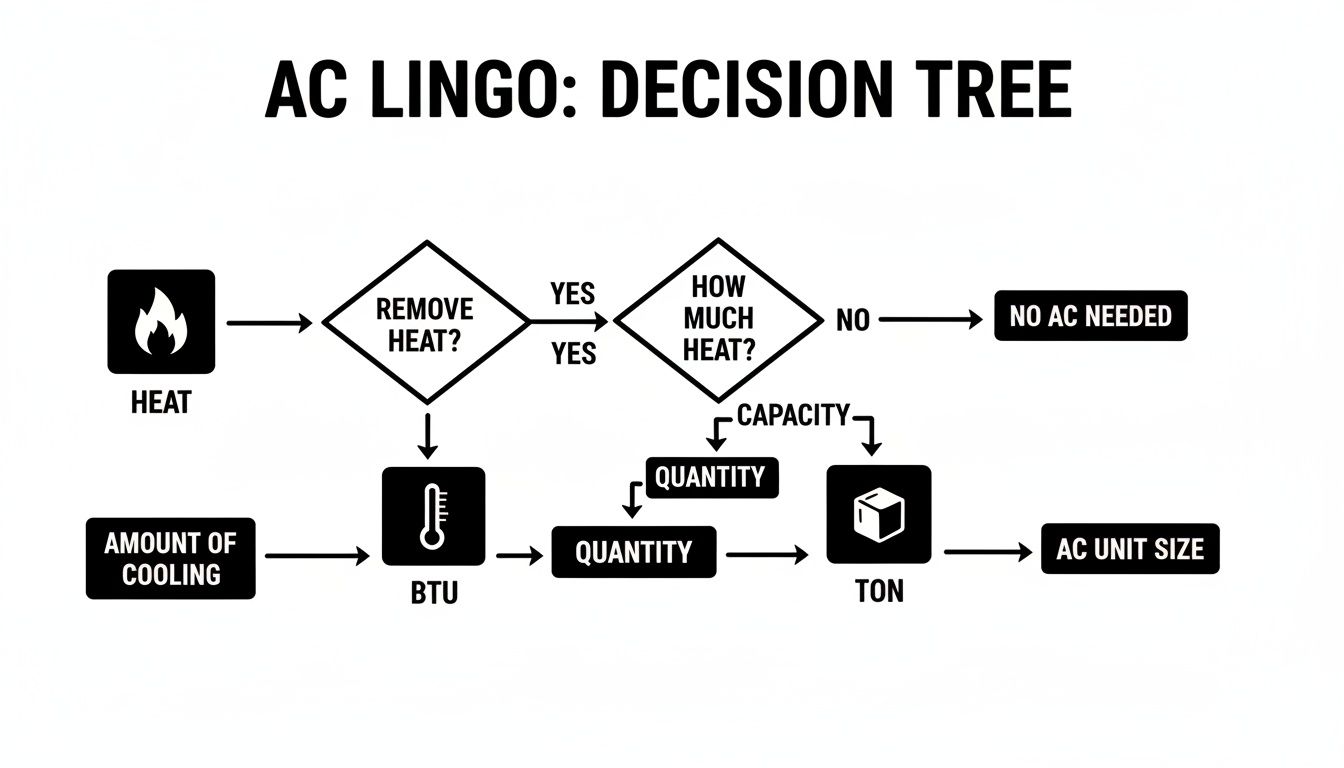
As you can see, the amount of heat that needs to be removed (measured in BTUs) is what determines the right AC tonnage. It’s a direct relationship, which is why a one-size-fits-all approach just doesn't work.
Climate and Sun Exposure
Here in Arizona, the relentless sun is easily the biggest factor driving up your home's heat load. A house in Tucson is fighting a much tougher battle than a similar-sized home in a milder climate. The direction your home faces also plays a massive role.
Think about it: those big, beautiful west-facing windows can feel like you’ve installed heaters in the wall during the afternoon, baking your living spaces and forcing your AC into overdrive. On the flip side, a home that gets plenty of shade from mature trees or nearby buildings will have a naturally lower heat load.
Home Construction and Layout
The actual bones of your house are another critical piece of the puzzle. An open-concept floor plan lets cool air circulate freely, which can often be easier to cool than a choppy layout with lots of small, closed-off rooms.
And don't forget these construction details:
Ceiling Height: A 1,500 sq. ft. home with standard 8-foot ceilings has 12,000 cubic feet of air to cool. That same home with 12-foot vaulted ceilings? Now you're dealing with 18,000 cubic feet, a 50% increase in air volume that absolutely demands more cooling power.
Number of Stories: A two-story home has completely different cooling dynamics than a single-story ranch. Heat rises, which often makes the upstairs a stubborn, warm pocket that's much harder to cool.
Occupancy: The number of people living in your home adds to the heat load. Every person is like a small furnace, and more activity means more heat that a properly sized AC has to handle.
Relying on a square-footage chart alone is essentially ignoring your home's unique personality. It’s the specific details, from window placement to ceiling height, that truly define its cooling needs and dictate the right AC size.
Insulation and Air Leaks
Your home's ability to fight back against the heat is paramount. Good insulation acts like a thermal barrier, slowing down the transfer of that brutal outdoor heat into your comfortable living space. If your attic or wall insulation is lacking, your AC will run constantly just to keep up with the heat seeping inside.
Air leaks around windows, doors, and even your ductwork are just as bad. These tiny gaps are exit routes for your expensive conditioned air and entry points for hot, dusty outside air. A well-sealed home holds onto its cool air much longer, taking a huge amount of strain off your AC system. To learn more, check out our homeowner's guide to air sealing a house.
Beyond just the square footage, factors like your home's insulation, the quality of your windows, and even how updating your window screens can help beat the Phoenix heat make a massive difference. Taking these elements into account is how you move from a rough guess to a precise, data-backed decision that guarantees comfort and efficiency for years to come.
The Hidden Costs of an Incorrectly Sized AC Unit
Getting your air conditioner size wrong isn't just a small hiccup; it's a costly mistake with frustrating, long-term consequences. It might seem logical that a bigger unit means better, faster cooling, but when it comes to HVAC systems, "bigger is better" is a total myth. Both oversized and undersized units create their own unique sets of problems that hurt your comfort, your equipment, and your wallet.
Choosing the right size AC for a 1,500 square foot home is all about finding that perfect balance. Think of it like Goldilocks: you need a system that’s not too big and not too small, but just right for your home's specific heat load.
The Problem with an Oversized AC Unit
An oversized air conditioner might sound like a great idea for beating back the brutal Arizona heat, but it causes a nagging issue called short-cycling. This is when the unit blasts your home with frigid air, hits the thermostat's target temperature way too quickly, and then abruptly shuts off. This rapid on-and-off sequence just repeats itself all day long.
While the air might feel cool for a moment, the system never runs long enough to do its second crucial job: dehumidification. This leaves your home feeling clammy, sticky, and uncomfortable, even when the thermometer says it's cool.
Short-cycling does more than just make you uncomfortable. The constant starting and stopping puts excessive wear and tear on the compressor and other vital parts, which can seriously shorten the lifespan of your expensive new system.
This inefficiency also hits you right in the bank account. The massive power surges from starting up the compressor over and over use far more electricity than a correctly sized unit that runs smoothly for longer, more consistent cycles. If you're wondering what else drives up your power costs, you can learn more about common culprits in our detailed guide.
The Downside of an Undersized AC Unit
On the other side of the coin, an undersized AC unit brings a completely different, but equally frustrating, set of problems. This system is the little engine that just can't. It will run constantly, struggling to keep up with your home's cooling demand, especially during the peak heat of a summer afternoon.
This nonstop operation has several painful effects:
Constant Discomfort: The unit will never quite reach the temperature you set on the thermostat. This leaves you with rooms that are always a little too warm and stuffy.
Premature System Failure: Running an air conditioner at maximum capacity for hours on end, day after day, is a recipe for disaster. The continuous strain leads to more frequent breakdowns and will ultimately cause the system to fail years before its time.
Sky-High Energy Bills: An AC unit that never shuts off is an energy-guzzling machine. You’ll see a dramatic spike in your utility bills as the system works overtime without ever actually getting the job done.
Ultimately, both scenarios lead to the exact same outcome: wasted money and a home that’s never truly comfortable. An incorrectly sized AC is an investment that fails to deliver on its one primary promise of efficient, reliable cooling. This is why a professional assessment isn't just a recommendation; it's absolutely essential for protecting your investment and ensuring your home remains a cool sanctuary from the heat.
How Professionals Guarantee the Perfect Fit
So, after seeing just how many things can throw off your cooling needs, it's pretty clear that a simple square footage guess just won't cut it. How do you get the sizing exactly right? The only way to guarantee a perfect fit is with the industry's gold standard: the Manual J load calculation.

Think of a Manual J calculation as a complete energy audit for your home, not a quick estimate. It was developed by the Air Conditioning Contractors of America (ACCA) to create a precise, scientific blueprint of your home's unique cooling load. It’s the difference between a doctor prescribing medicine based on your specific symptoms versus just your height and weight.
The Science Behind a Manual J Calculation
A Manual J moves way beyond basic measurements. It dives deep, analyzing every single element that adds or removes heat from your home. An experienced technician will meticulously gather data on a whole host of factors to build an accurate heat load profile.
This isn't a five-minute process; it's a comprehensive evaluation. The technician will measure and record specific details, including:
Insulation Levels: The R-value of your attic, walls, and floors.
Window Specifications: The size, type (single vs. double pane), and the direction each window faces.
Air Infiltration: The rate at which outside air leaks into your home.
Ductwork Condition: The location and sealing quality of your air ducts.
Occupancy and Appliances: The number of people living in the home and the heat generated by your appliances.
By feeding all of this data into specialized software, professionals can pinpoint the exact number of BTUs required to keep your home cool and comfortable, even on the most brutal Arizona day.
Why This Calculation Is Non-Negotiable
Opting for a Manual J calculation is the only way to ensure your investment in a new AC system delivers maximum efficiency and comfort. It completely eliminates the risks of oversizing or undersizing, protecting you from sky-high energy bills, premature system failure, and an uncomfortable home. This precise approach is absolutely critical when determining what size ac unit for 1500 square feet is truly correct for your specific property.
A professional Manual J calculation is not an upsell; it is the fundamental first step in a proper AC installation. Any contractor who skips this process and relies solely on a rule of thumb is doing you a disservice and gambling with your money and comfort.
This data-driven method ensures your system lasts. In fact, a properly sized AC, based on an accurate Manual J, can last over 15 years, a big jump from the 10-year lifespan of a mismatched unit. When you consider that proper sizing saves the nation an estimated $14 billion annually in energy costs, the value becomes undeniable.
Ultimately, this professional assessment is the foundation of a successful HVAC system. For a deeper dive into what a quality installation involves from start to finish, check out our expert air conditioning installation Tucson guide.
Choosing Your Expert for Sizing and Installation
Figuring out the right AC unit is a huge step, but picking the right team to size and install it is just as important. All the research in the world won't matter if the final execution is flawed. This is where professional expertise separates a system that runs like a dream for years from one that becomes a constant source of frustration.
The question of what size AC unit for 1500 square feet is too critical to leave to a wild guess or an outdated rule of thumb. Your family's comfort, your monthly energy bills, and the lifespan of your brand-new equipment are all on the line.
Why a Professional Consultation Isn't Optional
That 2.5-ton rule we talked about? It’s a great starting point for a conversation, but it should never be the final word, especially not here in Arizona. An expert assessment from a reputable company like Covenant Aire Solutions is absolutely essential.
A true professional won't just take a quick look at your square footage and spit out a quote. They'll insist on performing a detailed load calculation to get it right.
A Manual J calculation isn't an upsell or a fancy, unnecessary extra. It is the bedrock of a reliable, efficient, and long-lasting cooling system. It's the only way to be certain your new unit is a perfect match for your home's unique cooling needs.
This data-driven approach takes all the guesswork out of the equation. It gives you a precise, scientific answer tailored specifically to your property.
What to Demand From Your HVAC Partner
When you invite an HVAC contractor into your home, you're placing a huge amount of trust in their hands. It’s your right, and your responsibility, to ask tough questions and expect a high standard of service. A trustworthy partner will be transparent, knowledgeable, and focused on your long-term satisfaction, not a quick sale.
Here’s what you should look for in an expert partner:
Insistence on a Manual J: Before they even start talking about specific models or prices, they should immediately recommend and perform a full Manual J load calculation.
Clear Explanations: A good technician will take the time to walk you through the results. They'll explain exactly why a certain size unit is the right call for your home, based on the data.
No Pressure Tactics: Their goal should be to educate you and find the right solution, not just push the biggest or most expensive unit. They will listen to your concerns about budget and comfort.
Licensed and Insured: Don't just take their word for it. Always verify that the company is licensed, bonded, and insured to protect you and your property during the installation.
Your Final Takeaway for a Smart Investment
Ultimately, it all comes down to this: use the 2.5-ton guideline as your entry point into the conversation, but let a professional, data-driven assessment be your final guide.
Investing in a new air conditioner is one of the most significant upgrades you'll ever make to your home. Don’t gamble with such an important system. By partnering with an expert who values precision over shortcuts, you ensure your home stays cool, comfortable, and efficient for years to come.
Got Questions About AC Sizing? We've Got Answers.
When you're looking at a new air conditioner, the details can get overwhelming pretty fast. To clear things up and help you feel confident about your choice, we’ve put together answers to the questions we hear most often from homeowners trying to size an AC for their 1,500 square foot home.
Do I Need a Bigger AC for an Open Floor Plan?
You might think so, but an open floor plan can actually be easier to cool than a layout chopped up into small, separate rooms. With fewer walls blocking the way, conditioned air circulates much more freely through your main living space.
The catch? Things like soaring vaulted ceilings or a huge wall of west-facing windows can add a serious amount of heat to that open area. A professional load calculation is smart enough to see that big, open volume and factor it in, ensuring your unit is powerful enough to handle it without being oversized.
How Much Does Insulation Affect AC Size?
Insulation is a huge deal. Seriously, it's one of the most critical factors in sizing an AC. Think of it as a protective thermos for your house: the better the insulation, the less your AC has to fight against that blistering Arizona sun.
A 1,500 sq. ft. home with modern, high-quality insulation in the attic and walls will hold onto its cool air for much, much longer. This often means you can get away with a smaller, more energy-efficient (and less expensive) AC unit. On the flip side, a house with old, settled, or just plain poor insulation is constantly losing the cool, forcing you into a larger unit just to keep up.
A well-insulated home can often step down a half-ton in AC size. That's a big win, saving you money on the unit itself and on your energy bills for the entire life of the system.
Can a Two-Story Home Use the Same Size AC as a Single-Story?
Almost never. A two-story, 1,500 sq. ft. home is a completely different cooling puzzle than a single-level ranch of the same size. We all know heat rises, and in a two-story home, that means the upstairs becomes a heat trap that requires a lot more cooling muscle to keep comfortable.
This usually points toward one of a few smart solutions:
A Zoned System: This setup uses one powerful AC unit but has dampers inside the ductwork that can direct more cool air upstairs when it's needed most (like on a hot afternoon).
Two Smaller Systems: Often, the most efficient route is to install one small unit dedicated to the downstairs and another for the upstairs. This gives you perfect, balanced cooling on both levels.
A Slightly Larger Single Unit: If the ductwork is perfectly designed for it, a single, slightly more powerful unit can sometimes handle the different loads between floors.
Is It Okay to Replace My Old AC with the Same Size?
Please don't. This is one of the most common, and costly, mistakes we see. Just grabbing a new unit with the same tonnage assumes the original one was sized correctly to begin with, and frankly, that’s a big gamble.
Think about it: building codes, insulation standards, and window technology have all improved dramatically over the last decade or two. Plus, you’ve likely made changes to your home yourself, like installing energy-efficient windows or beefing up your attic insulation. All these upgrades reduce your home's cooling needs, which means you might now need a smaller, more efficient system. Always, always insist on a fresh Manual J calculation to size the right unit for your home today.
Ready to skip the guesswork and get a precise, data-driven answer for your home? The experts at Covenant Aire Solutions will perform a detailed load calculation to ensure your new air conditioner is a perfect fit for your needs and budget. Contact us today to schedule your no-pressure consultation.