
Expert Air Conditioning Installation Tucson | Guide & Tips
Getting a new air conditioner in Tucson isn’t just an upgrade, it's an essential part of surviving our brutal desert heat. When temperatures soar past 100 degrees, a reliable AC system is what keeps your home a safe, comfortable retreat. This guide is your roadmap, designed to cut through the confusing jargon and give you the confidence you need from start to finish.
Your Roadmap to a Cool and Comfortable Tucson Home
Think of your air conditioner as the heart of your home's comfort system. Here in Tucson, that heart has to work overtime. The process of getting a new AC involves more than just picking a unit and having it plugged in. It’s about understanding our unique climate, choosing the right system for your specific home, and finding a pro you can trust to install it correctly.
A great installation is also a smart investment. Local real estate trends consistently show that energy-efficient HVAC systems are a huge draw for homebuyers. With median home prices in our area hovering around $367,000, upgrades that improve efficiency are key to boosting your property's value. You can dig into more details on how cooling systems affect property values by checking out these Tucson market trends and findings.
Key Factors for a Tucson AC Installation
To make the right call, you need to focus on what really counts in our desert climate. The big three are the system's size (or tonnage), its energy efficiency rating, and its ability to handle not just the dry heat but also the intense humidity we get during monsoon season.
Get this part wrong, and you could be stuck with years of sky-high utility bills and a home that never feels quite cool enough. Nailing it from the get-go saves you a ton of money and stress down the line.
A well-maintained air conditioner can easily last 15 years or more. But a sloppy installation can cut that lifespan in half. Starting your system's life with a professional, by-the-book installation is absolutely critical.
Before we get into the nuts and bolts, it helps to see the big picture. Here’s a high-level look at what we’ll cover, so you feel prepared for every phase of your project.
Choosing Your System: We’ll break down the pros and cons of different AC types, like traditional central air and ductless mini-splits, and explain what those efficiency ratings (SEER2) actually mean for your monthly bills.
Budgeting & Permits: We'll give you a realistic idea of what a new system costs and explain why pulling the right city or county permits is a non-negotiable step for safety and compliance.
Hiring a Pro: You'll learn the right questions to ask and what to look for to ensure you're hiring a licensed, insured, and reputable contractor.
Installation Day: We’ll walk you through what to expect when the crew shows up, so there are no surprises.
Think of this as your playbook for a smooth, stress-free AC installation. With the right information, you can turn your home into the cool, comfortable sanctuary it should be.
To help you keep track of what matters most, we've put together a summary of the most critical factors for your Tucson AC installation project. Use this table to help you prioritize your needs and have a more productive conversation with potential contractors.
Key AC Installation Factors for Tucson Homeowners
Factor | Why It Matters in Tucson | Key Takeaway |
|---|---|---|
System Sizing (Manual J) | Tucson's extreme heat means an undersized unit will run constantly and fail to cool, while an oversized one will cycle improperly and struggle with humidity. | Insist on a Manual J load calculation. A "rule of thumb" estimate isn't good enough for our climate. |
SEER2 Rating | Our long, intense cooling season makes energy efficiency paramount. A higher SEER2 rating directly translates to lower summer electricity bills. | Aim for a SEER2 rating of 15 or higher to see significant savings. The upfront cost is often offset by lower utility bills. |
Humidity Control | Monsoon season brings high humidity, making the air feel sticky and uncomfortable. A good AC system needs to effectively remove this moisture. | Ask about systems with variable-speed blowers or enhanced dehumidification features for superior comfort during the monsoons. |
Ductwork Condition | Leaky or poorly insulated ducts in a scorching Tucson attic can lose up to 30% of your cool air, wasting energy and money. | Your contractor should inspect your ductwork. Budget for potential sealing or repairs to maximize your new system's efficiency. |
Contractor's License & Insurance | An unlicensed contractor puts you at risk. Proper licensing (AZ ROC) and insurance protects you from liability and ensures code compliance. | Always verify a contractor's ROC license number and ask for proof of liability and worker's compensation insurance. |
Considering these factors will put you in a much better position to choose the right system and the right team for the job. It's the difference between just buying an air conditioner and making a smart, long-term investment in your home's comfort and value.
Choosing the Right AC System for the Desert Climate
Picking the right air conditioner is probably the most important decision you'll make for your home's comfort and your wallet. Here in Tucson, where summer days regularly push past 100 degrees Fahrenheit, your AC isn't just a nice-to-have, it's a lifeline. The system you choose today will dictate how comfortable you are and how much you pay in energy bills for the next 10-15 years.
For most Tucson homes, the choice boils down to a few solid options: traditional central air, versatile ductless mini-splits, or super-efficient heat pumps. Each one has its place, depending on your home's layout, budget, and how much you want to save on those summer TEP bills. Getting this choice right from the start saves a decade of headaches.
A central air system is the workhorse you see in most homes, especially those with existing ductwork. It’s great for consistent, whole-home cooling. But what if you have an older home with no ducts, or you're adding a casita? That's where a ductless mini-split shines, giving you targeted cooling without tearing up walls.
Decoding Efficiency and System Size
Once you start shopping for a new system, you'll run into some technical jargon that has a real impact on your money. The most important term is the SEER2 (Seasonal Energy Efficiency Ratio 2) rating. Think of it as the "miles per gallon" for your AC; it tells you how much cool air you get for every unit of electricity you use.
A higher SEER2 rating means better efficiency. The federal government says new units in our region must have a rating of at least 13.4, but in a place like Tucson, that’s just the starting line. I always recommend clients consider a unit with a 16 SEER2 or higher. Yes, the upfront cost is a bit more, but the savings on your electric bill during our brutal summers will pay you back year after year.
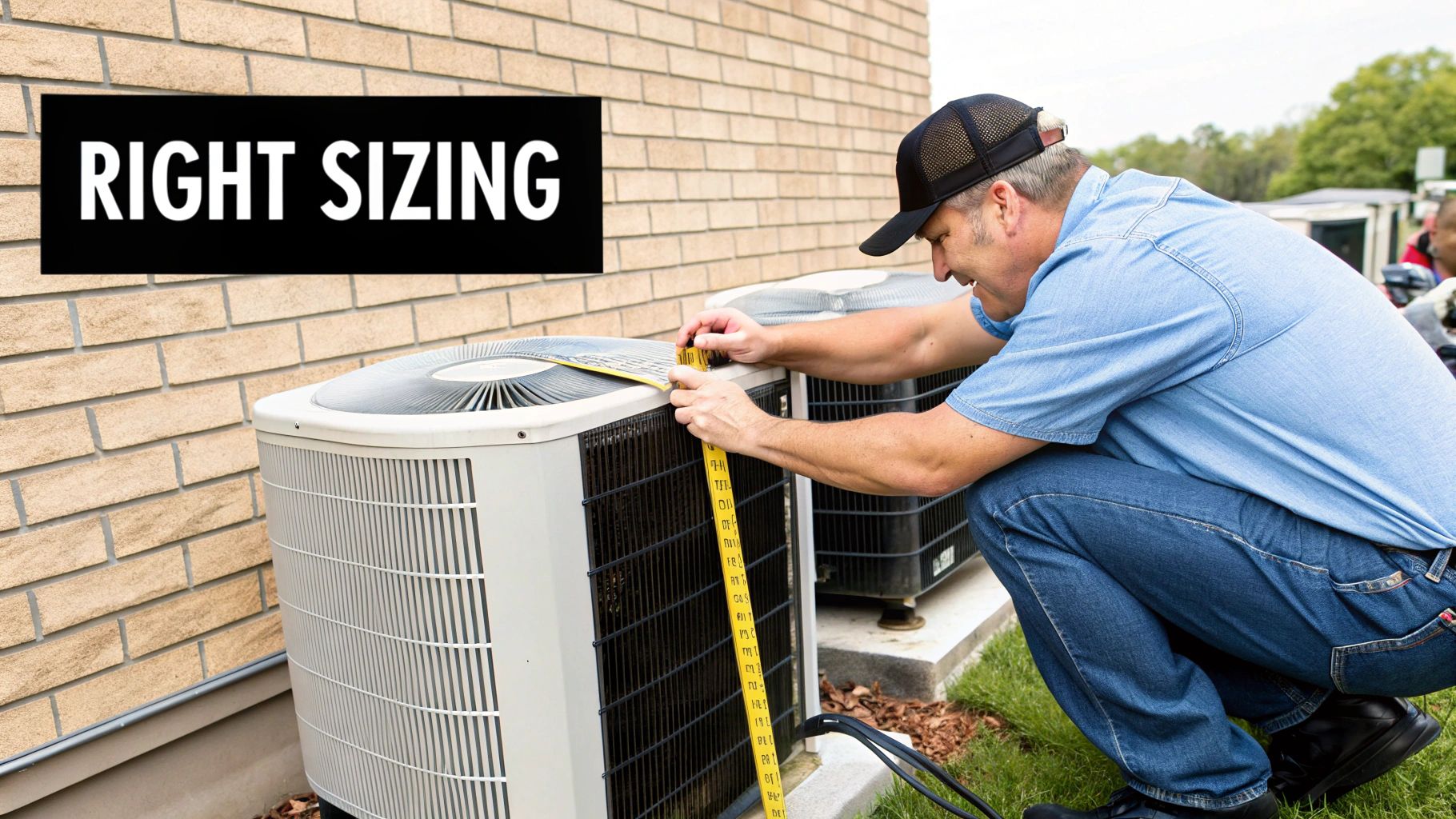
The right size is just as vital as the right efficiency rating. An undersized unit will run constantly without ever making your home comfortable, while an oversized unit will cycle on and off too quickly. This rapid cycling fails to remove humidity effectively, leaving your home feeling clammy during monsoon season, and it also causes excessive wear on the compressor.
This is exactly why a professional load calculation is non-negotiable. The industry gold standard is the Manual J load calculation. It's a deep dive that looks at everything from your windows and insulation to your home's orientation to determine the precise cooling capacity (measured in "tons") you need. Any contractor who just uses a simple square-footage guess for an air conditioning installation Tucson project isn't doing their job right.
If you want to dig deeper into this critical step, check out our guide on how to size an air conditioner for your home.
Comparing Your AC System Options
To help you sort through it all, here’s a quick breakdown of the most common systems we install in Tucson homes.
System Type | Best For | Key Considerations |
|---|---|---|
Central Air Conditioner | Homes with existing, well-maintained ductwork. | The standard for a reason. It delivers powerful, even cooling to the whole house. |
Ductless Mini-Split | Home additions, zoned cooling, or houses without ducts. | Unbeatable efficiency and lets you cool specific rooms independently to save energy. |
Heat Pump | Homeowners wanting an all-in-one heating and cooling solution. | A smart two-for-one deal. It cools your home in summer and efficiently warms it during Tucson's mild winters. |
At the end of the day, the "best" system is the one that's perfectly sized for your house, hits your efficiency targets, and is installed by a pro who truly gets the demands of our desert climate.
Navigating AC Installation Costs and Permits in Tucson

Let's talk about the money side of a new air conditioner. Budgeting for a new AC can feel a bit overwhelming, but when you know what to expect, the whole process feels much more manageable. The final price for an air conditioning installation in Tucson really comes down to a few key things: the type of system you choose, its brand and efficiency rating, and of course, the size of your home.
But there's another major player in the cost game: your ductwork. If your ducts are old, leaky, or just not insulated well, they'll need some work before a new high-efficiency unit can do its job properly. It's a necessary step to make sure you actually get the performance you're paying for. Labor rates also factor in, reflecting the expertise needed for a top-quality installation.
Breaking Down the Costs
A new AC unit is a serious investment in your home, with the total cost often falling somewhere between a few thousand and upwards of ten thousand dollars. Here in Arizona, the heating and air conditioning industry is a massive part of our economy, with a market size of about $3.5 billion. You can dig into more data on the regional HVAC industry from IBISWorld. That big number isn’t surprising; in Tucson’s heat, reliable cooling is non-negotiable.
So where does all that money go? Here's a quick look:
Equipment Costs: This is the biggest chunk, covering the price of the outdoor condenser and the indoor air handler.
Labor and Installation: This pays for the skilled technicians who will remove your old system, set the new one, and safely handle all the electrical and refrigerant connections.
Ductwork Modifications: If your existing ducts need repairs, sealing, or even new runs installed, that will be part of the project cost.
Permits and Fees: These are the official charges from the City of Tucson or Pima County to ensure the installation meets all safety codes.
We know the upfront expense can be a lot to handle. To get a better feel for your financial options, take a look at our guide on HVAC financing options and ways to save on your system.
The Importance of Pulling Permits
It can be tempting to try and save a few bucks by skipping the permit process. Please don't. This is one of the most serious mistakes a homeowner can make. A permit isn't just bureaucratic red tape; it's your guarantee that the job is done safely and to the high standards set by our local building codes.
A permitted installation is a documented, professional job. It protects your family from potential safety hazards like improper electrical wiring or refrigerant leaks, safeguards your home's resale value, and ensures your homeowner's insurance will cover any related issues.
Any reputable HVAC contractor will handle the entire permitting process for you. They’ll file the right paperwork with the City of Tucson or Pima County and arrange for the mandatory post-installation inspection. This final check by a third-party expert confirms your new system is safe, compliant, and ready to go. It’s an absolutely critical part of a professional air conditioning installation in Tucson.
How to Hire a Qualified Tucson HVAC Contractor
You can buy the best, most expensive air conditioner on the market, but if it’s installed incorrectly, it will never perform the way it should. Honestly, the quality of your installation is every bit as important as the equipment itself. Finding and properly vetting the right HVAC contractor is the single most important thing you can do to protect your investment and ensure your system runs efficiently for years.
This is your no-nonsense guide to finding the best pros for an air conditioning installation in Tucson.
The search always starts with the essentials: credentials. Any contractor you even consider must have a current, valid license with the Arizona Registrar of Contractors (ROC). This isn't just a suggestion; it's your primary protection against shoddy work.
Right alongside that license, you need to see proof of both general liability insurance and worker's compensation. Think of it this way: this insurance protects you from any potential accidents or damages that could happen on your property during the install. It’s a non-negotiable.
Vetting Potential Contractors
Once you’ve confirmed the legal must-haves, it's time to dig a little deeper to find a truly reliable partner. A contractor's real-world experience and professionalism are just as critical as their paperwork. You’re not just hiring a technician; you’re hiring a team that understands the unique, brutal challenges of our Tucson climate.
Look for contractors whose technicians hold certifications from respected industry organizations. A perfect example is NATE (North American Technician Excellence) certification, it’s the gold standard for verifying an individual's hands-on HVAC expertise. A company that invests in certified technicians is a company that genuinely cares about quality.
If you want to keep everything straight, you can check out our ultimate HVAC install checklist for a step-by-step guide on what to verify during this process.
The residential HVAC market is a massive $15.4 billion industry that’s also facing a nationwide shortage of around 110,000 skilled technicians. This makes finding a certified, experienced team right here in Tucson even more critical. Quality labor is absolutely at a premium.
Asking the Right Questions
Okay, so you have a shortlist of licensed, insured, and certified contractors. Now it's time to ask the questions that reveal how they really operate. A great contractor will welcome your questions and provide clear, confident answers without hesitation.
Here are a few essential questions to get the conversation started:
Experience: How many years have you been doing air conditioning installation in Tucson? Have you worked on homes like mine before?
Process: Will you perform a Manual J load calculation to size the new system correctly? What does your process look like on installation day?
Warranties: What kind of warranties do you offer on your labor and the equipment you install?
Permits: Do you handle the entire permitting and inspection process with the City of Tucson or Pima County?
The infographic below gives you an idea of how the costs typically break down in a professional quote, from the equipment itself to labor and permits.
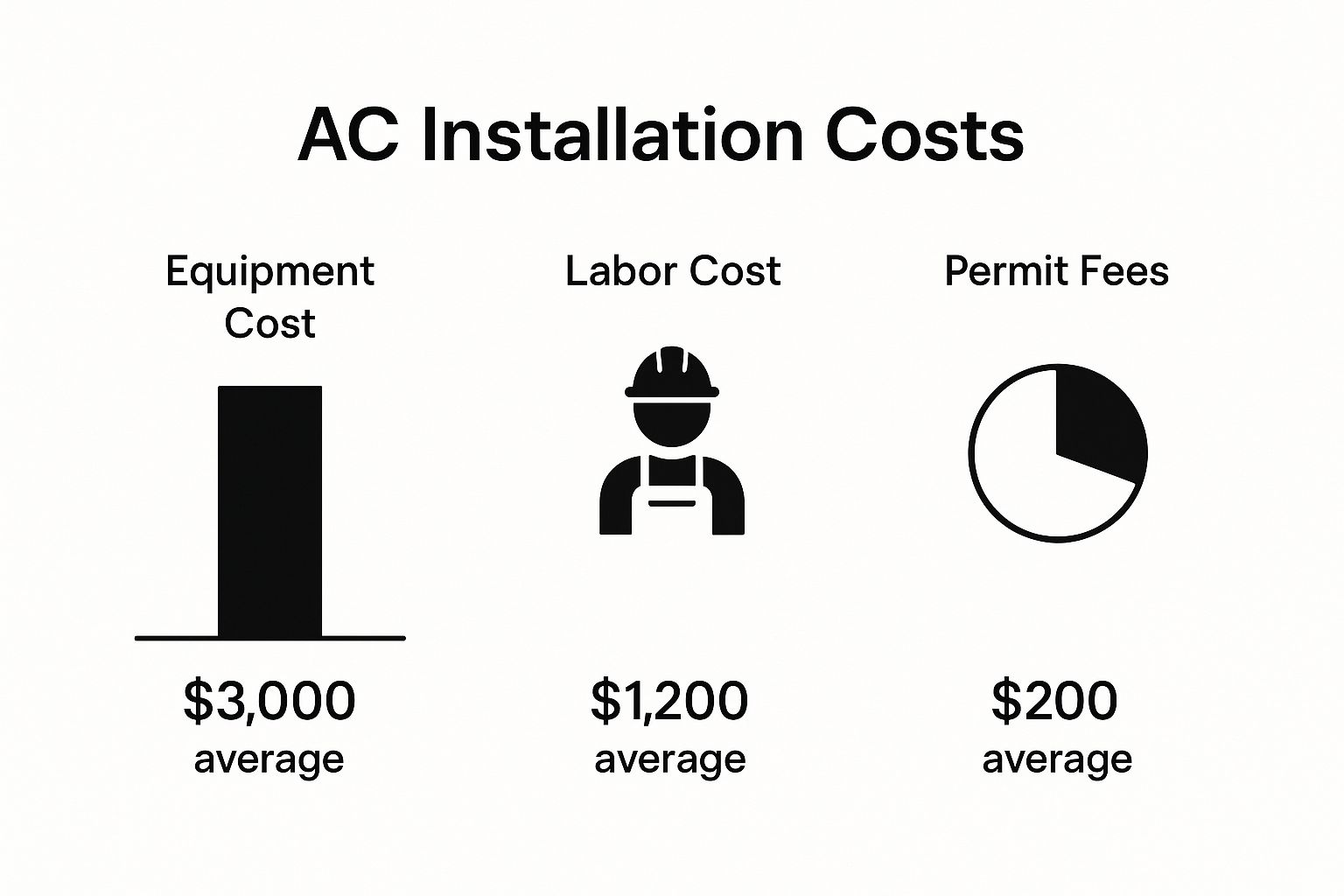
As you can see, while the AC unit itself is the biggest line item, labor and other fees are significant parts of the total project.
Comparing HVAC Contractors: What to Look For
Sorting through quotes can be confusing. To help, here’s a quick comparison to help you distinguish a reliable pro from a risky choice.
Attribute | Professional Contractor | Risky Contractor |
|---|---|---|
Licensing & Insurance | Readily provides ROC license number and proof of insurance. | Vague about credentials, or can't produce them. |
Estimates | Provides a detailed, written estimate outlining all costs. | Offers a verbal quote or a suspiciously low price. |
Sizing Calculation | Performs a Manual J load calculation to ensure proper sizing. | "Eyeballs" the size based on square footage alone. |
Certifications | Employs NATE-certified technicians. | Lacks industry certifications; may use untrained labor. |
Pressure | Answers questions patiently and gives you time to decide. | Uses high-pressure sales tactics; "act now" deals. |
Permits | Includes pulling all necessary permits in their process. | Suggests skipping permits to "save money." |
At the end of the day, be wary of red flags. Extremely low bids almost always mean corners are being cut somewhere. High-pressure sales tactics or a refusal to provide a written estimate are also huge warning signs. Your family's comfort and safety truly depend on hiring a genuine professional.
What to Expect on Your AC Installation Day

The day your new AC gets installed can feel like a big deal, but knowing what's coming makes the whole process feel much smoother. When you understand the flow of the day, you can feel confident and prepared for the team's arrival. A professional air conditioning installation in Tucson is a well-oiled machine, fine-tuned to be as quick and clean as possible.
The day kicks off when the lead technician arrives. They'll walk you through the game plan, double-check the work order, and answer any last-minute questions you have. Right away, you'll see them lay down drop cloths and other protective coverings to keep your home pristine. It's this kind of communication and respect that sets the stage for a great experience.
The Installation Process Unfolded
Once everything is prepped, the crew gets to work. You’ll likely see them split up to be more efficient. One team will head outside to start disconnecting and removing the old, bulky condenser unit. At the same time, another team will be inside, usually in the attic or a utility closet, tackling the old air handler or furnace. This teamwork is what makes a one-day installation possible.
Getting the site ready for the new equipment is one of the most important parts of the job. This isn't just about swapping boxes; it's about setting the foundation for years of reliable cooling.
Setting the New Condenser: The outdoor unit gets placed on a brand-new, perfectly level composite pad. The crew makes sure it has plenty of room to breathe for proper airflow.
Positioning the Indoor Unit: Inside, the new air handler or furnace is carefully maneuvered into place, ensuring it lines up just right with your home's ductwork.
Connecting Lines: Now, the real technical work begins. The technicians will skillfully run and connect the copper refrigerant lines (the "line set") and all the necessary electrical wiring that bridges the indoor and outdoor units.
If you really want to get into the nitty-gritty, we've got more essential AC installation tips for 2025 on our blog that break down what a top-quality installation truly looks like.
Finalizing and Testing Your New System
With the heavy lifting done, the crew shifts to the final, highly technical stages. They'll braze the refrigerant lines, creating a permanently sealed system. This is immediately followed by a pressure test and then a deep vacuum process to pull out every last bit of air, moisture, and contamination. This is an absolutely critical step for your system's health and efficiency. Any tech who rushes or skips this isn't a pro.
The final hour of the installation is just as important as the first. This is when the system is truly brought to life through careful calibration. Technicians will charge the unit with the precise amount of refrigerant specified by the manufacturer, a step that directly impacts performance and energy use.
Once the system is charged, it's time for the moment of truth. The technicians will fire it up and run a battery of tests. They’ll check that the thermostat is communicating correctly, measure the airflow coming from your vents, and use temperature probes to verify the system is cooling effectively.
When everything checks out, the team does a full cleanup, hauling away the old equipment and any debris. Before they head out, they’ll walk you through your new thermostat, showing you all the features so you can get the most comfort and savings out of your new system from day one.
Common AC Installation Questions in Tucson
Deciding to move forward with a new air conditioning installation in Tucson is a big step. Even after you've done your research, it's natural to have a few final questions pop up. It's a major home investment, after all.
We've been through this process with hundreds of Tucson homeowners, so we’ve heard just about every question there is. To help you feel completely confident in your decision, we've put together some straightforward answers to the most common things people ask.
How Long Does a Typical AC Installation Take?
For most homes here in Tucson, a standard central air conditioner replacement is surprisingly quick. A professional crew can usually get the entire job done in about 8 to 10 hours, meaning it's just a one-day project.
Now, that timeline can stretch. If your project is more involved, say, it requires significant changes to your ductwork or you're installing a system for the first time in a house without ducts, it could take two or even three days. Your contractor should always give you a firm, clear timeline after they’ve had a chance to evaluate your home in person.
What Is the Best SEER2 Rating for Tucson?
In a climate as punishing as ours, the SEER2 rating isn't just a technical spec; it's a critical factor in your long-term budget. The federal minimum for the Southwest is 13.4 SEER2, but honestly, that's just the bare minimum.
For Tucson's brutal, months-long cooling season, we always recommend investing in a system with a rating of 16 SEER2 or higher. Yes, the upfront cost is a bit more, but the significant savings you'll see on your monthly TEP bills deliver a fantastic return on that investment over the system's life.
A higher-efficiency unit simply works smarter, not harder, to keep you comfortable. And if you're thinking about other ways to trim those energy bills, check out these tips to improve AC efficiency and lower your bills.
Should I Replace My Furnace and AC Together?
In nearly every case, the answer is a resounding yes. It’s almost always the right move to replace your furnace and air conditioner at the same time, especially if they are both over 10-12 years old.
Think of your AC and furnace not as two separate appliances, but as two halves of a single, integrated system. They share the same indoor air handler (the blower fan) and are designed by the manufacturer to work together as a "matched set." This communication is key to achieving the efficiency ratings you're paying for. Plus, it's far more cost-effective to pay for the labor of one combined installation than to pay for two separate jobs down the road.
Are There Rebates for a New AC Installation?
Absolutely. There are often financial incentives available that can help take a bite out of the cost of a new AC installation. Homeowners can often find:
Federal Tax Credits: These are typically offered for installing high-efficiency systems that meet specific ENERGY STAR qualifications.
Local Utility Rebates: Companies like Tucson Electric Power (TEP) frequently provide rebates for purchasing qualifying energy-efficient AC units and smart thermostats.
These programs can and do change, so it's a good idea to ask your HVAC contractor about the current rebates and credits you might qualify for. A good contractor will stay on top of these programs and help you get every dollar in savings you're entitled to.
Ready to get your questions answered by a pro and start planning your project? The certified technicians at Covenant Aire Solutions are here to provide honest advice and expert service for your Tucson home. Visit us at covenantairesolutions.com to schedule your free, no-pressure consultation today.