
Indoor Air Quality and Ventilation: A Practical Guide
On a Tucson afternoon, the thermostat says the house is cool, yet the living room feels stale. The windows stay shut against the heat, the dog has been indoors all day, and someone eventually opens a window for “fresh air,” only to let in hot dust. The discomfort is real, but temperature is only one part of the problem.
Indoor air quality and ventilation involve pollutants, moisture, outdoor conditions, airflow, and filtration. A comfortable thermostat setting can't tell you whether cooking emissions are lingering, whether a filter is restricting airflow, or whether wildfire smoke is entering through the ventilation system.
The practical answer isn't always to open a window or run a fan longer. Good indoor air management is a decision system. It matches source control, ventilation, filtration, and air cleaning to the pollutant and the conditions outside. That approach applies to a Tucson home, a retail space, an office, or a larger commercial building.
Why the Air Inside Your Home Deserves Attention
You can feel that something is off in a room before you can name it. After dinner, the kitchen may look spotless but still feel heavy. A bedroom can be cool enough for sleep and still leave someone waking up with a dry throat, irritated eyes, or a headache. In a Tucson home, that confusion is common because comfort and air quality are related, but they are not the same thing.
The U.S. Environmental Protection Agency's Total Exposure Assessment Methodology studies found that concentrations of approximately a dozen common organic pollutants inside homes were generally 2 to 5 times higher than outdoors, including in rural and highly industrial areas (EPA guidance on volatile organic compounds and indoor air quality). EPA also reports that concentrations of many volatile organic compounds can reach up to 10 times outdoor levels, while short-term peaks during activities such as paint stripping may reach 1,000 times typical outdoor background levels.
Those numbers are a warning to pay attention, not a reason to panic. They show why indoor air deserves its own diagnosis instead of being treated as a side effect of heating and cooling. Everyday activities and building materials add emissions continuously. Outdoor pollution can enter too, especially when doors open often, ductwork leaks, or a ventilation system pulls in air that is hot, dusty, or smoky.
Practical rule: A cool room isn't automatically a clean room.
That matters because ventilation is a decision, not a reflex. Bringing in outdoor air can dilute indoor pollutants, but only when the outdoor air is better than the air already inside and the airflow reaches the rooms that need help. On a mild day, opening the house may help. During a dust event, heavy pollen period, or wildfire smoke, the better move may be to keep windows closed and rely more on filtration, local exhaust, source control, and equipment that is clean and working as intended.
The useful question is simple. Which pollutant is likely present, what are conditions outside, and which control removes it without creating a new problem?
The Core Concepts Behind Indoor Air Quality
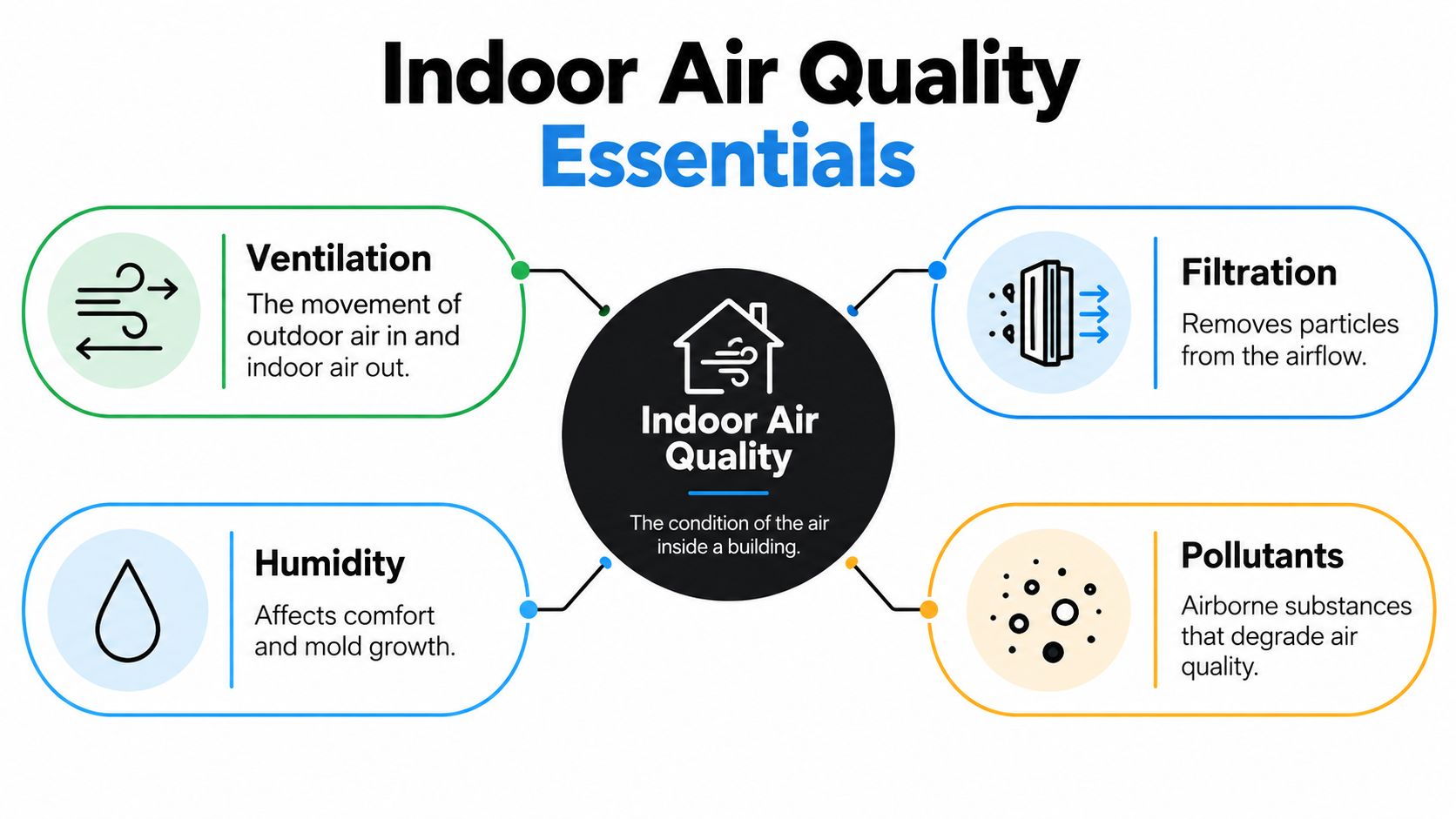
Indoor air quality, or IAQ, describes the condition of the air inside a building. Think of it as the combined result of what enters the building, what people and products release, what the HVAC system removes, and how moisture behaves.
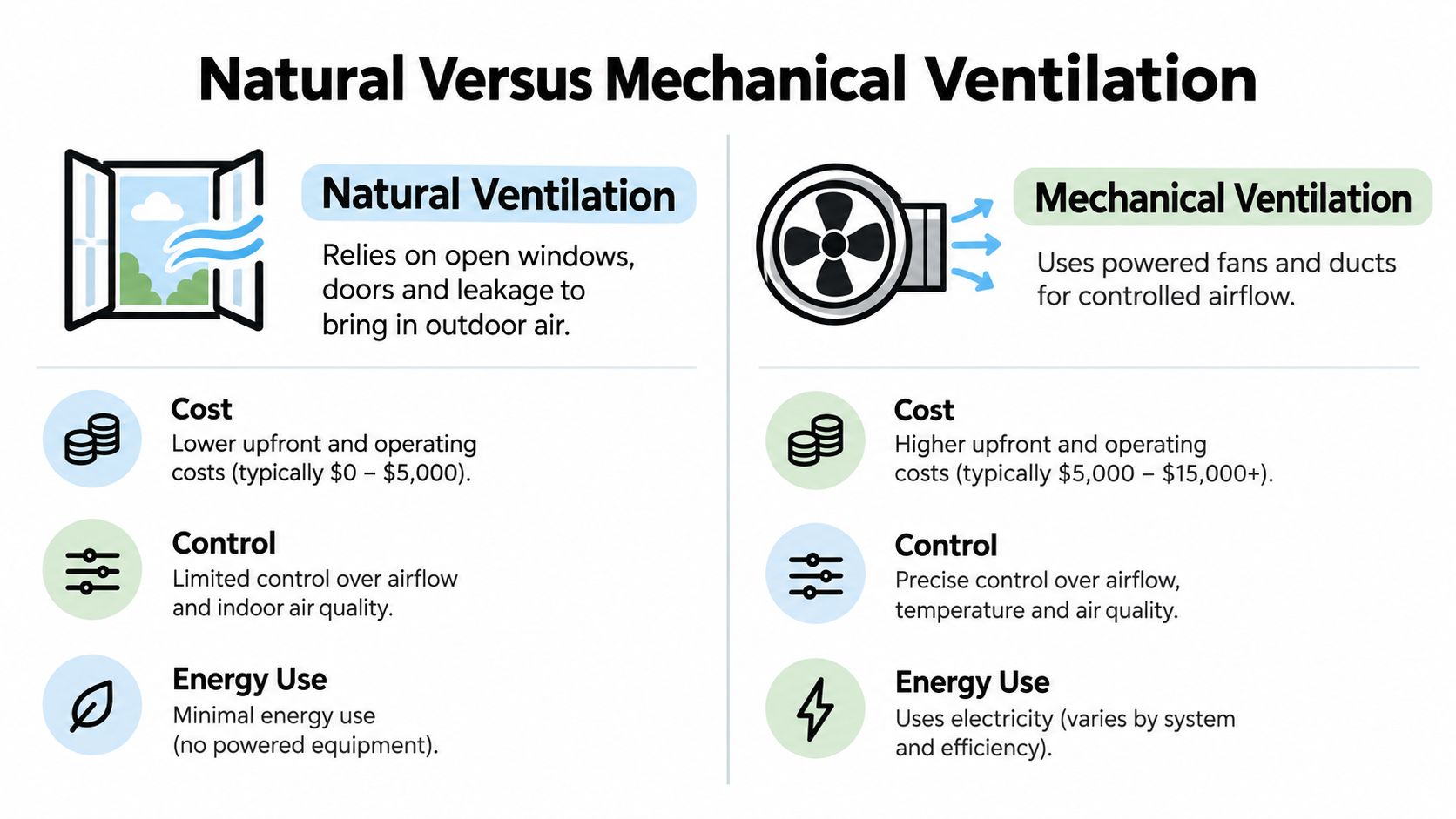
Ventilation is the controlled movement of outdoor air into a building and indoor air out. Natural ventilation uses openings and leakage. Mechanical ventilation uses fans, ducts, dampers, and controls. Neither is automatically better in every situation.
Three measurements that clarify the picture
Air changes per hour, or ACH, estimates how often the air volume in a room is replaced by an equivalent amount of airflow. Imagine a fish tank being filtered repeatedly. ACH describes the turnover, but it doesn't prove that clean air reaches every occupied corner or that a pollutant is removed at its source.
MERV, or Minimum Efficiency Reporting Value, describes filter performance. A low-efficiency filter is like a wide window screen that catches large insects. A higher-MERV filter has finer openings and captures smaller particles, but the tighter material can make the HVAC blower work harder.
CADR, or Clean Air Delivery Rate, describes how quickly a portable air cleaner delivers cleaned air. You can think of it as the effective speed of a vacuum cleaner, not just the size of the motor. A room cleaner must be matched to the room and the pollutant you want to reduce.
ASHRAE uses ventilation standards to establish minimum outdoor-air requirements, while EPA guidance addresses filtration and air cleaning. Homeowners comparing service proposals can also use indoor air quality standards to understand why a contractor should discuss airflow, filtration, and source control rather than only equipment capacity.
For a readable introduction to related air-quality concerns, I PAINT STUFF on Colorado air quality offers useful context about pollutants associated with painting and indoor work. The same principle applies in Tucson: identifying the source makes the remedy more precise.
The Pollutants Hiding in Plain Sight
You walk into the house after a Tucson dust event, close the door, and the air still feels off an hour later. That feeling usually comes from a mix of pollutants, not one obvious culprit. Four families cover most of what homeowners are dealing with, and each one points to a different control decision.
Particles
Particles are the solids and droplets floating in the air or waiting on surfaces to be stirred back up. Dust, pollen, pet dander, smoke residue, and fine debris from outdoors all fit here. In Tucson, this category matters year-round because dry soil, tracked-in grit, and windblown dust can enter through doors, window gaps, attic leaks, and return-side duct leaks. A rug, sofa, or bed then acts like a storage shelf until footsteps, pets, or the air handler put that material back into circulation.

Particles often bother the eyes, nose, and throat first. The practical lesson is simple. Filtration only catches what reaches the filter, so housekeeping and air sealing still matter. Cleaning bedding, rugs, and neglected edges helps lower the amount available to go airborne, and the benefits of professional track cleaning show up here because window tracks often hold dust that gets reintroduced whenever windows open and close.
Volatile organic compounds
VOCs are gases released by many indoor materials and products. Fresh paint, new flooring, cabinetry, adhesives, cleaning products, and air fresheners are common examples. A newly finished room may smell sharp for a while because materials are still off-gassing. Odor is not a meter, but it is a useful clue that source control and timed exhaust deserve attention.
This pollutant family calls for judgment, especially in Tucson. If the outdoor air is clean and temperatures are reasonable, targeted ventilation may help clear the space. If outdoor conditions are dusty, smoky, or extremely hot, bringing in more outside air can trade one problem for another. In that case, reducing product use, isolating the source, and exhausting only when conditions improve is often the better move. For background on how VOCs affect indoor environments, see EPA information on VOCs and indoor air quality.
Biological pollutants
Biological pollutants follow moisture. Mold growth, bacteria, viruses, and allergen-bearing material become more likely when water gets where it should not. A damp bathroom, a slow plumbing leak under a cabinet, or condensation near supply grilles can matter more than a room's smell. In desert homes, people sometimes assume mold cannot be a problem. It can, because the issue is local wetness, not just regional climate.
Combustion gases
Combustion pollutants come from fuel-burning appliances, fireplaces, cooking, attached garages, and stored vehicles. Carbon monoxide is dangerous because you cannot rely on smell to detect it. Nitrogen dioxide can also build up around gas cooking and other combustion sources. This is why source-focused controls matter. Use local exhaust, maintain appliances, and keep carbon-monoxide alarms working.
A good troubleshooting habit is to ask what changed, and where. New materials suggest VOCs. Dust near returns or sills suggests particles. Damp surfaces point to biological growth. A garage, stove, or furnace shifts the investigation toward combustion. The fix should match the pollutant, not just the symptom.
Natural Versus Mechanical Ventilation
Natural ventilation uses windows, doors, vents, and leakage. It can be simple and inexpensive, but its performance changes with wind, temperature difference, building layout, occupant behavior, and outdoor pollution. A cracked window may exchange little air in one room and create a strong draft in another.
Mechanical ventilation uses powered fans, ducts, dampers, and controls. It offers more predictable airflow and can direct exhaust from bathrooms or kitchens, but the system must be sized, balanced, maintained, and commissioned. A bath fan running continuously may exhaust conditioned air without removing the pollutant that caused the problem, especially if replacement air enters through an uncontrolled path.
Match the method to the conditions
Situation | Natural ventilation | Mechanical response |
|---|---|---|
Mild outdoor weather and clean outdoor air | Openings may provide useful short-term exchange | Controlled outdoor-air ventilation can add consistency |
Tucson summer heat | Open windows add heat and humidity load to the cooling system | Use designed ventilation, filtration, and local exhaust |
Dust storm or wildfire smoke | Opening windows can bring pollutants indoors | Close openings and use filtration or suitable purification |
Kitchen or bathroom emissions | General window opening may spread pollutants | Use spot exhaust near the source |
Security or noise concerns | Open windows may be impractical | Mechanical systems can provide airflow while windows stay closed |
Tucson conditions make the trade-off obvious. A window opened during a 105-degree afternoon can increase the cooling load. During a haboob or wildfire-smoke event, it can also import particles. During a period of acceptable outdoor air, controlled ventilation may be beneficial, but the decision still depends on temperature, occupancy, and the building's ability to distribute air.
Bathrooms and kitchens need special attention because moisture, odors, cooking emissions, and combustion by-products begin at specific sources. Guidance such as bathroom mould prevention Dublin reinforces a principle that applies across climates: remove moisture close to where it is produced.
For practical ventilation ideas, review ways to improve ventilation, then ask whether the proposed change accounts for outdoor air quality and cooling demand. A fan is a tool, not a complete IAQ strategy.
Measuring Performance With ACH, MERV, and CADR
A fan running in the background does not tell you much. Air quality improves when the system delivers enough clean air to the space, and these three measures help you check that: ACH, MERV, and CADR.
One way to start is air changes per hour. Guidance collected in the EPA guidance on air cleaners in the home points to at least 5 ACH or 30 CFM per occupant, whichever is greater, for occupied indoor environments. ACH uses the formula ACH = 60Q/V, where Q is airflow in cubic feet per minute and V is room volume in cubic feet.
A simple example shows why that is only the first step. A room with a volume of 2,400 cubic feet served by 200 CFM works out to about 5 ACH. On paper, that sounds acceptable. In real use, a room filled with people can still come up short if each person is not getting enough outdoor air. Tucson homeowners run into this with home offices, bedrooms during gatherings, and bonus rooms that were comfortable for two people but stuffy with six.
That is the key idea. Room size matters, but occupancy can change the answer fast.
Filtration is not free airflow
MERV tells you how well a filter captures particles across tested size ranges. Higher ratings usually catch more of the fine material homeowners worry about, including dust and smoke. The same guidance recommends MERV 13 or the highest filter rating the HVAC system can accommodate, and notes that MERV 13 and higher filters demonstrate at least 50% removal efficiency for the smallest particles tested.
The trade-off is airflow resistance. A denser filter works like a finer screen in a faucet. It catches more debris, but it also makes it harder for air to pass through. If the blower cannot handle that added pressure drop, delivered airflow falls. Some rooms get less conditioned air, static pressure rises, energy use can increase, and the equipment may work harder than it should.
That is why filter upgrades should be checked in the field, not guessed from the label. A technician should measure delivered airflow, static pressure, filter fit, and the condition of the filter rack after the new filter is installed.
MERV Range | Particles Captured | Typical Use | Pressure-Drop Impact |
|---|---|---|---|
Lower MERV range | Larger household dust and lint | Basic residential protection | Usually lower, but depends on filter design |
Mid MERV range | More fine particles and common allergens | Homes needing stronger particle control | Moderate, system compatibility matters |
MERV 13 and higher | Includes the smallest particles tested at the stated minimum efficiency | Smoke and fine-particle control when equipment allows | Higher resistance is possible and must be evaluated |
Portable cleaners add another metric, CADR, or clean air delivery rate. If ACH tells you how often the room air is replaced or cleaned, CADR tells you how much cleaned air the portable unit can supply. Size the cleaner to the room, then place it where air can circulate instead of blowing into a blocked corner.
Filter life is conditional, not fixed. Replacement may often fall around 60 to 90 days, but dust, smoke, pets, occupancy, filter size, and system runtime can shorten that interval. If you want to confirm whether the numbers on paper match the house's real performance, a guide to indoor air quality testing costs can help you ask better questions before scheduling an inspection.
Building a Layered Defense for Cleaner Indoor Air
Cleaner indoor air comes from layers that support one another. An air purifier can't compensate for a strong pollutant source, and ventilation can't remove a particle that enters during a smoke event if outdoor air is the problem.
Start at the source
Use low-VOC paints where practical, keep chemical products sealed, and exhaust cooking emissions outdoors when the equipment allows. Fix water leaks promptly, keep combustion appliances properly maintained, and avoid introducing smoke indoors. Source control reduces the amount of work demanded from every later layer.
Add deliberate air exchange
Ventilation brings suitable outdoor air in and removes indoor air out. It can dilute emissions from occupants and products, but it should respond to outdoor conditions. A control schedule linked to occupancy is more useful than running a fan without knowing where replacement air comes from.
Filter the air that already moves
Central HVAC filters clean recirculated air as the system operates. Portable air cleaners can serve a bedroom, office, or other occupied zone. Both need correct sizing, unobstructed airflow, and maintenance.
Consider active purification as an upgrade
Active purification, including NASA-certified ActivePure technology, can be considered as an additional layer for homes with sensitive occupants or businesses with specific risk-management concerns. It isn't a universal requirement, and it shouldn't replace source control, ventilation, or particle filtration. Claims about any active technology should be evaluated against the pollutant, installation method, maintenance requirements, and applicable testing.

A household with asthma, an immunocompromised occupant, or a business with liability concerns may reasonably ask whether an added purification layer is worthwhile. The decision should follow an IAQ assessment, not a marketing label. Details about air purification system installation can help frame the questions around equipment compatibility and intended use.
When More Fresh Air Is the Wrong Move
At 4 p.m. in Tucson, the instinct to crack a window can backfire. If a dust storm is building, wildfire smoke is drifting in, or ozone is high, outside air may be the dirtier choice. Add extreme summer heat, and that same open window can pull in hot, unfiltered air that makes the house less comfortable and harder to cool.
Ventilation works best as a decision, not a reflex.
Use a simple sequence. First, check outdoor conditions. If smoke, dust, or ozone is high, keep windows and doors closed as much as practical. Next, consider heat and cooling demand. On a 110-degree afternoon, uncontrolled outdoor air adds load and can push some rooms farther from the thermostat setting. Then identify the source. If the problem is cooking, shower moisture, or cleaning products, target it at the source with local exhaust instead of flushing the whole house. Finally, account for the people inside. Occupants with asthma or other respiratory concerns often need tighter control during outdoor pollution events, with recirculated air cleaning carrying more of the load until conditions improve.
Energy upgrades make this trade-off more important. New windows, insulation, and air sealing reduce random leakage, which is good for comfort and efficiency, but a tighter home can also hold onto cooking emissions, cleaning chemicals, moisture, and formaldehyde if mechanical ventilation is missing, undersized, poorly balanced, or left off. A 2025 review found that post-retrofit IAQ depends heavily on how systems are operated and understood by occupants, and it also reported that a monitoring study of eight deep-retrofit dwellings showed sensor-based demand-controlled ventilation did not remove every occupancy-related and non-occupancy-related pollutant (a 2025 Purdue conference review of IAQ after energy retrofits).
Sensors help. They do not confirm that every pollutant is under control. Commissioning still matters.
Practical Steps for Homeowners and Building Managers
Start with observation, then verify the system. A homeowner can learn a great deal by recording when odors, dust, condensation, or symptoms appear and what equipment was operating at the time. A facility manager can add occupancy, room use, outdoor conditions, and maintenance history to the same log.
A practical inspection sequence
Inspect the filter: Confirm the size, fit, loading, and replacement history. Choose the highest MERV rating the equipment can handle after airflow and pressure are evaluated.
Test local exhaust: Check whether kitchen and bathroom exhaust pulls air at the grille and whether it discharges outdoors rather than into an attic or wall cavity.
Review outdoor-air controls: Ask whether the damper opens, whether the intake is clean, and whether controls respond to occupancy or outdoor conditions.
Inspect ducts: Look for leaks, disconnected sections, dust loading, insulation damage, and pressure problems that prevent air from reaching intended rooms.
Measure the room: A technician can compare delivered CFM with room volume and occupancy, then calculate ACH where appropriate.
Check moisture: Keep indoor humidity between 30% and 50%, a range associated with comfort and reduced mold and dust-mite growth (Asthma and Allergy Foundation of America guidance).
Use sensors carefully: A CO₂ and particulate spot check can reveal trends, but it isn't a complete pollutant survey. A CO₂ sensor for HVAC is most useful when readings lead to a verified operational change.
Ask a qualified technician for delivered airflow, external static pressure, filter pressure drop, outdoor-air rate, exhaust performance, duct condition, and commissioning documentation. For a quick check after service, confirm that the filter is seated, supply airflow is present in intended rooms, exhaust fans operate, and controls respond as designed. That 60-second review won't replace testing, but it can catch obvious failures.
Covenant Aire Solutions can provide residential and commercial IAQ assessments, HVAC and duct inspections, ActivePure installations, and biannual maintenance plans. Treat indoor air quality as ongoing maintenance, not a one-time purchase, because filters load, controls drift, ducts age, and Tucson conditions change.
Covenant Aire Solutions offers indoor air quality assessments, ventilation and duct evaluations, filtration upgrades, and ActivePure installations for Tucson homes and commercial spaces. Visit Covenant Aire Solutions to schedule an assessment and turn your indoor air quality concerns into a measured plan.