
Duct Repair Cost Explained for Arizona Homeowners
A single duct repair section in Arizona runs about $150 to $500, whole-home sealing costs about $300 to $700, and full ductwork replacement averages about $3,440. The question is which scope your ducts need.
You may be looking at a room that never cools properly, an air conditioner that seems to run all afternoon, or an estimate that lists “duct repair” without explaining what the technician will repair. In Tucson, those problems deserve a closer look because attic heat and long cooling seasons can turn a small leak into a recurring comfort and energy expense.
A disconnected branch and a collapsed attic run aren't the same job. Neither is a visible joint that needs mastic comparable to a concealed system with widespread leakage. The useful question isn't, “How much does duct repair cost?” It's, “How much leakage will this work correct, and is the proposed scope large enough to solve the problem?”
Why Duct Repair Cost Matters More in Arizona
A Tucson homeowner gets a quote for duct repair after one bedroom stays warm all afternoon. Up in the attic, the technician finds a loose branch, worn insulation, and a few connections that may be leaking. That is where duct repair costs start to matter. The ranges introduced above can point you in the right direction, but they do not tell you whether the quoted work matches the actual problem.
That mismatch is common. Many cost guides stop at one broad national range, yet a real invoice is built line by line. A small repair at one visible joint is a different job from sealing several hidden connections across the attic. Full replacement is a different decision again. In Arizona, the useful question is whether the quote fits the scope, whether measured leakage supports that scope, and whether repair will solve the comfort problem for less than replacement.
Why Tucson attics change the decision
The U.S. Department of Energy says residential duct systems can lose a large share of heating or cooling through air leakage and heat transfer, especially when ducts run through unconditioned areas such as attics, crawl spaces, and garages. In Tucson, that point hits home because many duct runs sit above the ceiling in extreme heat. If you want a plain-language overview of how those parts fit together, this residential HVAC ductwork guide is a helpful starting point.
A duct system works like a cooler with the lid cracked open. The equipment may still run, but part of what you paid to cool never reaches the room.
So duct repair is not just a maintenance line on an invoice. A separated joint or damaged insulation can dump cooled air into a hot attic and force longer run times. The best quote explains what is leaking, how much of the system is affected, and whether targeted repair is enough or replacement makes better financial sense.
How Ductwork Loses Money Before You See the Damage
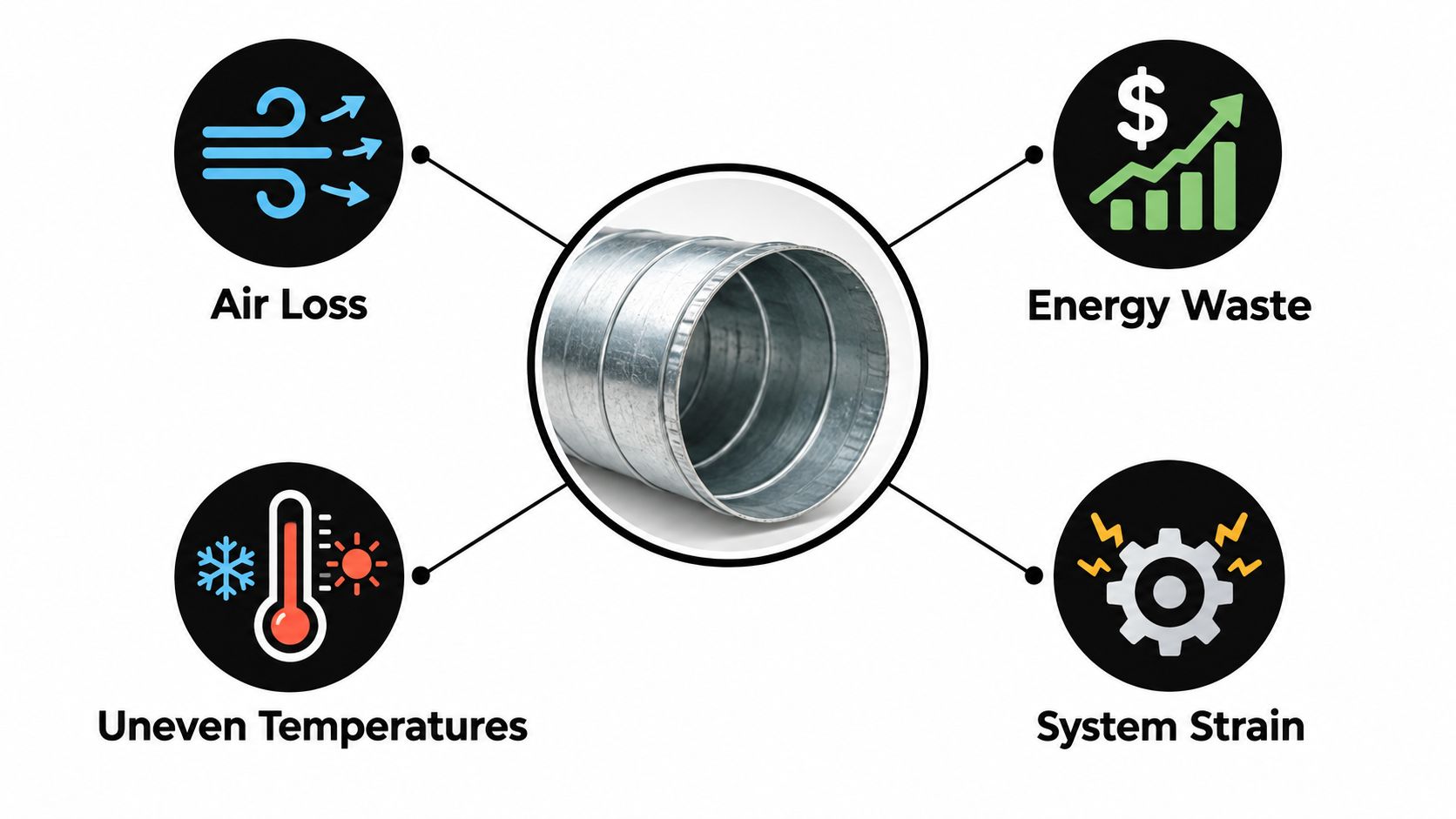
Think of a garden hose with a split near the handle. Water still reaches the flower bed, so the hose appears to work, but some of what you paid for sprays onto the sidewalk. Ductwork behaves similarly: the air conditioner can operate normally while part of the cooled air escapes before it reaches the rooms.
The plenum is the larger connection that distributes air from the equipment into the duct branches. Joints connect sections together, boots connect ducts to registers, and flexible branches carry air through attic or crawl-space layouts. Each connection is a possible leak point.
A joint can separate. A flexible branch can kink, crush, or tear. Insulation can become loose or deteriorate, allowing heat transfer even when the inner air path remains intact. A plenum connection may have gaps that are hard to see from inside the home.
The measurement that makes a quote meaningful
ENERGY STAR reports that typical homes lose approximately 20% to 30% of ducted air through leaks, holes, and poor connections, which can reduce heating and cooling efficiency by as much as 20%. That doesn't mean every Tucson home has the same loss, or that a contractor should apply one savings percentage to every invoice.
A calibrated duct-leakage test pressurizes the sealed duct system, commonly at 25 Pa, and reports leakage in CFM25. The most useful result is usually leakage to the outside. It shows how much air escapes into an attic, garage, crawl space, or another unconditioned area, instead of leaking somewhere inside the building envelope.
Practical rule: Repair value depends on the amount of leakage corrected, not just the size of the visible damage.
Ask whether the contractor will provide pre-repair and post-repair readings. You can also review pressure testing for ductwork before your appointment. If you're managing a rental, pairing duct improvements with a broader guide to reducing rental utility costs can help you evaluate recurring operating expenses rather than focusing only on the service invoice.
Five Factors That Drive Your Duct Repair Price
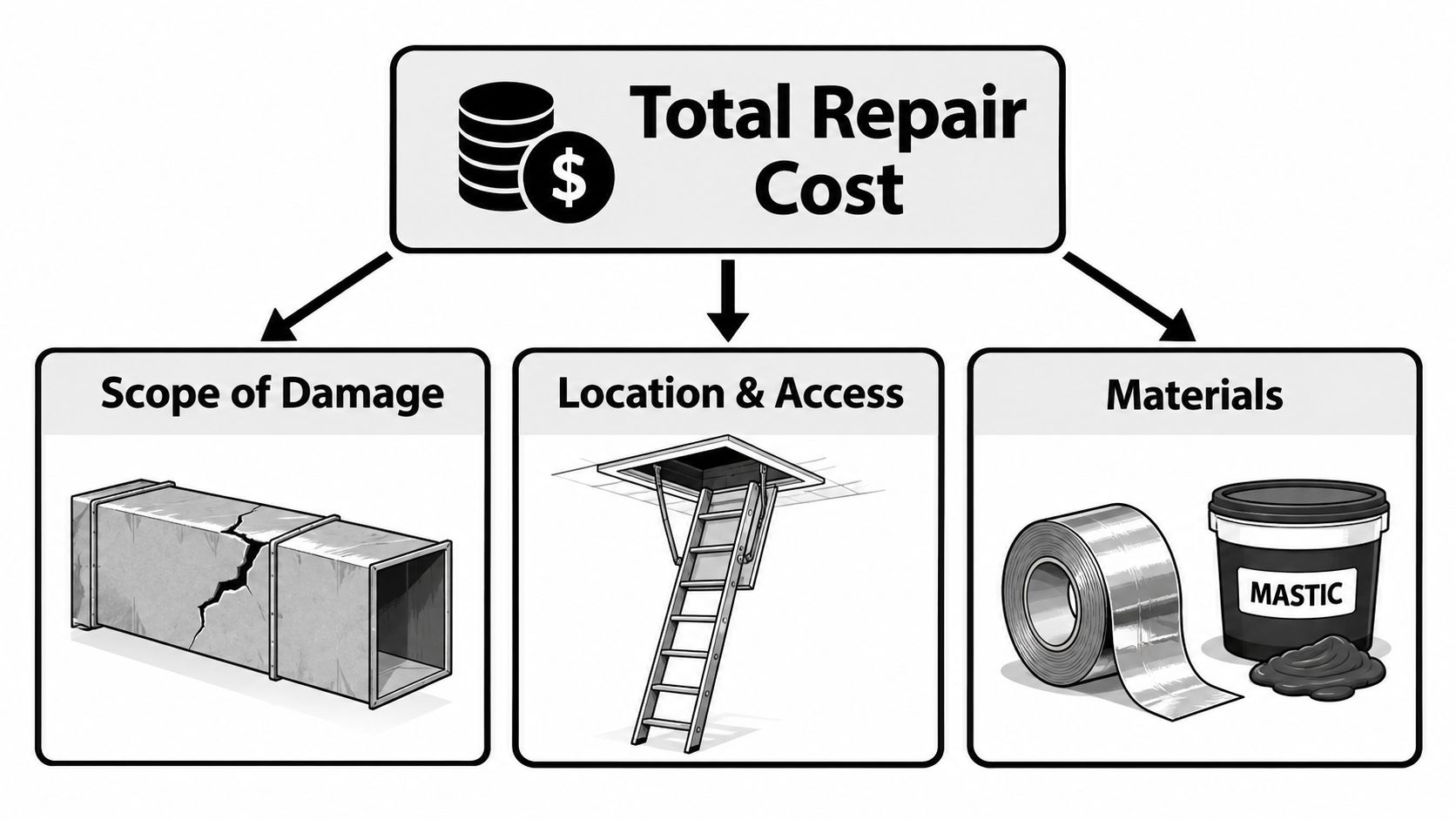
Two homes can have similar comfort complaints and receive very different estimates. The price changes because the technician isn't charging only for sealant or replacement duct. The invoice reflects the difficulty of finding, reaching, repairing, and verifying the problem.
1. Damage type
A small puncture or separated connection may need a patch, mastic, or UL 181-listed foil tape. A crushed flexible branch needs to be cut out and replaced so airflow can move properly. Widespread leakage at many joints requires more preparation, sealing time, and testing.
A visible loose connection is a narrower scope than a branch that has collapsed behind attic insulation. If the duct is structurally sound and the leakage is concentrated at joints, sealing often makes more financial sense than replacing an entire run.
2. Access
A duct in an open garage is easier to inspect and reach than a run buried under attic insulation. Access can add labor because technicians may need to move insulation, create a safe work path, protect the home, or open and restore finished surfaces.
Arizona attic work can also require careful scheduling and additional preparation during hot weather. The price should identify access work rather than hiding it inside a vague “duct repair” line.
3. Materials
Mastic and UL 181 foil tape suit different accessible sealing tasks. New flexible duct may be appropriate for a damaged branch, while sheet metal may be selected for a structural section or a layout problem. The cheapest material isn't automatically the lowest-cost choice if it doesn't address compression, support, or insulation.
A quote should identify what the technician plans to install. “Seal ductwork” doesn't tell you whether the scope includes mastic at joints, new flex duct, insulation repair, or a combination.
4. Duct size and system scope
Replacing one small branch is different from rebuilding a central trunk and several supply runs. Larger duct sections require more material and may involve changes to supports, connections, and insulation. A whole-system sealing proposal also covers more joints than a single-room repair.
A national residential modeling study evaluated upgrades that reduced leakage to approximately 5% and raised insulation to R-8 in unconditioned spaces. The modeled measure produced about 7% total site-energy savings, with the largest benefits in homes that started with poor duct conditions, as reported in the residential duct upgrade analysis.
5. Duct location
Ducts inside conditioned space usually face less heat transfer than ducts in an attic, garage, or crawl space. A leak in a conditioned basement may still affect airflow, but it doesn't carry the same heat-exposure concern as a leaky supply run crossing a hot attic.
The quote should state where the affected ducts are located, whether insulation is damaged, and whether the technician can reach every connection. Those details explain why two estimates with similar wording can have different totals.
Typical Duct Repair Costs in Arizona With Real Examples
A Tucson homeowner usually sees the same surprise. One company quotes a few hundred dollars, another quotes a few thousand, and both say the ductwork needs attention. The only way to judge whether that spread makes sense is to line up the price with the actual scope of work, measured leakage, and how much of the system is affected.
Repair Scope | Typical Arizona Price Range |
|---|---|
Single accessible patch or reconnection | $175 to $600 |
Targeted leak sealing | $300 to $1,225 |
Whole-house manual sealing | $1,000 to $4,100 |
Aerosolized sealing | $1,775 to $5,175 |
Replacement of one crushed or damaged branch | $375 to $950 |
Minor duct sealing and repairs | $850 to $1,650 |
Partial replacement, 30% to 50% of system | $2,200 to $4,800 |
Complete replacement, 1,500 to 2,000 square feet | $4,500 to $7,200 |
Complete replacement, 2,000 to 3,000 square feet | $6,800 to $10,400 |
Attic duct insulation upgrade | $1,200 to $2,400 |
The repair and sealing ranges come from an Arizona ductwork repair schedule. The broader repair and replacement figures come from Arizona duct replacement estimates.
Example one, a limited attic repair
Suppose a technician finds one disconnected attic branch feeding a back bedroom, with insulation pulled aside and enough blown-in insulation around the boot and trunk line that access takes extra labor. That still fits a localized repair, usually somewhere in the $175 to $600 reconnection range or the $375 to $950 branch replacement range, depending on whether the duct can be reattached or the damaged section has to be replaced.
The important part is the boundary line. If testing shows the rest of the system is holding up well, a full-system proposal is hard to justify financially. A careful quote should separate the actual branch repair from insulation repair, attic access time, and any post-repair testing so you can see what fixed the airflow problem and what covered the difficult working conditions.
Example two, leakage across the distribution system
Now take a wider problem. A leakage test finds air escaping at multiple joints, several attic runs have damaged insulation, and a few sections are crushed enough that sealing alone will not solve the airflow loss. In that case, repeated spot repairs can start to look like patching one hole at a time in an old garden hose. You spend money in several places and still end up with a weak system.
That is where scope comparisons help. A partial replacement covering 30% to 50% of the system is listed at $2,200 to $4,800. Complete replacement is listed at $4,500 to $7,200 for a 1,500 to 2,000 square-foot home and $6,800 to $10,400 for a 2,000 to 3,000 square-foot home. If the damage is spread out, those numbers may pencil out better than layering a $1,000 to $4,100 whole-house manual sealing job on top of several individual repairs.
A $175 reconnection quote and a $4,100 whole-house manual sealing quote are prices for different jobs. Compare measured leakage, access, materials, and verification before you compare totals. If you need help sorting out repair language versus replacement language, this ductwork replacement cost resource gives a clearer scope breakdown.
DIY Duct Sealing Versus Hiring a Professional
You spot a loose joint in the attic, feel cool air leaking out, and wonder whether a bucket of sealant and a free Saturday can solve it. Sometimes, yes. If the problem is small, visible, and safely reachable, a careful homeowner can seal that one connection with mastic or UL 181-listed foil tape after cleaning the surface and following the product directions. Ordinary cloth-backed duct tape is still the wrong material for this job.
That kind of fix works like patching one leak in a garden hose. It can stop air loss at that spot, but it does not show whether other branches are leaking, whether the system was losing far more air than you could see, or whether the repair still holds once the blower puts the duct under pressure.

What professional work adds
Professional duct sealing is less about spreading more sealant and more about measuring the whole system before and after the work. A technician can run a calibrated leakage test, check airflow, inspect insulation, and verify the result after the repair. That matters in Arizona homes where ducts often run under attic insulation or through concealed spaces you cannot inspect from the hallway ceiling grille.
The method also changes with the problem. Hand sealing makes sense for accessible joints. Aerosolized sealing is usually reserved for leakage spread through hidden runs, where a person cannot reach every gap by hand. It often costs much more than manual spot sealing because the process treats the larger concealed system, not just one visible seam. For a plain-English breakdown of how duct sealing works on accessible joints versus a larger duct system, review that scope before you compare quotes.
Professional work also gives you documentation a DIY repair cannot. You can ask for before-and-after test results, a written scope, and warranty terms.
If you are collecting contractor questions before making calls, the SkipCalls HVAC resource library is a useful place to start. Hand the job to a pro when you find crushed duct, damaged insulation, contamination, hidden leakage, or a tight attic area that turns a simple repair into a bigger risk.
How to Read and Evaluate a Duct Repair Quote
At $81 to $172 per hour in Arizona, a duct quote can rise fast if the crew has to crawl a tight attic, move insulation, or open access to a hidden run. That is why the total at the bottom matters less than the scope above it. A good quote reads like a map of the problem and the fix, not a vague promise to “seal ducts.”
Start with what the contractor measured. If there is no pre-repair leakage result, you have no baseline. If there is no post-repair result, you have no proof the money bought a real improvement. Duct repair is a lot like patching a slow tire leak. You want to know where air was escaping, what got sealed or replaced, and whether the system held pressure afterward.
The line items to request
Ask for these details in writing:
Pre-repair leakage: Request the initial leakage result, including whether the figure is total leakage or leakage to outside.
Post-repair leakage: Ask for the final reading and the test conditions used to obtain it.
Materials: Confirm whether the crew will use mastic, UL 181 foil tape, new flexible duct, sheet metal, or insulation.
Access work: Identify attic preparation, insulation movement, removal, restoration, and concealed-run access.
Airflow verification: Ask how the technician will confirm that repaired branches deliver appropriate airflow.
Labor and materials: Require separate line items so you can see whether a larger total comes from labor, equipment, materials, or access.

One short line can hide a lot. “Seal ducts” might mean one accessible joint near the air handler, or it might mean several leaking branches plus insulation repair. Ask the contractor to name the affected runs, the repair method, and whether the price covers only visible sections or the full system area that tested leaky.
A replacement quote also needs support. Arizona price schedules show a wide spread between repair, sealing, and full replacement, so the contractor should explain why your home falls into the larger scope, not just point to a big total from an earlier statewide range. If testing shows a limited defect and the duct material is still sound, repair may be the better buy. Replacement makes more sense when ducts are collapsed, contaminated, undersized, structurally deteriorated, or unlikely to hold a reliable repair.
Financing, Maintenance, and Getting an Accurate Estimate
The most useful financial decision starts with a measured scope. A leakage test and airflow inspection can separate a small repair from a system-wide problem, while an inspection of attic insulation can reveal whether sealing alone would leave heat transfer unresolved.
A maintenance plan can help catch loose connections, damaged insulation, and airflow changes before they become larger projects. Covenant Aire Solutions describes preventive plans with biannual check-ups, priority service, and exclusive discounts. Flexible financing can also spread a major repair or replacement across payments, but review the terms carefully and decide how much you can safely spend before approving work.
Compare scopes, not just totals
Covenant Aire Solutions states that it provides transparent upfront pricing with no hidden fees, 24/7 emergency response, and special rates for teachers, military personnel, and first responders. Those service terms can affect the practical value of an estimate, but they shouldn't replace technical evidence. Compare what each contractor will measure, seal, replace, insulate, and verify.
For homeowners considering concealed leakage, this aerosol duct sealing cost resource for Tucson can help clarify why inaccessible runs may require a different method from visible joint sealing.
Before approving the work:
Schedule a leakage test: Request calibrated testing and ask for leakage to outside where applicable.
Get itemized quotes: Ask at least two licensed and insured contractors to list labor, materials, access, insulation, and testing.
Compare the scope: Put repair, sealing, partial replacement, and full replacement side by side instead of choosing the lowest total.
Ask for verification: Require post-repair leakage or airflow measurements that show whether the work changed system performance.
Covenant Aire Solutions can inspect Tucson-area duct systems, identify whether repair, sealing, insulation work, or replacement fits the measured problem, and provide an upfront estimate based on access and duct scope. Visit Covenant Aire Solutions to request a professional evaluation before committing to a duct repair cost.