
HVAC Repair and Maintenance for Arizona Homeowners
A Tucson homeowner hears the outdoor unit click late on a hot summer evening. The thermostat keeps rising, the air coming from the vents feels weak, and the next available service appointment may not be until after the weekend. That's when a small maintenance issue becomes a comfort problem, a safety concern, and potentially an expensive repair.
Good HVAC repair and maintenance prevents many of those midnight surprises by treating the system as a connected machine. Filters affect airflow, airflow affects coil temperature, duct condition affects how much cooling reaches each room, and electrical or refrigerant faults can turn reduced performance into a complete shutdown. The practical goal isn't to perform every task yourself. It's to recognize what you can safely handle, identify trouble early, and call a qualified technician before a minor fault becomes an emergency.
Why HVAC Repair and Maintenance Matters in Arizona
Arizona air conditioners work under demanding conditions. In Tucson, long cooling seasons expose coils, motors, capacitors, ductwork, filters, and electrical connections to sustained heat and operating stress. A system that loses a little airflow or develops a small refrigerant leak may still run, but it can run longer, cool unevenly, and place more strain on components.
The energy impact is larger than many homeowners expect. The U.S. Energy Information Administration's residential electricity data reports that residential air conditioning consumed approximately 254 billion kilowatt-hours in 2020, equal to about 19% of all electricity used in American homes. Commercial cooling consumed another 170 billion kilowatt-hours in 2018, and commercial ventilation consumed 213 billion kilowatt-hours, although ventilation energy includes more than cooling. Those figures show why an HVAC fault isn't merely a comfort inconvenience. Cooling represents a substantial operating expense.
The Department of Energy also states that regular heating and cooling maintenance can reduce household heating and cooling costs by 10% or more, although the actual result depends on the equipment's condition, ductwork, insulation, schedule, and climate. Its guidance recommends checking or replacing filters monthly during peak-use periods because clogged filters restrict airflow and increase system workload. You can read more about equipment life and local conditions in this guide to how long AC units last in Arizona.
Practical rule: A tune-up should produce measurements, not just a reassuring glance at the equipment.
A useful maintenance visit checks the filter, airflow, coils, condensate drainage, electrical components, thermostat operation, duct condition, and refrigerant-related performance. It should also identify whether the system is operating safely under the current load. That approach is more valuable than just washing the outdoor cabinet or adding refrigerant because the thermostat says the home feels warm.
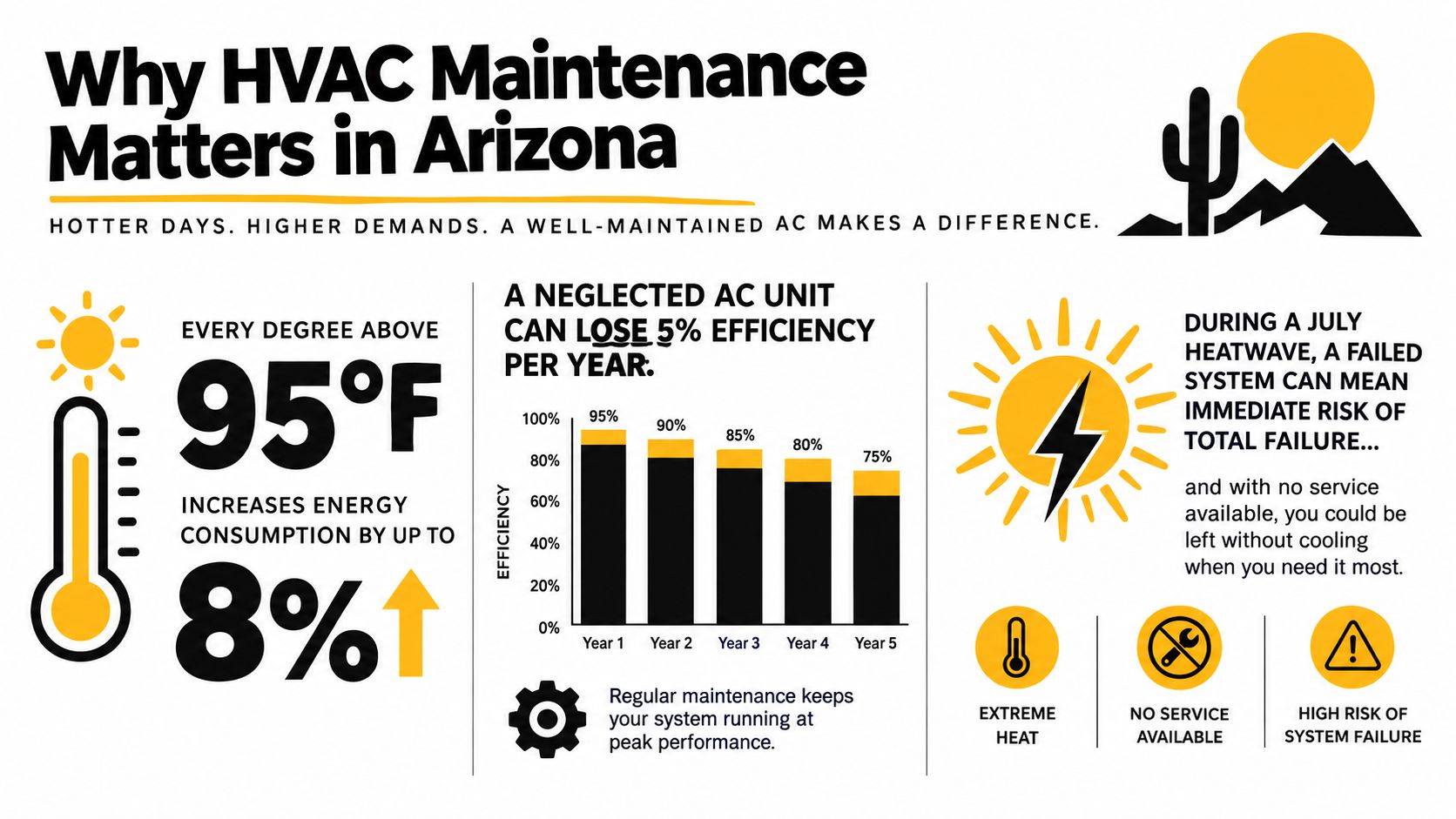
A homeowner can prevent some failures by replacing a dirty filter, keeping debris away from the condenser, and noticing unusual sounds early. A professional must handle refrigerant diagnostics, electrical testing, airflow measurement, and repairs inside sealed or energized equipment. That division of responsibility keeps maintenance useful without turning a simple filter change into a dangerous experiment.
Seasonal DIY Maintenance You Can Safely Handle
Homeowner maintenance should begin with tasks that don't expose you to energized components, pressurized refrigerant, or moving machinery. Keep the work visual and basic. If a panel must come off, a wire must be disconnected, or a refrigerant line must be opened, stop and call a licensed professional.
Monthly checks
Start with the filter. Hold it toward a light, look for dust loading, and confirm that the arrow points toward the air handler or furnace. A filter that looks gray, bowed, wet, or packed with debris deserves immediate attention. During wildfire smoke events, filtration becomes a system-capacity decision. The CDC recommends MERV 13, or the highest-efficiency filter the system can accommodate without negatively affecting performance. Its ventilation guidance explains that MERV ratings run from 1 to 16, and that MERV 13 provides specified particle-capture efficiency across relevant particle ranges.
Check that the filter fits tightly in its rack. Air bypassing around the edges can carry dust into the blower and coil, while an overly restrictive filter can reduce airflow. Don't assume the highest rating is automatically the safest or most effective choice.
Look at the outdoor condenser without opening it. Remove leaves, plastic, weeds, and loose debris from the surrounding area. Confirm that the thermostat display, room temperature, and a separate thermometer broadly agree. A thermostat that reads incorrectly can send you toward an unnecessary equipment repair.
Seasonal checks
Vacuum return grilles and supply registers. Clear objects that block vents, and inspect the insulated refrigerant lines for damaged insulation. Check the condensate drain outlet for signs of blockage or standing water. You can pour a small amount of water into an accessible drain opening to confirm that it flows, but don't force tools into the line or use aggressive chemicals.
For smoke protection, use recirculation when outdoor conditions are poor if your system and household needs allow it. Check that the filter is seated correctly and watch for reduced airflow, whistling, or unusual blower noise. A recent wildfire-smoke filtration study found that tested charged polymer filters experienced a rapid decline in smoke-removal efficiency during exposure, while mechanical media performed more consistently but increased airflow resistance. MERV alone doesn't tell you how a filter will behave in every smoke event.
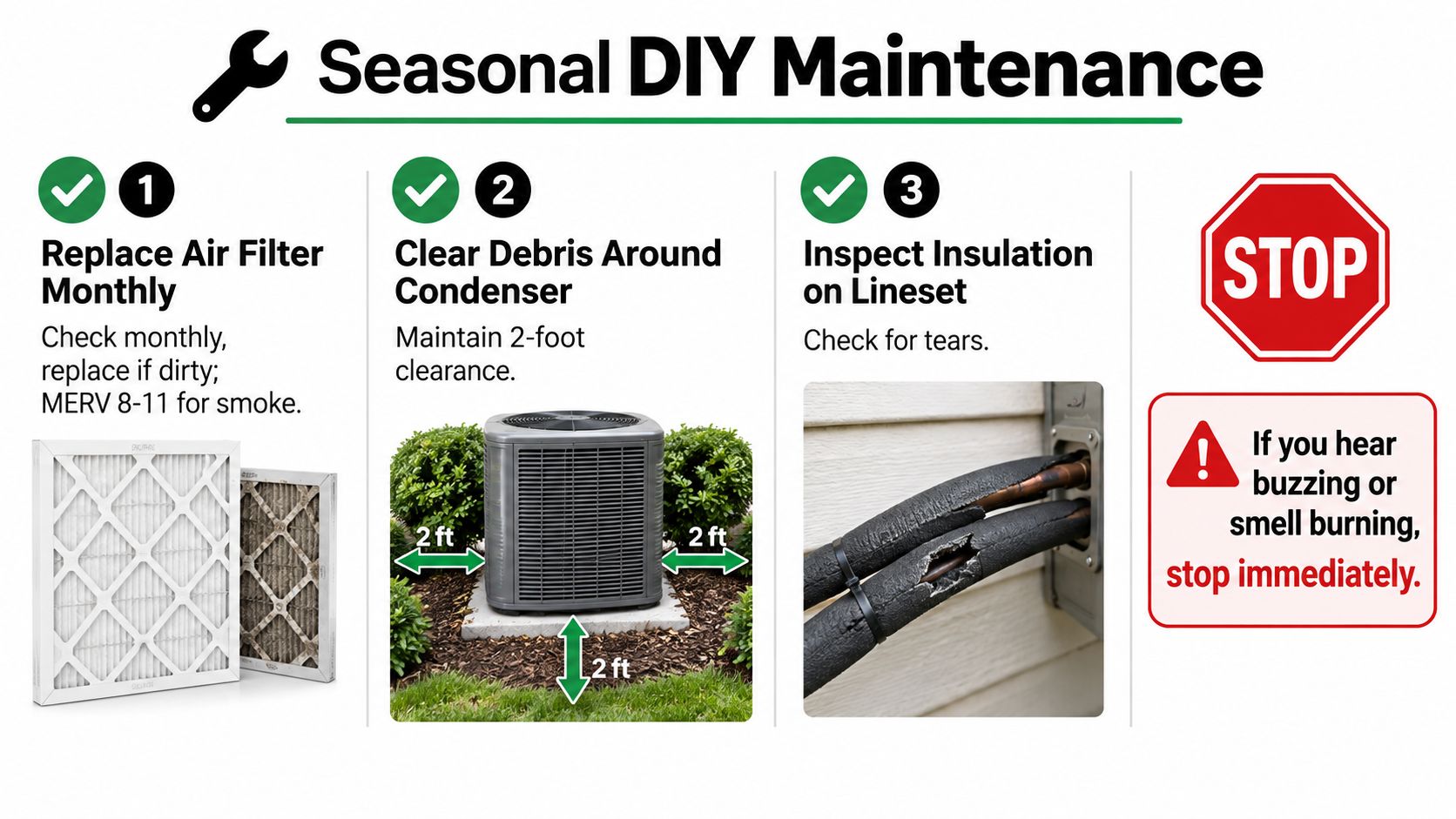
Watch the accompanying maintenance demonstration before attempting only the simple tasks that match your equipment and comfort level.
If you're also coordinating plumbing work, a resource such as Total Plumbing & Hot Water Systems can help you understand why separate household systems still require different specialists. For seasonal HVAC scheduling, review this seasonal AC maintenance guide.
Never open an electrical panel, discharge a capacitor, remove a blower wheel, connect gauges, or handle refrigerant as a DIY project. Refrigerant handling requires the appropriate EPA certification, and mistakes can damage equipment or injure you.
The Hidden Role of Airflow, Filters, and Ductwork
A warm room doesn't automatically mean the system needs refrigerant. In normal operation, refrigerant doesn't get consumed. A gradual decline in cooling more often deserves an airflow investigation first, including the filter, evaporator coil, blower, return path, and ductwork.
The Department of Energy reports that air loss through ducts can account for about 30% of a cooling system's energy consumption. It also reports that routinely cleaning or replacing air filters can lower air conditioner energy consumption by approximately 5% to 15%. The DOE home cooling guidance recommends professional duct cleaning and air sealing where appropriate, rather than assuming a new outdoor condenser will solve a distribution problem.
What homeowners can observe
Rooms that never reach the thermostat setting, dust streaks around registers, a louder blower, weak supply air, or a return grille that pulls aggressively all justify closer inspection. So does a system that cools the hallway while bedrooms remain uncomfortable. Those signs can point to restricted airflow, duct leakage, poor return design, a dirty coil, or a blower problem.
Smoke filtration adds another trade-off. A more efficient filter can capture more particles, but it also creates more resistance. If the blower, filter rack, or return duct can't handle that resistance, the system may lose airflow, freeze the coil, run longer, or provide less comfort. Match the filter to the equipment's measured pressure drop and airflow, not to a marketing label alone. This explanation of what an air filter does is useful before changing filter types.
Airflow vs. Refrigerant: Where Cooling Losses Actually Come From | Typical Share of Cooling Problems | Energy Cost Impact |
|---|---|---|
Dirty filter or restricted return | Not a fixed share, diagnosis depends on measurements | Can increase blower resistance and cooling runtime. DOE reports filter-related energy reductions of approximately 5% to 15% when filters are cleaned or replaced. |
Leaking, constricted, or poorly insulated ducts | Not a fixed share, leakage varies by building | Duct air loss can account for about 30% of cooling-system energy consumption, according to DOE. |
Dirty evaporator or condenser coil | Not a fixed share, confirm through inspection and operating readings | Reduces heat transfer and can contribute to longer runtime or coil icing. |
Refrigerant fault | Not assumed from symptoms alone | Requires pressure, temperature, superheat, subcooling, and leak evaluation against manufacturer specifications. |
A technician should measure airflow before adding refrigerant. Low airflow can imitate an undercharge, and adding refrigerant without proving the cause can create an overcharge while leaving the underlying restriction untouched.
Warning Signs That Point to a Needed Repair
HVAC symptoms become easier to interpret when you record what happens before calling. Note whether the sound occurs at startup, during the cooling cycle, or when the system shuts down. Photograph water, ice, oil residue, thermostat messages, and breaker positions if doing so is safe.
Symptom | Likely Cause | First DIY Check |
|---|---|---|
Clicking, buzzing, or repeated starting attempts | Contactor, capacitor, control, or compressor problem | Turn the thermostat off and listen from a safe distance. Don't remove panels. |
Squealing or grinding | Belt, bearing, blower, or motor wear | Turn the system off and check whether the sound stops. Schedule service if it returns. |
Musty odor | Wet insulation, drain issue, microbial growth, or dirty coil | Check for visible condensate around the air handler and confirm the filter is dry. |
Burning smell | Electrical overheating, motor issue, or damaged wiring | Shut the system off at the thermostat and disconnect if accessible. Seek prompt professional help. |
Water under the air handler | Blocked drain, frozen coil, pan failure, or condensate pump issue | Turn cooling off, protect nearby flooring, and check for an obvious drain overflow. |
Ice on refrigerant lines or coil | Restricted airflow, dirty coil, or refrigerant fault | Turn cooling off and let ice melt. Don't chip it away or add refrigerant. |
Constant running | Heat gain, duct loss, dirty coil, low airflow, or capacity problem | Check the filter, registers, doors, windows, and thermostat setting. |
Short cycling | Thermostat issue, safety control, oversized equipment, or fault condition | Confirm the thermostat isn't exposed to a supply vent or direct sunlight. |
Uneven room temperatures | Duct leakage, balancing issue, insulation problem, or restricted airflow | Check whether registers are open and unobstructed, then document the affected rooms. |
A thermostat problem can be as simple as a loose battery or inaccurate sensor, but repeated cycling deserves diagnosis. Capacitors can fail without obvious visual damage, and blower motors can draw abnormal current while still turning. Those components require electrical testing, not guesswork.
Stop immediately if: you smell burning, see smoke, hear violent electrical arcing, find a damaged wire, or see refrigerant oil around a joint. Shut the system down and arrange urgent service.
For broader context on symptom-based troubleshooting, this guide to fixing an air conditioner in Brisbane illustrates why sounds, odors, airflow, and water should be treated as diagnostic clues rather than isolated nuisances. Arizona equipment differs, but the principle is the same: document the symptom before someone resets the system and makes the evidence disappear.
A technician will work faster if you provide the approximate start time, outdoor conditions, thermostat setting, affected rooms, sounds, odors, photos, and any recent filter or electrical work. Don't keep restarting a unit that trips a breaker or produces a burning smell.
Repair, Replace, or Wait on R-410A Equipment
The R-410A decision is more nuanced than “the refrigerant is banned.” New residential split-system air conditioners and heat pumps using R-410A could no longer be manufactured or imported in the United States beginning January 1, 2025, but existing R-410A equipment can still be serviced. An R-410A system also can't be converted by just replacing its refrigerant with R-32 or R-454B. Those newer A2L refrigerants require purpose-designed equipment.
The environmental difference is substantial. R-454B has a global-warming potential of 466, compared with approximately 2,088 for R-410A, according to the R-410A and newer refrigerant guidance. That difference doesn't automatically make replacement the right financial decision for every Tucson homeowner.
Repair vs Replace Decision Matrix | Repair | Replace |
|---|---|---|
Immediate financial impact | Usually limits the immediate work to the failed component and required testing | Requires a larger upfront investment, including equipment, installation, and possible electrical work |
Efficiency | Keeps the existing rating and installation quality | Creates an opportunity to improve efficiency, duct performance, controls, and system matching |
Refrigerant access | Existing equipment may continue to receive service, subject to availability and leak condition | Uses equipment designed for an approved newer refrigerant |
Reliability | Makes sense when the fault is isolated and the system remains sound | More compelling when failures recur or the system has broader condition problems |
Decision evidence | Requires accurate diagnosis, leak confirmation, parts availability, and warranty review | Requires a load calculation, duct evaluation, equipment match, installation scope, and warranty terms |
Repair is reasonable when the problem is isolated, the system has a sound coil and compressor, parts remain available, and the leak or fault can be corrected responsibly. Replacement deserves serious consideration when leakage keeps returning, the equipment has multiple major faults, comfort remains poor after proper repair, or the installation itself is unsuitable.
A practical decision path
Verify the fault. Require airflow, electrical, and refrigeration measurements rather than a refrigerant charge based only on low cooling.
Check the leak history. A recharge without leak investigation may postpone the decision while leaving the underlying failure active.
Review the whole system. Include duct leakage, efficiency, electrical capacity, warranty status, expected summer load, and the time you expect to remain in the home.
Compare written scopes. A replacement quote should identify equipment, refrigerant type, line-set requirements, electrical work, permits, commissioning measurements, and warranty coverage.
Choose the least wasteful responsible option. A minor repair on a healthy system can be sensible. Repeatedly recharging a leaking system may not be.
For a homeowner facing this decision, the R-410A refrigerant phase-out guide provides additional context. Commercial owners need a separate compliance review. EPA rules effective January 1, 2026 apply leak-repair requirements to certain refrigerant-containing appliances with a full charge of at least 15 pounds when the refrigerant is an HFC, or an HFC substitute with a global-warming potential greater than 53. The EPA phasedown frequently asked questions also explain that residential and light-commercial air-conditioning and heat-pump systems are excluded from those specific provisions. Applicability depends on equipment category, charge, refrigerant, and use, so commercial owners should verify the exact unit data.
When to Stop DIY and Call a Licensed Technician
DIY troubleshooting ends when the next step requires energized testing, refrigerant access, combustion diagnosis, or removal of a safety control. Turning off a thermostat isn't the same as making equipment safe. Capacitors can retain a dangerous charge, and a disconnect doesn't eliminate every electrical hazard inside the equipment.
Safe DIY
Filter service: Inspect, replace, and confirm correct airflow after installation.
Outdoor inspection: Remove loose debris without opening the cabinet.
Thermostat observation: Record settings, room temperature, error messages, and cycling behavior.
Drain awareness: Look for overflow and shut off cooling if water threatens the air handler or ceiling.
Documentation: Photograph accessible conditions and write down when symptoms occur.
Defer to a professional
Electrical testing: Capacitors, contactors, relays, breakers, voltage, amperage, and wiring require qualified testing.
Refrigerant diagnosis: Gauge readings, leak testing, recovery, charging, and refrigerant substitutions aren't homeowner tasks.
Airflow commissioning: A technician should measure airflow, static pressure, duct leakage, temperature split, and filter pressure drop.
Gas furnace work: Heat exchangers, burners, venting, safeties, and combustion must be evaluated professionally.
Major installation changes: Refrigerant line sets, disconnects, equipment replacements, and associated electrical work may require permits and code compliance in Tucson. Confirm requirements with the local authority and the contractor before work begins.
Call immediately
Burning odor or smoke: Shut the system down and arrange same-day help.
Repeated breaker trips: Don't keep resetting the breaker. The fault may involve wiring, a motor, a compressor, or a serious electrical condition.
Gas odor or suspected carbon monoxide: Leave the area, avoid switches or flames, and contact the appropriate emergency service.
Active water damage: Stop cooling if the drain or pan is overflowing and protect ceilings, walls, and flooring.
Refrigerant leak evidence: Oil residue, hissing, or sudden performance loss requires professional leak evaluation.
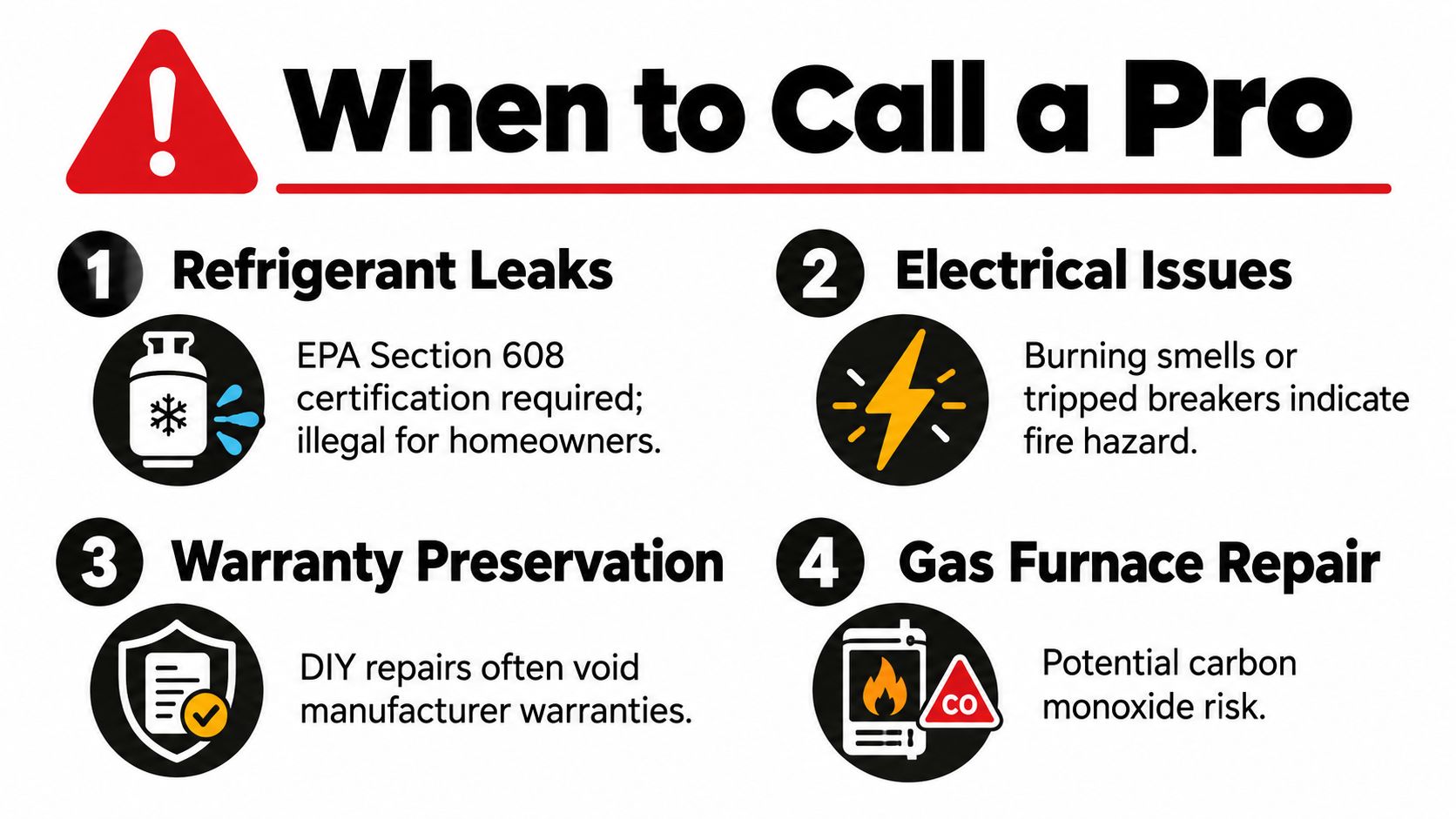
Refrigerant work also carries legal requirements. EPA Section 608 certification applies to technicians who service equipment containing regulated refrigerants. A homeowner shouldn't vent, recover, transfer, or charge refrigerant. Unauthorized work can create an environmental violation, damage the compressor, and complicate warranty claims.
Bring the technician a clear record: equipment model, filter type, thermostat behavior, breaker history, photos, sounds, odors, and the time the problem began. That information reduces repeated testing and helps the technician arrive prepared for a real diagnosis rather than a vague “not cooling” call.
Building a Preventive Maintenance Plan That Pays Back
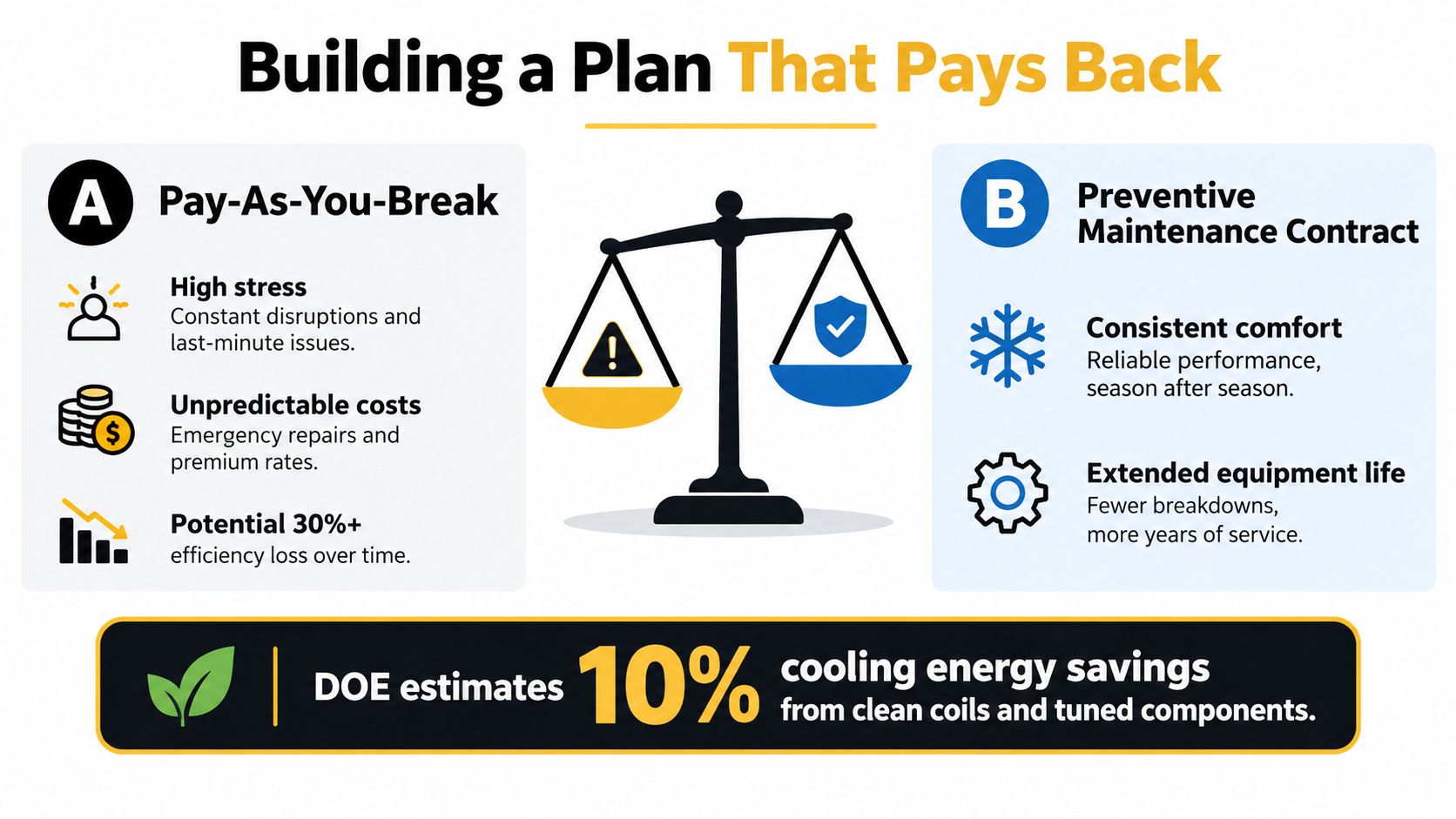
A preventive plan earns its value when it finds a correctable problem before the equipment has to operate through the hottest part of the season. The DOE's 10% or more potential reduction in household heating and cooling costs supports maintenance as an energy-management measure, not just a cleanliness ritual. Actual savings vary, so the technician should explain which measured condition supports the recommendation.
A useful visit includes more than a quick visual inspection. Ask for a written record of filter condition, airflow, temperature performance, coil condition, condensate drainage, electrical readings, blower amp draw, refrigerant-related measurements, thermostat operation, and duct concerns. If the technician recommends refrigerant, ask what evidence supports the recommendation and whether a leak search is necessary.
What a sound plan includes
Preseason inspection: Check cooling equipment before heavy summer demand, then inspect heating operation before colder weather.
Coil and cabinet service: Remove dirt that interferes with heat transfer, while protecting electrical components and insulation.
Drain protection: Flush the condensate path and identify pan, pump, or slope problems.
Electrical review: Test capacitors, contactors, connections, safeties, voltage, and amperage rather than just tightening everything.
Airflow verification: Check filters, returns, supply delivery, static pressure, blower performance, and duct leakage.
Written findings: Record measured conditions, recommended repairs, urgency, and what should be monitored.
The alternative is pay-as-you-break service. That approach can appear cheaper while the system is operating normally, but it leaves the homeowner with less scheduling flexibility and less information about gradual deterioration. A maintenance agreement won't guarantee that equipment never fails. It does create regular opportunities to identify restricted airflow, drainage issues, electrical wear, and refrigerant problems before they become harder to manage.
A practical homeowner schedule is straightforward:
Check the filter during peak-use periods and replace it when dirty or as the equipment manufacturer specifies.
Keep a spare filter that matches the approved size and system requirements.
Use recirculation during wildfire smoke events when appropriate, while monitoring airflow and comfort.
Have duct leakage evaluated when rooms remain uneven, dust returns quickly, or the system runs excessively.
Schedule professional cooling and heating inspections before the seasons that place the greatest demand on each system.
Keep service records, model numbers, warranty documents, and repair photographs together.
The HVAC preventive maintenance plan guide can help you compare plan features and decide which measurements and services should be included.
Covenant Aire Solutions provides Tucson-area homeowners with AC repair, heating service, system replacement, indoor air quality support, and preventive maintenance visits that focus on measured performance rather than guesswork. Visit Covenant Aire Solutions to schedule an evaluation, discuss recurring HVAC problems, or build a maintenance plan before the next Arizona heat surge.