
How Long Do AC Units Last in Arizona
Most central AC units in Arizona last 10 to 15 years, while Phoenix-area systems are often closer to 8 to 12 years. The hottest parts of the Phoenix Valley can shorten that expectation further, while a premium, well-maintained system may reach 16 to 20 years in favorable conditions.
You may be asking that question tonight because the thermostat says 84 degrees, the outdoor unit is still running, and the electric meter seems to be working as hard as the AC. In Arizona, the calendar age of the equipment matters, but operating hours, dust exposure, equipment quality, and maintenance history usually tell the more useful story.
A July Night in Tucson and the Lifespan Question
At 11 p.m. on a July night in Tucson, a homeowner steps outside and feels hot air blowing from the condenser. The indoor temperature is still 84 degrees. The outdoor fan is turning, but the house isn't catching up, and the system seems to have been running since breakfast.
That scene raises the practical version of the question, not just “How long do AC units last in Arizona?” The better question is, how many hard cooling hours has this system already worked, and how well has someone cared for it?
Most Arizona central air conditioners last about 10 to 15 years, according to Arizona-specific AC lifespan guidance. Phoenix-area equipment often lands closer to 8 to 12 years, while systems in more moderate parts of the state may last longer. The difference isn't luck. A condenser that works through long cooling seasons and extreme afternoon heat experiences more compressor, capacitor, contactor, and coil stress than identical equipment in a mild climate.
The question behind the number
A Tucson homeowner may have a 12-year-old system that's still worth repairing. Another homeowner with a similar model may have an 8-year-old condenser that has suffered from blocked coils, poor airflow, and repeated refrigerant problems. Age starts the conversation, but it doesn't finish it.
Your home's insulation, window exposure, duct condition, thermostat settings, and equipment sizing also affect runtime. If you're trying to cool a hot room tonight, practical steps such as lowering indoor heat and cooling a house efficiently can reduce strain while you decide what to do next.
Windows matter, too. A west-facing room with aging glass can force the AC to fight a heavier afternoon load. Homeowners comparing single-pane and double-pane windows with Breaking Glass Co. can often identify envelope improvements that reduce demand on the cooling system, even though better windows won't repair a failing compressor.
The rest of the diagnosis comes down to desert conditions, local submarket, system construction, service records, and symptoms. Tucson, Phoenix, and Flagstaff don't age equipment in exactly the same way. The useful answer is not a promise that a unit will reach a specific birthday. It's a decision process that tells you when maintenance is worthwhile, when a repair is sensible, and when another summer with the same equipment is a poor gamble.
How Arizona's Climate Shortens AC Life
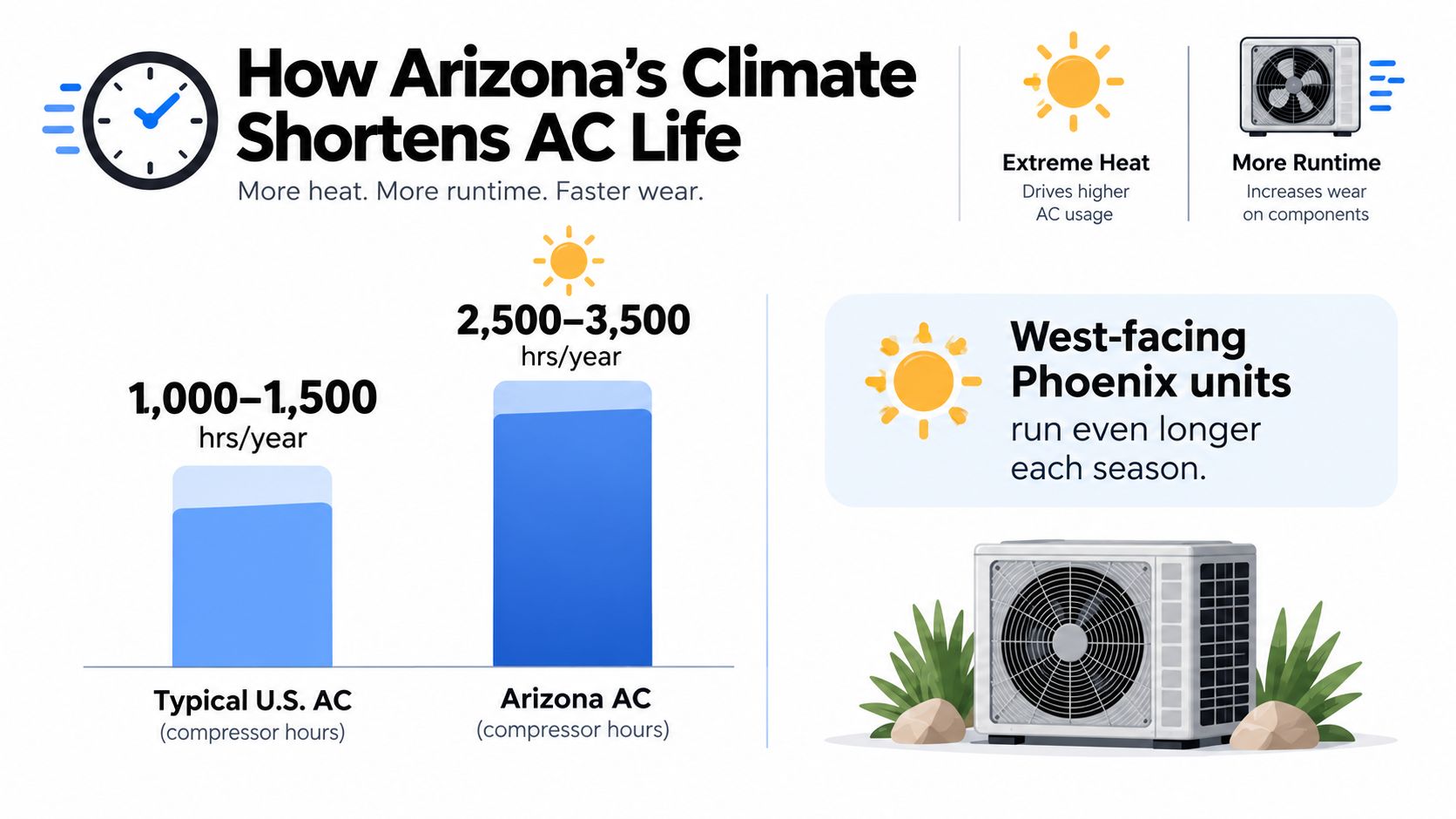
An AC system doesn't experience wear in calendar years alone. Runtime is the mechanical workload. Arizona systems may operate 8 to 10 months per year, and during peak summer they can run 18 to 22 hours a day, according to Arizona AC operating and lifespan guidance.
That sustained workload affects nearly every major component. The compressor starts and runs under high outdoor temperatures, the condenser coil must reject heat into already hot air, and electrical parts remain exposed to heat soak for long stretches. A unit can be younger on paper but older in practical wear than a system that runs only during a short, mild summer.
Heat raises the load
The outdoor condenser has one job during cooling: move indoor heat outside. When the outdoor air is already extremely hot, the system has a harder time completing that transfer. That increases operating pressure and can raise electrical demand, especially when the coil is dirty or the refrigerant charge isn't correct.
The compressor takes the punishment first. Long, hot cycles can accelerate wear in the compressor motor and associated electrical components. Capacitors and contactors also operate in an environment where heat can shorten their useful service life. This is why a system that still produces cool air may be approaching a major failure, even if the thermostat appears normal on a mild day.
Dust blocks heat rejection
Fine desert dust, construction debris, and seasonal debris collect on outdoor coils. A dirty coil works like a partially blocked radiator. The fan may continue spinning, but the condenser can't release heat as effectively, so the compressor works harder to deliver the same cooling.
Indoor filters create a second airflow bottleneck. When a filter loads with dust, the blower has to move air through greater resistance. That can reduce comfort, increase runtime, and contribute to coil icing or other airflow-related problems. Seasonal AC maintenance guidance is useful because it treats filters, coils, electrical parts, and drainage as a connected system rather than isolated chores.
Practical rule: If the outdoor coil is visibly matted with dust or the filter is gray and loaded, don't judge the compressor until airflow and heat rejection have been corrected.
Continuous runtime is not automatically a failure. On a properly sized system, a long cycle can provide steady comfort. The trouble starts when the unit runs almost constantly because of a dirty coil, weak airflow, refrigerant loss, poor insulation, duct leakage, or insufficient capacity. Those conditions turn ordinary Arizona heat into repeated mechanical stress, and they help explain why desert equipment usually falls below the service life expected in milder climates.
Lifespan Across Arizona Submarkets and Build Quality
A condenser in the western Valley can face a very different workload from one in Flagstaff. Arizona is not one climate bucket. Phoenix and the western Valley place a harsher cooling demand on equipment than higher-elevation communities, while Tucson varies with neighborhood, elevation, shade, home design, and maintenance history. Flagstaff's cooler conditions give cooling equipment more relief, although installation quality and operating habits still matter.
The statewide 10 to 15 year benchmark is a starting point, not a promise, as reflected in Bryant's HVAC lifespan guidance. In the western Valley, heavy runtime can push planning toward the shorter side. Phoenix-focused replacement guidance commonly places systems in the 8 to 12 year range, while well-maintained premium equipment may last longer, according to desert replacement-planning guidance. Plan around the elevation, heat exposure, and hours of operation at your address, not an average for the entire state.
Find your position on the curve
Equipment quality sets the starting point. A basic single-stage system usually costs less initially, but it has fewer operating modes and may run at full output more often. Two-stage equipment can run more steadily when the load is lower. Variable-speed inverter systems adjust capacity gradually, which can improve comfort and reduce abrupt starts when the equipment, ductwork, and controls are correctly matched.
Submarket | Typical Summer Conditions | Annual Runtime | Builder-Grade | Mid-Range | Premium Inverter |
|---|---|---|---|---|---|
Phoenix Valley and western Maricopa County | Extreme low-desert heat and severe condenser workload | Very heavy, often near the upper end of Arizona demand | Often the shortest practical service life | Better control and durability when correctly installed | May reach the upper Arizona range with strong maintenance |
Tucson and Southern Arizona | Hot Sonoran Desert conditions, with meaningful variation by elevation and shade | Heavy seasonal use, generally less severe than the hottest Phoenix situations | Often calls for earlier replacement planning | Useful balance of cost and comfort | Strong option when runtime and comfort justify the investment |
Flagstaff and higher country | Milder cooling conditions than the low desert | Lower cooling demand than Phoenix and Tucson | May last longer than in low-desert markets | Often operates under more favorable conditions | May reach the upper end of the service-life range when maintained |
The submarket difference affects repair decisions as much as lifespan estimates. Arizona location-specific lifespan analysis identifies meaningful variation between Tucson, Southern Arizona, and Phoenix-focused expectations. A Phoenix condenser with long daily cycles should not be judged by a Flagstaff expectation, and a Tucson unit should not automatically be assigned the same replacement schedule as equipment in the western Valley.
Build quality cannot compensate for neglect, and poor installation can erase the benefit of premium equipment. The installer needs to size the system correctly, verify airflow, charge refrigerant properly, and commission the controls. A premium condenser with restricted ducts or an incorrect charge remains a stressed system.
For repair versus replacement, combine age with workload and repair history. A heavily used western Valley unit near the shorter planning range deserves a replacement estimate after a major compressor or coil failure. A lightly used, well-installed system in higher country may justify repair when its components and cabinet remain sound. That judgment is more useful than applying one statewide age cutoff.
Maintenance Habits That Add Real Years
Arizona maintenance should reduce the workload placed on the compressor, blower, condenser fan, and electrical components. In practice, the difference between a unit that reaches the later part of its service life and one that fails early often comes down to clean coils, unrestricted airflow, and electrical parts replaced before they cause a no-cool call.
A low-desert system with long daily runtimes needs closer attention than a lightly used unit in a milder Arizona submarket. Dust, construction debris, and outdoor heat raise the cost of neglect, so maintenance frequency should reflect the equipment's operating hours and the conditions around the home.
Start with airflow
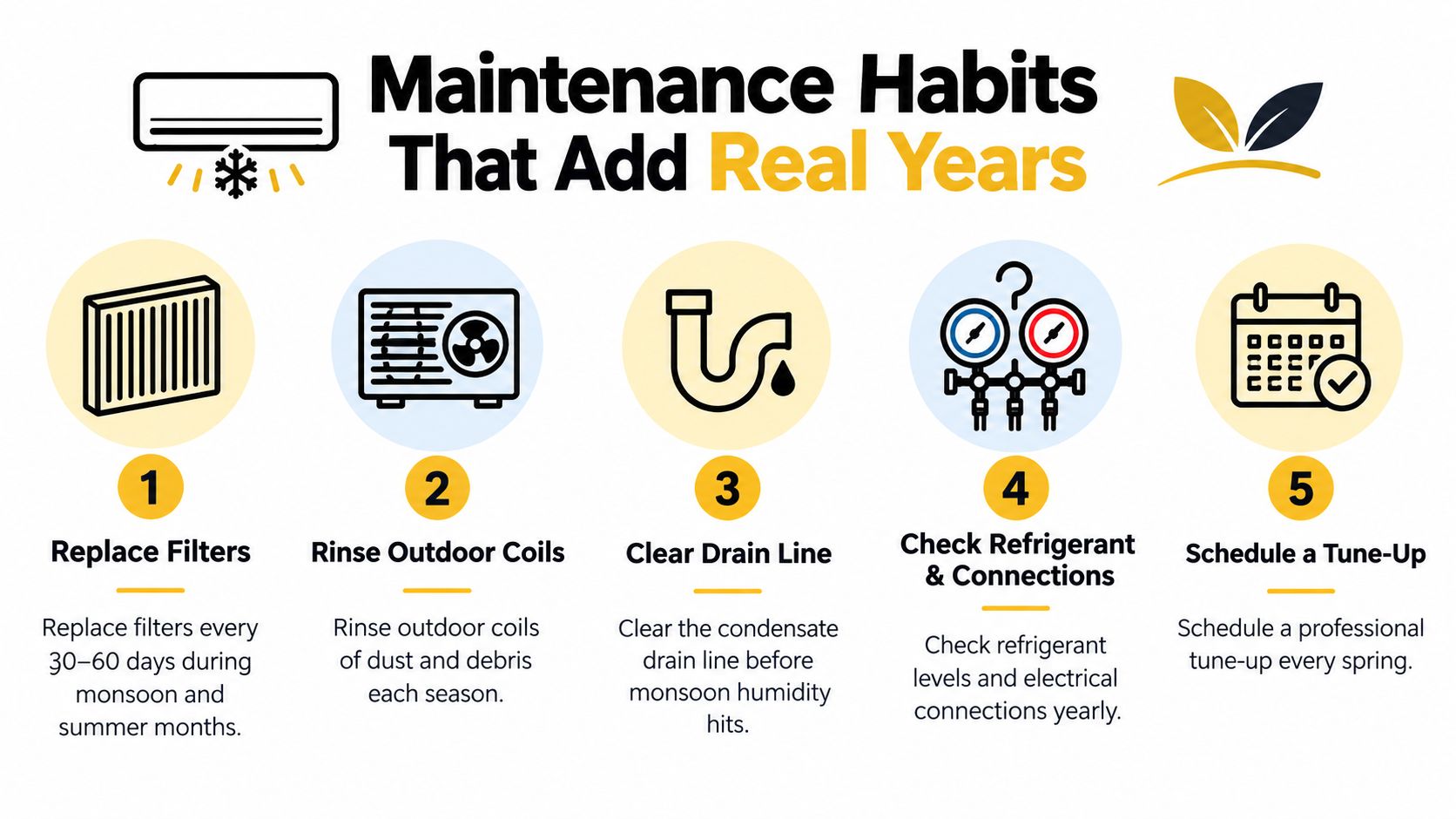
Check the filter every 30 days during heavy cooling season, following filter and outdoor-coil maintenance guidance. Replace it when it is loaded rather than waiting for a calendar reminder. Homes near construction, unpaved roads, or heavy dust may need more frequent checks.
A restricted filter makes the blower work harder and reduces airflow across the indoor coil. That can produce weak airflow, uneven temperatures, icing, and longer cycles. A filter costs far less than a compressor, making this one of the simplest maintenance decisions a homeowner can control.
Keep heat moving outside
Outdoor coil cleaning removes dust and debris that interfere with heat rejection. The fins bend easily, so aggressive pressure washing can reduce airflow through the coil. A technician should clean the coil safely and check for corrosion, cottonwood, or debris that has damaged the fin pack.
A useful service visit should cover the indoor coil, refrigerant performance, electrical connections, contactor, capacitor, blower operation, condensate drain, safety controls, and condenser clearance. Coil cleaning alone will not correct a slow refrigerant leak or a weakening capacitor. Those problems need diagnosis and, where appropriate, repair before they create a larger failure.
Use a seasonal routine
A spring inspection gives the technician time to find airflow, coil, electrical, and refrigerant problems before the hardest cooling weather. An inspection after the heavy cooling season can identify drainage trouble, heat-related wear, and damage that should be addressed before the system sits unused.
An Arizona preventive maintenance schedule should list the checks performed, rather than promise only a quick visual review. Ask whether the visit includes coil condition, refrigerant performance, electrical measurements, drain operation, filter review, and outdoor-unit clearance.
Maintenance cannot guarantee a specific service life. It improves the odds that high-use equipment avoids preventable failures, while giving you a repair history for the eventual repair-versus-replace decision. When a major component fails, that history helps show whether the unit has been maintained well enough to justify another repair or whether continued investment no longer fits its workload.
Warning Signs Your Arizona AC Is Wearing Out
A Tucson system that runs through a long July afternoon may show trouble first at night, when the thermostat still cannot pull the house down to its setting. In a high-use Phoenix Valley home, the same warning can appear as longer cycles, rising power bills, or a condenser that struggles after sunset. These symptoms deserve attention before the unit stops cooling completely.
Match the symptom to the component
The ages below are planning signals, not guarantees. Arizona service-life guidance provides useful reference points, but desert dust, coil fouling, corrosion, airflow restrictions, operating hours, and maintenance history can shift failure earlier or later. Equipment serving a heavily used home in a harsher submarket may show wear sooner than a lightly used system in a less demanding location.
Component | Typical Failure Age | Symptom |
|---|---|---|
Compressor | Commonly around years 12 to 15 | Warm air, hard starting, laboring sounds, or a tripped breaker during severe heat |
Capacitor or contactor | Often around years 7 to 10 | Clicking, slow fan start, humming, or a condenser that runs without cooling properly |
Evaporator coil | Varies with corrosion and service history | Refrigerant loss, repeated low-charge symptoms, ice, or declining cooling |
Condenser coil | Varies with dust, corrosion, and cleaning | High operating stress, reduced cooling, and longer cycles |
Outdoor fan motor | Varies by bearing wear and heat exposure | Grinding, squealing, wobbling, or a fan that struggles to start |
Airflow system | Can occur at any age | Weak registers, uneven rooms, icing, and long runtimes |
A capacitor can produce a no-cool complaint without the compressor being defective. It is less expensive than a compressor, but the symptoms can overlap. A technician should test the electrical components and operating conditions instead of approving a major replacement based only on warm air. Replacing a sound compressor because a capacitor failed is an avoidable diagnostic error.
Watch the soft signals
Higher summer bills can reflect declining performance, though utility rates, thermostat settings, and household use can change as well. Longer cycles, weak airflow, ice on the suction line, uneven room temperatures, or a thermostat that takes much longer to reach its setting all justify testing. A system that runs nearly nonstop in a severe cooling period may be showing capacity loss, airflow trouble, or coil contamination rather than just working hard.
Stop treating repeated breaker resets as a repair. Repeated trips can point to an electrical fault or compressor problem, and continued resets can increase the risk of equipment damage.
Before approving a major repair: Ask which component failed, whether the system has a refrigerant leak, what caused the failure, and which other parts show age-related wear.
One failed part does not automatically justify replacement. Several failures in one cooling season are more concerning, especially when the unit has already endured high operating hours and sits near the shorter end of Arizona's service-life range. The practical question is whether the proposed repair restores dependable cooling or only delays another failure from an already stressed system.
Repair or Replace at the 8 to 12 Year Mark
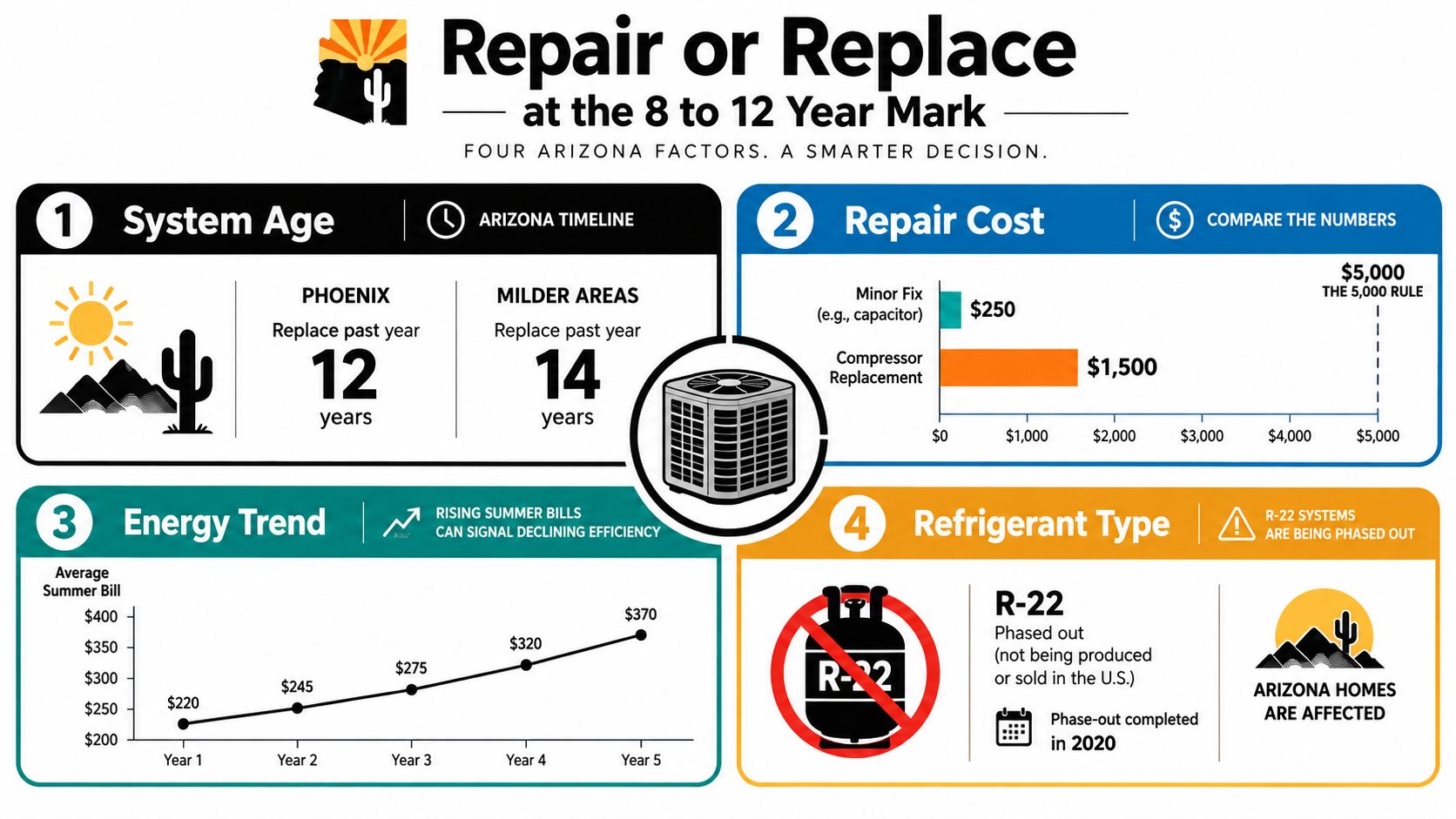
The 8 to 12 year range deserves a closer financial review in Arizona, particularly for equipment serving the hottest parts of the Phoenix Valley. It doesn't create an automatic replacement order. It marks the point where the owner should compare repair cost, equipment age, refrigerant, energy performance, comfort, and failure history instead of approving every repair in isolation.
Start with the repair itself
A failed capacitor, contactor, drain component, or other limited part may justify repair when the rest of the system has a clean history. A compressor, coil, or repeated refrigerant problem deserves a broader inspection because the new part may be joining other components that have already endured years of heavy runtime.
Ask for two separate answers:
What failed today?
What is likely to fail next, based on testing and visible condition?
The first answer explains the invoice. The second helps you decide whether the invoice makes sense.
An AC repair-versus-replace assessment for Arizona homes should consider whether the system still holds charge, whether airflow is correct, whether the condenser coil is sound, and whether the compressor starts and runs within acceptable electrical limits. A low-cost repair can be sensible on an otherwise healthy system. The same repair can be poor value on equipment with several simultaneous defects.
Use a practical threshold
Replacement becomes more compelling when several of these conditions appear together:
Age: The system is near or beyond the service-life range for its submarket, with Phoenix equipment generally facing earlier replacement pressure than higher-elevation equipment.
Major component: The estimate involves the compressor, evaporator coil, or a substantial refrigerant-system repair.
Repeat failures: The unit has needed several service visits and no longer has a clean operating history.
Comfort loss: The system runs for long periods but can't hold the setpoint or cool rooms evenly.
Energy trend: Summer consumption is rising without a clear change in thermostat settings, occupancy, or weather.
Refrigerant concerns: The system uses an older refrigerant and the repair requires sourcing additional charge or correcting a recurring leak.
No single item proves that replacement is correct. Several together usually mean you're paying to preserve an aging platform rather than restoring dependable cooling. If the system is still young for its location, has one isolated failure, and passes the broader inspection, repair may be the more responsible choice.
The best replacement timing is before the first emergency of the season, not during a no-cool call on the hottest afternoon. Give yourself time to compare load calculations, duct condition, efficiency ratings, warranty terms, and installation quality. A rushed replacement often focuses on getting cold air back quickly instead of choosing equipment that fits the home and the Arizona climate.
Arizona Replacement Options and Local Recommendations
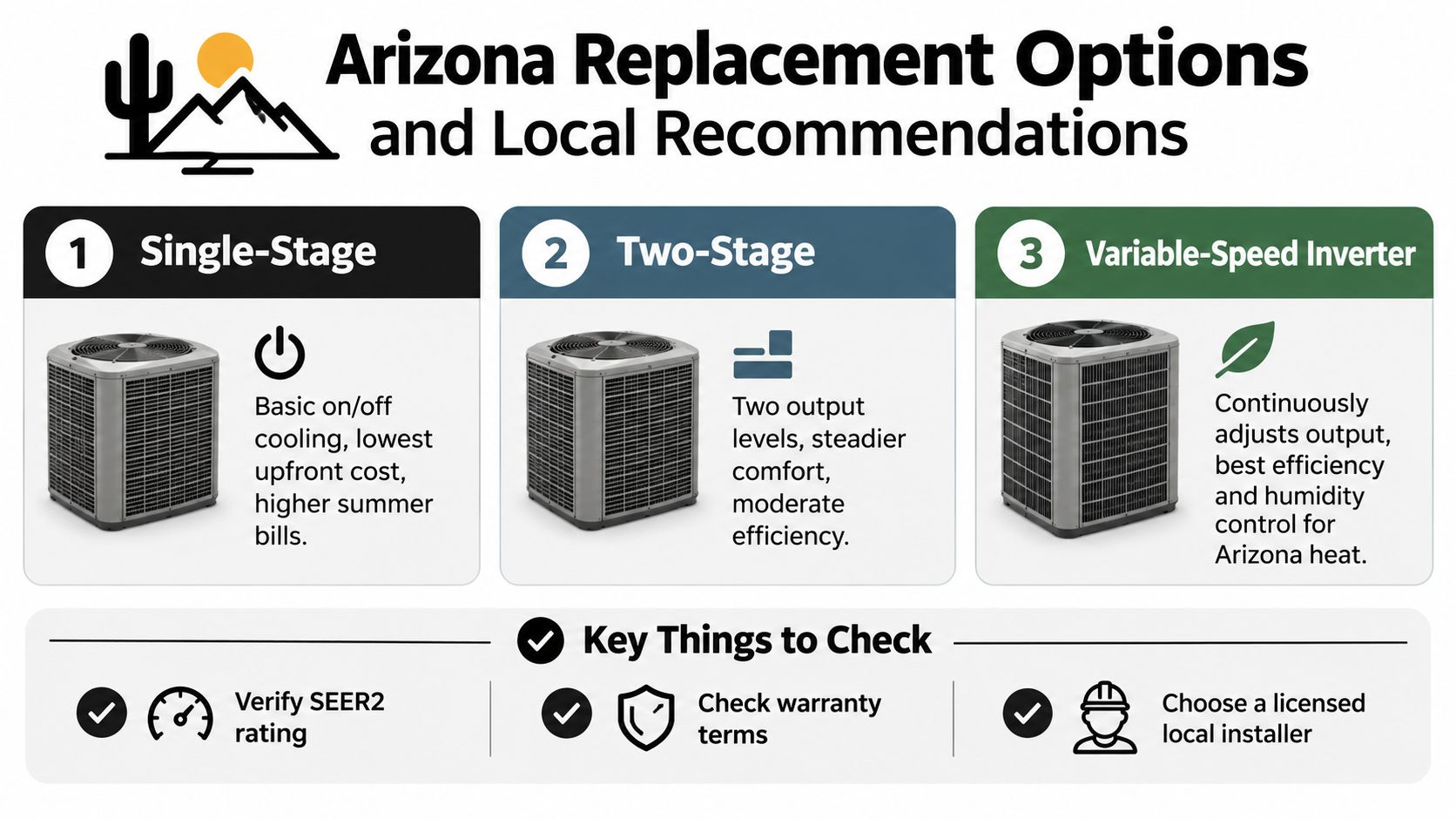
Once replacement makes sense, the equipment choice should match the home rather than chase the highest label on a brochure. Arizona homeowners generally compare single-stage, two-stage, and variable-speed inverter systems, each with a different balance of upfront cost, comfort, control, and operating behavior.
A single-stage system is straightforward. It runs at full output when cooling is called and shuts off when the thermostat is satisfied. That can be a reasonable fit for a smaller or simpler home, but it may produce wider temperature swings and less refined operation.
A two-stage system has a lower and higher operating capacity. It can run more gently when the load is moderate and bring on additional capacity when the afternoon heat demands it. That often improves comfort, but the installation must match the ductwork, thermostat, and control strategy.
A variable-speed inverter system adjusts output more continuously. In a home with a properly designed duct system, it can reduce abrupt starts, maintain steadier indoor conditions, and respond more efficiently to changing loads. It costs more to specify and install, so the decision should include expected runtime, comfort priorities, electrical service, and the condition of the ductwork.
Plan around demand
Tucson homeowners may find scheduling easier during the cooler part of the year, including October through November, when cooling demand generally drops. The best window still depends on contractor availability, equipment supply, and the condition of the existing system. Waiting until a compressor fails during extreme heat removes much of your negotiating and planning time.
A maintenance plan can also make sense for a system that isn't ready for replacement. Look for a plan with two visits per year, outdoor and indoor coil attention, electrical and refrigerant checks, drain inspection, and clearly stated priority-service terms. Don't assume every plan includes the same work. Ask for the checklist before enrolling.
Financing and incentives change, so verify current eligibility directly with the utility, manufacturer, contractor, or tax professional. Homeowners may encounter utility programs from TEP, federal HVAC credits that remain active when eligibility requirements are met, and contractor financing through companies such as Synchrony or Service Finance. Those options should be compared by total repayment, not just the monthly figure.
Arizona AC replacement cost guidance can help you prepare questions, but a written proposal should still identify the equipment, efficiency rating, labor, permits, warranty, thermostat, duct modifications, and removal of the old system.
Before choosing a Tucson HVAC company, ask:
Licensing and insurance: Can the contractor provide current documentation?
Technician qualifications: Does the team include NATE-certified technicians or equivalent documented training?
Ductwork: Will the company inspect the ducts and refer or perform corrective work when airflow is part of the problem?
SEER2 rating: Is the quoted rating clearly listed for the matched system, not just the outdoor unit?
Commissioning: Will the installer verify airflow, refrigerant charge, electrical operation, and thermostat controls after startup?
The right replacement is the one that fits the home's load, the occupants' comfort needs, and the owner's tolerance for upfront cost. A careful installation and a maintenance routine will matter long after the equipment label is forgotten.
Covenant Aire Solutions provides AC repair, replacement, and biannual preventive maintenance for Tucson-area homes, with technicians who can inspect airflow, coils, refrigerant performance, electrical components, and system condition before you commit to another repair. Visit Covenant Aire Solutions to request an evaluation and discuss a practical plan for keeping your current unit running or replacing it before the next Arizona heat wave.