
Heat Pump Running Costs: What Really Drives Your Bill
Search for heat pump running costs and you'll meet the same promise in a dozen forms: a heat pump cuts heating bills by half, so the upgrade pays for itself. The claim isn't false. It's answering a question most homeowners never asked.
That half-off figure compares a heat pump with electric resistance heating under average conditions. It says nothing about the rate printed on your utility bill, the fuel you're replacing, the ducts running through a 140°F attic, or where the thermostat sits when nobody's home.
The equipment is one variable among several, and the others routinely move the number further. An efficient unit on an expensive tariff can cost more to run than a mid-range unit on a cheap one.
What a Heat Pump Costs to Run per Unit of Heat
The figure that decides whether a heat pump is economical isn't the price on the quote. It's the cost of one kilowatt-hour of heat delivered into your rooms, and you can get it from a single division.
Electricity price ÷ seasonal COP = cost per kWh of delivered heat.
A heat pump doesn't create heat. It moves it, the way a pump lifts water: one unit of effort can shift three or four units of the useful thing. The U.S. Department of Energy describes an air-source heat pump as using electricity to move heat on the same general principle as a refrigerator, rather than generating it through combustion or resistance wire. That's why modern air-source units can cut electricity use by about 50% compared with furnaces and baseboard heaters, while geothermal systems can reduce it by approximately 30% to 60%.
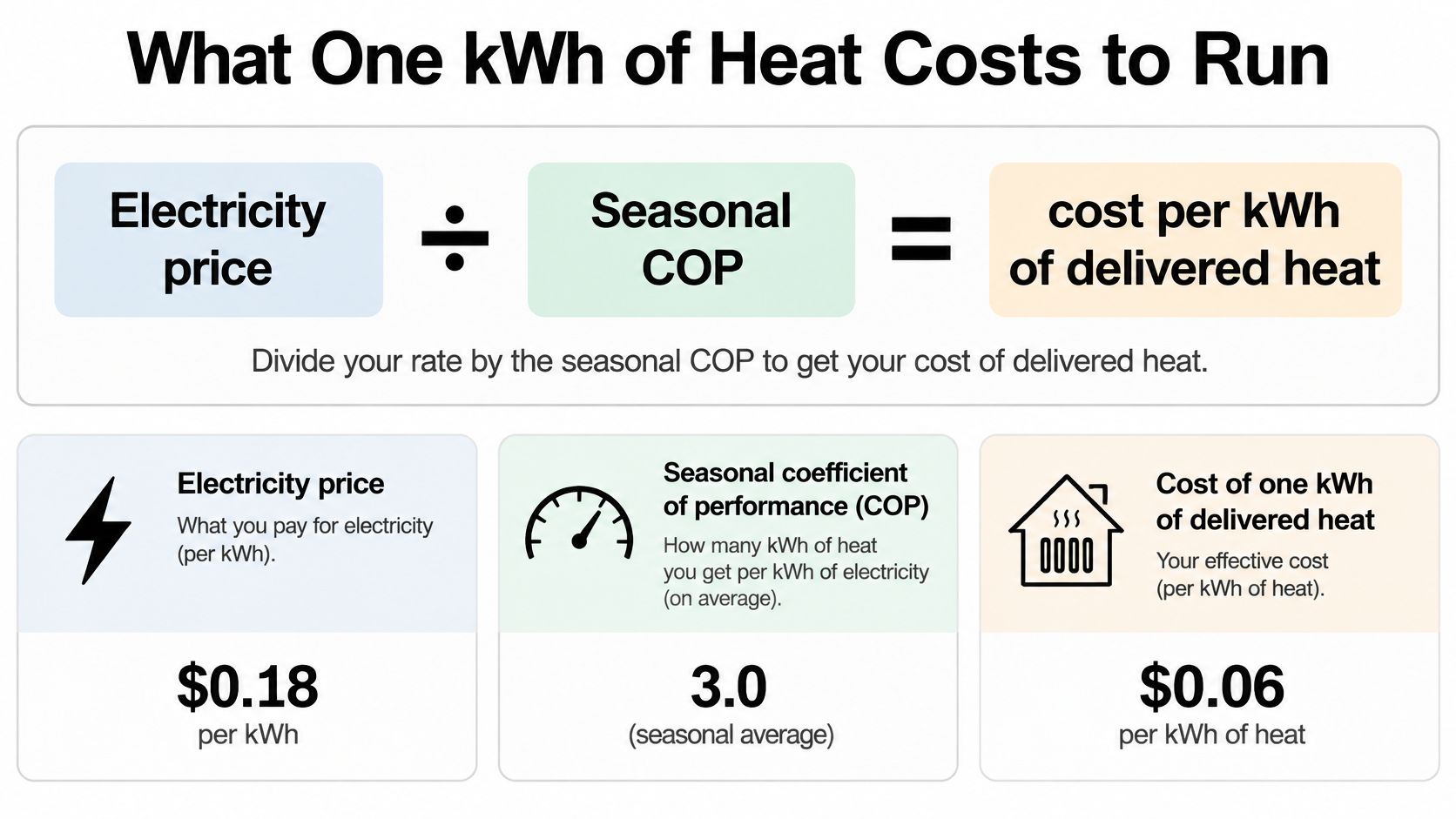
Arizona gives a clean worked example. Residential electricity in the state averaged 15.76 cents per kWh in May 2025, up from 15.49 cents a year earlier, according to the Arizona Corporation Commission. At that rate a unit running at a seasonal COP of 3.0 delivers heat for about 5.25 cents per kWh-equivalent, while a unit at COP 2.0 costs about 7.88 cents, which is 50% more for the same thermal output.
Seasonal COP | Electricity price | Cost per kWh of delivered heat |
|---|---|---|
2.0 | 15.76 cents/kWh | 7.88 cents |
2.5 | 15.76 cents/kWh | 6.30 cents |
3.0 | 15.76 cents/kWh | 5.25 cents |
3.5 | 15.76 cents/kWh | 4.50 cents |
4.0 | 15.76 cents/kWh | 3.94 cents |
Where the formula stops matching your bill
The table prices delivered heat, not the bill itself. Actual bills depend on load, thermostat settings, duct losses, defrost operation, auxiliary resistance heat, and time-of-use tariffs, and a strong cooling rating tells you very little about winter heating cost. Short cycling or restricted airflow pulls real-world efficiency below the number on the specification sheet.
Start here: divide your own tariff by your system's seasonal COP before you compare a single quote, a fuel, or a salesman's percentage.
How Efficiency Ratings Change the Annual Bill
Efficiency tiers translate into very different annual energy use, and the gap compounds. The Department of Energy's Federal Energy Management Program published a comparison of residential air-source heat pumps across three tiers, and the spread across 15 years is larger than most homeowners expect.
Efficiency tier | SEER2 / HSPF2 | Annual energy use (kWh) | Annual energy cost | 15-year energy cost |
|---|---|---|---|---|
Best-available air-source | 24 / 11 | 7,394 | $814 | $9,328 |
ENERGY STAR model | 15.2 / 7.8 | 10,990 | $1,210 | $13,864 |
Less-efficient model | 14.3 / 7.5 | 11,551 | $1,271 | $14,571 |
Read the columns together and the arithmetic becomes blunt. The best-available unit uses 7,394 kWh a year against 11,551 kWh for the least efficient, a difference that comes to about $457 a year and $5,243 across 15 years at the analysis's cost assumptions.
Why the purchase price doesn't settle it
A second Department of Energy purchasing analysis, this one summarized in a California Public Utilities Commission filing, puts annual heating-and-cooling costs at $846 for a best-available air-source heat pump, $1,283 for an ENERGY STAR model, and $1,354 for a less-efficient one, a spread of $508 per year, or approximately 38%.
Use one set of numbers or the other. The two analyses rest on different cost assumptions, and blending them produces a savings figure that describes no real household.
Then read the ratings separately, because they measure different seasons. SEER2 governs cooling, HSPF2 governs heating. A unit with a strong SEER2 and a weak HSPF2 will look excellent on a spec sheet and mediocre in February. In Tucson, where summer dominates the annual load, the SEER2 number deserves as much scrutiny as the heating rating, which is the point behind this explanation of whether new heat pumps are actually more efficient than the unit being replaced.
The same compressor logic shows up in pool equipment, where desert homeowners face an identical rate-versus-COP trade-off when they compare pool heating options in Arizona.
Ask any seller this: what annual kWh figure do you calculate for my city and my load, and what tariff did you use?
How Electricity Rates and the Fuel You Replace Set Your Savings
Savings are a comparison, so the first question isn't how efficient the new unit is. It's what's heating the house now.
Replaced system | Reported annual savings | Basis of estimate |
|---|---|---|
Electric resistance heating | about 3,000 kWh, about $459 | Cold-climate heat pump in Northeast and Mid-Atlantic at $0.153 per kWh |
Heating oil | about 6,200 kWh, about $948 | Same electricity price assumption as the resistance comparison |
Propane or electricity (Michigan) | about $1,500 | Average for homes switching to a suitable cold-climate heat pump |
Natural gas | about $300 in the U.S. during elevated prices | IEA comparison; moves with local gas and electricity prices |
The national picture supports a switch for most households. Independent national-laboratory analysis cited by the Department of Energy found that replacing worn-out heating equipment with a properly matched heat pump would lower energy bills for more than 90% of the American households assessed, and in Michigan, homes running on propane or electricity could average about $1,500 a year in savings with a suitable cold-climate unit.
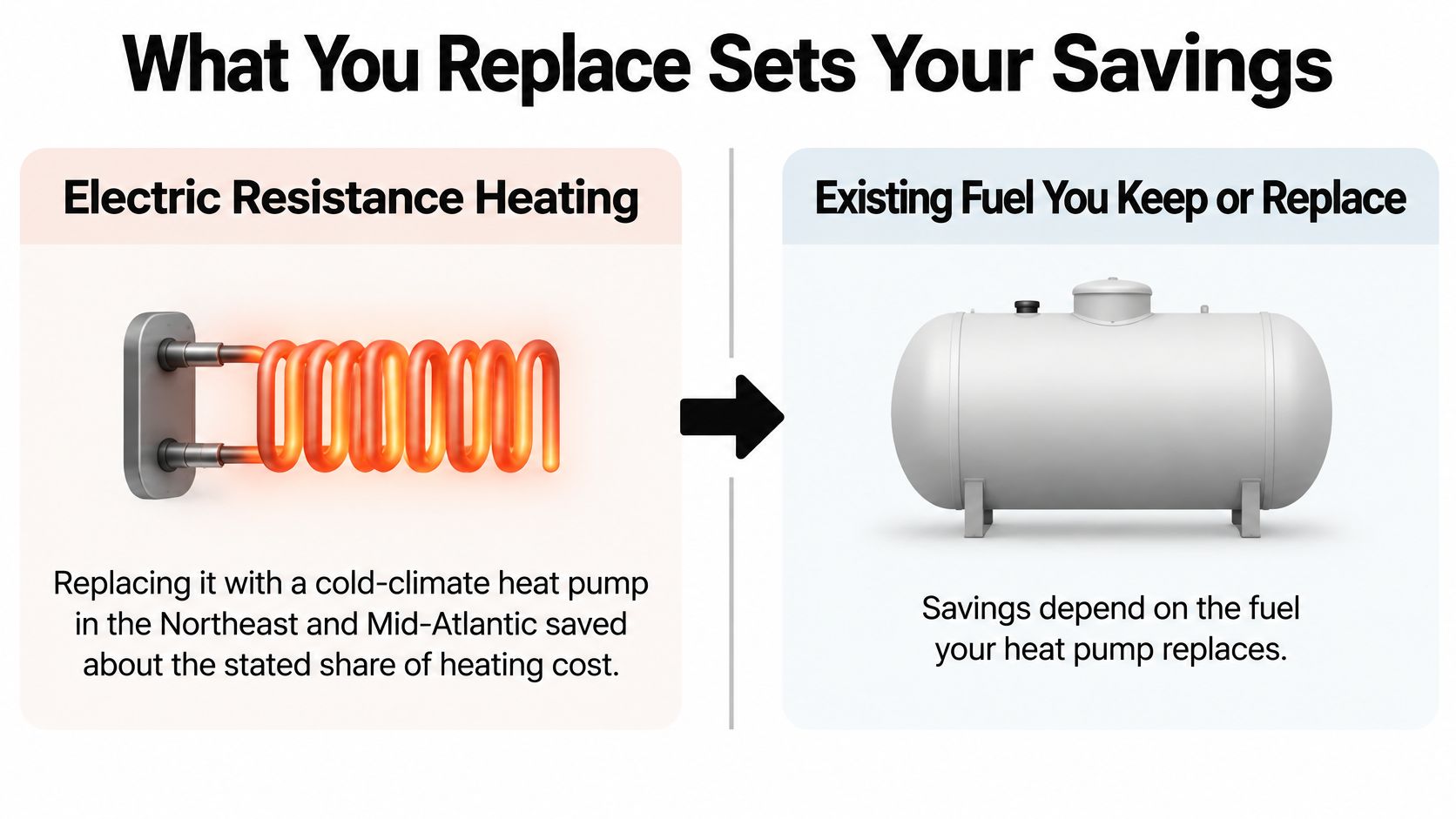
Natural gas is the harder case. The International Energy Agency reports that heat pumps on the market are typically three to five times more energy-efficient than natural-gas boilers, and that rising gas tariffs outpaced electricity tariffs in many major heating markets, which widened the advantage. Against gas, local prices decide the outcome, not the efficiency ratio alone.
The tariff can outweigh the rating
A New York case study tracked one heat-pump household through a colder season and makes the mechanism visible. Heating-season electricity cost rose to $3,148 at an average price of $0.21/kWh, against $2,044 the year before at $0.18/kWh. The household still spent $1,043 less than it would have continuing with fuel oil, because oil prices climbed too, as the NYSERDA case study documents.
A tariff increase and a fuel-price increase can cancel each other out, or double the case for switching. You can't know which without pricing both fuels.
Run the comparison on the same cost-per-kWh-of-heat basis used earlier, including time-of-use peak charges, before trusting any percentage. If a gas furnace is staying in the house as backup, which is the arrangement described in this guide to replacing a furnace with a heat pump, the gas price belongs in the calculation too.
How Climate and Outdoor Temperature Shift Running Costs
Temperature changes running cost because the system must lift heat across a wider gap. Think of carrying a bucket up a hill: the steeper the slope, the more work per bucket, and the heat pump's efficiency falls as the outdoor air pulls further from indoor temperature.
A Department of Energy cold-climate development project quantified it. The prototype, described in this DOE cold-climate heat pump report, operated down to -13°F with an integral COP above 2.3, and reached a COP above 4.0 at the 47°F rating condition. At -13°F its efficiency declined by as much as 50% and its heating capacity by about 25%. That combination, less capacity and lower efficiency, is what drives electricity use up in a cold snap, either through longer runtime or through backup resistance heat. A separate DOE field demonstration reported up to 70% energy savings against electric resistance heating and up to 40% against conventional air-source heat pumps.
Why Tucson's load looks different from a northern city
Climate zone changes which savings are available at all. National Renewable Energy Laboratory modeling of complete geothermal heat-pump packages, published in this NREL analysis, found roughly 29% cooling-electricity savings across the modeled building stock, but the distribution split by climate: warm zones generally showed around 10% or less in median site-energy savings, with the upper quartile near 20%, while colder zones averaged approximately 20% to 30% and reached 40% or more in the upper quartile.
That pattern is worth sitting with, because it cuts against the usual sales pitch. In a cooling-dominated climate like Tucson's, most of the annual load arrives in July and August, so the rating that governs cooling matters more than cold-weather performance. The building envelope matters more still. The roof over the ducts decides how much heat the attic dumps into them, and shingle shade is part of that calculation, which is why Aastro Roofing on hurricane-ready roof colors is a more useful read for some homeowners than another efficiency brochure.
Any published running cost should state the outdoor conditions assumed and whether supplemental resistance heat runs. If it doesn't, ask, and while you're at it ask how the equipment behaves across a Tucson summer, which this guide to how heat pumps work in winter covers from the other end of the year.
How System Condition and Sizing Quietly Raise Bills
A correctly rated unit can still be an expensive one. Condition and sizing decide how often the system runs at its efficient steady state, and a poor installation can erase the advantage of a premium model.
Start with oversizing, the costliest and most common defect in this climate. An oversized unit reaches setpoint too quickly and shuts down before it has run long enough to dehumidify or to settle into efficient operation. The visible sign is frequent cycling with short run times, and the measurable check is a room-by-room load calculation, not a rule of thumb based on square footage.
Undersizing looks the opposite: the system runs almost continuously, never quite reaches setpoint on a design day, and leans on electric backup heat that costs several times more per unit of heat. Duct leakage is the quiet one. Air lost through a joint in a 140°F attic never reaches a room, so you pay to cool the attic, and the symptom is a room that never matches the thermostat no matter what you set.
The checks that find the money
Refrigerant charge: a system outside the manufacturer's target loses capacity and efficiency together. Ask for the measured charge against the specification, not an assurance that it was "checked."
Airflow across the coil: dirty filters and blocked coils force the fan and compressor to work harder for less heat transfer. Ask for a measured number.
Duct leakage: sealed and insulated ducts in unconditioned space are the highest-return repair in most older Arizona homes.
Envelope: insulation and air sealing can lower bills without touching the heat pump, which is the substance of this guide to reducing heating and cooling costs in older homes.
Covenant Aire Solutions handles heat pump repair, heat pump maintenance, and heat pump replacement, and our Comfort Maintenance Plans include free condenser coil cleans, which is the least glamorous and most reliable way to protect airflow over a season. The maintenance routine that keeps a system near its rated output is laid out in this Tucson heat pump maintenance guide.
Four questions before you sign: was sizing done from a load calculation, what is the measured duct leakage, what is the refrigerant charge, and is airflow measured at commissioning?
How Thermostat Habits and Backup Heat Change Your Bill

Is leaving the thermostat steady cheaper than turning it down? Sometimes, yes. The instinct to set back every night and every workday comes from gas furnaces, which recover quickly and cheaply. A heat pump recovering from a 5°F setback can trigger high-output operation or supplemental resistance heat, and a 2026 Department of Energy field-study analysis found the setback increased peak demand by about 1 kW per home in one heating zone and 0.8 kW in another, as reported in this cold-climate heat pump field study.
The answer depends on the system. A variable-speed unit with a well-configured controller handles recovery gradually and may give up little. A single-stage unit with electric backup and a crude schedule can spend more on recovery than it saved during the setback. Demand-based tariffs add another layer, because recovery often lands in the peak window.
The same field study found something else worth knowing: the lowest-performing cold-climate and high-performance units tested were measured at roughly 22% and 26% below published performance. The nameplate describes a laboratory condition. Your bill describes your installation.
In Tucson the same controls run year-round, so the settings to inspect aren't only winter setbacks. Check the defrost cycle and auxiliary-heat lockout so backup strips don't run on mild mornings, confirm the ductwork isn't leaking cooled air into the attic, and set a vacancy schedule for snowbird months. A modest setpoint during absence usually beats switching the system off and asking it to pull a hot house back down on return. The programming mechanics are covered in this walkthrough of how to program a thermostat to save money.
Settle it with your own data: find two billing months with similar weather and different habits, then compare kWh per degree day rather than the dollar total.
Estimate Your Heat Pump Running Cost Before You Buy or Adjust
Six steps, each with a reason, take you from a utility bill to a defensible answer.
Pull twelve months of kWh from your bills and mark the heating and cooling months. The split tells you which rating deserves your attention, and in Tucson it will not be the heating rating.
Find your electricity tariff, including time-of-use peak rates. Leave out fixed charges that don't change with usage, because they don't change with efficiency either.
Take SEER2 and HSPF2 from the equipment specification and ask for a seasonal COP estimate for your climate. A rated condition and a Tucson August are not the same thing.
Divide your tariff by the seasonal COP. That gives you the cost per kWh of delivered heat, the number that compares across technologies.
Convert your current fuel to the same basis. Oil, propane, gas and resistance electricity all reduce to a cost per kWh of heat once you divide by the efficiency of the equipment burning them.
Adjust for thermostat habits, duct condition and sizing. These can move the answer further than the efficiency tier does.
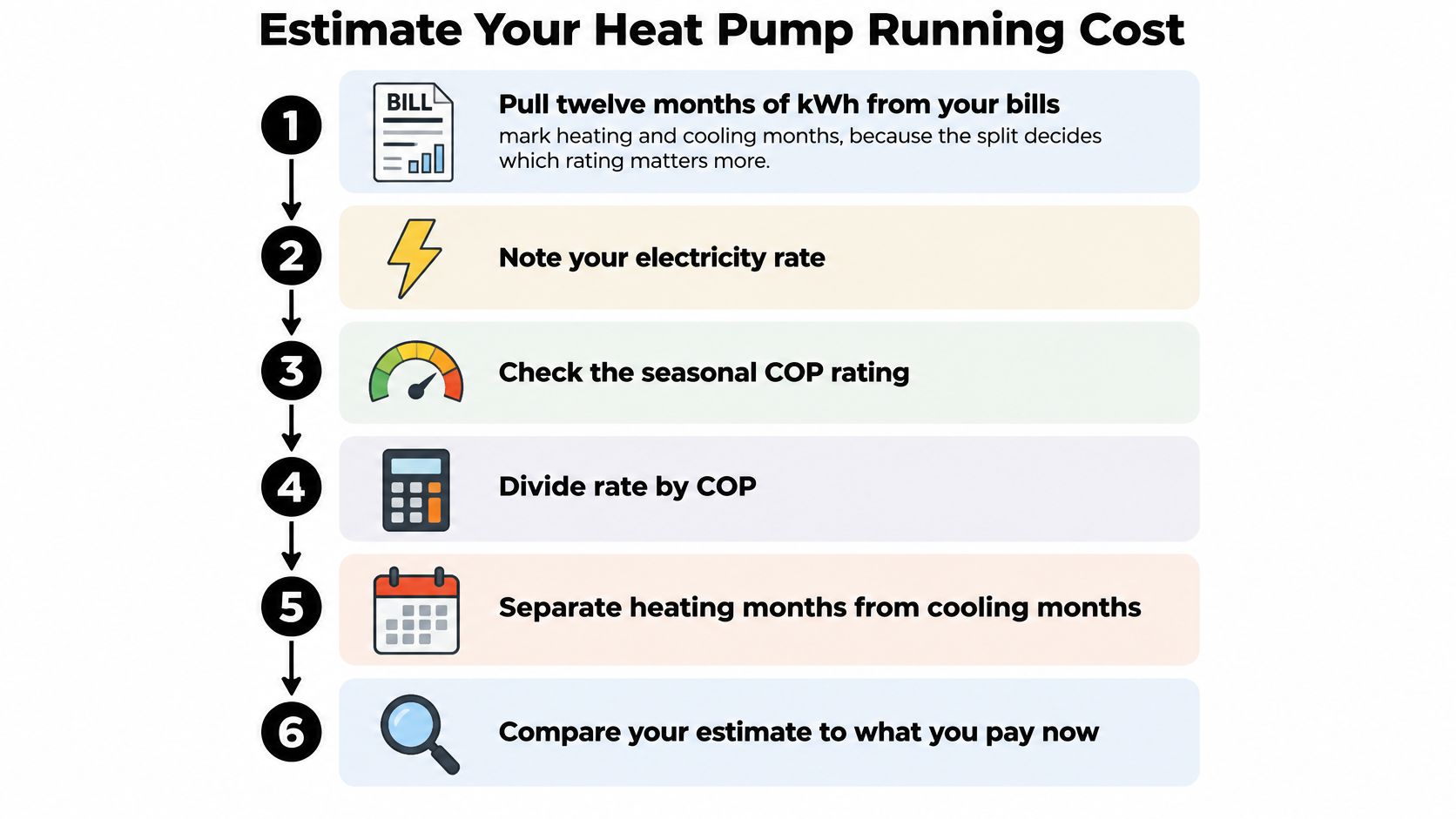
The decision rule: if the heat pump's cost per kWh of heat sits below your current fuel's, replacement is likely to lower running costs. Any quote worth signing states the expected annual kWh figure in writing.
When you're ready to act on the numbers, our heating services include gas and furnace repair, maintenance and replacement, and heat pump repair, maintenance and replacement, all delivered with upfront transparent pricing and no hidden fees or charges. That matters here because the calculation above only works if the installed system matches what was quoted, sized from your load rather than a square-foot guess.
Run your own division before you accept anyone's savings estimate, and bring the numbers to us if you'd rather have them checked against the equipment in your attic. Covenant Aire Solutions provides heat pump repair, heat pump maintenance, and heat pump replacement across Tucson and the surrounding communities, along with the duct sealing and airflow work that decides whether a high-efficiency unit ever reaches its rated output. Visit Covenant Aire Solutions to schedule a load-based assessment and get the annual kWh estimate in writing before you commit to a replacement.