
MERV 13 vs MERV 11: Which Filter to Use
Buying the higher-rated filter isn't always an upgrade. In the MERV 13 vs MERV 11 decision, the better filter is the one that captures particles while still letting your particular HVAC system move the air it needs. A restrictive filter in a struggling Tucson air handler can leave you with weaker cooling, uncomfortable rooms, and a better-looking label on the wrong product.
Dust and smoke make filtration worth taking seriously. But before you order a bulk pack, look beyond the rating to the filter's construction, cabinet fit, and measured airflow.
MERV 13 vs MERV 11 at a Glance
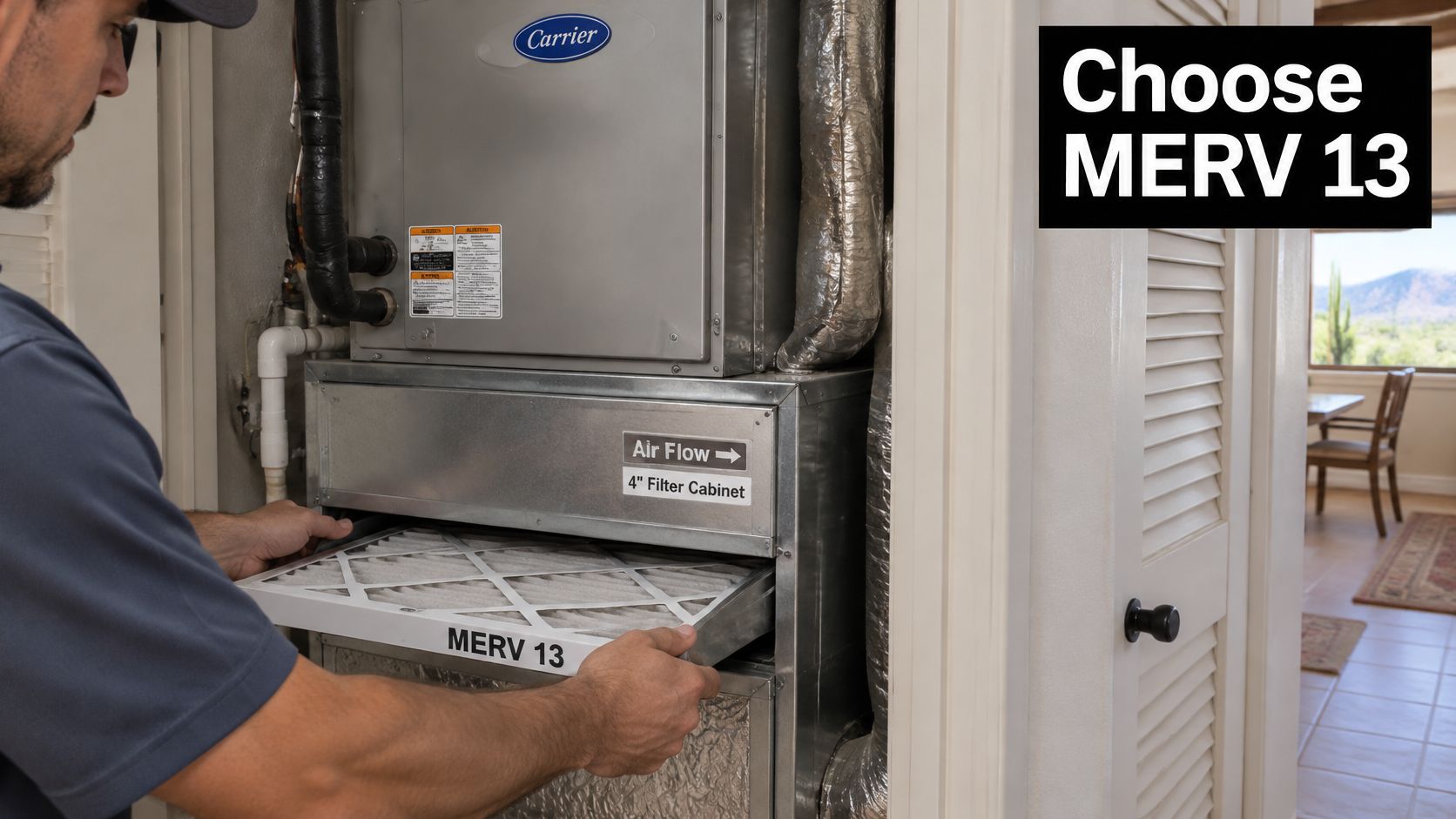
Choose MERV 13 when your blower and filter cabinet can maintain required airflow with a properly sealed filter. Keep a correctly fitted MERV 11 while checking compatibility if your system already struggles to move air, has a narrow filter slot, or pulls the proposed replacement out of shape. A shallow cabinet is a reason to investigate, not automatic proof that a higher rating won't work.
MERV 11 vs MERV 13 minimums and risks
The particle-capture figures below are laboratory single-pass minimums under ASHRAE Standard 52.2, not whole-room removal guarantees.
Criterion | MERV 11 | MERV 13 | What changes |
|---|---|---|---|
0.3 to 1 micron particles | At least 20% | At least 50% | 30-percentage-point gap; 2.5 times the required fraction |
1 to 3 micron particles | At least 65% | At least 85% | 20-percentage-point rise |
3 to 10 micron particles | At least 85% | At least 90% | 5-percentage-point rise |
Virus guidance target | Below the stated EPA and ASHRAE home target | At least MERV 13 recommended | MERV 13 is the public-health target |
Main failure mode | More fine particles pass through | Restrictive or dirty media can reduce airflow; poor fit permits bypass | A sealed MERV 11 can beat a leaking MERV 13 |
Where the difference matters most
The biggest practical distinction is fine-particle capture, not catching visible lint. Both ratings address larger particles effectively, but MERV 13 has a substantially stronger minimum requirement for the smallest tested band.
That distinction matters when you're selecting filtration for smoke-size particles rather than keeping debris off the equipment. It doesn't mean the room becomes clean immediately, and it doesn't mean the filter removes every airborne contaminant.
The public-health target also needs context. It identifies a filtration goal for compatible equipment, not permission to ignore the blower's limitations or force a filter into an unsuitable rack.
Buying rule: Treat the rating as your shortlist. Treat fit and verified airflow as the approval test.
Why a room won't match the laboratory result
In a laboratory test, air passes through the filter under controlled conditions. At home, some air may slip around the frame, the filter gradually loads with debris, and the system cycles according to heating and cooling demand.
Consider a Tucson home where the replacement filter bows inward because its frame doesn't sit securely in the rack. Even if the media has the higher rating, air can take the easier path around its edges. The number printed on the frame doesn't describe that bypass.
A different home might have an appropriate cabinet, a secure filter, and adequate blower capacity. There, the stronger filtration can do its intended job without sacrificing comfort.
Before buying filters in quantity, confirm cabinet depth, actual filter dimensions, and external static pressure. Those details help distinguish a useful upgrade from an incompatible substitution, especially when the existing system already has uneven room temperatures.
Ratings and the Particles They Catch
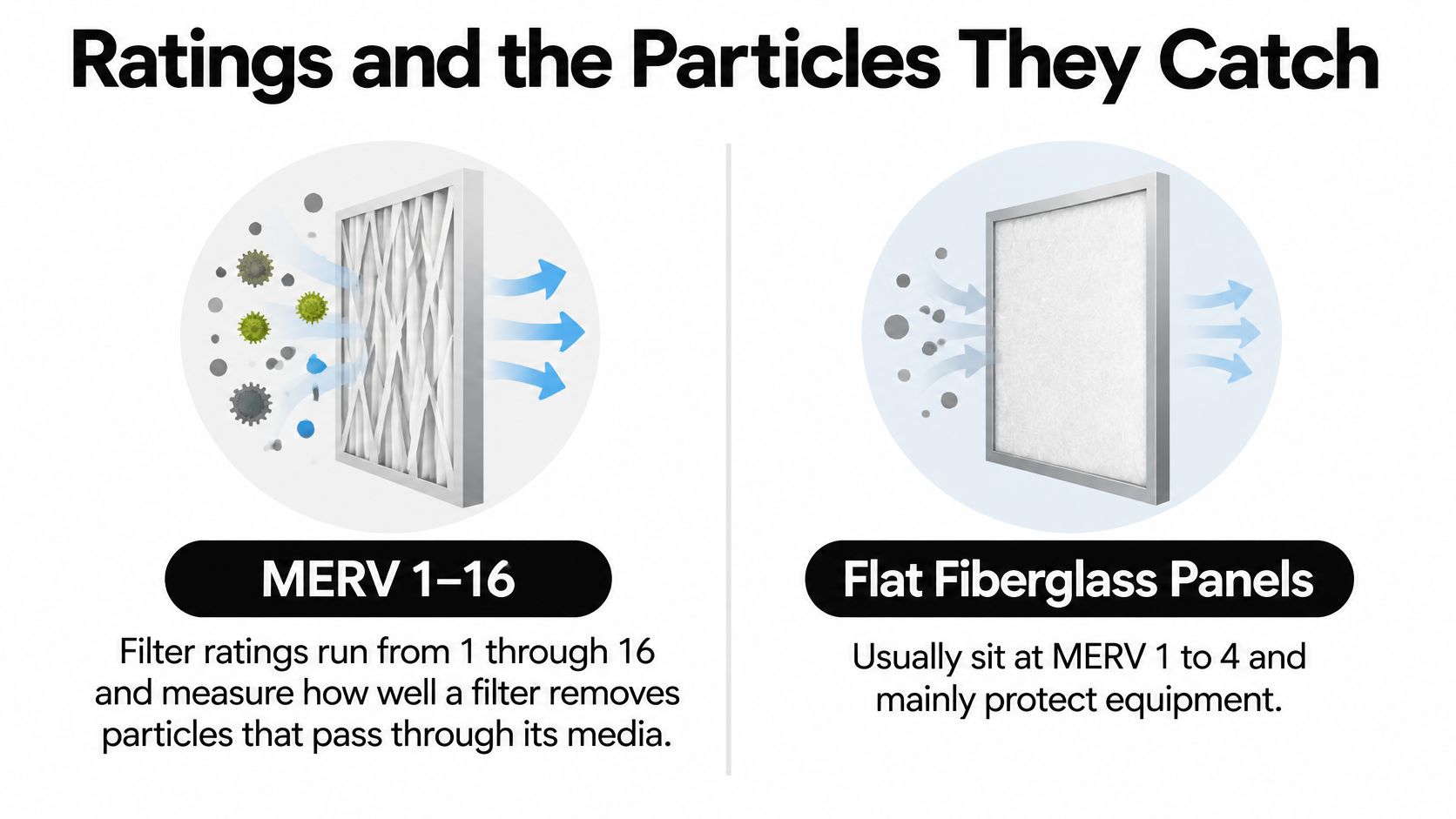
MERV means Minimum Efficiency Reporting Value. It describes particle-removal performance, not the filter's thickness, service life, or ability to eliminate odors. A package labeled for allergies still needs a stated rating and product-specific airflow information.
According to the Department of Energy's Building America Solution Center, ratings run from 1 through 16; ENERGY STAR requires MERV 6 or higher, while DOE Zero Energy Ready Home and EPA Indoor airPLUS require MERV 8 or higher. The same guide identifies at least MERV 13 as the EPA and ASHRAE recommendation for managing COVID-19 and other virus concentrations in a home.
Household particles aren't all the same size
The debris you can see is only part of the filtration problem. A layer of dust on a bookshelf doesn't tell you how many finer particles remain suspended in the room.
Use these categories to understand what you're trying to control:
Larger airborne debris: Lint, coarse dust, and some pollen-related material are easier filtration targets than fine smoke particles. Capturing visible debris is useful, but it doesn't establish strong fine-particle performance.
Smaller allergen-bearing particles: Fine dust, pet dander, and broken allergen-containing material can remain airborne and travel through a return grille. Their size varies, so household contaminants don't fit neatly into exclusive testing bands.
Smoke and respiratory particles: These can include much finer material. That's where the distinction between the ratings becomes more important than a package's general dust-control claim.
Pollen, dander, and smoke aren't single-size substances. It's more accurate to think of each as containing a range of particles than to assign every example to one exact band.
Our guide to MERV ratings and HVAC health provides additional background if you're comparing a current filter with a replacement.
Capture isn't disinfection or odor removal
A particle filter traps material carried through its media. Capturing a virus-carrying particle isn't the same as killing a virus, and a MERV label doesn't establish a guaranteed reduction in someone's infection risk.
Likewise, smoke contains more than particles. Don't assume that choosing a higher MERV rating will eliminate smoke odors or address every gaseous contaminant. The media's other properties and any separate treatment technology require their own evaluation.
For a broader explanation of equipment beyond the filter rack, Comfort Experts' resource on air purification offers useful context. Compare what a proposed device treats rather than assuming filtration and purification are interchangeable.
Match the filter to the problem
Say your main complaint is pet-related irritation. Start by identifying the airborne material you want to reduce, then evaluate filtration alongside cleaning and source control. A stronger filter can help with particles that reach the return, but it won't vacuum upholstery or remove settled debris from flooring.
During smoke, the concern shifts toward fine airborne particles and outdoor intrusion. That calls for a compatible filtration strategy, not just a product marketed for fresh air.
A higher rating is a stronger particle-capture specification, not a complete indoor-air-quality plan. Keep that distinction clear when comparing filters, purifiers, ventilation changes, and household cleaning measures.
Pressure Drop and What the Blower Can Hold
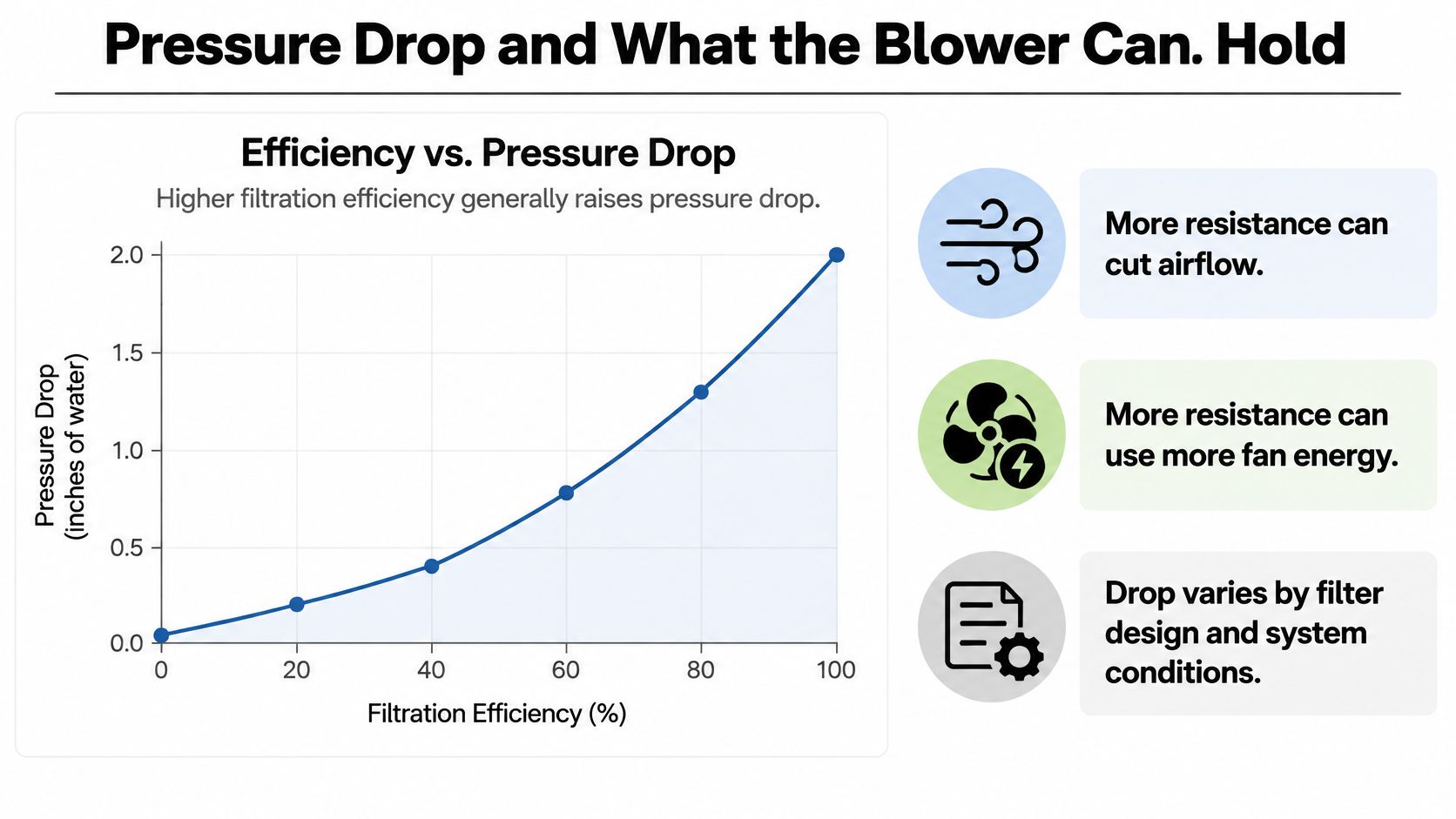
The engineering trade-off is resistance to airflow, not the MERV number by itself. Filter depth, pleat arrangement, available media area, and media treatment all affect how difficult it is for the blower to pull air through.
A deeper, well-designed MERV 13 can therefore offer less resistance than a poorly designed MERV 11. Compare the manufacturer's clean-filter pressure drop at your system's operating airflow, then consider how the filter will behave as it loads.
Measured filter pressure drop, not just the MERV label
Source | Filters covered | Pressure result | What it means at home |
|---|---|---|---|
MERV 13 samples | About 0.16 to 0.19 in. w.g., approximately 40 to 48 Pa; viral-filtration efficiency roughly 79% to 96% | Products with the same rating can have different resistance and tested capture | |
Filter equivalent to MERV 11 | Initial 0.09 and 0.22 in. w.g. at two airflow rates; final 0.50 in. w.g. | Loaded-filter resistance can substantially exceed clean-filter resistance | |
MERV 4 through MERV 13 in homes | 16 to 173 Pa, average 71 Pa | Real installations don't share a single pressure drop based on rating |
These aren't interchangeable product tests or a ranking of which filter you should buy. They show why a rating alone can't establish the resistance your equipment will encounter.
The general relationship is straightforward, but filter design and system conditions change the result.
What excessive resistance looks like
Pressure drop is the pressure difference across a component, such as the filter. External static pressure evaluates the resistance the blower encounters through the external air-distribution system, using the equipment manufacturer's specified measurement locations.
Our explanation of static pressure in ductwork can help you understand what the technician is measuring. A manometer supplies information that a hand held over a register can't.
Watch for rooms that take longer to reach the thermostat setting, new return noise, or noticeably weaker supply air after a filter change. Those signs warrant investigation, but they don't prove the filter is the only problem.
Approve the installation, not the package
A technician should inspect the rack and filter dimensions, check the frame seal, measure external static pressure, and verify delivered airflow. Testing should account for the equipment's operating mode and manufacturer requirements.
Reduced airflow can impair coil performance during cooling and create overheating concerns during furnace operation. Some blowers use more energy while trying to maintain airflow; others deliver less air as resistance increases.
That's why approval shouldn't stop with a clean filter on installation day. Leave room for the additional resistance that develops during normal use, rather than selecting a product that barely works when new.
Filter Price and Fan Energy Over a Year
The cheapest filter at checkout isn't necessarily the least expensive filter to use. Your annual cost includes replacements, blower operation, and the consequences of letting a restrictive filter remain in service.
There isn't a defensible universal price premium or electricity penalty for choosing MERV 13. The exact product, accepted cabinet depth, replacement needs, and blower response matter more than a broad shopping estimate.
Compare the exact products you can install
Price filters with the same actual dimensions and the depth your cabinet accepts. A nominal size on the package may not tell you whether the frame seats correctly, so don't compare products solely by their large printed dimensions.
Use a simple annual calculation:
Annual filter spending = price per filter × actual replacements during the year.
Track replacements rather than assuming the package's suggested interval matches your household. Pets, dust entering during home projects, and smoke events can change how quickly a filter needs attention.
A deeper media filter may cost more per replacement, yet offer a different service interval and resistance profile. That doesn't make it automatically cheaper. Compare the actual product specifications and your replacement history before deciding.
For a bulk purchase: Confirm compatibility with a single filter before committing to a case.
For a cabinet upgrade: Include the installation work and airflow evaluation, not just the replacement media.
For seasonal budgeting: Keep spare compatible filters available so an unusually dirty filter doesn't stay installed because you haven't bought its replacement.
Don't assign an automatic energy penalty
A blower's response to resistance depends on its design and controls. Some systems increase power to maintain airflow, while others lose airflow and may run longer because rooms aren't reaching the set temperature.
A low-resistance MERV 13 can be a better operating choice than a neglected, clogged MERV 11. The reverse can also be true when the higher-rated product is unsuitable for the equipment.
Our HVAC energy-saving tips for Arizona homes address the broader operating habits that affect efficiency. Don't try to compensate for an airflow problem by repeatedly lowering the thermostat.
Record the filter model, installation date, and any comfort changes. If cooling weakens after a swap, investigate promptly instead of waiting for an expensive electric bill to confirm that something changed.
Which Rating Fits Each Tucson Home
MERV 13 is the preferred direction when the equipment supports it, not an automatic everyday choice for every home. The EPA's smoke-exposure guidance recommends MERV 13 or the highest rating the system can safely handle, advises professional compatibility checks, and notes that filters may need more frequent replacement during smoke events.
The choice should reflect both your household's needs and the condition of the air handler.
Choose according to the installation
Tucson situation | Starting choice | What would change the choice |
|---|---|---|
Newer equipment with a deep media cabinet and verified airflow | MERV 13 | Excessive measured resistance or inadequate delivered air |
Older equipment with weak supply airflow | Keep a compatible MERV 11 while diagnosing | Testing confirms adequate capacity for the proposed MERV 13 |
Allergy-sensitive or immune-sensitive household | Compatible MERV 13 | Equipment limitations require a different air-cleaning strategy |
Pet-heavy home | MERV 13 if supported | Poor airflow makes the proposed product unsuitable |
Office or retail space | Highest compatible rating | Occupancy, operating schedule, and equipment measurements require a different selection |
Equipment age alone doesn't decide compatibility. A newer installation can have restrictive ductwork, while an older system may accept a carefully selected filter without difficulty.
A household with asthma or immune concerns should also recognize that filtration isn't a medical guarantee. Use the strongest compatible particle-control strategy without treating the HVAC filter as the only protective measure.
A correctly installed MERV 11 is preferable to an incompatible MERV 13. The higher rating only helps when the installation works.
Adjust for dust, smoke, and seasonal occupancy
During wildfire smoke, use the highest compatible rating and inspect the filter more closely. After a Tucson dust event or debris-producing work around the house, check its condition rather than assuming its normal calendar still applies.
For seasonal residents, inspect the filter before leaving and again when returning. Replace a loaded filter before the system operates unattended, and confirm that the cabinet closes securely after installation.
A closed house can still have indoor-air-quality concerns that a filter alone won't resolve. Our guide to indoor air quality and ventilation explains why air exchange and particle treatment need to be considered together.
Light commercial properties require the same discipline. Choose filtration around the actual equipment, occupied spaces, and operating schedule rather than applying a residential recommendation without checking the installation.
Filter Fit Checklist Before You Buy
Bring the current filter model and equipment information to the buying decision. A compatible replacement needs to fit the cabinet and the blower's operating limits, not merely match a familiar brand.
Check the installation in order
Copy the size and thickness. Photograph the current frame's label, then verify the cabinet requirements. Don't assume the existing filter is correct just because someone installed it.
Record existing warning signs. Note weak rooms, return whistling, or a frame that pulls inward. Resolve those concerns before adding resistance.
Find the equipment limit. Locate the maximum external static pressure in the installation manual or equipment information. Leave instrument testing and access-panel work to a technician.
Request useful product specifications. Compare clean-filter pressure drop at the system's actual airflow, not an unrelated catalog test point.
Check the perimeter seal. Install the filter in the marked airflow direction and confirm that air can't slip around its edges. Don't force an oversized frame into the rack.
Have an alternative ready. If the proposed MERV 13 causes unacceptable airflow loss, return to a compatible MERV 11 or evaluate a deeper cabinet rather than bending the filter.
Recheck under use. Inspect after loading and unusual dust or smoke exposure. Our guide to air filter replacement frequency can help you build a condition-based routine.
Address problems outside the filter rack
Our indoor-air-quality services include air duct cleaning, Aeroseal duct sealing, and air purification systems. Leaking ducts and cabinet gaps need their own attention; changing media won't repair them.
ActivePure Technology air purification systems neutralize 99.98% of airborne and surface pathogens without producing harmful byproducts, and address dust, pet allergens, toxins, mold, bacteria, viruses, smoke, and unpleasant odors. That's a separate purification capability, not a MERV rating or a replacement for airflow testing.
Each Covenant Comfort Maintenance Plan includes two visits per year, one in spring and one in fall. Use those opportunities to review filter condition and equipment operation, with measured supply airflow and external static pressure deciding whether the proposed filter fits.
Covenant Aire Solutions offers HVAC maintenance, system upgrades, duct sealing, and indoor-air-quality solutions to help match filtration to your equipment. Visit Covenant Aire Solutions to arrange an evaluation of your filter cabinet, airflow, and static pressure before committing to a MERV 13 upgrade.