
Furnace Repair After Hours: Safe Steps for Tonight
The house is getting colder, the thermostat says it's calling for heat, and the furnace either won't start or keeps shutting itself down. You're wondering whether to try the switch again, pile on blankets, or pay for an emergency visit.
Before arranging furnace repair after hours, separate a loss of comfort from a possible combustion emergency. A thermostat problem can wait while you check the basics. A carbon monoxide alarm, gas odor, or sick family member changes what you should do immediately.
Check for Carbon Monoxide and Gas Before Anything Else
Before you touch the furnace, check the people. Does anyone have a headache, dizziness, nausea, confusion, or flu-like symptoms that ease once they step outside? Has a carbon monoxide alarm sounded?
If anyone has symptoms or an alarm sounds, leave immediately. Call emergency services from outside, and don't reenter until responders declare the building safe. The U.S. Fire Administration's carbon monoxide guidance stresses that CO is colorless and odorless, so a home that smells normal isn't necessarily safe.
A rotten-egg odor or hissing near a gas furnace raises the stakes further: don't operate light switches, unplug equipment, use a phone indoors, or try to shut the furnace down at its electrical switch. Even a small spark can ignite leaking gas. Get outside, then contact emergency services and the gas utility.
Recognize when troubleshooting must stop
Without opening the cabinet, look for soot, scorch marks, unusual combustion odors, or flame rollout. A yellow, wavering flame seen through an existing viewing window warrants inspection, though flame appearance alone doesn't diagnose a fault. New window condensation during furnace operation also deserves attention, especially alongside other warning signs.
Any one of these signs ends the safe-check phase. Each restart attempt runs a suspect appliance again.
For a closer explanation of these warning signs, review our guide to furnaces and carbon monoxide.
Indoor carbon monoxide readings and required response
The ambient CO bands below are general field guidance for interpreting a meter reading. They're professional investigation thresholds, not permission to remain inside when an alarm or symptoms demand evacuation.
Ambient CO reading (ppm) | Required response | What to do tonight |
|---|---|---|
9-35 | Notify occupants and investigate the source | Shut the furnace off if safe, ventilate, and book a full inspection before restarting it |
36-69 | Turn off fuel-burning sources and ventilate | Keep the furnace off, move occupants to fresh air, and call for emergency service |
70 or greater | Evacuate and notify emergency services | Leave the home now, call emergency services from outside, and do not reenter until declared safe |
Leave diagnostic measurements to the technician
If you already own a CO meter, don't delay evacuation to collect readings. The CPSC's residential investigation guidance describes ambient measurements at the center of each room while standing approximately 5 feet from a potential source. Flue sampling requires professional equipment and training; a household alarm held near an exhaust pipe can't do that work.
Opening windows or running fans won't reliably prevent CO buildup. Ventilation follows safe shutdown and emergency instructions; it never replaces evacuation.
Safety boundary: A clear meter reading after the furnace stops doesn't clear an appliance that triggered an alarm or showed combustion warning signs.
Keep that furnace off until a technician investigates the venting, chimney, combustion-air supply, and appliance.
Quick Checks You Can Run Safely Tonight
These checks are for a home with no alarm, symptoms, gas odor, or combustion warning signs. Stay outside the burner and electrical compartments, and don't remove screwed-on service panels.
The infographic summarizes the basic external checks.
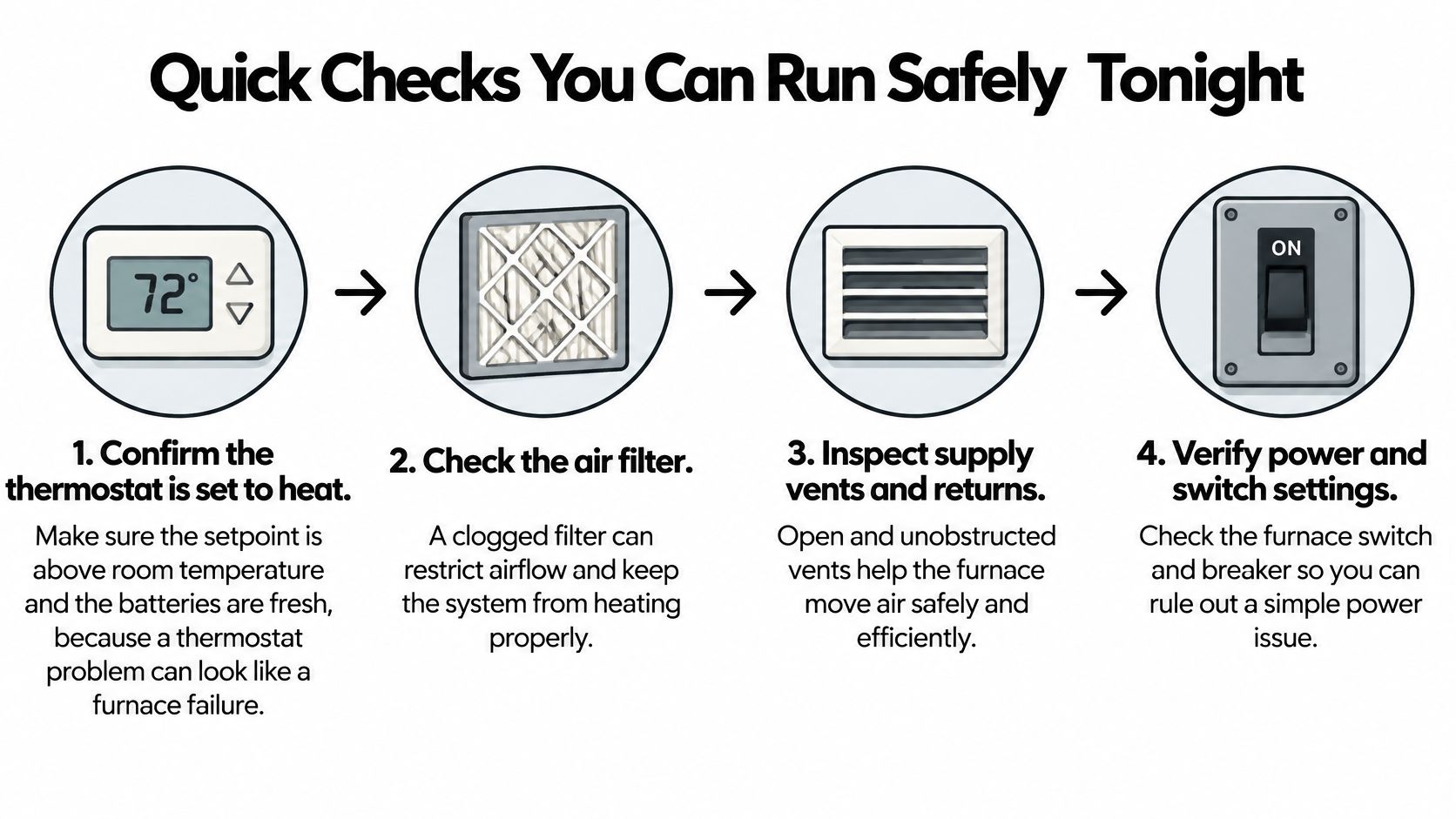
Confirm the thermostat. Select heat and set the target above room temperature. Replace user-accessible batteries if needed, because a thermostat without power can look like a failed furnace.
Verify the power supply. Check the furnace switch near the unit and look at the labeled breaker without removing the electrical-panel cover. If there's scorching, buzzing, moisture, or a burning smell, stop; otherwise, a single reset of a tripped breaker is reasonable, but leave it off if it trips again.
Inspect the filter and room airflow. Turn the furnace off before sliding out a filter from its designated homeowner-accessible slot, and replace a dirty filter with the correct size and airflow orientation. Open supply registers and uncover return grilles, since restricted airflow can cause overheating and protective shutdowns.
Check the access door. If a user-removable door is visibly loose, seat it correctly with power off. Many furnaces have a door interlock, but you must never tape or hold that switch closed.
Look at the outdoor pipes. With the furnace off, inspect accessible intake and exhaust terminations from ground level. Brush away loose surrounding snow or debris without pushing anything into the pipe; stop for professional service if you find internal blockage, substantial ice, nesting material, or damaged venting.
Observe without dismantling. Note whether you hear the inducer, an ignition attempt, or the main blower, and photograph any code visible through the viewing window. Don't open a burner compartment to watch the flame.
Stop after a single reset. Follow the manufacturer's homeowner restart procedure only if the safety screening remains clear. A breaker reset already counts as that attempt; don't add repeated switch cycling when the furnace locks out again.
Where a simple check ends
Our furnace-not-blowing-hot-air troubleshooting guide can help distinguish thermostat and airflow issues from faults requiring service.
If a check reveals a gas smell, burning odor, or blocked exhaust, stop trying to restore heat. Move away from the equipment and arrange the appropriate safety response.
Safe Ways to Stay Warm Until the Repair
A portable electric space heater is useful only when its placement and power supply are safe. Plug it directly into a wall outlet, never an extension cord or power strip, and keep 3 feet of clearance from bedding, curtains, and furniture. Choose tip-over shutoff and automatic overheat protection, and turn it off before sleeping or leaving the room.
Temporary heating options and when to avoid them
Option | Safe use | Avoid when |
|---|---|---|
Plug-in space heater | Plugged straight into a wall outlet with 3 feet of clearance and a tip-over shutoff | Run on an extension cord, placed near bedding or curtains, or left running unattended |
Gas oven or stovetop | Not safe for heating | Always, because it can release carbon monoxide into the home |
Portable propane or kerosene heater | Only when rated for indoor use and with ventilation required by its instructions | The heater is rated for outdoor use only or ventilation is not available |
Layered bedding and one closed room | Insulated sleeping bags, thermal layers, a hat, and towels across door gaps | Never a substitute when the house is cooling toward unsafe levels or vulnerable occupants need reliable heat |
For an overnight furnace outage, I'd choose electric heat over introducing another fuel-burning appliance. Never bring a grill, patio heater, or generator indoors.
Reduce heat loss without creating another hazard
Layer your bedding. Use dry thermal clothing and insulated sleeping bags. Cashmere Boutique's guide to cashmere throws for quiet evenings offers ideas for an extra comfort layer, not a substitute for dependable heating.
Use a suitable room. Close its door and reduce door-gap drafts, but don't cover air grilles or combustion-air openings.
Protect vulnerable plumbing. Open sink cabinets on exterior walls, keeping chemicals away from children and pets. A small faucet drip can help exposed plumbing, but it won't guarantee protection during prolonged freezing conditions.
Relocate before conditions deteriorate. Infants, older adults, and people with heart or lung conditions shouldn't have to endure a steadily cooling home. Arrange a friend's house or hotel, and reassess anyone who feels unwell before settling down.
Mistakes That Turn a Cold Night Into a Hazard
A furnace that finally lights after a third reset has not been repaired. Each reset clears the lockout that was keeping a faulty appliance from running, and the condition that tripped it is still there. Treat a successful restart as the end of your safe troubleshooting. One more attempt past a lockout is where a reset turns into a shutdown you should not cross.
Resist the urge to keep turning up the thermostat. A higher setpoint cannot push a struggling furnace past a safety limit; it only keeps the unit cycling against the same fault.
Shortcuts that remove protection
Repeated resetting wipes fault history the technician could have read and keeps forcing ignition attempts the control board already rejected. Leave the inducer, pressure switch, and flame-sensing circuit alone.
Bypassing switches or jumpering wires defeats the protections against overheating and unsafe venting. Running with panels removed also changes airflow through the cabinet and exposes moving or energized parts.
Increasing gas pressure without combustion analysis can overfire the furnace. A warmer supply-air stream does not prove the burner is operating correctly.
Ignoring obstructed venting leaves the exhaust problem in place while the furnace keeps running. The Consumer Product Safety Commission's furnace safety guidance identifies defective or blocked venting and poor maintenance as possible causes of CO exposure.
Declaring success at first flame misses faults that appear after warmup or once the blower starts. The technician needs measurements taken across a full run cycle before anyone calls the furnace safe.
If you cannot tell whether an odor is a fuel leak, our furnace gas-leak guide walks through the warning signs. Read it from outside, after everyone has left the house.
A heat exchanger needs evidence, not a patch
A cracked or defective heat exchanger generally calls for replacement rather than repair, so ask the technician to show you the evidence behind whatever is proposed. Flame wavering or a sharp change in flue CO when the blower starts warrants a closer look, and neither observation alone proves a crack.
A successful ignition is a diagnostic observation, not a return-to-service decision.
Ask for the inspection findings and the corrective work in writing. After any repair, steady-state combustion testing and recorded readings should back the decision to run the furnace overnight.
Watching a technician work through a diagnosis is fine. Keep the same hands-off boundary you kept at the furnace, and let the demonstration stay on the screen.
How to Reach an After-Hours Technician
Lead with information the dispatcher can act on. You can say: “The furnace has stopped heating. Everyone is accounted for, and there are no symptoms or CO alarms. It's a gas furnace, the thermostat is calling for heat, and the viewing window shows this fault code.”
Only make those safety statements if they're true. If there's an alarm, illness, or gas odor, contact emergency responders from outside before arranging equipment repair.
Have the equipment details ready
Identification: Photograph the make, model, and serial number if the label is accessible without opening a service compartment.
Operating condition: Give the fuel type, thermostat display, room-temperature trend, and whether the blower runs.
Fault information: Report the exact code or blink pattern rather than guessing which component failed.
Checks completed: Explain what you changed, whether a reset was attempted, and whether the breaker tripped.
Our after-hours HVAC service guide explains emergency-service considerations. We're licensed, bonded, and insured, and we explain the service steps rather than expecting you to authorize unexplained work.
Get a usable arrival commitment
Ask for a specific arrival window, not just a promise of tonight. Confirm that the dispatched technician can perform combustion analysis and ambient CO testing when a fuel-burning furnace is involved.
Also establish whether a trip or diagnostic charge applies if the required part isn't available. A visit can still provide valuable diagnosis and safe shutdown, but you should understand what you're paying for before dispatch.
Write down the company name, arrival window, callback number, and agreed fees. If nobody follows up within the promised window, call back for an update and contact another provider if safe arrangements can't be confirmed. Don't postpone relocation while waiting for an uncertain arrival.
What a Technician Should Do When They Arrive
Say the furnace has locked out, the house is cooling, and no alarm has sounded. A careful technician starts by asking what happened before the shutdown, whether anyone felt unwell, and what checks you performed. They then assess ambient CO and the appliance area before treating the call as an ordinary failed-part replacement.
Next comes a controlled diagnosis. The technician checks the thermostat demand, stored faults, electrical supply, ignition sequence, flame proving, and blower behavior rather than replacing whichever part seems plausible.
Measurements should support the diagnosis
For a gas furnace, appropriate testing includes:
Venting performance: Inspecting the connector and termination, checking draft and spillage where applicable, and considering competing exhaust equipment.
Combustion operation: Measuring flue gases and fuel input or gas pressure with suitable instruments.
Airflow and temperature rise: Confirming that the blower and duct system can move the required air without overheating the furnace.
Repair verification: Running the appliance through its operating sequence and documenting the results after corrective work.
An electric furnace needs electrical and airflow diagnosis rather than gas-combustion testing. Your technician should explain which tests apply to your equipment.
A useful outcome: If the technician can't establish safe operation, isolating the furnace and arranging safe temporary accommodation is responsible service, not a failed visit.
Expect communication, not an unsupported deadline
In a 2025 survey of 1,000 U.S. homeowners published by FIELDBOSS, 73.8% of respondents who experienced an urgent heating or cooling outage expected service within 24 hours, including 29.8% who expected help within a few hours. Those are customer expectations, not a guarantee that a provider can meet them.
Before the technician leaves, ask what failed, what measurements changed after repair, and whether further work is needed. Stop and question any proposal to bypass a safety device just to get through the night.
What Each After-Hours Charge Covers
After-hours furnace charges and when to approve them
Charge | What it covers | Approve tonight when |
|---|---|---|
Diagnostic or trip charge | Time to locate the fault and confirm safety | The technician has explained the fault and what the charge covers |
Labor | Hands-on repair time, often at an after-hours rate | The work is needed to make the furnace safe to run |
Parts | The component replaced, such as an igniter, flame sensor, or pressure switch | The part is in stock and the technician has confirmed the failure |
Temporary stabilization | Work that keeps the system safe until normal hours | The unit must stay off or a technician verifies a safe, limited operating arrangement |
Full replacement | A new furnace | Usually deferred until daytime, unless repair is unsafe or the unit cannot be repaired |
Agree to the diagnostic fee before dispatch, even though the technician won't know the fault yet. Before approving additional work, request an itemized estimate separating labor, parts, and temporary measures.
After-hours labor can cost more than daytime work. That makes a written scope more useful than a hurried verbal authorization, particularly if the visit might become a replacement discussion.
Approve a defined result
A confirmed failed igniter that's available now is a different purchase from speculative parts replacement. Ask what test demonstrated the failure and what verification the repair includes.
For warranty coverage, establish whether you're receiving a part warranty, labor coverage, or both. A covered component doesn't automatically mean every associated service charge is covered.
Use our furnace repair cost guide to prepare questions about the invoice, not as a substitute for a diagnosis-specific quote.
Question work that can safely wait
Part availability: Is the component available tonight, or are you authorizing a later return?
Temporary measures: Does stabilization mean safe isolation, or verified operation? Supervision doesn't make unsafe combustion acceptable.
Financial support: Ask about payment arrangements and contact the utility or local public energy-assistance office about emergency heating help.
You don't need to approve a new furnace just because the existing one must remain off overnight. Safe shutdown and temporary relocation can give you time to compare replacement options.
Decide Between a Repair Tonight and a Morning Visit
Authorize tonight's repair when it restores verified safe operation. Wait for daytime when the furnace can remain off and everyone has a safe place to stay. Consider replacement when the heat exchanger is defective, repair is impractical, or the repair's value is poor against the condition and expected remaining service of the equipment.
Use these decision criteria:
Safety: Do recorded measurements support operation, or must the appliance remain isolated?
Cost: Does the itemized repair make sense given the unit's condition, warranty, and likely remaining life?
Timing: Can the household safely wait without running the faulty furnace?
Financial pressure makes this difficult. HomeServe survey reporting published by The Reflector found that 22% of U.S. homeowners needed an HVAC repair or replacement during the prior year, while more than half had $1,000 or less reserved for unexpected home repairs.
The fastest available repair isn't always the best long-term purchase. But saving money never justifies operating equipment that should be shut down.
Leave with a written plan
Keep the fault codes, test readings, itemized quote, and follow-up appointment with your warranty paperwork. If you defer repair, get explicit written instructions that the furnace must remain off.
We're typically there within 24 hours of the call when a unit fails in the middle of summer or winter. That's a typical response, not a reason to remain in an unsafe or increasingly cold home.
We offer 24/7 emergency services for furnace failures that can't wait for regular business hours. Visit Covenant Aire Solutions to arrange after-hours help in Tucson and surrounding areas, and have your furnace details and fault code ready when you call. If you suspect gas leakage or carbon monoxide exposure, leave and contact emergency services first.