
Air Conditioner Repair or Replace: Costs and Age Limits
The outdoor unit is humming, the house is getting warmer, and the technician has just handed you a repair quote. You need cooling back, but you don't want to spend good money keeping a worn-out system alive or replace equipment that only needs a straightforward fix. The air conditioner repair or replace decision starts with the diagnosis, but it ends with a comparison of remaining life, operating cost, refrigerant exposure, and the risk of another breakdown.
Repair or Replace at a Glance
A younger, otherwise healthy unit with a single minor fault usually deserves repair; an older unit facing major work deserves a replacement comparison before you authorize it. Say a 12-year-old condenser fails during the hottest week of July, and the hypothetical compressor quote is $1,800. That price alone doesn't settle the decision, because the condition of the rest of the system matters just as much.
Start with these questions:
Age: How old are the outdoor unit and indoor coil?
Failure type: Has one electrical component failed, or does the sealed refrigerant system need work?
Equipment details: What's the efficiency rating, and which refrigerant does it use?
Repair history: How many failures have occurred within the last year, and were they related?
Repair or replace signals and the lean each one points to
Signal | Default lean | Reason |
|---|---|---|
Unit under 10 years old, good service record, single minor fault | Repair | Young equipment with one failed part usually justifies the fix |
Unit over 10 years old, first major failure | Compare replacement | Repair preserves an aging, potentially lower-efficiency system |
Two or more major repairs within 12 months | Replace | As a screening heuristic, repeated major work suggests wider wear |
Repair quote approaching half the cost of a new system | Lean replace | A large investment may buy limited remaining service |
Refrigerant leak on an R-22 system | Lean replace | Reclaimed refrigerant and leak work can make repair expensive |
Compressor failure on a unit over 10 years old | Replace | Major sealed-system work deserves a whole-system comparison |
Rising energy bills with no change in usage | Compare replacement | Diagnose lost performance before committing to either path |
These are screening signals, not automatic retirement rules. The numerical cutoffs in the table are practical heuristics, not guarantees of remaining life.
The decision flow below illustrates the hypothetical compressor scenario.
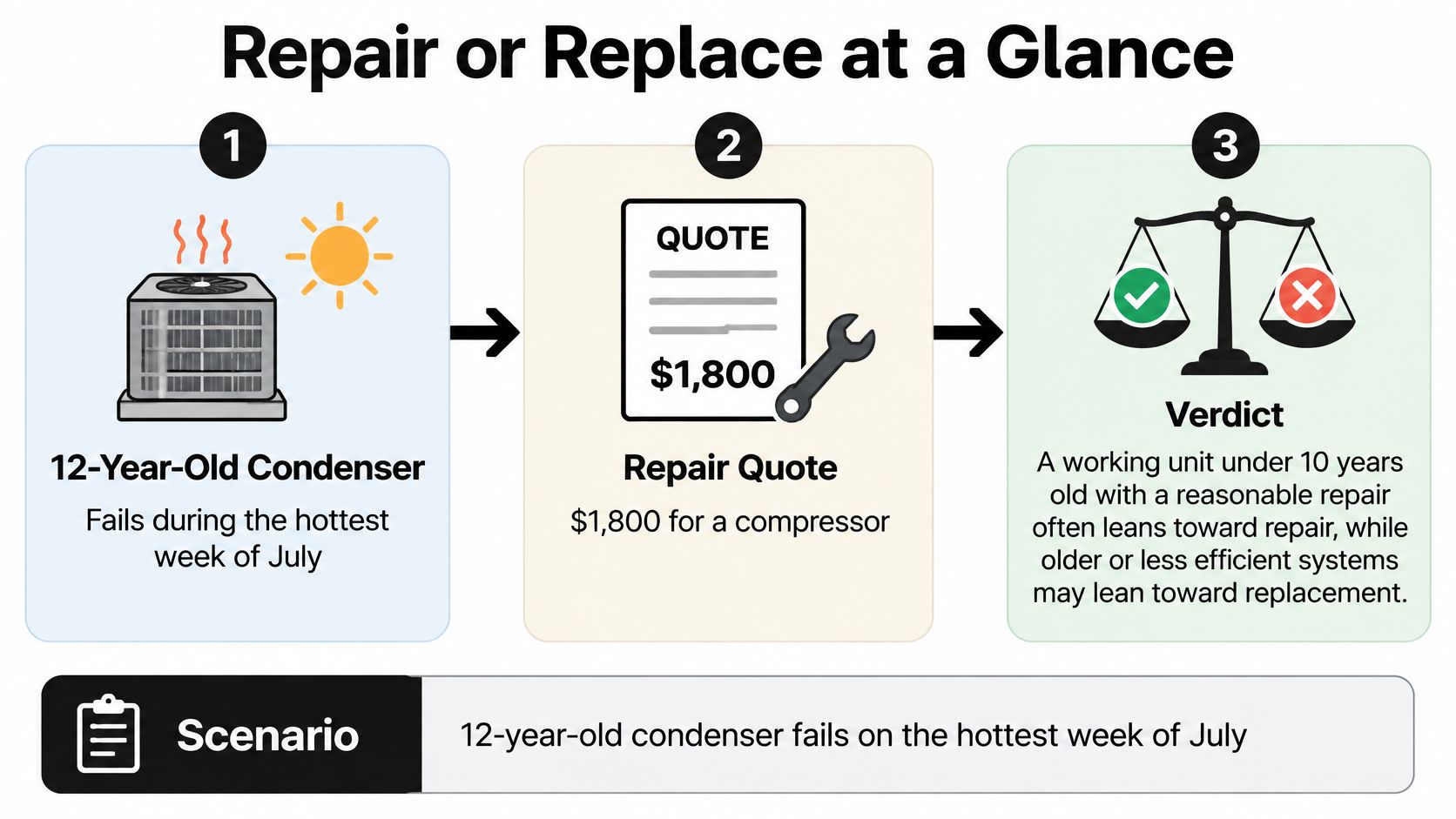
A working legacy system can still be worth keeping. Don't let its birthday substitute for testing the actual fault.
What Common AC Repairs Cost in 2026
Thumbtack reported an average professional HVAC repair evaluation and repair cost of $390 in 2025. That's a combined repair benchmark, not a diagnostic-only fee or a current quote for a particular component.
Before dispatch, establish whether diagnosis is charged separately and whether that payment is credited toward approved work. A low advertised service-call price doesn't tell you the completed repair cost.
Compare the completed repair scope
The table distinguishes the specific planning ranges below from items that require an equipment-specific quote. Don't treat an unpriced row as a reason to approve work without a written total.
Typical US repair costs and when each repair usually makes sense
Repair | Typical cost range | Usually worth repairing when | Replacement signal |
|---|---|---|---|
Capacitor replacement | $150 to $400, illustrative budgeting range, not a verified national average | Almost always as an isolated fault, at any age | Rarely a replacement trigger alone |
Contactor replacement | Itemized installed quote required | Almost always as an isolated fault, at any age | Repeated failures within a year |
Blower motor replacement | $400 to $900, illustrative budgeting range, not a verified national average | Unit under 10 years old and otherwise sound | Motor damage accompanies other expensive faults |
Control board replacement | Model-specific installed quote required | Younger equipment with available parts | Repeated board failures or obsolete parts |
Refrigerant leak repair and recharge | Leak location, repair, and refrigerant quote required | Leak can be located and sealed economically | R-22 exposure or recurring low charge |
Compressor replacement | Complete sealed-system quote required | Younger, healthy equipment, especially with applicable warranty coverage | Older equipment or repair approaching half of replacement |
Full central AC replacement | Sized, installed-system quote required | Not applicable as a repair | Baseline for comparing every major repair |
Region, labor rates, equipment capacity, component access, and refrigerant type all affect the invoice. A conventional replacement motor and a model-specific electronically controlled motor aren't interchangeable purchases.
Ask for diagnosis, parts, labor, refrigerant, and warranty coverage as separate line items. Our AC repair cost guide provides additional context for reviewing an estimate.
Practical rule: A repair approaching half the installed replacement price deserves closer scrutiny. That's a budgeting heuristic, not a technical reason to condemn equipment.
For illustration, a $200 capacitor repair on a five-year-old system is very different from a $1,500 to $2,800 compressor proposal on older equipment. Those are hypothetical quotes, not national price claims.
Keep emergency savings separate from the equipment decision. For readers managing Canadian household finances, Fintrack's guide to build an emergency fund in Canada offers a budgeting resource, although its country-specific guidance isn't a Tucson HVAC pricing reference.
How Age and Efficiency Set the Replacement Threshold
Age measures exposure to wear; efficiency measures electricity use for cooling delivered. A system can be old and serviceable, or relatively young and performing poorly because of installation or airflow problems.
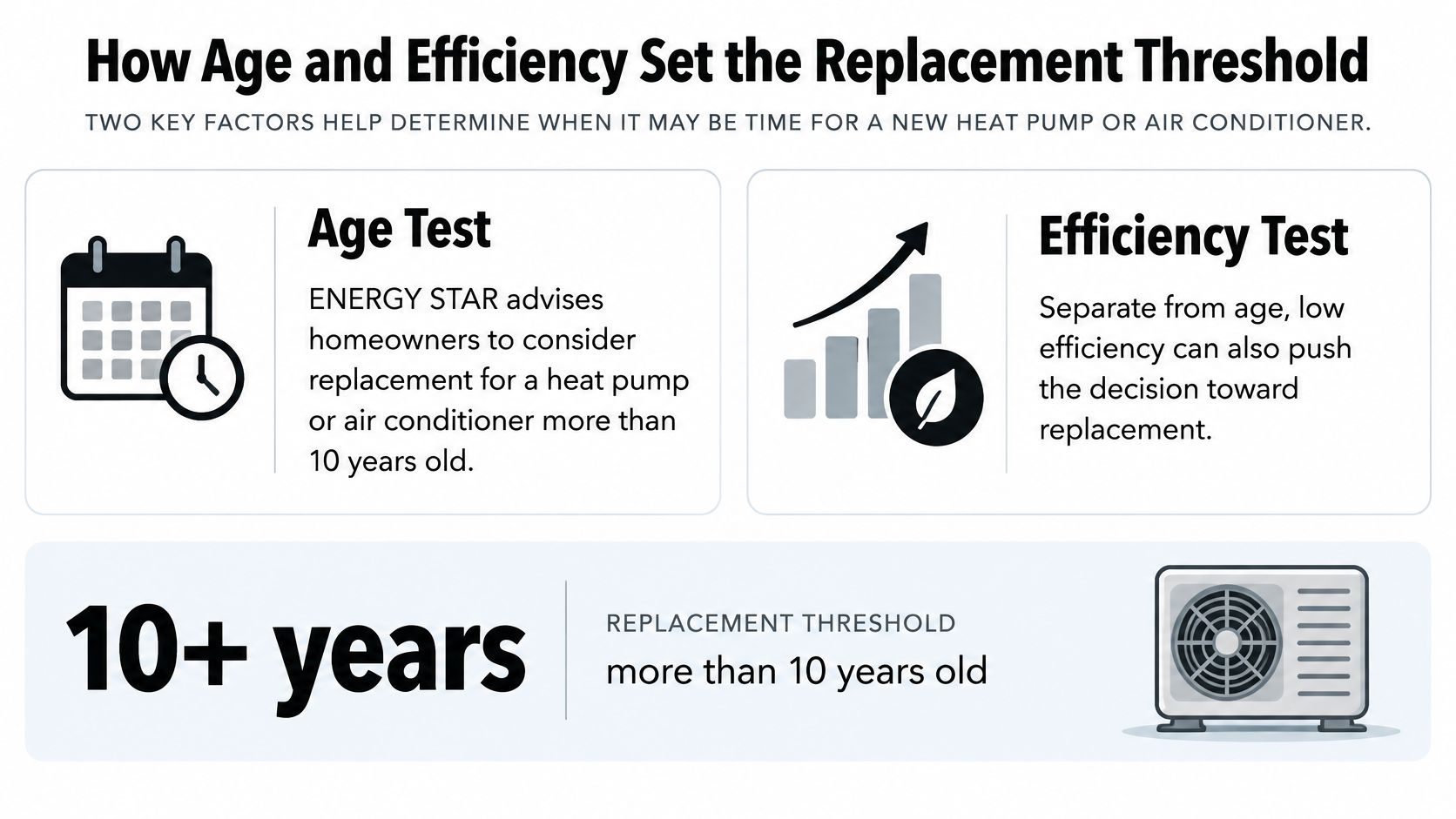
ENERGY STAR advises considering replacement when a heat pump or air conditioner is more than 10 years old, particularly with repeated failures, declining performance, or costly repairs. That isn't an instruction to discard functioning equipment, and its guidance favors repair for younger systems with a good service record and a minor fault.
The age and efficiency tests should remain separate when reviewing a proposal.
Read the rating before estimating savings
SEER measures seasonal cooling output divided by electricity consumption; EER measures efficiency at a particular operating condition. The Department of Energy's heating and cooling guide explains that upgrading from SEER 9 to SEER 14 can reduce energy consumption by more than 35%; its example translates a $100 monthly direct cooling cost into savings of as much as $35.
That example concerns cooling electricity, not the entire household utility bill. Don't apply the percentage to water heating, appliances, lighting, or unrelated electrical loads.
The same DOE guide describes minimum SEER requirements applying since January 2006, but installation date alone doesn't establish an individual unit's rating. Read the model documentation rather than assuming every older system has the same efficiency.
Compare matching metrics: SEER2 uses a newer test method and isn't directly interchangeable with legacy SEER.
Identify the complete system: Outdoor equipment, indoor coil, and blower configuration affect the rated combination.
Check actual operation: Restricted airflow or a dirty coil can impair performance without making replacement the cheapest remedy.
For local lifespan considerations, our guide to how long AC units last in Arizona helps frame the questions to ask about condition and service history.
This video provides another way to review the repair-versus-replacement decision.
I would give substantial weight to replacement when low efficiency, advanced wear, and an expensive failure appear together. A minor electrical fault on otherwise efficient equipment points the other way.
How Refrigerant Rules Change Repair Decisions
The refrigerant transition doesn't automatically make your existing air conditioner illegal to repair. The important distinction is between maintaining installed equipment and installing a new whole system.
For older equipment, the EPA's guidance on purchasing and repairing home air conditioners explains that R-22 systems can still be serviced, but after 2020, servicing relies on recycled, reclaimed, or previously produced refrigerant rather than newly produced or imported supply. A working system doesn't need replacement merely because its nameplate says R-22.
Where refrigerant changes the economics
A contactor failure doesn't require opening the refrigerant circuit. A leaking coil does, and that difference changes the labor, materials, and future-service exposure you should compare.
For a plain-language companion explanation, Erica's Plumbing, Air Conditioning & Restoration provides R-22 refrigerant phaseout explained. Get the actual refrigerant quantity and price on the repair proposal rather than assuming a standard recharge cost.
Refrigerant diagnosis involves more than attaching gauges to the outdoor unit.
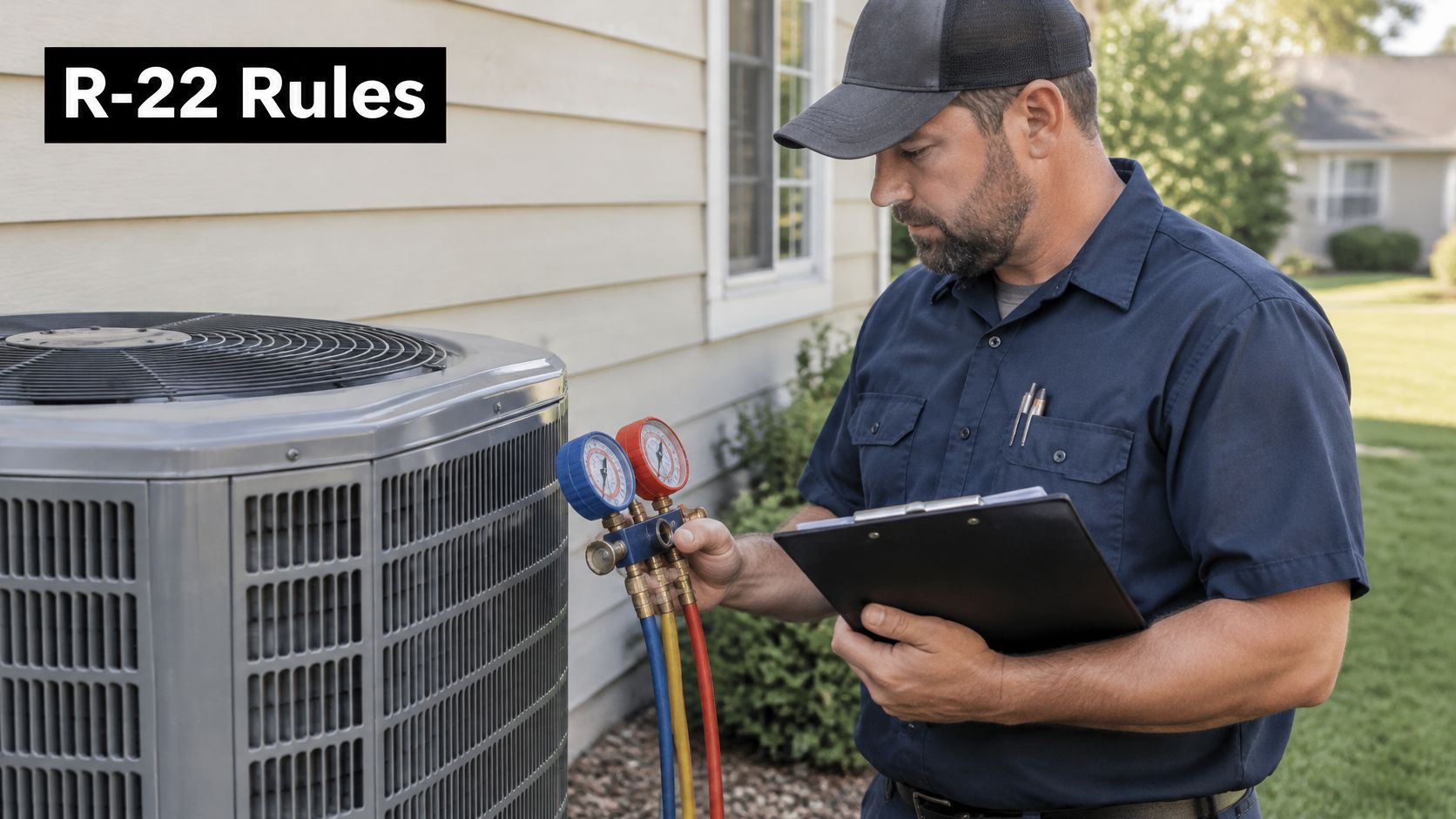
The EPA's HFC phasedown questions state that owners may continue maintaining and repairing existing equipment, including compatible R-410A component replacements; beginning January 1, 2026, new residential and light-commercial systems must use refrigerants with a global-warming potential below 700. Component repair isn't the same regulatory event as installing a new system.
Our explanation of the R-410A refrigerant phaseout helps distinguish those situations. New refrigerant isn't a drop-in substitute just because both products are used for air conditioning.
Ask what the repair actually fixes
Electrical components: Capacitors, contactors, control boards, and blower motors usually remain component-repair decisions.
Sealed-system failures: Coils, refrigerant tubing, and compressors require closer review of compatibility and remaining equipment condition.
Recurring low charge: Require leak diagnosis, not an open-ended pattern of adding refrigerant.
The DOE HVAC end-of-life guide identifies Section 608 of the Clean Air Act as prohibiting knowing refrigerant releases during service or disposal. Work must include appropriate recovery and handling, not intentional venting.
Lifetime Cost, Financing and Maintenance Plans Compared
An efficiency gap becomes useful only when you translate it into money over a consistent period. Use an 18-year comparison horizon, matching the Department of Energy Federal Energy Management Program example, which compares a SEER2 13.4 system using 9,159 kWh annually and costing $1,008 per year, an ENERGY STAR SEER2 15.2 model costing $889 annually, and a SEER2 23.5 model costing $575 annually.
Over that assumed life, DOE estimates $1,853 in lifetime energy-cost savings for the ENERGY STAR model and $6,724 for the best-available model compared with the less-efficient option. Those are modeled comparisons, not promised savings for a particular Tucson home.
Use the same accounting on both sides
Compare these totals:
Repair path: Immediate repair + energy + maintenance + likely future repairs + eventual replacement within the comparison period.
Replacement path: Installed price + financing charges + projected energy + maintenance and future repairs, less confirmed discounts or incentives.
Don't subtract energy savings again after using the new system's lower projected energy cost. That would count the benefit twice.
Upfront cost and lifetime effect of each repair and replacement path
Path | Upfront cost | Effect on lifetime cost | Best when |
|---|---|---|---|
Repair and keep the current unit | Usually lowest, one repair invoice | Retains current efficiency and repeat-repair exposure | Younger equipment has one isolated fault |
Replace with cash | Full installed price paid at once | Can reduce cooling electricity without interest charges | Aging, inefficient equipment needs major work |
Replace with financing | Equipment price spread over time | Interest and fees can offset operating savings | Replacement is justified but cash flow is tight |
Maintenance plan with repair discounts | Annual plan fee | Can reduce covered repair charges and support upkeep | Expected benefits exceed the fee |
A repair doesn't make an old unit new. If it is unlikely to last through the comparison period, include its later replacement rather than pretending the repair buys an entire additional equipment lifetime.
Payment terms aren't equipment savings
Financing changes when you pay, not what the system costs to operate. Compare APR, fees, total payments, promotional conditions, and the cash price, and distinguish a genuine interest-free loan from deferred-interest terms.
A maintenance agreement needs its own calculation. Count inspections and discounts you'll use, then compare their value with the annual fee; don't assume every prevented repair can be predicted or credited as guaranteed savings.
Our guide to HVAC maintenance plans can help you review coverage and exclusions.
A lower monthly payment isn't necessarily a lower ownership cost.
Use your electricity tariff, cooling consumption, house load, and installer sizing to revise the estimate. The highest efficiency rating isn't automatically the best purchase if its added installed cost exceeds its realistic operating benefit.
Which Choice Fits Your Situation
A younger unit with an isolated electrical fault
Consider a hypothetical six-year-old system with a $450 capacitor-and-contactor repair. The coils are sound, airflow is acceptable, and the technician has checked why the components failed rather than swapping parts.
Repair it. The decisive figure is the hypothetical $450 invoice for an isolated fault, not an unsupported assumption that a new system must be better value.
An aging system with a compressor proposal
Say a 14-year-old unit has an $1,800 compressor quote, and summer bills have climbed each year. First separate electricity-rate increases from increased consumption, then obtain a replacement proposal with projected operating costs.
Replacement is the stronger candidate, but the facts don't yet prove a financial winner. Enter the hypothetical $1,800 repair into the repair path, include eventual replacement, and compare that total with the installed alternative over the common ownership horizon.
A legacy system that repeatedly loses charge
Suppose an 11-year-old R-22 system loses charge every July. Before authorizing another recharge, compare a located-and-sealed leak repair, including refrigerant, with a replacement that addresses the complete equipment condition.
Don't approve recharge-only work as the long-term solution. The decision-driving cost is the complete leak correction, not the advertised price of adding refrigerant.
A DOE Building America HVAC guide reports a study in which 20% undercharge produced an approximately 21% efficiency reduction. That finding supports correcting the leak, not treating low charge as routine consumption.
Repeated failures and weak delivered performance
Consider a 15-year-old central air conditioner with two failures during one summer and a rating around SEER 10. Those are hypothetical homeowner facts, not a universal replacement threshold.
Compare high-efficiency replacement against repair paired with duct sealing and airflow correction. In this scenario, the two failures make reliability a substantial concern, while the duct assessment determines how much either equipment choice can improve delivered cooling.
For a Tucson homeowner, peak-season risk also includes practical consequences: vulnerable occupants, an unattended seasonal home, or an inability to relocate during an outage. Replacement may be worth choosing before complete failure, but no equipment purchase eliminates outage risk.
Age shows the risk, the invoice shows the immediate cost, and neither shows the full cost alone.
In HomeServe's 2024 survey of 2,353 U.S. adults, 26% of surveyed U.S. homeowners reported an HVAC repair or replacement emergency during the previous 12 months. Getting written alternatives before peak season gives you room to decide without treating every breakdown as a forced purchase.
Confirm Your Decision Before You Sign
A defensible recommendation should survive a written comparison. If the explanation is only that the unit is old or the refrigerant is changing, the diagnosis isn't complete enough to authorize major work.
Use this checklist to confirm the scope before committing.
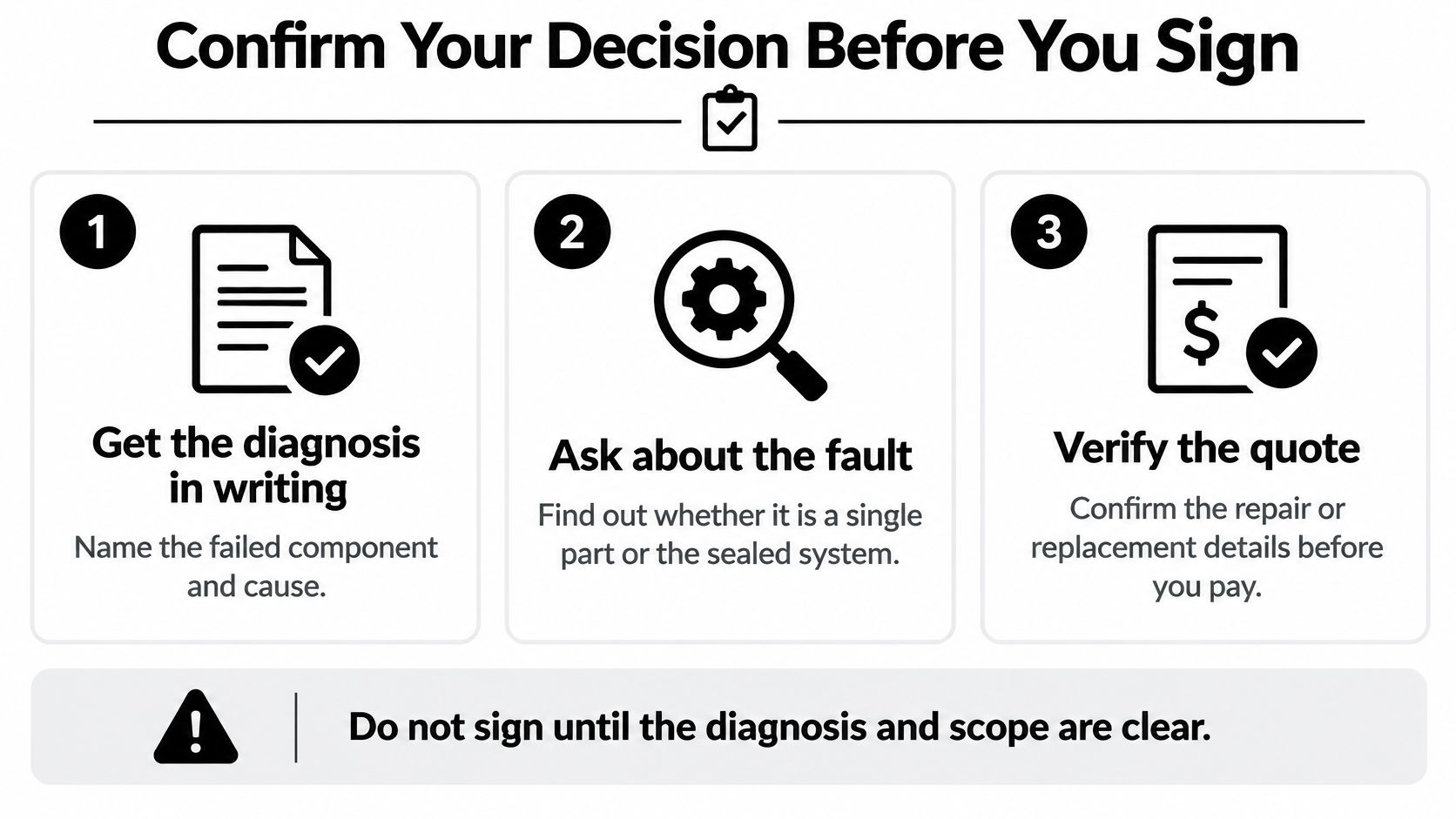
Get the diagnosis in writing: Name the failed component, test results, and likely cause. A noisy outdoor unit isn't a compressor diagnosis by itself.
Identify the repair boundary: Establish whether the work involves a single electrical part or opening the sealed refrigerant system.
Request a condition-based outlook: Ask what supports the remaining-life estimate and which other components show deterioration. Treat that estimate as a judgment, not a warranty.
Verify replacement sizing: Request a load calculation based on the house, including windows, insulation, orientation, and duct conditions, rather than copying the old equipment capacity.
Check delivered airflow: Inspect filter restrictions, coils, ducts, and blower setup. A higher-rated condenser won't correct a poorly functioning air-distribution system.
Compare written alternatives: Put repair and replacement on the same ownership timeline, with clear installation scope, projected electricity use, warranty terms, and payment conditions.
Make the contractor comparison specific
Our guide to choosing an HVAC contractor can help you evaluate the proposal alongside the diagnosis. We provide detailed diagnostics with honest recommendations, so the explanation should connect the measured fault to the recommended work.
As one option to compare against other written quotes, Covenant Aire Solutions offers a free quote and free estimate for services, 15% off A/C unit replacement, and 0% APR financing for 60 months on A/C unit replacement. Offers can change, so confirm current eligibility, financing terms, discount conditions, and whether offers can be combined in writing before deciding.
Covenant Aire Solutions offers AC repair, maintenance, and replacement, along with a free quote and estimate to help you compare the available paths. Visit Covenant Aire Solutions to arrange an evaluation, and have your equipment details, repair history, and recent utility bills ready so the recommendation reflects your system rather than a generic age rule.