
HVAC Maintenance Plans: A Practical Guide for Homeowners
A Tucson homeowner can do everything right and still get caught by a bad week. The filter was changed, the thermostat was working, and the air conditioner sounded normal in June. Then, in late July, the condenser goes silent. The indoor temperature climbs past 88°F, and the first available technician appointment is five days away.
That isn't a minor inconvenience in the Arizona desert. Air conditioners may run 14 or more hours a day during intense summer conditions, and a failure can create genuine health and safety concerns for older adults, children, pets, and anyone sensitive to heat. A maintenance plan exists to reduce the chance of facing that exact situation, while also improving the odds of getting help sooner when equipment does fail.
HVAC systems rarely break down on a convenient schedule. Reactive service during peak demand can mean long waits, emergency pricing, and limited contractor availability. The right plan can act as a form of risk management, but the wrong one charges you for benefits you won't use. This guide separates the useful coverage from the sales language, explains what seasonal visits should include, and shows when paying for a plan makes sense for a Tucson-area home.
When the AC Goes Out in July
The homeowner in this example has two problems, not one. The first is a failed air conditioner. The second is that every nearby contractor is dealing with the same heat-driven surge in calls.
A maintenance agreement doesn't guarantee that a compressor, capacitor, or control board will never fail. It can, however, create an established service relationship before the emergency occurs. That distinction matters because a contractor already familiar with the equipment can review prior readings, recognize recurring weaknesses, and place a plan member ahead of some non-members when the schedule is crowded.
Arizona rule: A maintenance plan is most valuable when downtime carries a real cost.
For a family in Tucson, five days without cooling can disrupt sleep, work, school, medication storage, and basic household routines. For a seasonal resident arriving at an uncooled property, the damage may include heat-stressed furnishings, moisture problems, or a system that cannot recover quickly after sitting unused. Commercial owners face a different version of the same risk, lost tenant comfort, interrupted operations, and pressure to approve repairs without time for comparison.
A plan also encourages action before the most demanding part of the season. A spring inspection can identify restricted airflow, a weak electrical component, a blocked condensate drain, or a refrigerant issue while technicians have more scheduling flexibility. That timing doesn't eliminate repair costs, but it can move the decision from an emergency call to a planned repair.
Homeowners who want a practical definition of an emergency should review this guide to what is considered an HVAC emergency. The important question isn't whether a contract sounds reassuring. It's whether the agreement reduces your exposure to heat-related downtime, unpredictable service access, and rushed repair decisions.
What an HVAC Maintenance Plan Actually Is
An HVAC maintenance plan is a prepaid service agreement between a homeowner and an HVAC contractor. In return for an annual or monthly fee, the customer receives scheduled inspections and selected service benefits, such as repair discounts and priority scheduling.
Routine care can find a small problem before it becomes a root canal, but the cleaning plan isn't dental insurance, and it doesn't pay for every major procedure. HVAC agreements work the same way. They organize preventive care and may lower the cost or waiting time when something goes wrong, but homeowners generally still pay for significant repairs.
The four parts that matter
Scheduled inspections: Solid plans commonly arrange seasonal visits, often one before cooling season and another before heating season. In Arizona, the spring appointment should prepare the cooling system for sustained demand, while the fall appointment should verify heating operation before colder nights arrive.
Priority service: Priority service means members may receive earlier scheduling when the contractor's calendar fills up. Ask for a specific response commitment. “Priority” can mean a meaningful queue advantage, or it can mean little more than a note on your account.
Repair discounts: Documented maintenance agreements may offer 10% to 15% off repairs or parts and labor, as shown in examples of HVAC maintenance agreements from Pilchuck Heating. Confirm whether the discount applies to both labor and parts, and whether common components are excluded.
Service records: A written history of inspections, readings, repairs, and recommendations helps track equipment condition. Those records can also support warranty administration and give a future buyer evidence that the system received regular attention.
A good agreement spells out what happens at each visit, what counts as a repair, and which costs remain outside the plan. It shouldn't rely on phrases such as “complete protection” without a task list.
Contractors also need dependable communication when calls surge. Businesses evaluating HVAC missed call solutions can use that resource to understand how service companies manage unanswered inquiries and urgent customer requests. For homeowners, the practical takeaway is simple: response systems matter, but a fast callback isn't the same as guaranteed repair availability.
Before signing, read the contractor's HVAC preventive maintenance plan details line by line. A plan becomes useful when its promises are measurable.
What Happens During a Biannual Checkup
A seasonal inspection should be more than a technician glancing at the thermostat and saying the system looks fine. The visit should produce readings, observations, and a clear record of what needs attention now, what can wait, and what may become a replacement concern later.
Spring cooling preparation
In Arizona, the spring visit, commonly scheduled in April or May, prepares the air conditioner for operation in temperatures above 110°F. The technician should verify refrigerant pressures, inspect and straighten condenser fins, clear drain lines, test compressor and blower-motor capacitors, measure the temperature split across the evaporator coil, calibrate the thermostat, and inspect electrical connections for heat damage.
The technician should also examine the filter, condensate pump, indoor coil, outdoor coil, and accessible ductwork. A written report should identify measured conditions rather than checking boxes.
Fall heating preparation
The fall visit, often scheduled in October or November, shifts attention to heating safety and performance. A gas furnace inspection should include the heat exchanger, igniter, flame sensor, combustion air, and blower operation. An electric system should receive an inspection of its heat strips and electrical components.
Both visits should include filter assessment or replacement, condensate pump testing, and written recommendations. A thorough appointment commonly takes 45 to 75 minutes. A technician who rushes through the entire process in 20 minutes is cutting corners on the work you're paying to receive.
Task | Spring, Cooling Prep | Fall, Heating Prep |
|---|---|---|
Refrigerant system | Check refrigerant pressures and cooling performance | Review heat-pump operation where applicable |
Electrical components | Test capacitors and inspect connections for heat damage | Inspect heating controls and electrical connections |
Air movement | Measure temperature split and verify blower function | Verify blower operation in heating mode |
Drainage | Clear drain lines and test the condensate pump | Test drainage components and inspect for standing water |
Heat-producing components | Not applicable for cooling preparation | Inspect heat exchanger, igniter, flame sensor, or heat strips |
Air quality basics | Assess filter and coil condition | Assess filter and combustion air condition |
Documentation | Record readings and recommendations | Record safety findings and recommendations |
The value of seasonal maintenance comes from the details. A homeowner should be able to ask what was measured, what was cleaned, and which finding supports each recommendation. Covenant Aire's explanation of seasonal AC maintenance offers additional context for evaluating the cooling-focused portion of a visit.
Comparing Plan Tiers and Coverage Levels
Plan tiers aren't interchangeable. A low-priced agreement may cover the appointment but leave you paying separately for the tasks that matter most in a desert climate. A premium agreement may add useful protection, but only if the equipment is old, heavily used, difficult to access, or costly to leave unattended.
Basic plans
A basic plan usually covers one annual or biannual tune-up, a standard visual inspection, and a modest repair discount. This may suit a newer system under warranty, a lightly used property, or a homeowner who handles filters and outdoor-unit housekeeping personally.
Standard plans
The standard tier is usually the practical middle ground for a primary Tucson residence. It may add priority scheduling, filter replacements, thermostat calibration, and coil cleaning. Homes that run cooling equipment through much of the year generally benefit more from these specific tasks than from a low price attached to a superficial inspection.
Premium plans
Premium agreements may include condensate-line treatment, refrigerant pressure checks, electrical tightening, waived diagnostic fees, and after-hours coverage. These additions can make sense for older equipment, vacation properties that remain unattended, or homes where a prolonged outage creates a serious problem.
Feature | Basic Plan | Standard Plan | Premium Plan |
|---|---|---|---|
Seasonal tune-up | One annual or biannual visit | Scheduled seasonal visits | Scheduled seasonal visits with expanded testing |
Priority scheduling | Limited or unavailable | Included during busy periods | Strongest priority and possible after-hours access |
Filters | Assessment may be included | Replacement or scheduled filter service may be included | Replacement or expanded filter support may be included |
Coil care | Visual inspection | Coil cleaning commonly included | Coil cleaning plus broader system cleaning |
Refrigerant checks | May be excluded | Often included during cooling inspection | Included with more detailed performance review |
Drain maintenance | Basic inspection | Cleaning or treatment may be added | Condensate-line treatment and pump testing |
Repair costs | Modest discount | Broader labor and parts discount | Larger discount or waived diagnostic fees may apply |
Best fit | Newer, lightly used systems | Most occupied Arizona homes | Older, high-use, or hard-to-monitor properties |
Don't choose a tier based on the word “premium.” Compare the actual work, response language, exclusions, and renewal terms. Covenant Aire's service agreement terms are the kind of document homeowners should review before treating a plan as a complete protection package.
The Real Cost of Preventive Versus Reactive Service
The financial case for maintenance rests on energy performance, equipment condition, and emergency exposure. It doesn't depend on the promise that every repair will be avoided.
Proper HVAC operations and maintenance can deliver 5% to 20% annual energy savings, according to Department of Energy-referenced industry guidance summarized by Facility Compliance Hub. That range isn't a guaranteed household result. It reflects the opportunity available when maintenance corrects airflow restrictions, dirty components, poor refrigerant charge, duct leakage, or other operating problems.
A California Energy Commission and Servidyne methodology found that technician training and improved preventive maintenance could reduce a typical community college's total energy bill by about 6% to 19%, as documented by the U.S. Department of Energy Office of Scientific and Technical Information. The lesson for homeowners is direct: maintenance can affect energy use when technicians correct the conditions that force equipment to work harder.
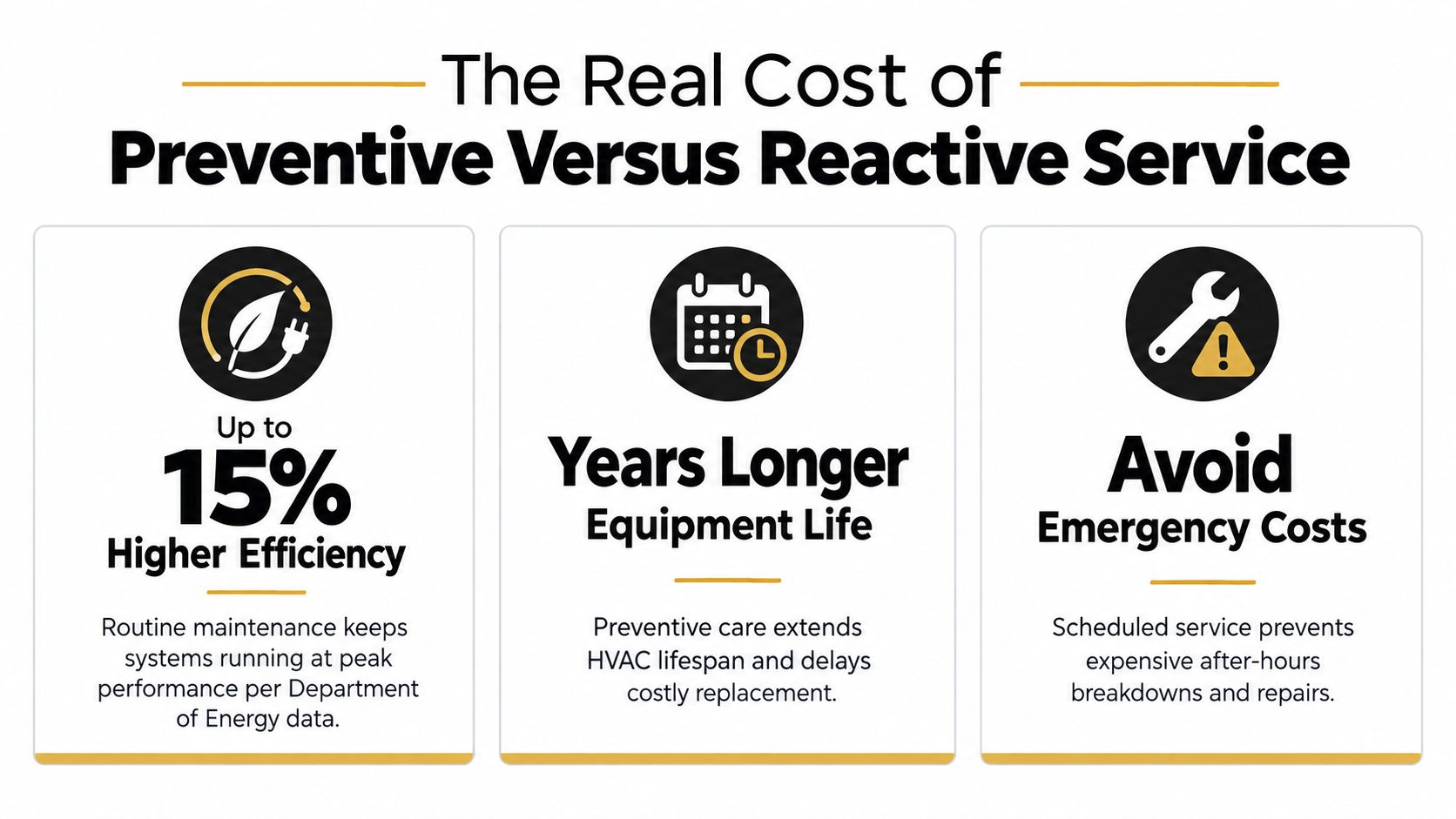
A neglected system may also consume more energy. Department of Energy-cited estimates report that poor installation or maintenance can increase household HVAC energy use by 30% or more, according to WorkTrek's HVAC maintenance statistics summary. In commercial and government buildings, HVAC can represent roughly 40% to 60% of total building energy consumption, which explains why planned care receives more attention in larger facilities.
The avoided-cost argument is harder to calculate for one house. A plan may pay for itself through a repair discount, a prevented failure, lower energy use, or a better-timed replacement decision. It may also fail to pay back if the system is young, reliable, and covered by warranty. Use the AC maintenance plan cost guide to compare the agreement's real inclusions with what you'd otherwise pay for scheduled visits.
How Covenant Aire Structures Its Maintenance Plans
Covenant Aire Solutions structures its maintenance agreements around southern Arizona's cooling demands. The plan includes a spring visit focused on pre-season air-conditioning readiness and a fall visit focused on heating components before the first cold snap.
The company describes its plan as including two annual unit checkups, a 21-point inspection, condenser coil cleaning, priority service, 20% off repair labor, 20% off replacement parts, and 10% off new unit purchases, as detailed in the publisher's product information. Those benefits matter only when the homeowner confirms the current agreement, eligible equipment, exclusions, and renewal terms before enrolling.
What members should expect
During the spring appointment, the technician should concentrate on cooling performance, airflow, electrical condition, drainage, coil cleanliness, and the components most likely to struggle under heavy summer operation. The fall visit should address heating operation, safety components, blower performance, and readiness for colder weather.
Members also receive documented service records, which create a useful history for warranty questions, resale discussions, and replacement planning. Financing is available for larger repair decisions identified during routine visits, so a homeowner can evaluate an important repair without treating the first recommendation as an automatic replacement order.
The service relationship includes practical reminders for filter changes and seasonal tips suited to desert conditions. The program also includes access to broader community programming, such as local energy-efficiency workshops and referral credits for neighbors who join. Those extras won't justify a plan by themselves, but they can add value for homeowners who want guidance between professional visits.
The strongest reason to consider this structure is scheduling. A spring and fall cadence puts routine attention on the calendar before the most demanding operating periods. It doesn't make the equipment failure-proof, and it doesn't turn major repairs into free repairs. It does create a documented process for finding problems earlier and contacting a familiar contractor when demand rises.
When a Maintenance Plan Is Not Worth the Money
A paid plan isn't automatically a smart purchase. Independent consumer guidance from Consumers' Checkbook warns that some contracts shift risk to the customer without delivering enough labor, repair, or maintenance value. The right choice depends on what the agreement includes and how likely you are to use it.
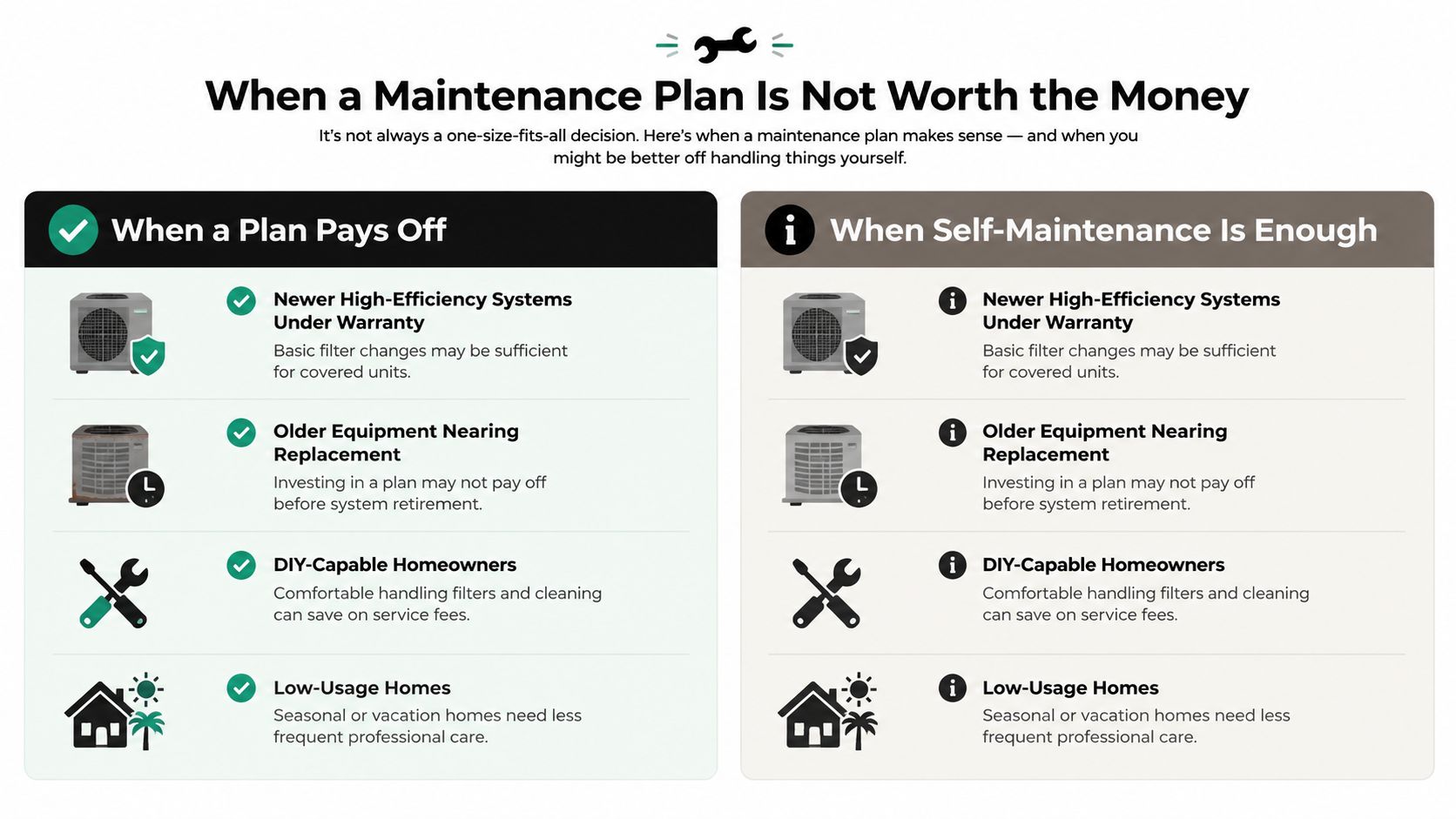
Self-maintenance may be sufficient in several situations:
Replacement is already near: If an older system is approaching retirement, paying for a multi-year agreement may not return enough value before replacement.
You handle basic care: A capable homeowner with an accessible system can manage filter changes, keep the outdoor unit clear, watch for weak airflow, and arrange professional service when readings or symptoms indicate a problem.
The equipment is secondary: A rarely used guesthouse, detached space, or vacation property may not justify the same coverage as a primary residence operating through intense summer heat.
You prefer pay-per-visit service: Some cash buyers would rather schedule professional inspections when needed than maintain a recurring agreement.
Contract warnings
Read the cancellation language before you focus on the discount. Watch for multi-year auto-renewal clauses, labor exclusions for common failures such as capacitors or contactors, peak-season surcharges that weaken the priority promise, and introductory pricing that rises sharply after the first year.
A Tucson rental or snowbird property is a good test case. If the home sits empty for long stretches and has remote monitoring, the owner may prefer professional inspections scheduled around occupancy rather than monthly plan payments. On the other hand, a poorly monitored property with a high cost of heat damage may justify coverage even when usage is seasonal.
A maintenance plan is a tool, not a moral decision. Skipping one is reasonable when you understand the trade-off, keep up with basic care, schedule professional checks appropriately, and maintain a reliable emergency contact for the day the system stops working.
Choosing the Right Plan and Getting Started
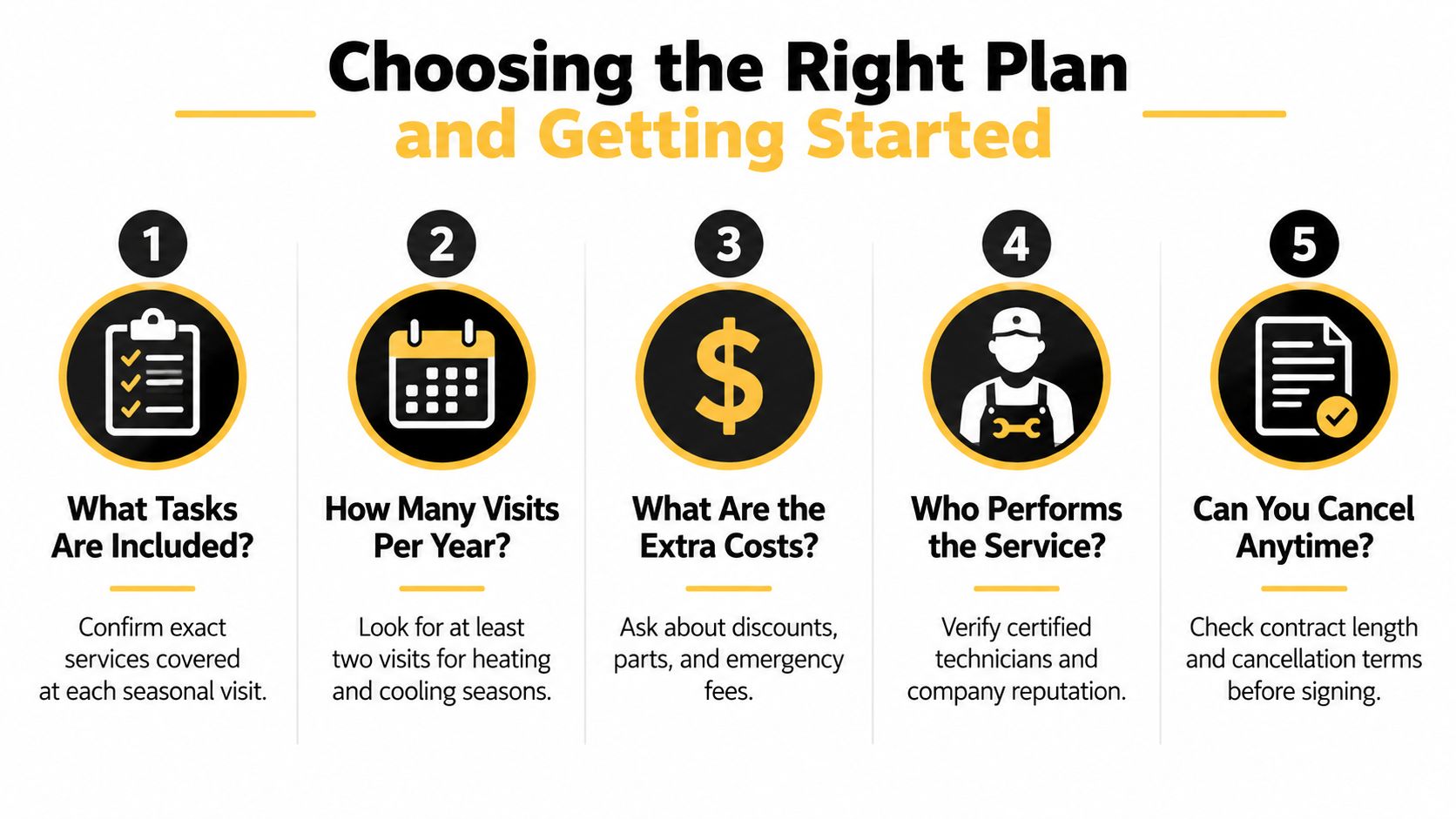
Use five questions to evaluate any HVAC maintenance plan before signing:
What tasks are included at each visit? Ask for the inspection checklist, not a general promise of a tune-up.
How many visits occur each year? Heating and cooling systems deserve attention at the appropriate seasonal intervals.
Which labor and parts receive discounts? Confirm whether capacitors, contactors, motors, controls, refrigerant work, and diagnostic charges are included or excluded.
What response time applies during peak summer? Ask whether priority means same-day scheduling, a defined queue position, or only a callback.
Can the agreement transfer or be canceled? A sale, rental change, or replacement may alter the plan's value.
Match the plan to the property
New construction with a warranty: Choose basic scheduled care if the warranty already covers major failures, but confirm the manufacturer's maintenance requirements.
A system around ten years old: Favor documented inspections, performance readings, repair discounts, and a clear replacement-planning process.
A rental property: Prioritize response rules, records, tenant coordination, and coverage that works when the owner isn't nearby.
A primary desert residence: A standard plan with two seasonal visits, coil and drain attention, priority scheduling, and meaningful repair discounts is usually the practical starting point.
Verify the contractor's license, request a sample service log, and ask for two references from current plan members in your neighborhood. Before the first visit, have the model numbers, recent repair history, filter size, and any unusual symptoms ready. A useful technician should explain the readings, separate urgent repairs from future concerns, and leave records you can use later.
If you choose Covenant Aire, request a plan quote that matches your equipment and property use. Expect the first visit to establish a baseline, document system condition, and identify maintenance or repair priorities, so future appointments become comparisons instead of guesses.
Covenant Aire Solutions offers biannual HVAC maintenance plans with seasonal checkups, a 21-point inspection, condenser coil cleaning, priority scheduling, and repair discounts for eligible customers. Visit Covenant Aire Solutions to request a plan quote and build a maintenance schedule suited to your Tucson-area home.