
What Causes AC Capacitor to Fail in Arizona Heat
It's a hot Tucson afternoon. The house is getting warmer, the thermostat is still calling for cooling, and the outdoor unit is humming without its fan starting. It's easy to assume the small capacitor inside the condenser has failed, but that part may be only one clue. The underlying stress could be heat, restricted airflow, electrical trouble, or a motor that's struggling.
A capacitor helps the compressor and fan motor start and keep running. When it weakens, the system may fail to cool, but replacing the part without finding what stressed it can lead to another breakdown. Capacitors can retain a dangerous electrical charge, so don't open the unit, test the part, or try to replace it yourself.
Why Your AC Capacitor Fails on a Hot Day
A humming outdoor unit can leave you wondering whether the compressor is starting, whether the fan is stuck, or whether the thermostat has stopped communicating. The sound alone doesn't identify the fault. It tells you the equipment is trying to operate, not which component needs repair.
Inside the condenser, a run or dual capacitor helps the compressor and fan motor start and run. It provides electrical support that helps the motors operate in the right rhythm. If that support weakens, a motor may struggle to start or may not run at all.
Several stresses can contribute to failure. Age gradually wears the part down. Heat from Tucson's long cooling season can speed that process, while voltage spikes and sags may add electrical stress. Vibration can loosen or damage connections, and skipped maintenance can leave airflow restricted, making the equipment work harder.
What to notice: A hum, a fan that won't start, or a system that stops cooling deserves attention, but none of those clues proves the capacitor is the only problem.
This guide will help you understand which conditions can point to heat damage, which may suggest an electrical-environment issue, and why a new capacitor can fail again when the cause remains. It'll also help you decide when to stop trying to run the system and call a qualified technician.
The next section explains what the capacitor does before looking more closely at the stresses that can wear it out.
How an AC Capacitor Works Until Heat Wins
A capacitor is a small energy reservoir that helps time the electrical phases needed by a motor. Think of a heavy flywheel that won't get moving on its own. The capacitor gives the compressor or fan motor a helper's push to start, then supports its operation as it runs.
In a residential condenser, a run or dual capacitor can support the compressor, the outdoor fan motor, or both. If you want a visual overview of how these components fit into the outdoor unit, see this homeowner guide to condenser parts.
The capacitor's internal dielectric changes chemically as it operates. The U.S. Naval Sea Systems Command's technical guidance on capacitor failures describes wear-out as a process affected by time, temperature, and applied voltage. Its rule of thumb is that chemical degradation roughly doubles for every 10°C increase in operating temperature. A capacitor operating at 70°C instead of 60°C can therefore age about twice as fast from temperature-related effects. Another 10°C rise can double the aging process again.
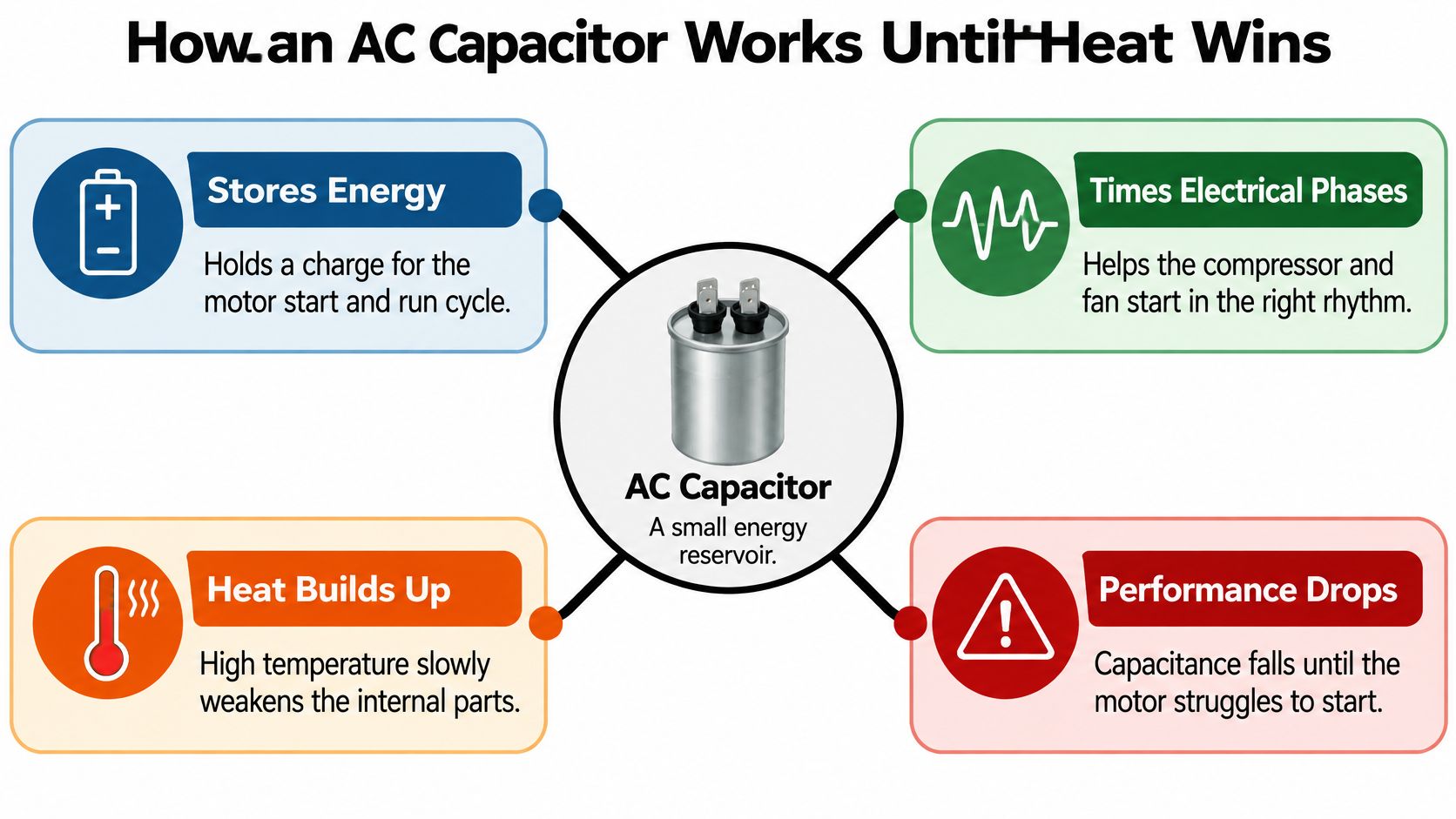
How temperature and electrical strain reinforce each other
Heat comes from the air around the condenser, but the capacitor can also warm internally as current passes through its equivalent series resistance, or ESR. NASA research on electrolytic capacitors found that thermal overstress caused average capacitance to fall by more than 9–11% after 3,400 hours, while resistance changed by about 20–22%. Those changes can leave the capacitor less able to provide the phase shift and starting or running current the motor needs.
As the capacitor loses strength, the motor can strain and draw more current. That current creates more internal heat, which adds stress to the capacitor. Long runtimes, direct sun, and restricted airflow around a Tucson condenser can intensify the cycle.
A swollen case, oil leakage, a humming motor, or difficulty starting can fit this pattern. They're clues, not a diagnosis. Only appropriate electrical testing can confirm capacitor condition, and that work should be left to a qualified professional.
The Main Causes of AC Capacitor Failure
A capacitor can fail through several distinct kinds of stress. Heat gets much of the attention in Arizona, but age, electrical conditions, vibration, and maintenance also matter. The same visible failure can have different causes in two homes.
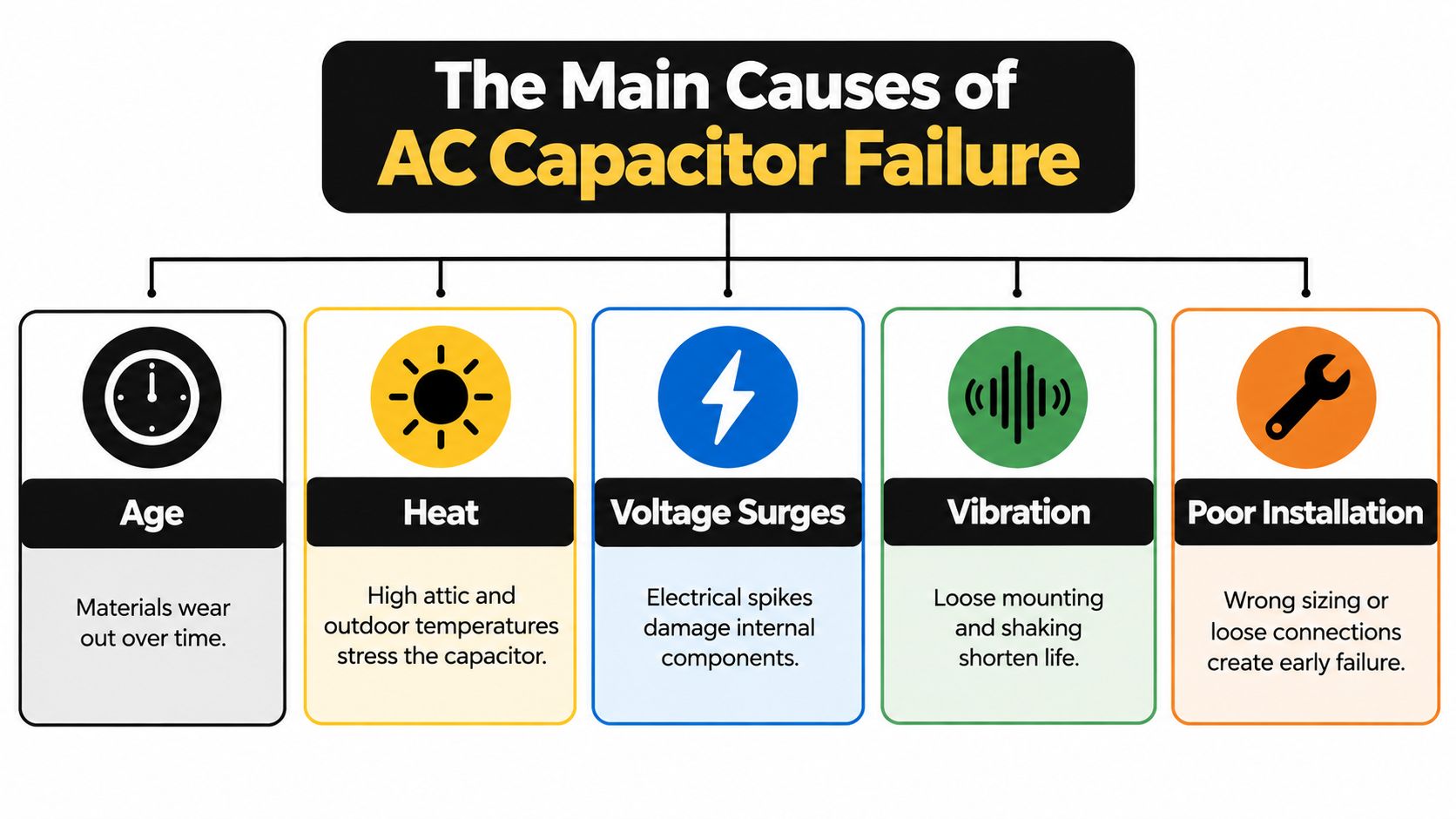
Age and heat
Age wears on the capacitor even when it looks normal. Each hour at operating temperature contributes to gradual material deterioration.
Heat accelerates that wear. A review of capacitor degradation describes operating temperature as a primary limit on capacitor life. It gives the commonly used rule that an electrolytic capacitor's service life is reduced by about half for every 10°C increase. End-of-life criteria can include capacitance falling by 10% or ESR rising by 250% or more from its original rated value.
Dirty coils, blocked clearance around the condenser, nearby hot components, and direct desert sun can all raise the capacitor's internal temperature above the outdoor air. The unit can therefore experience heat stress even when the supply voltage appears normal.
Voltage, vibration, and maintenance
Excessive voltage, voltage transients, ripple current, and repeated charge-and-discharge cycles can add electrical stress. Ripple current passing through ESR generates internal heat, even when a simple voltage check doesn't reveal an obvious problem. Outage patterns and voltage sags deserve separate attention, covered later.
Vibration creates a different path to trouble. A loose mounting bracket, a failing fan, or shaking from a storm or nearby activity can stress connections and wiring.
Poor maintenance can add mechanical and thermal strain. Dirty coils and restricted airflow can make the equipment work harder, while ignored signs of weak airflow leave that strain in place. A capacitor replacement may restore cooling temporarily, but it won't correct the conditions that made the part run hot or stressed its electrical connections.
The visible can is only the first clue. Finding the stress behind the failure matters as much as replacing the failed component.
What Capacitor Symptoms Really Point To
A humming condenser doesn't automatically mean the capacitor is the only failed part. In Tucson, heat, airflow, motor condition, and the electrical supply can overlap, so a technician needs to check the system as a whole.
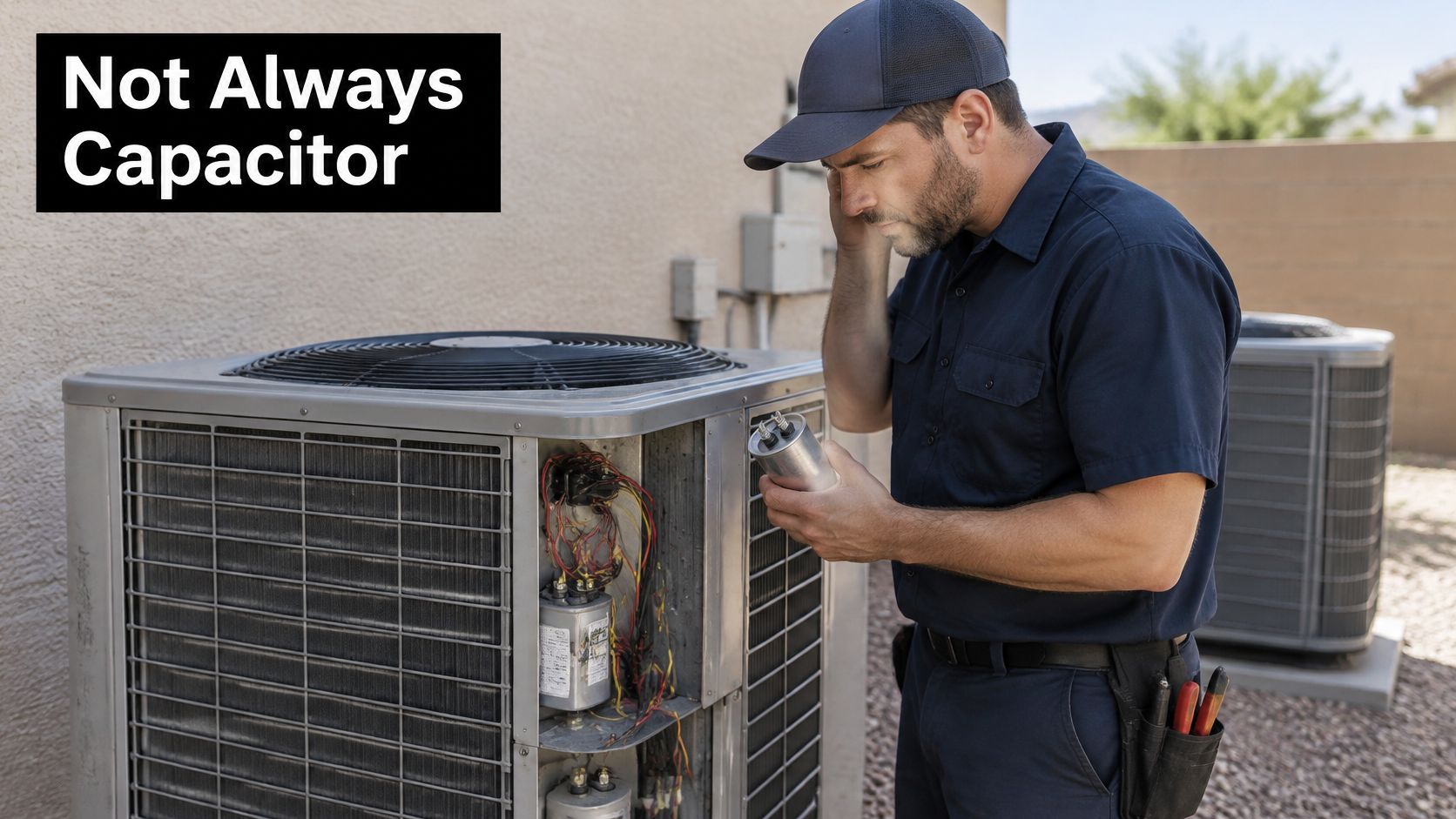
Three situations that can look alike
Consider a condenser sitting in direct sun with a matted coil. Restricted airflow can raise head pressure and compressor current, adding thermal stress. A new capacitor might get the system running again, but the coil and airflow problem still needs attention.
A different system may start and stop repeatedly because of a control problem, an oversized system, or a thermostat issue. Those repeated starts can stress the capacitor even if its case looks normal. If the unit is cycling frequently, a technician can investigate whether short cycling is affecting the system.
Or a fan may hum after a storm but refuse to start. A weak capacitor could be involved, but so could a struggling motor, a loose connection, or a replacement part with the wrong rating. A new capacitor that fails again may be telling you that the system's underlying problem wasn't fixed.
Clues to share, not proof to act on
Bulging, leaked oil, a burnt smell, poor cooling, or a rising electricity bill can help describe what's happening. None confirms by itself that the capacitor is at fault. Don't open the electrical compartment to look for damage or attempt a test. A capacitor can retain hazardous charge, so homeowner testing and replacement aren't safe shortcuts.
After a replacement, a technician should check:
Coil and airflow condition, including condenser-coil cleanliness.
Motor behavior, including fan-motor current and compressor starting behavior.
Electrical supply and connections, including voltage under load and wiring torque.
Part ratings, including the capacitor's microfarad and voltage ratings.
This video offers additional context about capacitor issues and repair:
The practical answer to “Why did my new capacitor fail again?” may be that the part was replaced, but the heat, motor, connection, or electrical condition that stressed it remained.
When Power Quality Shortens Capacitor Life
Electrical stress doesn't come only from a lightning strike. Brownouts, brief voltage sags, motor switching, and nonlinear electronic loads can also create a less stable electrical environment for HVAC equipment.
Industry reporting that cites IEEE power-quality terminology says voltage sags and interruptions account for about 92% of power-quality problems. It also notes that HVAC equipment may be affected by voltage drops of roughly 10–15% lasting a second or longer. These figures are discussed in industry coverage of power-quality risks to inverter HVAC equipment.
Ripple current can also create heat inside a capacitor through ESR, even when a voltage check taken while equipment is idle appears acceptable. Electrical damage may affect the dielectric or cause electrolyte leakage, reducing the capacitor's ability to provide the phase shift a compressor or fan needs.
Watch for patterns around the failure
A power-quality issue becomes more plausible when equipment trouble follows repeated utility interruptions or monsoon activity. Notice whether several appliances reset at the same time, whether the problem follows an outage, or whether nearby heavy equipment is operating. Those observations don't prove the cause, but they can help a technician investigate.
Homeowners and facility managers can also note whether lights repeatedly flicker or other electrical symptoms occur, then share that history with a professional. If flickering is persistent, it may be useful to describe the pattern when discussing lights that constantly flicker.
Traditional air conditioners may use a dual-run capacitor. Inverter and variable-speed systems rely on electronic power-conversion components and can have narrower voltage tolerances, so a single-capacitor explanation may not apply. Document what happened; don't try to measure voltage yourself. A technician can distinguish the equipment type and check the supply under operating load.
How to Choose Capacitor Repair or Replacement
When an outdoor unit stops cooling, waiting and hoping may feel like the easiest choice. Replacing only the capacitor may seem like the quickest fix. A full diagnosis takes more investigation, but it can show whether the failed part was the whole problem or just the first visible sign.
A parts-only replacement can fall short if the microfarad or voltage rating is unsuitable, a motor is drawing abnormal current, a connection is loose, or the supply behaves differently under load. Electrical overstress can include excessive applied voltage, transients, ripple current, and repeated charging and discharging. A technical review of electrical factors affecting capacitor life explains that ripple current through ESR generates internal heat. Capacitor damage can reduce capacitance, cause leakage, or lead to a short, interfering with motor operation.
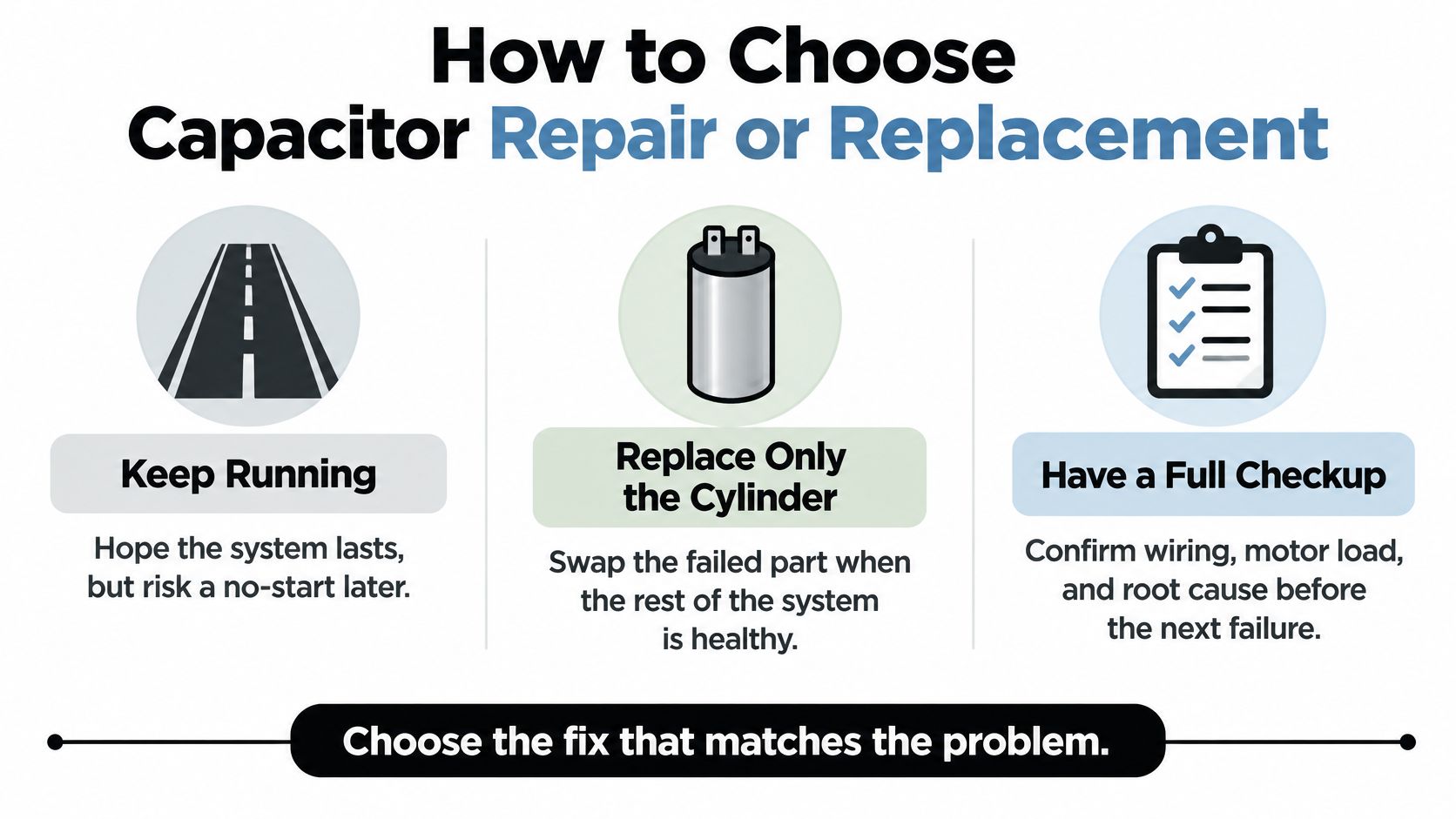
Match the pattern to the next check
What you notice | What should be verified | Safe next step |
|---|---|---|
The outdoor unit hums but won't start | Capacitor condition, motor behavior, and connections | Stop repeated attempts to start it and request professional diagnosis |
The capacitor was replaced, then failed again | Motor current, coil cleanliness, wiring torque, and correct ratings | Ask the technician to check for the underlying stress, not just swap another part |
The problem followed an outage or several appliances reset | Supply voltage under operating load and possible power-quality concerns | Record when it happened and share the pattern with a technician |
The system struggles during hot weather | Airflow, coil condition, and motor starting behavior | Arrange a service visit rather than assuming the capacitor is the only cause |
Covenant Aire Solutions provides HVAC diagnostics and repairs in Tucson and nearby areas. Its certified technicians can assess heating and cooling equipment, check a failed part in context, and recommend repair or replacement based on what they find. Service options also include preventive maintenance plans with biannual visits and priority service, 24/7 emergency response for homes and small commercial spaces, upfront pricing, and financing or special rates for eligible customers. For background on repair decisions, see this guide to AC repair costs.
Prevent Capacitor Failure and Call a Pro
A capacitor is more likely to last when it stays cooler, receives stable voltage, and isn't being asked to support a struggling motor. Long Arizona cooling seasons, direct sun, dirty coils, and repeated difficult starts can shorten its useful life. There isn't one lifespan that fits every system because the operating conditions vary.
A few homeowner habits can reduce avoidable strain:
Keep the condenser clear: Move plants and debris away so airflow isn't blocked.
Replace filters: Follow the equipment's guidance so poor airflow doesn't add system strain.
Schedule coil cleaning: Have the outdoor coil checked and cleaned as part of routine care.
Track electrical interruptions: Note outages, breaker trips, or multiple appliances resetting.
Stop repeated restart attempts: A humming unit that won't start shouldn't be forced through cycle after cycle.
Seasonal service can help identify airflow and electrical concerns before they contribute to another breakdown. See guidance on seasonal AC maintenance when planning routine care.
Bulging, oil leakage, a hum with no start, or another capacitor failure soon after replacement deserves professional diagnosis. Don't discharge, test, or replace an energized capacitor. The part can hold a hazardous charge, and a qualified technician can check it safely along with the motor, wiring, coil cleanliness, and voltage under load.
Contact Covenant Aire Solutions for a diagnostic visit in Tucson or the surrounding area. Tell the technician when the failure happened and whether other appliances reset, then ask for the capacitor ratings, motor condition, coil cleanliness, and voltage under load to be checked together. If the system is older or the capacitor has already been replaced once, ask whether a maintenance plan fits your needs.
Covenant Aire Solutions provides AC diagnostics, repair, emergency response, and preventive maintenance for Tucson homes and small commercial spaces. If a capacitor has failed or a new one didn't last, contact Covenant Aire Solutions to arrange a professional evaluation of the part and the conditions around it.