
AC Tune Up Service in Tucson: What Homeowners Need
It's the first real hot week, the thermostat says you're holding temperature, but the bedroom feels warmer than it did last summer and the system just keeps running. You can tell yourself it's fine for another year, or you can find out what's drifting before Tucson heat turns a small problem into a weekend failure. That's what a real AC tune up service should do, and it's supposed to leave you with measurements, not just a wiped down condenser and a bill.
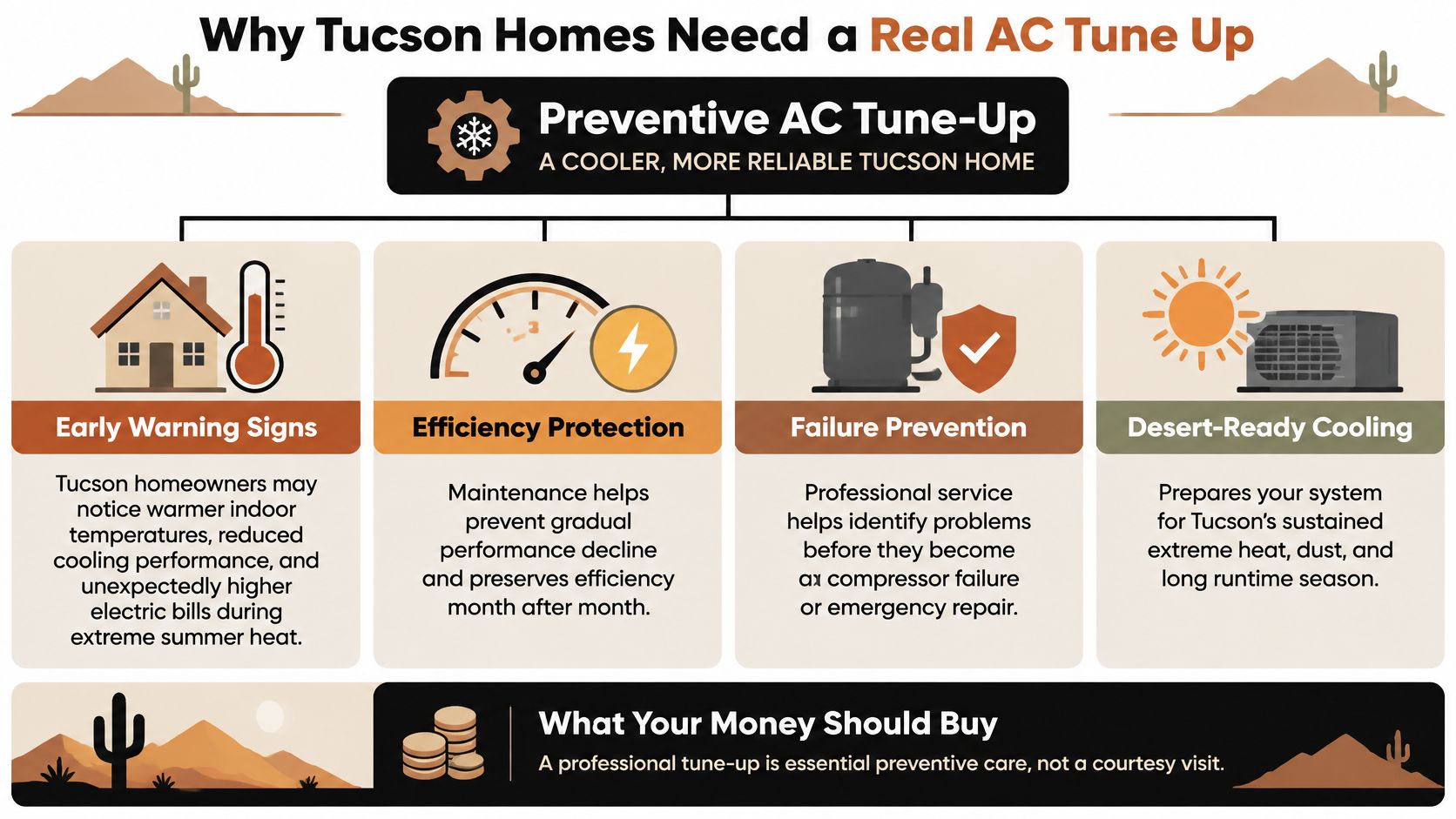
Why Tucson Homes Need a Real AC Tune Up
Last June, a homeowner on the east side called because airflow felt weak at two vents and the house wouldn't pull down in the late afternoon. The system hadn't failed. It cooled, sort of, and that in between state is exactly where people lose money for months before anything breaks outright.
He'd skipped service the year before because nothing seemed wrong. By the time we looked, the filter was loaded, the outdoor coil was matted with dust, and the blower was working against both. None of that shows up as an alarm on your thermostat. It shows up as longer runtimes, warmer rooms, and a bill that climbs while comfort slips.

What Skipping a Year Actually Costs You
A tune up isn't a courtesy visit. It's preventive work on a machine that's about to run for hours a day, in dust, in heat that doesn't let up at night. Small losses in airflow or heat transfer don't stay small under that load. The compressor runs longer to do the same job, electrical parts cycle under more stress, and a marginal capacitor or contactor gets pushed toward failure on the hottest Saturday you could pick.
That's the trade off you're really weighing. Pay for a measured check in spring, or pay for an emergency call later plus the higher operating cost you've been absorbing since May.
If your system still cools but takes longer to get there, don't read that as good news. Read it as your early warning, while the fix is still cheap and scheduled.
For most houses here, the smart question isn't whether you need a visit this year. It's what that visit should prove about your cooling system and its seasonal readiness before the technician leaves. A proper AC tune up service answers that with numbers you can keep.
What a Professional AC Tune Up Service Actually Includes
Forget the vague pitch about checking everything over. A thorough visit is organized around what the system has to do: move air, transfer heat, control refrigerant, and start and stop safely. Each task below produces a reading or a condition a technician can write down.
Controls, Electrical, and Safety
Thermostat and control operation comes first, because a system that short cycles or overshoots will look inefficient even if the equipment is sound. The technician confirms the thermostat reads accurately, calls for cooling correctly, and shuts the system down cleanly. Startup and shutdown matter more than people think in Tucson, where a system may cycle under heavy load all afternoon.
Next are electrical readings at the compressor, fan motor, capacitor, and contactor. Loose, corroded, or heat damaged connections raise resistance and stress motors. A weak capacitor doesn't fail politely, it makes the compressor work harder on every start until it won't start at all. Amperage should be compared against the nameplate, not guessed at by ear.
Refrigerant Charge Verified Against Spec
A lot of cheap tune ups fall apart right here. A technician shouldn't just hook up gauges, glance at pressures, and add refrigerant because the air doesn't feel cold enough. Charge has to be verified against the manufacturer's required method, typically superheat for fixed orifice systems or subcooling for thermostatic expansion valve systems, under documented operating conditions.
That precision matters because ENERGY STAR guidance on incorrect refrigerant charge reports that an incorrect charge can reduce efficiency by approximately 5% to 20% and can also damage the compressor and shorten equipment life. Overcharging isn't safer than undercharging. Both raise operating cost and compressor stress, and topping off a leaking system without finding the leak just schedules the same problem again.
Airflow, Coils, and Condensate
Airflow at the indoor coil: Inadequate airflow reduces heat transfer, raises coil freeze risk, and hurts humidity control, so filter condition, blower cleanliness, and blower operation get checked together.
Coil cleaning on both sides: The outdoor condenser and the indoor evaporator are heat transfer surfaces. Dirt insulates them, and hosing off the outside cabinet isn't the same as cleaning the coil faces and straightening damaged fins.
Condensate path: The drain line, trap, and pan get inspected and cleared so summer condensate doesn't back up into a ceiling or shut the system down on a float switch.
Duct connection points: Obvious disconnects, crushed runs, or heavy dust loading get noted, and deeper air duct cleaning and duct condition issues are flagged separately rather than sold as part of a basic visit.
Practical rule: If a technician can't tell you how charge was verified, by superheat or subcooling and against what target, you didn't get a diagnostic tune up. You got a look around.
Done right, an AC tune up service ends with recorded temperatures, pressures, electrical values, and coil condition, not a verbal assurance that everything looked fine.
When to Schedule a Tune Up in Tucson's Climate
Spring is the window, and it's not close. Your system has sat through months of light use, dust has settled where it shouldn't, and you want defects found before sustained heat turns them into capacity problems you can't ignore.

Wait until June and two things happen. First, you're competing for appointments with every homeowner whose system just quit, which means longer waits and fewer choices. Second, your equipment has already been running hard on dirty coils or marginal parts, so you've paid for the inefficiency and still own the risk.
The Cadence That Works Here
One major cooling check in spring is the baseline for most Tucson homes. That's consistent with U.S. Department of Energy guidance on annual air conditioner maintenance, which recommends annual maintenance including evaporator coil inspection and cleaning when necessary, to improve comfort, efficiency, and equipment life. The evaporator coil point matters, because that indoor coil does the actual cooling work and dirt there directly interferes with heat transfer.
Homes with heat pumps benefit from a fall visit too, since the same equipment carries your heating load and reversing valve operation, defrost, and auxiliary heat deserve a look before winter. Gas furnace households have a separate reason for a fall check, combustion and safety controls, which a cooling visit doesn't cover.
Spring: Full cooling tune up, charge and airflow verified, coils cleaned, condensate cleared.
During heavy use: Check your filter monthly and replace it when it's dirty, rather than waiting on a fixed calendar if dust loads it early.
Fall: Heating side check for heat pumps and furnaces, plus a post monsoon look at the outdoor coil.
Monsoon season is the variable people forget. Wind driven dust and debris load the outdoor coil and filters faster in some years than others, so a system that was clean in April may not be clean in September. Build the spring visit in as non negotiable, then let dust, runtime, and equipment type decide whether fall earns a second one.
DIY Maintenance vs Hiring a Professional Technician
There's honest homeowner work here, and it matters. There's also a clear line where DIY stops saving money and starts risking the equipment, your warranty, or you.
What You Should Do Yourself
Filter care is the highest value task you own. The U.S. Department of Energy statement on replacing a clogged air filter says replacing a clogged filter can reduce air conditioner energy consumption by up to 15%. A loaded filter restricts airflow, cuts cooling performance, and forces longer runtimes, so checking it monthly during heavy use isn't busywork.
You can also keep the outdoor unit clear of leaves, tumbleweeds, and stored items, confirm supply vents aren't blocked by furniture, replace thermostat batteries, and watch the condensate drain for slow drainage or water where it shouldn't be. Those checks cost you minutes and catch visible problems early.
What Needs Gauges, Meters, and a License
Refrigerant work is not a homeowner task, full stop in practical terms. Verifying charge takes manifold gauges or digital probes, accurate temperature clamps, the manufacturer's charging chart for your specific model, and the judgment to recognize when low charge means a leak rather than a top off. Guessing at charge can damage the compressor you're trying to protect.
The same applies to capacitor testing, motor amperage, contactor condition, and static pressure. A professional AC tune up service uses an ammeter, multimeter, and manometer to produce values that can be compared against nameplate and commissioning data. You can't hear a capacitor drifting out of spec, and you can't feel high static pressure at a vent.
Do the monthly filter and visual checks yourself, without exception. Pay a technician for the measurements you can't take and the refrigerant handling you're not equipped or certified to do.
That split is the honest answer. Homeowners who handle filters and debris get more out of a professional visit, because the technician spends time diagnosing instead of doing basic cleanup. Skipping the professional side entirely, though, leaves the expensive failure modes completely unexamined.
Typical Costs, Maintenance Plans, and Financing Options
Pricing conversations in this trade get murky fast, so here's how to think about it without invented promises. A single visit costs what it costs because a trained technician, a stocked truck, diagnostic instruments, insurance, and travel all have to be paid for. When a price looks far below what that work can plausibly cost, the visit is usually a sales appointment wearing a maintenance costume.
Single Visit Versus a Plan
A one off tune up makes sense if your system is newer, you've kept up with filters, and you want a documented check before summer. You pay once, you get the readings, and you decide on any recommended repairs with no ongoing commitment. The downside is scheduling. When heat arrives, plan members and emergency calls tend to move first.
A maintenance plan spreads the work across scheduled visits, typically a cooling check and a heating check, and commonly adds priority scheduling and a discount on parts and repairs when something does fail. For a Tucson household, priority access during peak breakdown season is often the value, not the visit discount. Waiting days without cooling in extreme heat isn't a minor inconvenience, and for landlords, seasonal residents, and light commercial properties it can become a tenant, liability, or business problem.
Plans also create a record. Year over year readings on charge, amperage, and coil condition let a technician spot drift, a capacitor weakening, amperage creeping up, airflow declining, that a single isolated visit can't show. That history is what turns maintenance from a checklist into equipment life cycle planning.
How to Judge the Offer in Front of You
Upfront pricing in writing: You should know the visit price and what's included before anyone opens a panel, with repair recommendations priced separately and approved by you first.
Defined scope: Ask whether coil cleaning, filter replacement, and charge verification by superheat or subcooling are included, or sold as add ons.
Discounts that apply to you: Covenant Aire Solutions, for example, publishes preventive maintenance plans with scheduled check ups and offers special rates for teachers, military personnel, and first responders, along with financing options for households that prefer to spread larger expenses over time.
No fixed savings promise: Be skeptical of anyone guaranteeing a specific utility bill reduction. Results depend on your system's starting condition, duct design, filter loading, and how you run the house.
Financing deserves a plain word. It's useful when a tune up uncovers a repair or replacement decision you'd rather not put on a credit card, and it's a poor reason to buy work you don't need. Use it to make a sound decision affordable, not to make an unsound one painless. The cheapest AC tune up service is rarely the least expensive summer.
What to Expect During the Service Visit
A good visit starts before tools come out. Expect an arrival window, a short walkthrough where you describe any warm rooms, noises, odors, or bill changes, and clear access needed to the thermostat, air handler, and outdoor unit. Mention the small stuff. A clicking start, a musty smell at startup, or one room that's always warm gives the technician somewhere specific to look.

The Report Is the Product
ENERGY STAR guidance on rigorous commercial HVAC tune ups characterizes a rigorous tune up as an assessment that can include temperature, pressure, electrical, airflow, control, scheduling, and operating checks, not merely a visual inspection. Hold a residential visit to the same standard. Your written report should separate normal findings from warnings and show actual values.
Measurements a Quality Tune-Up Should Document
Measurement | What It Confirms | Typical Healthy Range |
|---|---|---|
Supply versus return temperature difference | Whether the coil is transferring heat as designed | Within the manufacturer's specified range for operating conditions |
Superheat or subcooling | Whether refrigerant charge matches spec | At the target value on the manufacturer's charging chart |
Compressor and fan amperage | Whether motors are operating under normal load | At or below nameplate rated load amps |
Capacitor capacitance | Whether starting components are weakening | Within the tolerance printed on the capacitor |
Static pressure and airflow | Whether ducts and filter are restricting the blower | Within the blower and equipment manufacturer's limits |
Coil and condensate condition | Whether heat transfer and drainage are compromised | Clean coil faces, clear drain, no standing water |
Questions Worth Asking Before the Technician Leaves
Ask whether charge was verified or adjusted, and if refrigerant was added, ask where the leak is. Adding refrigerant isn't routine maintenance, and it shouldn't be presented as a normal seasonal refill. Ask for your refrigerant type and model number to be recorded too, especially on older equipment, because that information drives every future repair decision.
If a repair is recommended, ask whether it's urgent, advisable, or worth monitoring, and get that in writing. Plenty of findings during AC tune up service visits are monitor items, and an honest technician will say so. If something does need prompt attention, you'll want the findings documented clearly enough to compare against any AC repair estimate you get afterward.
Tucson-Specific Risks and a Smarter Maintenance Schedule
Desert conditions don't just make your system run longer. They change what fails, how fast, and what your maintenance schedule needs to catch.
Dust, Heat Load, and Fouled Coils
Monsoon dust and fine desert grit work into outdoor coils and blower assemblies in ways a quick rinse doesn't reverse. Dirt insulates heat transfer surfaces and restricts airflow, so the blower and compressor run longer to satisfy the same thermostat setting. The effect is measurable: ASHRAE published field results on restoring a fouled air handler report that restoration reduced coil pressure drop by about 14%, raised sensible cooling coil efficiency by roughly 25%, and improved overall energy efficiency by about 10% to 15% under the documented conditions. Your house won't necessarily see those exact numbers, since results depend on how fouled the equipment was, but the mechanism is the same one punishing neglected Tucson systems every summer.
After cleaning, a technician should verify static pressure and temperature performance again. Cleaning without rechecking readings tells you the coil looks better, not that the system performs better.
Older Systems and the Refrigerant Question
Plenty of older Tucson homes still run R-22 equipment, and newer systems face their own refrigerant transition rules affecting what can be manufactured and installed. Existing equipment isn't automatically required to be replaced because of those rules. What a tune up should do is document your refrigerant type, model and serial numbers, and leak history, then separate what's legally required from what's an optional efficiency upgrade.
That record lets you make a repair versus replace decision based on equipment age, reliability, repair cost, and how long you expect to stay in the home, not on a refrigerant label alone. It also matters for safety, since products marketed as drop in substitutes aren't all approved for existing systems. Ask whether any proposed refrigerant is approved for your specific equipment before anyone adds it.
Duct leakage belongs in this conversation too, particularly in older homes where cooled air escapes into a hot attic. If readings point that way, AeroSeal duct sealing is one route worth evaluating after the equipment itself checks out, not before.
A Schedule You Can Actually Keep
Every spring: Book a full diagnostic AC tune up service before peak heat.
Monthly in season: Check the filter, clear the outdoor unit, glance at the condensate drain.
After monsoon storms: Look for debris against the coil and unusual dust loading.
Every fall: Add a heating check if you run a heat pump or furnace, and book next spring's visit while you're at it.
Put the next appointment on the calendar before the technician leaves your driveway. That one habit does more for reliability than any single product anyone can sell you.
If your system is cooling unevenly, running longer than it should, or heading into another Tucson summer without a documented check, a diagnostic tune up will tell you exactly where it stands and what, if anything, needs attention. Covenant Aire Solutions offers scheduled preventive maintenance with recorded readings, priority service for plan members, and round the clock emergency response across the Tucson area. Visit Covenant Aire Solutions to book your spring AC tune up service before peak season fills the schedule.