
How Much AC Repair Cost: A Practical 2026 Guide
Most common AC repairs cost about $150 to $600, while a compressor replacement can reach roughly $3,000. The bill depends on what failed, how difficult the diagnosis and repair are, which refrigerant the system uses, and whether you need service during a Tucson heat emergency.
If your thermostat is calling for cooling but warm air is coming through the vents, the immediate question isn't just how much AC repair costs. It's whether the technician can identify the failure, explain the price before starting work, and get your home safe and comfortable without turning urgency into pressure.
That No Cool Moment in a Tucson Summer
A Tucson homeowner wakes up on a 105-degree day to a house that won't cool. The thermostat is set, the indoor fan is running, and the air coming from the vents feels warm. A seasonal resident may be trying to arrange service from out of town; a family at home is watching the indoor temperature climb. In either case, the repair decision has a clock attached to it.
The first hour should be about diagnosis, not guesswork. A technician should check the thermostat and electrical supply, inspect the outdoor unit, test relevant components, and evaluate whether the system is moving air and cooling as expected. A useful diagnosis identifies a failed part or a measurable problem. “Your system is old” isn't a diagnosis, and it shouldn't be the only explanation supporting an expensive repair recommendation.

The final invoice is a bundle, not one mysterious fee. It may include the diagnostic visit, labor, a replacement part, refrigerant, leak testing, and an after-hours charge. Ask the technician to explain which items apply before approving work, especially if the proposed repair involves refrigerant or a major sealed-system component.
Practical rule: A fast response matters in extreme heat, but speed doesn't excuse a vague estimate. Ask what failed, what work will correct it, and what the quoted price includes.
For a no-cool emergency, understand what counts as urgent service and what to prepare before the technician arrives. This guide to emergency AC repair in Tucson can help you organize the call and the information you'll need.
What Most Homeowners Actually Pay for AC Repair
One national number will not price a Tucson breakdown. A national compilation places a typical HVAC repair near $350, with a common range of $150 to $600; a 2025 U.S. News survey of 1,200 homeowners puts HVAC repairs around $130 to $2,000 and replacement systems around $5,000 to $12,500 (national HVAC cost compilation). Use that as scale, then demand the local variables: urgency, access, part condition, refrigerant type, and whether the call lands after hours during extreme heat.
Older homeowner surveys belong in a different conversation. They can show that many central-air repairs historically stayed under a modest threshold, and they describe another labor and refrigerant market. I would not let an old national pattern set the ceiling for a July no-cool call.
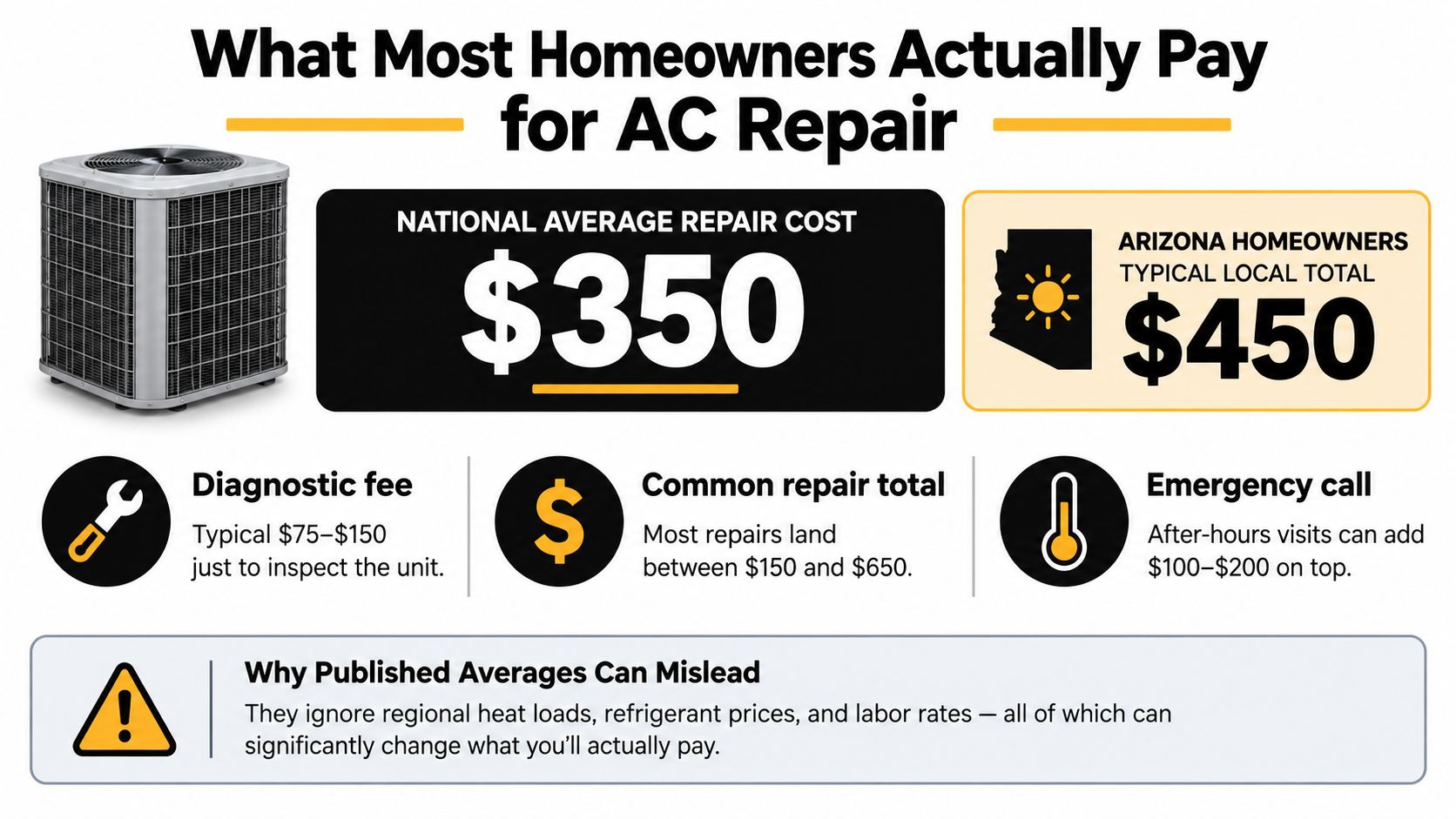
That is where homeowners get overcharged: the average sounds reasonable, so the estimate goes unchallenged. If the diagnosis is a small electrical part, a compressor-sized price needs proof. If the refrigerant circuit is opened, the bill should identify the refrigerant, leak testing, recovery or evacuation work, and the charge itself.
Compare repair with replacement only after the fault is priced clearly. The same compilation puts replacement systems above ordinary repair territory, while the right answer depends on your unit and the written scope. A good advisor can defend each line. A weak one hides behind an average.
Breaking Down the Bill by Repair Type
A fair estimate should make it possible to connect the diagnosed fault to the repair category. Standard diagnostic visits commonly cost $75 to $200, and common repair totals often fall between $172 and $664. Capacitor replacement is commonly estimated at $100 to $250, while compressor replacement can reach approximately $800 to $3,000 (AC repair cost estimates).
Repair Type | Typical Price Range | What Drives the Cost |
|---|---|---|
Diagnostic visit | $75–$200 | Testing time, dispatch terms, and whether the fee is credited toward approved work |
Capacitor replacement | $100–$250 | Component price, testing, access, and labor |
Common repair total | $172–$664 | Failed part, labor, and diagnostic work |
Refrigerant work | Varies widely | Refrigerant type and amount, leak testing, access, and whether the leak is repaired |
Blower motor repair | Get an itemized estimate | Motor type, access, and whether the repair requires replacement |
Compressor replacement | $800–$3,000 | Sealed-system work, parts, refrigerant handling, and labor |
The broad range comes from the difference between swapping a small electrical component and opening a sealed refrigerant circuit. Compressor work is more involved than replacing a capacitor, and refrigerant jobs can add leak detection, recovery, evacuation, and recharge to the bill. Accessibility and system age can also change the labor and parts required.
A blower motor estimate deserves the same scrutiny. Ask whether the quote covers a repair or a complete replacement, which motor is being installed, and whether testing found an electrical or airflow problem that also needs attention. Don't accept a parts label without a plain-language diagnosis.
When a compressor is the proposed repair, ask for the measured evidence and a written comparison with replacement. This guide to a new air-conditioning compressor can help you understand the decision before you approve major work.
Reading an Itemized Estimate Like a Pro
An estimate is only useful if it tells you what the technician found and what your payment covers. Look for separate entries for the diagnostic fee, labor, parts, refrigerant, leak detection, any after-hours charge, and warranty terms. If the quote bundles everything into one number, ask for an itemization before approving it.
The technician's wage isn't the same as the company's customer service rate. The U.S. Bureau of Labor Statistics reported a median wage of $29.33 per hour for heating, air-conditioning, and refrigeration mechanics and installers in May 2025. A contractor's service rate also supports dispatch, vehicles, insurance, licensing, tools, training, office operations, and warranty obligations (BLS occupation and wage information). A rate above an employee's wage isn't, by itself, evidence of overcharging.
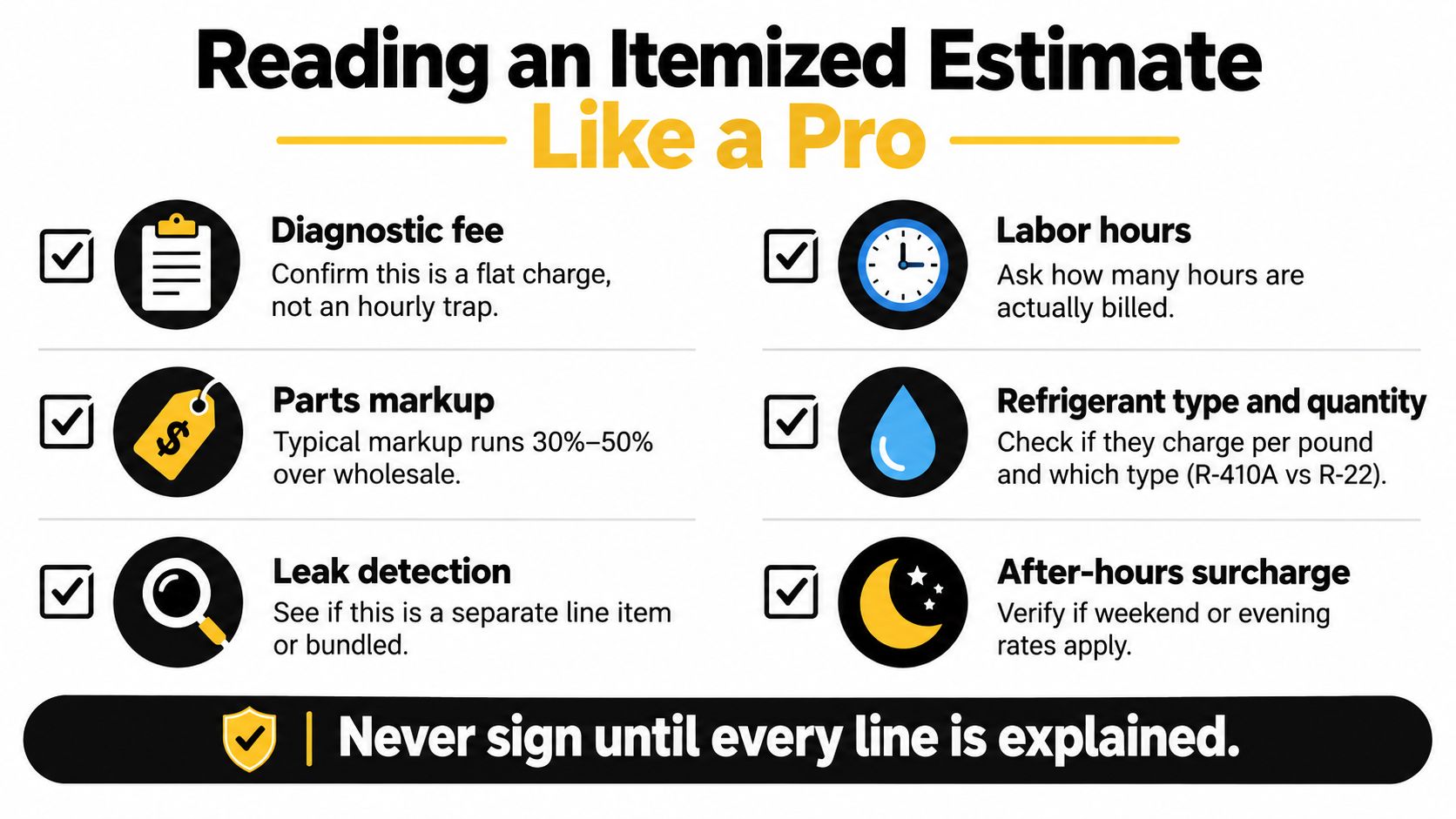
Questions to ask before approving work
Diagnosis: What component failed, and what test or measurement confirmed it?
Labor and parts: How much labor is included, and what part will you install?
Refrigerant: What type and quantity are included, and does the quote include leak detection or repair?
Timing: Is there an after-hours surcharge, and is it already included in the total?
Warranty: What coverage applies to the part and the labor?
If the answer is “the system is old,” ask the technician to show the failure that makes this repair necessary.
A clear estimate doesn't need to be complicated. It should let you compare the proposed work with another written quote and understand whether the price is for a lasting repair or a temporary step. If you're choosing a contractor, use this guide to selecting an HVAC contractor to focus on licensing, communication, and the quality of the written scope.
Why Refrigerant and Recharge Costs Are Deceptively Complicated
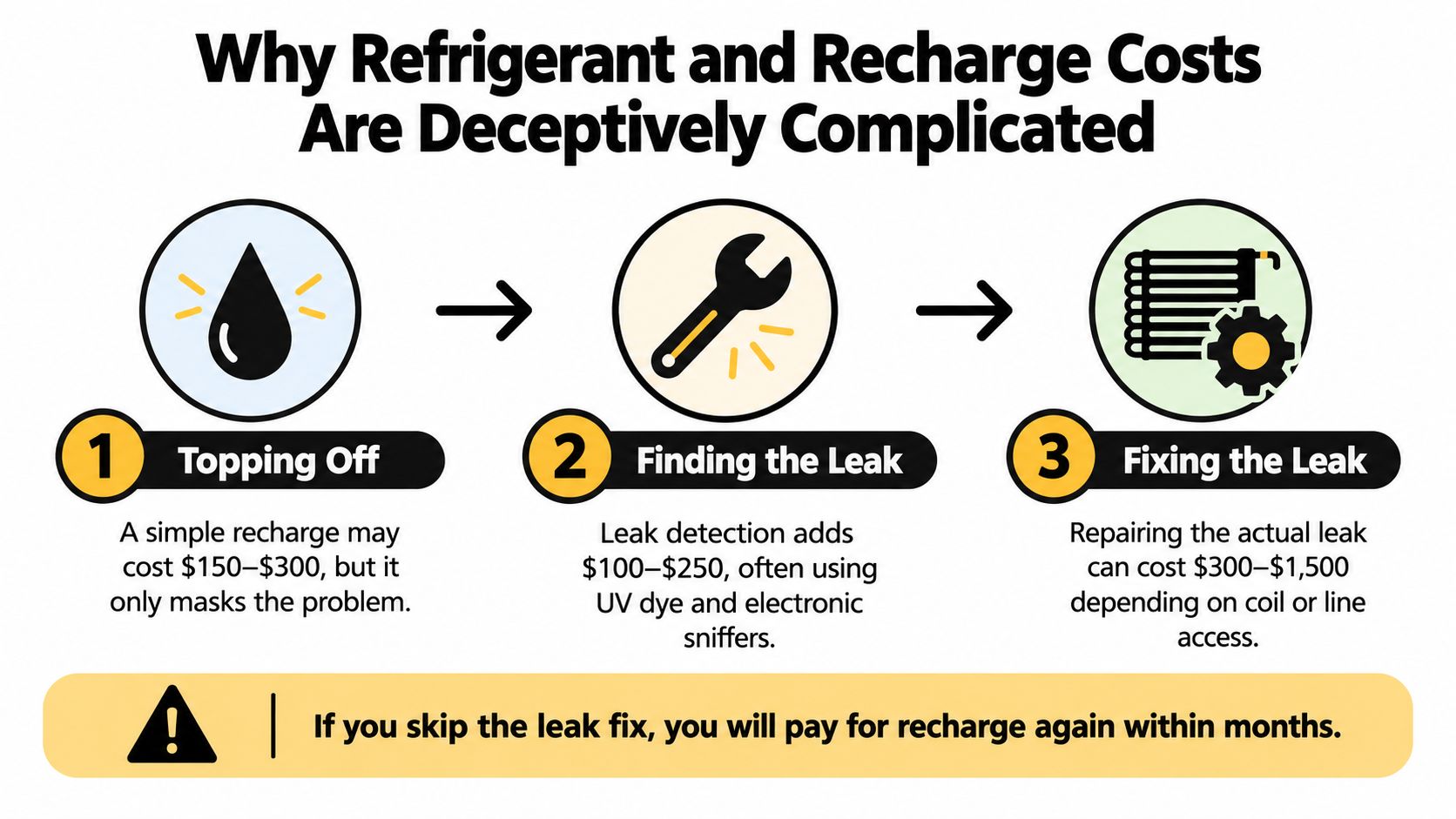
A recharge isn't the same as a leak repair. If a system is losing refrigerant, adding more may restore cooling temporarily, but it won't stop the loss. A sound estimate distinguishes the cost of finding the leak, repairing it, and recharging the system from the price of just adding refrigerant.
The refrigerant type matters, too. Typical recharge pricing is reported around $100 to $600, but leak detection, access to a coil or line, recovery, and repair can increase the bill. Technical guidance summarized from NIST modeling indicates that a system roughly 30% low on refrigerant may use about 17% to 23% more annual energy, while a system overcharged by 30% may use **10% to 16% more (technical guidance on AC refrigerant and maintenance).
An older R-22 system needs special attention. U.S. production and import of virgin R-22 ended in 2020, so remaining supply and the system's condition can influence whether another refrigerant repair is sensible. R-410A has been common in newer equipment, while newer systems manufactured from 2025 generally must use refrigerants with a global-warming potential below 700, such as R-454B or R-32. Don't assume refrigerants or parts are interchangeable. Ask the technician to identify what your equipment requires.
Before authorizing refrigerant work, ask for the refrigerant type, the amount added or recovered, the leak location, the repair method, and post-repair readings. If the technician can't explain whether the quote fixes the leak or only restores charge, pause before agreeing. A guide to AC refrigerant leaks can help you understand why the diagnosis matters.
Repair, Replace, and the Tucson Heat Reality
A four-figure compressor quote on a nine-year-old condenser in mid-July is where this decision gets real. Weigh the repair scope against the system's condition, the reliability you can expect afterward, and what another failure means during Tucson's cooling season. A patch that leaves a known problem unresolved costs more over time and can leave the house without cooling on the week it matters most.
An older ACHR News survey recorded a clear shift in homeowner preferences as repair bills rose: 52% said they would replace at a $1,500 repair, 78% at $3,000, and 88% at $5,000. Treat those figures, as noted earlier, as historical survey responses. Their real value is as a prompt to put any large repair estimate up against a replacement quote, not as a cutoff.
Local heat makes reliability part of the math. The 2025 Southern Arizona Heat Summit, organized by the City of Tucson with the University of Arizona and Pima County, addressed increasing risks from extreme heat, and Pima County reported its 2025 cooling-center network served more than 33,552 people (Southern Arizona Heat Summit report). In a no-cool emergency, days without a working system carry real consequences, so dependable operation belongs on the same page as the invoice.
Make the comparison on paper
Ask for a written repair estimate and a separate replacement proposal when the repair is substantial. Compare what each option includes, the equipment's condition, warranty coverage, and the odds of another failure. Age alone is a weak reason to replace. A major repair deserves a straight answer on why it beats the alternative.
Federal tax incentives can shift replacement math, with eligibility rules attached. The IRS says qualifying home-energy improvements installed from 2023 through 2025 could receive a 30% credit, generally capped at $1,200 annually, while heat pumps had a separate annual limit of up to $2,000 (IRS home-energy tax credit guidance). Confirm current rules, equipment eligibility, and required documentation before counting any credit in your budget.
For a structured side-by-side, work through this AC repair-versus-replacement guide. Pick the option that gives you a defined scope, a credible reliability outlook, and a cost you can plan for.
Practical Ways to Lower and Plan for AC Repair Costs
The best time to control an emergency repair bill is before the system stops cooling. Regular maintenance can catch loose electrical connections, drainage problems, airflow restrictions, and other developing issues before they become urgent. A maintenance plan with biannual check-ups and priority service can also make it easier to arrange care before the busiest heat periods.
When a quote arrives, use a simple order of operations:
Get the diagnosis in writing. Ask what failed and what testing supports the conclusion.
Separate immediate work from optional work. Have the technician identify what restores safe operation and what can be planned later.
Compare major estimates. Get a second opinion on a substantial quote, especially when the recommendation is a compressor repair or replacement.
Ask about affordability. Check whether the company offers financing or special rates for teachers, military personnel, and first responders.
Keep the paperwork. Save estimates, invoices, equipment details, and warranty information, particularly if you're a seasonal resident arranging service remotely.
Before work starts, ask whether the contractor is licensed, bonded, and insured. Confirm the total price, what parts and labor it covers, and what happens if the technician finds another problem after opening the system. If the price changes, ask for an updated written estimate before approving additional work.
Covenant Aire Solutions offers AC repair, maintenance plans with biannual check-ups, priority service, financing options, and special rates for teachers, military personnel, and first responders. For an itemized estimate and service options in Tucson and surrounding areas, contact Covenant Aire Solutions and explain what your system is doing before the technician arrives.
Get a written diagnosis, a clear price, and a repair plan that addresses the actual failure before authorizing work. Visit Covenant Aire Solutions to discuss AC repair, maintenance, or replacement options for your Tucson home.