
Indoor Air Quality in Winter: A Homeowner's Guide
You close the windows against the Tucson night, turn up the furnace, and settle in with the family in the warmest room. By morning, the air may feel stale, your skin may feel dry, and condensation may be gathering on a cold window. Those clues point to a shared indoor-air problem: how a home is sealed, heated, ventilated, and humidified affects the same air.
Indoor air quality in winter isn't fixed by buying a humidifier or upgrading a filter alone. The useful starting point is to measure what's happening, identify where pollutants come from, and check whether the home's ventilation and heating equipment can manage them.
Why Winter Changes the Air Inside Your Home
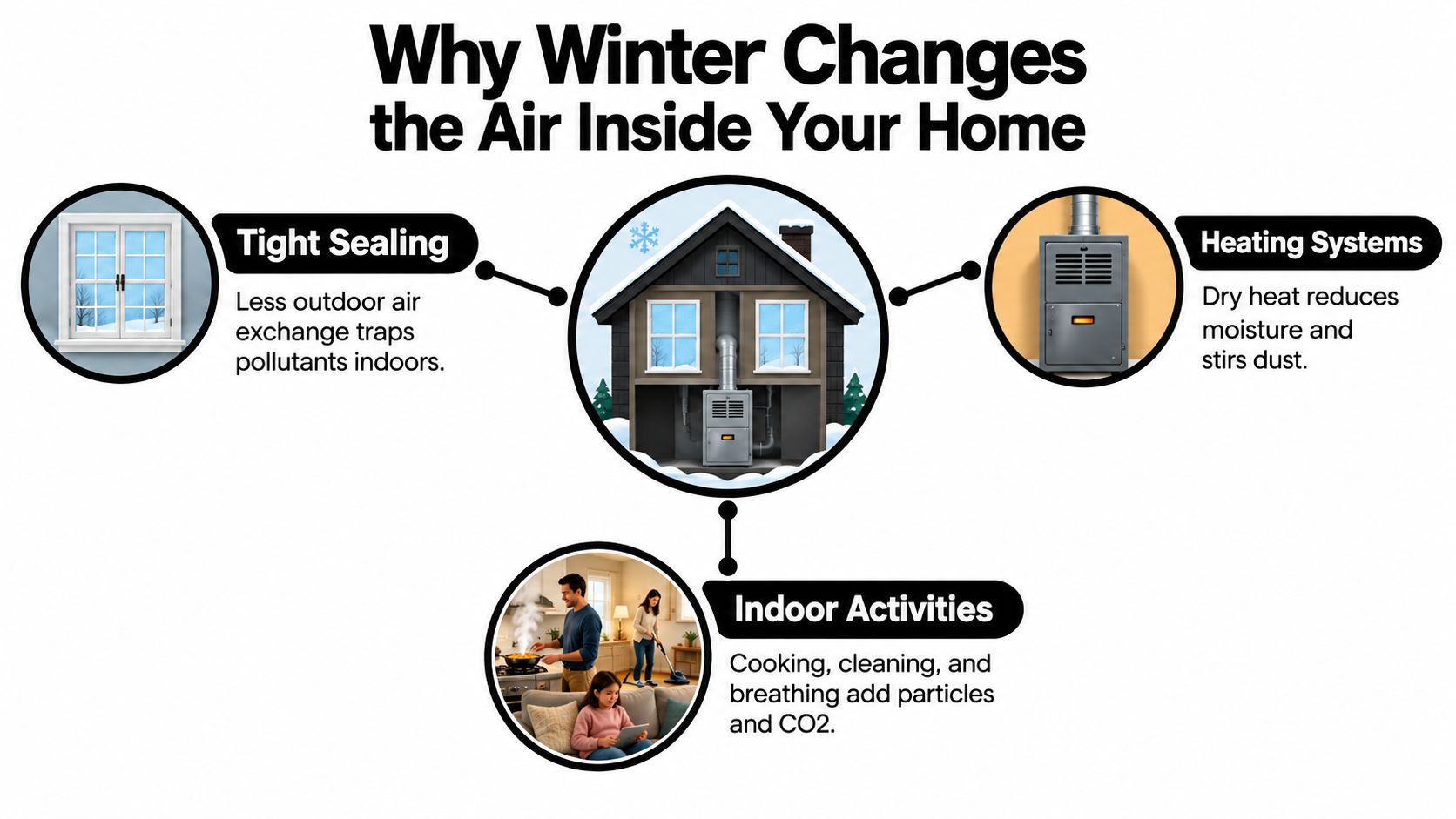
In a sealed-up winter house, the furnace runs while windows stay shut and people spend more time together indoors. Cooking, showers, cleaning, and everyday breathing continue, but less outdoor air may enter to dilute what those activities add. Heating also changes how moisture behaves, while combustion appliances can introduce pollutants if they're poorly maintained or vented.
These forces collide. The U.S. EPA warns that closing windows and increasing heating can let indoor pollutants accumulate when mechanical ventilation isn't maintained, because outdoor-air exchange falls while occupants spend more hours inside (EPA guidance on indoor air and changing outdoor conditions). A tightly sealed home can use less energy for heating, but sealing without a ventilation plan may also trap moisture and pollutants.
The heating system matters, but it isn't the whole story. In homes using wood, charcoal, coal, crop waste, dung, or kerosene for cooking or heating, combustion can add fine particles and other harmful pollutants. The World Health Organization estimates household air pollution from polluting fuels and technologies caused 2.9 million premature deaths in 2021, including more than 309,000 deaths among children younger than five; it also attributes approximately 95 million disability-adjusted life years to exposure that year (WHO household air pollution and health).
Read the house as a connected system
The fixes work together: ventilation removes or dilutes pollutants, filtration captures particles that pass through the system, and humidity control helps limit both dryness and condensation. Improving one without checking the others can create new trouble. A humidifier adds moisture but doesn't remove pollutants; a high-efficiency filter can't compensate for inadequate outdoor-air supply.
For a practical overview of how airflow and indoor conditions interact, see Covenant Aire Solutions' guide to indoor air quality and ventilation. Homeowners comparing flooring and indoor-air considerations may also find Savera's indoor air quality resources useful.
The Physics of Cold Air and Dry Winter Homes
On a cold Tucson morning, the heat comes on and the house feels dry. Outdoor air entering through leaks or ventilation warms indoors, lowering its relative humidity even when its water-vapor content stays unchanged. Heating changes the reading without necessarily removing moisture.
Relative humidity, or RH, compares the water vapor present with saturation at the air's current temperature. ASHRAE identifies 40% to 60% RH as a preferred health-and-comfort range, but very cold conditions may require RH below 35% to prevent condensation on windows and walls (ASHRAE guidance on humidity and condensation). EPA recommends keeping indoor RH below 60%, ideally around 30% to 50% (EPA advice on weatherization and indoor air quality).
Those ranges need a surface-temperature check.
Sealing leaks reduces uncontrolled outdoor-air exchange, which can reduce winter drying while also limiting pollutant dilution. Air exchange rate, or AER, describes that exchange; a hygrometer cannot measure it. Likewise, an RH reading does not tell you the concentration of fine particles, measured as PM2.5. After sealing a home, check humidity and ventilation together rather than assuming the old humidifier setting still fits.
Measure before adjusting
Place a hygrometer in an occupied room, away from sunlight, supply registers, kitchens, and bathrooms. Compare rooms, including a closed bedroom and spaces near cold exterior walls. Record readings with the heating running under normal conditions. If RH is low, check symptoms and cold surfaces before adding moisture.
Static shocks, dry skin, nosebleeds, and cracking wood can suggest dryness, but measurements should guide adjustments. Persistent window condensation, damp corners, or musty odors warrant checking moisture sources and air movement. A comfortable reading in the middle of a room can coexist with condensation on cold glazing.
Practical rule: Use room-level readings and visible condensation together. If windows start sweating, lower the humidity setting and check ventilation before adding more moisture.
Minneapolis homes often need lower winter RH because windows and walls get colder. Tucson follows the same physics: cold glazing, poorly insulated ducts, and thermal bridges can create condensation sites despite warm room air. Use this guide to ideal indoor humidity ranges in Arizona to choose a starting setting, then adjust it against actual room readings and surface conditions.
Common Winter IAQ Problems and Where They Come From
Dinner is cooking, the heat is running, and the windows are shut in a Tucson home. Particles from the stove can reach occupied rooms while moisture collects on a cold surface nearby. Sealing, heating, and humidity interact: the same house can retain pollutants and develop damp spots without feeling humid overall.
Start by identifying what enters the air and how it travels.
WHO's health-based guidelines for PM2.5 are 5 micrograms per cubic meter as an annual average and 15 micrograms per cubic meter over 24 hours; for PM10, the corresponding values are 15 and 45 micrograms per cubic meter. Exposure below these levels is not guaranteed risk-free (WHO information on air pollutants and health impacts). Compare measurements over matching periods; a brief cooking spike is not a daily average.
A 2025 study of winter wood-burning households recorded median indoor PM2.5 of 38.4 micrograms per cubic meter during open-fireplace use (study of indoor pollution during winter wood burning). That finding makes fireplace use worth investigating when particle readings rise. Cooking, tobacco smoke, and outdoor particles are other possible sources.
Pollutant | Typical winter source | Why winter makes it worse |
|---|---|---|
PM2.5 and PM10 | Cooking, wood fires, other combustion, outdoor particles | Lower outdoor-air exchange allows particles to persist |
Formaldehyde, acetaldehyde, and other VOCs | Building materials, furnishings, cleaners | Heating can increase some emissions while lower air exchange limits dilution |
Carbon monoxide | Fuel-burning appliances and fireplaces | Faulty equipment or venting creates danger in closed homes |
Moisture and biological growth | Showers, cooking, leaks, condensation | Cold surfaces and weak air movement leave localized damp areas |
Air sealing saves heating energy, but ventilation needs attention alongside it, as described in EPA weatherization and indoor-air guidance. Chemical odors call for investigating materials and products; this explanation of volatile organic compounds covers common emissions and ways to reduce them.
Use source, pathway, and recipient to organize a weekend walkthrough. Note whether PM2.5 rises during cooking or fireplace use. Check how air moves toward bedrooms, especially with doors closed. Consider who occupies those rooms and for how long.
RH describes moisture conditions; air exchange rate, or AER, describes outdoor-air replacement. Neither substitutes for a particle measurement. Reducing a source avoids the heating penalty of extra ventilation, while ventilation can dilute pollutants that particle filters do not capture. Suspected combustion or venting faults require professional inspection, not a filter upgrade.
Humidity Control That Actually Works
A Tucson bedroom can feel dry while its window collects moisture. Before adding a humidifier, check RH in the living area and bedrooms, then inspect cold glazing, exterior-wall corners, and supply ducts. A central thermostat reading can miss those local conditions. Choose the device only after you know where added moisture is needed.
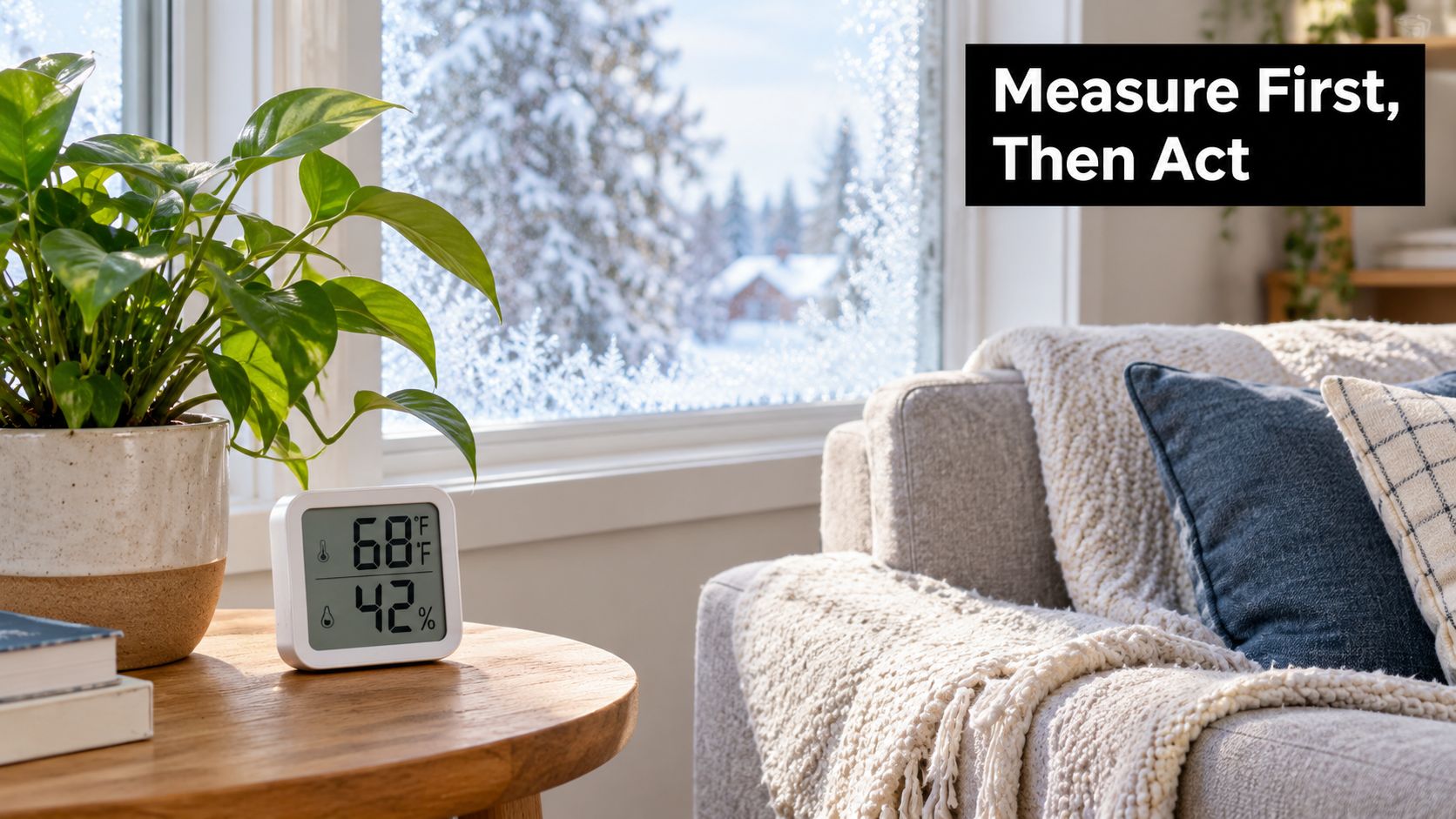
Use the humidity guidance noted earlier as your starting point, with EPA humidity and ventilation recommendations as a reference. Cold surfaces still need checking even when room RH looks acceptable. Heating changes relative humidity, while sealing and outdoor-air replacement affect how much added moisture stays indoors. That interaction determines whether a humidifier setting works for your house.
Match the device to the house
A whole-house humidifier distributes moisture through the HVAC system and needs a suitable control, accessible maintenance points, and regular inspection. It makes sense when several rooms need moisture, but check bedroom readings rather than assuming distribution is even.
A portable unit gives you room-by-room control. The trade-off is hands-on cleaning and refilling wherever you use it. Before buying, check whether you can reach and clean the water-contact surfaces and follow the manufacturer's maintenance instructions.
Choose equipment you can keep clean.
Watch the cold surfaces: Moisture on glazing, a damp patch near a supply duct, or a musty exterior-wall corner calls for lowering the humidifier setting and checking airflow and insulation before adding more moisture.
Recheck RH and those surfaces after adjusting the setting. Persistent dampness needs investigation, not fragrance or a higher humidity setting.
You can compare ultrasonic humidifier options with room size, cleaning access, and humidity control in mind. After installation, use the hygrometer to confirm the result in the occupied room rather than relying on the unit's setting alone.
Filtration and Active Purification Compared
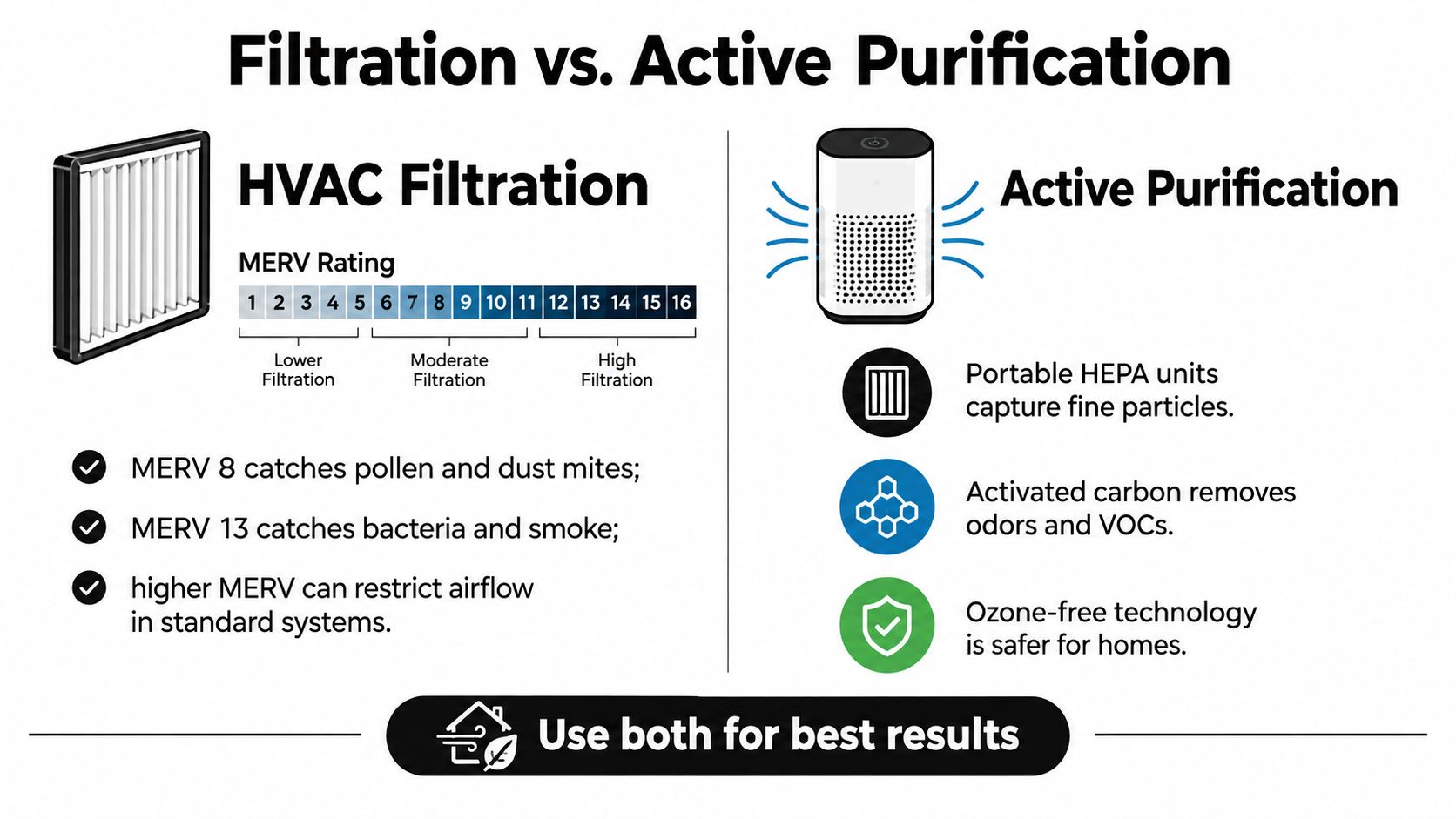
An HVAC filter captures particles as air passes through it. MERV, or Minimum Efficiency Reporting Value, describes a filter's particle-capture efficiency, but a higher rating isn't automatically a better choice for every furnace. A restrictive filter can reduce airflow if the equipment can't handle its pressure drop, so verify airflow and static pressure rather than selecting a filter by number alone.
Active purification works differently from passive filtration. A filter must catch a particle as it moves through the filter media; an active device is intended to treat air in a space or through an HVAC system, depending on its design. Neither approach replaces source control or adequate ventilation. A portable HEPA unit can capture fine particles in a room, while activated carbon can help with some odors and gases, depending on the product and use conditions.
Option | Where it helps | What to check |
|---|---|---|
HVAC filter | Captures particles moving through the central system | Equipment compatibility, filter fit, airflow, and pressure drop |
Portable HEPA cleaner | Provides particle filtration in a selected room | Room suitability, placement, and filter maintenance |
Activated-carbon media | Can reduce some odors and gases | Media type, capacity, and replacement needs |
Active purification | Offers an additional air-treatment layer, depending on technology | Device instructions, installation, and how it fits with ventilation and filtration |
Covenant Aire Solutions offers HVAC-integrated air purification using ActivePure technology. It's one option to discuss alongside conventional filters and portable units, rather than a replacement for sound ventilation and source control. For a fuller description of that approach, see Covenant Aire Solutions' overview of ActivePure air purification.
The practical setup is layered: control pollutant sources, provide measured outdoor air, use a filter the HVAC system can support, and consider room or whole-home purification where it fits. Watch the equipment, not just the filter label. If airflow falls after a filter change, the system may need a different filter or a professional assessment.
A Practical Winter Maintenance Routine
If rooms feel stuffy after you seal drafts and start running the heat, check the house as a connected system. Reduced outdoor-air exchange, heating airflow, and moisture levels affect one another. A useful winter routine tracks those changes alongside equipment condition.
Monthly and seasonal checks
Check the HVAC filter: Inspect its condition and fit, especially during heavier heating use. Dust buildup can restrict airflow; gaps let particles bypass the filter. Follow this guide to air-filter replacement frequency, adjusting replacement timing to condition and runtime.
Read room conditions: Record relative humidity (RH) in rooms that feel uncomfortable and note whether the heat is running. Check for condensation and musty spots. Differences between rooms warrant an airflow or cold-surface check before changing the whole-house humidity setting. If you monitor PM2.5, compare readings around cooking and cleaning to identify particle sources.
Test alarms: Test carbon-monoxide and smoke alarms according to their instructions. Check accessible combustion vents for visible damage without dismantling them. DOE guidance describes hard-wired CO detectors at roughly one per 1,000 square feet in homes with combustion appliances or an attached garage (Building America residential best practices).
Clean carefully: Use a sealed-system vacuum where possible. Equipment that exhausts unfiltered air into the room can redistribute the dust you are trying to remove.
Annual and professional checks
Before heating season, arrange inspection of the furnace or heat pump, ductwork, ventilation paths, and combustion venting.
Ask a professional to size and check whole-house ventilation against ASHRAE 62.2, as described in the same DOE document, accounting for floor area and occupancy. After air-sealing work, have ventilation reassessed: reducing drafts also changes outdoor-air exchange.
If a CO alarm activates, leave the home and contact emergency services. Arrange professional service for venting trouble, persistent stuffiness, or recurring condensation and musty odors. Covenant Aire Solutions offers preventive maintenance plans with biannual check-ups for homeowners who prefer scheduled service.
Winter IAQ Myths That Keep Homes Unhealthy
Opening a window once a day isn't a dependable ventilation plan. It can briefly exchange indoor and outdoor air, but it doesn't guarantee that ventilation continues as people cook, shower, and occupy the house. Carbon dioxide can help reveal when outdoor-air supply isn't keeping up: indoor levels above 1,000 parts per million are identified as a sign of poor indoor air quality and may be associated with fatigue, headaches, or reduced concentration (European Agency for Safety and Health at Work guidance on indoor air quality). CO2 is not a complete air-quality measure, and it's different from carbon monoxide, which requires its own alarms and source control.
A bigger humidifier isn't automatically better. If moisture collects on windows or cold surfaces, raising RH can make a building problem worse. Air freshener doesn't clean the air either, and sealing every draft without maintaining ventilation can leave pollutants and moisture indoors, as EPA warns in its guidance on winter air exchange.
Treat the house as a mechanical system. Measure RH, notice condensation, maintain ventilation, and choose filtration the equipment can support. Those checks are more useful than guessing from comfort alone.
If you want help checking ventilation, ductwork, heating equipment, or indoor-air options, Covenant Aire Solutions provides HVAC maintenance and indoor air quality services for Tucson-area homes. Schedule an assessment to identify what's affecting your air and which practical improvements fit your home.