
ActivePure Air Purifier: How NASA-Certified Tech Cleans
You've wiped the dust from the coffee table, changed the HVAC filter, and still see particles drifting through a sunbeam in your Tucson living room. Maybe the house smells stale after the windows stay closed, or someone in the family reacts whenever pollen, dust, or wildfire smoke moves into the area. An ActivePure air purifier may appear to offer a different answer, but understanding what it delivers requires separating controlled laboratory results from everyday room performance.
ActivePure is marketed as an active air and surface purification technology, not as another filter. Its history includes NASA-linked development, outside testing, and commercial use, but those points don't automatically tell you how well a particular unit will treat your home. Room layout, airflow, occupancy, filtration, ventilation, and maintenance all affect the outcome.
Why Indoor Air Quality Matters More Than You Think
A Tucson homeowner can run the air conditioner regularly and still have indoor air concerns. The HVAC system controls temperature and moves air, but its standard filter mainly captures particles that pass through the return-air path. Dust can settle on furniture before the system collects it, while odors and some gaseous pollutants require a different treatment approach.
Arizona homes often stay closed for long periods because outdoor heat makes open-window ventilation uncomfortable. That reduces natural air exchange and allows indoor contaminants from cooking, cleaning products, pets, furnishings, and tracked-in dust to accumulate. A tightly sealed home can feel comfortable while the air remains stale.

What your HVAC filter can and can't do
A conventional filter is a passive capture device. Air must reach the filter, and the filter must be rated and installed appropriately for the particle in question. It won't remove every contaminant from the room, and it doesn't sanitize surfaces where particles have already settled.
That distinction matters because indoor air quality involves more than visible dust. Homeowners may care about:
Particles: Dust, pollen, smoke, and other airborne material.
Biological contaminants: Airborne microorganisms and material transferred to surfaces.
Odors and gases: Compounds that a basic particle filter isn't designed to capture.
Ventilation: The introduction of outdoor air and removal of stale indoor air.
An active system attempts to treat contaminants beyond the filter location. That can complement filtration, but it doesn't make the filter unnecessary. For a broader explanation of indoor air quality practices, homeowners can also review this Long Island indoor air quality advice from Savera Wood Floor Refinishing, especially when comparing source control, ventilation, and cleaning.
Why the room matters
A purifier's label may sound impressive, yet a hallway, bedroom, open living area, and closed office behave differently. Air doesn't distribute evenly through every doorway, and an HVAC blower may not operate continuously. Before selecting equipment, review the relationship between the home's layout and its indoor air quality standards.
Practical rule: Treat filtration, ventilation, source control, and active purification as separate tools. A device can help with one pathway without solving every indoor air problem.
How ActivePure Technology Works
In a Tucson home, the same purifier can perform differently in a closed bedroom, an open living area, or a hallway connected to several rooms. Airflow, blower runtime, furnishings, and contaminant sources determine how much treated air reaches the breathing zone. The technology's laboratory results describe a controlled test, while room performance depends on how the equipment is installed and operated.
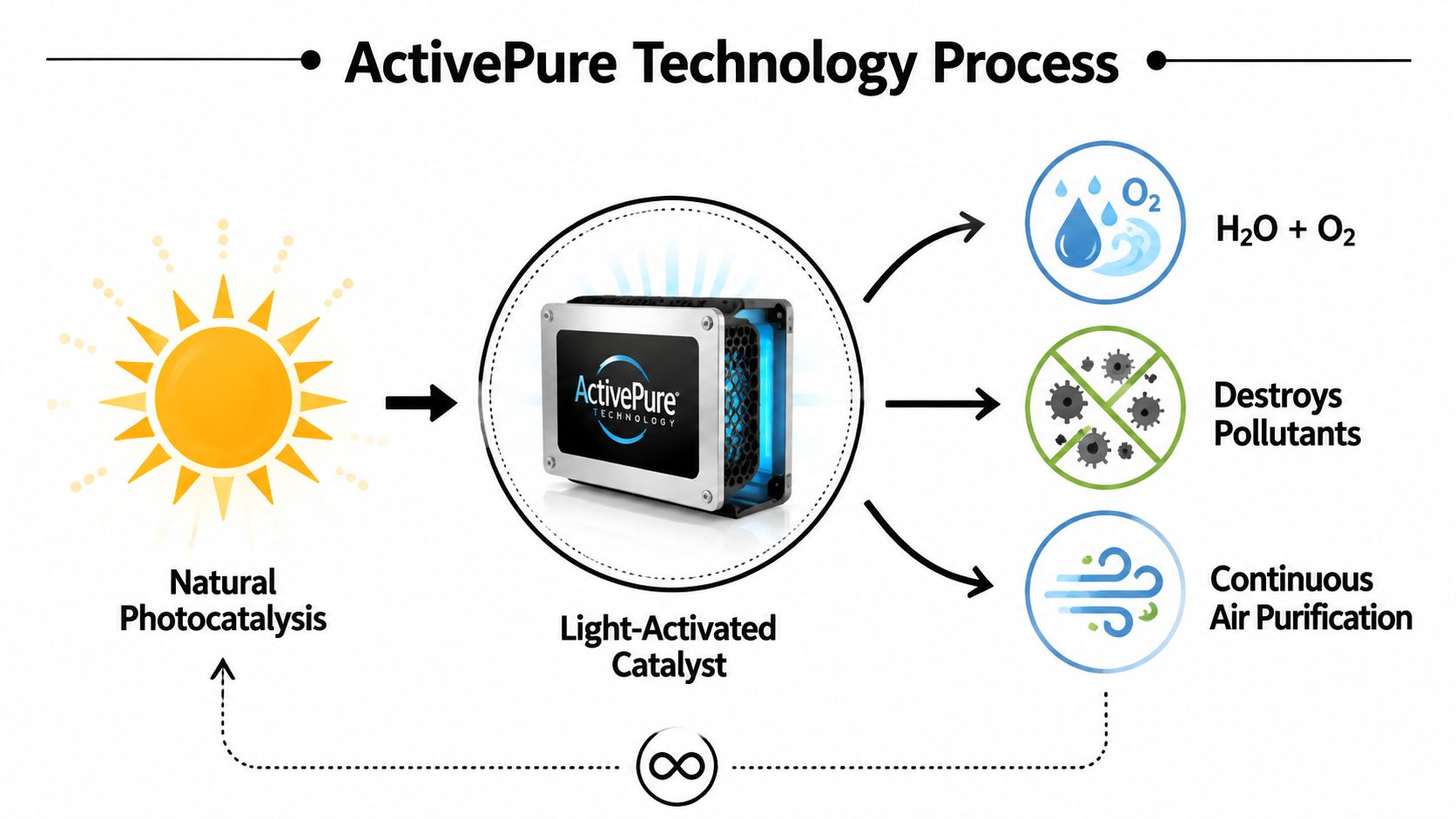
ActivePure systems use a light-activated catalytic process. A specialized light interacts with a catalytic surface, producing reactive oxidizing molecules. Those molecules travel with the air and interact with contaminants, rather than waiting for every particle to pass through a dense filter.
A simple operating sequence
The process follows four connected actions:
Air movement carries contaminants through the treated space. The device does not need to capture every contaminant at its housing before treatment can occur.
Light activates the catalytic surface. This creates reactive species intended to interact with pollutants.
Reactive molecules contact airborne contaminants and surfaces. That contact supports ActivePure's air and surface purification approach.
The HVAC system, portable fan, or natural room movement redistributes treated air. Coverage still depends on room geometry, airflow, and operating conditions.
A HEPA-style purifier uses fan-driven airflow through filter media to remove particles. Active purification uses a different mechanism. A properly sized HEPA system can provide useful particle removal, while ActivePure may serve as a complementary treatment rather than a replacement for filtration.
What the NASA connection means
ActivePure traces its commercial history to 2009, when Aerus invested in an early generation of the system. The Space Foundation later recognized the technology as Certified Space Technology, and the company says it is the only air-cleaning technology inducted into the Space Technology Hall of Fame, an honor received by about 75 technologies over 30 years. The company documents that history in its ActivePure technology history.
That recognition establishes a technology lineage. It does not guarantee identical performance in every home. Earlier validation described approximately 90% inactivation of airborne microorganisms in less than 60 minutes, while later unaffiliated-lab testing reported reductions exceeding 99.99% for some bacterial and fungal spores in 60 minutes. Target organisms, airflow, exposure time, and test conditions all affect the result, so these figures should not be treated as universal room guarantees.
For Tucson homeowners, the practical question is how the active treatment fits the existing HVAC design. A professional air purification system evaluation should review the return-air path, blower operation, filter, room arrangement, and the contaminants the system is expected to address.
Proven Benefits for Health and Comfort
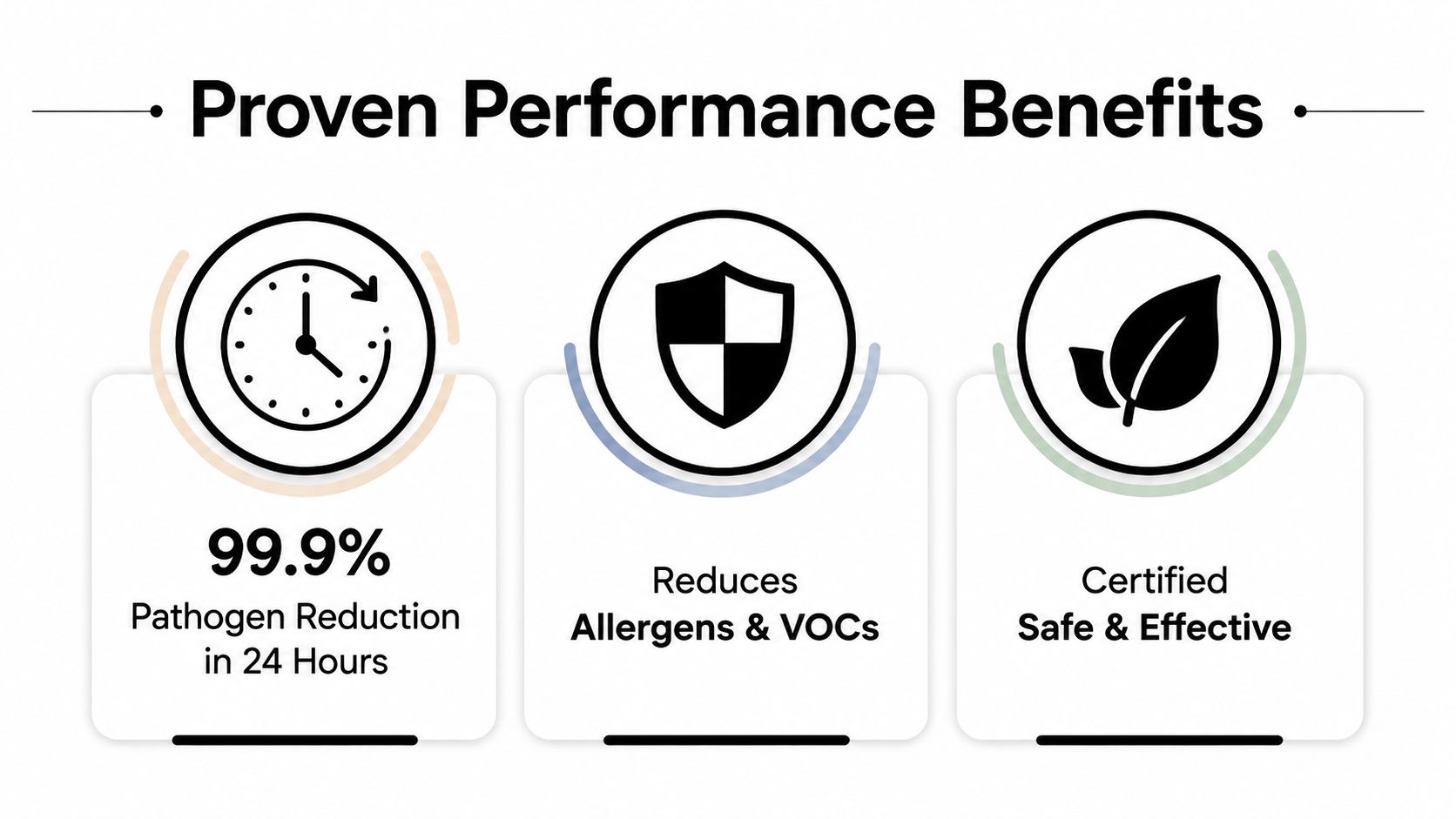
For a Tucson household dealing with odors, allergens, or concern about airborne pathogens, ActivePure's reported results provide useful context, but not a room-by-room guarantee. Testing publicized by the University of Texas Medical Branch found that ActivePure Technology inactivated more than 99.9% of highly concentrated airborne SARS-CoV-2 within a 60-second testing period in an enclosed setting. The study used triplicate tests and low air movement of 29 cubic feet per minute, with virus levels falling below detectable limits by 1.6 logs. The reported reduction ranged from 99.57% to at least 99.83%, as described in the University of Texas Medical Branch release.
What those results suggest
The test supports rapid inactivation under its stated conditions. Actual room performance depends on air mixing, open doors, furnishings, occupants, dust loads, and continuing contaminant sources. A Tucson homeowner should therefore ask how quickly the treated air circulates through the occupied space, not rely on the pathogen percentage alone.
ActivePure also cites peer-reviewed work from two ICU settings, where healthcare-associated infections fell by greater than 70% after deployment. One site changed from 24 HAIs to 7, and another from 10 to 3, with lower MRSA, fungal, and aerobic-bacteria air and surface bioburdens reported in the company's air purification FAQ.
If someone in the home has compromised immunity, continue following the person's medical guidance, isolate illness when advised, improve ventilation, control dust, and maintain the HVAC filter. An active purifier can support those measures, but it cannot replace them or turn a residence into an ICU.
Air, surfaces, and comfort
Separate testing of ActivePure's Surface and Air Purification platform reported over 99% inactivation of aerosolized SARS-CoV-2 in one minute in an unaffiliated laboratory. A controlled surface test reported a 99.98% reduction in live SARS-CoV-2 within seven hours, according to the University of Cincinnati test document.
This air-and-surface approach may appeal to households concerned about odors, microbial burden, and re-aerosolization from settled contamination. It does not remove dust from shelves. Cleaning, source control, outdoor-air management, and a properly selected HVAC filter remain necessary.
Seasonal dust, pollen, and wildfire smoke also affect Tucson homes. Ask the installer for room-sizing logic, airflow details, filter compatibility, and maintenance requirements. For respiratory comfort, this air purifier guide for asthma concerns places ActivePure within a broader indoor-air strategy.
Choosing Between Standalone Units and HVAC Integration
The installation method determines how air reaches the technology. A standalone unit has its own fan and sits in the room you want to treat. An HVAC-integrated model connects to ductwork, so treatment occurs as the blower moves air through the system.
Neither format automatically wins. The right choice depends on whether you need one-room control, whole-home distribution, access to ductwork, and a system that fits the building's actual airflow pattern.
Standalone units
Portable equipment suits a bedroom, apartment, home office, or single room where modifying the HVAC system isn't practical. You can place it near the primary concern, move it between rooms, and avoid a ductwork installation.
The limitation is distribution. A portable unit may treat its immediate environment more consistently than distant rooms, especially when doors remain closed. Product documents describe several units as recommended for up to 2,000 square feet in an open-plan space, while commercial recommendations can fall to 1,000 square feet depending on occupant density and other factors. The ActivePure product FAQ also notes assumptions involving contiguous spaces and, in some cases, 8-foot ceilings.
HVAC-integrated systems
An in-duct installation keeps the equipment out of living areas and uses existing duct distribution. It can make sense for a homeowner seeking broader coverage, a commercial property manager managing several connected rooms, or a building where portable units would create clutter.
The HVAC blower schedule still matters. If the fan rarely runs, the unit has fewer opportunities to distribute treated air. A technician should also verify installation access, electrical requirements, filter condition, and whether the duct layout connects the spaces you want treated.
Feature | Standalone Units | HVAC Integration |
|---|---|---|
Best fit | Single rooms, apartments, targeted treatment | Whole-home or commercial distribution |
Installation | Plug-in placement with minimal modification | Professional installation in or near ductwork |
Visibility | Equipment remains in the occupied space | Equipment is mostly out of sight |
Air distribution | Depends on the unit fan and room arrangement | Depends on duct design and blower operation |
Coverage planning | Open-plan assumptions may apply | Occupancy, duct layout, and airflow require review |
Maintenance access | Usually direct and visible | May require access to the air handler or duct section |
A homeowner weighing whole-home options can review this guide to choosing whole-house air purification systems. The key is to compare the claimed coverage with the actual connected space, not just the home's total square footage.
Maintenance Requirements and System Lifespan
Active purification equipment isn't a fit-and-forget appliance. Its catalytic cell or related lamp assembly performs the core treatment, and performance can decline when the component reaches the end of its service interval. Dust buildup, restricted airflow, long operating hours, and neglected HVAC maintenance can also reduce practical effectiveness.
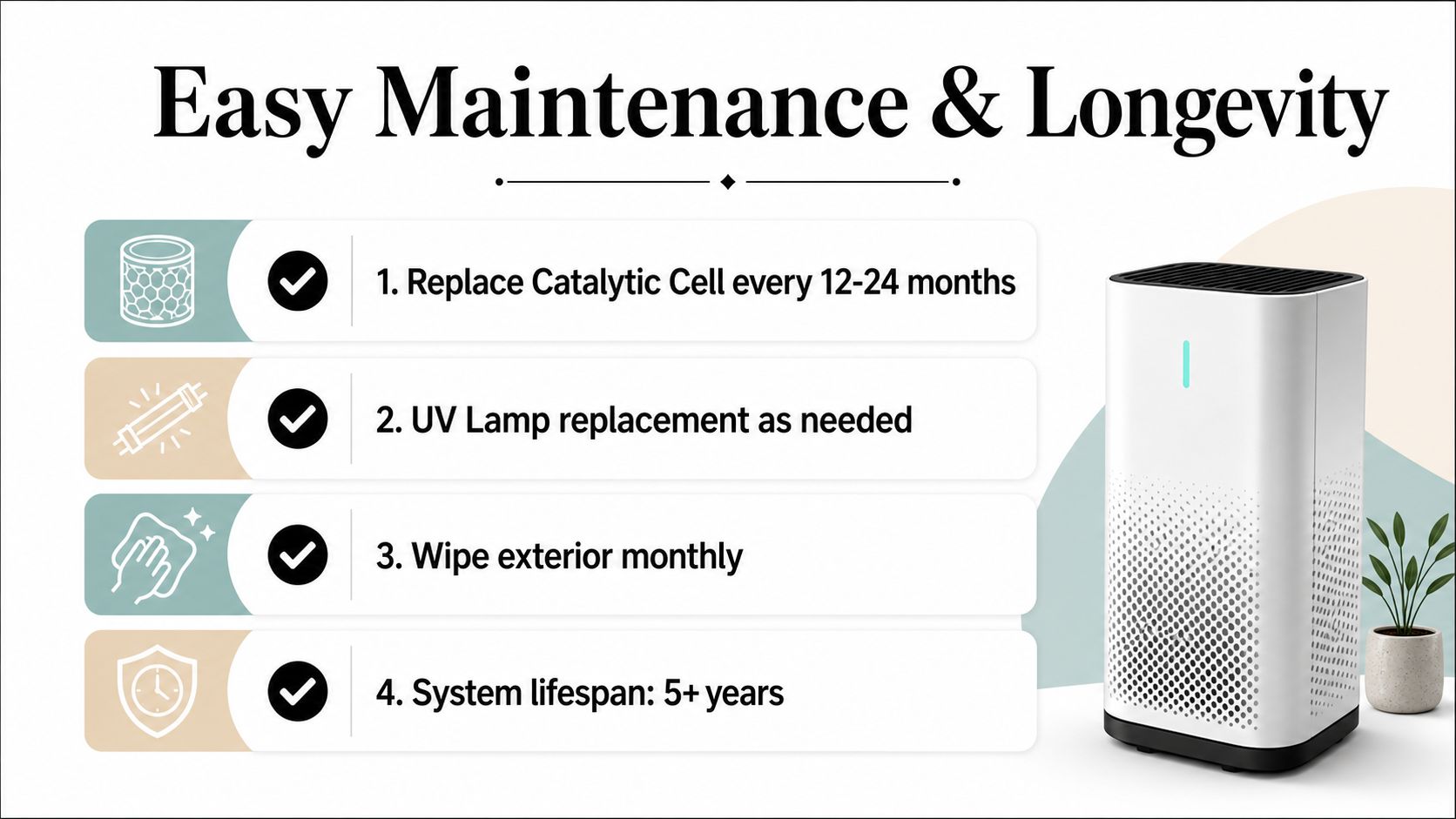
Manufacturer guidance and product materials commonly direct owners to replace catalytic cells or UV lamps periodically. The specified replacement window is typically 12 to 24 months, depending on usage and environmental conditions, as reflected in the provided maintenance guidance. Overall system life is commonly described as 5 to 10 years with proper maintenance, although the actual service life depends on the model, installation, operating environment, and component availability.
What owners can do
Start with simple visual checks. Keep the housing clean, confirm that vents aren't blocked, and watch for unusual noise or a warning indicator. A portable unit may allow direct access to its service components, while an in-duct unit may require a technician to reach the air handler safely.
Use the HVAC filter recommended for the system and replace it on the schedule appropriate for the home's dust load. If you're comparing fine-particle filtration, learn what it means to choose a 0.2 micron filter, but don't install a restrictive filter without confirming that the blower and duct system can handle it.
What requires professional attention
A technician should inspect electrical connections, confirm airflow, examine the cell or lamp, and verify that the installation remains secure. Professional service is particularly useful when the device is mounted inside ductwork or near the air handler, where improper access can create electrical or HVAC safety problems.
Budget for replacement parts and electricity as recurring ownership costs. Exact energy use and part pricing vary by model, so request those details before purchase. A preventive HVAC visit can combine air-conditioning inspection with purifier service, which reduces the chance that a failed cell or dirty housing will go unnoticed. This air purification system cost guide can help homeowners organize installation and ongoing-cost questions.
Addressing Safety Concerns and Common Questions
The most useful safety answer is neither an unconditional endorsement nor a blanket warning. ActivePure materials cite a peer-reviewed PLOS ONE study reporting no statistically significant differences between exposed test groups and control groups. That evidence is relevant, but sensitive occupants may still want model-specific documentation, correct installation, and professional evaluation before running any air-treatment device continuously.
Is continuous operation appropriate?
Company materials promote continuous operation, yet the need for constant use depends on the building and the concern. A home with a persistent odor source, irregular occupancy, or an HVAC fan that rarely runs may need a different operating plan than a continuously occupied office.
People with asthma, chemical sensitivities, respiratory conditions, infants, pets, or other concerns should ask for the exact model's emissions information and operating instructions. If anyone experiences irritation, headaches, coughing, or a new odor after installation, turn the unit off and investigate rather than assuming the reaction is unrelated.
What about ozone?
Buyers often confuse active purification, ionization, and ozone-generating products. Don't accept a broad category claim as an answer for a specific device. Ask the installer for the model's ozone documentation, applicable safety certifications, and any required operating limits.
The same caution applies to pathogen claims. A sealed chamber result isn't a room-wide guarantee. Real homes have leakage, uneven mixing, surface barriers, doors, furniture, variable blower cycles, and ongoing contaminant generation.
The missing comparison metric
Many ActivePure products don't appear to publish AHAM-style CADR data, according to independent review coverage from Purifier Beast's ActivePure analysis. That makes direct comparison with conventional room purifiers difficult, especially for dust, smoke, and particle removal.
CADR is useful for comparing delivered particle-cleaning capacity, while ActivePure's published evidence often emphasizes time-dependent pathogen inactivation in controlled settings. Those are different measurements. If your priority is visible dust or wildfire smoke, ask whether the proposed system includes adequate particle filtration and what airflow data supports the recommendation.
For many homes, filtration plus ventilation and source control may be simpler. ActivePure may be more relevant when the buyer specifically wants air and surface treatment, accepts the measurement limitations, and has a suitable installation plan. Review warranty coverage, return terms, replacement parts, and expected startup behavior in writing before committing.
Professional Installation and Support in Tucson
Tucson buildings place unusual demands on HVAC equipment. Dust enters through doors and leaks, air conditioners run heavily during hot weather, and homeowners may keep windows closed for comfort. A useful air-purification consultation should begin with the building, not with a product label.
Covenant Aire Solutions offers consultation, installation, and service for residential and commercial HVAC and indoor air quality systems in Tucson and surrounding areas. Its technicians can evaluate the space, occupancy, duct layout, existing filtration, blower operation, and the homeowner's actual concern before discussing an ActivePure configuration.
What a practical evaluation should include
A sound consultation should answer specific questions:
Which contaminants matter most? Dust, smoke, allergens, odors, and biological contaminants may require different combinations of controls.
How does air move? The technician should review return-air placement, supply distribution, room separation, and HVAC runtime.
What installation fits the building? A standalone unit may suit a targeted room, while duct integration may suit connected spaces.
What will ownership involve? Ask about cell or lamp replacement, cleaning, service access, warranty terms, and operating costs.
Professional installation matters because an in-duct device must work with the air handler and duct system. Incorrect placement, poor electrical connections, blocked access, or unrealistic coverage assumptions can undermine an otherwise suitable technology.
Covenant's maintenance plans include biannual check-ups, priority service, and exclusive discounts. The company also lists flexible financing and special rates for teachers, military personnel, and first responders. Its service model includes 24/7 emergency response, transparent pricing, and support for both residential and commercial properties. The company has operated since 2019, when Danny Polangco founded the family-owned business.
The best buying decision is the one that matches the problem. If you want a purifier for smoke, ask about particle filtration and room delivery. If you want continuous air and surface treatment, ask about test conditions, distribution, sizing, and maintenance. A technician who answers those questions clearly is more useful than a sales pitch built around one impressive laboratory percentage.
Covenant Aire Solutions can assess your Tucson home or commercial space, compare standalone and HVAC-integrated ActivePure options, and explain the filtration, airflow, maintenance, and safety considerations before installation. Visit Covenant Aire Solutions to request a consultation and discuss an indoor air strategy matched to your building.