
AC Capacitor Failure Symptoms: What to Look For
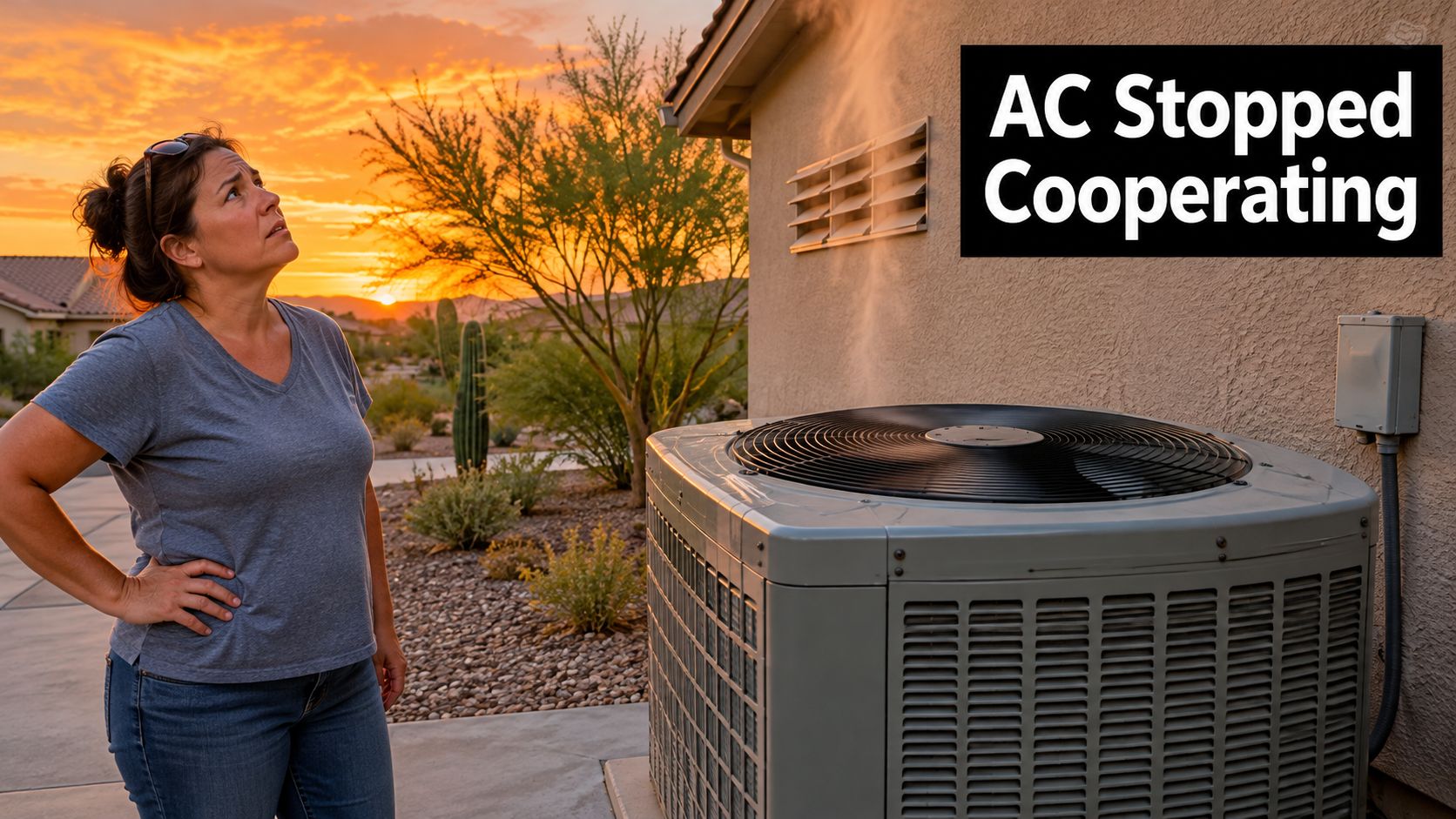
You step outside on a hot Tucson evening because the house is getting warmer, and the outdoor AC unit is making a low hum. The condenser fan barely turns, or it sits still while the indoor blower continues pushing room-temperature air through the vents. You may also notice a burnt electrical odor, a clicking sound, or an abrupt stop after the system tried to start.
Those are recognizable AC capacitor failure symptoms, but they aren't a diagnosis. A weak run capacitor can cause a motor to struggle, overheat, and shut down, yet failed motors, loose wiring, airflow restrictions, voltage problems, contactor faults, and compressor trouble can produce much of the same pattern. The safest response is to treat the signs as screening clues, stop unnecessary restart attempts, and have the electrical components tested by a qualified technician.
The Moment Your AC Stops Cooperating
At first, the sequence can seem confusing. The thermostat calls for cooling, the outdoor unit clicks, and then a low hum begins. The fan may twitch, move slowly, or remain motionless. Inside, air still comes from the registers, but it isn't becoming cooler, and the temperature rises faster than expected.
That sequence often points toward a motor that isn't receiving enough starting support. As a run capacitor weakens, the compressor or condenser fan motor can lose torque. The motor may hum without starting, start slowly after repeated attempts, run hot, or stop when its thermal protection responds to excessive heat and current. HVAC Laboratory describes this pattern of humming, delayed startup, rapid cycling, and a bulging capacitor case.
What you may notice first
Sound: A steady hum can mean the motor is energized but can't get moving. Clicking may indicate repeated control attempts.
Movement: A condenser fan that turns slowly, hesitates, or doesn't turn at all deserves prompt attention.
Comfort: Warm air, uneven cooling, or a system that stops and restarts can follow when the compressor isn't operating correctly.
Odor: A sharp electrical or burning smell raises the urgency because overheated terminals, wiring, or motor parts may be involved.
Timing: Problems that appear during a heavy cooling demand deserve more attention than a single unexplained thermostat delay.
Don't lean over the cabinet, spin the fan blade, or remove the access panel to investigate. A capacitor can retain a dangerous electrical charge after shutdown, and the same symptoms can come from a more expensive motor or compressor fault. If the unit is humming without cooling, 24-hour AC repair in Tucson may be appropriate, particularly when indoor temperatures are rising quickly.
The two points to remember are simple: a symptom pattern can justify testing, but it can't prove capacitor failure, and a replacement that fails again may be warning you about heat, airflow, voltage, wiring, or motor stress elsewhere in the system.
What the AC Capacitor Actually Does
The run capacitor gives the compressor and condenser fan motor the electrical phase shift they need to produce starting torque. In practical terms, it provides the push that helps each motor overcome resistance and begin turning. Power may reach the motor without that assistance, yet the motor can still hum, hesitate, or fail to start.
The capacitor also supports the motor during normal operation. It helps maintain the electrical relationship between the motor windings, so the motor can produce the torque required to keep running. As capacitance falls, the motor may draw higher current, generate more heat, and operate less efficiently.
Why a weak part creates familiar symptoms
A healthy motor starts promptly and reaches its normal speed. A weakening capacitor can change that sequence:
The motor receives too little starting boost.
The compressor or fan hums, hesitates, or turns slowly.
The motor runs with reduced torque and greater electrical stress.
Heat builds until a protective overload interrupts operation.
That sequence explains why one homeowner hears a hum while another sees a slow outdoor fan, warm air, intermittent cooling, or short cycling. The result depends on which motor is struggling and how far the capacitor has degraded. The run-capacitor field guide from GSI Store connects these symptoms with reduced torque, higher current draw, overheating, and thermal-overload shutdown.
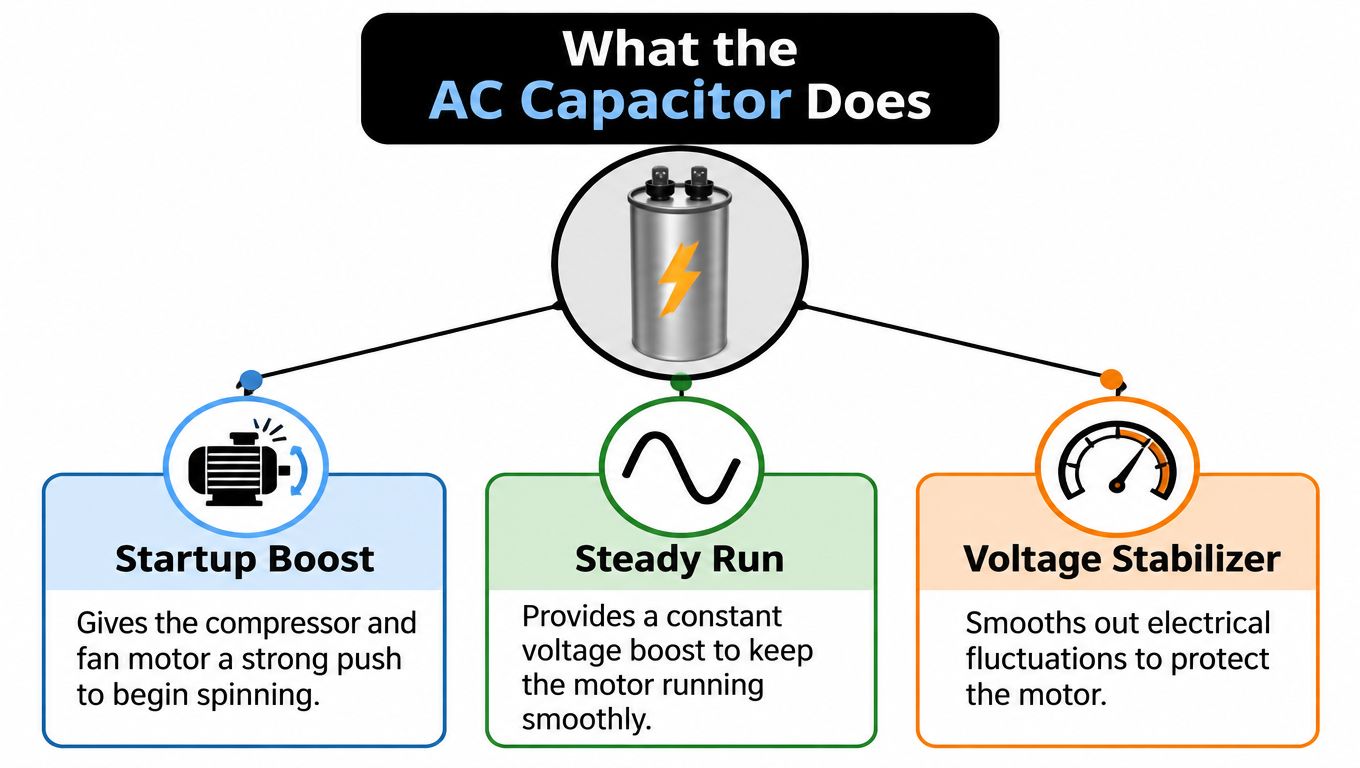
Many outdoor units use a dual run capacitor. One component serves both the compressor and the condenser fan motor, so a single failing part can affect cooling and fan operation together. A technician must still match the correct terminals and ratings. The component is not a generic electrical cylinder, and a visual match alone does not confirm compatibility or failure.
Airflow and ductwork can affect comfort, but they do not explain every outdoor-unit symptom. If you are considering broader airflow work, this independent resource on whether AC duct cleaning is worth it can help separate duct concerns from condenser electrical problems. For the relationship between the compressor, fan, refrigerant circuit, and indoor components, review how an AC system works. A capacitor symptom is therefore a screening clue, not proof. Testing must distinguish it from motor, wiring, voltage, airflow, or compressor trouble.
The Symptoms Homeowners Notice First
A Tucson afternoon can turn a small electrical fault into an obvious comfort problem. The outdoor unit hums, the fan hesitates, and the vents keep blowing air that is no longer cool. These are recognizable AC capacitor failure symptoms, but they are screening clues, not proof. Read them by what you hear, feel, see, or smell, then look for a pattern rather than relying on one sign.
What you hear
A steady hum from the outdoor unit often means a motor is receiving power but lacks enough starting torque to turn. The condenser fan may begin slowly, stop, and try again. Clicking can occur when the system attempts to engage and then drops out.
Silence does not rule out a capacitor problem. The indoor blower may continue while the outdoor unit stays inactive because a control circuit, contactor, wire, motor, or compressor has failed. In other words, quiet operation can point to several faults, not one definite part.
Unusual sounds can be difficult to describe accurately. Air-conditioner noise troubleshooting can help you identify whether you hear humming, clicking, repeated starting, or another outdoor-unit noise before service.
What you feel
Warm air from the vents often appears when the indoor blower runs but the outdoor compressor does not start or operate correctly. Weak cooling can also come from low refrigerant, restricted airflow, duct problems, compressor trouble, or a control fault. Indoor comfort alone cannot identify the failed component.
Short cycling deserves attention. A motor with inadequate electrical support may overheat and stop under thermal protection, then attempt to run again after cooling. Similar cycling can result from a dirty coil, low voltage, an oversized system, or a thermostat or control problem.
A higher electric bill is another clue, not a diagnosis. Longer run times caused by dirty airflow, refrigerant trouble, poor insulation, or extreme weather can raise energy use without a capacitor being responsible.
What you see or smell
Look for a swollen case, oil leakage, cracked housing, darkened terminals, or burn marks. These physical signs can indicate internal capacitor damage, yet overheating, arcing, overvoltage, excessive electrical ripple, and loose connections can produce similar discoloration.
A sweet or sharp electrical odor near the condenser increases the urgency. Smoke, scorching, or a tripped breaker calls for the same response. Turn the system off and arrange professional service rather than opening the cabinet.
Symptom | What it suggests about the capacitor | Other possible causes |
|---|---|---|
Outdoor unit hums without starting | Insufficient starting torque | Failed motor, contactor problem, low voltage, compressor fault |
Fan turns slowly or hesitates | Reduced motor support | Worn fan motor, obstruction, wiring issue |
Warm air indoors | Compressor may not be operating | Low refrigerant, airflow restriction, compressor or control fault |
Rapid stopping and restarting | Motor may be overheating or losing support | Dirty coil, voltage problem, thermostat or control issue |
Bulged or leaking case | Internal capacitor damage is possible | Heat, overvoltage, connection or broader electrical damage |
Burn marks or odor | Excess heat or arcing may be present | Loose terminal, motor fault, contactor or wiring failure |
A technician still needs measurements to separate a weak capacitor from motor, wiring, voltage, airflow, compressor, and control problems. Repeated failures in a hot climate such as Tucson also deserve a wider inspection, because heat, connections, electrical conditions, and the surrounding system may be contributing to the capacitor's stress.
How a Technician Confirms Capacitor Failure
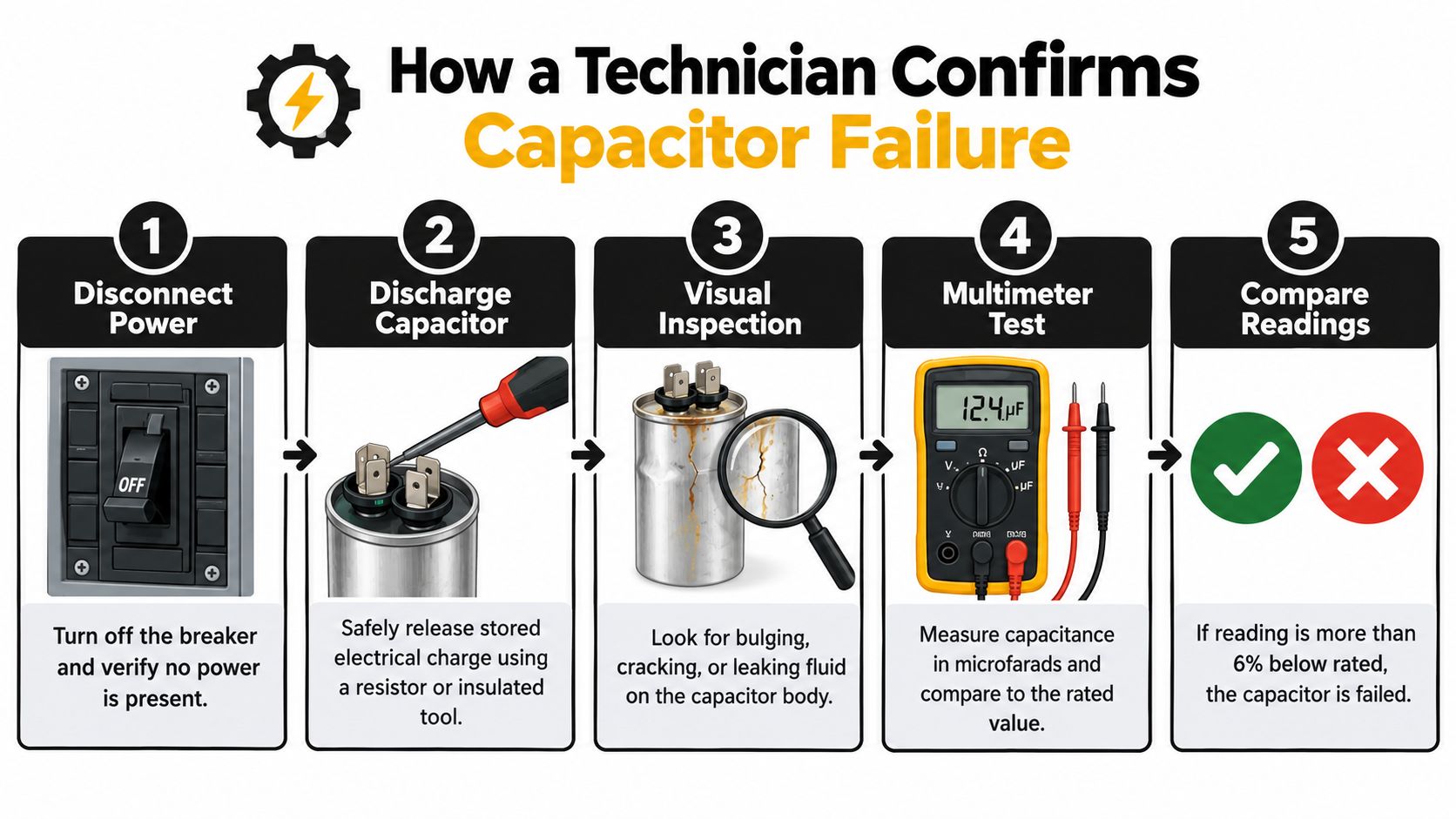
A proper diagnosis starts with safety, not a screwdriver. The technician disconnects power, verifies that the unit is no longer energized, and safely discharges the capacitor before touching its terminals. The outdoor disconnect and breaker are part of the isolation process, but switching them off doesn't automatically remove stored charge.
The measurement that matters
Once the component is safe to test, the technician measures capacitance in microfarads, or µF, and compares the result with the rating printed on the capacitor. A commonly cited tolerance is approximately plus or minus 6 percent. For a capacitor rated at 45 µF, that means a reading between 42.3 and 47.7 µF under that rule. Service Magazine explains the nameplate comparison, including the 45 µF example and the common interpretation of a reading more than 10 percent below rating as weak.
The printed tolerance on the actual component controls the final judgment. A technician doesn't replace a part solely because the case looks old, and a normal-looking case doesn't guarantee reliable operation.
The checks around the capacitor
A careful service visit also looks for the reason the capacitor weakened or the possibility that it isn't the problem. The technician may check:
Voltage: Whether the electrical supply at the relevant terminals is appropriate.
Amp draw: Whether the compressor and fan motor are pulling excessive current while operating.
Connections: Whether terminals are loose, darkened, corroded, or damaged.
Airflow: Whether dirty coils or restrictions are forcing the outdoor section to run hot.
Motor behavior: Whether the fan and compressor start, run, and shut down normally after testing.
This broader process is why HVAC system diagnostics matters more than a quick parts swap. Homeowners dealing with a wider electrical concern may also benefit from a separate guide to home electrical troubleshooting, while an HVAC technician focuses on the AC circuit and motor loads.
Visual inspection helps identify obvious damage, but it can't confirm health. Research on capacitor degradation identifies corrosion as a primary aging mechanism and reports that capacitance reduction may remain negligible until failure is close. A capacitor can therefore look acceptable and still require electrical testing.
Why a New Capacitor Can Fail Again So Soon
A failed capacitor isn't always an old part reaching the end of its useful service. In Tucson, the outdoor unit may face intense heat and long cooling demand, while dirty condenser coils, restricted airflow, voltage disturbances, loose terminals, and motor problems add stress. The part can be the visible failure without being the original cause.
Capacitors degrade faster under combined thermal and electrical stress. Corrosion is a primary aging mechanism, and a capacitor may show little measurable capacitance loss until failure is imminent. NASA technical research discusses the connection between capacitor degradation, corrosion, and combined electrical and thermal stress.
What should be investigated
Outdoor heat: High cabinet temperatures accelerate stress inside the component, especially when the system runs for extended periods.
Condenser airflow: Dirt on the coil or obstructions around the unit can trap heat and raise operating strain.
Voltage quality: Low voltage, disturbances, and spikes can push the capacitor and motor outside normal conditions.
Terminal condition: A loose or corroded connection can create resistance, heat, and arcing.
Motor health: A fan motor or compressor drawing abnormal current can repeatedly damage a replacement capacitor.
Part selection: The replacement must match the required microfarad and voltage ratings. An incorrect rating can leave the motor operating outside its intended electrical conditions.
A quality service visit should therefore include more than removing one cylinder and installing another. Ask whether the technician verified the nameplate rating, checked voltage and amp draw, inspected connections, evaluated condenser cleanliness, and tested the motor after the replacement.
Practical rule: If the same failure returns, ask what condition caused the replacement part to fail. “The weather is hot” may be part of the explanation, but it shouldn't end the investigation.
Safe Steps Before the Technician Arrives
Start at the thermostat. Set the system to OFF so it doesn't keep attempting to start a struggling compressor or fan. If you know which breaker supplies the AC and can operate it safely, switch it off as well, but don't remove panels or touch internal components.
You can improve conditions without entering the condenser cabinet. Replace a visibly dirty indoor air filter, and clear leaves, plastic, weeds, or other debris from the area around the outdoor unit. Keep your hands away from the fan and grille, and don't pour water into the cabinet or try to cool the unit with a hose while power may be present.
Stop and seek prompt service when you notice
Burning odor: A sharp electrical smell can indicate overheating or arcing.
Smoke: Smoke from the condenser is not a wait-and-see symptom.
Visible arcing: Sparks or flashes require the system to remain off.
Repeated breaker trips: Do not keep resetting the breaker to force operation.
Leaking or ruptured capacitor: Fluid, cracks, swelling, or a split case require professional handling.
No cooling during dangerous heat: Protect vulnerable household members and arrange service promptly.
The condenser cabinet is not a safe place for homeowner experimentation. Capacitors can retain dangerous electrical charge after shutdown, so don't open the cabinet, discharge the part, remove wires, or handle the capacitor directly. Even if you have a multimeter, safe isolation and discharge require the right training and procedure.
A Homeowner's Decision Framework and Prevention Habits
Use the symptom pattern to choose the next action:
Arrange prompt service: The AC isn't cooling, the outdoor unit hums or smokes, the breaker trips, or you notice burning odor, arcing, or a damaged capacitor.
Schedule professional testing soon: The fan starts slowly, the unit cycles unexpectedly, or cooling is intermittent without an immediate electrical danger sign.
Monitor only briefly: A single mild comfort change with no outdoor-unit noise or electrical warning still deserves attention if it returns. Don't keep restarting a unit that hums or struggles.
Prevention means reducing stress and catching abnormal operation early. Keep the condenser clear, maintain indoor airflow, and ask for seasonal service that includes voltage, amp-draw, connection, and capacitor checks. For a Tucson property, a preventive maintenance schedule can help organize those inspections before heavy cooling demand.
Because a capacitor can remain dangerous after shutdown, visual inspection and electrical testing belong to a qualified technician, as explained by this guide to identifying faulty capacitors. Ask the technician to verify the replacement's microfarad and voltage ratings against the nameplate, then confirm that the fan and compressor operate normally after service.
Covenant Aire Solutions provides HVAC diagnostic assessments that include capacitor testing, voltage verification, and amp-draw checks for symptoms such as humming, hard starting, intermittent operation, or no start. Visit Covenant Aire Solutions to request professional AC service in Tucson and discuss the right next step for your system.