
24 Hour AC Repair Tucson: Fast Emergency Help
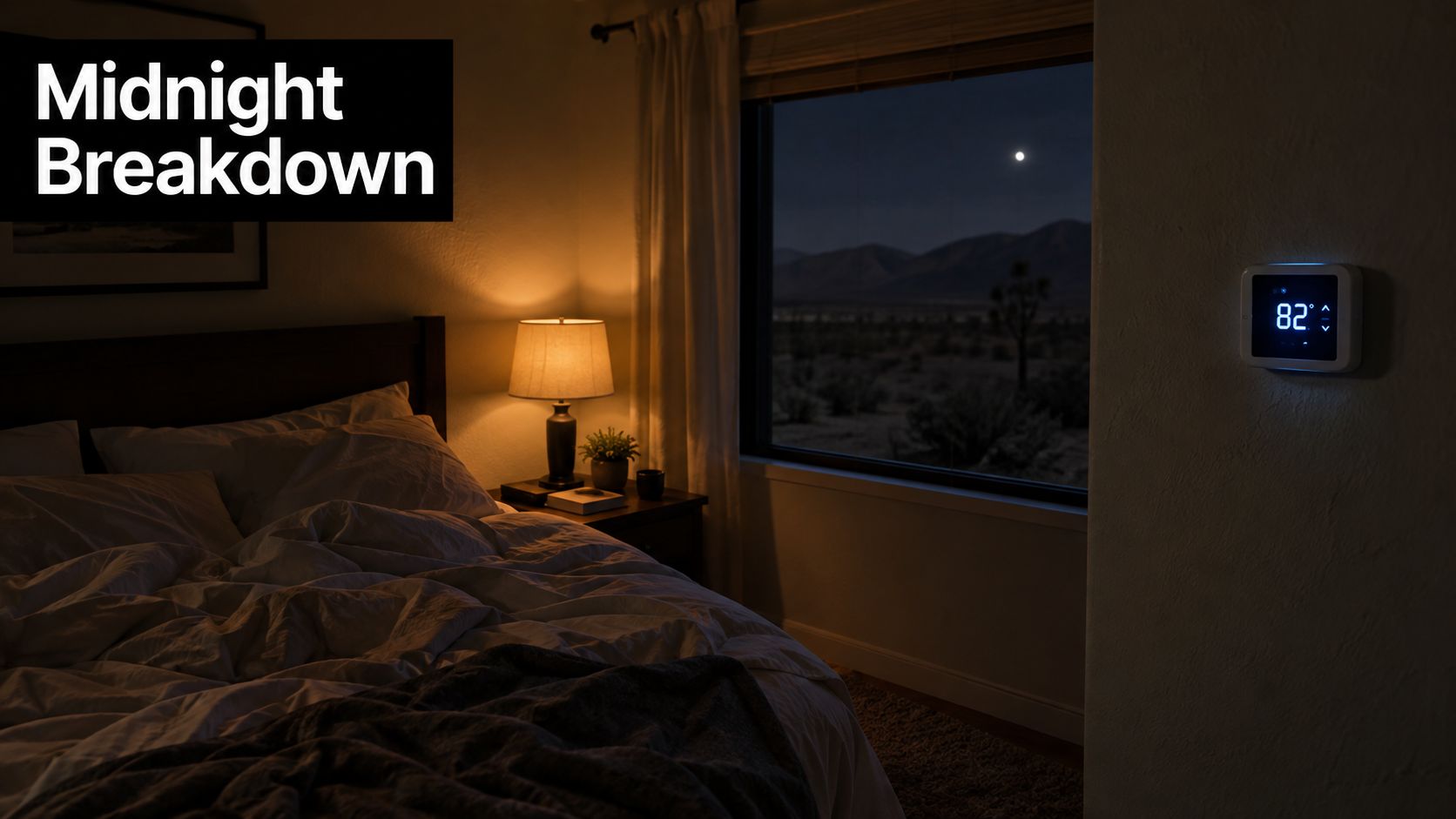
You're lying awake in a Tucson bedroom, listening to the outdoor unit cycle without delivering cold air. The thermostat has climbed to 82°F, the house is getting warmer, and the usual daytime service options are closed. In this climate, deciding whether to wait until morning requires more judgment than a quick search for "24 hour AC repair Tucson."
A failed system can be a comfort problem, an electrical hazard, or a rapidly developing heat emergency. The right response depends on the symptoms, the occupants, and how quickly the indoor temperature is changing.
When Your AC Fails at Midnight in Tucson Heat
At 2:00 AM in July, a thermostat reading of 82°F can feel deceptively manageable. The outdoor air may still be hot, the walls and roof may be releasing stored heat, and a bedroom with closed windows can become uncomfortable quickly. If the system has stopped completely, the temperature will keep moving in the wrong direction.
Tucson records over 146 days above 90°F annually, and summer heat indexes can exceed 115°F, according to local Tucson climate information. After an AC failure, indoor temperatures may rise 20 to 30°F within 2 to 3 hours, making a broken system more than an inconvenience for older adults, infants, people with health conditions, pets, seasonal residents, and businesses that need stable indoor conditions.
Start with the people, not the equipment
Move vulnerable occupants to the coolest available room while you assess the system. Close blinds and curtains, avoid using the oven, reduce unnecessary lighting, and use safe fans if power is available. A practical guide to how to cool down a house can help while assistance is on the way.
Windows also matter. Clean glass won't repair an air conditioner, but clear window surfaces and properly managed coverings can support a broader heat-control routine. These Tucson window cleaning tips are useful when you're reducing solar heat gain around the home.
Practical rule: If the indoor temperature is rising rapidly, or a vulnerable person or animal is becoming distressed, treat the failure as urgent rather than waiting for normal office hours.
A 24-hour technician can't make the outdoor heat disappear, but professional diagnosis can identify whether the system has a recoverable control problem, a failed electrical component, restricted airflow, or a condition that requires the equipment to remain off. The safest choice is based on the risk inside the property, not just the time on the clock.
What Happens When You Call for Emergency AC Repair
A good emergency call begins with clear information. Tell the dispatcher whether the system is completely off, blowing warm air, making an unusual noise, leaking, tripping a breaker, or producing a burning smell. Share the thermostat reading, whether the indoor fan runs, whether the outdoor unit starts, and whether anyone in the property is especially vulnerable to heat.
Ask four direct questions before the technician comes:
Availability: Is a technician assigned to an after-hours call?
Diagnosis: Is the initial visit intended to identify the failure and explain repair options?
Pricing: Will you receive the cost of the proposed work before authorizing it?
Qualifications: Is the work being performed under the appropriate Arizona contractor license?
A company shouldn't promise a repair before seeing the equipment. It should explain what it can assess on arrival, what parts may affect timing, and whether shutting the system off is advisable. For a broader overview of the service process, see this guide to emergency HVAC repair.
Licensing is part of the safety check
Arizona requires a contractor license for HVAC work valued at more than $1,000, and the state's R-39 Air Conditioning and Refrigeration classification covers installation and repair of comfort air-conditioning systems, refrigeration, evaporative cooling, ventilation, and heating, with or without solar equipment. The scope is described by the Arizona Registrar of Contractors.
That doesn't mean a license alone guarantees a good repair. You still want written recommendations, a clear explanation of the failed component, and a distinction between a temporary restoration and a durable repair. A technician should inspect the equipment rather than replace parts by guesswork.
Expect diagnosis before commitment
Emergency service works best when the technician first makes the system safe, then identifies the failure, and finally presents choices. Some calls end with a straightforward component replacement. Others reveal a refrigerant problem, compressor damage, or an aging system where a temporary fix may restore cooling without solving the underlying reliability issue.
Don't authorize work you don't understand. Ask what failed, what caused it, whether the repair protects the system from repeat damage, and what must happen if the replacement part isn't available that night.
Quick Troubleshooting Steps Before the Technician Arrives
Safe checks can eliminate simple causes and give the technician useful information. They shouldn't involve opening the equipment cabinet, touching refrigerant lines, testing live electrical parts, or bypassing safety controls.
Check the controls first
Confirm that the thermostat is set to cool, the target temperature is below the current room temperature, and the display is active. Replace weak thermostat batteries if the screen is blank or inconsistent. If the thermostat responds but the system doesn't start, note that detail rather than repeatedly changing settings.
Inspect the air filter next. Desert dust can load a filter and restrict airflow. Restricted airflow may cause the indoor coil to freeze, reduce cooling, and force the system to shut down. Replace a visibly dirty filter with the correct size if you have a spare, but don't remove the filter and operate the system without one.
Reset a breaker only once
Look at the electrical panel for a breaker that has moved to the middle or off position. Switch it fully off, then back on once. If it trips again, leave it off and call for professional help. Repeated resets can worsen an electrical fault and expose the equipment to additional damage.
The safe process for resetting an AC breaker is useful if you're unsure which step comes next. Don't open the condenser, remove access panels, or handle capacitors. A capacitor can retain a dangerous electrical charge even when the system isn't running.
Make a visual check outside
Stand clear of the outdoor fan and inspect the area around the condenser. Remove loose leaves, bags, or other objects from the surrounding space, but don't spray water into the cabinet or reach through the grille. If you see ice on the refrigerant line, shut the system off and don't chip at the ice.
Burning odors, sparks, smoke, exposed wiring, or a breaker that trips immediately change the situation. Turn the equipment off if you can do so safely, keep people away from it, and wait for a qualified technician. If there's an active fire, smoke spreading through the building, or immediate danger to people, contact emergency services first.
Common Emergency Causes of AC Failure in Tucson
Tucson equipment works under a demanding combination of heat, dust, long runtimes, and seasonal storms. Emergency service is concentrated from May through September, especially June and July, when cooling demand places the greatest load on systems, as described by this Tucson emergency HVAC overview.
Rooftop equipment can sit in 110°F sun, collect dust, and face monsoon conditions. Those exposures accelerate wear on capacitors, contactors, and other electrical components. Local systems also often run more hours each year than equipment in many other U.S. markets, so a component with marginal performance may fail at the worst possible time.
The parts that commonly stop the system
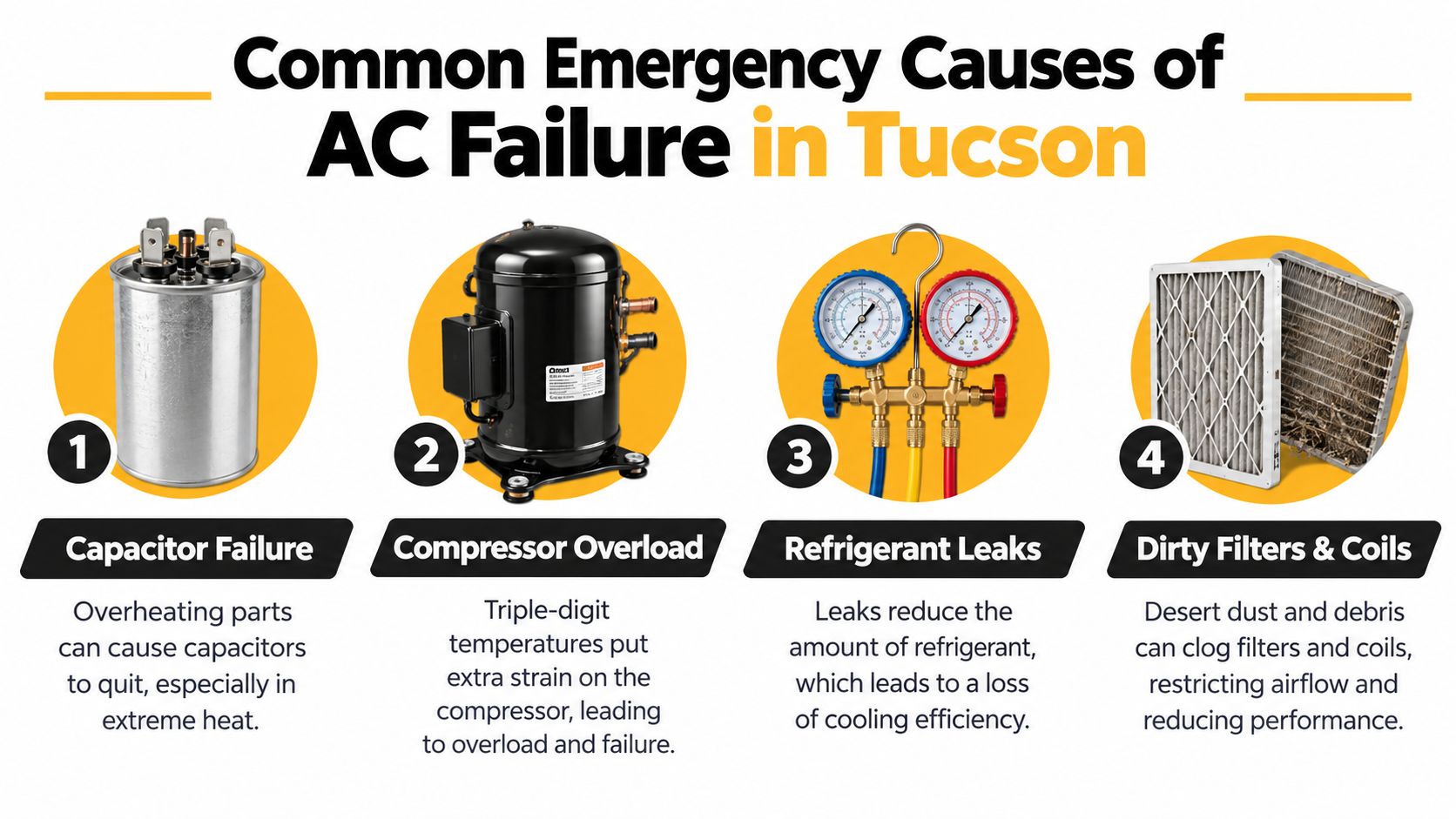
Capacitors help motors start and run. Heat and repeated cycling can weaken them, leaving the outdoor fan or compressor unable to start. You may hear humming without normal cooling, but never diagnose or replace a capacitor yourself.
Contactors and electrical controls connect power to major components. Pitted contacts, dust, heat damage, or wiring faults can prevent the condenser from operating. A tripped breaker may be a symptom rather than the cause.
Refrigerant leaks reduce cooling performance and can make the system run longer without reaching the thermostat setting. Ice on a line doesn't prove a leak, since airflow restrictions can create similar symptoms. A licensed technician needs to locate the cause and handle refrigerant correctly.
Compressors face heavy thermal and mechanical stress during long periods of high demand. A compressor may trip protection, make abnormal sounds, or fail to start. Read more about AC compressor failure before deciding whether a repair or replacement conversation is appropriate.
Dirty filters and coils also deserve attention. Restricted airflow makes the system work under poorer conditions, while a dirty outdoor coil can't release heat effectively. Cleaning may solve the performance problem, but electrical or mechanical damage requires a deeper repair.
When to Call Immediately Versus Waiting Until Morning
The decision isn't just “no cooling equals emergency.” A better triage process weighs danger, indoor conditions, and who is inside the property.
Situation | Safer response |
|---|---|
Burning smell, smoke, sparks, exposed wiring, or repeated breaker trips | Turn the system off if safe, keep clear, and call for immediate professional help. Contact emergency services first for fire or immediate danger. |
Refrigerant leak suspected, active water leak near electrical equipment, or loud mechanical failure | Shut the system down if you can do so safely and request urgent HVAC service. |
No cooling with an older adult, infant, medically vulnerable person, pet, or heat-sensitive occupant inside | Start cooling and relocation measures immediately while arranging emergency service. |
Mildly weak airflow in an otherwise stable, unoccupied property | A next-day appointment may be reasonable after checking the filter and thermostat. |
Routine maintenance, minor temperature imbalance, or a nonurgent noise with normal cooling | Schedule regular service, unless the symptom worsens or a safety sign appears. |
Electrical symptoms take priority
A burning smell isn't a normal part of an AC cycle. Sparks, smoke, hot wiring, or a breaker that won't stay on indicate a potential electrical hazard. Don't keep resetting the breaker to force the system to run, and don't pour water on equipment.
A refrigerant concern also warrants prompt attention, especially if the system is icing or the leak is obvious. Keep children and pets away from the area, avoid touching the lines, and let a qualified professional inspect the equipment.
Heat changes the threshold
An empty home with modest loss of cooling may tolerate a morning appointment better than an occupied home that is already becoming dangerously warm. Older adults, infants, people with medical conditions, pets, and commercial spaces containing heat-sensitive materials need a more conservative decision.
Commercial managers should also consider the consequences of downtime. A failed unit can affect employees, tenants, inventory, or equipment even when the building doesn't feel immediately unbearable. If the property is already above a safe operating range, call rather than waiting for a routine slot.
A comfort issue can become a safety issue when the occupants, equipment, or indoor temperature remove your margin for waiting.
Preventive Maintenance Options to Reduce Emergencies
Tucson's cooling season leaves little room for weak components to recover. Average highs reach 101.2°F in June and 100.2°F in July. The city also recorded 18 days at or above 110°F in 2024, followed by a historic 53-day streak of 100°F or higher temperatures from June 16 to August 7, according to National Weather Service Tucson climate records.
A useful maintenance visit goes beyond a visual glance. The technician should inspect electrical connections, test operating components, examine coils, check airflow, look for refrigerant problems, and confirm that safety controls respond correctly. The scope should match the equipment and its condition.
Build maintenance around failure prevention
Covenant Aire Solutions offers preventive plans with biannual check-ups, priority service scheduling, and member discounts. A recurring schedule, outlined in this preventive maintenance schedule guide, can reveal a weak capacitor, deteriorating contactor, dirty coil, or airflow restriction before a hot-night failure. It also creates a documented condition assessment, which helps homeowners and property managers decide whether to repair now or plan a replacement.
If indoor air quality enters the discussion, ask the contractor to explain the proposed purification technology and whether it addresses a measured problem. Treat filtration or purification as a separate equipment decision, not an automatic add-on to routine HVAC maintenance.
Ductwork deserves inspection as well. Leaky or poorly sealed ducts can make a correctly operating system seem undersized. If you are comparing residential duct sealing prices, ask the HVAC contractor to identify the leakage and explain whether sealing would correct a measured airflow problem.
Maintenance cannot prevent every emergency. It can replace a surprise failure with a planned repair or replacement decision, reducing disruption for households and property managers.
Schedule Your Emergency AC Repair Today
Tucson's heat doesn't affect every neighborhood equally. An analysis reported an urban heat island score of 7.65, and about 365,000 residents live in areas at least 8 degrees hotter, while approximately 65,000 live in areas at least 9 degrees hotter, according to reporting on Tucson's urban heat conditions. That variation reinforces a practical point: the same equipment failure can become urgent faster in one property than another.

For a residential property, the first priority is protecting occupants and making the equipment safe. For a commercial property, add tenant communication, sensitive inventory, operating requirements, and access coordination to the call. In either setting, ask for an explanation that separates an immediate restoration from work that can be planned later.
Covenant Aire Solutions serves Tucson and surrounding communities with residential and commercial HVAC services, including emergency cooling response, repairs, replacements, maintenance, and indoor air quality solutions. The company describes its technicians as certified and its business as licensed, bonded, and insured. It also offers flexible financing and special rates for teachers, military personnel, and first responders, though availability and terms should be confirmed directly.
A transparent provider should tell you what failed, what the proposed repair accomplishes, and what risks remain. If the system is old or has a recurring fault, ask whether the emergency repair is a sensible long-term choice or whether a planned replacement would reduce future downtime.
Watch this service overview before you call so you know what information to have ready.
Don't wait for the thermostat to become the only warning. Save the service contact, note the model and symptoms if accessible without opening the equipment, and arrange maintenance before the next prolonged heat period.
Covenant Aire Solutions provides 24-hour emergency AC repair, planned maintenance, replacements, and indoor air quality services for Tucson homes and commercial properties. Visit Covenant Aire Solutions to request service, review available options, and prepare your cooling system before the next breakdown.