
Indoor Air Quality Testing Cost Guide
A standard professional indoor air quality assessment averages about $437, with most basic evaluations ranging from $292 to $584. Multi-pollutant inspections can cost $1,200 or more, depending on the property, contaminants, samples, and reporting involved.
You may be dealing with stale rooms, recurring allergy symptoms, a musty odor, or dust that seems to return soon after cleaning. The right indoor air quality testing cost depends less on a national average than on what you're testing for and how much evidence you need. A single radon test is a different service from a multi-room mold, VOC, and ventilation investigation.
For Tucson homeowners, the smartest approach is to identify the symptom first, then choose the narrowest test that can answer the question. That keeps you from paying for unnecessary laboratory work while still giving you reliable information when a serious contaminant or HVAC problem may be involved.
Understanding Baseline Testing Expenses
If your home feels stuffy but you don't know why, a basic professional assessment is a reasonable starting point. A standard evaluation in the United States averages about $437, and most homeowners spend approximately $292 to $584 for a basic assessment, according to professional indoor air quality testing cost data. Broader pricing commonly falls between $300 and $1,200, because a simple spot check and a multi-pollutant inspection require very different levels of labor and analysis.
A technician may begin with a visual review of the home, airflow observations, and limited sampling. That type of visit can help identify obvious concerns such as poor ventilation, visible moisture, unusual odors, or a filter and ductwork issue. A larger assessment may involve several rooms, indoor and outdoor comparison samples, multiple contaminants, laboratory analysis, and a written interpretation.
What the basic price usually covers
The quoted fee should clearly state whether it includes the technician's visit, equipment, sample collection, laboratory processing, and a written report. Ask this before scheduling, because a low initial quote may cover only the field visit while lab fees and additional samples appear later.
The size of the property also matters. A small home with one clearly defined concern may need a focused evaluation, while a larger Tucson property with separate bedrooms, living areas, and HVAC zones can require broader sampling. Testing becomes more involved when the technician needs to compare several areas rather than collect one representative sample.
Practical rule: Don't ask only, “How much is an air quality test?” Ask, “What contaminants, rooms, samples, laboratory fees, and reporting are included in that price?”
Know what kind of assessment you're buying
A basic diagnostic visit isn't the same as an environmental audit. If you need documentation for a real-estate transaction, an insurance matter, or a dispute involving a suspected contaminant, insist on a written scope and ask who will interpret the results.
Before hiring anyone, review practical background on indoor air quality standards so you understand the terminology in the proposal. For homeowners who want to understand available laboratory and testing approaches, the Topair Systems overview can also provide useful technical context. Neither resource replaces a property-specific assessment, but both can help you recognize whether a contractor is offering a targeted test or a much broader package.
Pricing Breakdown by Specific Contaminant
A Tucson homeowner with a musty odor should not pay for the same testing package as someone worried about radon or fumes from new cabinets. Start with the symptom and likely source. A focused test can control costs when the problem is clear, while an uncertain source may justify broader testing.
Published cost ranges for professional air testing place radon testing at about $150 to $800, VOC testing at about $200 to $500, and mold air sampling at about $150 to $400. Broader professional assessments commonly range from $500 to $2,000 or more, depending on the work included. Review these published cost ranges for professional air testing before comparing local quotes.
Contaminant | Average Cost Range |
|---|---|
Radon | $150 to $800 |
Volatile organic compounds | $200 to $500 |
Mold air sampling | $150 to $400 |
Broader professional assessment | $500 to $2,000 or more |
Match the test to the symptom
A persistent musty odor or history of water intrusion calls for a mold-focused investigation. Air sampling can help, but the technician should also inspect for moisture sources, concealed growth, staining, and contamination inside the HVAC system. An air sample alone cannot explain why mold may be present.
An odor from new flooring, cabinets, paint, furniture, or cleaning products supports VOC testing. Tell the technician what changed in the home and when the odor started. That timeline helps connect the laboratory result to a likely source instead of producing numbers with little practical meaning.
A concern about an invisible, naturally occurring soil gas calls for radon testing. Low-cost do-it-yourself kits are widely available through mail and retail channels, according to the EPA guide to indoor air quality. Choose professional testing when you need documented procedures, expert interpretation, or a report suitable for a real-estate transaction.
Sneezing, irritation, or recurring indoor allergy complaints do not identify one contaminant by themselves. Dust, particles, mold, ventilation problems, and outdoor air entering the home can overlap. If one targeted test cannot explain the pattern, order a broader evaluation rather than repeatedly testing at random. For a suspected mold issue, review this Tucson mold testing guide for homeowners before discussing the scope with a local technician.
Key Factors That Influence Your Final Bill
Your final bill depends on the answer you need, not the size of the home. The technician must choose sampling locations, determine how many samples are appropriate, select the laboratory methods, and decide how much interpretation your symptoms require. A Tucson home with one suspected source needs a different scope from a property with several HVAC zones, additions, or hard-to-access areas.
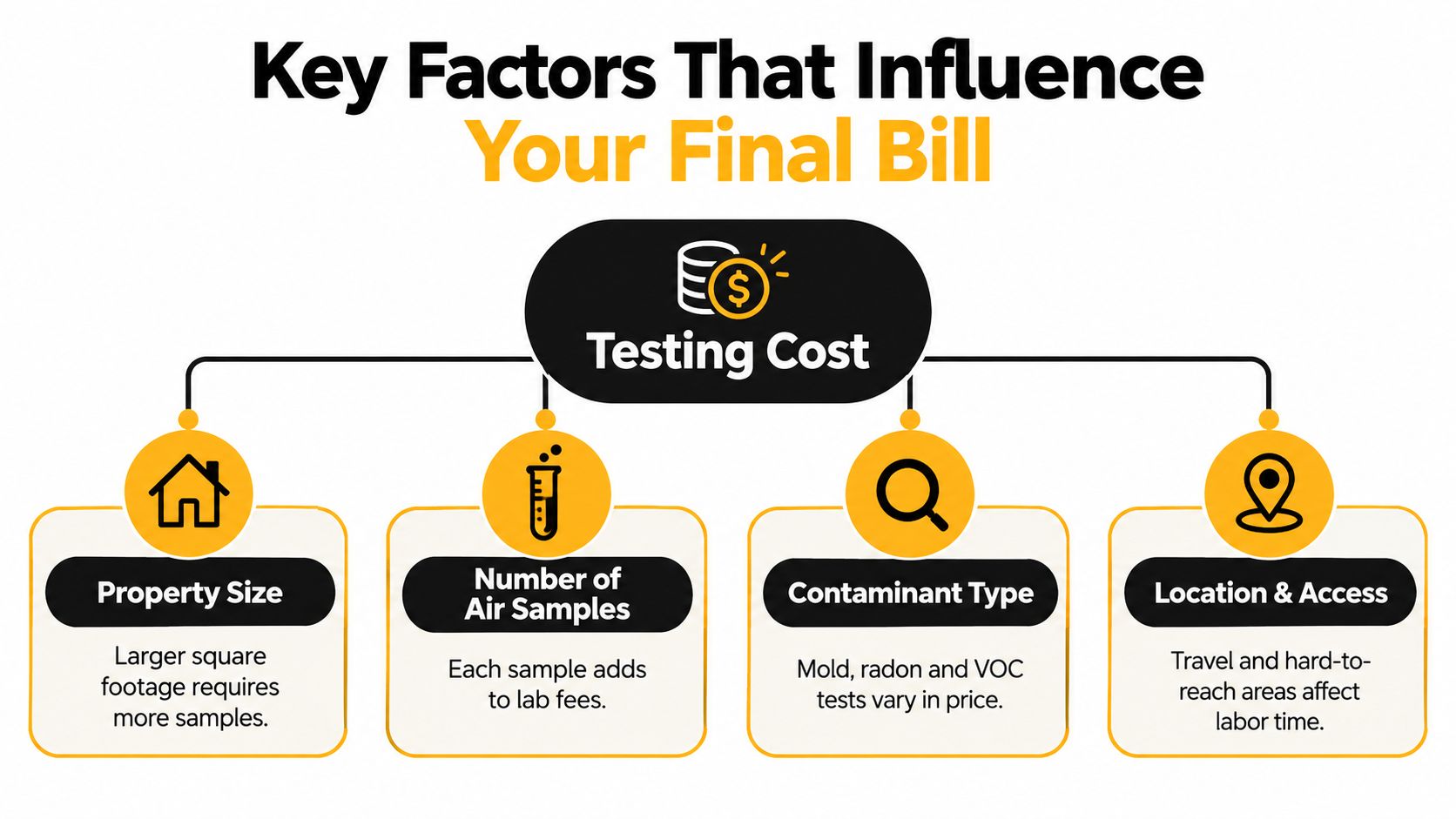
Four cost drivers to ask about
Property size: Larger homes and commercial spaces may need samples from several rooms. One central living area cannot represent every bedroom, closed room, or separately served HVAC zone.
Number of air samples: Each additional sample may add a laboratory charge. Confirm whether indoor samples, outdoor control samples, and repeat samples are included or billed separately.
Contaminant type: Mold, radon, VOCs, and allergens use different collection methods and laboratory processes. The method affects both the quote and whether the result answers your actual concern.
Location and access: Travel distance, crawl spaces, attics, confined mechanical areas, and difficult-to-reach vents increase labor time. Tucson homes with additions or multiple air-conditioning systems may require a more detailed site plan.
Lab work and reporting
A clear quote separates fieldwork from laboratory analysis. Ask whether the laboratory fee is included, whether the report identifies each sample location, and whether a professional will explain the findings. A spreadsheet without interpretation does not tell you whether to improve filtration, investigate moisture, repair ductwork, or pursue remediation.
A certified industrial hygienist review adds cost when the project involves several sampling methods, formal documentation, or remediation recommendations. Full residential assessments with that level of review and documentation are often quoted at $500 to $2,000. Some assessments requiring three testing areas can start at $1,800, according to these example quotes for full residential assessments with hygienist review.
Ask for this in writing: the number of samples, each contaminant being analyzed, control samples, laboratory fees, report format, follow-up consultation, and any travel or access charges.
Get those details before the appointment. Compare proposals by the work included and the decisions the report will support, not by the largest or smallest number at the top of the estimate. For a symptom-driven test in Tucson, paying for the right sample locations and interpretation is more useful than ordering every available analysis.
Evaluating DIY Kits Versus Professional Assessments
Low-cost monitoring is useful, but it isn't a universal substitute for professional testing. DIY kits generally cost about $10 to $20, while consumer monitors and entry-level devices range from about $89 to $229, according to consumer and professional indoor air quality testing comparisons. Professional multi-pollutant assessments usually involve a much larger investment because they combine calibrated equipment, sample handling, laboratory analysis, and interpretation.
A consumer monitor can help you observe patterns in CO2, PM2.5, humidity, or VOC proxies. That information may show whether readings change after cooking, cleaning, showering, opening windows, or running the HVAC system. It can also help you decide when a room behaves differently from the rest of the home.
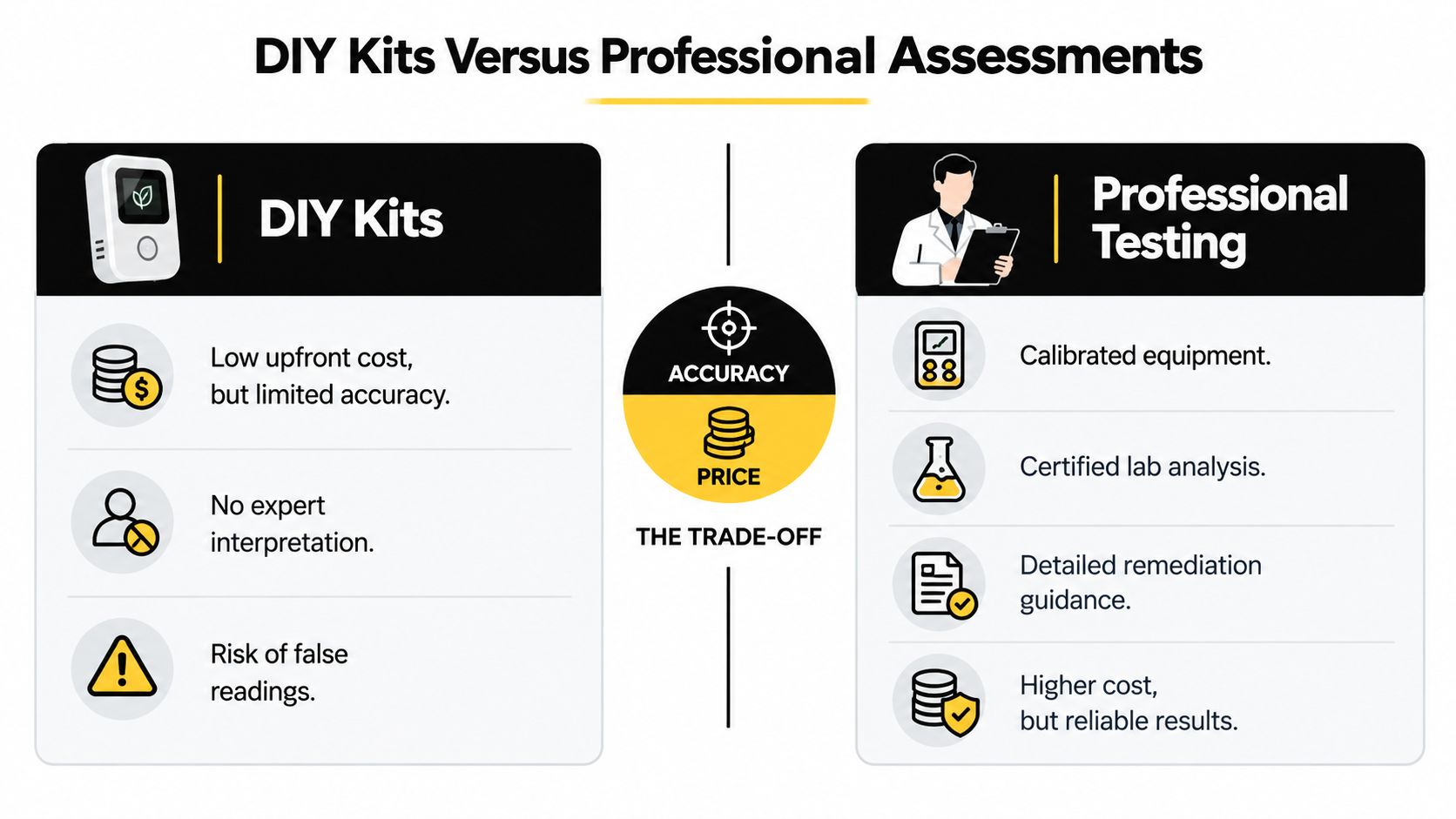
When a monitor is a sensible first step
Use a consumer device when your question is about trends rather than proof. For example, you might want to see whether a bedroom's humidity rises overnight or whether particle readings increase when the air handler starts. Those observations can give an HVAC technician useful context and may reveal a straightforward ventilation or filtration issue.
A monitor also makes sense when you're still gathering information and don't have signs of a specific contaminant. Keep a simple record of conditions and events, but don't treat a device reading as a laboratory conclusion.
The more serious mistake is using a cheap device to answer a question it wasn't designed to answer. Consumer tools don't replace lab-grade sampling for radon, formaldehyde, mold spores, or legal and real-estate documentation needs. A screen may indicate that something is changing, but it may not identify the substance, concentration, source, or corrective action.
Avoid the false economy
If there has been water damage, a strong unexplained odor, visible growth, or a requirement for formal documentation, professional sampling is the appropriate path. Spending less on an unsuitable kit can delay the investigation and leave you with a result that cannot support a repair, remediation, or transaction decision.
For a general overview of home test kit options, review this guide to air quality home test kits. Use the information to choose the right level of investigation, not to assume that every concern needs the most expensive service.
Interpreting Results and Planning Remediation
A laboratory report is only useful when it leads to a sensible decision. Don't jump straight to an expensive air-cleaning product because one reading looks unfamiliar. First identify what was measured, where the sample came from, whether the result is consistent with the reported symptoms, and whether the technician identified a likely source.
Tucson homes face a distinct mix of conditions. Desert dust can enter through doors, windows, leaks, and poorly sealed duct connections. Seasonal monsoon moisture can change indoor conditions, while heavy reliance on air conditioning means the filter, coil, drain, blower, and ductwork all influence how air moves through the home.

Turn findings into priorities
Start with the source, not the gadget. If the report suggests particle infiltration, inspect filtration, return-air leaks, door seals, and duct connections before buying additional equipment. If moisture or mold is suspected, correct the water source and investigate affected materials rather than relying on an air purifier alone.
For VOC concerns, list recent products and renovations, improve controlled ventilation where appropriate, and ask whether additional sampling is necessary. For radon, follow the testing professional's recommendations for confirmation and mitigation instead of trying to solve the issue with ordinary HVAC filtration.
Use the report to choose the next service
A useful report should distinguish between a reading that needs observation and a condition that calls for action. It should also identify limitations, such as a sample that represents one room but not the whole property. Ask the technician to explain every recommendation in plain language and to separate urgent corrections from optional comfort improvements.
A home air monitor may help you watch patterns after repairs, but it shouldn't replace a targeted investigation when the original concern involves mold. Homeowners can review guidance on an air quality monitor for mold, then ask whether ongoing monitoring or repeat professional sampling is appropriate.
The right remediation plan fixes the source first, then verifies whether the corrective work changed the indoor conditions.
Financing Options and Local Service Advantages
Professional testing becomes easier to justify when the provider explains the scope clearly and gives you a realistic path for follow-up work. Ask whether testing, HVAC repairs, filtration changes, ductwork, and air purification are priced separately. You should be able to decline an add-on without losing access to the core diagnostic service.
Local companies may also offer flexible financing plans for qualifying work and preventive maintenance agreements that spread service needs across the year. Maintenance agreements can include scheduled checkups, priority scheduling, and discounts, but the exact terms vary, so read the agreement before signing. Don't accept a package that bundles equipment you don't need just because the monthly payment looks manageable.
Look for transparent community pricing
Tucson homeowners should ask whether special rates are available for teachers, military personnel, and first responders. These programs can reduce the immediate burden of professional service without requiring you to choose a less thorough testing method. Confirm eligibility, exclusions, financing terms, and whether laboratory charges are included.
A local provider can also coordinate testing with HVAC inspection, filter evaluation, airflow checks, and repairs when the findings point toward a mechanical source. That can save time, but keep the diagnostic conversation separate from the sales conversation. The contractor should explain why a recommendation fits the test results.
Indoor conditions are also affected by cleanliness, dust accumulation, and building-use patterns. If you need help assessing janitorial requirements for an office or shared property, this resource can help you choose the right office cleaner. Cleaning support won't replace contaminant testing, but it can support a broader plan for keeping dust and debris under control.
Review HVAC financing options before approving major work, and ask for an upfront estimate with no hidden fees. The best financial decision is the one that pays for an answer first and equipment second.
Preparing Your Home for Accurate Air Sampling
Poor preparation can make a properly collected sample less representative of normal living conditions. Your goal is to keep the home operating normally while avoiding unusual activities that could temporarily change airborne particles, odors, or chemical readings.
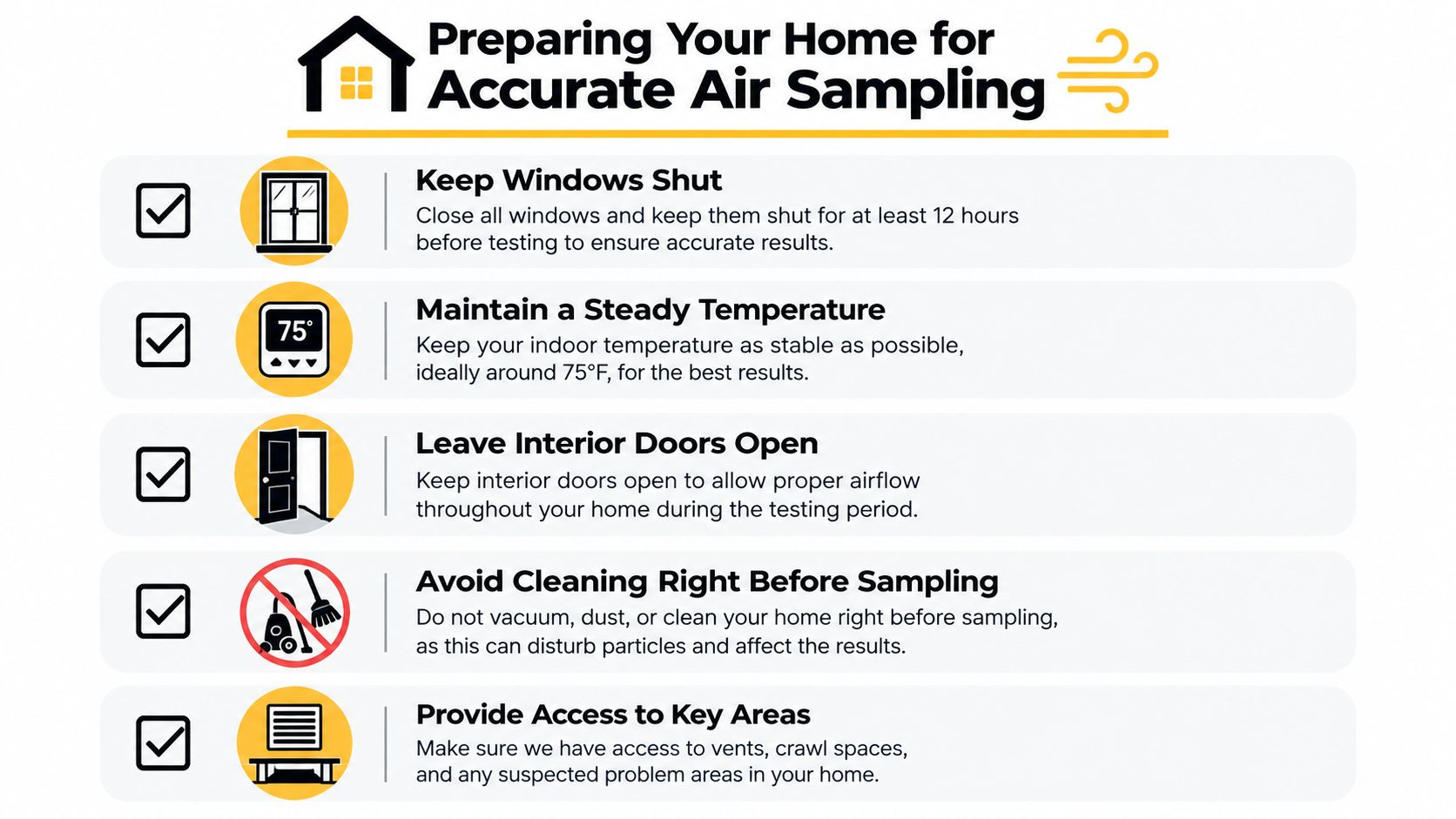
Use this preparation checklist
Keep conditions consistent: Follow the technician's instructions about windows, doors, fans, and HVAC operation. Don't create an unusually ventilated or sealed environment just before sampling.
Avoid strong chemical products: Skip painting, heavy disinfecting, air fresheners, pesticides, and solvent-based work before testing when VOCs or odors are part of the concern.
Don't disturb settled dust: Avoid unusual cleaning, vacuuming, or dusting immediately before the appointment unless the technician specifically tells you otherwise.
Provide access: Clear the area around vents, returns, mechanical equipment, crawl spaces, attics, and locations connected to the suspected problem.
Record recent events: Write down leaks, remodeling, new furniture, cleaning products, odor changes, filter replacements, and symptom patterns so the technician can connect results to actual conditions.
Don't relocate furniture or shut off systems without guidance. A technician may need to see how air normally circulates through the home, particularly when the concern involves one room that feels different from the rest of the property.
Read the report before booking follow-up work
Confirm the sample locations and laboratory methods first. Then ask which findings are actionable, what source investigation is recommended, and whether the report supports HVAC service, moisture correction, cleaning, filtration, or additional testing.
Schedule follow-up only after you understand the reason for it. If the technician recommends remediation, request a written scope that identifies the affected area, source correction, cleaning method, verification plan, and price. That process keeps the indoor air quality testing cost connected to a clear outcome instead of turning it into an open-ended series of add-ons.
Covenant Aire Solutions provides Tucson-area indoor air quality evaluations, HVAC service, maintenance, and air purification options matched to the problem identified in your home. Visit Covenant Aire Solutions to request a clear assessment and discuss the right next step without paying for testing or equipment that doesn't fit your situation.