
Heat Pump Defrost Mode: Is Your System Normal?
The whoosh comes first. Then the outdoor fan goes quiet, a plume of white rises off the unit into the night air, and the vents inside push room-temperature air for a few minutes before the warmth returns. On a damp January evening in Tucson, that sequence sends plenty of homeowners reaching for the phone.
What they witnessed is heat pump defrost mode, and it's the most misunderstood event in home heating. Most explanations stop at the outdoor temperature and call it weather. A better test looks at three things instead: how long the cycle lasted, how often it repeats, and what the system does once the cycle closes. Those answers tell you more than a thermometer ever will.
What Defrost Mode Does and Why Heat Pumps Need It
When a heat pump is heating on a cold, damp morning, frost can build on its outdoor coil even though the air temperature is above freezing. The coil must be colder than the outdoor air to draw heat from it, so moisture can freeze on the fins. As frost thickens, it blocks airflow and reduces the heat the system can collect.
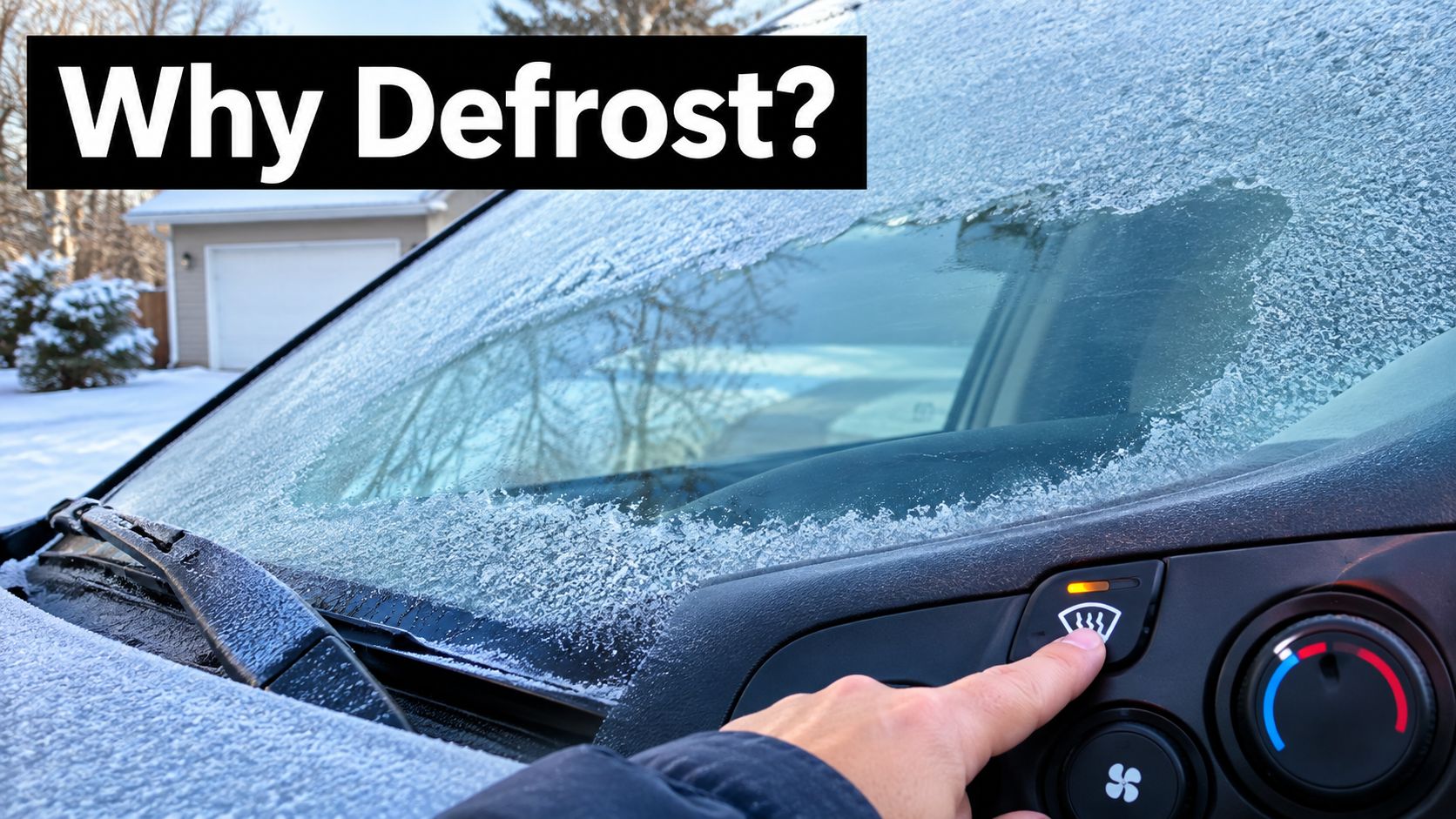
Defrost mode clears the coil by briefly reversing the refrigerant flow. Hot refrigerant warms the outdoor coil from within, melting the frost. The outdoor fan may stop or slow so it does not carry that heat away. The system may also use auxiliary heat indoors to limit the chill while the cycle runs.
The U.S. Department of Energy's Building Science Education program gives 5 to 15 minutes as a typical defrost-cycle duration (Building Science Education guidance on air-source heat pumps). Duration alone does not tell the whole story: consider how often defrost starts and whether the unit returns to normal heating when it ends. Outdoor temperature matters, but moisture and the system's controls matter too.
A defrost cycle is a protective step when it clears the coil and the system resumes heating afterward.
During a cycle, you might hear the compressor change pitch, see water drip from the outdoor unit, or notice a brief change in the warmth coming from the vents. Vapor from melting frost can look like smoke in cold air. These signs make more sense when you understand how a heat pump moves heat between indoors and outdoors.
Around Tucson, frost is more likely during unusually cold, damp weather than during ordinary summer cooling. Yet temperature alone cannot diagnose a defrost problem: the cycle's duration, frequency, and return to heating are more useful clues.
Normal Defrost Behavior Versus Warning Signs
Two units can behave identically for the first minute and then diverge completely. What separates a healthy cycle from a problem is duration, frequency, and what happens after the cycle ends.
What You Observe | Usually Normal | Warning Sign |
|---|---|---|
Cycle duration | Usually 5 to 15 minutes, median about 4 to 6 minutes | Cycles running past 20 minutes or never ending |
Cycle frequency | Repeated cycles on cold, damp nights around 10 to 30 °F | Repeated cycles in mild, dry weather |
Steam or fog at outdoor unit | Visible during the cycle | Steam still rising long after the cycle ends |
Indoor temperature | Drop under 1 °F (0.6 °C) | Cold drafts or falling room temperature |
Sound | Brief change in compressor or fan noise | Grinding, banging, or constant loud noise |
Coil after cycle | Clear of frost | Ice remaining after the cycle ends |
Auxiliary heat | Runs briefly during defrost | Runs constantly |
Read the right-hand column as the point where the shape of a normal cycle breaks.
Duration is the easiest trait to measure, because a phone timer settles the question. A cycle that ends on its own and hands the system back to heating is doing its job. One that won't close, or that restarts the instant it finishes, is not.
Frequency depends on weather and control logic together. A homeowner who hears the unit cycle roughly hourly on a damp night near freezing, sees steam, and gets warm air back each time is watching textbook operation. The same hourly rhythm in a dry 75 °F week tells a different story.
Steam, sound, and indoor temperature belong in one conversation. Steam during the cycle is water vapor from melting frost, and a brief whoosh or rumble is the reversing valve moving. Steam that keeps rising after the fan restarts, grinding or banging, or a room that keeps sliding colder all belong on the warning side.
Inspect the coil after the melt, not during it. Clear fins mean the cycle completed its work. Ice still gripping the coil means water is refreezing or the melt never reached the edges. If the indoor side is what worries you, our guide to a heat pump that isn't blowing hot air covers the symptoms that show up at the vents.
How Defrost Controls Decide When to Start
Manufacturers don't let a wall thermostat make this decision. A control board decides, using coil temperature, elapsed run time, refrigerant pressure, or some combination, which is why two houses on the same street can defrost on completely different schedules.
U.S. Department of Energy technical documentation lists the inputs manufacturers commonly rely on: outdoor-coil temperature combined with elapsed time, compressor operating time, or refrigerant-pressure conditions (DOE heat pump technical note).
Timer logic starts the clock, not the frost
One documented approach begins a cycle when the outdoor coil stays below a temperature typically near 32 °F for a specified period, and 60 minutes is a common factory default. Nothing in that logic checks whether frost formed.
A unit sitting on a 60-minute timer through a dry, mild week still defrosts on schedule, which is why a cycle can seem to ignore the weather entirely. The board counted to sixty. The coil was never part of the question.
Pressure and demand logic read the coil
A pressure-based control waits for frost to push the refrigerant pressure entering the compressor past a low threshold, then starts the cycle. Demand control goes further, comparing outdoor-air and coil or refrigerant temperatures, and ends the cycle when the refrigerant leaving the outdoor coil reaches about 21 °C (70 °F) (ASHRAE Handbook, refrigeration chapter).
Once triggered, a typical sequence runs roughly 10 minutes: the compressor shifts from heating to cooling, the coil warms from within, and the board switches back when its termination condition is satisfied.
Repeated defrosting during damp freezing weather is the equipment doing its job. Continuous cycles, or a count that keeps climbing in mild weather, point instead at restricted airflow, a sensor problem, or another service need.
Control takeaway: cycle count reflects two things, the logic the board was programmed with and how much moisture is landing on the coil. Weather alone explains neither.
What Defrost Costs on Your Electric Bill
Defrost spends energy twice. The compressor works against the cooling effect it creates while warming the outdoor coil, and auxiliary resistance heat often runs to hold supply-air temperature steady.
A U.S. Department of Energy field evaluation found defrost especially energy-intensive at outdoor temperatures from about 5 °F to 35 °F, with median defrost energy shares of roughly 5% to 8% in those temperature bins. EPRI summarizes the broader heating-season penalty during frost-forming conditions as approximately 10% to 15%, depending on climate, control strategy, equipment, and auxiliary-heat use (PNNL field evaluation of heat pump defrost).
A 2026 building-simulation paper put defrost at 10.2% of total heat-pump energy consumption (IBPSA building simulation paper on defrost control).
Peak demand is the part that surprises people. Department of Energy field data recorded peak power during defrost at approximately 2.5 times typical electrical power in heating operation, and a field-validation report found defrost energy exceeded 20% of compressor-based heating energy at 4 of 12 monitored sites, largely because auxiliary heat ran during the cycle (DOE field validation of heat pump defrost).
Say your January bill climbs and the thermostat never moved. Pull the cycle history from the thermostat app if it has one, note whether auxiliary heat runs with each defrost, and compare that week against a milder one. A colder week with more cycles and more strip heat explains much of the difference, and our walkthrough of why an electric bill spikes all of a sudden covers the rest.
Defrost occupies a small share of runtime and can carry a much larger share of the electricity. A higher bill is a reason to review controls and auxiliary staging, not proof that the equipment has failed.
Troubleshoot Frequent Defrost at Home
Excessive defrost usually has a physical cause, and most of them are visible from the ground.
Symptom | Likely Cause | Fix to Start With |
|---|---|---|
Cycles repeating about hourly in mild weather | Dirty or debris-blocked outdoor coil | Clear debris and rinse the coil gently with a garden hose while the unit is off |
Ice rebuilding right after a cycle | Restricted airflow or poor drainage | Check the drain line and pan, and confirm the fan spins freely |
Cycles running past 20 minutes | Misplaced coil sensor or control fault | Ask a technician to verify the sensor and cycle termination |
Auxiliary heat running throughout defrost | Refrigerant charge problem | Schedule service; do not add refrigerant yourself |
Frost on the coil during a dry season | Sprinklers or irrigation spraying the unit | Redirect the spray away from the outdoor unit |
In southern Arizona, moisture decides whether frost forms, not the calendar. Humidity, dew point, airflow, coil cleanliness, shading, and how the system is running all matter alongside temperature, which is why a dry spring week can pass with no cycles at all and a cold damp night in the same month can produce several. A system can still need defrost during occasional cold, humid spells, while heavy defrosting in mild, dry conditions deserves investigation.
Controls are catching up to that reality. A neural-network study found that commonly available heat pump sensors could identify frosting behavior, with ambient and evaporator temperature inputs improving energy efficiency by up to 9.4% compared with conventional time-controlled defrosting. A second study reported a simulated 12.3% average efficiency improvement over 31 days from self-optimizing defrost initiation, while deviations of 10 to 20 minutes from the optimal defrost point reduced efficiency by 9% to 16% (International Institute of Refrigeration summary of frost-detection research).
Work through this list in order before you call anyone:
Log a day of cycles. Record the start time, outdoor temperature, and how humid it feels for 24 hours. A pattern beats a memory, and it's the first thing a technician asks for.
Cut power at the outdoor disconnect. That means the pull-out block or breaker at the unit, not the thermostat setting.
Clear the debris. Leaves, grass clippings, cardboard, and cottonwood fluff all choke the fins. Rinse with a garden hose on a fan spray while the power is off.
Check clearance and the fan. Confirm the spacing listed in your manual, commonly one to two feet, and make sure the blade turns freely by hand.
Follow the water. A clogged drain line or an iced pan refreezes the coil base. Melt water needs somewhere to go.
Change the indoor filter. A starved return drops airflow across the whole system, and low airflow is exactly the condition that lets frost hang on.
Read the thermostat. Confirm it's set to heat and that emergency heat hasn't been switched on by accident.
Move the water source. Sprinkler heads, roof runoff, and hose spray aimed at the cabinet put moisture on the coil the weather never provided.
Restore power and watch one full cycle. Time it from start to the moment warm air returns, then compare that against your log.
Rule for the rinse: power off at the disconnect first, garden hose only, and never a pressure washer. Bent fins restrict airflow worse than the dirt did.
A healthy cycle clears frost, returns to heating, and holds indoor temperature steady. The rest of the seasonal checklist lives in our Tucson homeowner's guide to heat pump maintenance. Sensor work, refrigerant charge, and reversing-valve repairs belong to a technician.
Decide Whether to Call a Heat Pump Technician
Some behavior doesn't belong in the normal column, and no amount of hose work will move it.
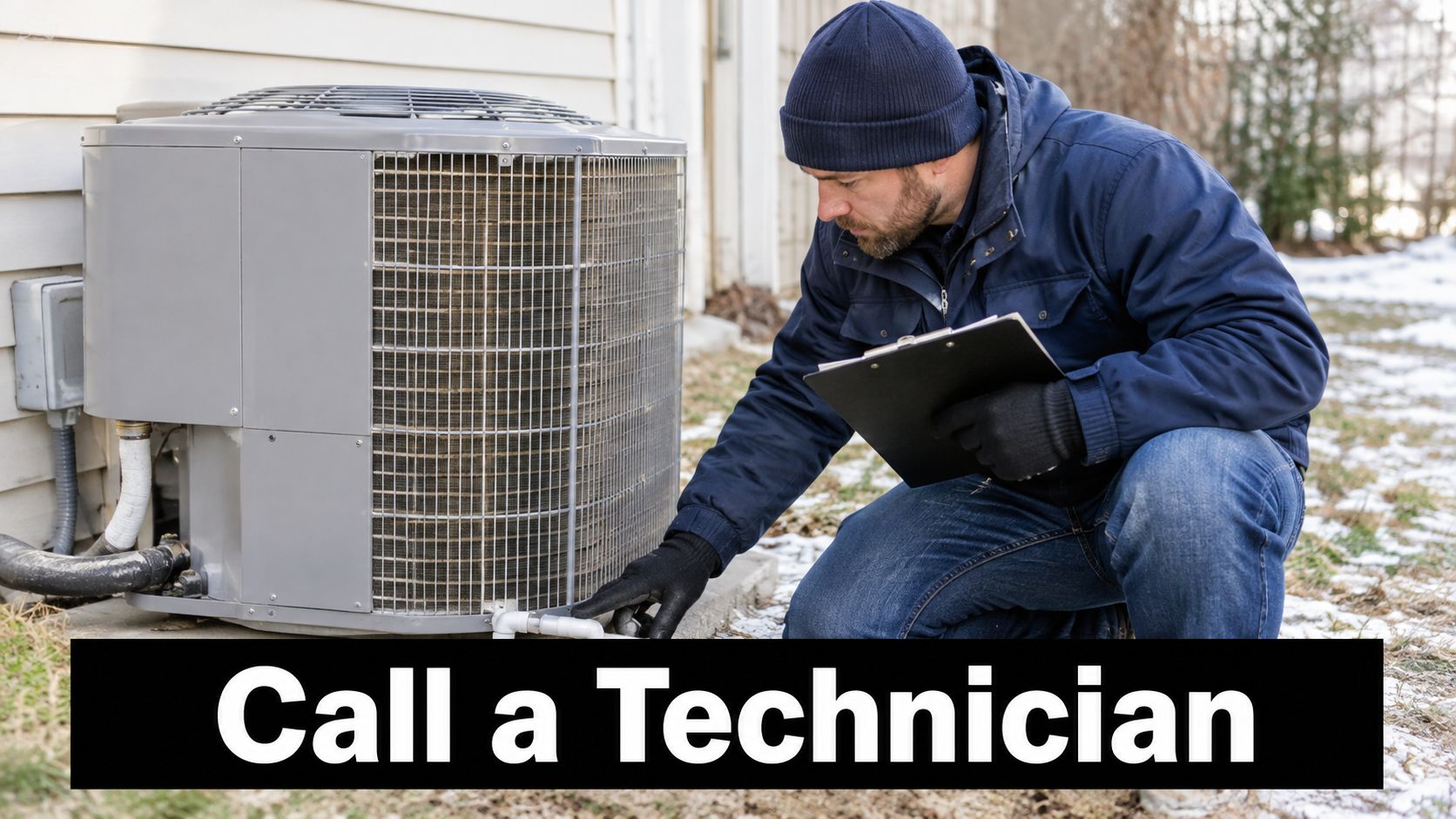
Book a visit when any of these holds after you've cleaned the coil and checked drainage:
Cycles keep repeating in mild, dry weather with no frost on the coil.
Ice is still on the coil after a cycle finishes, or the unit ices over again within minutes.
A cycle runs past 20 minutes, or the system never quite returns to heating.
Auxiliary heat stays on through the entire defrost and beyond it.
You hear grinding or banging at the outdoor unit or the indoor air handler.
A technician checks four things in sequence: sensor placement and termination, refrigerant charge, reversing valve operation, and the control settings themselves. Sensor position matters more than most homeowners expect, because a probe reading the wrong spot on the coil can start or end cycles at the wrong time.
The cycle at the cabinet looks like this, allowing you to match the sound to the hardware.
A rise in the power bill with no change in how you run the house is another reason to book a visit, since it often traces to strip heat running when it shouldn't. Covenant Aire Solutions handles heat pump repair, maintenance, and replacement across the Tucson area, and Danny Polangco holds EPA Certification, Trane Comfort Specialist credentials, and NATE Certification. When a unit fails in the middle of summer or winter, we're typically there within 24 hours of the call. Repair pricing itself is covered in our breakdown of heat pump repair costs.
Do one thing today: take what you observed and hold it against the warning column of the comparison table. If it matches after cleaning and a drainage check, that's your answer, and a certified heat pump technician can confirm it with a gauge and a meter instead of a guess.
Covenant Aire Solutions provides heat pump repair, maintenance, and replacement throughout Tucson and the surrounding communities, and a tune-up includes checking the defrost board's behavior and confirming the sequence runs as designed. If your log shows cycles that run long, repeat in mild weather, or leave ice behind, we can inspect the sensors, charge, and control settings instead of blaming the forecast. Visit Covenant Aire Solutions to schedule a visit.