
Heat Pump Not Blowing Hot Air? A Practical Troubleshooting Guide
It's one of the most frustrating things to experience in the middle of a cold snap: you crank up the heat, but the air coming out of your vents feels lukewarm, or worse, outright cold. When your heat pump isn't blowing hot air, it's easy to assume the worst. But more often than not, the culprit is something surprisingly simple.
Before you even think about calling for a repair, a few quick checks can often solve the problem in minutes. Let's walk through the most common reasons this happens and what you can do about it right now.
Initial Troubleshooting Checklist for Your Heat Pump
Before diving deeper, run through these simple checks that solve most common heating issues.
Potential Cause | What to Check | Simple Solution |
|---|---|---|
Thermostat Setting | Is the thermostat set to "HEAT"? Is the temperature set higher than the current room temp? | Switch the mode from "COOL" or "AUTO" to "HEAT". Raise the set temperature by at least 5 degrees. |
Power Supply | Have any circuit breakers tripped? | Locate your electrical panel. Flip any tripped breakers for the indoor and outdoor units off, then back on. |
Defrost Cycle | Is it a particularly cold, damp day? Has the cool air only been blowing for a few minutes? | Wait 15-20 minutes. The unit is likely running a normal defrost cycle and will switch back to heating. |
These three issues account for a huge percentage of service calls we get. Working through them first can save you a lot of time, hassle, and money.
Quick Fixes When Your Heat Pump Blows Cold Air
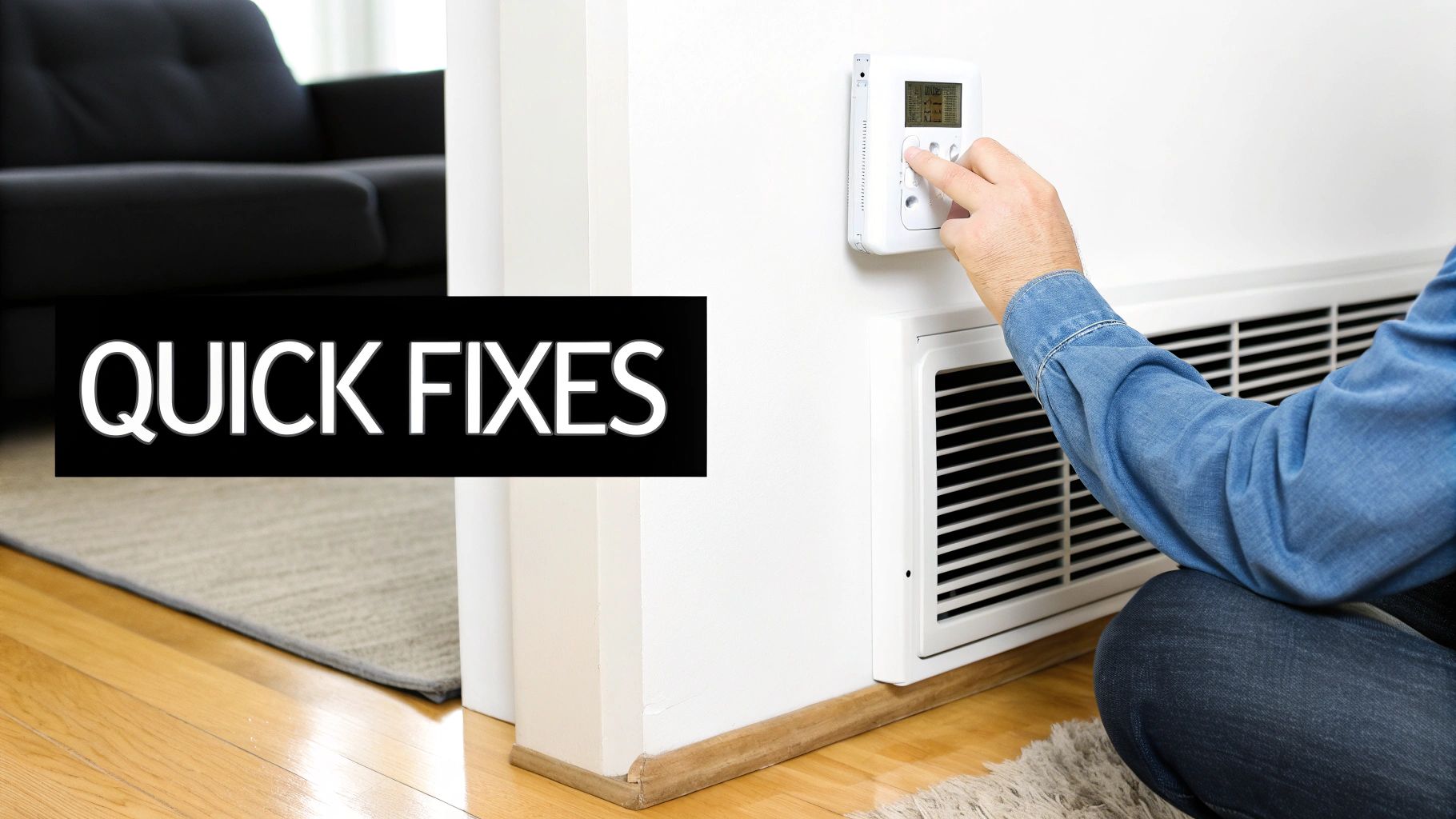
First, Double-Check Your Thermostat
Your thermostat is the brain of your entire HVAC system, and a simple settings mix-up is the number one reason for heating hiccups. It happens all the time; someone accidentally bumps it, or it gets switched to the wrong mode.
Make sure your thermostat is set to "HEAT" mode. If it’s on "COOL," it will obviously blow cold air. The "AUTO" setting can also be tricky, as it might switch between heating and cooling to stay in a narrow temperature range, which isn't ideal for consistent warmth.
Also, take a look at the temperature you have it set to. If the set temperature is actually lower than the current temperature in your house, the heat pump has no reason to kick on. Nudge it up a few degrees higher than the room temperature to get the heating cycle started.
Next, Check the Circuit Breaker
A heat pump is a powerful appliance, and it needs a lot of electricity. That’s why it has its own dedicated circuit breakers in your home’s electrical panel. It's a quick and easy thing to check.
Your system actually has two main breakers: one for the indoor air handler and another for the outdoor condenser. If a power surge or a momentary overload occurs, one of them can trip, which cuts the power and stops the system in its tracks.
Find your breaker box and look for any switches that have flipped to the "OFF" position or are stuck in the middle. To reset it, push the breaker firmly all the way to "OFF" and then back to "ON." If it trips again right away, that points to a bigger electrical problem, and it's time to call in a pro. For more tips on this, check out our guide on what to do when your heat isn't working.
Could It Be a Normal Defrost Cycle?
Have you noticed cool air blowing for just a little while, especially on a really cold and icy day? Your heat pump might just be running a perfectly normal defrost cycle.
When it's cold outside, frost can build up on the outdoor unit's coils. To keep itself running efficiently, the heat pump will periodically reverse its cycle to melt that ice. During this process, the outdoor fan stops, and it briefly sends cooler air through your vents inside.
This is a totally normal function and usually only lasts for about 5 to 15 minutes. Once the frost is clear, the system will switch right back to heating mode. If that cool air keeps blowing for more than 20 minutes, however, you might be dealing with a different issue.
DIY Fixes for Common Airflow Problems
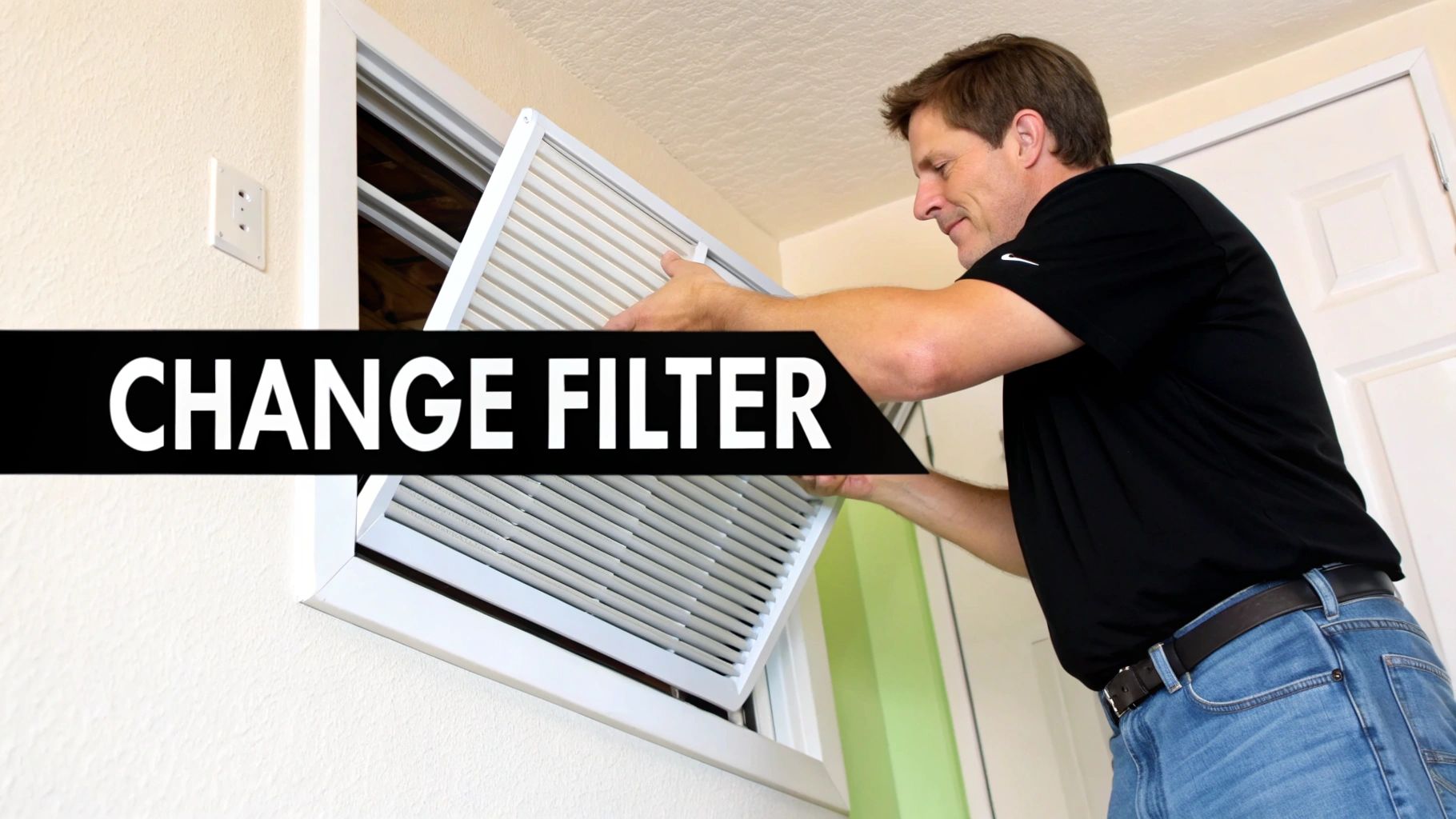
If your heat pump is running but the air coming out is cold, don't panic just yet. More often than not, the culprit isn't a catastrophic mechanical failure. It's usually a simple airflow problem, which is great news because you can often solve it yourself without spending a dime on a service call.
A heat pump’s job is to move heat from one place to another, and it needs a clear path for air to do that. Think of it like an athlete; if it can't breathe, it can't perform.
First Stop: The Air Filter
Your air filter is the number one suspect. It’s designed to trap dust, pet hair, and all sorts of gunk, but over time, it gets completely saturated. A clogged filter is like trying to breathe through a thick blanket; it chokes your system, drastically cutting down the amount of air that can be heated and sent through your vents.
When this happens, the heat pump keeps trying to work, but the warm air it creates gets trapped inside the air handler. This not only leaves you shivering but also puts a ton of stress on the system's most critical parts, setting the stage for more expensive breakdowns.
Pro Tip: Don’t just glance at the filter. A surefire test is to hold it up to a light. If you can’t see the light through it, it’s well past time for a new one. Swapping it out is easily the cheapest, most effective thing you can do for your system's health.
Changing the filter is a breeze. Find the filter slot on your indoor unit (it's usually in a closet, attic, or basement), pull out the old one, and slide in the new one. Just make sure the little arrow on the filter's frame points in the direction of the airflow. We tell our clients to check it every 30 days and plan on replacing it at least every three months.
Next, Check for Blockages Outside
Once you’ve sorted out the indoor filter, take a quick trip outside. Your outdoor unit, the condenser, also needs to breathe freely. It pulls in outside air to extract heat, and if anything is blocking the way, it simply can't do its job.
Take a quick walk around the unit and look for these common culprits:
Landscaping: Overgrown shrubs, weeds, and low-hanging branches can suffocate the unit. You want to maintain at least a two-foot clear zone all the way around.
Yard Debris: After mowing or on a windy day, grass clippings, leaves, and other debris can get plastered against the sides, blocking the delicate metal fins.
Snow and Ice: A big snowstorm or ice event can completely bury your unit. You’ll need to gently sweep the snow away and carefully chip off any ice, being careful not to bend the fins.
A classic scenario we see all the time is a heat pump that quits working right after a storm. The homeowner assumes the worst, but it turns out the unit is just caked in wet leaves or stuck in a snowdrift. A few minutes of cleanup is often all it takes to get things running again.
This lack of airflow is a bigger deal than you might think. Studies have found that dirty or frozen coils are behind 30% of "no heat" calls, as the blockage can slash your heat output by a staggering 50-70%. You can learn more about how the heating market is shaped by these trends on BCC Research's blog. Beyond the filter and outdoor unit, clogged vents or leaky ducts can also cause major airflow issues, a topic we cover in depth in The Ultimate Guide to HVAC Duct Inspection.
Digging Into Deeper Mechanical and Electrical Problems
So, you’ve checked the thermostat, changed the filter, and made sure the power is on, but your heat pump is still blowing cold air. When the simple fixes don't work, it’s a strong signal that the problem lies deeper within the system's mechanical or electrical components.
These aren't issues you can tackle yourself, but understanding what’s going on is incredibly helpful. It allows you to have a much clearer conversation with a technician and prepares you for what the repair might involve. Let’s walk through two of the most common culprits: the reversing valve and the compressor.
The Critical Role of the Reversing Valve
Think of the reversing valve as the traffic cop for your heat pump. This small but vital part controls the direction of the refrigerant, essentially telling your system whether to be an air conditioner or a heater. When you switch your thermostat to "HEAT," the reversing valve is supposed to jump into action, sending hot refrigerant to your indoor coil to warm your home.
But sometimes, they fail. A reversing valve can get stuck in one position, and its default is usually cooling mode. This means even in the dead of winter, your heat pump is stubbornly trying to cool your house, blowing cold air no matter how high you crank the thermostat.
A stuck reversing valve is a surprisingly common reason for a heat pump not blowing hot air, accounting for 15-20% of heating failures in many air-source models. It’s one of the most frequent complaints we get during the first cold snap of the year. In fact, some U.S. Department of Energy reports have shown that nearly 18% of all heat pump service calls were tied to this specific part.
The classic sign of a failed reversing valve? The system works perfectly fine as an air conditioner in the summer but only blows cool or lukewarm air in the winter. This is nearly impossible to diagnose without professional tools, so it's a definite "call a pro" situation.
When the Compressor Fails
If the reversing valve is the traffic cop, the compressor is the engine. Tucked away in your outdoor unit, this powerful motor does the heavy lifting of pressurizing the refrigerant and pumping it through the system. Without a working compressor, the heat transfer process grinds to a complete halt.
A failing compressor is one of the most serious issues a heat pump can have, and the signs are usually anything but subtle.
Here’s what to listen and look for:
Loud, Unsettling Noises: A healthy compressor has a steady, low hum. A failing one, on the other hand, can make some truly awful sounds: think loud grinding, metallic clanking, or even high-pitched shrieking as its internal parts break down.
Constant Breaker Trips: The compressor is a major power draw. If it’s struggling to start up or has an electrical short, it will pull way too much current and trip your circuit breaker over and over again.
A Shaking Outdoor Unit: In severe cases, a damaged compressor can make the entire outdoor unit shake violently when it tries to kick on.
The compressor is a complex, sealed component. To get a better sense of how this workhorse operates, you can check out our explainer on what a scroll compressor is.
Because the compressor is the heart of your heat pump, replacing it is a major, and expensive, repair. If your system is getting on in years, a technician will often recommend replacing the entire outdoor unit, as it can be more cost-effective in the long run. Any issue with the reversing valve or the compressor is strictly professional territory; they require specialized diagnostic gear and a license to handle refrigerant safely.
Why Refrigerant Levels Can Make or Break Your Heat Pump’s Heating Power
Think of refrigerant as the workhorse of your heat pump. This special fluid is constantly cycling through the system, grabbing heat from the chilly outside air and carrying it inside to warm your home. If you don't have the right amount, that whole heat-transfer process grinds to a halt.
When the system is low on refrigerant, it just can't absorb enough heat to do its job. This is easily one of the most common reasons homeowners find their heat pump blowing cold air right when they need warmth the most.
The Biggest Misconception About Refrigerant
A lot of people think heat pumps "use up" refrigerant over time, like gas in a car. That couldn't be further from the truth. Your heat pump is a sealed system, which means the refrigerant level should stay exactly the same for its entire life.
So, if your system is low, it doesn’t just need a "top-off." It means there’s a leak somewhere, in the lines, the coils, or at a connection point. Just adding more refrigerant without finding and fixing that leak is a temporary, expensive band-aid that’s also bad for the environment.
Key Takeaway: Low refrigerant is always a symptom of a bigger problem: a leak. A pro needs to find and repair the leak before recharging the system. Anything else is just throwing money away.
Telltale Signs of a Refrigerant Leak
A refrigerant leak might start small, but it always leaves clues. Catching these signs early can save you from a much bigger headache, like a fried compressor.
Keep an eye (and ear) out for these common symptoms:
Hissing or Bubbling Noises: A distinct hissing or gurgling sound from either the indoor or outdoor unit is a dead giveaway. That's the sound of refrigerant escaping through a crack or loose fitting.
Ice on the Outdoor Coils: When it’s in heating mode, you might see frost or ice building up on the outdoor unit, even when it’s not in a defrost cycle. Low refrigerant makes the coils get way too cold, causing ice to form.
Lukewarm Air: This is the most obvious one. The air coming from your vents feels weak, cool, or just barely warm. The heating performance has clearly dropped off.
Skyrocketing Energy Bills: Your heat pump has to run constantly to even try to hit the temperature you set on the thermostat. That extra work shows up as a sudden, nasty surprise on your electricity bill.
Why You Absolutely Need a Pro for This
Let's be clear: handling refrigerant is not a DIY job. It requires specific tools, deep training, and an EPA certification because it can be hazardous to both you and the environment. Only a licensed technician can legally and safely find the leak, repair it properly, and then recharge the system with the precise amount of refrigerant specified by the manufacturer.
This isn't a rare problem, either. Service technicians report that low refrigerant is behind a staggering 42% of 'no heat' calls. Leaks can be caused by anything from a defect at the factory to corrosion over the years or even simple vibrations that work a connection loose. Repairing a leak can cost anywhere from $500 to $1,500, all depending on where the leak is and how bad it is. If you're interested in the broader industry trends, you can discover additional insights on the heat pump market.
It’s also important to know what kind of refrigerant your system uses, especially if it’s an older model. To get up to speed on that, check out our complete guide to what replaces R-22 refrigerant. If you think you have a leak, the smartest and safest thing to do is shut your system down completely and call a certified HVAC expert right away.
Knowing When to Call an HVAC Professional
Look, I'm all for homeowners tackling a few basic maintenance tasks. Changing a filter or checking a thermostat setting can absolutely save you a service call. But there's a clear line in the sand, and crossing it can turn a small problem into a costly, dangerous disaster. Knowing when to put down the tools and pick up the phone is one of the smartest things you can do for your home and your wallet.
Some symptoms are more than just minor hiccups; they’re bright red flags signaling a serious mechanical or electrical failure. These aren't issues you can fix with a YouTube video and a screwdriver. They demand specialized tools, certified expertise, and a deep understanding of how these complex systems work.
Definitive Signs You Need an Expert
If your heat pump starts acting up in any of the following ways, it's screaming for professional help. Trying to fix these yourself is a gamble you don’t want to take, as it can lead to bigger breakdowns or even personal injury.
Loud, Unusual Noises: Your heat pump should produce a consistent, low hum. If that hum turns into a loud grinding, metallic shrieking, or intense buzzing, something is seriously wrong. This often points to a failing compressor or motor bearings that have given up, both of which are critical component failures.
Persistent Electrical Problems: Does the circuit breaker for your heat pump trip over and over again? Stop resetting it. This is a clear sign of a major electrical fault, like a short circuit or a compressor that's drawing way too much power. Both are serious fire hazards.
Any Signs of a Refrigerant Leak: As we've touched on, refrigerant isn't something to mess with. If you hear a hissing sound, see ice building up on the coils, or spot an oily film around the refrigerant lines, you have a leak. Only an EPA-certified technician can legally and safely handle refrigerant.
This decision tree gives you a good visual for how symptoms of a refrigerant leak should be handled, and spoiler, it always ends with calling a pro.
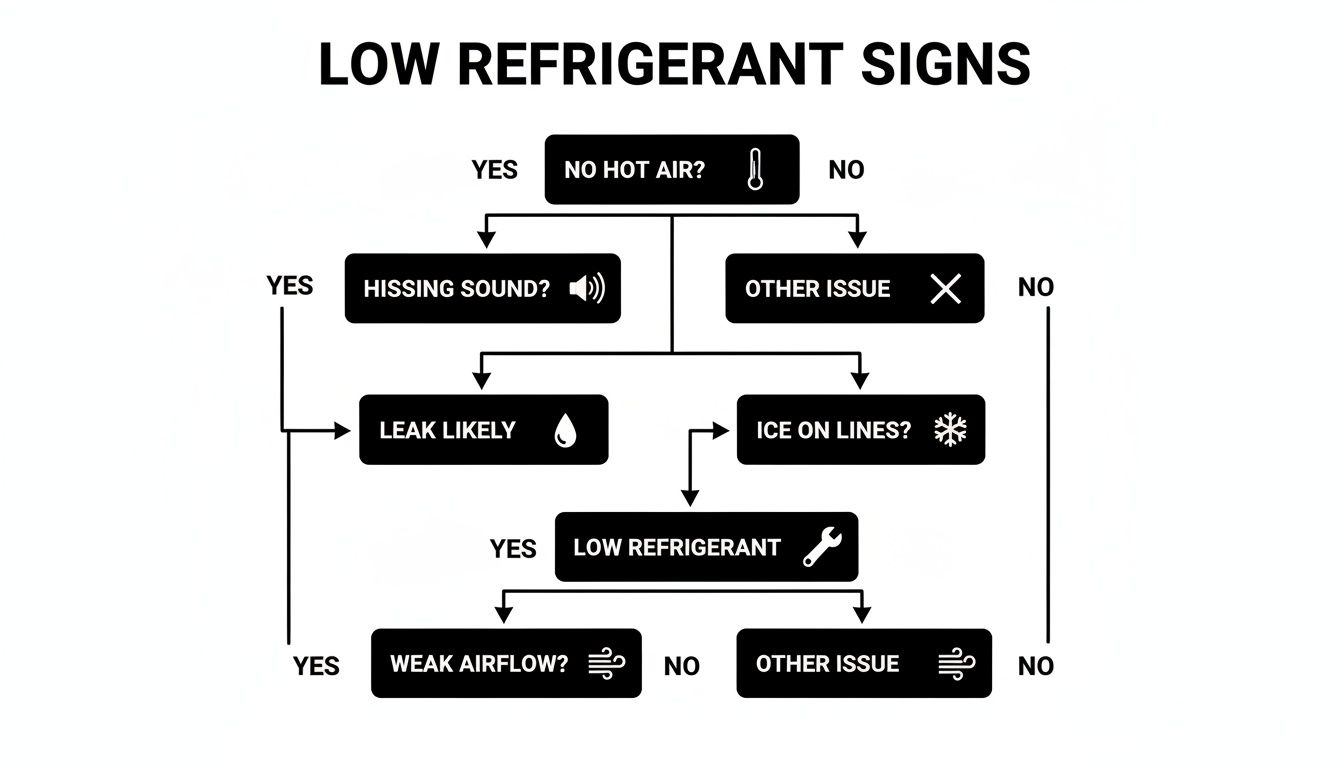
As the flowchart shows, things like hissing sounds or unexpected ice point directly to a refrigerant problem, which is firmly in "professional-only" territory.
Drawing the Line Between DIY and Pro Repairs
I get it. Nobody wants to pay for a service call if they don't have to. But when it comes to HVAC work, safety has to be the number one priority. You’re dealing with high-voltage electricity and pressurized chemicals. Without the right training and gear, it’s just not worth the risk.
When your heat pump is not blowing hot air, the problem can escalate quickly. Ignoring major warning signs like a constantly tripping breaker doesn’t just leave you in the cold; it risks a complete system breakdown.
It's natural to worry about repair costs when you're deciding whether to make that call. To get a better handle on what you might be looking at financially, it helps to know what goes into different types of repairs. You can get a clearer idea of what to expect by decoding your heat pump repair costs in our detailed guide. It’ll help you have a more productive conversation with your technician.
And if you're ever curious about how expert service providers get found online when you search for help, it often comes down to solid local SEO strategies for home service companies.
To help you draw that line between a simple fix and a serious hazard, we've put together a quick table outlining which tasks are generally safe for homeowners and which absolutely require a certified technician.
DIY Fixes vs Professional Repairs
Task | Safe for DIY? | Why a Pro Is Needed |
|---|---|---|
Changing Air Filters | Yes | This is a basic, safe, and essential maintenance task. |
Checking Thermostat Settings | Yes | Simple adjustments require no technical expertise. |
Resetting a Tripped Breaker | Yes (once) | If it trips again, it signals a deeper electrical issue. |
Cleaning Outdoor Unit | Yes | Removing leaves and debris is safe with the power off. |
Repairing Refrigerant Leaks | No | Requires EPA certification and specialized recovery equipment. |
Fixing Electrical Faults | No | High voltage presents a serious risk of shock or fire. |
Replacing a Compressor | No | A complex job involving both electrical and refrigerant systems. |
Troubleshooting Blower Motor | No | Involves high-voltage capacitors and delicate components. |
This table should make it clear: once you get beyond basic cleaning and settings, the risks climb exponentially. It’s always better to be safe than sorry.
A Quick Safety Checklist Before You Start
Before you even think about troubleshooting, run through these questions. Your answers will tell you whether to proceed or call for backup.
Does this involve opening sealed electrical panels? If the answer is yes, stop right there. Anything beyond flipping a circuit breaker back on should be handled by a professional.
Does this require touching refrigerant lines? If you even suspect a leak, the only right answer is to call a pro. It's a matter of safety and federal regulations.
Can I physically access the equipment safely? Don't risk a fall by climbing onto a slippery roof or squeezing into a cramped, unstable attic space. Your safety comes first.
Do I have the right tools and knowledge? Using a wrench when you need a multimeter is a recipe for disaster. If you aren't 100% confident in what you're doing, it's time to call for assistance.
If you're hesitating on any of these, that's your cue. Calling a certified technician from Covenant Aire Solutions is the smartest move. Our team has the training and equipment to diagnose and fix these complex problems safely, ensuring your system gets repaired right the first time.
Answering Your Top Heat Pump Questions
Even after you've checked all the basics, it's natural to have a few more questions about your heat pump. Knowing the ins and outs of how these systems operate can make a huge difference in spotting small issues before they become big, expensive problems. Here are the answers to the questions we hear most often from homeowners.
How Often Does My Heat Pump Need a Professional Tune-Up?
To keep your heat pump humming along, you really should have it professionally serviced twice a year. We recommend scheduling one visit in the spring to get it ready for the cooling season and another in the fall to prepare it for winter. Think of it as a wellness check for your home's most important appliance.
During a tune-up, a certified technician does a lot more than just swap out the filter. They'll give the coils a deep clean, check your refrigerant levels, tighten electrical connections, and make sure all the moving parts are properly lubricated.
This isn't just about avoiding a breakdown. The U.S. Department of Energy estimates that routine maintenance can boost your system's efficiency by up to 25%. That translates to real savings on your utility bills and can add years to your unit's life.
Is It Normal for My Heat Pump to Run All the Time?
When the temperature outside really takes a nosedive, yes, it can be perfectly normal for your heat pump to run almost constantly. This doesn't automatically signal a problem.
Unlike a furnace that blasts hot air in short bursts, a heat pump is engineered to deliver a slow, steady stream of warmth. It's actually most efficient when it maintains a consistent temperature instead of kicking on and off all the time. So, if it's freezing out but your house feels comfortable, your system is probably just doing its job.
The real red flag is when it runs constantly but can't keep your house warm. That's when you might be looking at a more serious issue, like a refrigerant leak or a compressor on its way out.
What’s the “Emergency Heat” Setting Actually For?
That "emergency heat" or "em heat" setting on your thermostat is your system's backup plan. When you switch it on, it activates a secondary heat source, usually a set of electric resistance coils inside your air handler.
It's designed for just two situations:
A True Breakdown: If your heat pump gives up in the dead of winter, flipping this switch will keep your home from turning into an icebox until a pro can get there.
Extreme Cold: In sub-freezing weather, your heat pump can sometimes struggle to pull enough warmth from the frigid outdoor air. The emergency heat gives it a powerful boost to reach your set temperature.
Use this setting with caution. Those electric coils are energy hogs and can make your electricity bill skyrocket. If you find yourself relying on it frequently, it’s a clear sign your heat pump is either undersized for your home or needs a professional diagnosis.
Should I Turn My Heat Pump Off If It’s Blowing Cold Air?
First, make sure it’s not just in a normal defrost cycle. But if you've confirmed there's a problem and cold air is coming through the vents, it’s a good idea to shut the system off at the thermostat.
Continuing to run the unit can make things worse, especially if the problem is something serious like a refrigerant leak or a struggling compressor. Turning it off protects the most expensive parts from burning out.
After you shut it down, you can check the simple stuff like the circuit breaker and air filter. If that doesn't fix it, leave the system off and give a professional a call. It’s the safest way to prevent a minor hiccup from becoming a major repair bill.
If you’ve walked through these steps and your heat pump is still giving you the cold shoulder, it’s time to call in the experts. The certified technicians at Covenant Aire Solutions have the tools and experience to diagnose the problem quickly and safely. Don't spend another day in the cold; contact us for reliable, 24/7 emergency service.