
A C Service Tucson: What to Book and When
More than 9 in 10 Arizona households use air conditioning, and cooling accounts for about one quarter of all energy consumed in Arizona homes, more than four times the national average at the time of the report, according to the U.S. Energy Information Administration's Arizona state analysis. That one statistic explains why AC service in Tucson isn't a seasonal errand. Cooling is the largest single load in the house and the thing that keeps the house livable.
This guide works through it the way a technician would on a hot afternoon. First the climate math, so you can see how many hours your system works in a year. Then the safety line, because an air conditioner that runs without cooling can be dangerous in a way a warm living room doesn't advertise. Then how to match a service to a symptom, how to judge repair against replacement while refrigerants change, what a filter rating really tells you, and how to book the right visit without paying for a diagnosis you didn't need.
Why Tucson Cooling Demand Never Really Stops
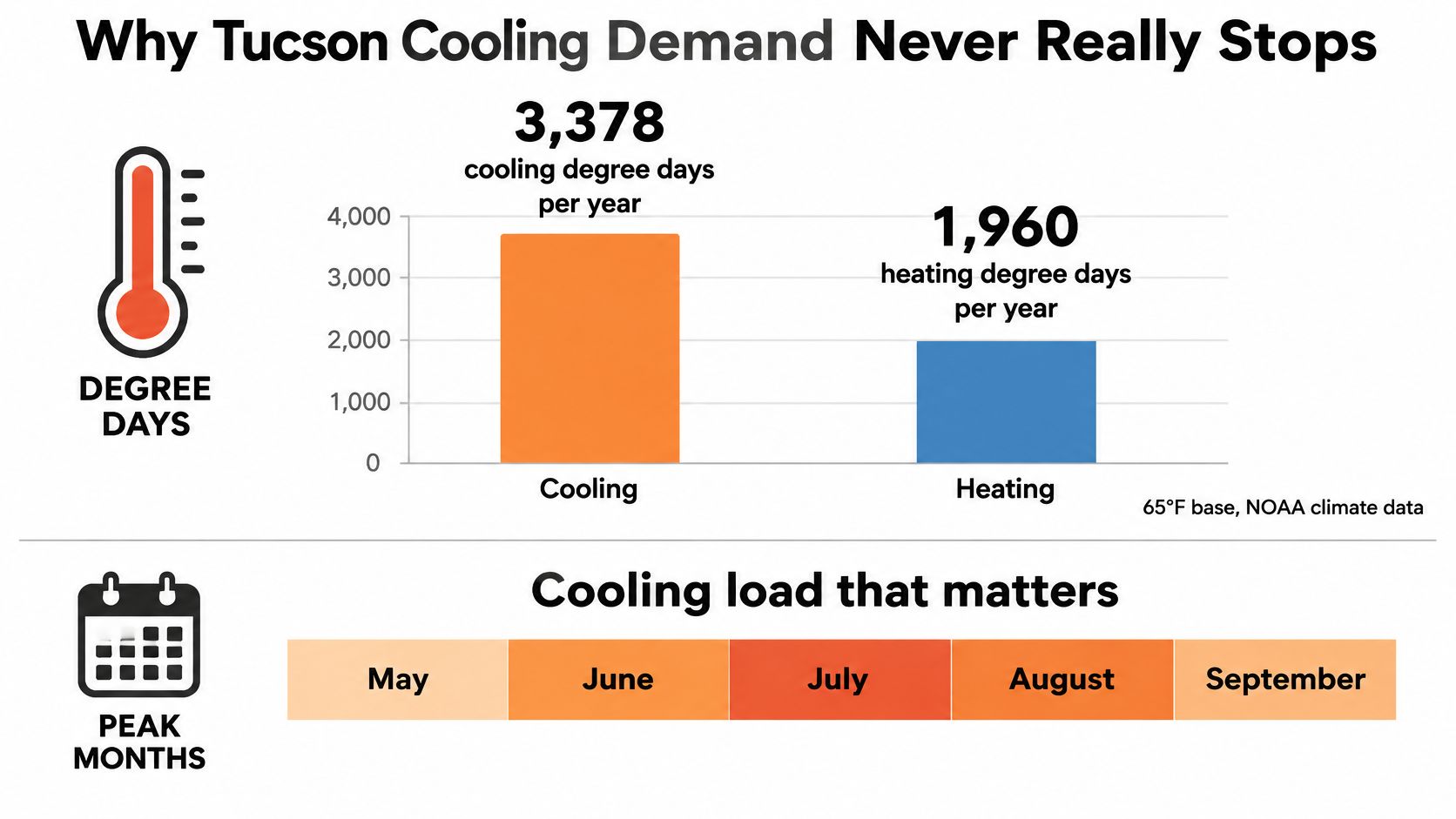
Start with the imbalance. NOAA's engineering climate data for Tucson puts the annual average at 3,378 cooling degree days against 1,960 heating degree days, both computed from a 65°F base temperature. A cooling degree day counts how far a day's average temperature sits above that base, so the ratio is a workload estimate before it's anything else. This climate asks far more of a condenser than of a furnace.
The monthly detail is where it becomes useful. Average cooling degree days run 368 in May, 631 in June, 660 in July, 605 in August, and 466 in September. Those five months total 2,730 degree days, roughly 80.8% of the annual figure, and July alone accounts for about 19.5% of the yearly load.
Now put those numbers on a machine. A system sized for this climate doesn't run for a few hot afternoons in July. It runs through a season that starts in May and is still working in early October, which changes what fails first.
Contactors and capacitors take the cumulative hit. Hundreds of compressor starts in one summer pit contact points and weaken a run capacitor until the outdoor fan or the compressor won't come back on.
Condenser coils pack with desert dust and cottonwood fluff. A dirty coil raises head pressure, which raises compressor current, which adds heat to the same house you're trying to cool.
Blower wheels load up and lose airflow long before a filter looks obviously bad on the return grille.
Condensate drains clog with the water a long cooling season produces, and the float switch shuts the whole system down when they do.
A Tucson system rarely fails on one hot afternoon. It fails from the accumulated hours of a season that starts in May and keeps working into the fall.
That's why a mild-climate maintenance model doesn't fit here. An annual tune-up built around a short summer peak misses both ends of the load, so the better pattern is a spring visit before May plus a second look after the heaviest dust, which is exactly what a proper AC tune-up service covers. Seasonal residents feel the gap most: a snowbird who arrives in October to a unit that sat idle for six months finds a failed capacitor the same way a July caller does, with less time to schedule around it.
Every decision below, repair, plan, replacement, or filter upgrade, answers one question. Will this system hold its design indoor temperature across 2,730 degree days of cooling load?
When Indoor Heat Is More Than Discomfort
Pima County's 2025 heat-season report counted 46 days above 100°F, including seven above 110°F, and heat-related emergency department or urgent care visits climbed 13%, from 787 in 2024 to 893 in 2025, according to the Pima County heat-season report. Those numbers describe a public health event, not a run of uncomfortable afternoons.
The most useful finding in that report is also the least comforting. More than 90% of indoor heat-related deaths involved a home with some type of AC unit. Nearly half of those homes had a unit that wasn't working, and more than one third had the AC turned off. The equipment existed. The cooling didn't.
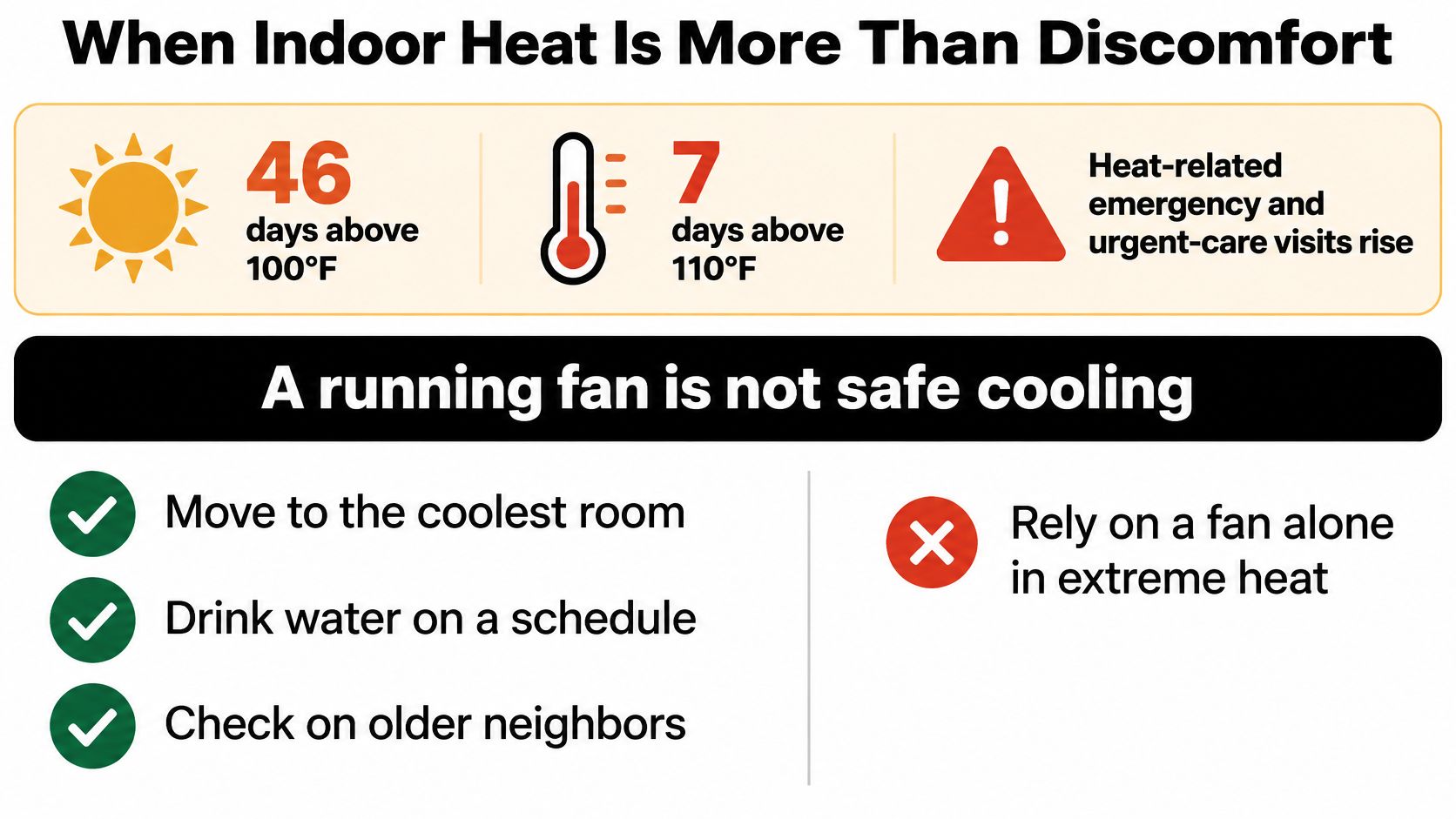
Owning an air conditioner is not the same as having cooling. The distance between those two things is where people get hurt.
A box fan moving 95°F air across your skin doesn't remove heat from the room. It moves air. In a house that's already at 88°F and climbing, that's a comfort gesture, not a cooling strategy.
A same-day sequence when the house keeps warming
Work these in order. Each one tells you whether to keep waiting or stop waiting.
Read the indoor temperature, not the setpoint. A thermostat set to 72°F means nothing if the room is 88°F and rising. A cheap digital thermometer on the kitchen counter gives you a trend line, and the trend is what matters.
Check who is in the house. Children, older adults, and anyone on medication that affects how the body handles heat need to leave sooner than a healthy adult does. Send their medication with them.
Note the symptom pattern. Short cycling, weak airflow at the registers, a burning smell, an outdoor unit that's silent, or a breaker that trips again after reset each point to a different failure, and each is worth describing on the phone.
Move people and medicines before the house gets hotter. If the indoor temperature keeps rising after you've closed the blinds and shut off the oven and the dryer, that's the moment to move to a cooled home or a cooling center rather than wait overnight.
Ask for same-day help. Our emergency line is 520-445-6540, staffed 24/7, because the failure that matters is rarely the one that happens at 10 a.m. on a Tuesday.
Manufactured and mobile homes need their own line in this conversation. They accounted for 10 indoor heat-related deaths in Pima County in 2025, and the reason is structural: thinner walls, less insulation, and one package unit working against direct sun on a low roof. If that's your home, a warm afternoon is the deadline, not the warning.
Cost belongs in the safety picture too. A unit that sits off because the bill is unaffordable fails a household the same way a dead compressor does. We offer free diagnostics and evaluations of non-working or failing units for eligible recipients, with materials and repairs billed separately. If you're unsure whether tonight counts as an emergency, this explanation of what is considered an HVAC emergency takes two minutes and settles it before you decide to sleep on it.
Which AC Service Matches the Problem
A service ticket should name one job. In practice, homeowners book a tune-up for a system that hasn't cooled since Tuesday, or ask for a replacement quote when a contactor has burned out. Search AC service Tucson on a 108°F afternoon and you'll get a page of ads, most of them written to sell the biggest job available. The table below is a better filter, because it starts from the symptom.
Service | Book it when | What gets checked | You should leave with |
|---|---|---|---|
AC repair | Warm air, short cycling, no start, noises, or a tripped breaker | Thermostat, capacitor and contacts, coils, drain, refrigerant performance, airflow | A named failed part and a repair scope, or a written reason it is not worth fixing |
AC maintenance | System still cools and summer or a dust event is ahead | Filter, coils, drain, electrical, blower, operating pressures | A cleaned, tested system and a list of items nearing failure |
AC replacement | Major repeat failures or it cannot hold setpoint after repairs | Age, leak history, load, ducts, electrical capacity, refrigerant type | A sized quote that separates equipment, labor, ducts, and warranty |
Heat pump service | One system both heats and cools | Cooling and heating modes, reversing valve, defrost, airflow | Confirmation of which mode failed and whether repair or swap fits |
Duct cleaning or Aeroseal | Hot rooms, dusty supply air, or bills high while the unit seems fine | Room airflow, leakage, static pressure | A seal or cleaning result tied to measured airflow, not a compressor guess |
Air purification | Allergies, dust, or smoke after the system can still move air | Filter size, MERV fit, blower static pressure | Filtration the air handler can handle, or a reason a higher rating will not |
Where the wrong booking costs you
Book a repair as maintenance and the visit is wasted. A tune-up can't fix warm supply air when the compressor isn't running or the capacitor has failed. It can only locate the fault and quote the fix, which means you paid for a diagnosis you could have had on the first visit.
Book maintenance as a repair and a routine problem becomes an emergency. A system that still cools in March but hasn't been opened in two years is a July breakdown waiting on a dust storm, and the visit that prevents it costs less at 9 a.m. than at 9 p.m.
Book a replacement where a repair would do and a fixable system becomes a financing agreement. Heat pump work deserves its own row because one machine handles two modes, and a technician who tests only cooling can walk past a reversing valve or defrost fault that surfaces in January.
Duct problems imitate refrigerant problems. Hot rooms, dusty registers, and high bills on an otherwise healthy unit point to leakage and static pressure, which is where cleaning or Aeroseal sealing enters. Sealing supports a refrigerant diagnosis, it doesn't replace one.
Purification comes after airflow. Selling a higher-rated filter to a blower that can't push through it makes the house dustier, not cleaner.
We handle AC repair, AC maintenance, and AC replacement, gas and furnace repair, maintenance, and replacement, heat pump repair, maintenance, and replacement, air duct cleaning, Aeroseal duct sealing, and air purification installation, for residential and commercial properties, on all makes and models. Pick the one row that matches what your house is doing and describe that symptom when you call, rather than the name of a service.
Repair Versus Replacement in the Refrigerant Shift
A refrigerant rule doesn't retire a system that still holds setpoint. That's the whole argument, and it runs against much of what a homeowner hears in mid-July. Federal refrigerant changes began affecting residential equipment in 2025, with new systems shifting toward lower-global-warming-potential refrigerants such as R-32 and R-454B, as this reporting on the 2025 refrigerant transition and its effect on AC costs lays out. Those rules govern what gets manufactured. They don't condemn what's already sitting on your pad.
Here's the part that is true. An R-410A system is not a drop-in match for R-32 or R-454B. The newer refrigerants are A2L, mildly flammable, and they carry their own handling, brazing, ventilation, and labeling requirements. Nobody should top off or mix across refrigerant types, and any technician who suggests it is telling you something useful about how they work.
Here's the part that's also true. A functioning R-410A unit can be repaired and serviced through this transition. Supply tightens over time and the price of a recharge reflects that, but your system doesn't become obsolete because a different gas exists. The decision in front of you is mechanical and economic, not regulatory.
Situation | Usual lean | Verify before you pay |
|---|---|---|
One failed capacitor, contactor, or fan motor on a younger system | Repair | Part price, labor, and whether coils and airflow are actually sound |
High pressure from a dirty coil or clogged filter | Maintain, do not replace yet | Temperature split and coil cleanliness after the cleaning |
Slow refrigerant leak, cooling still acceptable | Repair only if the leak is found and sealed | Leak location, recharge amount, and how soon it returned |
Compressor failure plus repeat leaks on an older, heavily used unit | Replace | Repair cost against remaining summers, warranty, and electrical capacity |
R-410A system that still holds setpoint | Keep and service | It is not obsolete solely because new systems use R-32 or R-454B |
Quote for new equipment | Replace only with a full scope | Refrigerant type, Manual J size, ducts, electrical, and warranty; no drop-in swap |
What a written quote has to say
A quote you can compare names the refrigerant type, a load-based size rather than the tonnage of the unit being hauled away, the duct work if ducts are in scope, the electrical work including panel and wire capacity for the new equipment, and the warranty in years plus what voids it. If any of those five is missing, you have a price, not a quote.
Ask the same question about efficiency that you'd ask about refrigerant. Shade on the condenser, attic insulation, duct leakage, airflow, and correct sizing move performance as much in desert heat as the gas in the pipes, and none of them appear on a spec sheet for a new box.
The question that separates a diagnosis from a pitch: what failed, what does it cost to fix, and how many more summers will that fix realistically buy?
If replacement does turn out to be the right call, we offer 15% off A/C unit replacement, and that discount belongs in the written price rather than in the argument for replacing. Lean toward repair for a younger unit with one failed electrical part, or for high head pressure traced to a filthy coil or a packed filter. Lean toward replacement when the compressor has failed on a mid-life or older unit with repeat leaks, or when repairs keep coming back inside the May to September load. This explainer on the R-410A refrigerant phase-out covers the timeline question in more depth if you want it before you sign anything.
Filters and Airflow for Desert Dust
Tucson's long cooling season means a filter has to catch dust without making the system work harder to move air. MERV rates how well a filter captures particles from 0.3 to 10 microns, using a test method developed by ASHRAE. Higher ratings capture more particles, but they do not automatically improve cooling.
The EPA guide to MERV ratings reports these minimum capture efficiencies for common filter ratings:
Filter | 0.3 to 1.0 micron | 1.0 to 3.0 microns | 3.0 to 10 microns |
|---|---|---|---|
MERV 8 | Less than 20% | At least 20% | At least 70% |
MERV 13 | At least 50% | At least 85% | At least 90% |
HEPA | At least 99.97% at 0.3 microns | Higher than MERV 13 | Higher than MERV 13 |
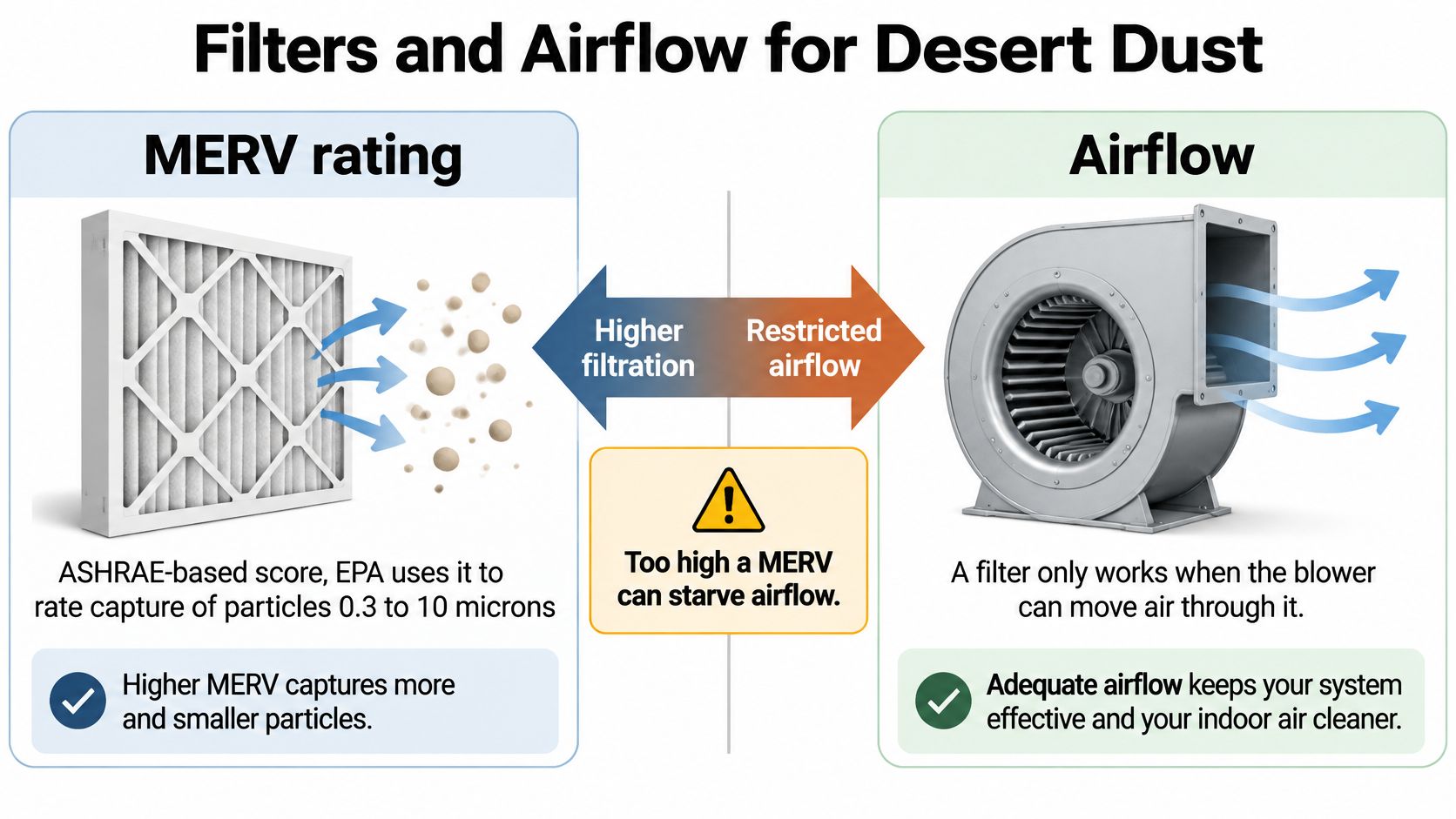
A higher MERV rating can also restrict airflow. A true HEPA filter captures at least 99.97% of particles measuring 0.3 microns, according to the EPA explanation of HEPA filtration. Its heavier pressure profile means it is not a drop-in replacement for a standard residential filter. Choose the highest rating the filter slot and blower can handle, which may be MERV 13 or a lower rating.
The airflow check, in order
Record the filter size and MERV rating. Write them inside the return plenum door so the next replacement is easier to match.
Check static pressure with the old filter and the new one. If the new filter pushes pressure beyond the manufacturer's range, it is too restrictive for the system.
Check supply-air temperature and rooms that cool slowly. Restricted airflow can lengthen run times, make the coil colder than it should be, and leave a bedroom struggling to catch up.
Follow the manufacturer's replacement interval, and check sooner after dust storms or smoke. A loaded filter can restrict airflow even if its rating is appropriate.
Reduce dust entering the system before choosing a higher-rated filter. Seal leaky returns, close gaps around registers, and use the bath fan for ventilation. If you are unsure when to change the filter, this guide to air filter replacement frequency explains how to set an interval for a dusty home.
Choose a Tucson AC Company and Book the Right Visit
Watch the visit before you book it. The clip above shows the sequence a competent call follows: confirm the complaint, test the system, show the homeowner what failed, then quote the repair. A company that can't describe that order on the phone won't produce it in your driveway.
The machine is usually the simple part. The variable is the company, and the surprises tend to be about scope rather than skill: a diagnosis that turns into a replacement pitch, a repair with no named part, an arrival window that slides six hours on the hottest day of the year.
Five things worth confirming before you book
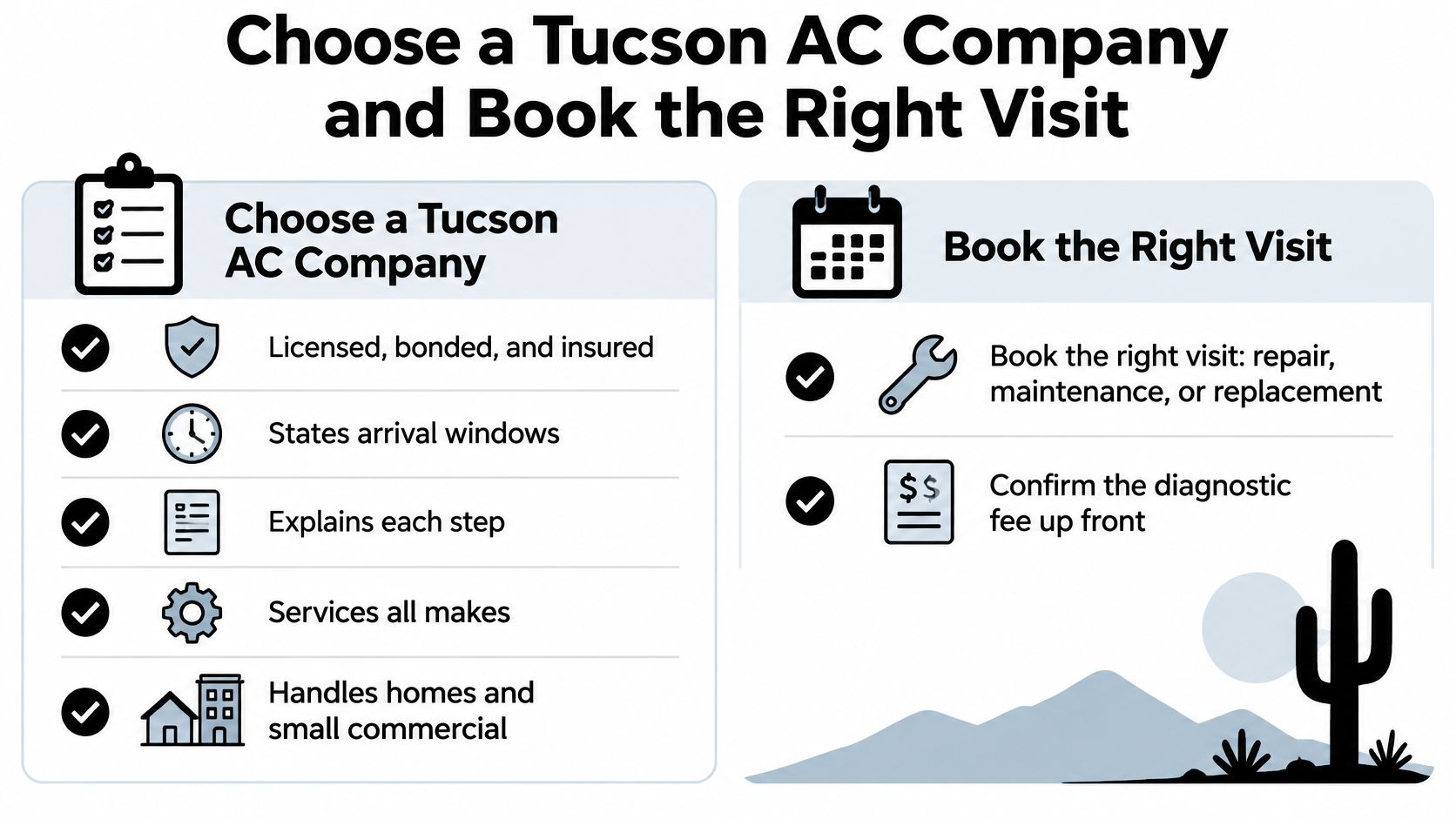
Licensed, bonded, and insured. Ask for the license number and confirm it. A logo on the van proves nothing.
A stated arrival window. "Sometime today" isn't a window, it's a hope, and on a 110°F afternoon the difference between a two-hour window and an open-ended one is the difference between planning your day and canceling it.
A technician who explains each step. You should be able to repeat back what was tested and what failed.
All makes and models. A company that only services what it installed is a company that will find a reason to replace yours.
Homes and small commercial spaces. A crew that handles a retail floor and a 1,400 square foot house has seen more failure patterns than one that only does new construction.
Coverage, credentials, and what a real price looks like
Covenant Aire Solutions is licensed, bonded, and insured, and we cover Tucson, Marana, Oro Valley, Casas Adobes, Catalina Foothills, Green Valley, Sahuarita, Vail, Benson, Sierra Vista, and smaller communities from Arivaca to Tombstone to San Manuel. The office is at 460 West Roger Road Suite 107, Tucson, Arizona 85705.
Pricing should be legible before the truck moves. A quote and an estimate are free. We take $55 off any service call, and the Shield Plan runs five years at $1,100 for one unit, $1,760 for two, $2,640 for three, $3,520 for four, and $4,400 for five, in exchange for the scheduled visits that keep equipment ahead of the May to September load instead of behind it.
Reject any quote that folds refrigerant, duct repairs, and permit or electrical work into one lump sum. Don't approve a system change until the refrigerant, a load-based size, the duct scope, and the warranty are written out. The same instinct applies when you're choosing an HVAC contractor: the written scope is the tell, and a company that resists putting it in writing has told you what the visit will feel like.
If you call at 8 p.m. and reach a voicemail box, you've learned something about after-hours capacity. Contractors who route calls through an HVAC answering service for contractors keep a person on the line through a heat wave, which matters when the gap between tonight and Thursday is a house sitting at 90°F with a toddler in it.
How to book the right visit
Match the visit to the failure. If people are getting hot and the indoor temperature is climbing, that's an emergency call, not a maintenance slot. If the unit should be cooling and isn't, it's a repair. If it cools today but summer is coming, it's maintenance. If the replacement table says replace, ask for a quote and take a day to read it.
Have five things ready when you call: the indoor temperature, the thermostat reading, what the outdoor unit is doing (humming, silent, short cycling), the filter size, and any prior leak or compressor repair. That isn't paperwork for its own sake. It tells the technician which parts to load and whether to bring a recovery machine on the first trip.
Then ask three questions at the end of the visit.
What failed, what does it cost in writing, and what happens if the house is still hot tonight?
A company that answers all three plainly has done the job. One that answers the first and dodges the other two is selling, not diagnosing.
When the house won't hold temperature, the next step is a conversation with a technician who will name the failed part instead of quoting a system. Covenant Aire Solutions handles AC repair, maintenance, and replacement across Tucson and the surrounding communities, answers the emergency line at 520-445-6540 around the clock, and puts the scope and the price in writing before anyone touches the equipment. Start at Covenant Aire Solutions and book the visit that matches what your house is doing today.