
AC System Service Guide for Arizona Homes
You're in the middle of an Arizona summer afternoon, the thermostat is set where it normally is, but the house feels warm and the system seems to run without catching up. Maybe the air coming from the vents is weaker than usual. Maybe the outdoor unit is making a new sound, or the upstairs rooms never cool as well as the rest of the home.
That situation often appears before a complete breakdown. In Arizona, long cooling seasons and heavy runtime expose problems that a quick visual inspection can miss. Effective AC system service goes beyond changing a filter or checking whether the outdoor fan spins. It verifies airflow, electrical condition, coil cleanliness, drainage, refrigerant performance, and the relationship between those components.
The U.S. HVAC services market includes installation labor, retrofit work, preventive maintenance, repairs, refrigeration, ventilation, and connected controls. It was valued at USD 17.93 billion in 2025 and is projected to reach USD 25.35 billion by 2031, with a 5.90% CAGR over that forecast period, according to Mordor Intelligence's U.S. HVAC services market analysis. That scale reflects a practical reality for homeowners: service is part of the equipment lifecycle, not merely an emergency purchase.
Why Professional AC System Service Matters
A homeowner may first notice the problem as a warm bedroom, a rising electric bill, or a system that never seems to shut off. The temptation is to lower the thermostat, replace the filter, and wait. Sometimes that solves a simple airflow restriction. It won't identify a failing capacitor, a blocked condensate drain, a dirty coil, a refrigerant leak, or a blower problem.
A professional visit matters because one symptom can have several causes. Weak cooling may come from restricted airflow, incorrect refrigerant charge, coil contamination, duct leakage, or an electrical issue. Adding refrigerant before confirming airflow can make the system appear to receive attention while leaving the actual fault unresolved.
Practical rule: A tune-up should explain what the system is doing, not just confirm that it turns on.
Arizona homes also have indoor air quality concerns. Dust, seasonal pollen, pet debris, and moisture around the indoor coil can affect comfort and cleanliness. Homeowners who want broader context on airborne contaminants can review the BacteriaFAQ.com indoor air guide, while an HVAC technician can evaluate the filter, coil, drain pan, and accessible duct conditions specific to the equipment.
Professional service is also about choosing qualified help. Ask how the contractor documents measurements, handles refrigerants, explains repair options, and separates recommended work from optional upgrades. This guide to choosing an HVAC contractor offers useful questions for comparing providers before the heat makes the decision urgent.
The best service visit leaves you with more than a receipt. You should know whether airflow is adequate, whether the system is operating safely, whether water is draining correctly, and which issues deserve attention before they become a no-cooling call.
What Happens During a Comprehensive AC Tune-Up
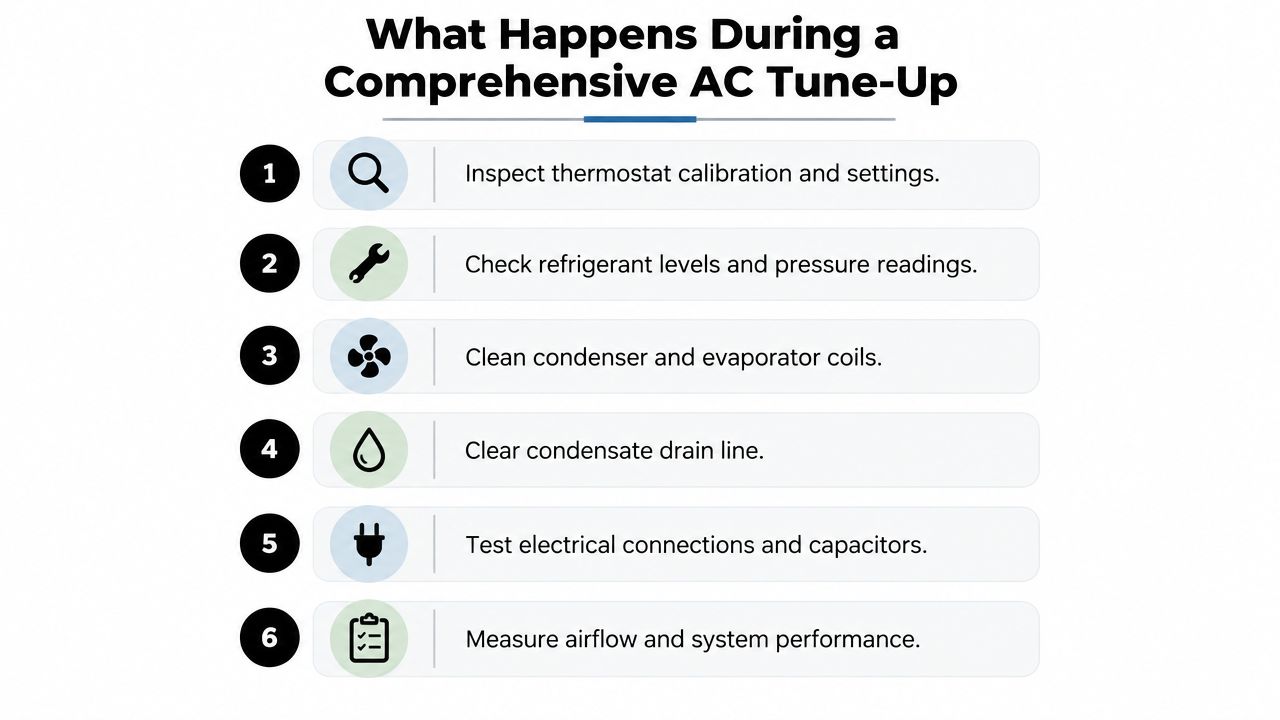
A thorough tune-up follows a logical sequence. The technician shouldn't begin by interpreting refrigerant pressures in isolation, because those readings depend on airflow and operating conditions. The sequence below shows what separates a technical service visit from a basic look-over.
Start with controls and safety
The technician begins with the thermostat, operating mode, temperature settings, and observed cycling behavior. A thermostat that isn't calibrated correctly can create a comfort complaint even when the equipment itself is functioning properly.
Electrical testing follows. The technician should inspect wiring, disconnects, contactors, capacitors, and terminals for unsafe conditions or signs of overheating. Loose connections and weak starting components can produce intermittent operation, nuisance trips, hard starts, or premature motor stress.
Clean the heat-transfer surfaces
The condenser coil releases heat outdoors. Dust, cottonwood, grass, and other debris can reduce the coil's ability to reject heat. The evaporator coil absorbs heat indoors, and contamination there can restrict airflow and interfere with moisture removal.
Cleaning isn't automatically the same for every system. A technician should consider coil construction, contamination type, access, surrounding materials, and the cleaning method's effect on fins and electrical components. Spraying indiscriminately can bend fins, spread dirt, or damage nearby parts.
The condensate drain also deserves a functional check. During cooling, moisture collects at the indoor coil and should move through the drain pan and line. A blockage can lead to water damage, especially when the air handler sits above finished rooms.
Verify airflow before charging refrigerant
This is the step many shallow tune-ups skip. ACR trade guidance on refrigerant charging emphasizes cleaning filters and confirming blower volume before interpreting refrigerant pressures. Manufacturers' performance charts assume known airflow across the indoor coil, so incorrect airflow can distort suction pressure, discharge pressure, and temperature-split readings.
The technician should let the system run long enough to stabilize, then evaluate airflow-related conditions before deciding whether refrigerant is actually missing. If the filter is blocked, the blower is underperforming, or supply and return airflow are restricted, adding refrigerant may produce an incorrect charge and an unreliable diagnosis.
A proper visit may include filter condition, blower operation, temperature readings, static pressure or other airflow indicators, refrigerant pressures, electrical measurements, and a record of system performance. The exact tests depend on equipment design and access.
For additional planning context, this explanation of how long HVAC maintenance takes can help you prepare for a visit without assuming every system requires the same amount of time.
You can also watch a visual overview of common tune-up tasks here:
What Preventive HVAC Maintenance Actually Delivers
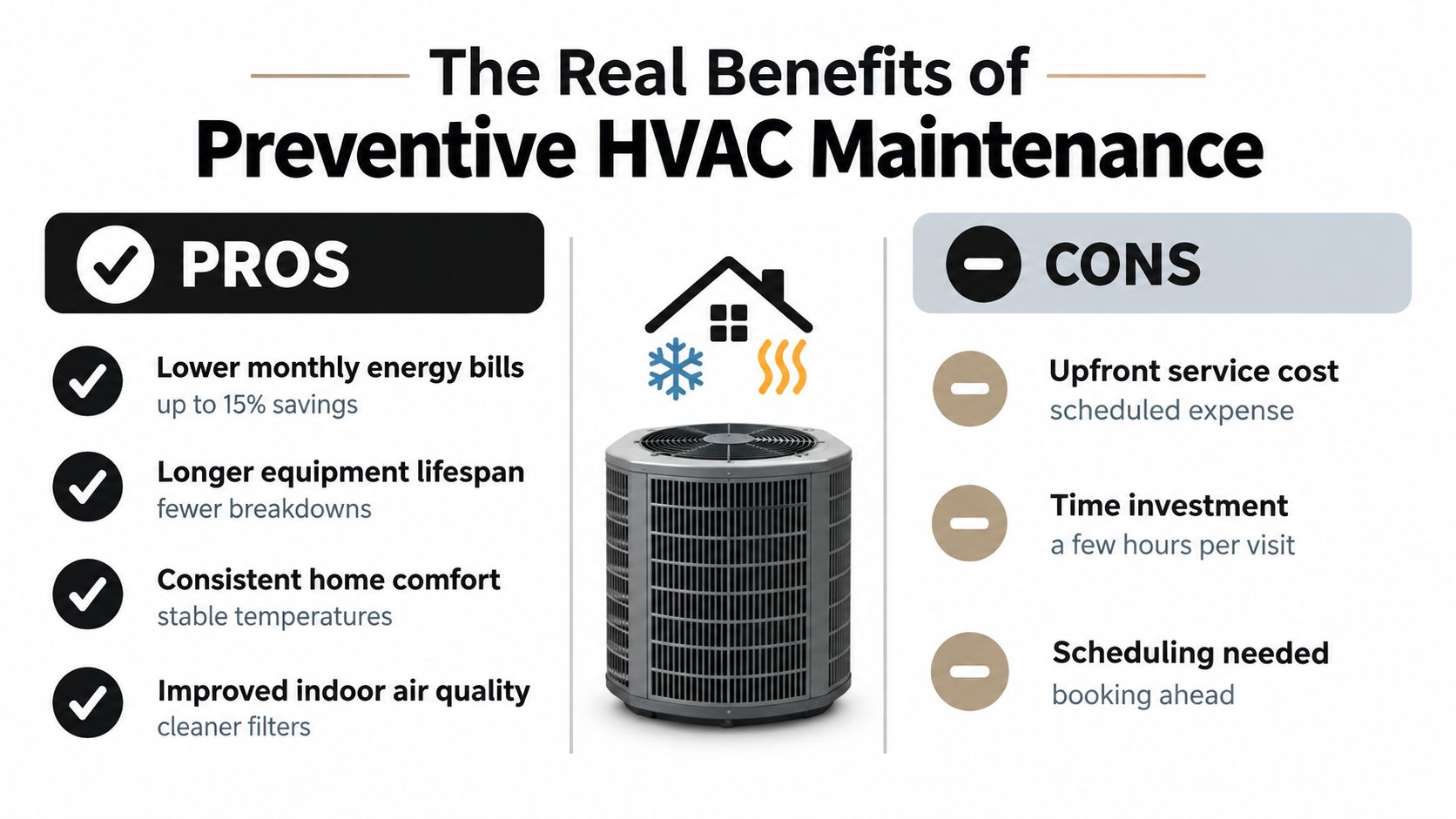
Preventive maintenance has value when each task addresses a specific operating risk. Coil cleaning supports heat transfer, drain clearing reduces water damage risk, and capacitor testing can reveal electrical weakness before a start failure. Airflow verification connects these checks. Without reasonable airflow, refrigerant readings and temperature performance can be difficult to interpret.
Efficiency improvements depend on system condition. Restricted airflow, dirty coils, failing components, duct leakage, thermostat settings, insulation, weather, and household use all affect energy consumption. Service should restore the conditions the equipment was designed for, then confirm whether comfort and runtime improve. It cannot guarantee a fixed level of savings.
The global HVAC maintenance services market was estimated at USD 87.2 billion in 2025 and is projected to reach USD 143.5 billion by 2033, growing at a 6.6% CAGR from 2026 to 2033, according to Grand View Research's HVAC maintenance services market report. That market includes residential, commercial, and industrial maintenance, so it reflects broad demand for inspection, cleaning, and repair rather than the expected result for one Arizona home.
Comfort and equipment protection
A maintained system can provide steadier cooling when the blower, coil, ductwork, and controls operate together. Service will not correct undersized equipment, poorly designed ducts, inadequate insulation, or major envelope problems. It can, however, help distinguish those design limitations from performance that has declined because of dirt, wear, or a developing fault.
Small defects also become easier to address before they stop cooling. A weak capacitor, loose or deteriorating electrical connection, restricted drain, or unusual motor noise gives the homeowner time to choose between monitoring, repair, and replacement. Planned work is generally less disruptive than an emergency diagnosis during an Arizona heat wave.
Filtration requires a system-level decision
Filter selection involves airflow as well as particle capture. ASHRAE's filtration guidance explains that higher-efficiency filters create greater pressure drop, which can reduce airflow and increase fan energy use. It recommends the highest MERV rating the system can accommodate, with MERV 13 preferred where feasible.
Fit matters too. Air that bypasses the filter does not pass through its media, so the frame, gasket, and cabinet seal need attention. A high-rated filter can worsen system performance if the blower and ductwork cannot move air through it properly.
The EPA explains that MERV measures particle capture across particles between 0.3 and 10 microns. MERV 13 or higher filters must demonstrate at least 50% removal efficiency for the smallest particles tested, and EPA MERV guidance notes that many home systems use MERV 8 filters by default.
Homeowners can pair technician measurements with the Bulls Eye Repair maintenance checklist for broader seasonal upkeep. A filter change is one useful task, not a complete tune-up. Guidance on whether HVAC maintenance is necessary can also help weigh service against the system's age, runtime, and condition.
Determining the Right Service Frequency for Your Home
“Once a year” is a useful starting point, not a universal prescription. A home in a mild climate with short cooling demand doesn't place the same load on its equipment as a Tucson home that runs cooling for long stretches.
Climate is only one factor. Runtime, dust exposure, pets, allergies, system age, occupancy, and previous repair history should change the schedule. A newer, lightly used system may need less professional attention than an older unit that runs hard and has recurring airflow or drainage issues.
Use household conditions as the filter
Consider these conditions when deciding how often to schedule service:
Long cooling seasons: Heavy runtime gives wear, dust, and drainage problems more opportunities to appear. A spring visit is important, and a second inspection can make sense when the system operates intensively.
Pets and indoor dust: Fur and debris can load a filter quickly and restrict airflow. Monthly visual checks are sensible, even when professional service occurs less often.
Allergy-sensitive occupants: Filter fit, coil cleanliness, and airflow deserve closer attention. A high-MERV filter should only be installed if the system can accommodate its pressure drop, as ASHRAE explains.
Older equipment: Age can bring more frequent component failures and harder-to-source parts. A technician should evaluate repair history and operating condition rather than apply a calendar rule.
High-use or critical spaces: Commercial guidance commonly separates annual residential attention from more frequent service for high-occupancy or critical facilities. Homes with unusually demanding operation may need a similar risk-based approach.
The EPA says manufacturers typically recommend replacing home HVAC filters every 60 to 90 days, with more frequent replacement when filters become heavily soiled, as described in its home air-cleaner guidance. That is a homeowner filter interval, not a substitute for a professional inspection.
Account for refrigerant changes
Refrigerant selection is becoming part of the repair conversation. Industry coverage states that new residential and light commercial air conditioners and heat pumps manufactured or imported in the U.S. can no longer use R-410A as of January 1, 2025, with newer equipment shifting toward lower-GWP A2L refrigerants such as R-454B and R-32. Some installed inventory has a one-year grace period into 2026, according to this HVAC refrigerant transition guide.
That transition doesn't mean every existing R-410A system needs immediate replacement. It does mean homeowners should ask whether a repair is compatible with the equipment, whether the technician is trained for the refrigerant involved, and whether a major repair makes economic sense compared with replacement.
Use a written preventive maintenance schedule that reflects your actual home. Annual service may suit a mild-use property, while a heavily used, pet-heavy, older, or allergy-sensitive home may justify service twice a year or more frequent checks.
Understanding Service Costs and Maintenance Plans
The cost question has two sides. Planned maintenance is a predictable household expense, while an emergency visit can combine a diagnostic charge, urgent scheduling, replacement parts, refrigerant work, and the consequences of a system operating under extreme heat.
No honest technician can quote a meaningful repair total without diagnosing the equipment. The price depends on the failed component, access, refrigerant requirements, warranty coverage, system age, and whether the problem involves one part or several. Ask for written findings and a clear distinction between immediate safety concerns, reliability repairs, and optional improvements.
Covenant Aire Solutions offers maintenance agreements with biannual check-ups, priority scheduling, and exclusive discounts, along with flexible financing and special rates for teachers, military personnel, and first responders. Those features don't eliminate repair costs, but they can make planned care easier to budget and may provide a defined service relationship when the system needs attention.
This AC maintenance plan cost guide gives homeowners another way to think through the difference between individual visits and an agreement.
Maintenance Plan Benefits Overview
Feature | Standard Service | Maintenance Agreement |
|---|---|---|
Visit timing | Scheduled as needed | Biannual check-ups |
Scheduling | Based on current availability | Priority scheduling |
Discounts | May vary by visit | Exclusive discounts |
Budgeting | Separate service decisions | More predictable planning |
Additional support | Visit-specific | May include plan-related customer benefits |
A plan isn't automatically the right choice. If your home is lightly used, the system is new, and you can reliably schedule inspections, individual service may be sufficient. If cooling is critical, the equipment runs heavily, or you want reminders and priority access, an agreement can reduce the chance that maintenance gets postponed until a failure.
The important comparison isn't “cheap service versus expensive service.” It's planned diagnosis versus delayed diagnosis. Choose the option that matches the cost of discomfort, water damage, equipment downtime, and an unplanned repair decision in your household.
How to Prepare Your Home for the Technician
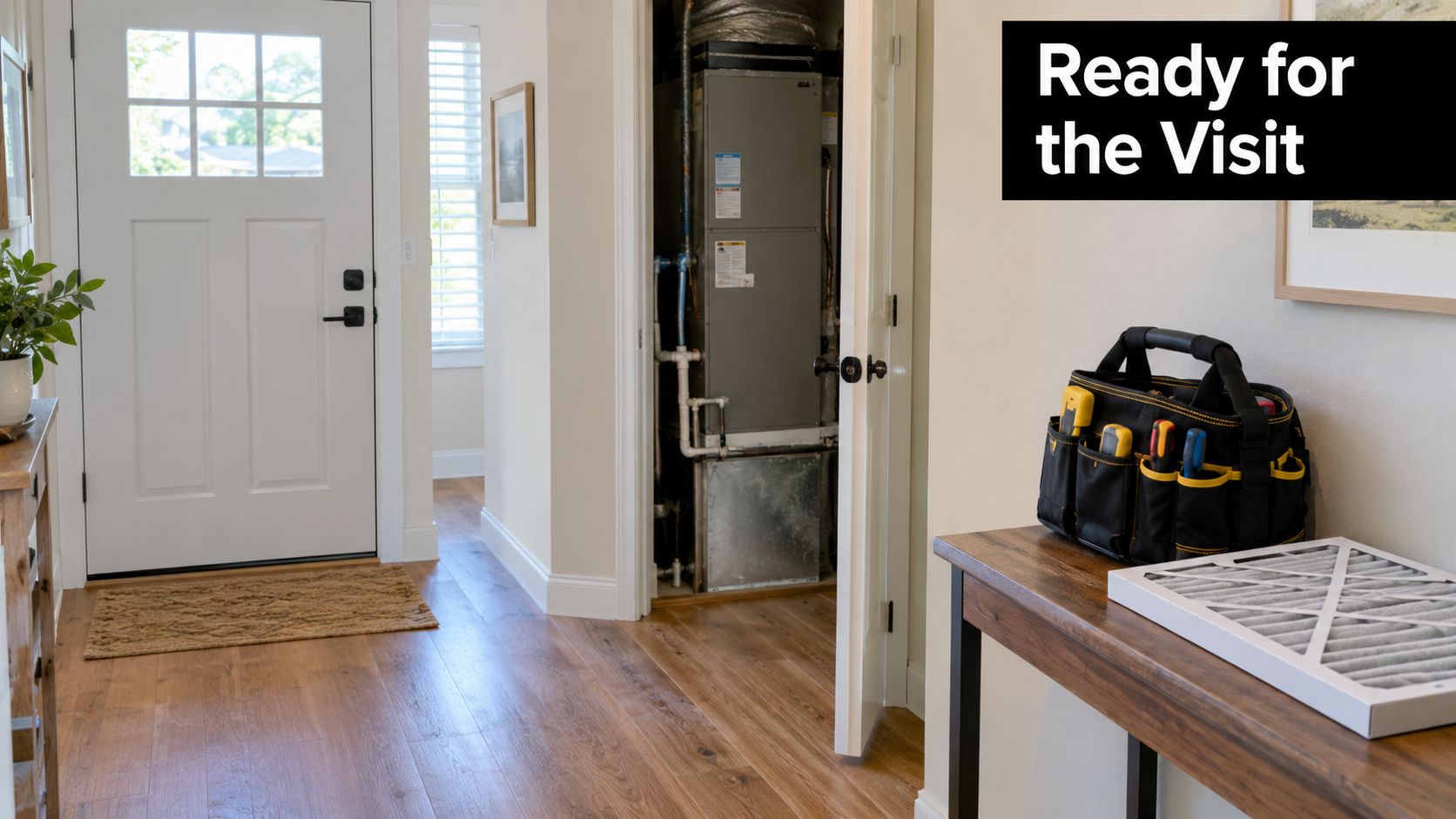
A technician can work faster and diagnose more accurately when the equipment is accessible and the homeowner has useful observations ready. Preparation doesn't require tools or technical knowledge. It requires clearing the path and recording what changed.
Before the appointment
Clear the condenser: Remove leaves, loose debris, stored items, and obstructions around the outdoor unit. Don't open electrical panels or spray internal components.
Provide indoor access: Move boxes, furniture, and household items away from the air handler, furnace, filter rack, attic access, or closet equipment.
Secure pets: Keep dogs, cats, and other animals in a separate safe area so the technician can work without distraction or accidental escape.
Check the filter: Have the current filter available for inspection, and note when it was last replaced. Don't install a higher-MERV filter without confirming that the system can handle the added pressure drop.
Leave vents open: Make sure supply registers and return grilles aren't blocked by furniture, rugs, curtains, or storage.
Write down symptoms: Note warm rooms, weak airflow, short cycling, unusual smells, water near the indoor unit, or noises from the outdoor equipment.
Gather system details: If available, provide the model information, previous repair records, warranty documents, and any recent thermostat changes.
The symptom log matters because intermittent problems may not appear during a short visit. “It makes a humming sound before starting” is more useful than “it sounds strange.” “The hallway is cool but the back bedroom isn't” helps the technician compare comfort complaints with airflow and duct conditions.
Don't try to repair refrigerant circuits, bypass electrical controls, or force a frozen system to run. If the system has visible ice, water leakage, a burning smell, repeated breaker trips, or a loud mechanical noise, switch it off when safe and tell the service provider exactly what happened.
A prepared home also lets the technician spend time on measurements instead of moving obstacles. That improves the chance of finding the cause rather than treating the most obvious symptom.
Securing Your Home Comfort Year-Round
Reliable cooling in Arizona depends on matching service frequency to actual system demand. A lightly used home may need a different plan from a Tucson property that runs its equipment through long hot seasons, houses pets, or has occupants sensitive to airborne particles.
A true tune-up also depends on measurements, not a quick visual check. The technician should verify airflow before adjusting refrigerant, confirm that the filter fits and seals correctly, and inspect coils, drainage, electrical components, controls, and blower operation. These details determine whether the system can deliver the comfort the thermostat requests.
The maintenance market's global scale, noted earlier, reinforces the role of this work. For an individual homeowner, the decision is simpler: maintain the equipment before Arizona heat turns a correctable issue into an urgent failure.
A maintenance agreement can suit homeowners who value biannual visits, priority scheduling, and discounts. Individual service may fit a lightly used system when inspections are scheduled consistently. In either case, choose a contractor who records findings, explains trade-offs, and checks filter condition and airflow before recommending more refrigerant.
Refrigerant changes add another planning point. Existing systems do not automatically require replacement, but major repairs should prompt a discussion about refrigerant compatibility, technician qualifications, parts availability, and the equipment's remaining value. Weigh safety, reliability, operating condition, and total cost together.
Schedule an AC system service visit with Covenant Aire Solutions to have airflow, coils, drainage, electrical components, controls, and refrigerant performance evaluated in the right order. Ask about biannual maintenance agreements, priority scheduling, financing, and applicable rates for teachers, military personnel, and first responders. Set a climate-specific service plan before the next Arizona heat wave.