
How Cold Should Air Conditioner Blow: Tucson Guide
You set the thermostat lower, hear the system running, and stand beneath the nearest vent waiting for that unmistakable blast of cold air. In a Tucson home, the room can still feel warm even when the air conditioner is operating normally, especially when sun-heated walls, ceilings, windows, and low humidity affect how your body reads the space.
So, how cold should an air conditioner blow? A single vent-temperature rule can mislead you. The more useful measurement is Delta T, the difference between the temperature of the air entering the return and the temperature of the air leaving the supply vent. That comparison shows whether the system is removing heat, regardless of the thermostat setting.
Understanding Comfort Beyond the Thermostat
A thermostat tells the system when to run. It doesn't tell you whether the system has enough airflow, whether the coil is absorbing heat properly, or whether the ductwork is delivering cooled air where you need it. A home can have a thermostat set to a comfortable target and still contain warm rooms because of restricted airflow, duct losses, radiant heat, or uneven air distribution.
Start with the return and supply temperatures
Measure the air at the main return vent, then measure the air coming from a nearby supply register while the system is actively cooling. The difference between those readings is Delta T. A properly working central air conditioner should generally produce supply air 14 to 20°F cooler than the air entering the return, according to this HVAC Delta T temperature-split guidance.
For example, if return air measures 95°F, supply air would typically be around 75°F to 81°F. That may not feel like refrigerated air at the register, but it can still represent effective cooling. A reading below roughly 15°F can indicate underperformance, low refrigerant, or an airflow problem, so the measurement gives you more useful information than judging the vent by hand.
Practical rule: Don't chase the coldest possible vent temperature. Confirm that the system is creating a healthy temperature difference while moving enough air.
Comfort includes more than air temperature
Your body also responds to humidity, air movement, and the temperature of surrounding surfaces. A dry Tucson room with hot tile, glass, or exterior walls can feel uncomfortable even when the supply air seems cold. Conversely, moving air can make a room feel cooler without changing the thermostat reading.
Check the basics before assuming the air conditioner needs a colder setting:
Airflow: Make sure return grilles and supply registers aren't blocked by furniture, curtains, or dust.
Thermostat operation: Confirm the system is in cooling mode and the fan setting isn't circulating untreated air between cooling cycles.
Indoor air quality: For practical measures that support cleaner, healthier indoor conditions, review these health-focused air quality tips from VirusFAQ.com.
The useful question isn't “Does this vent feel freezing?” It's “Is the system removing heat at the expected rate, and is the cooled air reaching the occupied space?”
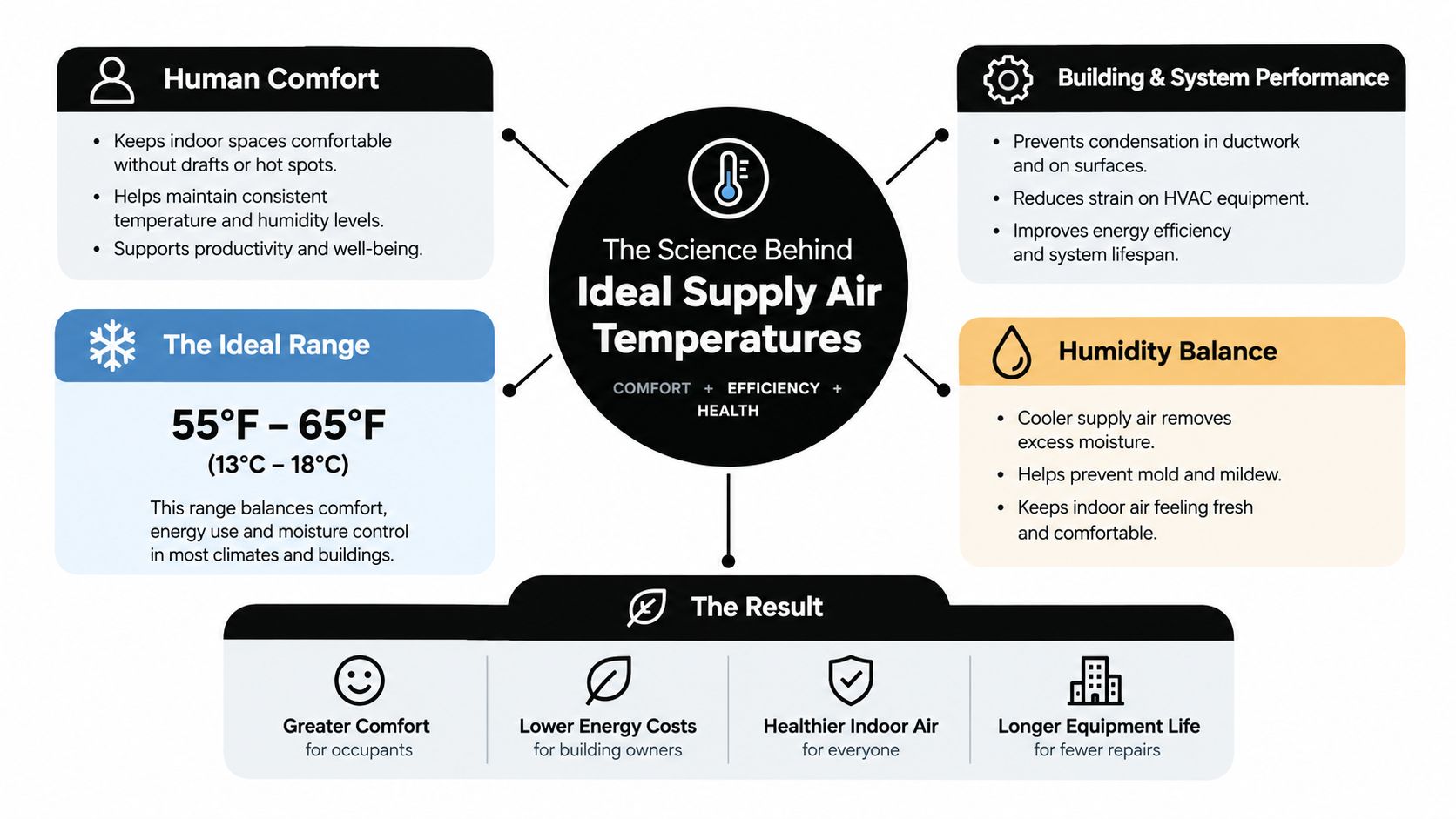
The Science Behind Ideal Supply Air Temperatures
The air inside the equipment can be considerably colder than the air you feel at a register. Cooling coils commonly leave air at about 53°F to 58°F, with 55°F often used as a typical engineering target, as explained in this technical overview of supply-air temperature.
That coil leaving temperature describes a condition inside the air handler. Before the air reaches your living room, it passes through the blower, supply plenum, ducts, registers, and the room itself. Mixing and duct heat gain can raise the delivered temperature. The system also needs to distribute that air gradually rather than turn the room into a cold storage area.
Why 55°F doesn't mean a 55°F room
A cooling coil absorbs heat from return air, and the blower sends the conditioned air into the duct system. The room then gains heat through windows, walls, ceilings, appliances, occupants, and air leakage. The air condition at the coil is therefore a working point in the refrigeration and air-distribution process, not the final temperature every surface or person should experience.
That distinction explains why a vent that feels cool but not icy can still be doing its job. System-level supply air around the mid-50s helps occupied homes settle into comfort ranges such as 75°F to 78°F, rather than forcing every delivered air stream to remain near the coil temperature.
For a clear explanation of the refrigeration cycle, airflow path, and major components, see this guide on how an air conditioner works. Understanding that path also helps you avoid a common mistake: treating a low vent reading as proof of good performance when the system may not be moving enough air.
The most reliable diagnosis combines temperature with airflow. A cold stream from one register doesn't compensate for weak delivery throughout the house, a blocked return, or rooms that never receive enough conditioned air.
Here is a short visual summary of the relationship between the coil and the occupied room:
Why Humidity and Airflow Change How Cold It Feels
Two rooms can receive supply air at the same temperature and still feel completely different. The difference often comes from humidity, air velocity, and the temperature of the room's walls and furnishings.
Thermal comfort isn't determined by air temperature alone. Commonly cited comfortable indoor conditions are around 30% to 60% relative humidity, with indoor temperatures near 72°F to 78°F, or 22°C to 26°C, according to this air-conditioning comfort guidance on temperature and humidity.
Tucson's dry climate changes the experience
Tucson's hot, dry conditions can make supply air feel sharp and cool at the vent while the room still feels warm near sun-exposed surfaces. A west-facing window, a hot roof assembly, or masonry that has stored daytime heat can continue radiating warmth after the air conditioner starts a cooling cycle.
Low humidity can also change how quickly perspiration evaporates from your skin. That may make moving air feel more refreshing, but it doesn't prove that the air conditioner is cooling the structure effectively. A room can feel briefly cooler near a register while heat remains concentrated in walls, floors, furniture, and the ceiling.
Air velocity affects comfort
Operative temperature describes comfort through more than the dry-bulb reading on a thermometer. It also reflects mean radiant temperature and air velocity. A faster fan can make air feel colder on your skin, while a slower stream may feel less noticeable even when the actual temperature is similar.
This is why you shouldn't close multiple registers just because one room feels too cool. Closing or obstructing outlets can alter system pressure and reduce the airflow available to other rooms. If you suspect the duct system isn't delivering air evenly, learn how technicians use static pressure in ductwork to evaluate restrictions and blower performance.
Use a thermometer and, when possible, a humidity meter rather than your hand alone. Then compare:
Return-air temperature: This represents the heat entering the indoor equipment.
Supply-air temperature: This shows the condition of air leaving the system.
Room conditions: These reveal whether heat from surfaces or outdoor exposure is defeating the cooling effect.
Air movement: This indicates whether the system is distributing enough conditioned air.
A colder register isn't automatically a more comfortable home. Good comfort comes from balanced temperature, appropriate moisture control, and enough airflow to distribute cooling throughout the occupied space.
Standard Cooling vs. Cold Air Systems
Most residential cooling systems are designed around a supply-air condition near 55°F. Specialized cold-air systems may deliver air between 42°F and 48°F, with 45°F to 48°F common in some commercial applications, according to this Trane discussion of cold-air system design.
That lower temperature can reduce the amount of air needed for some large commercial applications, but it changes the design requirements. The coil must remain above the saturation point to avoid unwanted moisture problems, and colder air can increase coil load and dehumidification demands. A residential system isn't improved just because its vents feel colder.
System Type | Supply Temp | Best Use Case |
|---|---|---|
Conventional residential cooling | About 55°F | Typical homes designed for balanced comfort and airflow |
Cold-air commercial system | 42°F to 48°F | Specialized commercial applications with suitable coil, duct, and humidity design |
Colder isn't always better
A system that produces very cold air may still struggle if airflow is restricted or the ductwork can't distribute that air effectively. Excessively cold coil conditions can also create moisture concerns, particularly when the system operates under conditions that allow condensation to accumulate or freeze.
For homeowners, the practical target is stable cooling performance, not the lowest possible supply reading. A normal residential design can maintain acceptable comfort with a conventional supply condition while controlling room temperature and moisture in a predictable way.
The same principle applies when comparing cooling equipment for other applications. If you're evaluating water-temperature equipment rather than home air conditioning, you can compare pool chillers in Arizona to see why system capacity and application matter more than one headline temperature.
Ductless equipment also follows its own airflow and sizing logic. A properly selected ductless cooling system can address a room or addition without forcing a central system to deliver colder air everywhere.
How to Measure Your Own AC Vent Temperature
You can perform a useful first check with a basic digital thermometer. Avoid measuring directly against a cold metal register, because the metal can distort the reading. Hold the probe in the air stream and allow the display to settle before recording the result.
Take two readings
Find the main return: Place the thermometer in the air entering the return grille, away from direct sunlight and nearby heat sources.
Run the cooling cycle: Let the air conditioner operate long enough for the supply air to stabilize.
Measure a supply register: Use the nearest accessible supply vent, keeping the probe in the moving air rather than touching the grille.
Record both values: Write down the return temperature and supply temperature so you can compare them accurately.
Calculate Delta T: Subtract the supply temperature from the return temperature.
A properly functioning central air conditioner commonly delivers supply air around 55°F to 65°F, and HVAC references also express normal performance as a 15°F to 22°F drop from return air, as described in this AC vent temperature diagnostic reference.
Measure the difference, not just the vent. The supply temperature has meaning only when you compare it with the temperature entering the system.
Interpret the result carefully
A temperature split in the expected range supports the conclusion that the system is removing heat normally, but it doesn't prove that every room has adequate airflow. A low split can point toward restricted airflow, low refrigerant, dirty heat-transfer surfaces, or another equipment problem. A normal split with one persistently warm room can point toward duct distribution, insulation, solar load, or room-specific airflow.
Check the filter and make sure registers aren't blocked before booking service. If the readings remain abnormal, or if the system is icing, leaking water, making unusual sounds, or cycling poorly, use professional HVAC system diagnostics rather than adding refrigerant or opening equipment yourself.
When to Call a Professional in Tucson
A homeowner can measure Delta T, inspect a filter, confirm thermostat settings, and check for blocked registers. That basic information helps a technician, but it can't confirm refrigerant charge, compressor condition, coil cleanliness, electrical safety, or duct leakage.
Call for service when the temperature drop stays below roughly 15°F, when warm air continues from the vents, or when some rooms remain hot while others cool normally. Those symptoms can accompany refrigerant leaks, compressor problems, frozen coils, or significant airflow restrictions, and continued operation may put additional strain on the equipment.
For Tucson-specific repair guidance, review air conditioner repair in Tucson. A qualified technician can test the system rather than guessing from vent temperature alone, identify the cause of the weak cooling, and explain whether repair, maintenance, or replacement makes practical sense.
Covenant Aire Solutions provides AC diagnostics, repair, maintenance, replacement, ductwork, and indoor air quality services for Tucson homes and businesses. If your Delta T looks abnormal or your home still feels warm despite continuous cooling, visit Covenant Aire Solutions to request professional help.