
Is HVAC Maintenance Necessary? the Real Benefits and Costs
Yes, HVAC maintenance is necessary, but it should be a targeted task list, not a blind subscription. The U.S. Department of Energy reports that proper operations and maintenance can reduce HVAC energy consumption by 5% to 20% annually, while documented service can also help preserve warranty eligibility.
So why do so many homeowners still ask, “Is HVAC maintenance necessary?” The hesitation makes sense. A service plan creates a recurring cost, newer equipment looks self-sufficient, and a system that still blows cold air feels healthy. But an air conditioner can keep running while airflow declines, electrical parts wear, a drain begins to clog, or a coil slowly loses its ability to transfer heat.
For a Tucson homeowner, the decision depends on climate, runtime, dust exposure, equipment age, and warranty terms. A lightly used system in a clean, well-sealed home may need a narrower maintenance routine than an older unit working through a long cooling season. The useful question isn't whether every visit is mandatory. It's which maintenance tasks effectively protect comfort, efficiency, reliability, and coverage.
Why Homeowners Ask Whether HVAC Maintenance Is Necessary
Yes, HVAC maintenance is necessary, but not every maintenance package deserves an automatic yes. Start with the work that has a direct mechanical purpose: replace restricted filters, clean coils, verify airflow, inspect electrical components, clear condensate drainage, and confirm refrigerant conditions. Service records matter too, especially when a manufacturer warranty requires proof of scheduled care, as ConsumerAffairs explains in its HVAC warranty guidance.
Five practical reasons usually settle the question:
Energy control: Dirty filters and fouled coils make the system work harder to move air and reject heat.
Comfort: Correct airflow helps the unit deliver cooling evenly instead of leaving bedrooms warm while the thermostat says the house is comfortable.
Failure prevention: A technician can identify worn electrical components, drainage problems, or abnormal operating readings before a peak-weather breakdown.
Equipment protection: Clean heat-transfer surfaces and correct operating conditions reduce unnecessary strain.
Warranty and records: A dated report can demonstrate that the system received the care required by its coverage terms.
Consider a Tucson family whose compressor fails during a 105-degree July afternoon. The immediate problem isn't only the replacement part. The household loses cooling when demand is highest, emergency scheduling becomes harder, and a small earlier defect may have become a major repair.
Tucson also gives homeowners reasons to pay closer attention than a mild-climate household might. Long cooling periods, dust storms, monsoon moisture, and mineral deposits associated with hard water can affect filters, coils, drains, and outdoor equipment. Those conditions don't prove that every home needs a service plan, but they do make a targeted inspection more valuable.
Practical rule: Treat maintenance as risk management. Schedule the work that protects airflow, heat transfer, drainage, electrical safety, and warranty records, then question extras that don't address a real need.
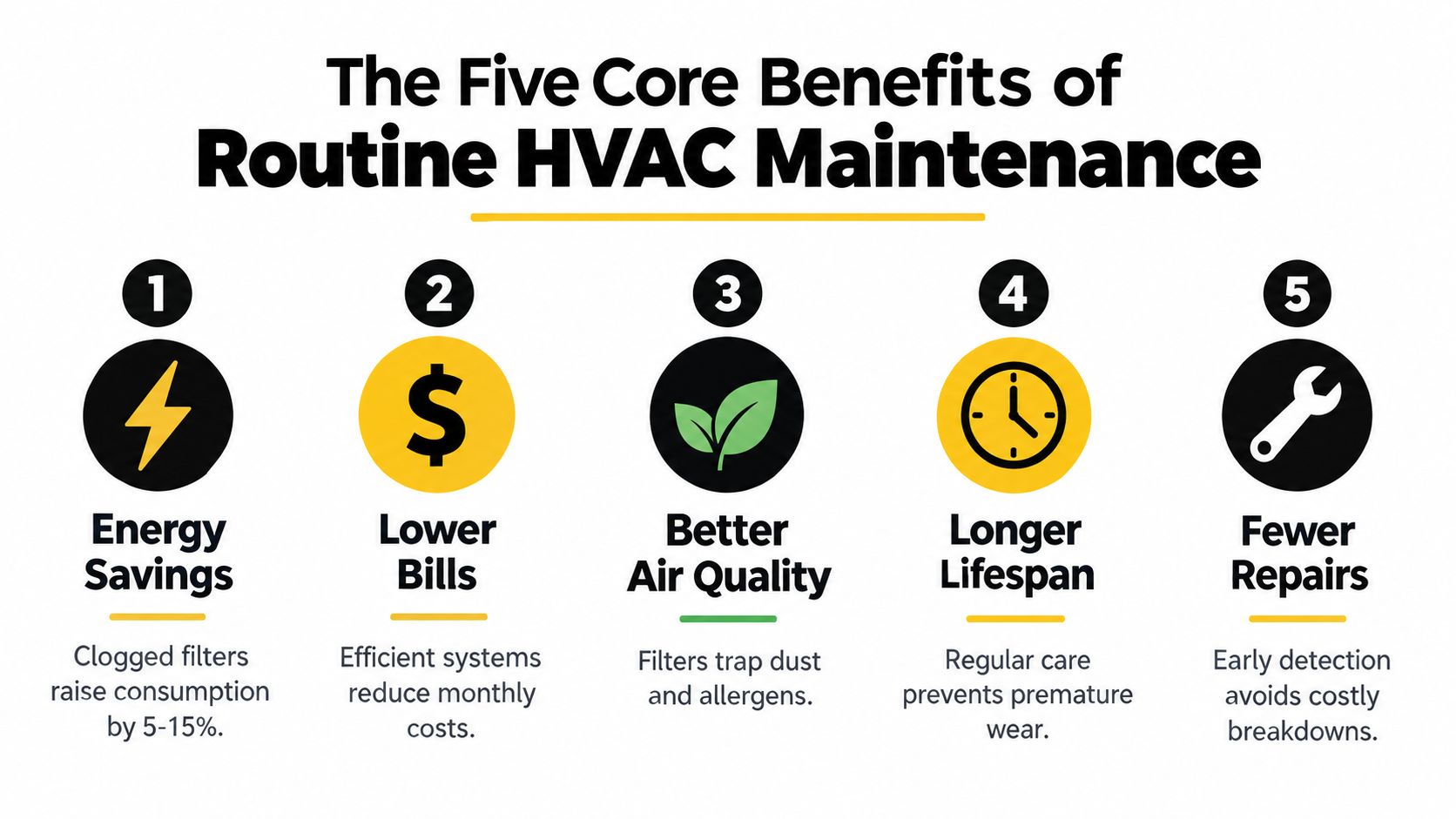
The Five Core Benefits of Routine HVAC Maintenance
Is HVAC maintenance necessary for every home, or does each task need to earn its place on the schedule? The answer depends on what the visit addresses. Filters, coils, refrigerant, drainage, and duct connections can affect daily operation. Other checks mainly document care for warranty requirements.
Energy performance
A clogged filter limits airflow, and dirt on the coil slows heat transfer. The result is similar to breathing through a blocked mask. The equipment may run longer to reach the same thermostat setting, especially during Tucson's long cooling season. Cleaning the surfaces and correcting airflow problems can improve operation, though the savings depend on the unit, ductwork, thermostat setting, and cooling demand.
Equipment life
A central air conditioner or heat pump that stays clean and operates within its design conditions has a better chance of reaching its expected service range. Industry guidance places typical lifespans at 10 to 15 years for central air conditioners and heat pumps and 15 to 25 years for gas furnaces. Neglected equipment can fail earlier (LG's HVAC maintenance overview). Maintenance cannot prevent every failure, but it can reduce avoidable strain from restricted airflow, dirty coils, or incorrect refrigerant conditions.
Cleaner indoor air
Filters capture airborne particles, yet they cannot clean every surface or fix leaking duct connections. Replacing the filter, cleaning accessible coils, and checking duct joints can reduce places where dust collects or enters the airstream. These steps support indoor air quality. They do not replace proper filtration or professional remediation when moisture or contamination is serious.
Safety checks
Heating service has a safety role that cooling-only maintenance does not cover. A technician may inspect the heat exchanger, combustion components, electrical connections, and safety controls. On cooling equipment, testing capacitors, contactors, wiring, and motors can reveal parts likely to overheat or fail under load.
Fewer emergency repairs
Small faults often show up as weak airflow, unusual cycling, water near the air handler, or a change in operating noise. Finding those signs during planned service gives a homeowner more control over timing and repair choices. It also helps separate useful work from visits that mainly produce paperwork.
A Tucson homeowner can use this explanation of what preventive maintenance means to judge each recommendation. Schedule work that protects airflow, heat transfer, drainage, electrical safety, or a specific warranty requirement. Question extras that do not address a documented condition.
Energy Savings and ROI You Can Actually Measure
The strongest public evidence supports a range, not a guaranteed household result. A clean filter, unobstructed coil, correct airflow, and accurate refrigerant charge can help the system use less energy, but the outcome depends on the unit's condition, the home's ductwork, the thermostat setting, and cooling demand.
The U.S. Department of Energy reports potential annual HVAC energy reductions of 5% to 20% from proper operations and maintenance. In one DOE-cited retrofit project, the documented result was 27% annual energy savings plus $18,900 in annual cost savings. That project shouldn't be treated as a promise for a Tucson residence, but it shows why maintenance can matter financially in equipment that runs for long periods.
Commercial owners have an even larger operating-cost exposure. HVAC systems commonly account for about 40% to 44% of total building energy use, and federal building guidance places HVAC use in a broader range of 30% to 70%, depending on the building and system. A modest efficiency improvement can therefore matter more in a busy office, retail space, or multifamily property than in a lightly occupied home.
Maintenance item | Typical cost | Annual savings or benefit | Payback period |
|---|---|---|---|
Filter replacement | Varies by filter and system | Protects airflow and reduces avoidable strain | Depends on filter condition and runtime |
Coil cleaning | Varies by access and fouling | Restores heat-transfer performance and supports efficiency | Depends on the starting condition |
Professional tune-up | Varies by provider and system | Reduces operating risk and may lower energy waste | Depends on system age, usage, and defects found |
Duct sealing | Varies by leakage and accessibility | Keeps conditioned air inside the intended space | Depends on leakage severity and cooling demand |
The right calculation is simple: compare the service price with likely energy waste, the value of avoided downtime, and the cost of a failed component. Don't assume maintenance will produce a fixed return, and don't ignore non-energy benefits such as warranty documentation or avoiding a no-cooling emergency.
Before comparing quotes, review what a visit includes and how pricing is structured in this guide to AC unit maintenance cost.
What Happens During a Professional HVAC Maintenance Visit
A legitimate tune-up should produce measurements and findings, not just a quick glance at the equipment. The technician should be able to explain what was checked, what was cleaned, and which recommendation is urgent, preventive, or optional.
The visit commonly follows this path:
Thermostat first: The technician confirms settings, checks calibration, and observes whether the system responds correctly.
Indoor equipment: The filter is inspected or replaced, the blower assembly is checked, and the cabinet is cleaned where appropriate. Motor amperage and airflow indicators help reveal strain.
Outdoor condenser: The technician clears debris around the unit, rinses the coil, inspects the fins, and tests the capacitor with a meter. Dirt on the coil can restrict heat rejection.
Refrigerant and airflow: A proper evaluation considers operating readings such as superheat and subcooling against the equipment information, not merely a single pressure reading.
Drainage: The condensate pan and drain line are cleared, the float switch is tested, and the technician checks for conditions that could cause overflow damage.
Electrical and heating controls: Connections, contactors, limit controls, flame sensors, heat exchangers, and other relevant safety parts receive an inspection appropriate to the system.
Documentation: The homeowner receives findings, recommendations, readings, and the service date for future troubleshooting, warranty records, and resale documentation.
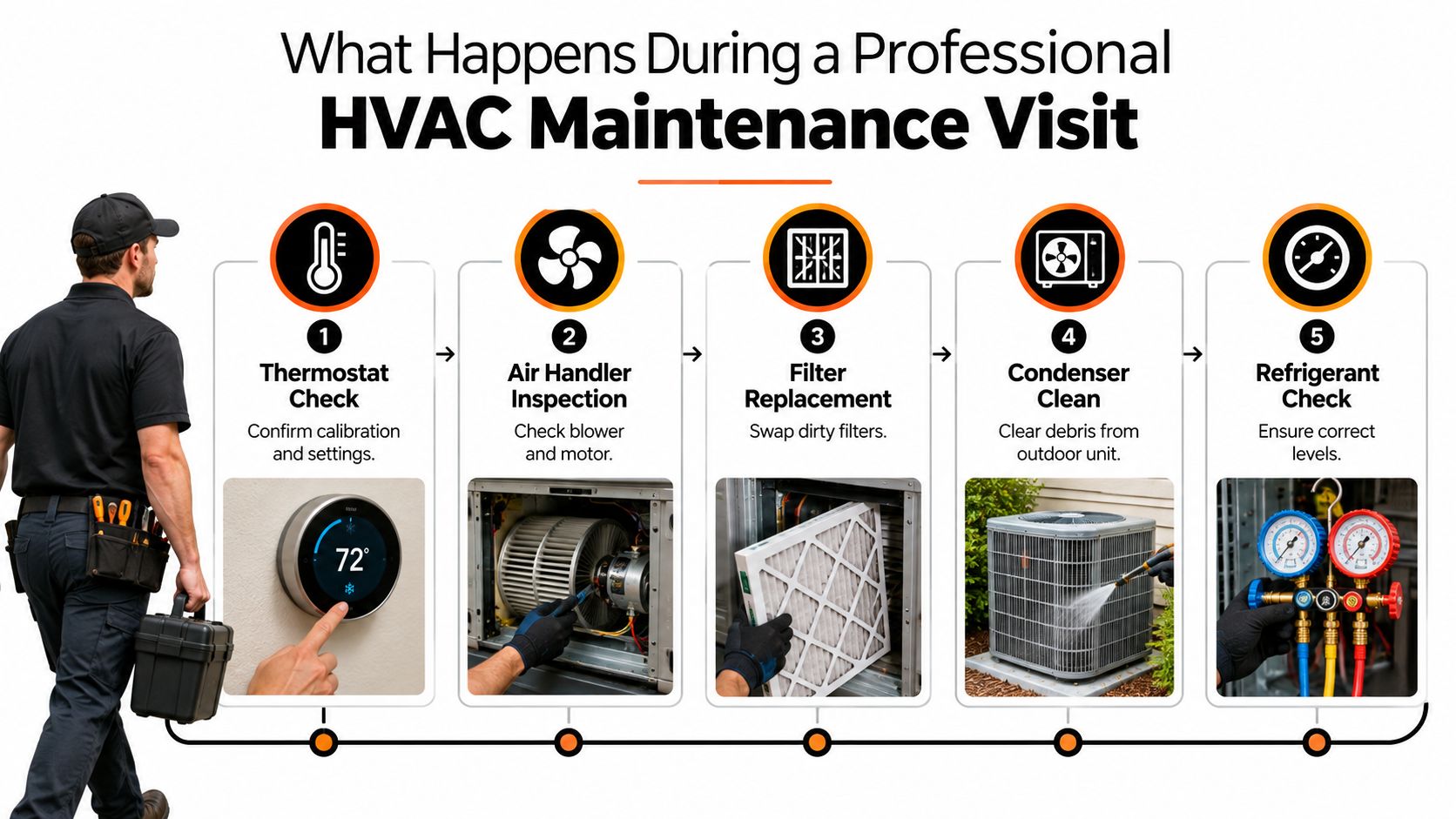
A service checklist should distinguish cleaning from diagnosis. Replacing a filter doesn't prove that airflow is correct, and checking refrigerant pressure alone doesn't prove that the charge is correct. For a closer look at the process, review this explanation of an HVAC system tune-up.
Real-World Examples of Maintenance Done Right and Wrong
A Tucson family skipped service for three summers. Their 14 SEER system continued operating, but the evaporator coil eventually iced during monsoon humidity, the equipment ran hot, and a July breakdown ended with a $4,200 compressor replacement. Their monthly cooling bills had also moved from $165 to $245.
Those details illustrate a familiar pattern, but they aren't verified data from the supplied evidence and shouldn't be treated as a representative case study. The defensible lesson is qualitative: a system can remain operational while airflow, coil condition, refrigerant level, or electrical performance steadily deteriorates.
A small bookkeeping office on Grant Road took the opposite approach and scheduled service before the cooling season and heating season. The technician cleaned the condenser, reviewed airflow, checked electrical parts, and documented operating conditions. That routine gave the owner a clearer maintenance history and a chance to address minor findings before they interrupted office operations.
Category | Skipped maintenance | Scheduled maintenance |
|---|---|---|
Airflow | Declines as filters and coils load with dirt | Checked and corrected before comfort suffers |
Refrigerant | A suspected problem may remain hidden | Operating conditions are evaluated and documented |
Drainage | A blockage can create an unexpected shutdown or overflow | The pan, line, and safety switch are inspected |
Electrical parts | Wear may remain unnoticed until failure | Connections and controls receive planned attention |
Operating decisions | Repair becomes urgent and reactive | The owner can prioritize immediate and future work |
The comparison isn't fear versus reassurance. It's about timing. Planned service gives an owner information while the equipment still has options. Neglect removes those options and turns a manageable finding into a disruption.
Common Misconceptions About HVAC Maintenance
“The system is new, so it doesn't need service.” New equipment still has filters, coils, drains, electrical connections, controls, and ductwork. Warranty terms may also require documented maintenance, so check the actual manufacturer paperwork rather than relying on the installation date.
“Changing the filter is a complete tune-up.” Filter changes are one of the highest-value homeowner tasks, but they don't measure refrigerant conditions, test a capacitor, inspect a contactor, verify condensate protection, or evaluate heat exchanger safety. Coil fouling can double evaporator pressure drop in about 7.5 years under typical conditions, according to a national laboratory analysis, with the rate influenced by filter efficiency, indoor particles, bypass, and coil or duct design (the national laboratory coil-fouling analysis).
“Winter maintenance is pointless in Tucson.” Heating equipment still needs a safety check before it operates after a long cooling period. Dust, dormant drains, electrical wear, and control issues don't disappear because winter is milder than summer.
“Maintenance only matters before extreme weather.” Shoulder seasons are often practical scheduling windows because you can address findings before peak demand. ASHRAE guidance supports cleaning coils and drains at the start of the cooling season, replacing dirty filters, and maintaining correct refrigerant charge and airflow (the HVACR maintenance review citing ASHRAE practices.
Maintenance matters less when a system is lightly used, clean, properly sealed, and recently inspected, but it still shouldn't be dismissed without checking the warranty and the equipment's condition. The decision should match actual exposure, not a one-size-fits-all sales script.
How Covenant Aire Solutions Maintenance Plans Work
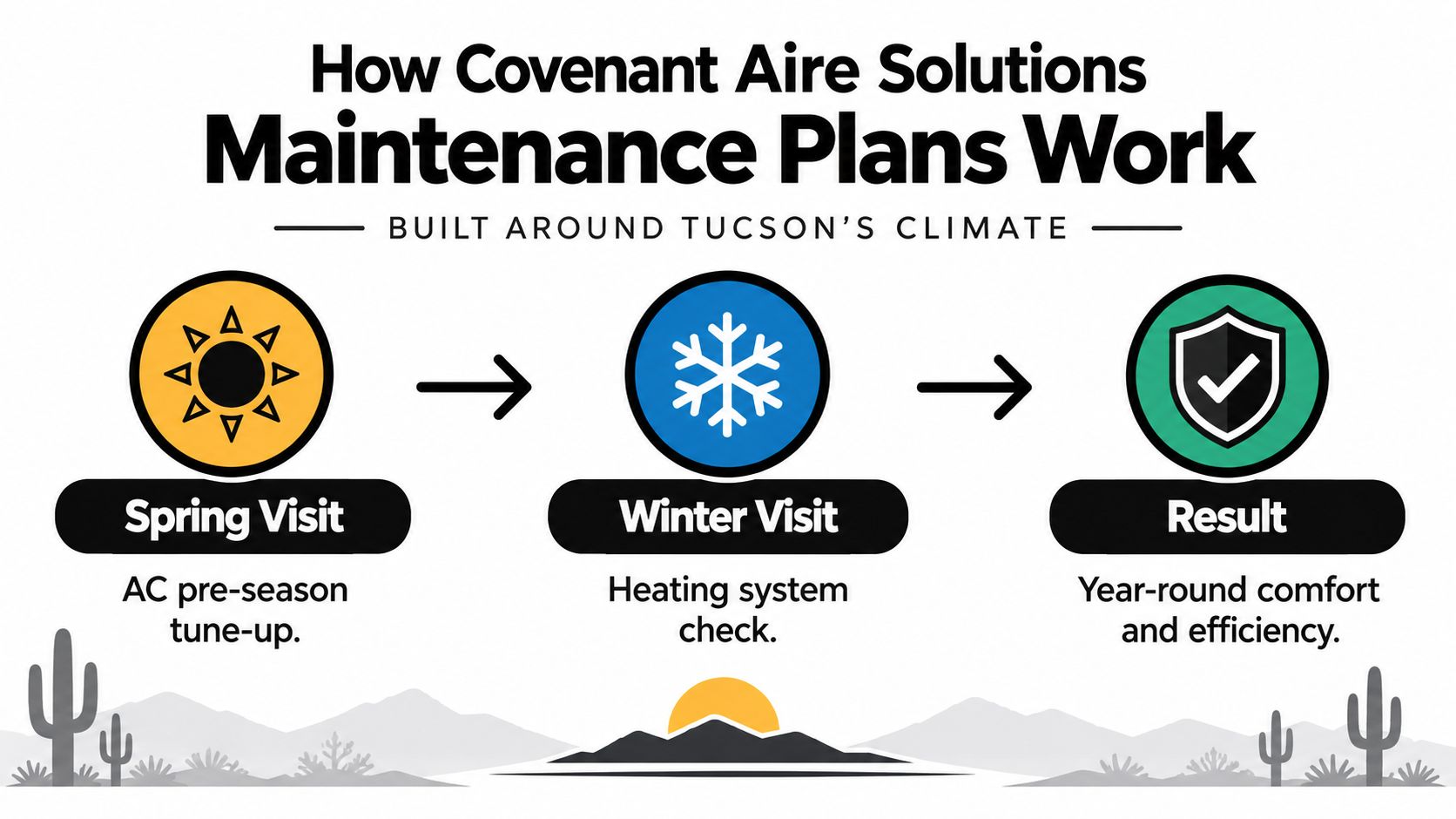
For Tucson homeowners, a plan can be useful when it turns scattered reminders into scheduled work. Covenant Aire Solutions structures its preventive maintenance offering around biannual visits, with one visit before the cooling season and another before the heating cycle. The stated service scope includes coil cleaning, refrigerant checks, electrical tightening, condensate clearing, and thermostat calibration.
The practical value of a plan depends on what the technician documents. Ask for readings, dates, identified defects, and completed tasks. Records can help with warranty questions and give the next technician a starting point when a system develops an intermittent problem.
Reported plan features include:
Scheduled visits: Spring and fall appointments address the two main operating transitions.
Priority dispatch: Members receive priority scheduling when summer demand rises.
Repair discounts: Covered discounts may apply to qualifying parts and labor.
Service records: Documented visits create a traceable maintenance history.
Reminders: Notifications reduce the chance of missing a planned inspection.
Flexible financing: Payment options can help landlords or small businesses manage planned costs.
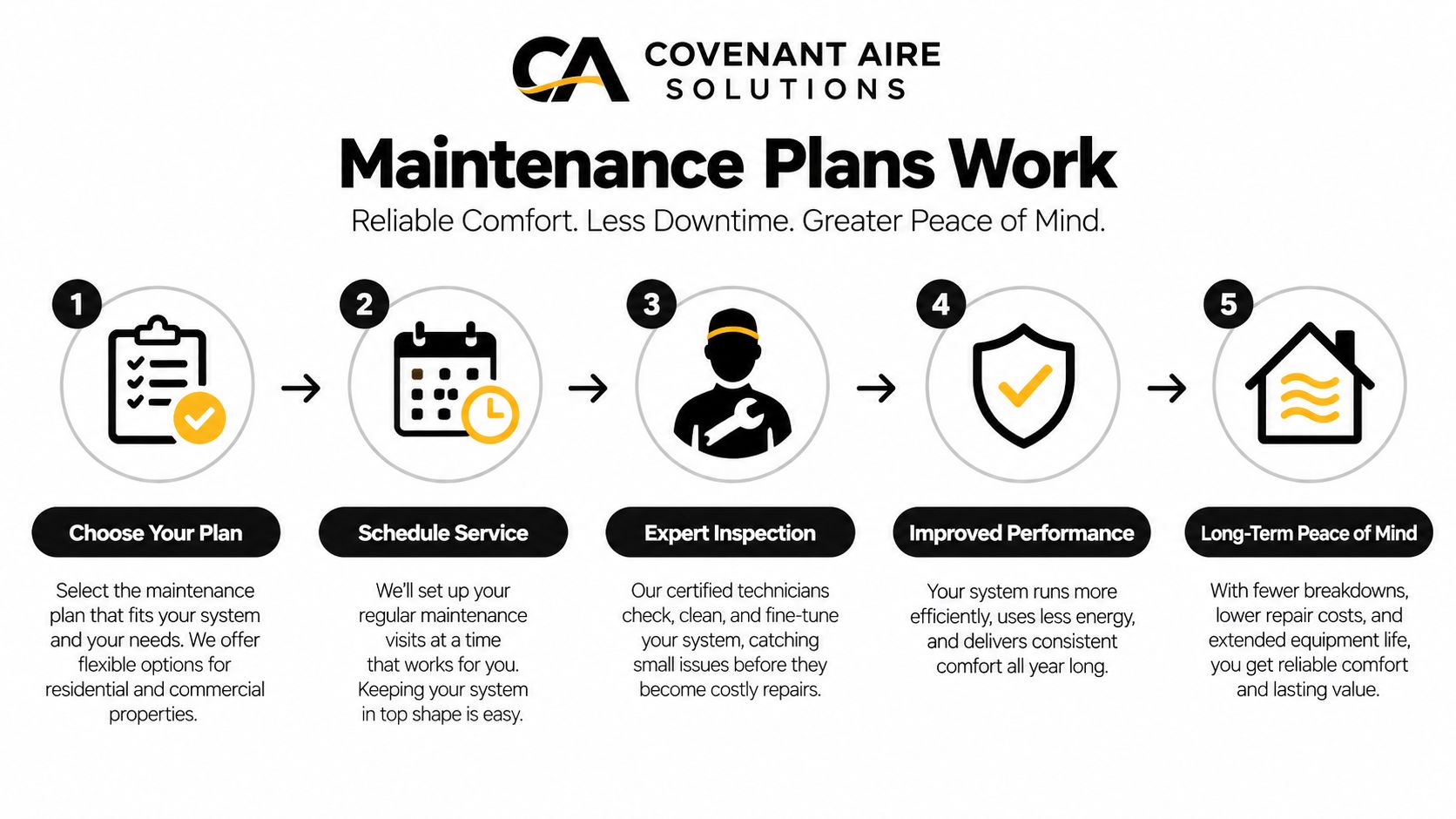
A plan isn't automatically the right choice. Compare its price with the included tasks, cancellation terms, repair discounts, response policy, and warranty documentation. For readers researching how agencies support local service companies, by Growth 4 Trades offers additional context on plumbing and HVAC marketing, while the maintenance details are outlined in this HVAC maintenance plans guide.
Building a Simple HVAC Maintenance Plan You Can Follow
You don't need to become an HVAC technician to manage the basics. You need a repeatable routine and a clear point at which professional service becomes appropriate.
Monthly checks
Inspect the air filter and hold it toward a light. If the material looks blocked, replace it with the correct size and type, especially after a dust storm. Note the date in a phone reminder or home-maintenance log.
Quarterly checks
Vacuum dust from supply and return registers, keep furniture away from vents, and remove leaves or debris around the outdoor condenser. Confirm that the thermostat display and room conditions appear reasonable, but don't open electrical panels or handle refrigerant yourself.
Seasonal professional checks
Schedule a cooling inspection in spring and a heating inspection in fall. The service should cover the relevant coils, airflow, drainage, electrical components, controls, and operating readings. ASHRAE Standard 180-2018 is cited as a maintenance reference for commercial systems, which reinforces the value of a documented, engineering-based process rather than an informal wipe-down.
Use a trigger list as well as a calendar:
First hot spell: Confirm cooling readiness before sustained high demand.
First cold morning: Arrange heating checks before the furnace or heat pump becomes essential.
After monsoon weather: Look for outdoor debris, moisture concerns, and unusual odors.
Any warning sign: Report weak airflow, water near the unit, strange sounds, or repeated cycling promptly.
Renters can follow the same approach by documenting filter changes and reporting changes early to the property manager. Property owners should retain service reports, because maintenance history supports troubleshooting, warranty conversations, and future equipment decisions.
For a more detailed calendar, use this preventive maintenance schedule. A practical baseline is a short monthly filter habit plus professional attention at the seasonal transition that matches your equipment and warranty.
Covenant Aire Solutions provides Tucson-area HVAC maintenance, repairs, heating and cooling service, and indoor air quality support, with preventive plans built around scheduled visits and documented checks. If you're deciding which tasks are worth paying for, visit Covenant Aire Solutions to review the available service options and schedule an evaluation.