
AC Unit Maintenance Cost: A Tucson Homeowner's Guide
A typical Tucson AC tune-up runs about $90 to $200, while a common annual plan costs $150 to $300 per year. Tucson's desert heat shifts the math upward because your system works through long, punishing cooling seasons, with dust, high outdoor temperatures, and heavy runtime stressing parts that might last longer elsewhere.
The national price range only tells part of the story. In Tucson, the right question isn't, “What does a tune-up cost?” It's, “What service keeps my system dependable when the thermometer stays above 105°F?” A cheap inspection that skips electrical testing, coil cleaning, airflow checks, or condensate service isn't a bargain. It's an incomplete visit.
The practical approach is simple: compare the scope of work, schedule service before peak demand, and choose a plan only when the included visits and repair benefits match your equipment.
What AC Unit Maintenance Cost Looks Like in Tucson
A Tucson homeowner should expect a one-time tune-up to run roughly $90 to $200. Annual preventive plans commonly fall between $250 and $500 for residential equipment, while emergency diagnostic fees often start around $80 to $150 before repair labor or parts. Those are useful local budgeting ranges, but published consumer guides show broader national pricing, including $75 to $200 for a central AC maintenance call and $150 to $360 for an annual plan, as reported in Angi's AC service cost guide.
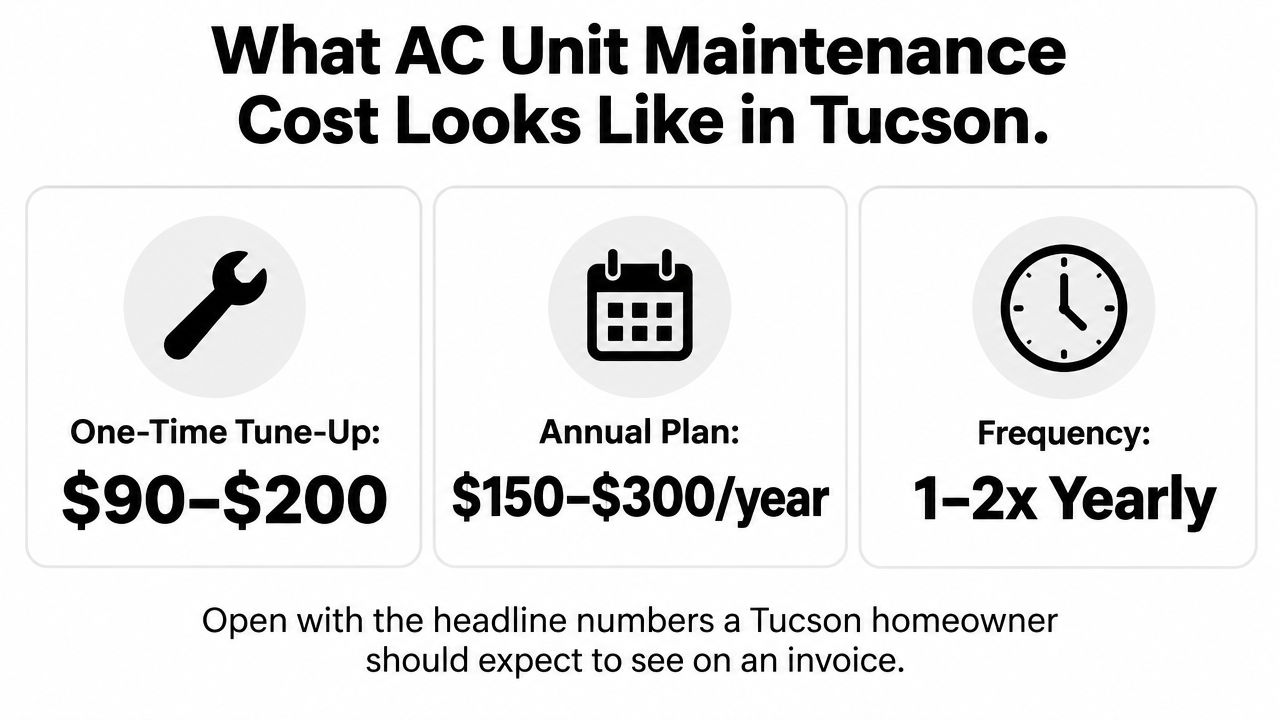
Tucson prices sit toward the higher end because cooling equipment carries a heavier workload here. Many systems run for eight to ten months a year, and extreme heat increases stress on compressors, capacitors, condenser coils, and fan motors. Dust also builds on outdoor coils and restricts heat transfer, so a technician may need more cleaning and testing than a contractor servicing a mild-climate home.
Demand changes the invoice, too. Scheduling pressure rises around the start of summer and during the late-season rush, which can affect availability and labor pricing. Book before the first major heat wave, not after the system stops cooling.
Use the invoice as your checklist
Before approving service, ask whether the price includes:
Electrical testing: Voltage, amperage, capacitors, contactors, and connections.
Airflow service: Filter inspection, blower evaluation, and coil checks.
Drain maintenance: Condensate line inspection and clearing.
Refrigerant diagnostics: Charge verification and leak evaluation, not an automatic “top-off.”
Written findings: Safety concerns, measured readings, and recommended repairs.
A routine maintenance visit averages about $250, with many homeowners paying $175 to $350, according to HomeAdvisor's AC maintenance cost reference. That benchmark includes broader HVAC maintenance contexts, so use the service scope to judge a Tucson quote rather than comparing one number blindly.
For a useful explanation of how inspection, labor, and repair work affect the final bill, review this guide to cooling system service cost.
What a Standard AC Tune-Up Actually Covers
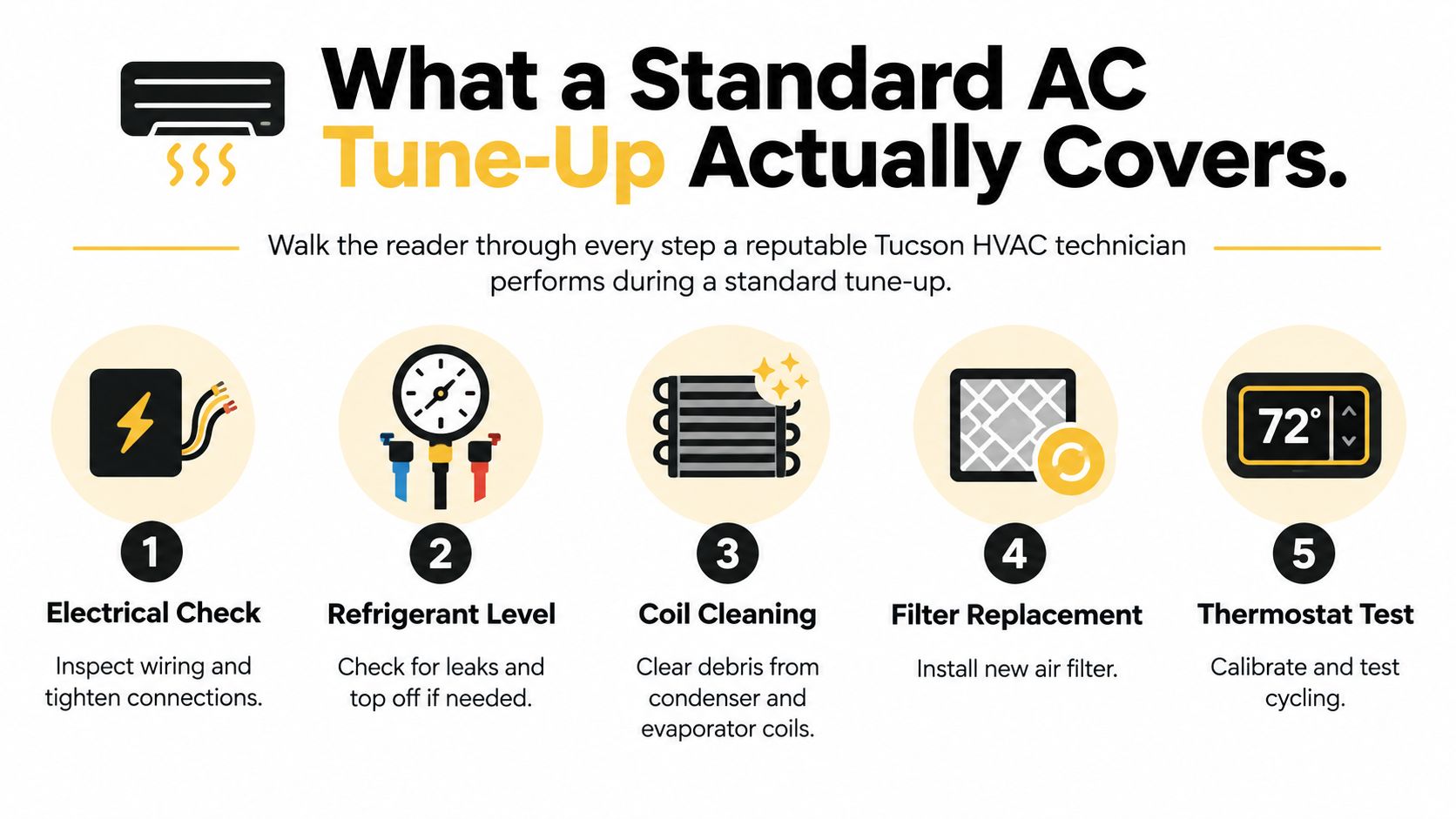
A reputable tune-up should leave you with more than a technician saying, “Everything looks good.” The visit should produce tested measurements, cleaned components, identified risks, and a written explanation of what needs attention now versus later.
Start with controls and electrical components
The technician should verify thermostat operation and calibration, then test the system's cycling. Loose electrical connections get tightened, and the technician measures voltage and amperage at the compressor and blower motor. These readings show whether the equipment is drawing power normally or working under abnormal electrical load.
The capacitor deserves special attention in Tucson. Heat can shorten the life of this component, and a weak capacitor may cause hard starts, humming, poor cooling, or a system that refuses to start. A technician should test its actual performance instead of assuming it's healthy because the equipment is still running.
Then inspect airflow and drainage
The filter gets checked and replaced when needed. The technician inspects the evaporator and condenser coils for dust, cottonwood material, and debris, because dirty coil surfaces interfere with heat transfer. The blower assembly should also be inspected for dirt, vibration, and balance.
The condensate drain line is another small component with a large consequence. A restriction can back water into the indoor unit or surrounding area. Clearing the line during maintenance is far cheaper and simpler than waiting for a drain backup during the cooling season.
Finish with refrigerant and documentation
A complete refrigerant check includes verifying the charge, checking for signs of leaks, and measuring the temperature split across the coil. A technician shouldn't recommend adding refrigerant without investigating why the level is low. Refrigerant doesn't get “used up” like fuel, so a repeated shortage points toward a leak or another system problem.
You should receive a written report that identifies safety findings, tested conditions, cleaning performed, and recommendations. Use this AC tune-up guide to compare the expected service scope before booking.
The following video offers a visual overview of the maintenance process:
Common AC Repairs and What They Cost
Maintenance finds problems. It doesn't eliminate the possibility of repairs, especially on equipment exposed to Tucson heat for much of the year. The repair price depends on the component, access, diagnostic time, refrigerant requirements, and whether the quote includes installation labor.
The most common call is often a failed capacitor. Replacement generally costs $150 to $350 installed, while contactor or relay replacement commonly falls between $120 and $275. Blower motor replacement can range from $400 to $900, and condenser fan motor work often runs $300 to $650. These are editorial planning ranges from the requested Tucson service framework, not figures supported by the verified source list, so ask for a written, itemized quote before authorizing work.
Repair | Typical Cost Range | Desert Relevance |
|---|---|---|
Capacitor replacement | $150 to $350 | Heat stress can shorten component life |
Contactor or relay | $120 to $275 | Electrical wear and frequent cycling matter |
Blower motor | $400 to $900 | Motor type and airflow demands affect labor |
Condenser fan motor | $300 to $650 | Outdoor heat makes condenser performance critical |
Refrigerant leak or recharge | $200 to $600 | Dust, heat, and leak location affect service scope |
Thermostat replacement | $150 to $400 | Controls must match the equipment |
Compressor failure | $1,500 to $3,000 | The repair-versus-replace decision becomes serious |
Refrigerant work needs careful judgment. A simple recharge may provide temporary cooling, but recurring leaks turn that charge into a repeating expense. Find the leak, understand the repair, and ask whether the system's age and condition justify continued investment.
A compressor failure is the major decision point. Independent 2026 coverage places full replacement at $3,800 to $12,000 or more, while repair visits can begin with a $75 to $200 service call before labor and parts, according to HomeServe's maintenance and repair coverage. Don't compare a compressor quote with a replacement price until you know the system's age, efficiency, warranty status, and history of failures.
Repair rule: On older equipment, a large repair deserves a replacement comparison. Don't approve another part simply because it costs less today.
For broader repair pricing context, see this breakdown of AC repair cost. If a roof issue is also affecting your home's comfort or causing water concerns near HVAC equipment, roof leak repair Tucson is a separate resource worth keeping available.
Maintenance Plans vs Pay-Per-Visit Pricing
Pay-per-visit service makes sense when you need a single inspection and your equipment is relatively new. A maintenance plan makes more sense when Tucson heat keeps your system running hard and you want scheduled attention before peak demand.
Independent consumer guidance places annual HVAC maintenance plans around $120 to $360 per year, with a common range of $150 to $300, as shown in HomeGuide's AC maintenance cost guide. Plan prices vary because some agreements cover only an inspection, while others include multiple visits, priority service, cleanings, or repair benefits.
Plan Tier | Annual Cost | Visits Per Year | Repair Discount | Best For |
|---|---|---|---|---|
Entry | $150 to $250 | One | Minor perks | Newer, reliable equipment |
Mid-tier | $300 to $450 | Typically one or two | 10% to 20% | Older systems needing predictable care |
Premium | $500 to $700 | Two | May waive diagnostic fees | High-use or complex systems |
The breakeven calculation is straightforward. At $120 per tune-up twice a year, two visits cost $240. That puts an entry plan in the same general territory and makes a mid-tier plan easier to justify when it adds coil cleaning, priority scheduling, or repair discounts. A premium plan needs a real reason, such as two included inspections, waived diagnostics, or equipment that serves a particularly demanding home.
When pay-per-visit wins
Choose individual visits when:
Your equipment is under warranty: The manufacturer or installer may already require specific maintenance documentation.
You plan to replace soon: A plan may not return enough value if replacement is expected within twelve months.
Your system has been reliable: One well-scoped annual visit may be sufficient for newer equipment.
The contract is vague: Avoid agreements that promise “priority service” without defining visits, fees, exclusions, and discounts.
Ask for the contract in writing. Compare included work, diagnostic charges, after-hours pricing, repair discounts, cancellation terms, and whether the plan covers every system in the home. A low price with thin coverage isn't a maintenance strategy.
For a closer look at agreement structures, review these HVAC maintenance plans.
Why Tucson's Desert Climate Raises Maintenance Costs
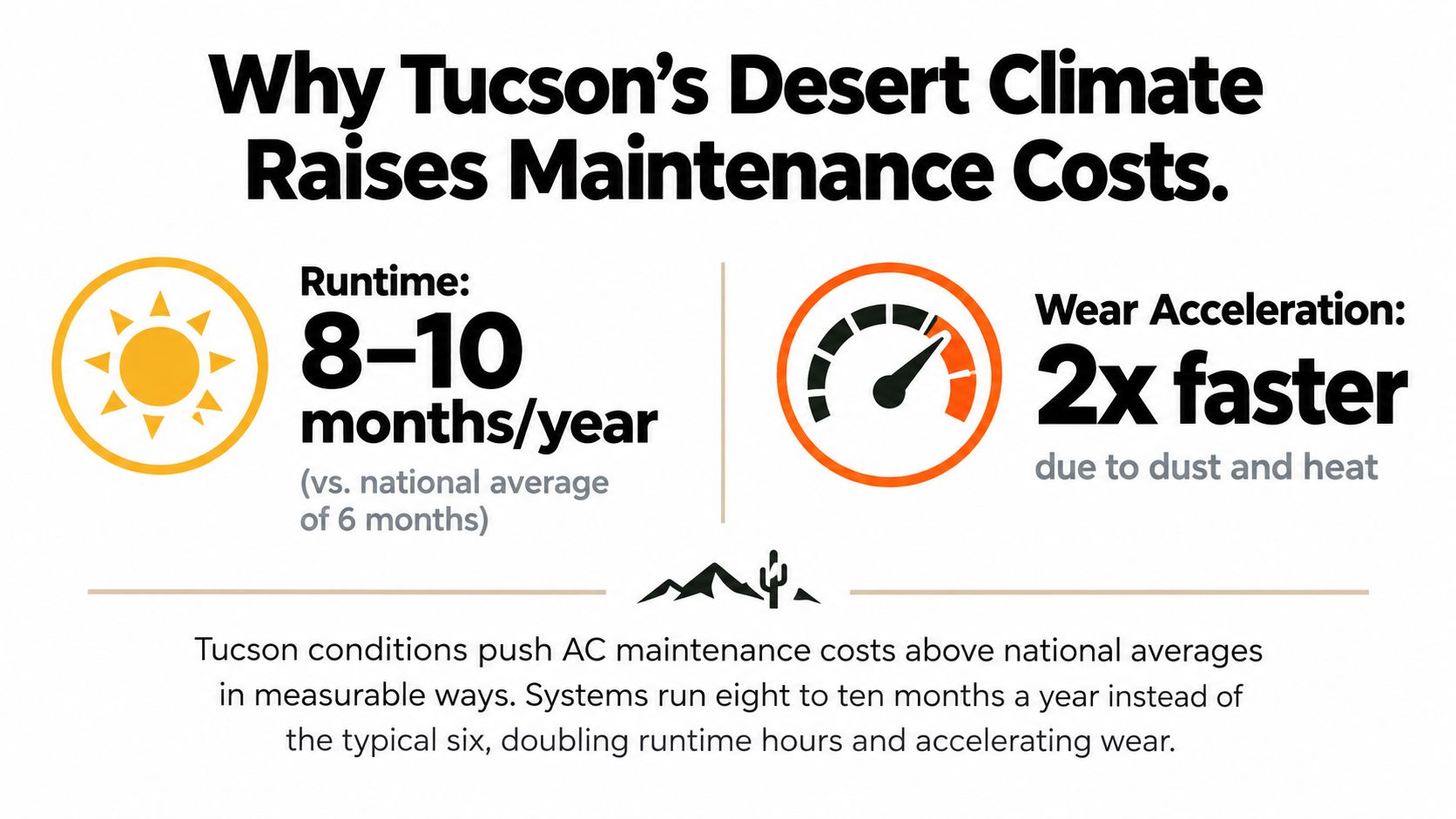
Tucson equipment faces a different operating environment from an AC system in a mild coastal town. The outdoor condenser must reject heat while surrounded by hot air, and the system often runs for much of the year. That combination places repeated demand on electrical components, motors, compressors, coils, and duct connections.
Dust is the obvious problem, but it isn't the only one. Fine debris settles on condenser fins and reduces airflow through the outdoor coil. Monsoon activity adds moisture and debris, while cottonwood material can collect in the same areas. A technician may need to clean more aggressively and inspect the coil more often than a system in a cleaner, milder location.
The parts that take the punishment
Capacitors and contactors handle repeated starts and electrical loads. Fan motors run longer during extended cooling periods. Compressors carry the heaviest financial risk because a failure can push the homeowner into a replacement decision.
Condensate systems deserve attention as well. Tucson isn't humid in the same way as coastal markets, but air conditioning still produces condensation indoors. Dust and buildup can restrict the drain, and mineral deposits can complicate cleaning where hard water affects service components.
Runtime changes the budget
The requested Tucson planning framework uses eight to ten months of annual operation, compared with a typical six-month cooling season elsewhere. Treat that as a local service-planning reality, not a universal measured average. Longer operation means more filter loading, more outdoor coil exposure, and more opportunities for a weak component to fail when the home needs cooling most.
Temperature swings also matter mechanically. Very hot afternoons and much cooler nights change operating pressures and material conditions across refrigerant lines, seals, and ductwork. Tucson's dry soil and airborne dust can add abrasion and contamination around outdoor equipment, while electrical connections still need inspection for corrosion and heat damage.
The practical conclusion is firm: schedule maintenance before the hottest stretch, keep the condenser clear, and don't treat a Tucson tune-up as interchangeable with a quick visual inspection in a mild climate.
How Preventive Maintenance Saves You Money
Preventive maintenance is a cost-control tool when the technician performs work that addresses real failure risks. The value comes from catching weak electrical components, restricted airflow, dirty coils, blocked drains, and refrigerant problems before the equipment fails under maximum demand.
A widely cited 2026 benchmark places routine HVAC maintenance at about $250, while repair visits can begin with a $75 to $200 service call and replacement can reach $3,800 to $12,000 or more, according to the cost information compiled by HomeAdvisor and the 2026 HomeServe coverage cited earlier. The point isn't that every tune-up prevents a replacement. The point is that a modest inspection gives you a chance to find a small problem before it becomes an emergency decision.
Three ways the math can work
A weak capacitor: A technician identifies a failing capacitor during a scheduled visit. Replacing it while the system is accessible is usually less disruptive than waiting for a hot-weather no-cool call.
A dirty condenser coil: Cleaning restores the coil's ability to release heat. The system can operate with less strain than it would while pushing air across a heavily contaminated surface.
A blocked condensate line: Clearing drainage during routine service reduces the chance of an indoor water event. The technician can also identify improper routing or a missing safety control before the pan overflows.
The verified commercial data makes the energy argument even stronger. One industry benchmark estimates commercial HVAC maintenance at about $2.15 per square foot per year, and an analysis cited in SmartService's HVAC service agreement guide says neglected upkeep can add 20% to 40% to true operating costs through hidden energy waste. Residential savings won't follow that exact commercial calculation, but the operating principle is the same: restricted airflow and dirty heat-transfer surfaces waste energy.
My recommendation: Pay for maintenance when it produces measurements, cleaning, and a written condition report. Don't pay for a sticker on the unit.
Change filters yourself when appropriate, keep furniture away from return grilles, and call a qualified technician for electrical or refrigerant work. Maintenance works best as a combination of simple homeowner habits and professional testing.
Discounts, Rebates, and Financing for Tucson Homeowners
Start with the utility before signing a replacement or upgrade contract. Tucson Electric Power programs can change, so verify current eligibility, equipment requirements, application deadlines, and whether the incentive applies to maintenance, replacement, or efficiency upgrades. Rebates usually matter more when you're replacing equipment than when you're buying a basic tune-up.
Federal 25C tax credits may apply to qualifying heat pumps and home energy upgrades, but equipment eligibility and tax treatment must be confirmed for the year you claim the credit. Manufacturer promotions often appear around seasonal sales periods, especially before and after the hottest part of the cooling season. Contractors may also offer documented discounts for teachers, military members, veterans, first responders, seniors, or customers maintaining multiple units. The requested local planning range for those discounts is 5% to 15%, but ask whether the discount applies to service labor, parts, plans, or replacement equipment.
Build the savings stack carefully
Program Type | Source | Typical Savings | Eligibility Notes |
|---|---|---|---|
Utility rebate | Tucson Electric Power | Varies | Confirm current equipment and application rules |
Federal tax credit | 25C program | Varies | Qualifying equipment and tax circumstances apply |
Seasonal promotion | Manufacturer or contractor | Varies | Promotions depend on timing and equipment |
Community discount | HVAC contractor | 5% to 15% | Documentation may be required |
Utility assistance | LIHEAP or Pima County programs | Varies | Income-qualified households only |
Financing | Contractor finance provider | Varies | Review interest, term, and deferred-payment rules |
Income-qualified households should check LIHEAP and Pima County cooling assistance before taking on a repair balance. For larger repairs, contractors may offer same-as-cash plans over 12 or 18 months, along with longer-term financing through providers such as Synchrony or Service Finance. Read the interest terms carefully. A deferred-interest plan can become expensive if the balance isn't paid within the promotional period.
The relevant comparison isn't “financing versus cash.” It's financing versus placing the repair on a high-interest credit card without a payoff plan. Review current options and questions to ask in this guide to HVAC financing options.
Choosing the Right Maintenance Path for Your Home
Your equipment's age, repair history, usage, and budget should determine the service path. Don't buy a premium agreement for a nearly new system just because the salesperson makes it sound all-inclusive. Don't rely on one low-priced inspection for an aging unit that already struggles through Tucson summers.
Scenario one, newer equipment
If the system is under five years old, has no current symptoms, and you handle filter changes, an annual fall tune-up is usually the sensible choice. The requested local planning range is $129 to $189 for that visit. Ask the technician to document electrical readings, temperature split, airflow concerns, drain condition, coil cleanliness, and any warranty-relevant findings.
Fall service gives you time to address problems before the next heavy cooling season. It also avoids the pressure of making a repair decision when the house is already hot.
Scenario two, midlife equipment
For a system around eight to twelve years old, especially one exposed to moderate dust, choose a plan with two visits per year if the contract includes meaningful work. Look for capped diagnostic fees, a parts or labor discount, priority scheduling, and clear coil and drain service.
The plan should pay for itself through included service or repair benefits within the first two visits. If it only provides a reminder and a sticker, pay per visit instead.
Scenario three, older equipment
A system past 15 years with a repair quote over $2,500 deserves a replacement comparison. The requested $5,000 rule multiplies the system's age by the repair cost. If the result exceeds $5,000, replacement usually wins under that rule, although warranty coverage, comfort needs, financing, and equipment availability still matter.
Don't claim an efficiency upgrade will pay back on a fixed schedule without reviewing your actual bills and system performance. Compare the existing equipment with proposed options, including SEER 14 versus SEER 16, and ask the contractor to show assumptions rather than promise savings.
Your Situation | Recommended Path | Typical Annual Cost | Best For |
|---|---|---|---|
Newer system, no symptoms | Annual fall tune-up | $129 to $189 | Warranty-minded homeowners |
Eight- to twelve-year-old system | Two-visit maintenance plan | Varies by coverage | Predictable service and repair benefits |
Older system, major repair | Repair and replacement comparison | Repair may exceed $2,500 | Avoiding repeated large repairs |
Covenant Aire Solutions offers AC tune-ups, biannual preventive maintenance, priority service, and financing options for Tucson homeowners who want a structured approach to ongoing AC unit maintenance cost. Visit Covenant Aire Solutions to request service, compare maintenance options, and get a clear recommendation for your equipment.