
AC Maintenance Check: A Tucson Homeowner's Guide
At 9 a.m. in mid-June, a Tucson homeowner checks the thermostat and sees the indoor temperature climbing past 80°F. The system ran through last summer, survived another monsoon, and never received a proper service visit. Outside, desert dust is already moving through the yard, while the compressor is preparing for another long afternoon.
That situation is common, but it isn't harmless. A neglected split system can lose airflow, struggle to shed heat, clog its condensate drain, or shut down when you need it most. A practical AC maintenance check separates safe homeowner tasks from measurements and repairs that belong to a qualified technician.
Why Tucson Homeowners Need a Seasonal AC Maintenance Check
Tucson's climate puts unusual pressure on residential air conditioning. Desert dust loads the filter and settles on coils. Mesquite and palo verde debris can collect around the outdoor condenser after windy weather. Once monsoon moisture arrives, the condensate pan and drain line face conditions that encourage algae growth. The cooling system then works through a prolonged hot season, with heavy demand from spring into fall.
Three problems appear repeatedly.
First, restricted airflow makes the blower and compressor work harder. A clogged filter or dust-covered evaporator coil can make a healthy system behave like a failing one. The indoor coil may even look frozen because inadequate airflow lowers its temperature, although the underlying problem isn't necessarily a refrigerant defect.
Second, the outdoor unit needs clear space to release heat. Windblown plants, tumbleweed, leaves, and fine dirt can block the condenser coil. Rinsing and clearing the cabinet helps, but bent fins, refrigerant-side contamination, and deeper coil cleaning require more care.
Third, monsoon humidity changes the condensate picture. The air conditioner removes moisture indoors, and a partially blocked drain can overflow into the air handler area. Preventive maintenance treats that drain as a system component, not an afterthought.
Practical rule: In Tucson, schedule the professional inspection before the cooling season becomes urgent, then keep up with filters and outdoor debris yourself.
The economics support that approach. Energy.gov guidance says regular air-conditioning maintenance can reduce heating and cooling costs by 5 to 10% and prolong equipment life. A clean filter alone can reduce AC energy use by 5 to 15%, according to the same federal guidance. The goal isn't to prevent every failure. It's to catch airflow, drainage, electrical, and refrigerant problems before a 110-degree afternoon turns a minor defect into an emergency call.
Filter Inspection and Replacement You Can Do Yourself
Filter work is the highest-return maintenance task most Tucson homeowners can perform safely. It requires attention, not specialized instruments, and it directly protects airflow through the return grille, blower, evaporator coil, and supply system.
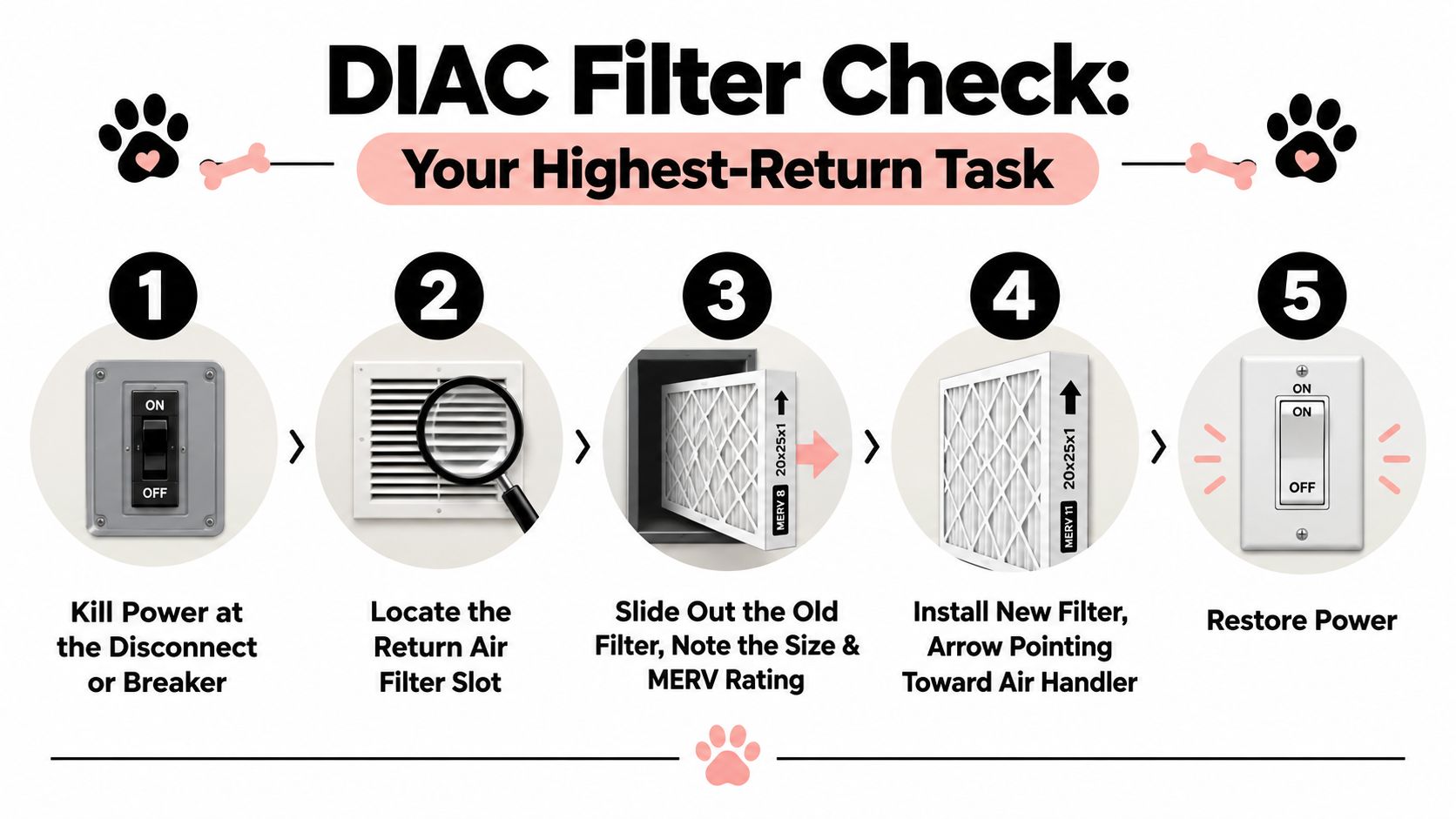
Start by switching off power at the disconnect or breaker. Locate the filter slot, which may sit behind a large return-air grille or inside the air handler cabinet. Slide the filter out slowly. A rushed pull can shake accumulated dust into the blower compartment, where it becomes a larger cleaning problem.
Hold the filter toward a bright light. If the media looks heavily gray and the light barely passes through, replace it. Don't rely only on appearance, though. Homes near unpaved areas, construction, active landscaping, or dusty roads may load a filter faster than a clean suburban interior.
For Tucson's long cooling season, I recommend a practical schedule:
April through September: Check a standard 1-inch filter monthly and expect replacement every 30 to 45 days in dusty homes.
Shoulder season: A replacement interval of 60 to 90 days may work when the system runs less and indoor dust levels stay low.
High-occupancy homes: Check more often if pets, remodeling, open windows, or frequent foot traffic add particles.
Federal and utility guidance commonly recommends checking filters monthly during heavy-use periods and replacing or cleaning them at least every 3 months. ENERGY STAR's maintenance checklist also treats filter condition as a core part of a professional check.
Choose filtration without starving airflow
MERV 8 to 11 suits many residential systems. MERV 13 can capture more fine particles, but it also creates greater resistance, so don't install it unless the blower and duct system are rated for that pressure drop. A filter that looks more advanced can reduce comfort if it restricts the airflow your equipment needs.
Install the new filter with the arrow pointing toward the air handler. Write the installation date on the cardboard edge with a Sharpie. That small habit removes the guesswork during the next inspection.
For more detail on choosing an interval, use this guide to air filter replacement frequency.
Coils, Drains, and the Outdoor Unit
These tasks sit just beyond filter replacement. Some are reasonable for a careful homeowner, while others become risky once panels, electrical components, or refrigerant circuits enter the job.
Start with the evaporator coil
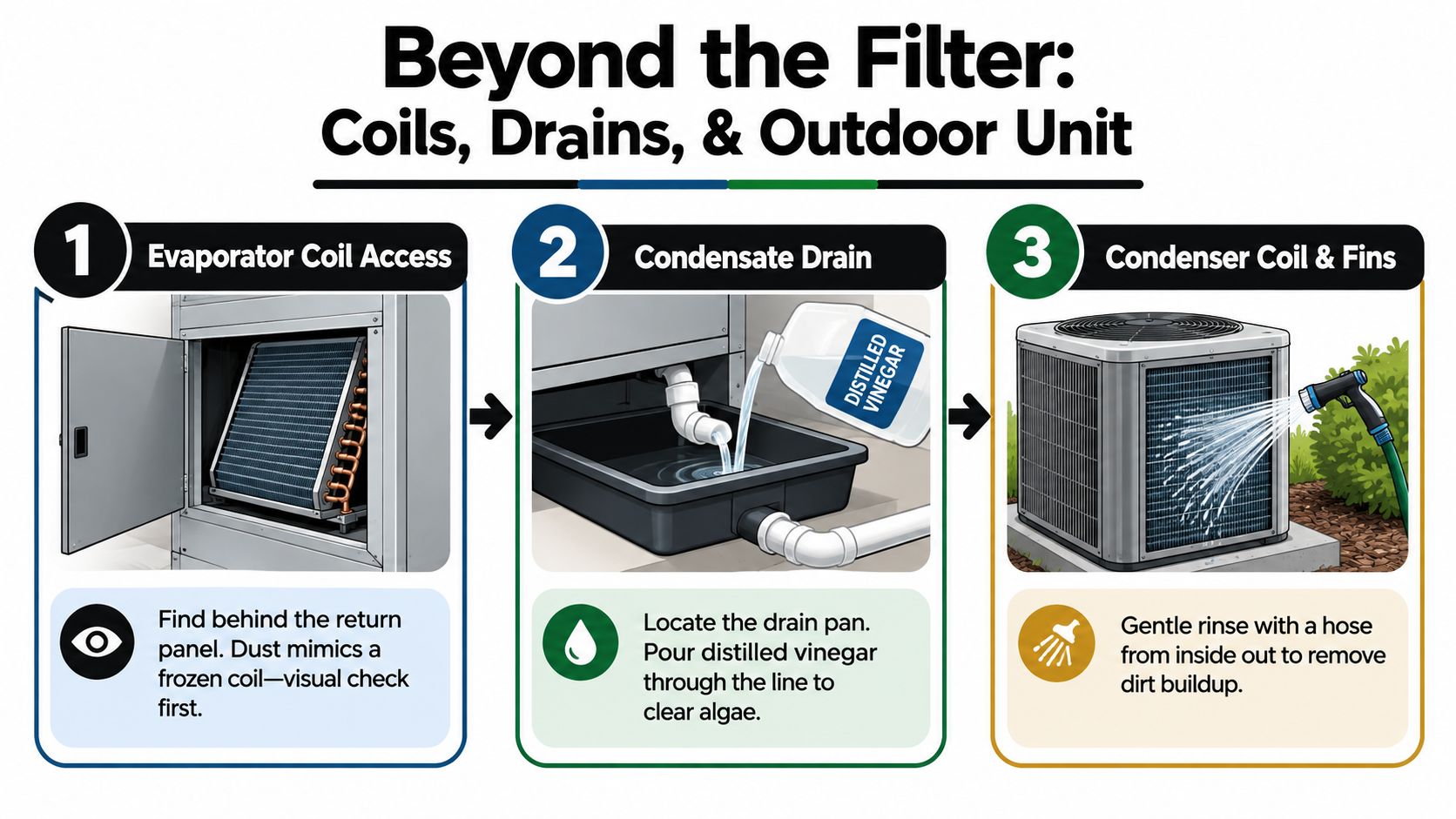
The indoor evaporator coil usually sits behind an access panel near the return side of the air handler or furnace. Before opening anything, shut off power. Look for visible dust buildup, biological growth, standing water, or signs of ice. Dust on the coil can imitate a frozen-coil complaint because both conditions reduce airflow.
A homeowner can remove light surface dust with a soft brush and use a coil-safe foaming cleaner exactly as the label directs. Avoid aggressive pressure, household degreasers, and improvised scraping. The aluminum fins bend easily, and a damaged coil can restrict airflow further.
A technician should handle a deep coil pull, heavy contamination, inaccessible coil sections, or any cleaning that requires refrigerant recovery. Professional checklists include evaporator and condenser coil inspection, refrigerant pressure measurement, and leak detection. One HVAC preventive-maintenance guide reports that 10% evaporator-coil fouling can increase energy consumption by up to 15%.
Keep the condensate path open
Find the PVC condensate drain leaving the air handler. Many systems include an access tee with a cap. With power off, a homeowner can pour a cup of white vinegar through the access opening as a routine treatment. Some technicians use a dilute bleach solution, but never mix cleaning chemicals, and don't pour anything into a line if you can't identify the correct access point.
Monsoon humidity makes drain inspection more important. Watch for slow drainage, water around the pan, a float-switch shutdown, musty odors, or staining near the air handler. A recurring clog needs professional diagnosis because the obstruction may sit beyond the accessible trap or involve an incorrectly pitched line.
Give the condenser a five-minute sweep
Before touching the outdoor unit, switch off power at the disconnect. Remove weeds, leaves, and tumbleweed debris, keeping vegetation at least 18 inches away from the cabinet. Rinse the fins gently with a garden hose from the inside out, so water pushes dirt outward rather than deeper into the coil. A fin comb can straighten visibly bent fins, but stop if the damage extends beyond cosmetic sections.
This condenser-coil cleaning guide shows the basic homeowner boundary.
A visual rinse won't replace refrigerant-side cleaning or airflow measurements. EPA checklist material emphasizes comparing pressure drop with the manufacturer's recommendations, which is why a clean-looking cabinet doesn't prove the system is operating correctly.
Thermostat, Electrical, and Refrigerant Checks Best Left to a Pro
A homeowner can observe symptoms, but accurate diagnostics require instruments, equipment data, and electrical safety training. A thermostat that responds to buttons may still read inaccurately, cycle poorly, or fail to manage staging correctly.
A technician verifies the thermostat's temperature accuracy, checks anticipator settings on older equipment, and confirms staging behavior on variable-speed systems. The technician also tests whether the system starts and stops as commanded, rather than assuming a display change proves correct operation.
Electrical testing has real hazards
A complete inspection may involve tightening lugs at the disconnect and breaker, measuring voltage across the compressor contactor, comparing capacitor microfarads with the nameplate rating, and testing the condensate float switch. These are not visual tasks.
Capacitor banks can retain a dangerous charge after power is switched off. Line voltage may remain present at the disconnect or inside the equipment, and an incorrect connection can damage expensive components. Homeowners should leave covers closed unless they're performing only an approved, power-isolated filter or exterior inspection.
Refrigerant requires measurement, not guesswork
A technician checks refrigerant pressure, operating temperatures, superheat, and subcooling to determine whether a system is undercharged or overcharged. Adding refrigerant without finding the cause of low charge can mask a leak and leave the compressor operating outside its intended conditions.
EPA Section 608 certification is required for technicians who recover or add refrigerant, including R-410A and older R-22 systems still found in Tucson homes. This heat-pump refrigerant guide explains why refrigerant work belongs with trained personnel.
Refrigerant planning also matters during replacement decisions. Recent industry guidance says new U.S. rules began restricting higher-GWP refrigerants in new HVAC equipment in 2025, while existing R-410A equipment can still be serviced. Some 2026 guidance says older units manufactured before January 1, 2025 may continue installation until available stock is depleted, so ask the technician to verify the refrigerant type, equipment label, leak history, and future service implications. The refrigerant-transition overview provides that context.
Before scheduling service, safely record the breaker condition, thermostat responsiveness, unusual sounds, water around the air handler, and whether the outdoor fan starts. Don't remove panels to investigate humming, sparking, or repeated trips.
One-Off Service Calls Versus a Biannual Preventive Plan
Tucson's service model should match how hard the system works. A one-off visit can provide a spring or fall tune-up without an ongoing commitment, but the equipment receives no scheduled attention between those visits. A biannual plan adds spring and fall appointments, filter discounts, priority scheduling, and documented records that can help support warranty claims.
The practical difference appears during the months between appointments. Dust may accumulate after a spring visit, and a monsoon drain issue may develop while the system is running every day. A plan doesn't guarantee that nothing will fail, but it creates a repeatable inspection rhythm.
Factor | One-Off Service Call | Biannual Preventive Plan |
|---|---|---|
Visit pattern | One scheduled spring or fall tune-up | Spring and fall check-ups |
Filter support | Usually purchased separately | May include discounts or scheduled replacement support |
Breakdown response | Standard scheduling | May include priority scheduling |
Records | Visit-by-visit documentation | Ongoing service history |
Best fit | Newer, reliable systems in part-time homes | Warranty systems, older equipment, frequent occupants, and traveling homeowners |
A single visit may be enough for a newer system in a seasonal home, especially when the owner checks filters and clears the condenser. Older units past year 10, systems still under warranty, and homes left unattended for stretches benefit more from scheduled oversight. In those cases, the service record can also help a technician identify gradual changes rather than treating every failure as an isolated event.
Cost comparisons need to include inconvenience. An emergency call during a 110-degree afternoon may involve a service fee, urgent scheduling limitations, and the possibility that a failed component cannot be sourced immediately. A plan costs money before anything breaks, while a one-off approach preserves flexibility but accepts more risk between visits.
Review the maintenance-plan structure and ask exactly what the agreement includes. Confirm whether drain work, electrical testing, refrigerant checks, filters, discounts, and emergency priority are included or billed separately.
Your Year-Round AC Maintenance Rhythm in the Desert
A Tucson maintenance rhythm works best when each season has a clear job. Keep the checklist short enough to follow, but specific enough to distinguish homeowner observations from technician measurements.
February and March
Book the pre-season visit: Have a technician test capacitors, electrical connections, airflow, refrigerant condition, and system operation before demand rises.
Review filtration: Upgrade to a higher MERV filter only if the blower and duct system can handle it.
Check the thermostat: Replace its battery if applicable and verify that heating and cooling commands respond normally.
April and May
Clear the condenser: Remove mesquite, palo verde, weeds, and windblown debris from around the outdoor cabinet.
Inspect the return: Install a clean filter and confirm that furniture, rugs, and curtains aren't blocking return grilles.
Watch startup behavior: Report grinding, delayed starts, loud contactor noise, or short cycling rather than opening the electrical compartment.
June through August
Check the filter monthly: Heavy cooling and desert dust make this the most important recurring homeowner task.
Inspect the drain visually: Look for water near the air handler, pan overflow, algae, or a float-switch shutdown after humid weather.
Call for measurements: A technician should verify airflow, pressure drop, coil condition, electrical performance, and refrigerant charge when comfort declines.
Keep the cabinet open to air: Maintain the recommended clearance and remove tumbleweed or storm debris promptly.
September and October
Schedule post-season cleaning: Have the technician inspect coils, treat the condensate line, and evaluate the outdoor unit before the system rests.
Change the filter: Don't carry a loaded summer filter into the next operating period.
Review equipment records: Note repairs, refrigerant type, unusual noises, and any recurring drain or airflow problem.
November through January
Exercise the system occasionally: Brief operation can confirm that controls still respond, but stop if the equipment makes unusual sounds.
Protect the outdoor area: Keep leaves and plant growth away from the condenser.
Avoid deep setbacks: Large thermostat changes can create an unpleasant restart demand when warm weather returns.
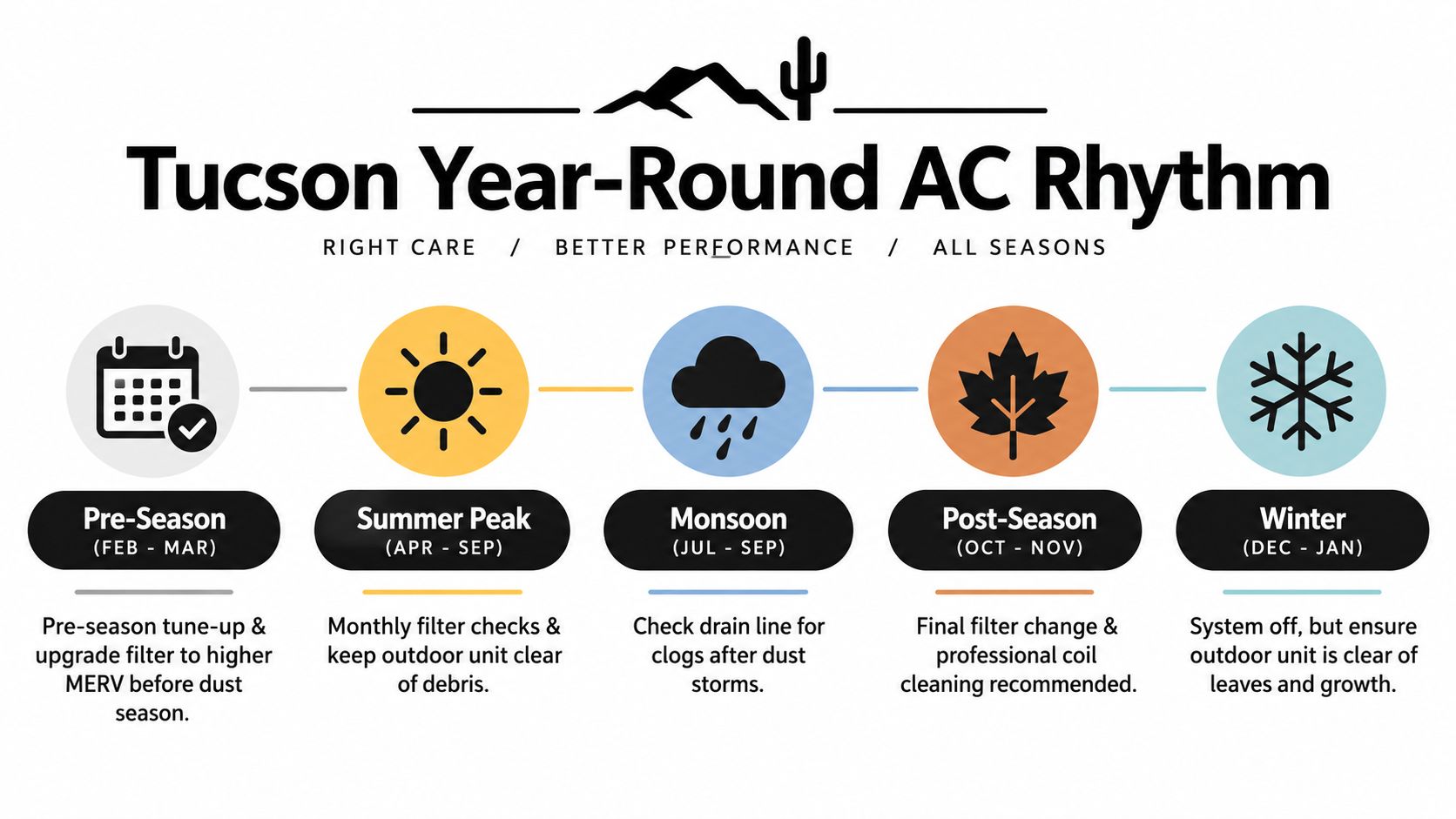
Print this list and tape it inside the utility-closet door. Check filters and outdoor conditions yourself, then reserve capacitor testing, refrigerant diagnostics, combustion safety checks on gas furnaces, and deeper coil work for a qualified technician.
Covenant Aire Solutions provides Tucson-area AC maintenance checks, including scheduled preventive service for residential and commercial systems. For help with filter strategy, drain inspections, coil cleaning, refrigerant diagnostics, or a biannual plan, visit Covenant Aire Solutions and arrange service before the next extreme-heat stretch.