
Emergency HVAC Repair: A Homeowner's Quick Action Guide
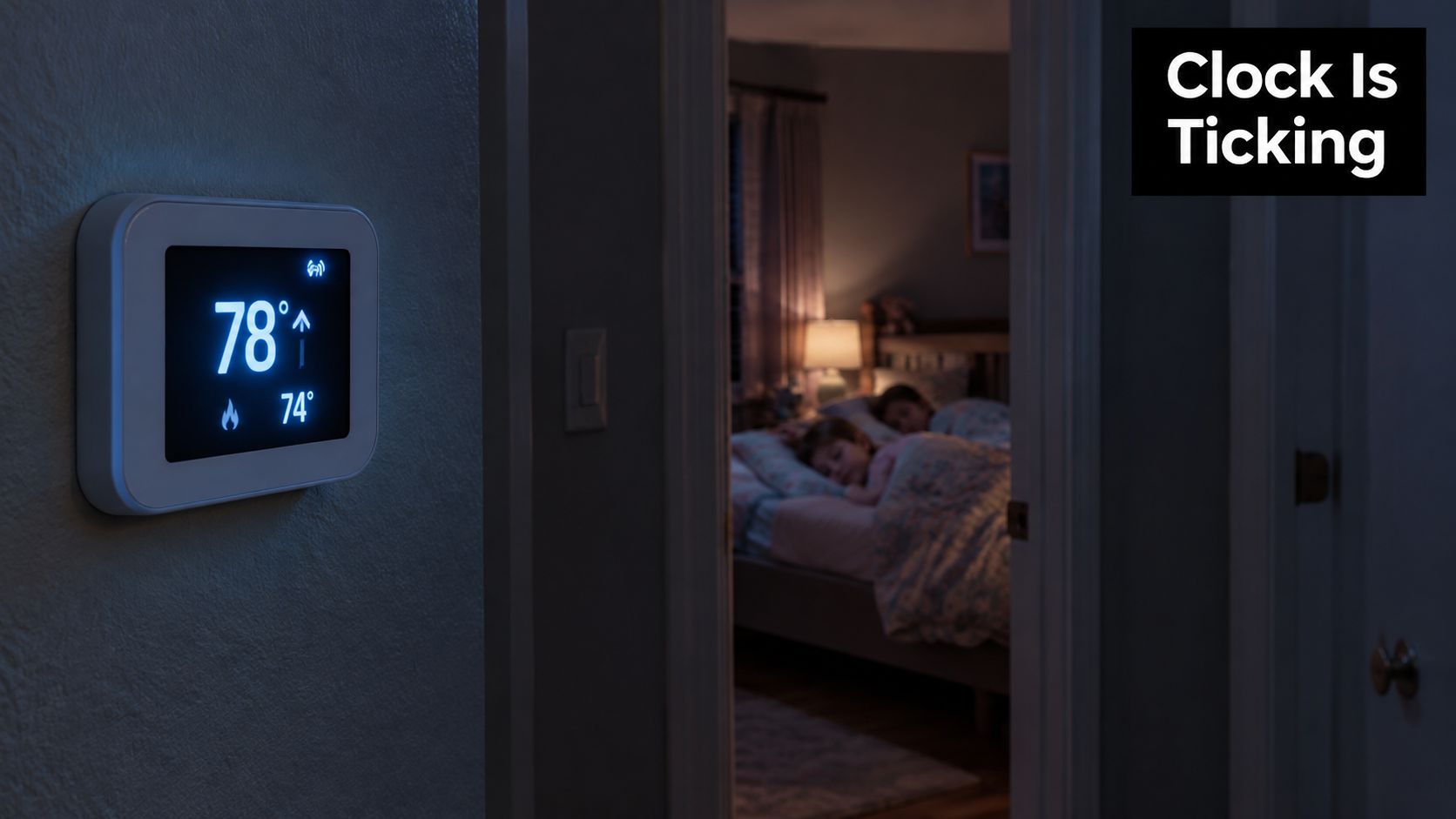
At 9:47 p.m. on a July evening in Tucson, the thermostat says 78°F, the bedrooms feel warmer by the minute, and the children are already asleep. You press the buttons, check the vents, and wonder whether the system has failed completely or whether a simple reset will bring it back.
That uncertainty makes emergency HVAC repair more stressful than many other home repairs. A failed appliance is inconvenient, but lost cooling or heat can quickly affect safety, health, and habitability. HomeServe's 2026 homeowner survey found that 26% of respondents had an HVAC repair or replacement during the previous 12 months, while nearly 75% experienced at least one home-repair emergency in that period (survey-based emergency repair data).
You don't need to diagnose the entire system tonight. You need an ordered plan: make the area safe, perform a few low-risk checks, decide whether the problem can wait until morning, and give the technician useful information if you call.
When the AC Dies and the Clock Is Ticking
The first question isn't, “What part failed?” It's, “Is anyone or anything at immediate risk?”
A Tucson cooling failure may be a comfort problem, or it may become a health concern for an infant, an older adult, or someone with a medical condition. A furnace failure during freezing weather can create a similar urgency. Water around an air handler, smoke from electrical equipment, a gas odor, or a carbon-monoxide alarm changes the situation again. Those aren't routine scheduling issues.
Start with the practical distinction explained in what is considered an HVAC emergency. An emergency is a failure that creates an immediate safety risk, threatens occupants' ability to remain safely in the home, or can cause rapidly increasing property damage. A system that makes an unusual noise but still maintains a safe indoor temperature may deserve prompt attention, but not necessarily an after-hours dispatch.
The demand is common enough that you shouldn't feel unprepared or singled out. HVAC failures recur because systems operate under heavy seasonal loads, electrical components age, filters restrict airflow, controls drift, and condensate systems can shut equipment down to prevent water damage.
The first ten minutes should reduce risk, not create a second problem.
Use the rest of this guide in that order. Safety comes before troubleshooting. Low-risk checks come before opening equipment. The emergency decision comes before discussing price. Prevention comes after the immediate failure is under control.
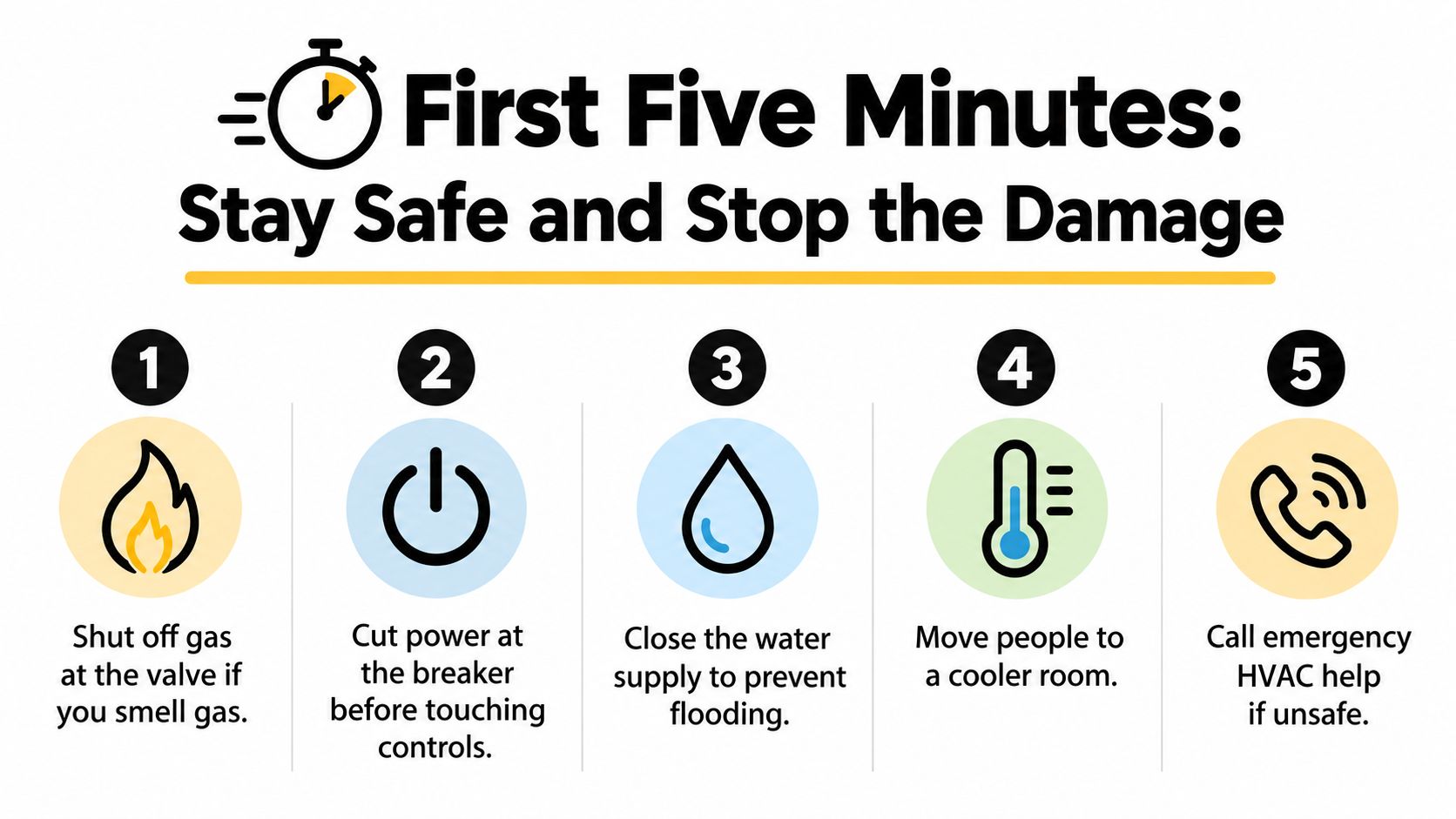
First Five Minutes Stay Safe and Stop the Damage
Before touching the thermostat or breaker, scan for signs that the equipment has become a hazard. If you smell gas, don't investigate the furnace yourself. Leave the home, avoid switches or flames, and contact the gas utility or emergency services from outside. If a carbon-monoxide alarm sounds, leave immediately and arrange professional help after everyone is safe. The guidance in furnace and carbon monoxide safety information is especially relevant when a heating appliance is involved.
Take these actions first
Move people away from danger: Keep children and pets away from the furnace, air handler, standing water, and outdoor equipment.
Cut power when there is smoke or sparking: Use the service disconnect or breaker only if you can do so safely. Don't touch a smoking unit or wet electrical equipment.
Stop water at the source: If a condensate line or drain pan is actively overflowing, close an accessible water supply valve to the equipment or shut off the system. Protect floors and ceilings while waiting for help.
Relocate vulnerable occupants: Move people to a cooler or warmer safe room, use approved temporary comfort measures, and avoid delaying medical care if anyone shows signs of heat or cold stress.
Call for urgent help when the home isn't safe: Gas odors, carbon-monoxide alarms, active flooding, fire, and exposed electrical hazards need emergency attention before routine troubleshooting.
Avoid the shortcuts that backfire
Don't repeatedly reset a breaker. A single trip may indicate a temporary fault, but repeated trips can point to a short, compressor issue, or another electrical problem. Don't pour water into a leaking condensate pan, wrap an outdoor condenser in a wet towel, bypass a safety switch, relight a gas appliance, or open sealed panels.
Gather the details a dispatcher will need: the system type, approximate age, fuel type, last service date, thermostat display, breaker status, visible water, unusual sounds, odors, and any error code. A photo of the thermostat or control display can also help, provided you don't expose yourself to an electrical or combustion hazard.
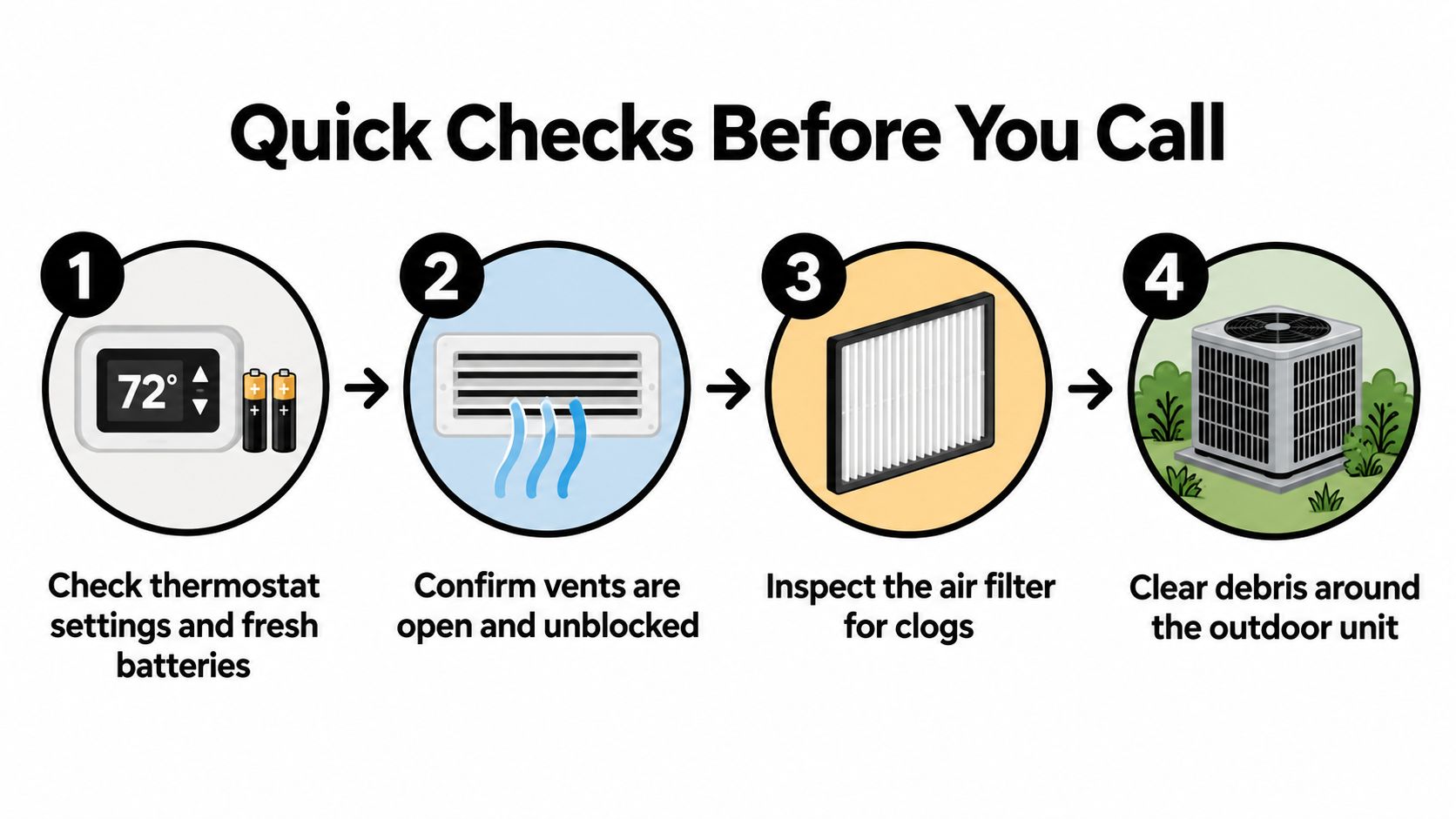
Quick Checks to Try Before You Pick Up the Phone
If there is no gas odor, smoke, carbon-monoxide alarm, active flooding, or exposed electrical danger, a few basic checks may restore operation or give the technician a cleaner starting point. Work from the thermostat outward. This keeps the process simple and avoids touching components that require training.
Begin at the thermostat
Confirm that the system is in Cool or Heat, not Off or Fan Only. In cooling mode, set the target below the current room temperature. In heating mode, set it above the current room temperature. Check whether a schedule or setback has changed the setting overnight, and replace weak thermostat batteries if the display is dim or blank.
Wait briefly after changing the setting. Many systems have a built-in compressor delay, so rapid button pressing doesn't make the equipment start faster. If the thermostat displays a fault message, record it instead of repeatedly clearing it.
Check power and airflow indoors
Look for the service switch near the furnace or air handler. It often resembles a light switch and may have been turned off accidentally. At the electrical panel, look for a tripped HVAC breaker, but reset it only once and only when there is no smoke, burning smell, water exposure, or repeated electrical activity. If it trips again, leave it off and tell the dispatcher.
Inspect the filter without opening the equipment cabinet. A heavily loaded filter can restrict airflow, freeze a coil, overheat a furnace, or trigger a safety shutdown. Replace it with the correct size if you have a suitable filter, but don't treat a new filter as a solution for ice, water, burning odors, or persistent warm air.
Confirm that supply vents and return grilles aren't blocked by furniture, rugs, or closed louvers. Airflow problems can make a healthy system appear to have a larger mechanical failure.
Finish with the outdoor scan
From a safe distance, check whether leaves, boxes, plastic, or other debris block the outdoor unit. Look for ice on the refrigerant lines or coil, standing water, and unusual sounds such as hard buzzing, grinding, or repeated clicking. Don't remove panels, touch refrigerant lines, spray the unit, or reach into the fan area.
If a single breaker reset, thermostat correction, battery replacement, or filter change doesn't restore normal operation, stop there. Guidance on a tripped HVAC breaker can help you understand the basic power check, but it can't replace diagnosis when the breaker trips again or the system remains unsafe.
When the Problem Is Worth an After-Hours Call
At 11 p.m., a dead air conditioner does not automatically justify an emergency dispatch. The right choice depends on three questions: is anyone at risk, can waiting cause property damage, and can the home remain safe until morning?
After-hours service costs more because a technician is responding outside normal scheduling, often during difficult weather or heavy demand. Industry reporting places emergency HVAC labor at about $140 to $600 per hour, compared with roughly $75 to $150 for standard daytime repairs. Weekend and holiday calls may cost 1.5 to 3 times normal rates, and service-call fees commonly add $150 to $500 (emergency HVAC pricing data).
Use the risk, damage, and delay test
Apply this three-part test before authorizing an overnight visit:
Risk: Could the condition harm occupants?
Damage: Could waiting damage the building or equipment?
Delay: Can the household stay safe until a regular appointment?
Tucson conditions change the answer. Extreme outdoor heat makes a total cooling loss more serious for medically vulnerable occupants. A hot attic increases equipment stress and indoor heat transfer. Monsoon humidity can make a warm home feel less comfortable, while an empty snowbird property may develop unnoticed water damage if a condensate problem continues.
A field study of air-handling units found supply-air-temperature setpoint drift on 55% of units at some point. The same study reported that about 40% of AHUs and 30% of ATUs had at least one fault on a given day (AHU fault-prevalence study). These findings support careful diagnosis rather than an automatic assumption that the compressor has failed. Setpoints, sensors, airflow, valves, and static-pressure control should be checked before approving expensive parts.
Symptom | Recommended Action | Reasoning |
|---|---|---|
Gas odor, carbon-monoxide alarm, smoke, or sparking | Leave the area and request emergency help | Safety risk takes priority over comfort and diagnosis |
Active water leak or ceiling damage | Shut down equipment if safe, limit water, call promptly | Waiting can expand structural damage |
Total cooling loss during extreme heat with vulnerable occupants | Request after-hours service | Occupant health and safe habitability may justify the premium |
Total heat loss during freezing weather | Request after-hours service | Cold exposure and frozen plumbing can make delay costly |
Loud mechanical noise with safe indoor conditions | Schedule the first practical appointment | Continued operation may worsen the fault, but waiting may be reasonable if the system is off |
Warm air while the system still runs | Turn it off if operation worsens the condition, then seek prompt service | The problem may involve controls, airflow, or refrigerant, not necessarily an immediate life-safety event |
One breaker trip with no smoke, odor, or repeat trip | Reset once, then schedule service if it stays on | Repeated resetting is unsafe and does not identify the cause |
Minor comfort imbalance with stable temperatures | Monitor and arrange routine service | A morning visit is usually more economical than an emergency dispatch |
Control failures deserve attention before major hardware replacement. An HVAC failure-behavior analysis found electronic failures represented 43.939% of total failures, compared with 17.424% mechanical, 12.878% software, and 12.121% electrical failures (HVAC failure-behavior research). A technician should verify boards, thermostats, sensors, and connections before condemning a compressor or replacing the entire system. Covenant Aire Solutions can use the same triage logic when deciding whether an overnight visit is justified or a morning appointment is the better value.
What Happens When You Call Covenant Aire Solutions at 11 p.m.
A useful 24/7 call starts with a live conversation, not a vague promise that someone will appear. The dispatcher should take your address, system type, symptoms, access details, and safety status. Tell them whether anyone vulnerable is inside, whether water is present, whether the breaker has tripped, and whether the equipment is currently off.

Before the truck rolls, ask for the after-hours diagnostic fee and how labor is priced outside regular hours. Covenant Aire Solutions presents itself as a family-owned Arizona HVAC company with transparent pricing and certified technicians. The practical value of that model is clarity: you should know what the initial visit covers before authorizing it.
A typical response may take one to three hours, depending on demand and weather. That isn't a guarantee, especially during a widespread heat event, but it gives you a reasonable basis for planning. Keep the equipment accessible, secure pets, turn off unsafe systems, and have the system information ready.
Diagnosis comes before the estimate
On arrival, the technician should first confirm the symptom and inspect the system safely. Common checks include thermostat communication, incoming power, breaker condition, safety switches, filter and airflow, condensate protection, control signals, capacitor and contactor condition, fan operation, temperature readings, and visible refrigerant or water problems.
The technician then explains whether the failure can be repaired during the visit, requires a return trip for a specific part, or needs a temporary measure followed by a full repair during business hours. Stock-on-truck inventory may cover common items such as capacitors, contactors, fans, and basic controls. A specific circuit board, motor, or refrigerant component may need to be ordered.
You should receive a written estimate identifying parts, labor, and any after-hours pricing before work begins. If the repair is likely to exceed your authorization limit, state that limit before the technician starts. A good visit leaves you understanding what failed, what can be restored tonight, and what remains outstanding.
The video below illustrates the type of service experience homeowners often want to understand before making an after-hours call.
Don't confuse a fast temporary restoration with a complete repair. A technician may restore safe operation while ordering a specialized part, but the invoice and follow-up plan should make that distinction clear.
How Much Emergency HVAC Repair Costs
A midnight failure can produce a wide invoice range, so separate the charges before approving work. Look for the diagnostic or service-call fee, labor rate, after-hours multiplier, parts, refrigerant work, and any access or disposal charges.
Emergency work may cost several times more than a daytime repair, especially when a technician must dispatch outside normal hours. Complex repairs involving major components or replacement can reach several thousand dollars. Treat these figures as planning guidance, not a quote for your equipment. For more context, review this HVAC repair cost guidance, then rely on the written estimate for the specific failure.
Read the quote by category
The service-call fee covers dispatch and diagnosis. Labor may be hourly, with a higher rate outside normal business hours. Parts range from common electrical components to motors, boards, compressors, and refrigerant-related work. Confirm whether the quoted amount includes testing, installation, cleanup, and a return visit if the required part is unavailable.
Ask for the total before authorizing work.
Refrigerant charges need careful review. The EPA says technicians should locate and repair refrigerant leaks instead of merely topping off a leaking system, since leak repair supports system performance, reduces emissions, and may lower energy use (EPA homeowner refrigerant guidance). Intentionally releasing refrigerant during service, maintenance, repair, or disposal is illegal.
A recharge-only recommendation deserves clarification. Ask what testing will be completed, whether the leak can be repaired, and whether the estimate includes final verification. If the system can operate safely until morning, compare that option with the after-hours premium. If the failure creates a safety concern, water damage risk, or loss of necessary heating or cooling, the premium may be justified.
Use this pre-call script
Before approving emergency work, ask:
“What is the diagnostic fee?”
“What after-hours or weekend multiplier applies?”
“Does the fee include the first portion of labor?”
“Will you contact me before exceeding my spending limit?”
“Can you provide the repair estimate in writing?”
“If a part is unavailable tonight, what safe temporary option exists?”
These answers let you compare immediate restoration with a morning appointment and avoid approving an unclear invoice.
Stopping the Next Emergency Before It Starts
Prevention starts with tasks that don't require a service call. Replace or inspect the filter as appropriate, keep supply and return grilles open, clear leaves and debris from the outdoor unit, and look for water stains around the air handler and drain route. Record unusual cycling, weak airflow, ice, new noises, or a thermostat that loses power.
During professional maintenance, ask the technician to inspect electrical components, clean coils, verify airflow, check condensate protection, calibrate the thermostat, inspect ductwork, and evaluate refrigerant performance. Arizona homes benefit from attention before major cooling and heating seasons, and seasonal residents should arrange a check before leaving a property empty for months.
Safety controls matter too. ASHRAE guidance says freeze stats, relief valves, flow and float switches, low-water cutoffs, and similar devices should be checked annually and repaired or replaced as needed (ASHRAE safety-device guidance). A freeze stat typically opens an electrical circuit when a one-foot section reaches its setpoint, usually 35°F, which can shut down equipment or trigger an alarm.
For covered stationary refrigeration equipment containing 50 pounds or more of ozone-depleting refrigerant, EPA rules require repair within 30 days of discovery when the applicable trigger rate is exceeded. If repair isn't feasible, the owner or operator must develop a retrofit or retirement plan within 30 days and complete it within 1 year, with initial and follow-up verification tests (EPA leak-repair requirements). The exact rule applicability depends on the equipment and refrigerant, so commercial operators should confirm requirements with a qualified professional.
A maintenance plan can be worthwhile if it includes scheduled inspections, priority dispatch, and clearly stated emergency-fee reductions or waivers. Compare the actual inclusions rather than paying for a label. Preventive HVAC maintenance planning should leave you with service records, identified wear, and a plan for the next high-load season.
Watch for these warning signs between visits:
Rising indoor temperature: The system runs longer without maintaining the setpoint.
Changing airflow: Vents feel noticeably weaker or uneven.
Visible moisture: Water stains, pan overflow, or recurring drain-line issues appear.
Unusual operation: Buzzing, grinding, repeated clicking, or short cycling begins.
Control problems: The thermostat goes blank, loses settings, or displays a recurring fault.
Covenant Aire Solutions provides 24/7 emergency HVAC service, diagnostics, repairs, maintenance, and heating and cooling support across Tucson and surrounding Arizona communities. When a failure can't safely wait until morning, visit Covenant Aire Solutions to request help and review the available service options before the next breakdown.