
How Much Does Ductwork Repair Cost in 2026
Most residential ductwork repairs in 2026 fall between roughly $237 and $955 nationally, with averages near $600, while broader repairs and replacements scale up sharply with access and scope. A small accessible leak may stay in the low hundreds, but damaged runs across a hot, cramped Tucson attic can turn the job into a much larger project.
You may be looking at a high summer electric bill, a bedroom that won't cool, or a register making a faint hissing sound whenever the air conditioner runs. Those symptoms can come from a loose connection, crushed flex duct, missing insulation, or leakage hidden above the ceiling. The number on a quote only makes sense when you know which problem the contractor found and how difficult it is to reach.
What Most Homeowners Pay for Ductwork Repair
A Tucson homeowner may receive a quote in the high hundreds for one accessible leak, then see a much larger figure when the same problem extends through an insulated attic run. National planning data places typical residential repairs at approximately $237 to $955, while another estimate puts ordinary repairs near $300 to $1,000, with an average close to $600. The published ductwork repair cost range provides a national benchmark, not a guaranteed local price.
The scope behind the number matters more than the label “duct repair.” A technician may seal one reachable leak, reconnect a separated joint, or patch limited damage. Several damaged sections, failed insulation, rodent damage, or a collapsed run under attic traffic require more labor and materials. The quote rises because the contractor is restoring part of the air-distribution system, not applying one patch.
Use the scope as your first filter
Read the estimate in this order:
What failed: Look for a disconnected joint, torn flex duct, crushed section, leaking boot, damaged insulation, or another specific diagnosis.
Where it failed: An exposed section near the air handler is easier to reach than a run buried in insulation or concealed behind a wall.
How much is included: Confirm whether the price covers testing, sealing, material removal, insulation restoration, balancing, and cleanup.
What happens next: Ask whether the recommendation is a localized repair, partial replacement, or complete replacement.
Practical rule: A quote without a defined scope is only a price, not a diagnosis.
Replacement requires a separate budget discussion. Limited projects may cost $500 to $2,000, full replacement may reach $1,200 to $4,500, and extensive whole-house work may reach $4,000 to $12,000 or more when deterioration, mold, corrosion, or difficult access expands the job. Those tiers are outlined in ductwork repair and replacement cost factors. A sound duct with a reachable leak may justify repair, while widespread deterioration can support replacement. The estimate should explain which condition applies in your home.
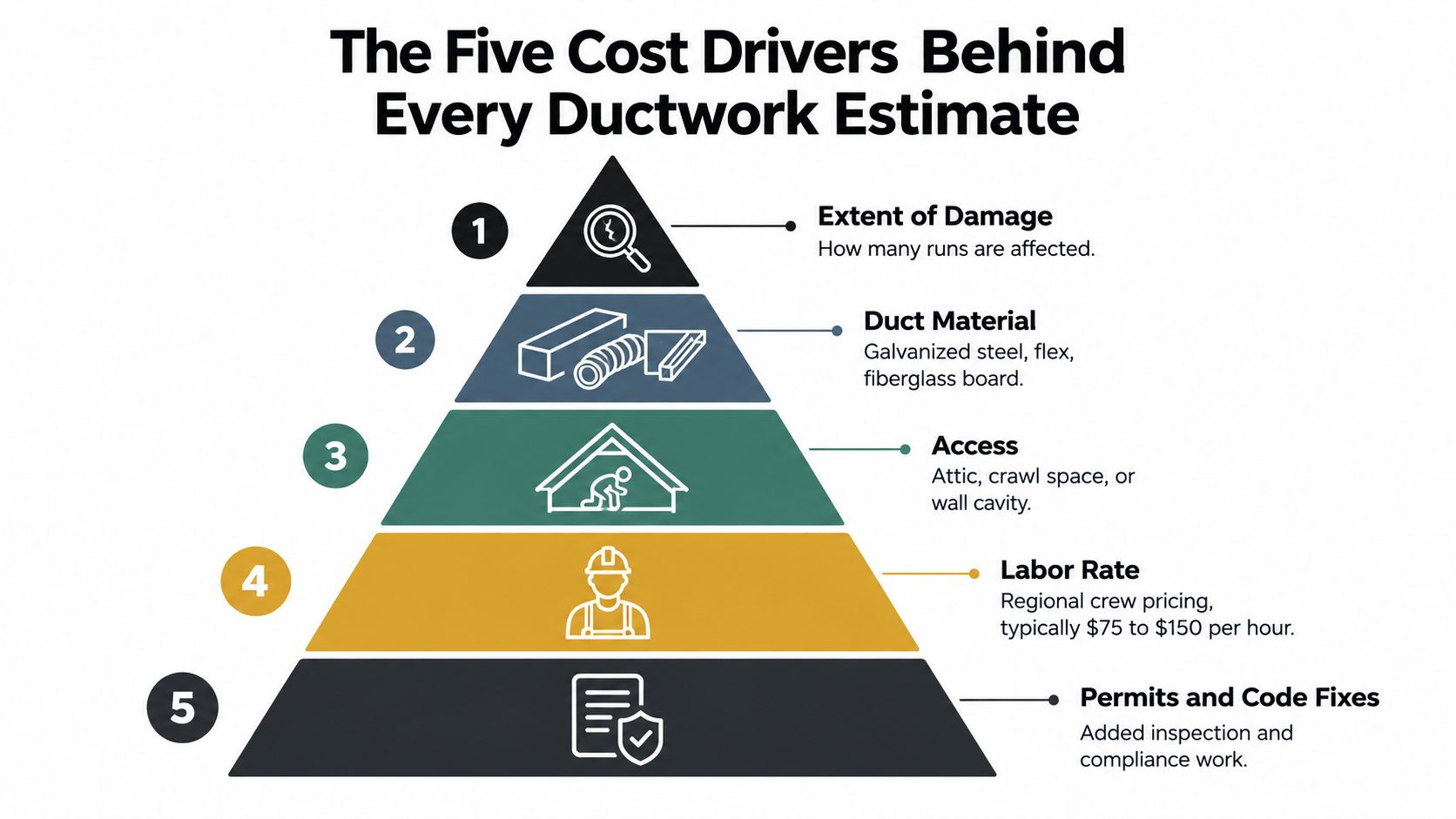
The Five Cost Drivers Behind Every Ductwork Estimate
Two homeowners may report “a bad duct” and receive very different quotes. A reachable pinhole leak is a contained repair. A corroded section buried in a tight attic or crawl space takes more labor, material, and careful movement around the home's structure.
Five questions explain most price differences
1. Extent of damage. One separated collar is a smaller job than several leaking branches. The technician must establish whether the visible defect is the full failure or only the easiest part to reach.
2. Duct material. Flexible duct, sheet metal, and fiberglass board need different repair methods. Flex may require a replacement section and proper support. Metal can require fitted pieces, approved sealant, and mechanically secured connections.
3. Access. Attic, crawl-space, and wall-cavity work changes the labor calculation. Tight areas slow inspection and material handling. Moving insulation or opening a finished surface can add work before the duct itself is repaired.
4. Sealing versus replacement. A sound duct with a reachable leak may need mastic and testing. A crushed, mold-damaged, corroded, or repeatedly failed section may justify replacement instead. Published repair guidance supports evaluating condition and access before assuming that replacement is the better choice. See this national ductwork repair cost guide for broader cost context.
5. Labor and diagnostics. Published trade-rate estimates place labor around $75 to $150 per technician hour. A small repair may take one technician 1 to 3 hours, while a diagnostic or service-call charge can add approximately $75 to $400 before repair begins.
Those figures describe labor and evaluation, not the whole scope. Code corrections, balancing, pressure testing, insulation restoration, and difficult access may appear as separate line items. They should identify work the contractor will perform and explain why the existing condition rules out a simpler repair.
Request separate lines for diagnosis, labor, materials, access, testing, and balancing. That breakdown makes competing estimates easier to compare, especially when one quote includes testing and cleanup while another prices only visible sealing.
Common Duct Repairs and Their Typical Price Ranges
The table below is a planning guide, not a guaranteed Tucson price. The scope behind each repair matters as much as the material itself. Attic heat, restricted access, damaged insulation, and seasonal scheduling can push a straightforward job toward the higher end.
Repair Type | Typical Cost Range | What Is Involved |
|---|---|---|
Small leak sealing | $200 to $700 | Locate and seal a limited leak with mastic or listed metal tape |
Joint reconnection | $200 to $700 | Reattach a separated connection, secure it, and seal the joint |
Register or boot repair | $200 to $700 | Correct leakage or damage where a duct meets the room opening |
Damaged flex-duct section | $800 to $6,000 for broader multi-section work | Remove failed material, install a sound section, support it, and restore insulation |
Rodent damage repair | $200 to $700 for limited damage | Remove compromised material and repair or replace affected sections |
Insulation restoration | Varies by access and scope | Restore the duct jacket or surrounding insulation after repair |
Published residential repair benchmarks support these broad ranges, but the same repair type can involve very different labor. An accessible leak may need limited sealing. A crushed attic run can require removal, rerouting, support against compression, and insulation restoration. Those extra steps explain why replacement is not automatically the better value. A sound duct with a reachable leak may be repaired effectively, while damaged or repeatedly failing material may justify replacement.
Register boots deserve separate attention. The duct itself can remain intact while the connection at the ceiling or wall leaks. Dust marks around a register, weak airflow, or a persistently uncomfortable room may point to that transition rather than a failure deeper in the run.
Rodent damage requires more than surface taping. If insulation or flex duct is contaminated, the contractor should identify what will be removed, what will be replaced, and how the new section will be sealed. A low-priced cosmetic patch leaves contaminated or weakened material in place.
Tucson attic temperatures, older homes with mixed duct materials, and summer demand can affect scheduling and labor. Cleaning and repair also solve different problems. This duct cleaning cost guide can help separate cleaning from sealing, replacement, and airflow correction. Do not bundle those services without a clear reason.
Ask the contractor to show whether the quote covers access, removal, testing, and insulation restoration. A table price is useful for comparison, but the work required to reach and correctly finish the repair determines the final bill.
Why Leaky Ducts Waste Money Even When They Look Fine
A Tucson home can have clean registers, a quiet air handler, and ductwork that looks acceptable from the attic access. A hidden supply leak may still send already-cooled air into the attic instead of the room. ENERGY STAR reports that typical homes lose approximately 20% to 30% of air moving through ducts because of leaks, holes, and poor connections, and that leaky ducts can reduce heating and cooling efficiency by as much as 20%, according to its duct-sealing guidance.

The equipment has already used energy to cool that air. The blower continues moving it, the thermostat continues calling for cooling, and the occupied rooms receive less of the system's output. The result may show up as a hot bedroom, longer run times, or a quote for repairs that includes access and testing rather than tape alone.
Return leaks waste comfort in another way. A return opening in a hot, dusty attic can draw that air into the system, increasing the cooling load and adding contaminants to the air path. The outer duct jacket may look intact while a joint, boot, or concealed connection remains the source of the problem.
Testing can change the repair decision
A visual inspection can find torn flex duct and loose connections, but insulation and cramped attic spaces can hide smaller leaks. Pressure testing ductwork gives the contractor a way to assess leakage beyond what can be seen. That testing fee may represent diagnostic work needed to identify the actual loss, not an unnecessary add-on.
A Florida Solar Energy Center study of 91 homes measured average duct-repair costs at about $200 per home and reported a simple payback period of less than two years. A separate field study of 18 homes reported an average repair cost of $455 and average cooling savings of $195 per year, as documented in the Florida duct-repair study. Those findings describe the tested homes, not every Arizona property, but they challenge the assumption that replacement is always the better financial choice.
A higher quote can be reasonable when it covers locating hidden leakage, sealing the correct joints, and checking the result.
Homeowners comparing methods can use this Utah duct sealing price guide to see how sealing scope affects pricing. Ask whether the contractor will test before and after the repair, and whether the price includes attic access, materials, and verification.
Repair vs Partial Replacement vs Full Replacement

A full replacement is not automatically the better answer. Published duct-system guidance recommends evaluating leakage and insulation before removing an entire network. The right scope depends on whether the ducts are structurally sound and whether the contractor can reach and correct the actual loss.
Compare the three scopes
Localized repair suits an intact system with a small leak, loose joint, damaged boot, or limited insulation problem. Sealing one accessible connection costs less disruption than opening multiple attic sections, and it preserves ductwork that is still serviceable.
Partial replacement fits one or several failed sections. A collapsed flex run, badly damaged branch, or corroded metal section may require removal while the rest of the network remains usable. Limited replacement projects are commonly described in the $500 to $2,000 range, but access, transitions, insulation, and balancing can change the quote.
Full replacement becomes more reasonable when deterioration affects much of the system, several runs have failed, or contamination and corrosion make repeated repairs impractical. Published cost guidance places full replacement around $1,200 to $4,500, while extensive whole-house work may reach $4,000 to $12,000 or more. A contractor who must remove attic insulation or work around tight framing may charge for access before installation begins.
Material choice changes the estimate. Flexible ducting may run approximately $1 to $4 per linear foot, compared with about $13 per linear foot for rigid sheet metal. Labor can represent around 50% of the project cost, and restricted crawl-space access can push an installation example to approximately $7,300, according to the replacement cost guidance. Those figures are useful for comparison, not a substitute for measuring the actual run and documenting access.
Use a simple decision test. If the ducts are sound and testing finds limited leakage, targeted repair often offers better value. If the network is collapsing, contaminated, corroded, or repeatedly failing, replacement may provide a cleaner long-term result. For projects that include ceilings, walls, or other concealed areas, this complete whole home renovation guide explains why access and sequencing can affect the scope.
Before approving a full swap, ask which sections failed, what airflow result is expected, and whether the quote includes insulation, sealing, testing, and balancing. This ductwork replacement overview can help you prepare those questions before comparing proposals.
Warning Signs That Point to a Ductwork Problem
A single warm bedroom can reveal more than a general complaint about poor comfort. If nearby rooms cool normally, inspect the affected supply run for a disconnected joint, crushed flex duct, or leakage before the register. Tell the technician which rooms are affected and whether airflow changes with blower speed. That detail helps separate a branch problem from a system-wide issue.
Dust around a vent points to a location worth checking. The gap may sit at the register boot, or the return side may be pulling air from the attic or wall cavity. A dusty grille alone does not prove the ductwork needs replacement. It gives the technician a starting point for testing.
Listen and watch while the system runs
Hissing or whistling: Escaping air may be passing through a small opening, loose connection, or poorly sealed boot.
Rattling or banging: A loose hanger, collapsed flex section, or disconnected trunk can shift when the blower starts.
Weak airflow: A kinked, blocked, disconnected, or heavily leaking branch may deliver little air to the room.
A sudden bill increase: If weather and usage appear similar but cooling costs rise, inspect concealed leakage and damaged insulation.
Dust that returns quickly: Repeated dust near registers can indicate gaps, disturbed insulation, or return-side leakage.
Pay attention to whether one room is affected or several. One weak register often calls for a branch-level inspection, while widespread low airflow may involve the filter, blower, trunk, or return system. The distinction matters because sealing or reconnecting one run costs far less than replacing an entire network.
A burning smell near a vent, a noticeable change in indoor air quality, or sudden airflow loss deserves prompt attention. Turn the system off if the odor is strong or electrical in character, then request service. A mild comfort imbalance can usually wait for a normal appointment, but visible duct collapse or active water intrusion can expand the repair scope if ignored. Ask the technician to photograph the defect, identify the accessible repair point, and explain whether testing supports repair or replacement.
Preventing the Next Repair Bill
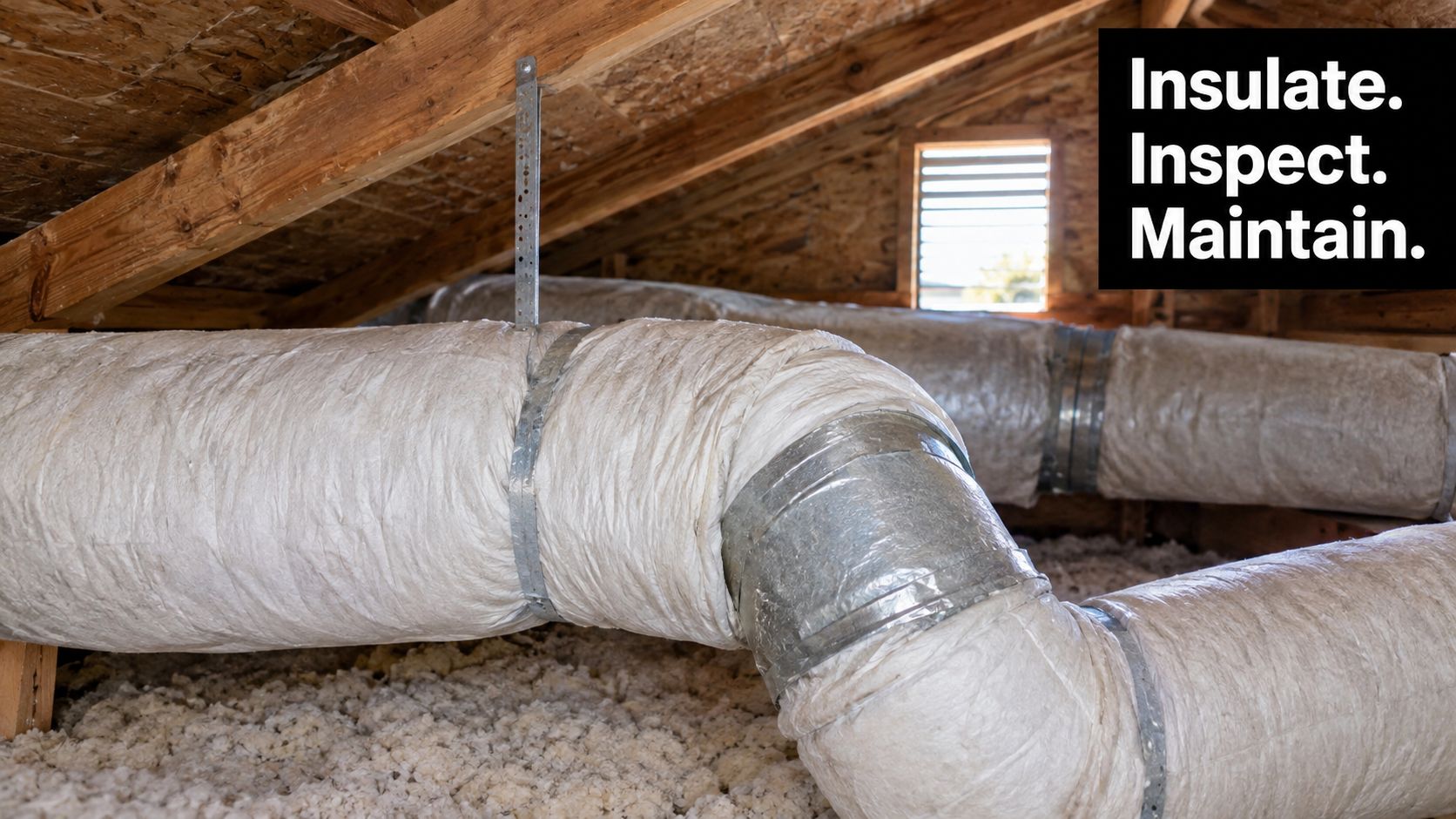
In an Arizona attic, prevention often starts with the insulation jacket around the duct. Missing, compressed, or torn insulation allows heat into the run before conditioned air reaches the room. Have the technician separate a damaged duct from damaged insulation. Replacing sound ductwork will not fix an exposed or poorly insulated section.
Three habits protect the system
Seal correctly. Use mastic or listed metal tape on suitable joints. Ordinary cloth duct tape is not a durable sealing method. Seal supply and return sides alike. Supply leaks waste conditioned air, while return leaks can pull attic contaminants into the system. Covenant Aire's ductwork sealing guidance explains how sealing differs from broader replacement work.
Protect the duct jacket. Do not step on flexible runs or stack storage against them. Compression can restrict airflow and make the blower work against a problem caused by physical damage.
Maintain the surrounding system. Replace the filter according to the equipment and household conditions, inspect accessible runs, and arrange regular professional checks. These small actions help reveal insulation damage, loose connections, and crushed sections before they require a larger attic repair.
National Laboratory of the Rockies modeling found that duct sealing and insulation upgrades produced about 7% total site-energy savings across the U.S. residential building stock. The cited retrofit research also reduced average leakage from 18% to 9% and lowered HVAC energy use by about 18%, according to the Building America duct-retrofit research. Results vary by home, access, and existing duct condition. They still support testing and repairing sound ductwork before assuming full replacement is the better spend.
Smart Next Steps and How to Read Any Ductwork Quote
Before calling, write down which rooms are uncomfortable, when the symptom began, whether you hear hissing or rattling, and whether the system recently ran longer than usual. Check the filter and look only at accessible vents and duct sections. Don't enter an unsafe attic or disturb insulation to investigate a suspected leak.
Give the contractor useful observations rather than a preferred repair. “The back bedroom has weak airflow and the register whistles when cooling starts” is more actionable than “I need new ducts.” A technician can then inspect the supply branch, boot, connections, and nearby return path before recommending a scope.
Require an itemized estimate
A sound proposal should separate:
Diagnosis: What testing or inspection identified the problem?
Labor: How many technicians and hours are included?
Materials: Which duct, sealant, insulation, supports, or fittings will be used?
Access: Is attic, crawl-space, wall, or ceiling work included?
Verification: Will the contractor test airflow, leakage, or system balance after repair?
Ask whether the quoted work addresses leakage, insulation, airflow balancing, physical collapse, or complete replacement. Those are materially different projects with materially different prices. If the quote recommends replacement, ask which sections cannot be repaired and what evidence supports that conclusion.
A licensed local HVAC company can pressure-test the system, explain the findings, and match the scope to your home and budget. Before signing any maintenance agreement, review the service agreement terms so you know what inspections, priority service, and exclusions are included.
Covenant Aire Solutions can inspect Tucson-area ductwork, identify whether sealing, partial replacement, or full replacement fits the actual problem, and provide a scope-based quote. Visit Covenant Aire Solutions to request service and get a clear explanation before approving the work.