
Ductwork Replacement Guide for Arizona Homeowners
A Tucson homeowner can do everything right, set the thermostat lower, replace the filter, and schedule routine air-conditioning service, yet still find one bedroom hot, another room chilly, and the system running almost nonstop. The problem may be hidden above the ceiling or inside a scorching attic: the ductwork that carries conditioned air through the home.
Ductwork replacement isn't automatically the answer. A loose connection, crushed flexible duct, damaged insulation, or an oversized leak may be repairable. Full replacement makes more sense when the distribution network is broadly deteriorated, poorly designed, contaminated, or so inefficient that repeated repairs no longer solve the underlying problem.
Introduction to Ductwork Replacement for Arizona Homes
Arizona homes place unusual demands on air distribution. Summer heat turns an attic into a harsh work area for ducts, while dust, aging insulation, tight access points, and installation defects can gradually reduce airflow. If the supply network leaks or transfers heat before air reaches the rooms, the air conditioner may keep working without delivering balanced comfort.
The U.S. Department of Energy states that typical duct systems can lose 25% to 40% of the heating or cooling energy delivered by a central furnace, heat pump, or air conditioner. The same federal guidance identifies leakage and conduction as the two main causes of conditioned-energy loss in ducts located in attics or crawl spaces. The DOE-referenced ductwork pricing overview provides useful context for why a replacement decision involves more than duct age.
That doesn't mean every inefficient duct system needs a complete rebuild. A contractor should first determine whether the trouble comes from leakage, poor insulation, compression, blocked airflow, disconnected joints, or an unsuitable layout. Testing turns a vague complaint, such as “the back rooms never cool,” into a repair-versus-replace decision.
What this guide helps you decide
You'll learn how to recognize warning signs, understand the difference between sealing and replacement, compare major cost and timeline drivers, and evaluate contractor proposals. You'll also see why Arizona attic conditions and code-based testing matter, especially when a project alters only part of an existing system.
For a homeowner, the practical outcome is a clearer path forward:
Comfort: Identify why rooms receive unequal airflow.
Efficiency: Find losses that force the cooling equipment to work harder.
Indoor air quality: Investigate dust entry, damaged lining, and unsealed returns.
Budget control: Compare targeted repair with a full ductwork replacement scope.
Hiring confidence: Ask for testing, written details, and final verification.
A helpful overview of residential systems is available in this guide to residential HVAC ductwork. Use it as background, then ask a qualified Arizona contractor to inspect the actual system rather than approving replacement based only on its apparent age.
What Ductwork Replacement Means and How It Works
Think of your ductwork as the home's circulatory system. The air handler or furnace is the pump, supply ducts are the outgoing vessels, and return ducts carry air back for conditioning. If those pathways are kinked, undersized, disconnected, or leaking, the equipment may operate normally while rooms receive the wrong amount of air.
Ductwork replacement means removing some or all of those air pathways and installing new runs, fittings, transitions, insulation, and connections. It differs from three narrower services:
Repair: A technician corrects a localized defect, such as a torn section or disconnected joint.
Sealing: The contractor closes leaks at seams, boots, plenums, and connections without necessarily removing the full run.
Replacement: The existing network is rebuilt because its condition, design, or accessibility makes isolated fixes inadequate.
The parts that determine performance
Flexible ducts can fit through restricted spaces, but installers must avoid kinks and compression. Sheet-metal sections provide rigid pathways and can support carefully shaped transitions. Fiberglass-lined components may reduce sound, but their condition and exposure to moisture deserve close inspection.
Material alone doesn't determine performance. A new duct can still waste energy if the installer leaves gaps at the air handler, compresses a flexible run, uses inadequate insulation, or fails to support the duct properly. The goal is a continuous, insulated air path with suitable sizing and balanced supply and return airflow.
Why leakage changes the decision
The DOE states that residential forced-air ducts can waste about 20% to 30% of conditioned air through leaks, holes, and poor joints. Its Building America guidance recommends reducing leakage by roughly two-thirds, targeting about 5% of system fan flow on each side, and upgrading insulation to R-8. The DOE Building America retrofit resource also says leakage to the outside shouldn't exceed 5% of total airflow on either the supply or return side.
Those targets explain why a visual inspection isn't enough. A duct may look intact while leaking at a hidden seam or losing heat through insufficient insulation. Pressure testing, airflow measurements, and inspection of the attic or crawl space help show whether sealing can restore performance or whether the network needs replacement.
Signs You Need Ductwork Replacement Soon
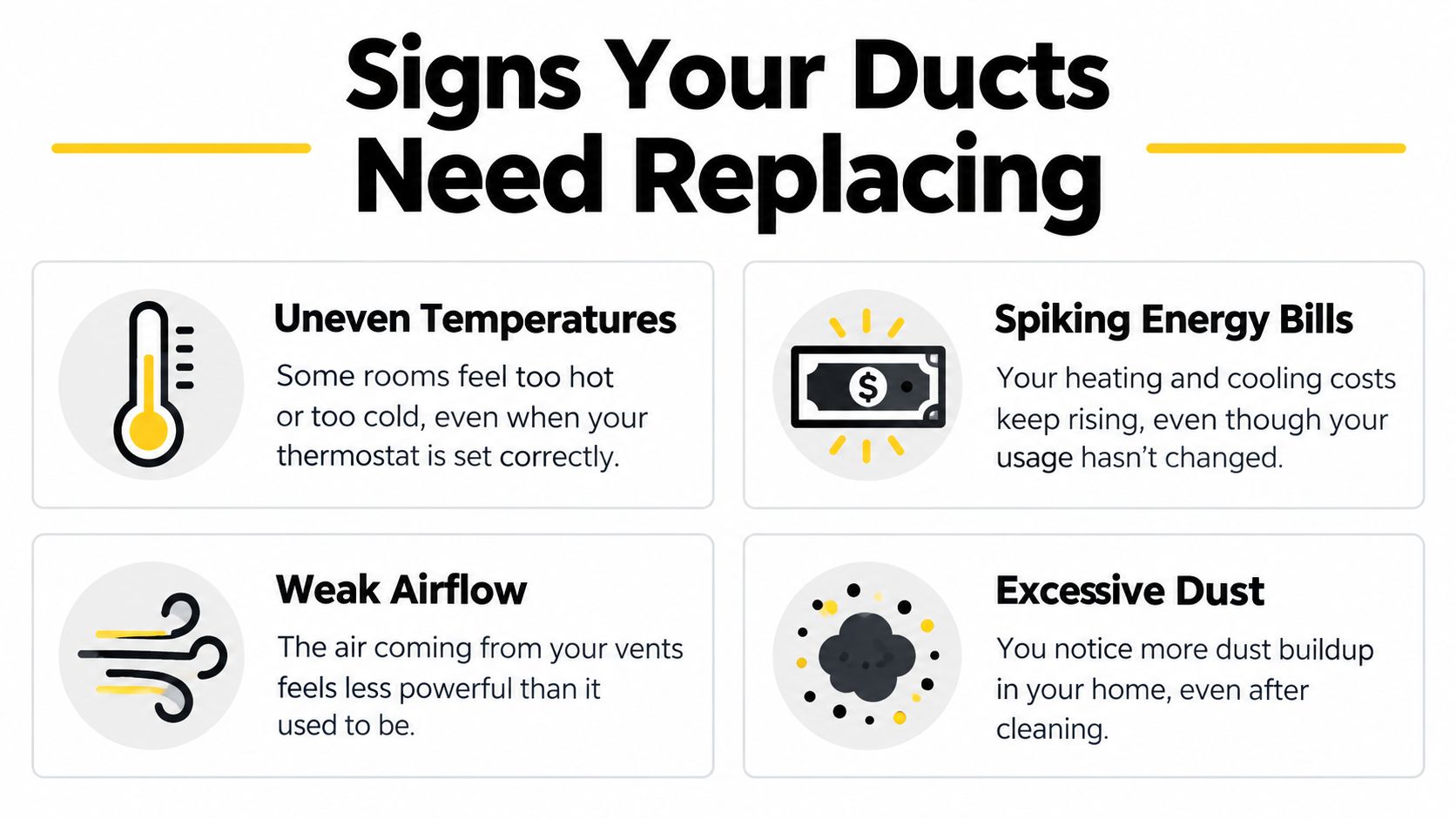
A bedroom can stay warm while the nearby living room feels comfortable. That pattern does not automatically mean the air conditioner is failing. A restricted branch, crushed flexible duct, poor balance, or leak before the register can all produce the same symptom. Closing vents in cooler rooms may shift pressure without correcting the cause.
Compare airflow at several registers with your hand. Treat the result as an observation, not a diagnosis. A technician must determine whether weak delivery comes from a duct restriction, blower problem, dirty equipment, closed damper, or limited return air.
The cost and comfort clues
Long cooling cycles during Arizona's hot weather are not, by themselves, proof of equipment trouble. Concern rises when long operation appears with uneven temperatures, weak registers, or higher energy use. The DOE's documented residential loss range of 20% to 30% supports testing the duct system before blaming the air conditioner alone. Measured leakage is more useful than an unsupported statement that the ducts are “old.”
Replacement becomes a repair-versus-replace decision. If testing finds a small number of accessible failures, sealing or replacing individual sections may be reasonable. If leakage is widespread, insulation is failing across the network, or repairs would leave repeated problem areas, full replacement may provide a more durable correction.
Dust offers another clue, especially around registers and return grilles. Unsealed return connections can draw attic or crawl-space air into the system. Damaged insulation or deteriorating duct interiors can also affect cleanliness. Dust does not prove that replacement is required, but it justifies inspecting joints, insulation, and nearby spaces.
Physical warning signs
Do not enter an unsafe attic or disturb questionable materials. From a safe access point, look for:
Disconnected joints: Sections no longer fit tightly at collars, plenums, or boots.
Crushed flex duct: Compression reduces the usable passage and can restrict delivery.
Torn outer jacket: Damaged insulation allows more heat transfer and further deterioration.
Rust or corrosion: Metal damage can weaken connections and indicate moisture exposure.
Visible biological growth: Suspected mold needs careful evaluation, not casual brushing or spraying.
Loose or missing supports: Sagging ducts can compress the run and reduce airflow.
Arizona attic heat makes weak insulation and poor sealing more costly. Monsoon moisture can complicate condensation and material condition. If ducts sweat or moisture appears nearby, review what causes HVAC ductwork to sweat before assuming replacement is the only answer.
A sound replacement recommendation connects visible defects to measurements. It identifies the failed components, explains why localized repair may not last, and states how testing will verify the proposed improvement.
How the Ductwork Replacement Process Works Step by Step
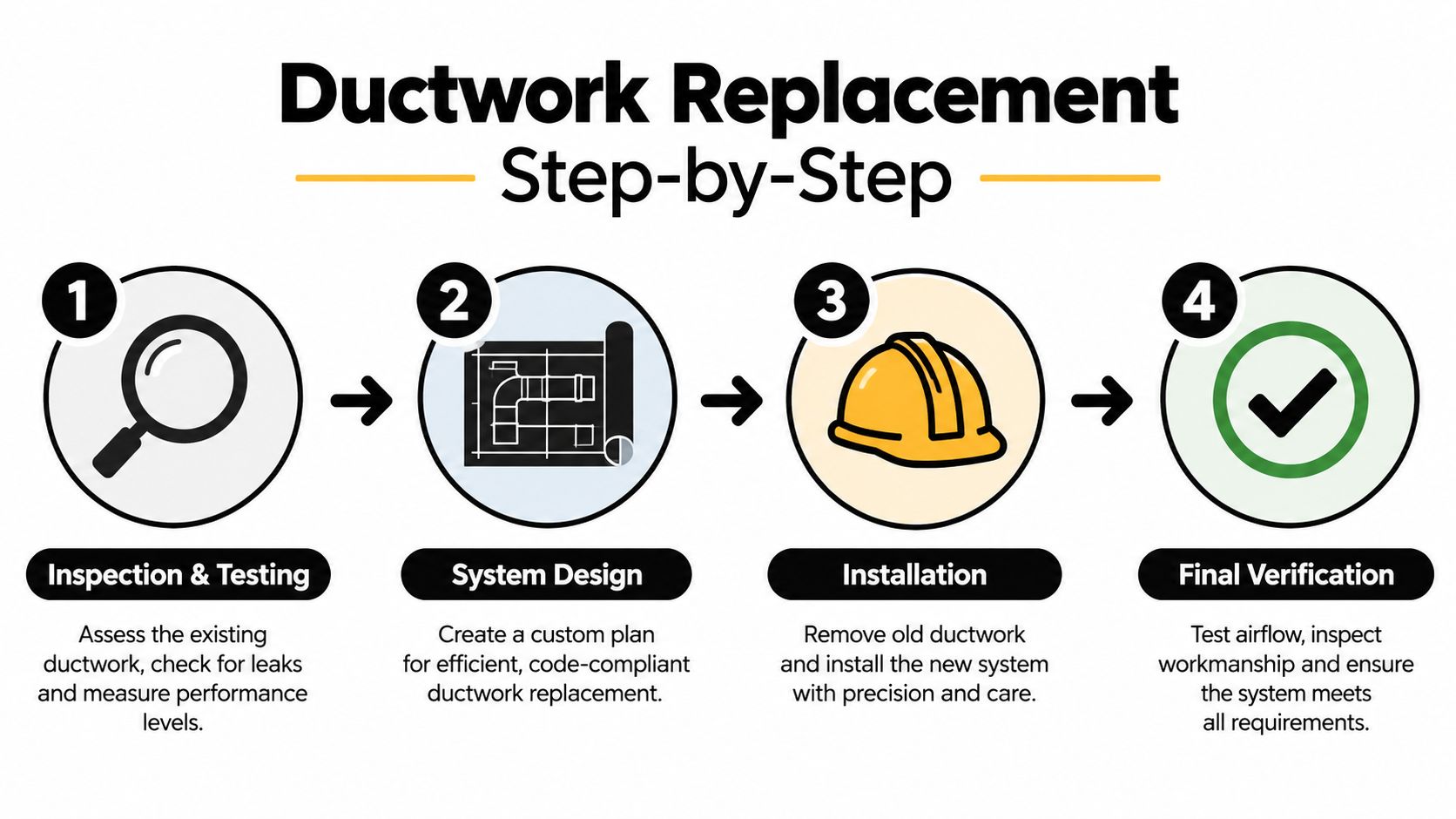
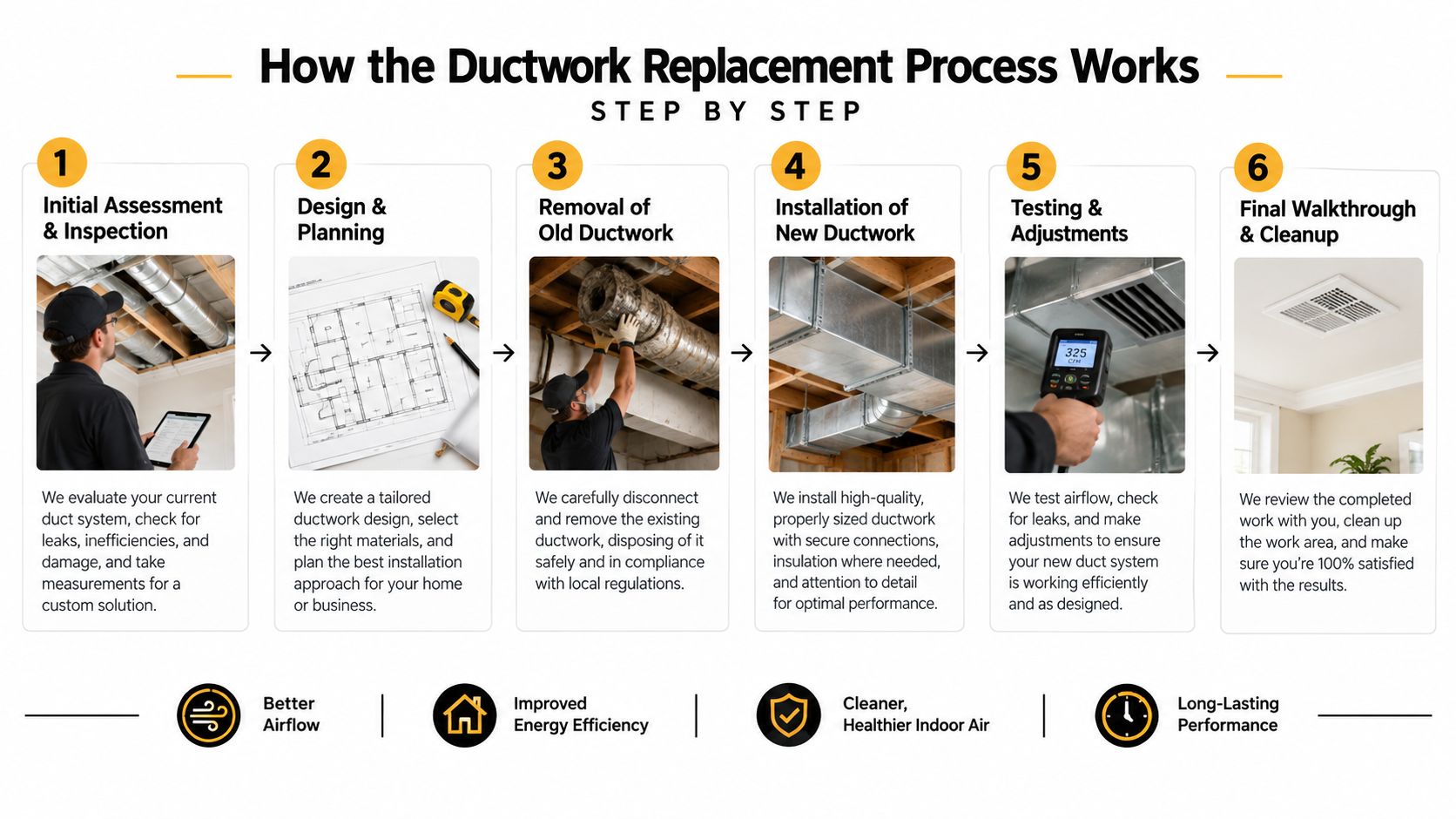
A homeowner may notice one room staying warm while the system runs longer. The cause could be a torn duct, a poor connection, an undersized return, or an attic route that transfers too much heat. A professional replacement project separates those possibilities before anyone installs new material. The contractor inspects the air handler, plenums, supply branches, return paths, insulation, registers, and access conditions, then uses measurements to identify leakage, pressure imbalance, inadequate airflow, or several issues together.
Inspection and design come first
The first visit should produce more than a visual opinion. Ask what the technician measured, which sections failed inspection, and whether the proposal includes sealing or replacing nearby components. The contractor should also document narrow attic access, enclosed runs, damaged framing, and removal risks that could affect ceilings or walls.
Testing helps decide whether repair is reasonable or replacement is justified. A measured leak at one accessible connection may call for sealing. Widespread leakage, damaged insulation, restricted routes, or repeated failures may support replacing a larger section. Arizona attic heat makes that distinction practical. A duct that appears serviceable indoors can lose performance when weak insulation and air leaks expose it to extreme attic temperatures.
System design follows the diagnosis. The installer selects routes, transitions, branch connections, return capacity, and insulation requirements. Copying a defective layout only supplies new materials without correcting the airflow problem.
Installation requires control
During removal, the crew protects the living space and removes failed sections safely. If questionable insulation or another hazardous material is present, specialized handling may be needed before installation begins.
New runs should be supported without crushing flexible sections. Connections need secure mechanical attachment and suitable sealant, while insulation must remain continuous around the duct. In an Arizona attic, small gaps expose the distribution system to intense heat, so workmanship around seams, boots, plenums, and penetrations matters as much as the duct material.
The contractor should explain how the system will remain usable during the work. Some projects require a temporary shutdown, while others proceed in stages. Access and scope determine disruption, so a written schedule gives the homeowner a clearer expectation than a universal promise.
Verification closes the project
Final verification should cover connections, insulation, supports, and air-handler transitions. The contractor should test leakage and airflow instead of treating installation completion as proof of performance. This guide to pressure testing ductwork explains how testing lets homeowners compare the finished system with its original condition.
For newer homes, ENERGY STAR requirements illustrate how specific duct testing can be. Rough-in and final leakage limits vary with conditioned floor area and the number of ducted returns. The applicable requirement should be identified in the project documents, and results should be recorded so the homeowner can confirm whether the proposed repair or replacement achieved its intended improvement.
Ductwork Replacement Costs Timelines and What Affects Them
Homeowners usually want a price before a contractor has inspected the attic, but ductwork replacement isn't a standardized package. A partial repair in an accessible area differs sharply from a full rebuild through enclosed ceilings or a complicated crawl space. A useful estimate separates labor, materials, removal, access work, sealing, insulation, testing, and permit-related requirements.
Home size affects the amount of duct and number of connections. Accessibility can matter just as much. An attic with a clear access path may be simpler than a smaller system concealed behind finished surfaces.
Factor | Impact on Cost | Impact on Timeline |
|---|---|---|
Home size and number of runs | More branches, returns, fittings, and materials generally increase the scope | More installation and verification work |
Attic, crawl-space, or concealed access | Restricted access adds labor and protection requirements | Removal and installation take longer |
Repair versus full replacement | Targeted sealing or component repair can limit the scope, while a rebuild requires more material and labor | A broader replacement creates more disruption |
Material and insulation selection | Rigid, flexible, and lined options carry different installation needs | Fabrication and fitting requirements vary |
Removal and disposal | Failed ducts must be removed safely before new runs are attached | Demolition can add work before installation starts |
Testing and permits | Required testing or approvals can add project administration | Scheduling may include inspection or verification steps |
Ask what the estimate actually includes
A credible proposal should state whether it covers old-duct removal, new connections, insulation, sealing, balancing, final testing, access repairs, and cleanup. It should also explain what happens if the crew discovers damaged surrounding materials or an inaccessible section.
For a related home project that also involves major overhead access decisions, an Arizona homeowner roof replacement overview can help you understand why site conditions and material choices affect planning. The comparison is practical, not exact: both projects can involve concealed building components, access limitations, protection of finished spaces, and inspection requirements.
Don't rely on an online calculator as a substitute for inspection. Use estimates from multiple contractors to compare scope, not just the final total. This ductwork replacement cost guide can help you prepare questions before requesting proposals.
Timeline expectations
A small, accessible repair may be completed quickly, while a full replacement can extend across several workdays. The actual schedule depends on system size, access, removal requirements, fabrication, permit coordination, and whether other HVAC work is performed at the same time.
Ask the contractor three direct questions: Which parts of the home will be opened, when will the air conditioner be unavailable, and what testing happens before final payment? Clear answers protect both your comfort and your budget.
How to Vet Contractors and Arizona Specific Considerations
The contractor who recommends replacement should be able to show why sealing or targeted repair isn't enough. A vague explanation based only on age is weak evidence, particularly when a measurable leakage problem may be repairable. Choose a company that treats testing, design, installation, and verification as one connected process.
Use a written screening checklist
Verify licensing: Confirm the contractor's Arizona credentials and the business information connected to the proposal.
Ask about insurance and bonding: Request confirmation that the company carries appropriate coverage for workers and property.
Demand a detailed estimate: Look for listed duct sections, insulation, sealing, removal, testing, access work, and exclusions.
Review references: Ask about projects with comparable attic, crawl-space, residential, or light-commercial conditions.
Read warranty terms: Check what the warranty covers, how long it applies, and whether workmanship and materials are treated separately.
Require final measurements: Ask for documentation of leakage, airflow, or balancing results after installation.
An estimating platform such as Exayard HVAC estimating software can help HVAC businesses organize project scopes and proposals. For homeowners, the important point is still the estimate's clarity. Software doesn't replace a site inspection or make an unsupported recommendation valid.
Practical rule: If a contractor won't explain what was tested, what failed, and why repair won't solve it, don't approve a full replacement yet.
Arizona conditions need specific questions
Attic heat can expose weak insulation and poor connections, while dust can enter through unsealed return paths. Monsoon humidity can complicate condensation concerns, especially where ducts, insulation, and metal surfaces meet. Ask how the crew will protect insulation, seal penetrations, support flexible runs, and prevent compression.
Code requirements may apply even when the project changes only part of the network. A California residential HVAC replacement fact sheet illustrates how alteration rules can be specific: duct runs longer than 40 feet require sealing and testing, with measured leakage at or below 15% of system air-handler airflow. The same document describes a Duct Sealing and Testing measure at or below 5% of system air-handler airflow. Use the California HVAC replacement energy-code fact sheet as an example of why local authorities and contractors should confirm the rules governing your Arizona project.
For a homeowner-focused hiring checklist, see how to choose an HVAC contractor. Compare proposals on evidence and scope, not on urgency or a suspiciously low price.

Benefits Financing and Maintenance After Replacement
A properly executed replacement can improve room-to-room comfort, reduce unwanted heat transfer, and help the HVAC equipment deliver air through a better-connected network. Better sealing also limits the movement of dusty attic or crawl-space air into the return system. The value comes from matching the scope to the measured problem, not from installing new duct because the old duct looks dated.
Insulation deserves attention. DOE Building America guidance identifies R-8 as an upgrade target in the referenced retrofit approach, but the correct application depends on the assembly, location, and applicable requirements. Ask the contractor to identify the insulation level, sealing materials, and verification method in writing.
Financing can make a necessary project easier to schedule, but compare the total repayment obligation, promotional period, fees, and approval terms before signing. A maintenance agreement may also support the investment through scheduled inspections, filter guidance, and priority service. Preventive plans that include biannual checkups can help identify airflow changes, damaged insulation, and emerging leakage before comfort problems become severe.
Your upkeep routine should stay simple:
Replace filters as specified: Use the correct size and follow the equipment manufacturer's guidance.
Watch room balance: Note new hot spots, weak registers, or unusual system noise.
Inspect safely: Look for visible damage around accessible ducts without entering unsafe attic areas.
Request periodic testing: Have a technician reassess leakage when performance changes or renovation work affects the system.
If testing shows a limited defect, repair may be the responsible choice. If the network has widespread damage or poor design, replacement may provide the more durable path.
Covenant Aire Solutions offers inspection, repair-versus-replace guidance, ductwork replacement, and final system evaluation for Tucson-area homes and businesses. Visit Covenant Aire Solutions to request an assessment and discuss a clear ductwork plan based on your system's condition, access, and measured airflow.