
Emergency HVAC Replacement: What Tucson Homeowners Need
The thermostat says the house is getting warmer, the air handler is silent, and everyone is watching the temperature climb. Outside, Tucson is delivering the kind of heat that turns a failed air conditioner into a health concern, especially when an older adult, infant, or medically vulnerable person is inside. You need a safe decision quickly, but you don't need to accept the first replacement quote placed in front of you.
Emergency HVAC replacement is a decision point, not an automatic sales outcome. First protect the occupants, then determine whether the system can be stabilized, document the failure, evaluate the equipment and refrigerant, compare repair with replacement, and verify the installation before the contractor leaves. This emergency air-conditioning repair guide for homeowners is useful for the immediate safety steps, but a replacement decision requires more than getting cold air back.
When the AC Goes Out and the Clock Starts Ticking
At 3 p.m., the indoor temperature is rising, the outdoor unit hums once and stops, and the technician's first available appointment is several hours away. Turn the system off if you smell burning, see smoke, hear sparking, or notice water near electrical components. Move vulnerable occupants to a cooler location, close blinds on sun-facing windows, use safe fans, and don't open electrical panels or refrigerant circuits.
Arizona heat changes the urgency. A failed system during a short mild spell may be a repair problem. A failed system during sustained extreme heat can become a safety problem, and the response should reflect the people in the home, not just the equipment's age.
Senior advisor rule: Protect people first, preserve the equipment second, and sign a replacement agreement only after you understand the failure.
The decisions usually arrive in this order:
Triage the risk. Identify heat exposure, electrical hazards, gas concerns, condensate damage, and occupants who can't safely tolerate high indoor temperatures.
Confirm the failure. Ask the technician to identify the failed component, refrigerant type, system age, and whether a temporary repair is safe.
Compare paths. Weigh repair cost, remaining service life, parts and refrigerant availability, installation quality, and total replacement scope.
Review the quote. Check the load calculation, matched equipment, refrigerant, efficiency rating, electrical work, permits, condensate protection, warranty, and financing terms.
Commission the system. Require airflow, refrigerant charge, static pressure, temperature split, and controls to be checked before the job is considered complete.
A fast installation matters when the home is unsafe. It doesn't justify skipping diagnosis or accepting a mismatched system that creates years of comfort and utility problems.
What Truly Counts as an Emergency HVAC Replacement
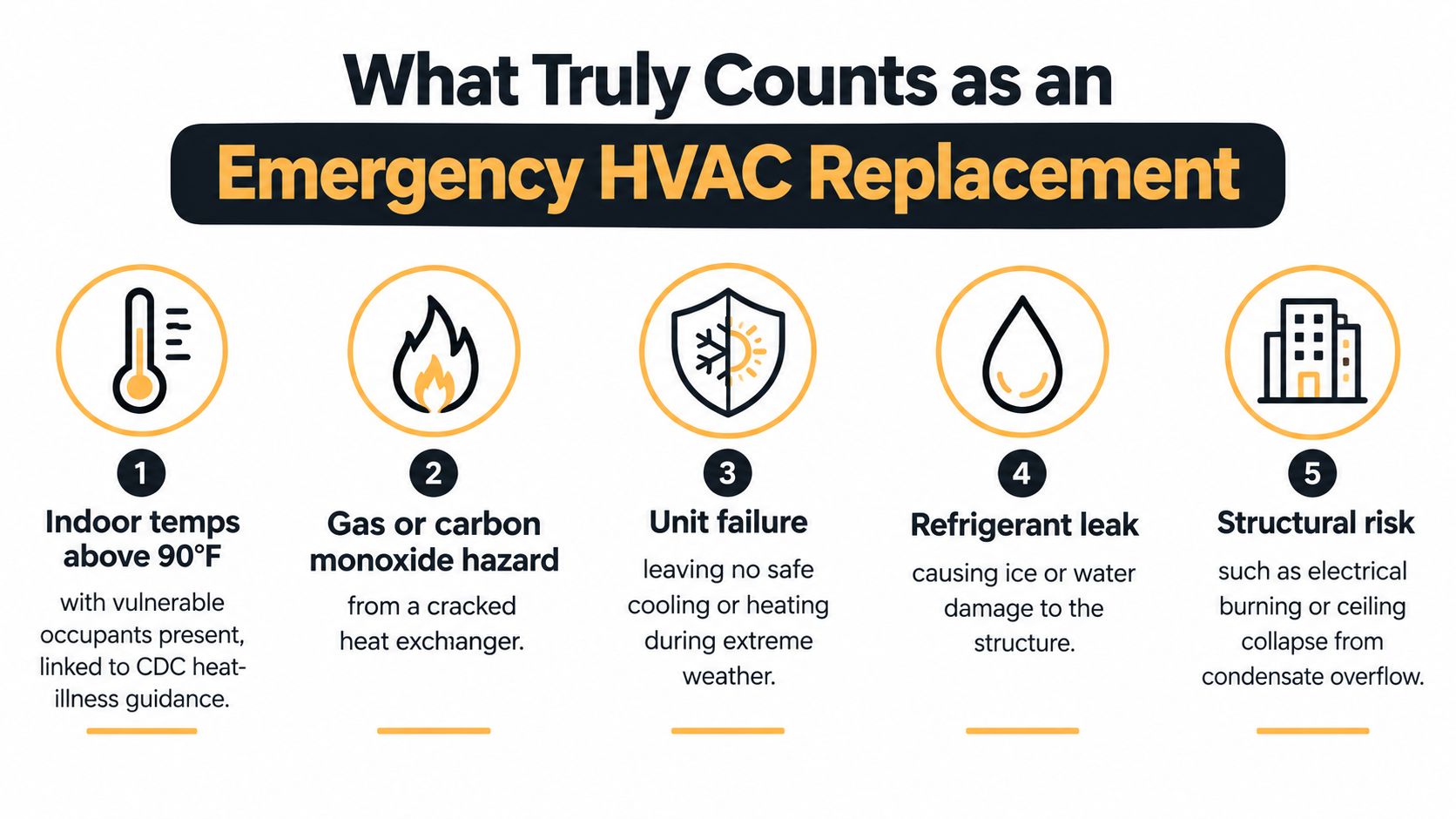
An emergency replacement is justified when the failed system creates a credible health, safety, or property risk and a safe repair can't restore protection quickly. No cooling with vulnerable occupants during severe heat belongs in that category. So does electrical burning, a serious refrigerant leak, structural water damage from condensate, or a failed component that can't be sourced or safely replaced.
The public-health context is serious. In 2020, Phoenix recorded 145 days above 100°F, Yuma recorded 148, and Arizona recorded 522 heat-related deaths, according to the CDC report on heat-related illness in Arizona. The same report found higher heat-related hospitalization rates among adults aged 65 and older than among younger adults. If an older resident or medically vulnerable person is waiting in a hot home, don't treat the outage as an ordinary scheduling inconvenience.
Call urgently when risk is present
A compressor failure may justify replacement when the system is old, the repair is substantial, and the refrigerant or compatible parts are difficult to obtain. A major leak can also change the decision, particularly on legacy equipment that depends on a shrinking supply of reclaimed refrigerant. An irreparable electrical fault, a burned control system, or a cracked heat exchanger on a gas furnace demands safety-first handling.
Call for urgent service when you find:
Heat exposure: Indoor conditions are becoming unsafe and vulnerable occupants can't relocate.
Electrical danger: You smell burning, see smoke, find melted wiring, or hear persistent arcing.
Water damage: Condensate is overflowing toward ceilings, walls, insulation, or electrical equipment.
Refrigerant failure: The system has a major leak, icing, or a failed compressor, and the technician can't offer a dependable repair.
Combustion risk: A furnace presents a gas or carbon monoxide concern.
A thermostat failure, dirty filter, tripped breaker, or minor condensate blockage may be urgent but isn't automatically a replacement emergency. A competent contractor should stabilize those problems when safe instead of turning every outage into a new-system sale. Use this HVAC emergency decision guide to distinguish a dangerous failure from a repairable interruption.
Repair Versus Replace Under Time Pressure
Even under time pressure, repair remains a valid option. Before approving work, require clear answers: what failed, what the repair costs, and how much dependable service the existing system can reasonably provide. That standard keeps a rushed diagnosis from becoming an automatic replacement sale.
Homeowners often expect rapid service, and many choose repairs while equipment prices rise, according to industry reporting on HVAC service communication and repair decisions. Those conditions create pressure, but a short appointment window does not justify skipping diagnosis, written options, or a comparison of total value.
Use four questions before approving work
Is the system young and dependable? A relatively new system with one isolated failure usually deserves a repair review, provided the work restores safe operation without creating a mismatched installation.
Is the failure major? A compressor, coil, heat exchanger, or severely damaged electrical assembly calls for a full repair-versus-replace comparison.
Can the parts and refrigerant be obtained? A repair dependent on uncertain components may delay the same decision and leave you facing another outage.
What share of replacement cost is the repair? Many homeowners use a 30% to 50% repair-cost threshold for comparison. Treat that percentage as a decision aid, not a rule.
Ask the technician to document the failure mode, repair scope, refrigerant, warranty impact, and expected limitations. If you approve a temporary repair, confirm that it preserves equipment and labor warranty eligibility. Also ask whether the contractor will apply any service charge toward a planned replacement.
For a commercial property, a documented condition review can separate one failed component from wider building risk. Owners can use the PCA report to add property-condition context when an HVAC decision affects an acquisition, maintenance program, or capital plan.
Repair makes sense when it buys safe time to compare bids, arrange a planned installation, or source suitable equipment. Replacement becomes the stronger choice when failures keep returning, a major component is damaged, refrigerant access is unfavorable, or the contractor cannot stand behind dependable performance. Review the AC repair versus replace guide alongside the technician's written findings, and judge the system's condition rather than its age alone.
What Happens on the Emergency Call and the First 24 Hours
A good emergency call starts with questions, not a sales pitch. Dispatch should ask what happened, whether there's a burning smell or water, what the thermostat shows, whether the outdoor unit runs, who is in the home, and whether temporary cooling is needed.
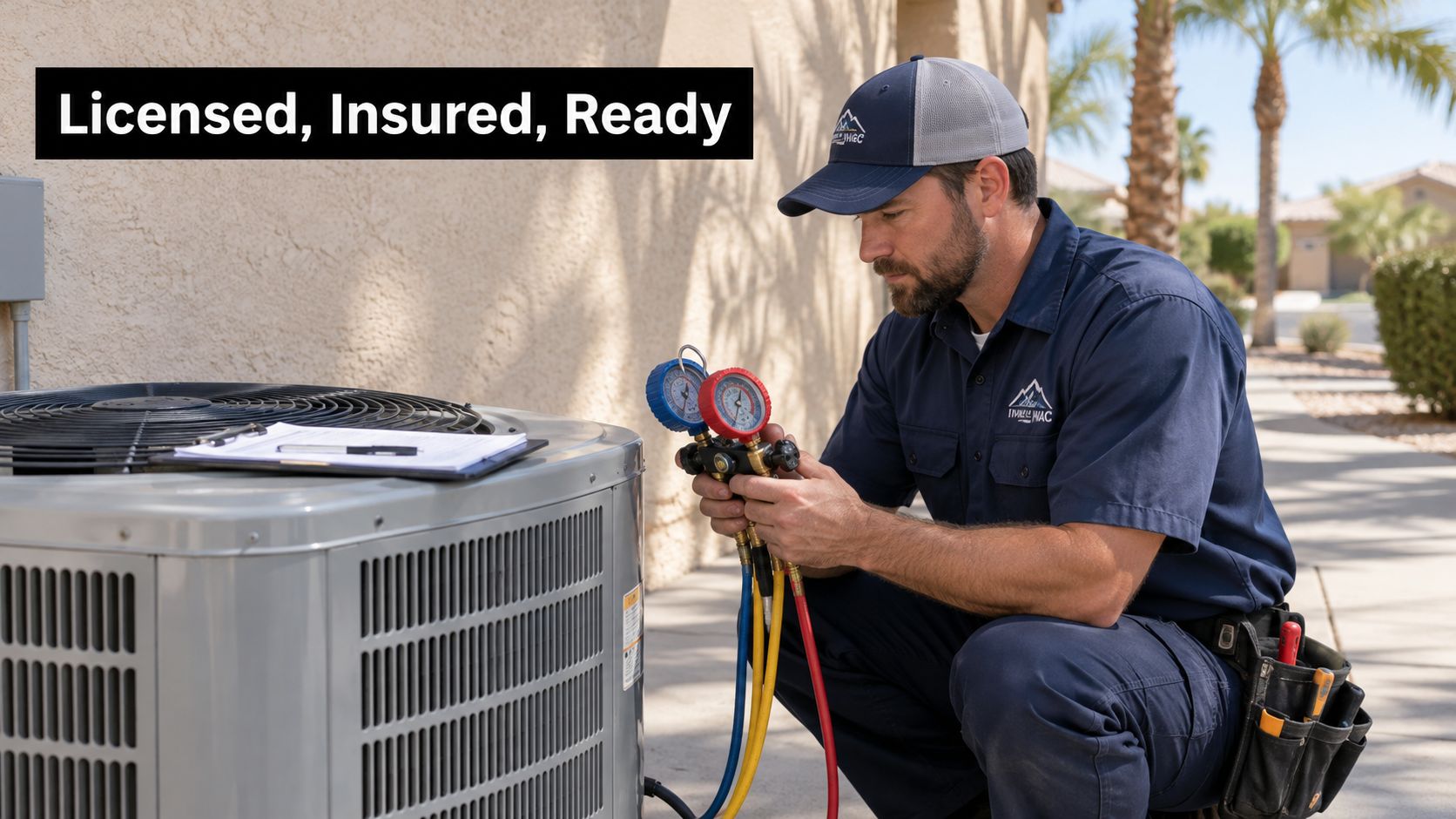
For a representative Tucson home, the technician should verify power, thermostat operation, filter condition, blower operation, outdoor electrical components, airflow, refrigerant pressures, visible leaks, condensate drainage, and equipment data plates. You should receive the system age, refrigerant type, observed failure, immediate safety concerns, repair option, replacement option, and any reason installation can't happen immediately.
Temporary cooling must be safe
A contractor may recommend portable spot coolers, strategic fan placement, or a temporary duct patch while equipment is sourced. Keep portable equipment on appropriate circuits, maintain clearance around the unit, and don't run extension cords in a way that creates heat or trip hazards. Never place combustion equipment or a portable cooler where condensate can reach electrical components.
If the home has a safe room that stays cooler, close interior doors to concentrate cooling there. Cover sun-facing windows, avoid unnecessary oven use, and relocate vulnerable occupants when indoor conditions continue to worsen. Temporary measures should buy time, not conceal a hazard.
The first visit may end with a repair, a temporary stabilization, or a written replacement proposal. Same-day installation depends on correctly sized equipment, compatible indoor and outdoor components, available labor, permitting, electrical requirements, and whether line sets or ductwork need changes. A few hours of waiting for the right system is preferable to a rushed installation that fails during the next heat event.
A professional should explain the following before you sign:
Diagnosis: The failed component and testing that supports the conclusion.
Replacement scope: Equipment, refrigerant, electrical work, condensate protection, duct modifications, permits, and disposal.
Timing: What can happen today, what requires sourcing, and what could delay startup.
Temporary plan: How the home will remain safe while the final decision is pending.
Choosing the Right Replacement Equipment and Refrigerant
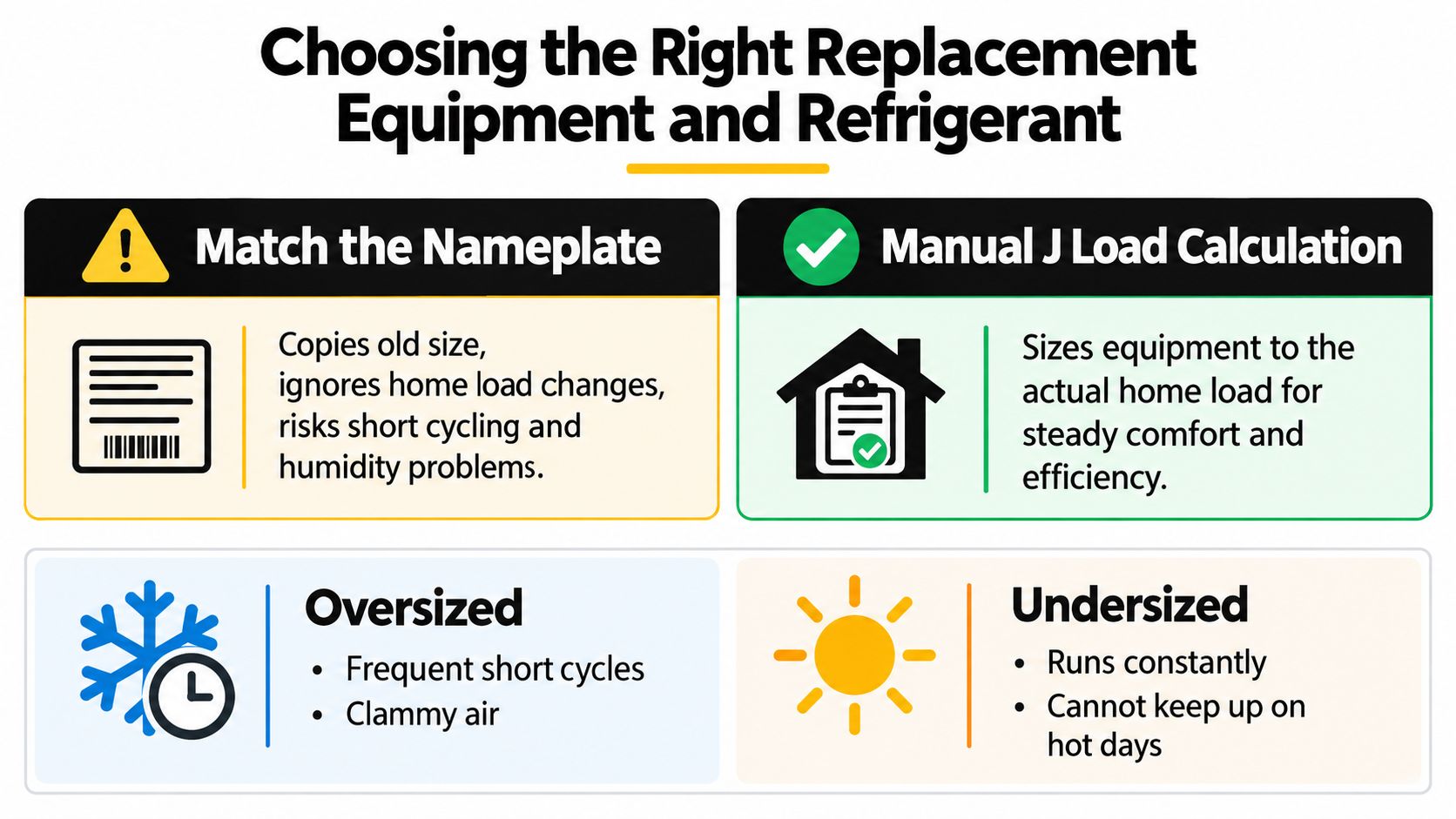
The old unit's nameplate is evidence of what was installed, not proof of what your Tucson home needs today. A proper Manual J-style load calculation accounts for envelope conduction, solar gains, infiltration, internal loads, and duct losses. Manual S, or an approved equivalent, then matches equipment to the calculated sensible and latent loads.
Oversizing creates short cycling, weak dehumidification, uneven temperatures, and unnecessary peak demand. Undersizing can leave the system running continuously while failing to maintain the setpoint during extreme conditions. Ask for the calculation and the equipment-selection logic, especially if the proposal just repeats the old tonnage.
Understand the refrigerant transition
Federal rules restrict newly manufactured residential and light-commercial equipment using refrigerants with global warming potential above 700 beginning in 2025, while new residential central air-conditioning systems installed after January 1, 2026 must use a lower-GWP refrigerant, according to the EPA's HFC phasedown guidance. That doesn't mean an existing R-410A system can't be serviced. It does mean a whole new system must be designed and listed for the applicable lower-GWP refrigerant.
A2L refrigerants such as R-454B and R-32 aren't drop-in substitutes. The indoor coil, outdoor unit, metering device, controls, safety procedures, and certification must work together. Don't accept mixed refrigerants, an improvised conversion, or an outdoor-unit-only replacement without a matched-system evaluation. For background on legacy refrigerants, see this R-22 replacement guide.
Your written quote should identify these items:
Metric | Typical 2026 Replacement Value | Why It Matters |
|---|---|---|
Refrigerant | Lower-GWP refrigerant for a new system | Confirms regulatory and equipment compatibility |
Efficiency | SEER2 rating and, where relevant, EER2 | Separates measured equipment performance from vague “high efficiency” language |
Equipment match | AHRI-matched indoor and outdoor combination | Protects capacity, controls, warranty, and certification |
Installation scope | Electrical, condensate, line set, ductwork, permits | Prevents omitted work from appearing as a surprise charge |
Sizing method | Manual J-style calculation and Manual S selection | Connects equipment capacity to the actual home load |
ENERGY STAR defines SEER2 as seasonal heat removed divided by seasonal electrical energy consumed, so it isn't a direct promise about your utility bill. Sizing, ducts, thermostat settings, climate, installation, and maintenance still determine household results.
Costs, Financing, and Timing Trade-Offs
Emergency replacement pricing depends on equipment capacity, efficiency, access, electrical work, duct condition, condensate protection, refrigerant, and installation complexity. Reject any quote that lists one total without defining the work included. Compare complete installed scopes, because a low equipment price can exclude required labor or upgrades.
System age should guide the decision. The Department of Energy's home-cooling guidance places a typical central air conditioner's lifespan at approximately 12 to 15 years and reports that ENERGY STAR qualified air conditioners are, on average, up to 15% more efficient than standard models. A major failure near or beyond that range warrants a replacement comparison. A younger, dependable system may still merit repair if the repair restores safe operation at a reasonable cost.
Compare payment paths carefully
Before signing, ask about manufacturer rebates, utility incentives, contractor financing, and payment plans. Review these HVAC financing options and ways to save on your system before comparing third-party offers. Covenant Aire Solutions advertises financing options and special rates for teachers, military personnel, and first responders. Confirm current eligibility, annual percentage rate, fees, deferred-interest terms, and whether the promotional rate changes later.
If a cash shortfall leaves you considering emergency loans, compare the full repayment cost with contractor financing and with a repair that safely buys time. Quick approval matters less than total repayment, so calculate interest, origination fees, and the effect of a short repayment term before choosing.
A 24-to-48-hour delay may give a contractor time to source a matched system, complete a better load assessment, or identify an available rebate. Accept that delay only when temporary cooling is safe and vulnerable occupants can stay elsewhere. A health or electrical risk calls for immediate safety decisions, even if waiting might lower the price.
Insurance generally excludes HVAC failures caused by age or wear. Coverage may apply when a covered event, such as a burst pipe or electrical fire, causes the damage. Document the failure, property damage, photos, and technician findings before cleanup.
Vetting a 24/7 Emergency HVAC Contractor
A contractor's late-night availability doesn't prove technical quality. Before approving replacement, verify the business through the Arizona Registrar of Contractors, confirm licensing, insurance, and bonding, and request a written estimate that names the equipment, refrigerant, efficiency, scope, warranty, and schedule.
A credible contractor should explain the diagnosis without hiding behind jargon. The sizing process should reflect the home's actual load. DOE ventilation and assessment guidance describes Manual J-style inputs such as conduction, solar gains, infiltration, internal loads, and duct losses, with Manual S or an equivalent used to match equipment to sensible and latent loads.
Red flags deserve a hard stop
No written diagnosis: The technician says “the system is done” without identifying the failed component or testing.
Pressure before details: You're told to sign immediately before receiving equipment and financing terms.
Vague specifications: The proposal omits refrigerant, SEER2, AHRI match, electrical requirements, or line-set treatment.
Nameplate-only sizing: The contractor copies the old capacity without discussing the home's envelope, solar exposure, ducts, and infiltration.
Unclear warranty: Nobody explains manufacturer coverage, labor coverage, registration, exclusions, or who handles a warranty claim.
Ask for references, technician credentials, and the company's process for permits and commissioning. A maintenance plan can also be useful when it includes priority service and scheduled tune-ups, but read the terms. It should clarify response expectations, discounts, exclusions, and whether maintenance affects warranty requirements.
Before signing, ask: “What failed? Can you repair it safely? What refrigerant is in the existing system and proposed replacement? Was the new system sized from a load calculation? Are the indoor and outdoor units AHRI matched? What will you test before leaving? What exactly does the labor warranty cover?” A contractor who answers directly earns consideration. A contractor who evades those questions doesn't.
After Installation, Maintenance, and Long-Term Value
Startup is not commissioning. The installer should verify airflow, refrigerant charge, static pressure, temperature split, condensate drainage, and control operation. Ask for the readings, equipment model numbers, warranty documents, registration instructions, permit information, and any recommendation for duct repairs or filtration changes.
Airflow deserves special attention after an emergency replacement. DOE materials identify testing and balancing, air-handler upgrades, economizers, and demand-controlled ventilation as practical measures that can improve indoor air quality and reduce energy use. A system that turns on but moves inadequate air isn't finished.
Treat the replacement as a long-term energy decision
The U.S. Energy Information Administration explains that space heating and air conditioning together accounted for 52% of average U.S. household energy consumption in 2020. The same source cites a study in which replacing a 12-SEER residential air conditioner with a 14-SEER unit reduced life-cycle carbon-dioxide-equivalent emissions by 6%. Those figures don't guarantee a specific bill reduction, but they show why equipment choice and installation quality matter beyond the day of failure.
Use this checklist before closing the job:
Safety: The home has safe temporary or permanent cooling, and hazards are resolved.
Diagnosis: The failure and repair-versus-replace reasoning are documented.
Sizing: The replacement reflects a load calculation, not only the old nameplate.
Compatibility: Refrigerant, indoor and outdoor equipment, controls, metering, and line set are compatible.
Quote: Efficiency, electrical work, condensate protection, permits, warranty, and financing are written down.
Commissioning: Airflow, charge, static pressure, temperature split, and controls are verified.
Follow-through: Filters, maintenance, indoor air quality, and priority-service options are understood.
An emergency HVAC replacement should restore comfort without sacrificing judgment. Protect the occupants, demand a real diagnosis, compare the complete options, and make the installer prove the new system is operating correctly.
Covenant Aire Solutions provides 24/7 emergency HVAC repair, replacement, and installation support for Tucson-area homes and businesses, including air conditioners, furnaces, and heat pumps. Visit Covenant Aire Solutions to request service and discuss a safe, properly specified replacement when your system fails.